How to Spot Misinformation Online: A 10-Step Verification Checklist Before You Believe or Share
Misinformation rarely announces itself.
A false claim may arrive through an unfamiliar account, but it may just as easily come from a friend, colleague, celebrity, politician, news-style website or polished video that looks completely authentic.
It may contain several true facts wrapped around one unsupported conclusion.
It may use a real photograph with the wrong date.
It may quote a genuine study but exaggerate what the researchers found.
It may show an authentic video from one country and claim that it was recorded somewhere else.
And increasingly, convincing images, audio and video can also be generated or altered with artificial intelligence.
The realistic goal is therefore not to become impossible to fool.
Nobody is.
The better goal is to build a verification routine that makes it harder for an unsupported claim to move directly from:
screen → belief → share
without passing through evidence first.
A useful routine is:
Pause → identify the claim → trace the source → read laterally → find independent evidence → check date and context → verify media → inspect the evidence → assess uncertainty → share only at the confidence level the evidence supports.
How to Spot Misinformation Quickly
Before believing or sharing an important claim, ask these questions:
| Check | Question |
|---|---|
| Pause | Am I reacting before checking? |
| Claim | What exactly is being asserted? |
| Source | Who originally made or published the claim? |
| Evidence | What evidence actually supports it? |
| Corroboration | Do independent credible sources confirm it? |
| Date | Is the information current? |
| Context | Is a real quote, photo or statistic being presented misleadingly? |
| Media | Can the image, video or audio be traced to an earlier source? |
| Uncertainty | Is the claim confirmed, disputed or simply unverified? |
| Sharing | Am I confident enough to amplify it? |
That checklist will not catch every deception.
It does something more realistic: it introduces friction between exposure and amplification.
What Is Misinformation?
Misinformation generally refers to false or misleading information shared regardless of whether the person spreading it intends to deceive.
Someone can therefore spread misinformation while sincerely believing that the claim is true.
Disinformation usually refers to false or misleading material deliberately created or distributed to deceive.
The difference concerns intent.
For ordinary verification, however, the first practical question is often the same:
Is the claim supported by reliable evidence?
You may never know why the person posted it.
You can still investigate whether it is accurate.
Misinformation Is Not Always Completely False
This is one reason misinformation can be difficult to recognise.
Misleading content may use:
-
a genuine photograph with a false caption;
-
a correct statistic without the relevant denominator;
-
an authentic quotation stripped of context;
-
an old article presented as breaking news;
-
real research used to justify a conclusion the study did not reach;
-
a genuine document with one important section omitted; or
-
a correct event combined with an unsupported explanation of why it happened.
Verification therefore cannot stop at:
“Is this real?”
The better question is:
“Is this evidence being represented accurately in this context?”
Step 1: Pause When Emotion Accelerates
One of the most useful moments to verify information is when a post makes you want to react immediately.
It may make you furious.
It may confirm something you already suspected.
It may be so funny that you want to forward it instantly.
It may frighten you.
It may make a group you support look exceptionally good—or a group you dislike look exceptionally bad.
Strong emotion does not prove that a claim is false.
But emotion can make rapid sharing feel more rewarding than careful verification.
FactCheck.org's current misinformation guidance similarly advises people to think before sharing, particularly when material generates a powerful emotional response or strongly confirms existing beliefs.
The practical response is simple:
Do not suppress the emotion. Delay the action.
Give yourself enough time to check the claim before helping it travel further.
Step 2: Identify the Exact Claim
A viral post can create a general impression without making its central factual claim obvious.
Turn it into a sentence that can actually be checked.
For example:
“Government agency X changed rule Y on 1 September 2026.”
“Study A found that supplement B reduces disease C by 40%.”
“This photograph shows flooding in city D today.”
“Company E has announced that it is closing all its stores.”
“This video shows person F making statement G.”
Once the claim has boundaries, you can ask what evidence would prove or disprove it.
Without this step, people often end up researching the entire surrounding controversy instead of verifying the specific assertion in front of them.
Step 3: Find the Original Source
Screenshots are convenient.
They are also weak evidence.
A screenshot can remove:
-
the original URL;
-
publication date;
-
surrounding comments;
-
correction notices;
-
account identity;
-
context;
-
preceding and following sentences; and
-
clues that the material was edited.
If a screenshot claims that a newspaper published something, find the newspaper article.
If it claims a government issued an order, look for the government notice.
If it quotes a research paper, find the paper.
If it shows a social-media post, find the original account.
If it quotes a court judgment, find the judgment or a reliable legal source describing it.
A useful rule is:
Move toward the evidence, not toward more screenshots of the claim.
If you cannot locate the alleged original source, confidence should decrease.
Primary Sources Are Powerful—but Not Automatically Infallible
Finding the original source does not finish the verification process.
A company press release is authoritative evidence for what the company announced.
It is not automatically independent evidence that every claim made by the company is correct.
A politician's speech establishes what the politician said.
It does not independently prove every factual assertion inside the speech.
A scientific paper is primary evidence about a study.
It does not automatically settle the broader scientific question.
The correct role of a source depends on the claim.
Sometimes the strongest verification combines primary evidence with reliable independent reporting or expert analysis.
Step 4: Read Laterally
One of the most useful verification habits is lateral reading.
Instead of staying on an unfamiliar website and examining its design, About page and professional-looking language for ten minutes, leave the site.
Open another tab.
Search:
Who runs this website?
What do independent sources say about it?
Does it have a reputation for accurate reporting?
Who funds it?
Is the author who they claim to be?
Research from the Digital Inquiry Group, formerly Stanford History Education Group, found that professional fact-checkers often evaluated unfamiliar websites this way. Rather than being persuaded by what a site said about itself, they opened new tabs and investigated its reputation using the wider web.
The strategy is especially useful because misleading sites can imitate the visual signals people traditionally associate with credibility.
Professional design is not evidence of professional standards.
Three Questions for Evaluating an Online Source
Digital Inquiry Group's Civic Online Reasoning framework emphasises three particularly useful questions:
Who's behind the information?
What's the evidence?
What do other sources say?
Those three questions are more useful than superficial checks such as:
“Does the website look professional?”
“Does the URL end in .org?”
“Does the account have a blue check?”
“Does the video look expensive?”
All of those features can exist without the claim being accurate.
Step 5: Find Independent Confirmation
For consequential claims, try to find credible independent confirmation.
But be careful with the word independent.
Imagine that ten news websites report:
“Scientists have discovered that food X cures disease Y.”
That may look like ten independent confirmations.
But if all ten articles copy one press release, there is really only one evidence path.
This is called a source-lineage problem.
Repetition is not the same as corroboration.
Strong confirmation means that different credible routes lead toward the same underlying fact.
For example:
-
an official record;
-
independent reporting;
-
a directly accessible dataset;
-
several eyewitness accounts whose identities and locations have been verified; or
-
multiple researchers interpreting the same study.
Ask not only:
“How many places are saying this?”
Ask:
“Where did they get it?”
Virality Is Not Evidence
Millions of views can create a powerful sense that something has been validated.
But engagement measures distribution.
They do not measure factual accuracy.
A claim can spread because it is:
-
shocking;
-
funny;
-
frightening;
-
politically useful;
-
emotionally satisfying;
-
easy to understand;
-
attached to a celebrity; or
-
amplified by recommendation algorithms.
The number of people who encountered a claim tells you almost nothing about the quality of its evidence.
A million shares cannot convert weak evidence into strong evidence.
Step 6: Check the Date
One of the easiest ways to mislead people online is to recycle old material.
A photograph from a flood in 2021 may be shared during flooding in 2026.
An old quotation can be presented as something said yesterday.
A five-year-old article may appear in a social feed without an obvious date.
An outdated policy may be presented as the current rule.
Always ask:
When was this information originally produced?
Then check whether the date fits the claim being made now.
This is particularly important for:
-
breaking news;
-
laws and regulations;
-
elections;
-
health advice;
-
product recalls;
-
financial information;
-
travel restrictions;
-
weather emergencies; and
-
scientific findings.
Correct information can become misinformation when its date is concealed.
Step 7: Check Location and Context
Real media can create false beliefs when attached to the wrong place.
A video of a fire in one country can be labelled as a current attack in another.
A photograph of a crowd at one event can be presented as attendance at another.
A cropped clip can remove what happened immediately before or after the moment being shown.
Ask:
Where did this media first appear?
Does the location match the caption?
Does the weather fit?
Do buildings, signs, road markings or landmarks match the claimed place?
Does an earlier version carry a different description?
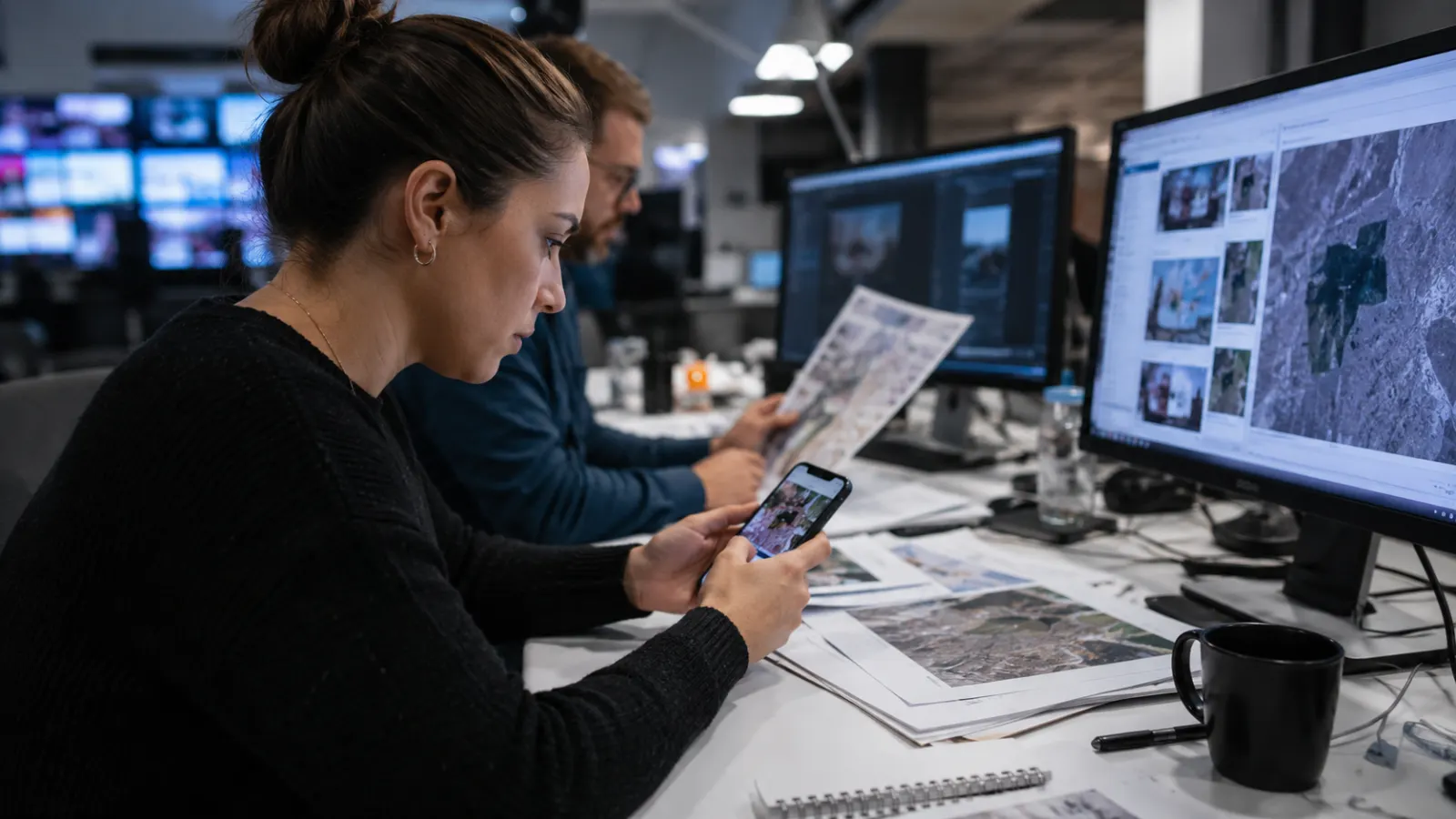
Professional visual-verification teams use combinations of source interviews, metadata, satellite imagery, maps, weather information and other evidence rather than trusting visual appearance alone. Reuters described this workflow in August 2026 as increasingly important as AI-generated and manipulated media become more convincing.
Step 8: Reverse-Search Suspicious Images
If an image is central to a claim, search for earlier versions.
Google Lens and similar visual-search tools can help locate:
-
visually similar images;
-
websites that used the image earlier;
-
alternate captions;
-
fact checks;
-
the original photographer or publisher; and
-
earlier events involving the same picture.
Google's About this image feature can also provide information about when Google first encountered similar versions, where else the image appears and, when available, metadata concerning how it may have been created or edited.
This is particularly effective against miscaptioned authentic images.
A real photograph does not prove the caption is real.
How to Verify a Video
Video verification can require more work.
Useful checks include:
Find the earliest upload
Search distinctive wording from the caption and see whether an older version exists.
Extract a frame
Take a clear frame from the video and run an image search.
This can locate older copies or the original event.
Listen carefully
Check whether audio appears continuous and whether speech matches visible mouth movements and environmental sound.
Inspect landmarks
Buildings, road signs, landscapes, business names and transit infrastructure can help establish location.
Check conditions
Does the claimed time match:
-
daylight;
-
weather;
-
vegetation;
-
shadows;
-
clothing; or
-
known events?
Find independent footage
Major real-world events often generate several independent recordings.
One isolated clip deserves more caution than several verified perspectives.
AI-Generated Does Not Automatically Mean False
This distinction is important.
An AI-generated illustration explaining how a volcano works may be factually useful.
A genuine photograph may be used with a completely false caption.
The factual question is therefore not simply:
“Was AI involved?”
It is:
“What claim is this media being used to support, and is that claim accurate?”
Likewise, identifying an image as synthetic tells you something about provenance.
It does not by itself tell you whether the accompanying statement is true or false.
Do Not Rely on AI Detectors Alone
AI-detection tools can be useful signals.
They should not be treated as infallible truth machines.
Professional verification works better by combining evidence:
-
provenance;
-
earlier copies;
-
source identity;
-
metadata;
-
visual inconsistencies;
-
independent reporting;
-
location verification;
-
creator contact; and
-
specialised detection tools where appropriate.
Even Reuters' current visual-verification process uses AI-detection tools as one component among multiple forms of evidence, not as a standalone verdict.
Content Credentials and Provenance Can Help—but Have Limits
Some images and other media now contain Content Credentials based on the C2PA standard.
These can provide signed information about the provenance and editing history of compatible media.
This can be valuable.
But provenance is not the same as truth.
A valid provenance record may help establish where a file came from or how it was created.
It does not automatically prove that:
-
the scene is being interpreted correctly;
-
the caption is accurate;
-
no relevant context is missing; or
-
the publisher's factual claim is true.
Likewise, the absence of Content Credentials does not prove that an image is fake.
The U.S. Office of Research Integrity specifically cautions that provenance indicators are useful positive signals but that the absence of such indicators cannot establish that content is synthetic or inauthentic.
Step 9: Read Beyond the Headline
Some misleading claims emerge without anyone fabricating an entire article.
The distortion happens during summarisation.
A research paper says:
“An association was observed.”
A press release says:
“Researchers find possible link.”
A news headline says:
“Scientists reveal X affects Y.”
A social post says:
“Science proves X causes Y.”
Each step becomes more confident.
Always compare the claim with the evidence underneath it.
Ask:
Does the article support the headline?
Does the document support the article?
Does the study support the social-media post?
The farther a claim travels from its original evidence, the greater the opportunity for distortion.
Correlation Is Not Automatically Causation
This matters particularly for health, science and social research.
If a study finds that people who do X experience more Y, that does not necessarily prove that X caused Y.
Other variables may explain the association.
Strong causal claims usually require stronger study designs and converging evidence.
If a post says:
“Study proves...”
open the study—or at least a reliable expert interpretation—and check what the researchers actually concluded.
The language of the original research often reveals whether the viral interpretation is exaggerated.
Check the Sample and Denominator
Statistics can mislead without being mathematically false.
Suppose a post says:
“Risk increased 100%.”
That sounds enormous.
But risk may have increased from:
1 in 10,000 → 2 in 10,000.
Both the relative and absolute change can matter.
Likewise, “80% support” means little until you know:
-
80% of whom;
-
how many people were surveyed;
-
how participants were selected;
-
when the survey happened; and
-
what question was actually asked.
A statistic without a denominator or methodology is incomplete evidence.
Step 10: Check Before You Share, Not After
People often treat sharing as a low-stakes action:
“I'm just forwarding it.”
But forwarding is distribution.
Research by Gordon Pennycook, David Rand and colleagues has found that shifting people's attention toward accuracy before sharing can improve the quality of content they say they are willing to share. A meta-analysis covering 20 experiments with 26,863 participants found improved sharing discernment, driven primarily by reduced willingness to share false headlines in those studies.
The useful personal habit is simple.
Before pressing Share, Forward or Repost, ask:
“How confident am I that this is accurate?”
That question will not solve misinformation.
It can interrupt automatic amplification.
A 90-Second Misinformation Check
You do not need to spend an hour investigating every ordinary post.
For something consequential, try this:
First 15 seconds: Stop
Do not share immediately.
Identify whether emotion or urgency is pushing you to act.
Next 15 seconds: State the claim
Turn the post into one checkable sentence.
Next 20 seconds: Find the source
Look for the original document, article, study, account, video or official statement.
Next 20 seconds: Read laterally
Search the publisher, author or account outside its own page.
Next 10 seconds: Check confirmation
See whether credible independent sources report the same underlying fact.
Final 10 seconds: Check context
Look at the date, place and whether old media is being reused.
If confidence is still low:
do not share yet.
“Unverified” is a valid conclusion.
Verification Standards Should Rise With the Stakes
Not every claim deserves the same investigation.
A false meme about a fictional character and a false medication dose do not have equal consequences.
Use a risk-based verification standard.
| Type of claim | Appropriate verification level |
|---|---|
| Harmless entertainment trivia | Basic source check |
| News event | Independent reputable confirmation |
| Election or public-policy claim | Primary records + reliable reporting where possible |
| Medical treatment or dosage | Authoritative health source / qualified clinician |
| Investment or financial claim | Regulator, official filings, qualified financial source |
| Legal deadline or legal right | Current official/legal authority or qualified lawyer |
| Emergency warning | Official local authority or emergency service |
The greater the cost of being wrong, the stronger the evidence should be.
Health Misinformation Requires a Higher Standard
Health claims can directly change behaviour.
Be especially cautious with posts that promise:
-
guaranteed cures;
-
dramatic weight loss;
-
“secret” treatments;
-
supplement megadoses;
-
warnings to stop prescribed medicine;
-
claims that doctors are hiding a treatment;
-
one-study medical breakthroughs; or
-
testimonials presented as clinical evidence.
Prefer sources such as:
-
national health agencies;
-
major professional medical organisations;
-
systematic reviews;
-
peer-reviewed research interpreted in context; and
-
appropriately qualified healthcare professionals.
A viral anecdote may justify asking a question.
It should not automatically dictate treatment.
Financial Misinformation Can Exploit Urgency
Common warning patterns include:
“Guaranteed return.”
“Buy before midnight.”
“Everyone is getting rich except you.”
“Risk-free opportunity.”
“Government-backed secret investment.”
Before acting, verify claims through regulators, official filings and recognised financial sources.
A screenshot of someone else's profit is not evidence that an investment is legitimate.
Legal Claims Change With Jurisdiction and Date
Online legal advice is especially vulnerable to context problems.
A rule may differ by:
-
country;
-
state;
-
province;
-
court;
-
type of case; or
-
date.
An accurate legal explainer from another jurisdiction can become dangerous if applied locally.
For consequential legal decisions, verify the current law through official sources or a qualified professional.
Breaking News Should Be Treated as Provisional
The earliest version of a major event is often the least complete.
During breaking news:
-
casualty figures change;
-
names are initially incorrect;
-
videos are mislocated;
-
old footage resurfaces;
-
witnesses contradict one another;
-
officials revise statements; and
-
reporters learn new information.
A responsible information consumer separates:
confirmed
from
reported
from
unverified
from
false.
Waiting for stronger evidence is not failure to keep up.
Sometimes it is the most accurate response available.
“Unverified” Is Different From “False”
This distinction prevents a lot of bad fact-checking.
Imagine a claim appears and no credible source has confirmed it yet.
You have not necessarily proved the claim false.
You have established that it is unverified.
Later evidence may confirm it.
Or disprove it.
The responsible conclusion should match the evidence available at that moment.
Useful labels include:
confirmed
supported
likely
disputed
unverified
misleading
false
Confidence should be graduated rather than binary.
Use Fact-Checking Sites as Shortcuts to Evidence
Professional fact-checking organisations can save time when a claim has already circulated widely.
Google's Fact Check Explorer can search fact-checks by keyword and, in some cases, by image, providing a quick way to discover whether a viral claim has already been investigated.
Other professional fact-checking organisations may provide:
-
primary documents;
-
archived posts;
-
expert interviews;
-
timelines;
-
image verification;
-
calculations; and
-
explanations of how a conclusion was reached.
But do not treat the label “fact check” as magic.
Read the reasoning.
Strong fact checks function as evidence maps.
They show you how to get closer to the underlying source.
Check the Fact-Checker Too
Fact-checking organisations are sources.
Sources should be evaluated.
Ask:
-
Who operates the organisation?
-
Does it publish its methodology?
-
Does it link to primary evidence?
-
Does it correct mistakes?
-
Does the conclusion match the evidence shown?
-
Are quotations presented in context?
The goal is not to replace blind trust in a social-media account with blind trust in another website.
The goal is to improve the quality and traceability of evidence.
Prebunking: Learn Manipulation Techniques Before You Encounter Them
Another approach to misinformation is called prebunking or psychological inoculation.
Instead of correcting one false claim after someone encounters it, prebunking teaches people to recognise common manipulation strategies in advance.
Examples include:
-
emotionally manipulative language;
-
false dichotomies;
-
scapegoating;
-
ad hominem attacks;
-
decontextualisation; and
-
attempts to discredit reliable sources without evidence.
Large experiments using short videos have found improvements in people's ability to recognise manipulation techniques and, in some studies, to make better sharing decisions.
More recent research also suggests that these effects can weaken over time and may benefit from reinforcement or booster exposures rather than being treated as permanent protection.
Prebunking is therefore useful training.
It is not an immunity certificate.
Manipulation Techniques Are Warning Signs, Not Proof of Falsity
This distinction is essential.
A true statement can be expressed emotionally.
A false statement can sound calm and academic.
Someone using a false dichotomy may still mention some accurate facts.
Recognising manipulation tells you:
“I should slow down and investigate.”
It does not automatically establish:
“Everything being said is false.”
Verification must return to evidence.
Do Not Trust One Weak Credibility Heuristic
Several common shortcuts are unreliable.
“It ends in .org, so it is trustworthy.”
Anyone can operate many kinds of domains.
“The account is verified.”
Verification may establish account identity or subscription status.
It does not make every claim true.
“The person is a doctor.”
A credential can establish expertise in one area.
It does not make someone authoritative in every medical or scientific field.
“The video looks professional.”
High production quality is now cheap and widely available.
“It has millions of followers.”
Audience size measures popularity.
“Several websites published it.”
They may all be copying the same source.
“It contains citations.”
Citations can be irrelevant, misquoted or invented.
“AI detected it as fake.”
Detector outputs are evidence to investigate, not absolute verdicts.
Credibility emerges from a chain of evidence, not one badge.
Be Careful With Screenshots of News Headlines
Fake-news screenshots can be created quickly.
Even genuine screenshots can be altered.
If someone posts an image claiming:
“Major newspaper reports X”
search the newspaper directly.
Try distinctive words from the headline.
Check the publication's official account.
Look for archived versions if necessary.
A screenshot should lead you toward verification.
It should not substitute for it.
Verify Quotations
Quotes are frequently shortened, paraphrased or fabricated.
When a quotation matters:
-
search a distinctive phrase;
-
find the complete speech, interview, transcript or document;
-
read the surrounding passage;
-
check the date;
-
determine whether words were removed in a way that changes meaning.
Even an exact quotation can mislead when context is removed.
Verify Scientific Studies Through the Original Paper
When a post says:
“New study proves...”
try to identify:
-
the actual paper;
-
journal;
-
publication date;
-
study type;
-
participant number;
-
outcome measured;
-
limitations; and
-
authors' actual conclusion.
Then ask whether the viral claim is stronger than the research.
Useful distinctions include:
association vs causation
animal experiment vs human evidence
laboratory outcome vs clinical outcome
preprint vs peer-reviewed paper
single study vs established evidence
One new study rarely erases an entire scientific literature overnight.
Be Skeptical of “Experts Say” Without Identifiable Experts
Credible reporting should normally allow readers to discover:
-
who the expert is;
-
relevant expertise;
-
institution;
-
what exactly they said; and
-
how their statement relates to the evidence.
An anonymous expert can sometimes be justified in investigative reporting.
But vague authority phrases deserve greater scrutiny when they carry the entire argument.
Ask:
Who specifically supports this claim?
Correct Misinformation Clearly When You Shared It
Everyone makes mistakes.
The important question is what happens after discovering one.
If you shared false information and others may have seen or acted on it, correct the record visibly.
A useful correction is:
“I shared this earlier, but the claim was incorrect. The verified information is X. Here is the source.”
Do not bury the correction under vague language such as:
“Apparently there is some confusion.”
State what changed.
If possible, edit or delete the false material while leaving enough correction visible that people who encountered the original can understand what happened.
Why Corrections Matter Even When They Are Imperfect
Corrections do not always erase every effect of misinformation.
People may remember the original claim.
They may remember the emotional impression even after forgetting the details.
That is an argument for correcting clearly and quickly, not for giving up.
Useful corrections usually:
-
identify the false claim;
-
state the correct information prominently;
-
provide evidence; and
-
avoid unnecessarily repeating the misinformation again and again.
A Practical Verification Workflow
For an important online claim, use this sequence:
1. Pause
Do not allow emotional urgency to decide whether you share.
2. Define
State the exact factual claim.
3. Trace
Find the original post, document, study, image or recording.
4. Investigate
Read laterally to understand who produced it.
5. Compare
Find credible independent coverage.
6. Contextualise
Check date, location and surrounding material.
7. Verify Media
Search images or video frames and inspect provenance where available.
8. Inspect Evidence
Check whether the underlying data, study or record supports the claim.
9. Calibrate Confidence
Decide whether the claim is confirmed, probable, disputed, unverified or false.
10. Share Proportionately
Do not state something with more certainty than the evidence supports.
That final step matters.
A claim supported by preliminary evidence should not be shared as established fact.
Frequently Asked Questions
What is misinformation?
Misinformation is false or misleading information shared regardless of whether the person distributing it intends to deceive.
What is the difference between misinformation and disinformation?
Misinformation can be spread unintentionally. Disinformation generally refers to false or misleading information deliberately created or distributed to deceive.
How can you tell if information online is reliable?
Trace the original source, investigate who produced it, examine the evidence, compare it with independent credible sources and check date, location and context before accepting the claim.
What is lateral reading?
Lateral reading means leaving an unfamiliar webpage and opening other sources to investigate the website, author or organisation rather than relying on what the original source says about itself.
How do fact-checkers verify online information?
Professional fact-checkers use multiple techniques including lateral reading, primary-source tracing, independent corroboration, database searches, media verification and contextual analysis.
How can I check if a photo is fake?
Search the image or a screenshot using visual-search tools, look for earlier versions, inspect the original source and check whether the date and location match the claim.
How do I know if a photo is AI-generated?
Provenance signals, metadata, Content Credentials, visual analysis and specialist detection tools may provide clues, but no single method should be treated as infallible. The factual claim attached to the image still needs separate verification.
Does a verified account mean information is true?
No. Account verification may help establish identity or account status but does not guarantee the accuracy of individual posts.
Are .org websites more trustworthy?
Not automatically. Domain type is a weak credibility indicator. Investigate who operates the site, its reputation and the evidence it provides.
Does a viral post become more credible if millions of people share it?
No. Virality measures distribution and attention, not factual accuracy.
How many sources should confirm a story before I believe it?
There is no fixed number. Quality and independence matter more than quantity. Several reports all copied from one source do not provide the same corroboration as genuinely independent evidence.
What should I do if no source confirms a claim?
Treat it as unverified rather than automatically deciding it is true or false.
Are fact-checking websites always correct?
No source is infallible. Strong fact checks explain their methodology, show evidence, link to original material and publish corrections when necessary.
What is Fact Check Explorer?
Google Fact Check Explorer is a search tool for finding fact-checks published by participating organisations and can also support image-based searches.
How do I verify breaking news?
Wait for credible independent confirmation, identify what is officially confirmed, trace images and videos to their source and expect early details to change.
How do I avoid sharing misinformation?
Pause before sharing, identify the exact claim, trace its source, find independent confirmation and explicitly ask yourself whether you are confident it is accurate.
What is prebunking?
Prebunking teaches people common misinformation and manipulation techniques before they encounter them, with the aim of improving recognition and resistance.
Can AI help fact-check information?
AI can assist with searching, summarising and identifying possible inconsistencies, but its output should itself be verified against reliable sources because AI systems can produce incorrect claims.
Can AI detectors prove that a photo is fake?
No. AI-detection tools can provide useful signals but should be combined with provenance, reverse searching, source verification and contextual evidence.
Should I trust screenshots?
Treat screenshots as leads rather than strong evidence. Whenever possible, locate the original post, article, document or account.
What should I do if I shared misinformation?
Correct or remove the false material and post a clear correction containing the verified information and source.
You Do Not Need an Immediate Opinion About Everything
The online information environment encourages instant judgment.
Believe.
Disbelieve.
React.
Share.
Choose a side.
But verification sometimes ends somewhere less dramatic:
“I don't know yet.”
That is not intellectual weakness.
It is an evidence-based conclusion.
A claim can remain unverified while evidence is incomplete.
Breaking stories can remain provisional.
A scientific result can be interesting without being definitive.
An image can remain suspicious without being proven fake.
A responsible information consumer allows uncertainty to remain uncertainty until stronger evidence arrives.
The Best Defence Against Misinformation Is Procedural
You cannot memorise every false claim that will appear tomorrow.
You cannot become an expert in every subject.
You cannot reliably identify every manipulated image by eye.
And you cannot guarantee that a source you usually trust will never make a mistake.
What you can build is a process.
Pause before reacting.
Define the claim.
Trace it toward the original evidence.
Investigate the source outside its own page.
Look for genuinely independent confirmation.
Check date, place and context.
Verify images and videos rather than trusting appearance.
Match confidence to evidence.
Raise your verification standard when the consequences of being wrong are high.
And if the evidence is not there, do not amplify the claim yet.
That routine does not make misinformation disappear.
It does something you can actually control.
It makes your attention, belief and sharing harder to exploit.