How Art Reflects Its Times: Reading History Through Art
Understanding how art reflects its times requires more than looking at an old painting and asking what people wore or what buildings stood in the background. Art is created inside systems of politics, religion, wealth, technology, social hierarchy and cultural expectation. Those systems influence who is able to become an artist, what materials are available, who pays for art, where it is displayed, which subjects are considered important and which images are prohibited.
An artwork can therefore become historical evidence.
But it is not a neutral transcript of the society that produced it. Artists select, idealise, exaggerate, criticise, omit and invent. Patrons make demands. Markets reward certain subjects. Governments commission monuments. Religious institutions determine acceptable images. Museums later decide what deserves preservation and how surviving objects should be interpreted.
A royal portrait, for example, may reveal less about what a ruler actually looked like than about how political authority wanted to appear. A painting of agricultural workers may preserve valuable information about clothing and labour while simultaneously revealing the artist's assumptions about class. A religious image can tell us about theology, but its size, location and cost can also tell us where wealth and institutional power were concentrated.
This is why art historians rarely ask only, “What does this picture show?”
They also ask: Who made it? Who paid for it? Who was meant to see it? Where was it displayed? Which traditions did it follow? Which traditions did it reject? What technologies made it possible? What did contemporary audiences think of it? And why has this particular object survived when countless others disappeared?
Art reflects its times because it is produced inside history. Yet art also helps make history by shaping identities, legitimising authority, challenging conventions, preserving memory and imagining worlds that do not yet exist.
Art Reflects Society, but Not Like a Mirror
The phrase “art reflects society” is useful only if the word reflects is understood carefully.
A mirror reproduces whatever appears in front of it. Artists do not.
They choose.
Two painters living in the same city during the same year can produce entirely different versions of social reality. One may paint aristocratic interiors. Another may concentrate on industrial labour. A third may avoid contemporary life entirely and paint mythological subjects.
All three works belong to the same historical moment.
The differences among them are themselves evidence.
The scholar does not therefore ask only what appears inside an artwork. Absence can be equally revealing. Which people rarely appear? Which forms of work are ignored? Which political events are transformed into heroic imagery? Which subjects are considered unworthy of large-scale painting?
Social historians have increasingly used artworks in precisely this way—as evidence of attitudes, social structures and historical experience rather than simply decoration accompanying written sources.
An artwork should therefore be approached like any other historical source: valuable, situated and partial.
Who Pays for Art Influences What Gets Made
For much of history, producing large or technically sophisticated artworks required substantial resources.
Pigments could be expensive. Stone had to be quarried and transported. Bronze casting required specialised labour. Monumental architecture depended on enormous workforces. Artists needed food, workshops, assistants and time.
Someone usually paid.
That person or institution might be a ruler, religious organisation, merchant, aristocratic family, civic government or wealthy collector.
Patronage therefore shaped art profoundly.
A ruler commissioning a portrait might specify symbols of military authority, dynastic legitimacy or wealth. A religious institution could determine which sacred story appeared above an altar. A merchant family might commission a chapel partly from devotion and partly to establish status within the city.
This does not mean artists lacked creative agency.
It means creativity occurred inside economic relationships.
The historical dominance of religious imagery in particular periods, for example, cannot automatically be interpreted as proof that every artist was personally devout. It also tells us that religious institutions possessed wealth, buildings, audiences and the capacity to commission major works.
When systems of patronage change, art changes with them.
Courts lose power. Galleries emerge. Commercial dealers develop. Governments establish academies and public museums. Corporations commission buildings and installations. Mass-media industries create enormous visual markets.
Who pays helps determine what becomes visible.
Power Creates Images of Itself
Political authority has always needed representation.
Rulers appear on coins, statues, paintings, seals and monumental architecture. Governments build ceremonial avenues and memorials. Empires represent conquest as order. Revolutions destroy old symbols and create new ones.
Art does not merely record political power.
It can produce the appearance of power.
A royal portrait may enlarge a monarch's authority through scale, clothing, posture and symbolism. A triumphal monument can turn military victory into permanent urban memory. Public architecture can make the state appear stable and enduring even when political conditions are fragile.
This is why official art has to be read critically.
The image of an emperor does not tell us simply what the emperor was.
It tells us how imperial authority wanted subjects to imagine the emperor.
The distinction becomes even clearer when rival groups produce competing images. Political cartoons can make an apparently powerful leader ridiculous. Protest posters can transform state violence into a symbol of resistance. Graffiti can appropriate walls intended to represent official order.
Visual culture therefore becomes a field in which power is both asserted and challenged.
Realism Changed Who Was Worthy of Serious Representation
Nineteenth-century French Realism provides a particularly clear example of art responding to social and political change.
The Metropolitan Museum of Art places the movement in the aftermath of the Revolution of 1848, when France was experiencing intense arguments about democracy, class and political representation. Realist painters rejected the traditional hierarchy that gave prestigious status to historical, mythological and religious subjects and instead represented contemporary life and ordinary people on an unprecedented scale.
This artistic choice was political even when the painting did not contain an explicit political slogan.
To paint workers, peasants and ordinary contemporary life on canvases associated with serious high art was to challenge assumptions about who deserved representation.
Gustave Courbet's commitment to painting the world of his own time was therefore not simply a stylistic preference.
It changed the social hierarchy of subject matter.
The history of Realism demonstrates an important principle: an artwork can reflect political change not by illustrating a parliamentary debate but by changing whose lives are considered worthy of artistic attention.
Industrialisation Changed Both What Artists Saw and What They Could Make
Industrialisation transformed nineteenth-century society through factories, railways, mass production, urbanisation and new forms of labour.
It also transformed art materially.
Industrial manufacturing made new pigments and prepared painting materials increasingly available. Railway travel altered where artists could work. Mass printing expanded the circulation of illustrations. Photography introduced a new technology for producing images.
Cities themselves became new visual environments.
Railway stations, boulevards, cafés, theatres, department stores and suburban leisure entered painting partly because everyday life was changing.
The history of Impressionism illustrates this connection especially clearly.
The Metropolitan Museum describes Impressionism as deeply connected with modern life. The independent artists who exhibited beginning in 1874 rejected aspects of the official Salon system while embracing new techniques, new technologies and contemporary subjects. Railways allowed Parisians to travel rapidly into the countryside, while paintings increasingly included factories, railway infrastructure and the redesigned city of Paris itself.
Modernity therefore entered Impressionist art at several levels simultaneously.
It appeared in the subjects being painted.
It affected the movement of artists and audiences.
It changed the institutions through which art was exhibited.
And industrial production affected the materials with which paintings were created.
Art does not merely depict technological change.
Technology changes the conditions under which art becomes possible.
Photography Changed What Painting Had to Do
Photography is one of the clearest examples of a technology changing artistic expectations.
Before photography, painting and drawing performed many documentary functions. Portraits recorded appearances. Artists documented landscapes, buildings, scientific specimens and events.
Photography did not immediately eliminate those functions, but it changed the visual environment.
If a camera could reproduce visible detail with unprecedented mechanical precision, painters could ask whether exact representation remained their primary task.
The consequences were complex.
Some artists incorporated photographic composition into painting. Others pushed further into colour, abstraction or subjective perception. Photography itself developed into an artistic medium rather than remaining merely a recording technology.
The larger lesson continues into film, video, digital imaging and generative systems.
A new technology rarely changes only technique.
It changes questions of authorship, originality, reproduction, distribution, labour and value.
Who counts as the creator?
What constitutes an original?
Does technical skill remain scarce?
Who owns a reproducible image?
How does an audience distinguish documentation from construction?
Those questions are historical questions as much as artistic ones.
Economic Crisis Changes What a Society Imagines About Itself
The Great Depression demonstrates another way social conditions enter art.
The economic crisis beginning in 1929 affected employment, migration, agriculture, housing and public confidence across the United States and much of the world.
Artists responded in very different ways.
Some represented unemployment and poverty. Others depicted industrial labour, rural communities or public infrastructure. Government programmes supported artistic production and helped distribute artworks to much wider publics.
The Metropolitan Museum's scholarship on American art of the 1930s emphasises how artistic culture became intertwined with the era's political, social and economic turbulence and with new technologies and government programmes that changed how art circulated.
There was no single “Depression style.”
That is important.
Historical events do not normally produce one automatic artistic reaction.
Economic crisis creates new subjects, institutions, anxieties and opportunities. Different artists respond differently according to political belief, geography, medium, audience and personal experience.
Art reflects a crisis through diversity of response, not necessarily stylistic uniformity.
War Produces Propaganda, Witness and Memory
War generates especially complicated visual records.
Governments may commission propaganda designed to encourage recruitment, sacrifice or national unity. Official war artists can document military conditions. Journalists and photographers may produce evidence of destruction. Soldiers and civilians create personal images. Survivors may produce art years later as memory work.
These objects should not be interpreted in the same way.
A recruitment poster tells us what authorities wanted citizens to believe.
A battlefield sketch may provide eyewitness evidence.
A memorial constructed decades later may tell us more about how a later society wanted to remember the conflict than about attitudes during the war itself.
An anti-war painting can emerge from the same conflict celebrated by a heroic monument.
This is why visual evidence from war must be read in relation to purpose, audience and date.
Art does not preserve “the war.”
It preserves competing ways of seeing, mobilising, experiencing and remembering it.
Religion Shapes Art Through Institutions as Well as Belief
Religion has shaped architecture, painting, sculpture, manuscripts, textiles, music and performance across human history.
But religious influence should not be reduced to subject matter.
Institutions also determine what kinds of images can be produced, where they may be displayed, who can enter sacred spaces and which objects can be handled by particular people.
Doctrine can change artistic practice dramatically.
Reform movements may reject images considered idolatrous. Other traditions may encourage elaborate narrative art to communicate sacred stories. Some environments emphasise figural representation, while others develop extraordinary traditions of calligraphy, geometry, architecture or decorative design.
The same religious tradition can also produce different visual cultures across centuries and regions.
Religious art therefore tells historians about belief, but also about authority, ritual, literacy, wealth, social organisation and institutional change.
A monumental sacred building is simultaneously theology, engineering, labour organisation and economic history.
Colonialism Changed Both Art Production and Art History
Art history cannot be separated from empire.
Colonial systems moved people, images, materials and objects across continents under profoundly unequal conditions.
European artists encountered and appropriated artistic traditions from Africa, Asia, Oceania and the Americas. Objects were collected through trade and purchase, but also through military campaigns, coercive relationships, archaeological extraction and illicit removal.
Museums became central to this history.
Objects removed from colonised societies were frequently reorganised inside European institutions under categories created by colonial-era scholarship. Meanwhile, artists from the societies that produced those works were often excluded from the supposedly universal canon of “great art.”
This history remains active rather than concluded.
UNESCO continues to support international processes concerning the return and restitution of cultural property, noting that the issue extends beyond ownership into questions of identity, spirituality, justice, memory and communities' relationship with their own heritage.
Restitution debates therefore demonstrate one of the central arguments of this article.
An artwork's historical meaning does not end when it is made.
Where it travels, who owns it, who displays it and whether it eventually returns can become additional chapters in its history.
Class Influences Who Becomes Visible
The surviving visual record of the past is socially uneven.
Wealthy families could commission portraits.
Rulers constructed monuments.
Religious institutions paid for major artistic programmes.
Ordinary workers often possessed far fewer opportunities to leave such elaborate visual records.
That creates a historical distortion.
If historians looked only at elite portraiture, they might learn extraordinary amounts about aristocratic clothing, status and self-representation while seeing much less of the lives of servants, agricultural labourers and urban poor.
Artists who depict ordinary people can therefore expand the historical archive.
Realist painters did this in nineteenth-century Europe. Documentary photographers later did it through another medium. Posters, advertisements and popular prints preserve still other kinds of everyday experience.
Yet representation itself does not eliminate inequality.
A wealthy artist depicting a poor worker still occupies a particular social position.
The important question remains:
Who is looking at whom?
Gender Shaped Who Could Become an Artist
Historical art institutions were not equally accessible.
For long periods, women faced restrictions on professional training, academy membership, life-drawing classes, patronage networks and public careers.
These restrictions affected both who became recognised as an artist and what kinds of art were later preserved as canonical.
The hierarchy between “fine art” and “craft” also had gender consequences.
Painting, monumental sculpture and architecture were often given higher institutional status than textiles, embroidery, decorative arts and other forms strongly associated with women's work.
When historians reconsider those hierarchies, they do more than add overlooked female artists to an existing list.
They change the definition of what counts as historically significant artistic production.
The canon is therefore not a neutral catalogue of the best things humanity happened to make.
It is itself a historical construction shaped by institutions, access and changing values.
Artistic Movements Often Define Themselves Through Rejection
Art reflects history partly through what artists refuse.
Realists rejected aspects of academic idealisation.
Impressionists challenged official exhibition structures and conventional expectations of finish.
Modernist movements questioned inherited representation and searched for forms suited to industrial, urban and psychologically changing worlds.
Later conceptual artists challenged the assumption that an artwork needed to be a conventional crafted object at all.
The Metropolitan Museum's history of Impressionism makes this institutional dimension particularly clear: the artists who organised the first independent exhibition in 1874 were united less by one fixed style than by independence from the official Salon jury.
Artistic change therefore emerges not only because society supplies new subjects.
It also emerges because artists challenge the institutions that decide what art should look like and who gets to define quality.
A movement can tell us about its historical moment through the conventions it attacks.
Popular Culture Eventually Enters the Museum
The emergence of mass consumer culture produced another transformation.
Advertising, photography, cinema, celebrity culture, comic books, packaging and television created an environment saturated with reproducible images.
Artists could not remain separate from that world.
Pop art made the connection impossible to ignore by bringing commercial and mass-media imagery directly into the domain of fine art.
A soup can, comic panel or celebrity photograph could become the material of gallery culture.
This was not simply a change in subject matter.
It raised questions about repetition, consumer desire, authorship, mass production and the boundary between commercial imagery and supposedly autonomous art.
The distinction between high culture and popular culture therefore became itself a subject of artistic investigation.
That boundary continues shifting today as memes, digital illustration, video games, street art and internet culture enter museums and academic study.
Censorship Reveals What a Society Finds Dangerous
Sometimes the most revealing artwork is the one authorities attempt to suppress.
Governments ban exhibitions.
Religious authorities prohibit images.
Political regimes destroy monuments.
Schools remove books and artworks.
Platforms restrict images under changing rules.
Censorship creates evidence about boundaries.
An image considered harmless in one period can be regarded as politically subversive or morally unacceptable in another.
The important historical question is therefore not only what was censored, but why authorities believed representation itself posed a threat.
A banned artwork can reveal anxiety about sexuality, religion, political legitimacy, race, national identity or public morality.
Censorship reminds us that visual culture is powerful precisely because representation can challenge the stories institutions want society to accept.
Museums Do Not Simply Store History
Museums are often imagined as neutral containers in which important objects are preserved.
They are also interpretive institutions.
Someone decides what enters the collection.
Someone determines what receives conservation resources.
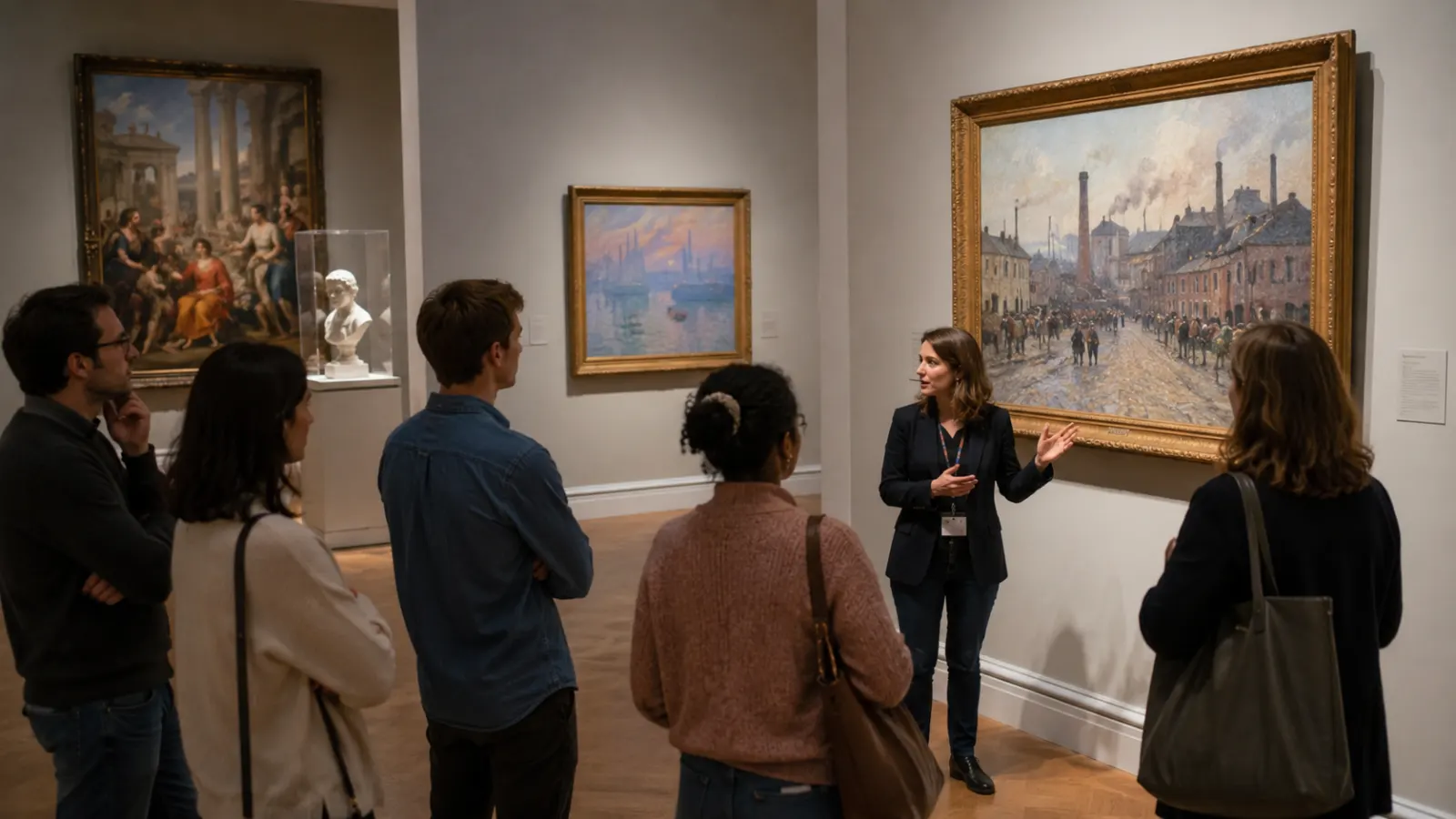
Curators decide which objects appear beside one another, what explanatory labels say and which historical categories organise galleries.
Those decisions change over time.
A museum once organised around “civilisations” or a narrow sequence of European masterpieces may later emphasise colonial networks, gender, trade, migration or connections among artistic traditions.
UNESCO describes museums as institutions that connect creation and heritage while allowing communities to engage with their cultural roots and other cultures. It also places documentation, conservation, access and return or restitution among major contemporary museum responsibilities.
Museums therefore reflect their own times just as the objects inside them reflect earlier ones.
A twenty-first-century exhibition about an eighteenth-century painting contains at least two historical layers:
the world that produced the artwork;
and the present-day world interpreting it.
Restitution Shows That Ownership Becomes Part of Meaning
Arguments over returning cultural objects demonstrate particularly clearly that the history of an artwork continues after production.
Consider an object created for a particular community, removed during colonial occupation, displayed for generations in another country's museum and eventually requested back by the community of origin.
Its meaning now includes all of those events.
The object is artistic evidence.
Its removal is historical evidence.
Its museum classification is historical evidence.
The restitution debate is historical evidence.
UNESCO notes that cultural restitution can reconnect communities with identity, memory, spirituality and heritage and that international attitudes toward such returns have changed substantially.
This is why provenance—the history of ownership and movement of an object—has become increasingly important to art history.
Where an artwork has been can matter almost as much as what appears on its surface.
Audiences Change the Meaning of Art
Artists do not possess complete control over interpretation.
A monument celebrated when erected may become controversial a century later.
A painter ignored during life may be declared essential by later critics.
An artwork originally understood within a religious setting can eventually enter a secular museum and be appreciated primarily for style.
Later political movements can appropriate old images for entirely new purposes.
This process is called reception history.
It examines what happens to an artwork after its initial creation.
Reception matters because cultural values change.
A nineteenth-century museum visitor may have approached an African object as ethnographic evidence. A contemporary curator may emphasise its authorship, sacred function, colonial displacement and relationship with living communities.
The object remains physically similar.
Its institutional meaning has changed.
Art history is therefore not merely the history of making objects.
It is also the history of how people continue to look at them.
Preservation Determines Which Art Gets a Future
The art that survives is not a random sample of everything humans created.
Stone can survive where textiles disappear.
Bronze may remain when wood decays.
A royal object stored in a treasury may survive more easily than inexpensive household objects.
Museums preserve some artworks deliberately, while ephemeral installations, performance, street art and domestic craft can disappear quickly.
War, colonial removal, religious destruction, environmental conditions and ordinary neglect eliminate still more material.
Markets also affect survival.
Collectors protect works believed to have financial value. Institutions preserve artists already considered important. Other objects vanish because no one invests resources in them.
This creates survival bias in art history.
The past we can see is partly the past that happened to remain available.
Historians therefore need to ask not only what survives, but why it survived.
Global Exchange Makes “National Art” More Complicated
Art is frequently organised by nation: French painting, Indian art, Chinese art, Italian Renaissance.
These categories can be useful.
But artists, materials and ideas rarely remain permanently inside national borders.
Pigments move through trade.
Artists migrate.
Prints circulate.
Religious imagery travels.
Imperial systems move objects and techniques.
A style apparently identified with one country may depend on materials imported from another continent or ideas transmitted through trade and conquest.
This does not make national categories meaningless.
It makes them incomplete.
Art history increasingly examines networks, movement and exchange alongside place.
The question changes from “Which country owns this style?” to “Which relationships made this visual form possible?”
Everyday Visual Culture Is Historical Evidence Too
If historians study only museum masterpieces, they miss much of what people actually saw.
Advertisements, posters, packaging, political cartoons, newspapers, fashion, television, photography, shop signs, social-media images and memes also form part of visual culture.
These materials can reveal ordinary assumptions about gender, race, work, beauty, success, consumption and family life.
Advertising is particularly revealing because it often presents not life exactly as it is but life as companies believe consumers want it to be.
That makes it valuable historical evidence.
A household advertisement can reveal technological aspirations.
A fashion poster can reveal ideals of beauty.
A political cartoon can reveal stereotypes and public anxieties.
A product package can reveal changing consumer culture.
The distinction between “fine art” and “ordinary visual culture” is itself historically produced.
Art Can Reflect Social Inequality—and Help Create It
Art does not only represent social hierarchy.
It can reinforce hierarchy.
Certain artistic styles may become markers of education and class status. Access to galleries, collecting and specialised artistic knowledge can function as cultural capital.
Anthropological approaches to art emphasise that artistic objects can participate directly in social relationships, marking status, inclusion and exclusion rather than existing merely for passive contemplation.
This adds another layer to the relationship between art and society.
Art does not simply show us social organisation.
The ownership, display and interpretation of art can themselves become part of that organisation.
A palace filled with expensive artworks communicates wealth.
A museum founded by industrial capital can convert economic success into cultural prestige.
An exclusive artistic vocabulary can distinguish insiders from outsiders.
Art is therefore capable of describing social status while simultaneously helping to produce it.
Art Can Also Resist Authority
The same visual power that supports authority can challenge it.
Political caricature reduces powerful figures to ridicule.
Protest posters compress political arguments into memorable symbols.
Street art can reclaim public surfaces.
Dissident performance can expose censorship precisely by provoking it.
Artists working under authoritarian governments may develop indirect visual languages because explicit criticism is dangerous.
Resistance does not always appear as obvious political imagery.
Choosing an excluded subject can itself be political.
Displaying art outside official institutions can challenge institutional control.
Using materials associated with domestic or marginalised labour can challenge artistic hierarchies.
Resistance can therefore operate through subject, style, medium, exhibition and distribution.
Art Can Anticipate Its Time Instead of Merely Reflecting It
If art only reflected existing society, artists could never surprise their audiences.
They clearly do.
Avant-garde movements often imagine forms of life, technology or identity before those ideas become widely accepted.
Artists can experiment with social arrangements institutions have not yet adopted. Designers imagine future cities. Science-fiction art visualises technologies before they exist. Performance artists challenge gender and bodily conventions before legal or social institutions recognise similar questions.
Art therefore has a future-facing dimension.
It reflects available materials and historical conditions, but it can recombine them into possibilities that do not yet exist.
This is why describing art merely as a mirror of society is incomplete.
Art can be a laboratory for possible societies.
How to Read an Artwork Historically
A historical reading begins by separating observation from interpretation.
First identify what the object actually is. What material was used? How large is it? What figures, objects or symbols appear? Is the work portable or fixed to architecture? Does it show signs of alteration?
Then establish production context. Who made it? When? Where? Who commissioned or purchased it? What technologies and materials were available? Was it produced independently or under institutional control?
Next investigate function and audience. Was it intended for a palace, church, temple, private home, street, market, publication or museum? Who was expected to encounter it?
Then examine representation. Which people are included? How are they shown? What has been idealised or omitted? Which conventions does the artist follow?
After that, compare the artwork with other evidence: letters, contracts, newspapers, photographs, diaries, government records, archaeological material and contemporary criticism.
Finally examine the afterlife. Who collected the artwork? Was it removed from its original setting? How has its interpretation changed? Has it been censored, restored, restituted or reclassified?
This method prevents a common mistake: assuming that whatever appears inside an artwork is simply factual documentation.
Art is evidence.
But like every historical source, it needs source criticism.
Questions to Ask When Using Art as Historical Evidence
A useful analysis can be organised around several recurring questions: Who created the work, and what do we know about their position in society? Who financed or commissioned it? What audience was expected to see it? What materials and technologies made it possible? What political, religious and economic institutions shaped production? What did contemporary viewers think of it? Which groups or experiences are absent? Does the image idealise or criticise its subject? How did the object enter its present collection? And how has its meaning changed since creation?
No single answer unlocks the artwork.
Historical interpretation comes from reconstructing the network surrounding it.
Common Myths About Art and Society
One misconception is that art provides an objective picture of the past. It does not. Artworks are constructed representations shaped by artists, patrons, conventions and audiences.
Another is that political art must contain explicit propaganda. Artistic scale, choice of subject, exhibition system and even refusal of conventional styles can carry political significance.
It is also misleading to assume that religious art proves the personal beliefs of the artist. Patronage and institutional context need to be considered.
Another myth is that museums preserve history neutrally. Museums select, classify and interpret objects according to institutional priorities that change over time.
Nor is the artistic canon simply a list of the objectively best works ever produced. Access to training, gender, class, colonial power, market value and preservation all influence which artists enter historical memory.
Finally, art does not merely reflect society.
Art can legitimise, challenge, organise and imagine society.
Frequently Asked Questions About How Art Reflects Its Times
How does art reflect its time?
Art reflects its time through its subjects, materials, technologies, institutions, patronage systems, social hierarchies and responses to political, religious and economic conditions.
How does art reflect society?
Artists work within societies that influence what can be produced, funded, displayed and understood. Art can therefore reveal cultural values, inequalities, conflicts and aspirations, although it should not be treated as a neutral mirror.
Why is art important for understanding history?
Art can preserve evidence about clothing, technology, religious practice, political symbolism, social hierarchy and cultural values, while also revealing how people wanted their society represented.
Can artwork be considered a historical source?
Yes. Historians use artworks as historical evidence, but they must examine authorship, patronage, audience, purpose and context just as they critically evaluate written sources.
Is art an accurate representation of society?
Not necessarily. Artists select, idealise, exaggerate and omit. An artwork can provide historical evidence without literally recording reality.
How does politics influence art?
Governments and political movements can commission monuments, portraits and propaganda, regulate exhibitions or censor artists. Artists can also use visual culture to criticise or resist political authority.
How did industrialisation affect art?
Industrialisation transformed urban life, transport, production, materials and image reproduction. It also created new subjects such as factories, railways, modern cities and mass leisure.
How did photography change art?
Photography created a new method of mechanical image production and changed expectations around realism, documentation, reproduction and artistic authorship.
How does religion influence art?
Religion can shape subject matter, architecture, iconography, patronage, rules about representation and the spaces in which artworks are produced and viewed.
How does colonialism affect art history?
Colonialism influenced artistic exchange, movement of objects, museum collections and the unequal classification of cultural traditions. Contemporary restitution debates continue to address this history.
How does class affect art?
Class influences who can commission, purchase and access art and whose lives are most extensively represented and preserved in visual culture.
How has gender influenced art history?
Women and other excluded groups historically faced unequal access to professional training, institutions and patronage, while artistic forms associated with them were often assigned lower status.
Why do museums change the meaning of art?
Museums remove or reposition objects, classify them and provide interpretive frameworks. Those decisions can change how later audiences understand the work.
What is provenance in art?
Provenance is the documented history of an artwork's ownership, custody and movement. It can reveal collecting practices, trade, inheritance, colonial removal or illicit trafficking.
What is art restitution?
Art or cultural-property restitution involves returning objects to countries, communities or owners from whom they were unlawfully or unjustly removed. UNESCO continues to facilitate international discussion and cooperation in this area.
Why did Realism reflect social change?
Nineteenth-century French Realists represented contemporary working-class and ordinary subjects on a scale traditionally associated with prestigious subjects, reflecting and participating in wider democratic and social changes.
How did Impressionism reflect modern life?
Impressionists represented modern Paris, suburban leisure, railways and changing landscapes while also challenging the official Salon exhibition system.
Does art always reflect the artist's personal beliefs?
No. Commission requirements, artistic conventions, market expectations and dramatic or symbolic strategies mean an artwork cannot automatically be treated as a direct statement of the artist's private beliefs.
Can art change society?
Art can influence public memory, political symbolism, social identity and cultural debate. Its effects depend on institutions, audiences and historical circumstances rather than occurring automatically.
Art Is Evidence, Not a Transcript
The deepest answer to how art reflects its times is that every artwork exists at the intersection of choices and constraints.
An artist chooses a subject, but the society helps determine which subjects carry meaning.
An artist chooses a material, but technology and trade determine what materials are available.
A painter can portray a ruler, but patronage influences what kind of ruler is shown.
A protest artist can challenge authority, but censorship determines the risks.
A museum can preserve an object, but its categories influence what future generations believe the object means.
A collector can rescue something from destruction while simultaneously removing it from the community that originally gave it significance.
Every artwork therefore has more than one history.
There is the history represented inside the object.
There is the history that made the object possible.
And there is the history of what happened to the object afterward.
This is why art cannot simply be used as an illustration accompanying a textbook paragraph.
A royal portrait is evidence of political representation.
A Realist painting is evidence of changing ideas about whose life deserves monumental representation.
An Impressionist railway scene belongs simultaneously to the history of painting, industrialisation, mobility and urban modernity.
A colonial museum collection belongs to the history of aesthetics, empire, collecting and contemporary restitution.
An advertisement belongs to the history of commerce and desire.
A censored artwork belongs to the history of whatever authority feared it.
And a work rediscovered generations after its creator's death belongs to the history of changing cultural values.
Art historians therefore do something more demanding than identifying styles.
They reconstruct relationships among objects, artists, patrons, institutions, audiences and historical change.
That approach also protects us from oversimplification.
Art does not prove that everyone in a period thought the same way.
It does not turn one image into a photograph of an entire society.
And it does not stop acquiring meaning after creation.
Artists transform the world they inherit.
Audiences reinterpret the result.
Institutions preserve some works and neglect others.
Governments celebrate or censor.
Markets elevate and forget.
Museums classify and reclassify.
Communities demand objects back.
New technologies change what can be made and who can distribute it.
Art therefore reflects its times precisely because it is made, circulated, contested and remembered inside history.
But reflection is only half of the relationship.
Art can also help society imagine what power should look like, which lives deserve representation, what should be remembered, what should be rejected and which futures might become possible.
That is why art is such valuable historical evidence.
It does not merely show us what happened.
It shows us what people wanted to display, believe, challenge, preserve, conceal and imagine.