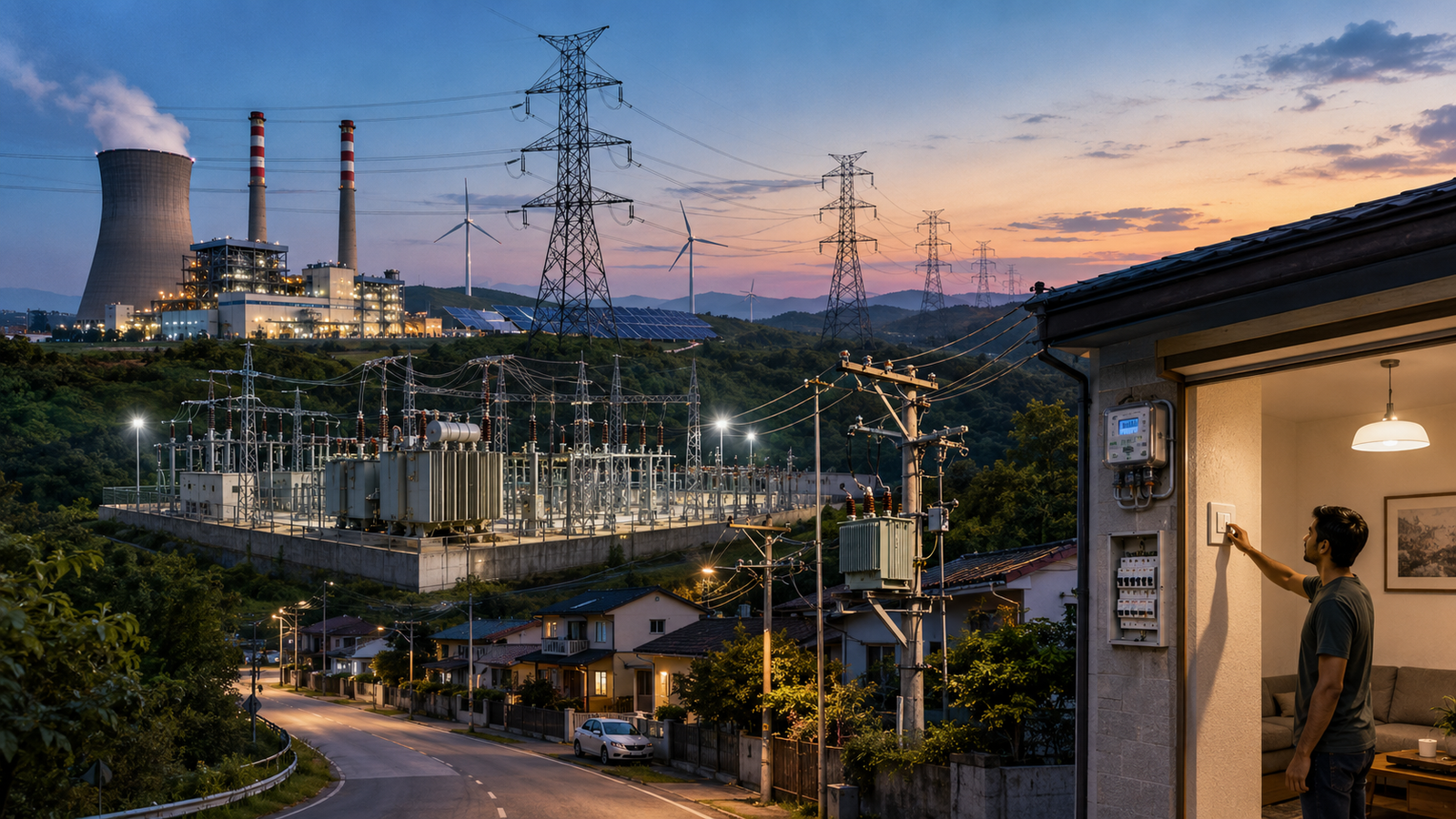
Every evening, millions of people press a switch and expect the room to light up instantly. The action feels local: your finger touches a switch, a bulb glows, a fan starts, a phone charger begins to work. But the electricity behind that small moment may have begun its journey many kilometres away at a generating station, moved through towers taller than buildings, passed through substations, changed voltage several times and entered your home through a carefully protected distribution system. The mystery is not that electricity exists. The mystery is how such a large, invisible system works quickly enough to feel immediate.
The Simple Definition
Electricity delivery is the process of moving electrical energy from a generating source to the place where it is used. A power plant may use coal, gas, nuclear energy, hydro power, solar energy, wind energy or another source to produce electrical power. Once generated, that power is not simply poured into a wire like water into a pipe. It must be converted to suitable voltage levels, transmitted over long distances, distributed locally and controlled for safety, reliability and quality.
Step One: A Power Plant Creates Electrical Energy
The journey usually begins with a generator. In many power plants, a turbine spins a generator. The turbine may be turned by steam, falling water, wind or another mechanical force. Inside the generator, magnets and coils interact so that mechanical motion becomes electrical energy. Solar photovoltaic panels are different because they convert sunlight directly into electrical current, but the larger delivery problem remains similar: the electricity must be moved to where people need it. At the plant level, electricity is produced at a voltage that is useful for generation equipment but not ideal for travelling long distances.
Step Two: Transformers Step the Voltage Up
Electricity loses some energy as heat when it moves through wires. One way to reduce that loss is to transmit power at very high voltage. This is why a step-up transformer sits near a generating station. It increases voltage before electricity enters the long-distance transmission network. Higher voltage allows the same amount of power to move with lower current, and lower current reduces heating losses in conductors. This is one of the most important ideas in the entire grid: electricity is not sent at one fixed voltage from start to finish. It is repeatedly adjusted to match the job.
Step Three: High-Voltage Lines Carry Power Across Distance
After the voltage is stepped up, electricity enters the transmission system. These are the large towers and cables often seen across fields, highways and city edges. Transmission lines are designed to move large quantities of power across regions. They connect generating stations, substations and major demand centres. The power moving through them is usually alternating current, or AC, because AC voltage can be transformed efficiently. In some special cases, high-voltage direct current is used for long-distance or underwater links, but the basic principle remains the same: the grid must move power with minimum loss and maximum stability.
Step Four: Substations Receive, Route and Step Power Down
A transmission line does not connect directly to your home. It first reaches substations. A substation is a technical junction in the electricity network. It may step voltage down, switch power between lines, protect equipment from faults and allow operators to manage flows. Think of it as a controlled intersection rather than a simple stop. Power enters at high voltage, passes through transformers and protection equipment, and leaves at lower voltage suitable for regional or local distribution. Substations are essential because homes, shops and small offices cannot safely receive transmission-level voltage.
Step Five: Distribution Lines Bring Power Near Your Street
Once voltage is reduced, electricity enters the distribution network. Distribution lines are the smaller lines that move power through towns, neighbourhoods, industrial areas and rural feeders. They may be overhead on poles or underground in cables. This part of the system is more local and more complex than many people imagine. A distribution network must serve houses, schools, shops, pumps, small factories, hospitals and streetlights, all of which use different amounts of power at different times. Local transformers continue to adjust voltage as electricity moves closer to the final user.
Step Six: The Final Transformer Makes It Safe for Home Use
Near your home, a distribution transformer reduces voltage again to the level used by household appliances. The exact voltage depends on the country and electrical standard, but the idea is universal: the final supply must be low enough for domestic wiring and appliances. From the transformer, electricity travels through a service line to the meter, then to the main distribution board inside the building. Circuit breakers or fuses protect circuits from overloads and faults. When you switch on a device, you complete a path that allows current to flow through the appliance and return through the electrical system.
Why the Light Turns On So Quickly
A common confusion is that electrons from a distant power station must race all the way to your bulb at the moment you press the switch. The actual explanation is subtler. The electrical signal and electric field propagate through the circuit very quickly, while individual electrons drift much more slowly. The wires are already full of mobile charge carriers. When the circuit is completed, energy is transferred through the electromagnetic field associated with the circuit. For everyday understanding, it is enough to know that the system responds almost instantly because the circuit is already connected to an energized grid.
Where Losses, Faults and Outages Happen
Every stage has limits. Long-distance lines lose some energy. Transformers can overheat. Distribution lines can be damaged by storms, trees, animals, construction activity or equipment failure. Demand can rise sharply during heat waves when air conditioners run at the same time. If supply and demand are not balanced, voltage and frequency can move outside acceptable ranges. Protection devices are designed to isolate faults before they spread, but that isolation can also cause local outages. Reliable electricity is therefore not a single invention; it is an ongoing act of engineering coordination.
Common Misconceptions
The first misconception is that electricity travels along one dedicated line from one power plant to one house. In an interconnected grid, power flows according to electrical physics across available paths. The second misconception is that transmission and distribution are the same. Transmission moves bulk power at high voltage across distance; distribution delivers lower-voltage power locally. The third misconception is that electricity can be stored easily at grid scale without planning. Batteries and storage systems are improving, but most grids still require real-time balancing between generation and demand.
Final Takeaway
Electricity reaches your home through a chain of generation, voltage transformation, transmission, substations, distribution lines, local transformers, meters and protective circuits. What feels like a simple switch is actually the last step in a vast technical system. The genius of the grid is that it hides this complexity so well that we notice it only when the lights go out.