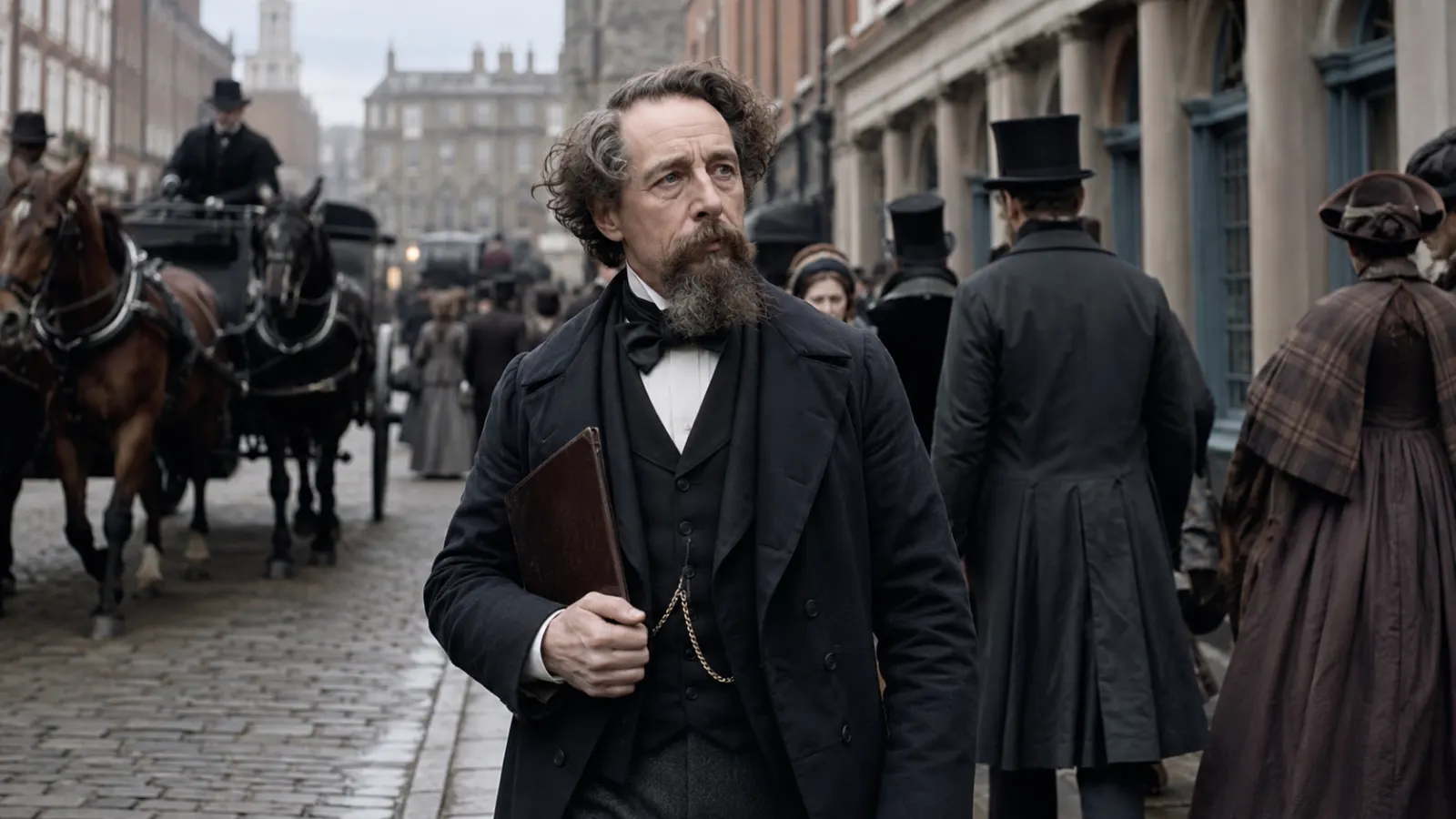
Charles Dickens: The Writer Who Turned Victorian Society Into Mass Storytelling
Charles Dickens became one of the most recognisable writers of the nineteenth century because he understood something larger than the mechanics of writing novels: stories could move through an entire society. They could appear month by month in serial parts, be discussed in homes and workplaces, circulate through lending libraries, inspire theatrical adaptations and eventually be performed by Dickens himself before paying audiences. His characters became part of popular culture long before cinema, television or modern entertainment franchises existed. Dickens wrote books, but he also mastered the emerging media environment through which those books reached people.
That reach helps explain why people who have never completed a Dickens novel may still recognise Oliver Twist asking for more, Ebenezer Scrooge confronting the ghosts of Christmas, Miss Havisham surrounded by the remains of her abandoned wedding, Pip becoming ashamed of his origins or Mr Micawber insisting that something will turn up. Familiarity, however, can flatten Dickens into a creator of eccentric characters and moral lessons. His work grew from family insecurity, humiliating childhood labour, journalism, publishing economics, relentless production, complicated domestic relationships and an intense need to control both his writing and his public reputation.
A useful biography therefore begins with a harder question than the familiar claim that Dickens simply “gave voice to the poor.” How did a boy whose family debt disrupted his education become a writer capable of turning the rapidly expanding Victorian city, its institutions and its inequalities into mass literary experience? The answer lies not only in talent but in the unusual combination of memory, journalism, serial publishing, theatrical instinct and professional discipline that shaped his career.
Childhood, Debt and the Blacking Factory
Charles John Huffam Dickens was born on 7 February 1812 in Portsmouth. His father, John Dickens, worked as a clerk in the Navy Pay Office, and the family's circumstances changed repeatedly as they moved between places including Chatham and London. John earned a respectable salary at times but struggled with money, leaving the household financially unstable.
The crisis came in 1824, when John Dickens was imprisoned for debt in the Marshalsea prison. Twelve-year-old Charles was sent to work at Warren's blacking warehouse, where he pasted labels onto bottles of shoe blacking. The episode became one of the most important memories of his life and later entered the autobiographical account he gave to his friend and biographer John Forster.
Dickens's later description suggests that the humiliation came not only from factory labour itself but from the belief that the adults responsible for him had accepted the destruction of his prospects. He had imagined a future involving education and intellectual achievement, yet suddenly found himself performing repetitive manual work while his family collapsed economically around him. The fear that respectability could disappear almost overnight became deeply embedded in his imagination.
The evidentiary distinction matters because much of what we know about Dickens's emotional response comes from his retrospective account rather than a neutral contemporary record. What can be stated confidently is that his father's imprisonment and Dickens's factory employment formed part of a childhood in which class position proved frighteningly unstable. Prisons, debts, neglected children, degrading labour and anxiety about falling socially would later recur throughout his fiction.
After the family's circumstances improved, Dickens returned to school, but his formal education remained limited compared with the university and classical training available to many literary figures of his period. Instead, he entered offices, law reporting and journalism. That practical education became one of the foundations of his literary style.
Reporter Before Novelist
As a teenager Dickens worked in legal offices before teaching himself shorthand and moving into parliamentary and newspaper reporting. He covered debates, elections and political meetings, acquiring the ability to observe quickly, remember detail and turn complicated events into readable prose under deadline pressure.
Reporting exposed him to institutions that would later become central targets of his fiction: Parliament, law courts, bureaucracy, local administration and the professional classes surrounding them. It also trained his eye. Dickens notices clothing, voices, gestures, rooms, street movements and the little performances through which people announce status. Characters often appear through a cluster of visual and verbal details before readers receive any formal explanation of who they are.
Journalism also taught him something fundamental about audience attention. A newspaper report must attract readers quickly, and serial fiction faces a similar problem. Episodes need movement, surprise, emotional variation and memorable characters capable of pulling readers into the next instalment. Dickens's extraordinary narrative energy therefore developed inside a professional environment where writing continually competed for attention.
His early London sketches, published under the pseudonym “Boz,” transformed observed urban life into comic and descriptive prose. Collected as Sketches by Boz, they helped establish his reputation. His decisive breakthrough, however, came when a publishing project initially organised around sporting illustrations developed into one of the major popular successes of Victorian literature.
The Pickwick Papers and the Discovery of Serial Power
The Posthumous Papers of the Pickwick Club, usually known as The Pickwick Papers, began appearing in monthly parts in 1836. The project had initially been conceived around comic sporting illustrations, but Dickens's narrative rapidly became the dominant attraction. Sales grew dramatically, and figures such as Samuel Pickwick and Sam Weller entered popular culture.
The success taught Dickens the enormous possibilities of serial publication. A novel no longer needed to reach the reader as one finished object. It could arrive in portions over many months, creating anticipation and allowing characters to become public acquaintances while the story was still being written. Readers discussed developments before the narrative was complete, making fiction a continuing social event.
Serialization also shaped technique. Each part had to provide enough incident, humour, suspense or emotional intensity to justify the reader returning. Dickens became exceptionally skilled at parallel plotlines, dramatic chapter endings, delayed revelations and the eventual convergence of characters who initially appeared unrelated.
The format also reminded him that authorship existed inside a production system involving publishers, printers, illustrators, advertising, distribution and contractual negotiation. Dickens paid close attention to money and increasingly fought for control over publishing arrangements and copyrights. The romantic image of an inspired writer operating outside commerce fits him badly. His imagination was enormous, but he was also a highly disciplined professional who understood deadlines, sales, formats and audience behaviour.
Oliver Twist and the City From Below
While his reputation was still developing rapidly, Dickens produced Oliver Twist, first serialised in Bentley's Miscellany. The novel moved into darker territory than much of Pickwick, bringing readers into workhouses, criminal networks and institutions governing poverty.
The famous opening workhouse scenes attack the logic surrounding the Poor Law through satire rather than policy analysis. Oliver is not presented as a sociological case study. Dickens instead makes institutional cruelty emotionally intelligible by contrasting administrative procedure with a hungry child. Committees, officials and supposedly respectable adults repeatedly turn suffering into paperwork and regulation.
That method became one of Dickens's greatest strengths. He could give abstract systems faces, rooms, voices and habits. Bureaucracy becomes something readers experience rather than merely understand intellectually.
Yet Oliver Twist also demonstrates the limits of Dickens's social sympathy. The Jewish criminal Fagin is repeatedly described in early versions through language that has become a major focus of criticism. Dickens later reduced some of that usage and created the more sympathetic Jewish character Mr Riah in Our Mutual Friend, but the problem cannot simply be erased. Dickens could expose one form of prejudice or cruelty while reproducing another convention of his era.
This tension is important because it prevents the biography from becoming hagiography. Dickens's sympathy was powerful without being universal or free from historical prejudice.
Marriage, Catherine Hogarth and the Household Behind the Author
Dickens married Catherine Hogarth in 1836, the same year Pickwick began appearing. They eventually had ten children, and the household existed alongside an extraordinary expansion of Dickens's professional activity. He wrote novels, edited magazines, travelled, organised amateur theatricals, participated in charitable projects and maintained a public schedule that became increasingly intense.
The image of Dickens as an advocate of warm domestic life was strengthened by his Christmas books and public persona. His own household eventually became much more difficult. In 1858 Charles and Catherine separated after more than two decades of marriage.
Dickens publicly circulated explanations of the separation, and later biographers have examined critically the degree to which he attempted to control the public story. His celebrity gave him considerable power to shape how the conflict was understood, while Catherine possessed far less ability to address the same audience.
Around this period Dickens also formed a close relationship with the young actress Ellen Ternan. The exact nature and chronology of their relationship remain matters that require careful treatment because the surviving evidence is incomplete and the people involved were discreet. What is clear is that Ternan became important in Dickens's later life.
The separation from Catherine exposes one of the most significant contradictions in his biography. The writer associated so strongly with domestic feeling and family reconciliation could exercise severe control within his own family relationships. That contradiction does not invalidate his fiction, but it does make it dangerous to treat the moral voice of the novels as a transparent reflection of the author's private conduct.
Writing the Industrial and Institutional City
Across the 1840s and 1850s Dickens expanded the social range of his fiction. Nicholas Nickleby attacked abusive schools, Martin Chuzzlewit satirised selfishness and included a sharply critical treatment of the United States following Dickens's first American journey, while Dombey and Son explored commerce, family pride and the disruptive force of railway modernity.
His mature novels increasingly transformed institutions into entire atmospheres. In Bleak House, the Court of Chancery is not merely an inefficient legal institution. Fog, delay, obscure language and accumulated paperwork spread across the fictional world. In Little Dorrit, imprisonment becomes psychological and social as well as literal. The Circumlocution Office satirises bureaucracy by creating a government institution whose essential achievement is preventing anything from being done.
Dickens's criticism was strongest when structure became experience. Readers do not simply receive an argument that a system is inefficient; they encounter rooms full of documents, voices using evasive language and characters whose lives are consumed by delay.
Critics have sometimes faulted Dickens for exposing injustice emotionally without offering a coherent political programme. The criticism has force if the novelist is expected to function as a legislator or political theorist. Dickens's distinctive intervention was different. He made institutional abstraction personal and memorable.
A Christmas Carol and Moral Storytelling
Published in 1843, A Christmas Carol became one of Dickens's most durable works. Its immediate popularity was considerable, but its cultural afterlife became even larger. The story contributed strongly to the nineteenth-century development of Christmas as a festival associated with generosity, family feeling, memory and concern for others, although Dickens did not independently invent those traditions.
Ebenezer Scrooge works as a character because his transformation involves more than being told to become generous. The ghosts change his relationship with time. The past returns memories he has suppressed, the present forces him to see lives existing beyond his own financial calculations, and the future confronts him with the meaning other people will assign to his death.
The novella demonstrates Dickens's unusual ability to combine spectacle, humour, fear, sentiment and social criticism without losing narrative momentum. He understood that readers can be moved morally through identification and imagination in ways that abstract argument often cannot achieve.
Dickens could push sentiment aggressively, and later imitators frequently reduced his method to emotional manipulation. Yet the continuing power of A Christmas Carol suggests that his best sentimental writing worked because emotion emerged through sharply constructed narrative experience rather than moral instruction alone.
David Copperfield and the Transformation of Autobiography
Dickens regarded David Copperfield with particular affection, and its relationship to his own life has long attracted readers. The novel includes a boy sent into degrading warehouse labour, a later career connected to writing and several emotional experiences that resemble known episodes from Dickens's biography.
But autobiography and transcription are not the same thing. Dickens rearranged experience, invented characters and transformed memory into fiction. The warehouse episode becomes part of a larger story about shame, mobility, love and the difficult process through which a person revises earlier understandings of other people and of himself.
This makes David Copperfield especially revealing about memory. Early humiliation does not disappear when the circumstances that caused it end. It continues influencing perception. Characters idealised by the young David appear differently when viewed from greater maturity, while apparently comic figures can acquire emotional seriousness.
Underneath Dickens's theatrical names and crowded scenes lies a sophisticated question about personal history: how does someone interpret a past whose meaning changes as they age?
Bleak House and the Architecture of Interdependence
By the time Dickens wrote Bleak House, he was capable of managing extremely complex narrative structures. The novel alternates between an impersonal present-tense narrator and the first-person recollections of Esther Summerson, creating two different forms of knowledge: one panoramic and socially expansive, the other personal and limited.
The legal case Jarndyce and Jarndyce provides one major structural connection, but the novel extends far beyond the courtroom. Disease crosses class boundaries, concealed family histories connect aristocratic households with neglected urban districts, philanthropy can become a form of self-display, and law, medicine, journalism and policing overlap.
Dickens's London therefore becomes a network rather than simply a backdrop. The rich and poor may inhabit radically different spaces, but they remain connected through institutions, money, disease, secrets and labour.
This helps explain why historians of urban modernity continue to take Dickens seriously. He did not produce statistical descriptions of London. He dramatised interdependence.
Hard Times and the Uses of Caricature
Published in 1854, Hard Times is among Dickens's most explicitly industrial works. Set in the fictional Coketown, it attacks a worldview that reduces human beings to measurable facts and economic functions. Thomas Gradgrind embodies an educational philosophy in which imagination is treated as irrelevant or dangerous.
The novel remains powerful as satire, but it should not be mistaken for a neutral treatment of utilitarian philosophy, education or industrial relations. Dickens compresses complicated intellectual debates into dramatic oppositions.
That simplification is partly deliberate. He is writing moral and social satire rather than political philosophy. The circus represents imagination, loyalty and emotional connection excluded by the narrow logic of Coketown.
Readers can therefore value the argument without assuming Dickens represented every target with complete fairness. Exaggeration was one of his primary artistic weapons.
Great Expectations: Shame, Money and Gentility
Great Expectations, serialised in 1860–61, returns intensely to themes that had haunted Dickens since childhood: money, class shame, social mobility and uncertainty over what makes someone a gentleman.
Pip imagines that wealth and education will make him more worthy. His embarrassment about Joe and the forge becomes a moral failure before it becomes a lesson about class. When Pip discovers that his financial benefactor is not Miss Havisham but the transported convict Magwitch, the narrative explaining his own advancement collapses.
The revelation destabilises the social hierarchy Pip had accepted. His desired gentility has been financed by someone respectable society has expelled. Money simultaneously creates social opportunity and exposes the instability of the categories that money appears to support.
The novel is more tightly organised around a single consciousness than many earlier Dickens works. Its power lies partly in showing how ambition can deform gratitude and how moral recovery requires Pip to reinterpret the relationships he previously undervalued.
Here the childhood fear of social descent becomes mature fiction about the instability of social ascent.
Dickens the Editor and Cultural Entrepreneur
Dickens never stopped thinking like a journalist after becoming a famous novelist. He edited periodicals including Household Words and All the Year Round, creating platforms that combined fiction, essays, travel writing, social commentary and topical material.
Editing allowed him to shape literary culture beyond the books printed under his own name. He commissioned contributors, selected material and used his magazines to serialise his own work. His role therefore extended beyond novelist into editor, publisher-like organiser and manager of readership.
This matters because literary history often isolates canonical books from the media systems surrounding them. Dickens's career makes that separation difficult. His influence came partly from building and controlling the routes through which writing moved.
He understood publication as infrastructure.
Public Readings and the Author as Performer
In the later part of his career Dickens transformed public readings into a major professional activity. He performed episodes from his novels before large audiences in Britain and abroad, carefully rehearsing voices, timing, gestures and emotional effects.
The readings reveal how theatrical his fiction had always been. Dialogue worked on the page but was also built for the ear. Characters with distinctive verbal rhythms could be recreated physically by the author.
These events were commercially successful and strengthened his celebrity, but the touring schedule became physically exhausting. Dickens continued despite declining health and concern from those close to him.
His reading career anticipates aspects of modern author culture. Literary celebrity became something that could be performed directly through tours, live events and personal contact with audiences. Dickens did not simply benefit from being famous; he turned fame into another medium.
Social Reform Without Sainthood
Dickens supported numerous charitable and reform causes and wrote repeatedly about sanitation, education, prisons, workhouses, poverty and administrative neglect. His involvement with Urania Cottage, established with philanthropist Angela Burdett-Coutts for women seeking to leave prostitution and related circumstances of vulnerability, illustrates his willingness to become involved practically as well as imaginatively.
But a balanced biography should resist converting social concern into sainthood. Dickens's representations of race, ethnicity, empire and gender can be deeply troubling by contemporary standards, and even some contemporaries challenged aspects of his worldview. His treatment of Catherine during their separation also complicates the image of the great advocate of domestic kindness.
These contradictions do not require choosing between admiration and dismissal. Historical figures can display profound moral imagination in one domain while reproducing prejudice or exercising power harshly in another.
Critical reading means preserving both sides.
Race, Prejudice and the Limits of Sympathy
Dickens's literary sympathy often reached people ignored by respectable Victorian institutions, but it was not distributed consistently. Fagin's representation in Oliver Twist remains the clearest example of language drawing on antisemitic conventions.
His representations of other ethnic and colonial subjects also reflect assumptions requiring scrutiny rather than excuse. A writer capable of attacking oppression in England could still operate within imperial and racial frameworks accepted by much of nineteenth-century British culture.
This matters because the phrase “voice of the poor” can imply a universal humanitarian politics that Dickens did not consistently possess. His strongest moral insight did not automatically release him from the prejudices of his environment.
Recognising those limitations does not reduce the force of his best social criticism. It makes our understanding of that criticism historically more accurate.
Dickens and America
Dickens's relationship with the United States was complicated. He initially travelled there with significant curiosity and enthusiasm, but became frustrated by aspects of American public life, including aggressive attention from admirers, publishing practices and the institution of slavery.
His criticism following the trip contributed to American Notes and sections of Martin Chuzzlewit. American readers who had celebrated Dickens could react angrily to what they considered caricature.
The conflict also involved copyright. Dickens strongly objected to the unauthorised republication of British works in the United States, where international copyright protection was weak. His campaigning sometimes appeared self-interested to American critics, but it reflected his broader determination that successful authors should retain meaningful control over the economic value of their writing.
Literary celebrity had made Dickens international, but international distribution also exposed the limits of national copyright systems.
Dickens and the Economics of Authorship
Dickens's obsession with contracts and publishing arrangements makes more sense when placed against both childhood insecurity and the realities of nineteenth-century publishing. Literary fame could generate substantial income, but publishers, periodicals and copyright arrangements determined how that income was divided.
Dickens understood that a successful writer needed not only artistic reputation but control over the commercial mechanisms around the work. Over the course of his career he negotiated aggressively, changed publishers when relationships deteriorated and increasingly built platforms he could influence directly.
Commerce was therefore not an embarrassing external element added to his literary career. It helped shape the conditions under which the novels were written and distributed.
This is especially clear in serialization, where artistic pacing and commercial scheduling became inseparable.
The Staplehurst Railway Accident
In 1865 Dickens survived the Staplehurst railway accident when a train travelling through Kent derailed at a bridge. The incident was traumatic, and Dickens participated in helping injured passengers before eventually leaving the scene.
Later accounts sometimes use the accident to explain almost every aspect of his declining health or psychological condition. Such retrospective certainty should be avoided. The event clearly affected him, but the precise medical consequences cannot be reconstructed confidently from historical evidence alone.
The accident nevertheless belongs to his later biography partly because it exposed the vulnerability underlying his extraordinary pace of work. Travel, touring, writing and performance had made movement central to his professional life, and modern transportation brought both opportunity and danger.
The Final Years
By the late 1860s Dickens's health had deteriorated under years of intense work and exhausting reading tours. Even as friends urged greater caution, he maintained a demanding schedule.
His final completed novel, Our Mutual Friend, continued his exploration of money, waste, class performance and moral identity. He then began The Mystery of Edwin Drood, which remained unfinished.
Dickens died at Gad's Hill Place in Kent on 9 June 1870 after suffering a stroke. He was buried in Poets' Corner at Westminster Abbey, reinforcing his status as a national literary figure, even though biographers have discussed his own preferences for a quieter funeral.
The unfinished Edwin Drood became an appropriate final symbol for a writer whose career had trained readers to wait for the next instalment. After his death, others continued trying to solve the story he had left incomplete.
Why “Dickensian” Became an Adjective
Few writers have had their names converted so successfully into descriptions of an entire social atmosphere. “Dickensian” can refer to crowded urban environments, grotesque characters, severe poverty, labyrinthine bureaucracy or institutions that convert suffering into administrative procedure.
The adjective survives because Dickens developed a recognisable method for making systems visible. Poverty becomes a room, debt becomes a prison, bureaucracy becomes a speaking character, and social inequality becomes a network connecting households that may appear unrelated.
The term can become imprecise when used merely to mean “old-fashioned Victorian poverty,” but its durability demonstrates how strongly Dickens shaped the imaginative vocabulary through which later societies understood nineteenth-century urban life.
Dickens and the Logic of Modern Serial Storytelling
Dickens's narrative techniques remain strikingly familiar because modern television and franchise storytelling use many of the same structural pleasures: parallel plots, recurring characters, delayed revelations, cliff-hangers and long-running mysteries.
Serialisation taught Dickens to sustain interest across long periods while repeatedly giving readers enough satisfaction to continue. Characters had to remain memorable between instalments, and apparently disconnected plots needed eventually to converge.
This is why Dickens can feel surprisingly modern despite the historical distance of his settings. The technological medium changed, but the logic of keeping an audience returning remains recognisable.
Streaming television encourages binge viewing, while Dickens's monthly readers had to wait. Yet both systems depend on an audience wanting to know what happens next.
Dickens Made Institutions Narratable
Perhaps Dickens's greatest social achievement was not providing specific policy solutions but finding ways to make institutions emotionally intelligible. Legal delay, debt, poverty administration, industrial ideology and bureaucracy are difficult subjects to transform into compelling popular stories.
Dickens accomplished this by turning structures into characters and environments. Chancery produces fog and endless documents. The workhouse produces Oliver's hunger. Coketown makes instrumental rationality visible through landscape and education. The Circumlocution Office converts bureaucratic failure into comedy.
The method can distort. Satire exaggerates, sentiment can simplify, and memorable villains can make systemic problems appear more individually caused than they really are.
But it also makes readers feel consequences that institutional language can hide.
Frequently Asked Questions
Who was Charles Dickens?
Charles Dickens was a nineteenth-century English novelist, journalist, editor and public performer whose major works include Oliver Twist, A Christmas Carol, David Copperfield, Bleak House and Great Expectations.
When was Charles Dickens born?
He was born on 7 February 1812 in Portsmouth, England.
Why did Dickens work in a blacking factory?
His family experienced serious financial difficulties, and after his father was imprisoned for debt in 1824, twelve-year-old Dickens was sent to work at Warren's blacking warehouse.
Did Dickens's childhood influence his novels?
Yes. Themes involving debt, prisons, neglected children, humiliating labour, class insecurity and social advancement recur throughout his fiction.
Was Dickens a journalist?
Yes. Before becoming famous as a novelist, Dickens worked as a legal and parliamentary reporter, and journalism remained central throughout his career.
What made The Pickwick Papers important?
Its enormous success established Dickens as a major popular writer and demonstrated the power of monthly serial publication.
Why did Dickens publish novels in instalments?
Serial publication made novels accessible over time, created anticipation and allowed publishers and writers to build continuing relationships with readers.
What is Oliver Twist about?
The novel follows an orphan through the workhouse system and criminal London while satirising institutions governing poverty and child welfare.
Why is Fagin controversial?
Fagin's depiction in Oliver Twist draws on antisemitic language and stereotypes, particularly in early versions of the novel.
Who was Catherine Dickens?
Catherine Hogarth Dickens was Charles Dickens's wife and the mother of their ten children. The couple separated in 1858 after a difficult marriage.
Who was Ellen Ternan?
Ellen Ternan was a young actress who became closely connected with Dickens during the later part of his life. The precise nature of their relationship has been reconstructed from incomplete historical evidence.
What is A Christmas Carol about?
It follows the miser Ebenezer Scrooge as encounters with supernatural visitors force him to reconsider memory, responsibility and his relationship with other people.
Is David Copperfield autobiographical?
It contains important elements inspired by Dickens's life, including degrading childhood labour and a career connected to writing, but it is a fictional transformation rather than a literal autobiography.
What is Bleak House about?
The novel uses the endless Jarndyce and Jarndyce lawsuit to explore law, class, disease, secrecy and institutional dysfunction across interconnected Victorian society.
What is Hard Times about?
It satirises an industrial and educational worldview that reduces human beings to facts, economic functions and measurable utility while neglecting imagination and emotion.
What is Great Expectations about?
The novel follows Pip's pursuit of gentility and examines class shame, money, gratitude, ambition and the instability of social status.
Did Dickens perform his own books?
Yes. In later life he became famous for highly rehearsed public readings from his fiction before paying audiences.
Was Dickens involved in social reform?
Yes. He supported and wrote about issues including education, sanitation, prisons, workhouses and vulnerable women, although his social views also contained significant limitations and prejudices.
What did Dickens edit?
He edited periodicals including Household Words and All the Year Round, using them to publish journalism, fiction and his own serialised work.
When did Charles Dickens die?
Dickens died on 9 June 1870 at Gad's Hill Place in Kent.
Where is Dickens buried?
He was buried in Poets' Corner at Westminster Abbey.
What was Dickens's final novel?
His last completed novel was Our Mutual Friend. The Mystery of Edwin Drood remained unfinished at his death.
What does “Dickensian” mean?
The term commonly describes social environments associated with Dickens's fiction, including extreme inequality, crowded cities, grotesque personalities and oppressive bureaucratic institutions.
Why is Dickens still important?
His novels influenced modern serial storytelling, social fiction and representations of urban life. His characters and stories remain widely adapted, while his methods for turning institutions and social systems into compelling narratives continue to influence popular storytelling.
Dickens Was More Than a Social Reformer
The label “social reformer” captures something important about Dickens but can also narrow his achievement. He exposed cruelty in workhouses, schools, legal systems and bureaucracies, yet he was not primarily a political theorist developing comprehensive programmes of reform. His distinctive power came from making systems imaginable.
Readers encounter Chancery as fog and paperwork, debt as imprisonment, industrial rationalism as Coketown, and class insecurity through Pip's shame. Dickens turns abstract social structures into scenes that can be remembered.
This explains why his fiction could influence public feeling even when it lacked detailed policy solutions. Stories reorganise attention. They can make conditions previously treated as administrative facts feel morally urgent.
Dickens understood that power remarkably well.
The Central Idea
Charles Dickens became one of the defining writers of Victorian Britain because he combined literary imagination with an unusually sophisticated understanding of media, audience and professional publishing. His childhood experiences of debt and humiliating labour supplied emotional material, journalism trained his powers of observation, and serialization taught him how to build stories that could sustain public attention over months.
His social criticism worked most powerfully when it became narrative form. He transformed workhouses, debtors' prisons, schools, law courts, industrial towns and government bureaucracy into memorable environments inhabited by characters whose lives made those systems visible. Dickens rarely provided comprehensive political solutions, but he made institutional consequences difficult to ignore.
His career also resists the comforting image of the morally consistent humanitarian author. His sympathy could coexist with prejudice. The writer celebrated for domestic warmth experienced a deeply troubled marital separation. The champion of vulnerable characters could exercise substantial control over his own family's public narrative. The critic of social cruelty remained a product of Victorian attitudes about race, empire, gender and hierarchy.
Those contradictions should remain visible because they make Dickens historically intelligible rather than less important.
He was also more than a novelist. Dickens was a journalist, editor, cultural entrepreneur and performer who understood that literature existed through systems of production and distribution. He built magazines, negotiated publishing arrangements and turned public readings into a major entertainment form. His celebrity became part of the mechanism through which his writing circulated.
That combination helps explain his extraordinary afterlife. Dickensian plots anticipate serialized television. His characters remain adaptable to new media. His Christmas story became cultural ritual. His language gave later generations an adjective for an entire vision of urban inequality.
Dickens's greatest achievement may therefore be described as the fusion of moral attention with narrative appetite. He could make audiences intensely curious about what happened next while gradually showing that apparently separate lives were connected by money, law, disease, family, institutions and chance.
He did more than describe Victorian society.
He made its systems narratable, and then used the machinery of mass publishing to make millions of readers want to follow the story.