Central Asia India: Why It Matters for India
central-asia-india-why-it-matters-for-india
Central Asia India explained through geography: why it matters for India, the evidence, global stakes and risks to watch next for serious readers today.
central asia india
central asia india; india angle; india foreign policy; energy security; climate diplomacy; resource geopolitics; country profiles and region explainers
Informational / editorial analysis
Country Profiles and Region Explainers, Editors Outlook, Geopolitics, India Angle, Energy Security, Central Asia
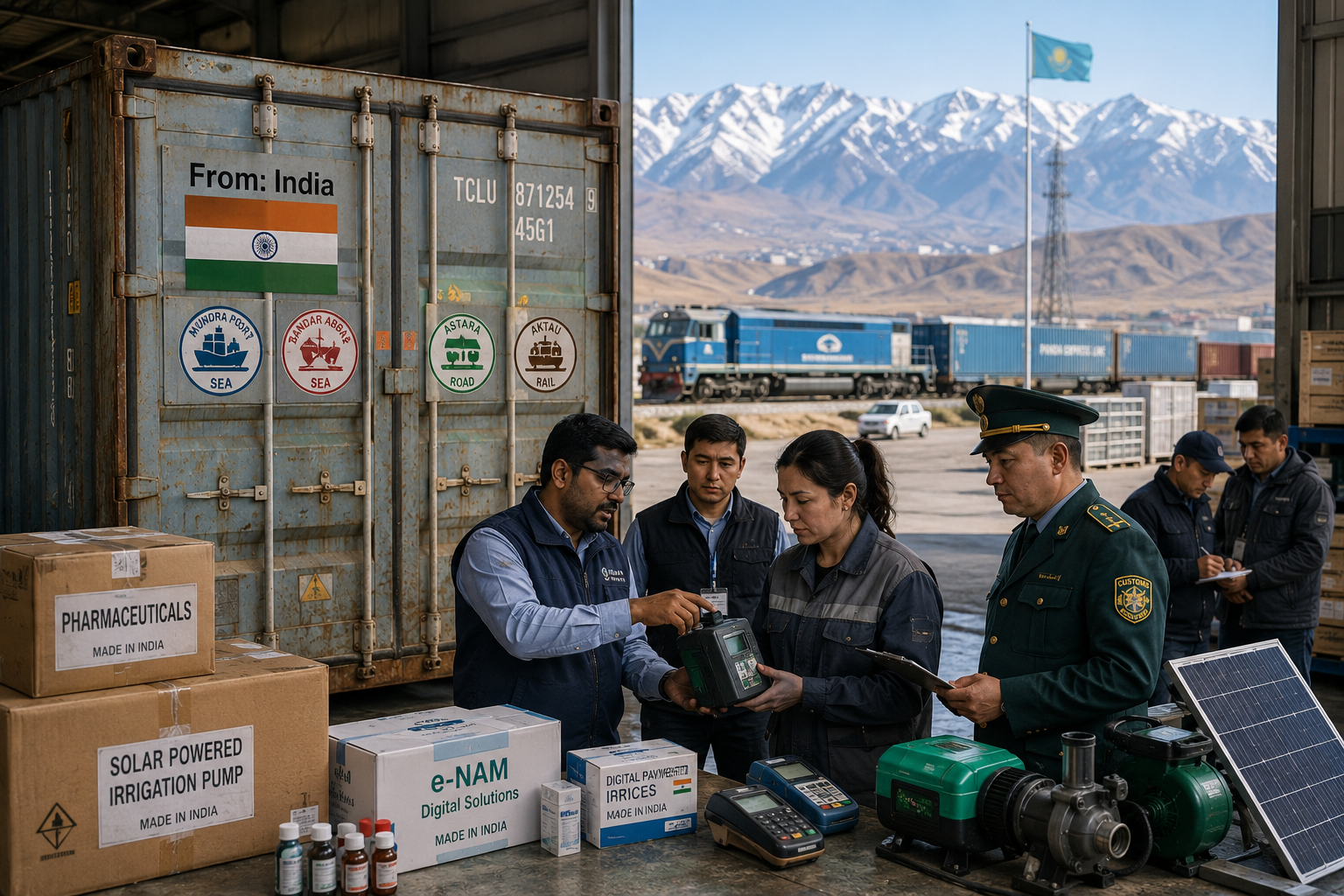
Premium editorial feature image for Central Asia India: geopolitical map, diplomatic table, flags, corridors and strategic pressure lines. Dark navy, muted gold and deep red palette, realistic magazine style, no text, no cartoon.
Approx. article draft word count: 1985 words. Target from Excel: 2,500-3,000 words. This is a complete editorial draft that can be expanded further during final publishing edit if required.
Central Asia is often described as a distant region on India's extended map. That description is technically convenient and strategically misleading. The five republics of Kazakhstan, Kyrgyzstan, Tajikistan, Turkmenistan and Uzbekistan sit between Russia, China, Iran, Afghanistan and the Caspian basin. They are not only a geographic bridge; they are a pressure chamber where energy, terrorism, connectivity, minerals and great-power rivalry meet.
Why the issue matters now
For India, the importance of Central Asia begins with a simple strategic problem: India is a major Asian power without direct land access to one of Asia's most resource-rich regions. Pakistan blocks the most natural route. China has built deep economic and infrastructure influence across the region. Russia remains the old security anchor. Iran offers the most practical westward access point through Chabahar. This makes Central Asia a test of India's ability to act beyond its immediate neighbourhood despite geographic constraints.
The energy argument is the most visible. Kazakhstan is a major producer of uranium and hydrocarbons. Turkmenistan holds some of the world's significant natural gas reserves. Uzbekistan has gas, gold and an increasingly reform-oriented economy. For a country like India, which must manage oil imports, gas demand, nuclear energy ambitions and clean-energy transition at the same time, Central Asia cannot be treated as a peripheral theatre. It offers resources that can diversify India's supply base and reduce overdependence on a narrow set of maritime suppliers.
But energy is only the starting point. Central Asia matters because energy corridors create political relationships. A pipeline, a port route or a rail corridor is never merely infrastructure. It tells a country whom it depends on, whom it trusts, and whose territory it must cross during a crisis. India has long discussed projects such as the Turkmenistan-Afghanistan-Pakistan-India pipeline, but the security risk of Afghanistan and Pakistan has made such routes fragile. That is why the Chabahar port and the International North-South Transport Corridor remain strategically important. They offer India a way to reach Afghanistan, Central Asia and Eurasia without being held hostage by Pakistan's geography.
The strategic geography
Security is the second major reason Central Asia matters. The region borders Afghanistan, and instability in Afghanistan rarely remains local. Extremist networks, narcotics trafficking, illegal arms flows and refugee pressure all move through porous terrain. India has suffered from cross-border terrorism for decades, and it understands that ideological radicalisation can be amplified by money, weapons and ungoverned spaces. Tajikistan, Uzbekistan and Turkmenistan have direct or near-direct exposure to Afghanistan. Their security choices affect the broader regional environment in which India must operate.
The Taliban's return to power in Kabul has made this equation more complex. India does not want Afghanistan to become a base for anti-India groups. Central Asian states do not want instability spilling northward. Russia worries about its southern flank. China worries about Xinjiang and Belt and Road assets. Iran worries about refugees, sectarian tensions and narcotics. This overlap gives India and Central Asia a shared security vocabulary even when their political systems and external alignments differ.
The third dimension is great-power competition. China has used the Belt and Road Initiative to create roads, pipelines, rail networks, loans and trade dependence across Central Asia. Russia remains tied to the region through military institutions, labour migration, language, media and security arrangements. Turkey is using cultural and linguistic links through the Organization of Turkic States. The Gulf is becoming a capital provider. Europe wants access to minerals and alternative routes that bypass Russia. In this crowded space, India's challenge is not to dominate Central Asia. It is to remain relevant.
India angle
India's comparative advantage is not cash on China's scale or military presence on Russia's scale. India's advantage is a combination of civilisational memory, education, pharmaceuticals, digital public infrastructure, capacity building, affordable technology and a reputation for non-coercive partnership. Central Asian elites are interested in diversifying their external options. They do not want to become dependent on a single great power. India can position itself as a serious but non-threatening partner, especially in health, IT, higher education, space applications, disaster management and counter-terrorism training.
This is why the India-Central Asia Dialogue is more than diplomatic ritual. It creates a regular platform to discuss connectivity, trade, technology, defence, Afghanistan and regional security. The 2025 joint statement of the dialogue reflected the continuing effort to institutionalise the relationship. Institutionalisation matters because relations built only on occasional summits often fade. Central Asia requires patient statecraft, not headline diplomacy.
The India angle is especially strong in three areas: energy security, continental access and strategic autonomy. On energy, Central Asia gives India another basket of suppliers and long-term cooperation possibilities. On access, it forces India to build routes through Iran, the Caspian and Eurasia. On strategic autonomy, it prevents India from being trapped in a maritime-only vision of power. A country that wants to be a leading power must be able to think both through the ocean and across the continent.
Counter-view and complexity
However, the relationship also has serious limitations. India's trade with Central Asia remains modest compared with its trade with the Gulf, Europe, the United States or East Asia. Connectivity is expensive, slow and vulnerable to sanctions, especially because Iran is central to the most practical route. Central Asian states have their own calculations; they will not risk their ties with Russia or China merely to please India. The region is also politically sensitive, with governance challenges, succession questions and economic inequality in several states.
The counter-view, therefore, is that Central Asia may matter more in theory than in India's actual economic priorities. India has easier maritime access to energy from the Gulf, Africa and global markets. Its businesses often prefer predictable routes and larger consumer markets. Central Asia is landlocked, politically complex and logistically demanding. This view is not wrong, but it is incomplete. Strategic regions are not always judged by today's trade volume. Sometimes they matter because they shape tomorrow's vulnerability.
What happens next
What happens next will depend on whether India can convert strategic interest into practical delivery. Three developments should be watched. First, whether Chabahar and the North-South Corridor become reliable commercial routes rather than symbolic talking points. Second, whether India can expand defence and intelligence cooperation without provoking unnecessary suspicion. Third, whether Indian companies enter Central Asia's mining, energy, agriculture, education and digital sectors with sustained seriousness.
The sharp editorial insight is this: Central Asia is not India's shortcut to great-power status; it is India's test of strategic patience. If India can build influence in a region where geography is difficult, rivals are entrenched and returns are slow, it will prove that its foreign policy has moved beyond slogans. If it cannot, Central Asia will remain another map on which India has interests but insufficient presence.
A deeper reading of Central Asia also requires India to understand the psychology of the region. These republics became independent after the Soviet collapse, but their state institutions, security habits and economic networks did not emerge in a vacuum. Russian language, labour migration, military linkages and elite networks still matter. At the same time, younger populations, urbanisation, digital change and national identity have created a desire for more diversified external relations. India should not approach Central Asia as if the region is waiting for a single outside power. It should approach it as a group of states trying to widen their options while avoiding unnecessary confrontation with Russia or China.
Kazakhstan is central because it has scale, resources and a tradition of multi-vector diplomacy. It can work with Russia, China, Europe, the United States, Turkey and India without formally choosing one camp. Uzbekistan matters because reforms and demographic weight make it a potential economic hub. Turkmenistan matters because gas reserves give it strategic value despite political isolation. Tajikistan matters because of its security exposure to Afghanistan. Kyrgyzstan matters because of its location, political volatility and regional connectivity. Treating the five states as one bloc would be a mistake; each requires a different Indian approach.
India's energy interest should be seen in three layers. The first is traditional energy: oil, gas and uranium-related cooperation. The second is energy transport: how resources move across politically difficult terrain. The third is future energy: critical minerals, renewables, grid management and technology cooperation. Central Asia can become relevant to all three, but only if India combines diplomacy with business risk appetite. Without Indian companies, banks and logistics players entering the region, even the best strategic statements will remain decorative.
Connectivity remains the hardest test. Chabahar, the International North-South Transport Corridor and Caspian routes can reduce India's dependence on Pakistan-controlled access. But these corridors require customs coordination, rail upgrades, insurance comfort, sanctions management, cargo aggregation and private-sector trust. A corridor is not built by signing a document. It becomes real only when exporters, freight forwarders and banks find it commercially usable. India must therefore move from strategic announcements to operational logistics.
The Afghanistan factor will continue to shape India-Central Asia relations. Central Asian states do not all view the Taliban in the same way, but all are affected by Afghanistan's security and economic condition. India has an interest in preventing Afghanistan from becoming a launchpad for terrorism, but it also has a humanitarian interest in avoiding collapse. Working with Central Asian partners on food aid, medicines, capacity building and counter-radicalisation can give India a responsible role without requiring premature recognition politics.
There is also a cultural opportunity. Bollywood, Indian medicine, yoga, education and historical memories of Silk Road exchanges give India a softer entry point. But soft power must be modernised. Central Asian students should see India not only as a civilisational friend but as a source of quality education, affordable healthcare, digital skills and business opportunity. Scholarships, university partnerships, IT training and medical cooperation can produce long-term elite familiarity.
India should also watch the internal politics of water and borders in Central Asia. The region's rivers, hydropower plans and agricultural needs can create disputes, especially between upstream and downstream states. Climate change may deepen these tensions. If India wants to be a serious partner, it can offer satellite data, water-management expertise, climate modelling and disaster-response cooperation. These areas are less politically sensitive than military alliances and can generate trust.
The final strategic point is that Central Asia rewards consistency. Countries in the region have seen many external powers arrive with grand language and leave when priorities changed. India must avoid episodic engagement. Annual dialogues, trade fairs, defence training, medical missions, academic links, digital infrastructure pilots and business delegations should continue even when no dramatic headline is expected. Influence in Central Asia will be built through cumulative credibility, not sudden breakthrough diplomacy.
A useful way to judge India's progress in Central Asia is to track practical indicators rather than summit language. Trade volume, cargo movement through Chabahar, frequency of direct flights, number of Indian students, defence training slots, mining investments, pharmaceutical exports, digital projects and joint working groups all reveal whether the relationship is thickening. If these indicators do not improve, strategic language will remain disconnected from reality.
India should also think about Central Asia in relation to Russia sanctions and Eurasian fragmentation. Many routes that pass through Russia now face compliance, insurance and political complications. This makes alternative corridor design more urgent but also more complex. Indian firms will need legal clarity and government support to operate confidently across sanctioned or sanctions-adjacent geographies.
The region also offers India a platform for engaging the Islamic world in a non-West Asian context. Central Asian societies are Muslim-majority but shaped by Soviet history, secular governance traditions and Turkic-Persian cultural layers. This gives India opportunities for cultural and educational diplomacy different from the Gulf or West Asia. A nuanced engagement can strengthen India's image as a plural civilisational actor.
Ultimately, Central Asia should be placed inside India's larger Eurasian strategy. India cannot allow Eurasia to become a space shaped only by China, Russia, Turkey and the West. Even limited but steady Indian presence can prevent strategic exclusion. The objective is not dominance. It is access, relevance and optionality.
Internal Links to Add
Why Iran Remains Central to West Asian Geopolitics | Why Africa Is Becoming the Next Big Geopolitical Theatre | Why the Gulf Is Becoming a Centre of Money, Power and Diplomacy | Why Taiwan Matters to the Global Economy and World Security