Calories and Energy Balance: Why Body Weight Is More Dynamic Than Simple Arithmetic
A calorie is a unit of energy. That simple definition sits underneath one of the most argued-over subjects in nutrition: if body weight is influenced by the balance between energy consumed and energy expended, why do real people rarely lose or gain weight according to a neat mathematical schedule?
The answer is that the energy-balance principle is real, but the human body is not a fixed machine. Energy expenditure changes with body size, food intake, physical activity, age, body composition and physiology. Appetite can change. Water and glycogen fluctuate. A person who loses weight generally needs fewer calories to maintain the smaller body than they did at the starting weight. During energy restriction, the body can also reduce expenditure more than would be expected from the loss of tissue alone.
That is why calories matter without being the whole story.
What a calorie actually measures
In nutrition, a kilocalorie — usually written simply as “calorie” on food labels — represents a quantity of energy. Carbohydrate, fat, protein and alcohol can all provide energy, although they do so in different amounts and with different nutritional effects.
The body uses energy continuously. Even during sleep, energy is required to maintain circulation, breathing, ion gradients, temperature regulation, tissue turnover and other basic processes. More energy is used to digest and process food, to stand and move, to perform household work, and to exercise.
So “calories out” is not a single process. It is the sum of several forms of energy expenditure.
The main parts of energy expenditure
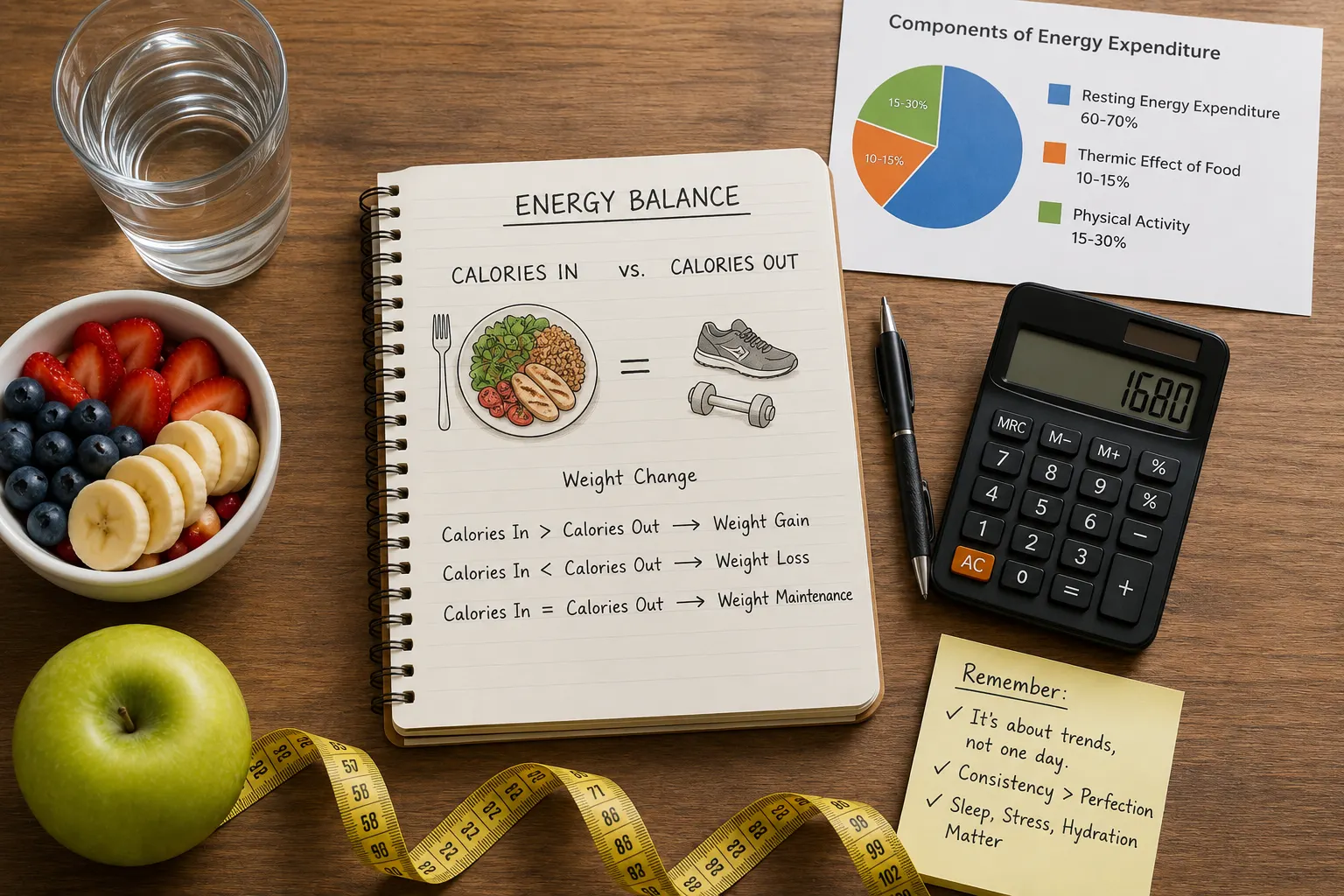
The largest component for most adults is resting energy expenditure: the energy required to keep the body functioning at rest. You may also see the related terms basal metabolic rate and resting metabolic rate. They are not measured under exactly the same laboratory conditions, but both refer to the large background cost of keeping a living body alive.
A second component is the thermic effect of food — energy used in digestion, absorption, transport and processing of nutrients.
A third is physical activity. This includes planned exercise and ordinary movement: walking to a shop, climbing stairs, cleaning, standing, fidgeting and hundreds of other actions. Researchers sometimes separate deliberate exercise from non-exercise activity because day-to-day spontaneous movement can vary greatly between people.
Together these components produce total daily energy expenditure.
What “energy balance” means
When energy intake and expenditure are equal over time, body energy stores are broadly stable. When intake persistently exceeds expenditure, the excess energy must be stored somewhere in the body. When expenditure persistently exceeds intake, stored energy is mobilised.
This is a statement of physiology, not a judgment about behaviour or character.
WHO’s healthy-diet guidance therefore includes balancing energy intake with expenditure as one element of a healthy dietary pattern. NIDDK similarly explains that taking in more calories than the body uses over time can lead to weight gain.
But “over time” is crucial. A single meal does not determine a person’s long-term body weight, and daily scale changes do not map directly onto daily energy balance.
Why the scale can move without a large change in body fat
Body weight includes much more than stored fat. Water, glycogen, food moving through the gastrointestinal tract, muscle, organs, bone and other tissues all contribute.
A high-sodium meal can temporarily increase water retention. Carbohydrate intake can alter glycogen stores, which are stored with water. Menstrual-cycle changes, bowel contents, inflammation after unfamiliar exercise and hydration can all move the scale independently of meaningful changes in body fat.
This is why interpreting every 24-hour change as “fat gained” or “fat lost” creates unnecessary confusion.
Why the old 3,500-calorie rule is too simple
A popular rule has claimed that a fixed cumulative deficit of about 3,500 calories produces exactly one pound of weight loss. It can be a rough illustration, but it is a poor long-term prediction model.
NIDDK’s Body Weight Planner was developed partly because static rules fail to account for the body’s response to weight change. As body mass decreases, the energy required to maintain and move that body generally decreases. Energy expenditure can also fall because of adaptive responses to reduced intake.
The result is that a calorie deficit that initially produces a certain rate of weight loss does not necessarily produce the same rate indefinitely.
A plateau does not violate energy balance. The terms of the balance have changed.
Metabolic adaptation is real — but it is not a “broken metabolism”
During weight loss, resting energy expenditure usually falls for two broad reasons. First, there is less tissue to maintain. Second, in many people there is an additional adaptive reduction in expenditure beyond what body-composition change alone would predict.
NIDDK explicitly notes that metabolism slows during weight loss and that the body needs fewer calories at a lower weight. Research reviews describe adaptive thermogenesis as one factor that can resist further weight loss and favour regain.
That should not be translated into the internet claim that dieting permanently “destroys” metabolism. The size and persistence of adaptation vary between people and studies. Weight management remains physiologically possible, but maintenance may require continued attention because the post-weight-loss body is not identical to the pre-weight-loss body.
If calories matter, does food quality matter?
Yes — for several reasons.
Two diets with the same theoretical calorie content can differ dramatically in fibre, protein, vitamins, minerals, sodium, saturated fat, food volume and the amount of processing. Those differences can affect health independently of weight.
They can also affect how easy an eating pattern is to sustain. Foods that are filling, nutrient-dense and compatible with a person’s culture and routine may make a lower energy intake easier to maintain than a diet dominated by foods that provide substantial energy with little satiety.
Macronutrients also have different thermic effects, although these differences do not abolish the larger principle of energy balance.
This is why “a calorie is a calorie” can be both technically true as a unit of energy and practically incomplete as dietary advice.
Exercise and energy balance
Physical activity raises energy expenditure, but its value goes beyond the calories displayed on a watch or treadmill.
Regular activity improves cardiovascular fitness, insulin sensitivity, physical function, mood and many other health outcomes. Muscle-strengthening activity helps preserve or build lean tissue. CDC notes that reducing calorie intake together with physical activity can create the deficit that produces weight loss, while regular physical activity is particularly important for maintaining lost weight.
Exercise does not need to “earn” food, and a workout should not be treated as a moral transaction. It is one component of health and energy expenditure.
Why two people can respond differently
Energy balance does not imply that every person has the same appetite, resting expenditure or environmental constraints.
Body size and composition influence energy needs. Genes can influence appetite and metabolism. Sleep, medications, medical conditions, stress, work patterns and the local food environment can alter both sides of the equation. NIDDK lists lifestyle habits, sleep, medicines, health problems, family history and environmental conditions among factors that affect body weight.
In other words, physiology obeys energy balance while human behaviour occurs inside biology and environment.
That distinction is essential. Saying that an energy deficit is required for fat loss does not mean producing or maintaining that deficit is equally easy for everyone.
Do you need to count calories?
Not necessarily.
Calorie tracking can be useful for some people because it reveals portion sizes, beverage calories or patterns they had not noticed. For others it becomes tedious, inaccurate or psychologically unhelpful.
A person can reduce average energy intake without counting every calorie by changing recurring habits: choosing more vegetables and whole foods, reducing frequent calorie-dense extras, changing beverage choices, adjusting portions, eating more deliberately, or restructuring the food environment at home.
Likewise, activity can increase without calculating the energy cost of every movement.
Calories describe the system. They do not prescribe one method of managing it.
The practical lesson
The most accurate way to think about energy balance is dynamic rather than mechanical.
Energy intake matters. Energy expenditure matters. But both can change as body weight, behaviour and physiology change. The scale reflects water and tissue as well as fat. Food quality affects health and can affect satiety and adherence. Exercise contributes to expenditure while providing benefits that cannot be reduced to a calorie number.
So the useful conclusion is neither “calories are everything” nor “calories do not matter.”
It is that body weight emerges from an adaptive biological system governed by energy balance — and understanding that system is more useful than pretending it is a pocket calculator.
Medical note
Individual energy needs can differ substantially, and deliberate weight loss is not appropriate for everyone. Pregnancy, adolescence, eating disorders, significant medical illness and unexplained weight change require individual professional assessment.