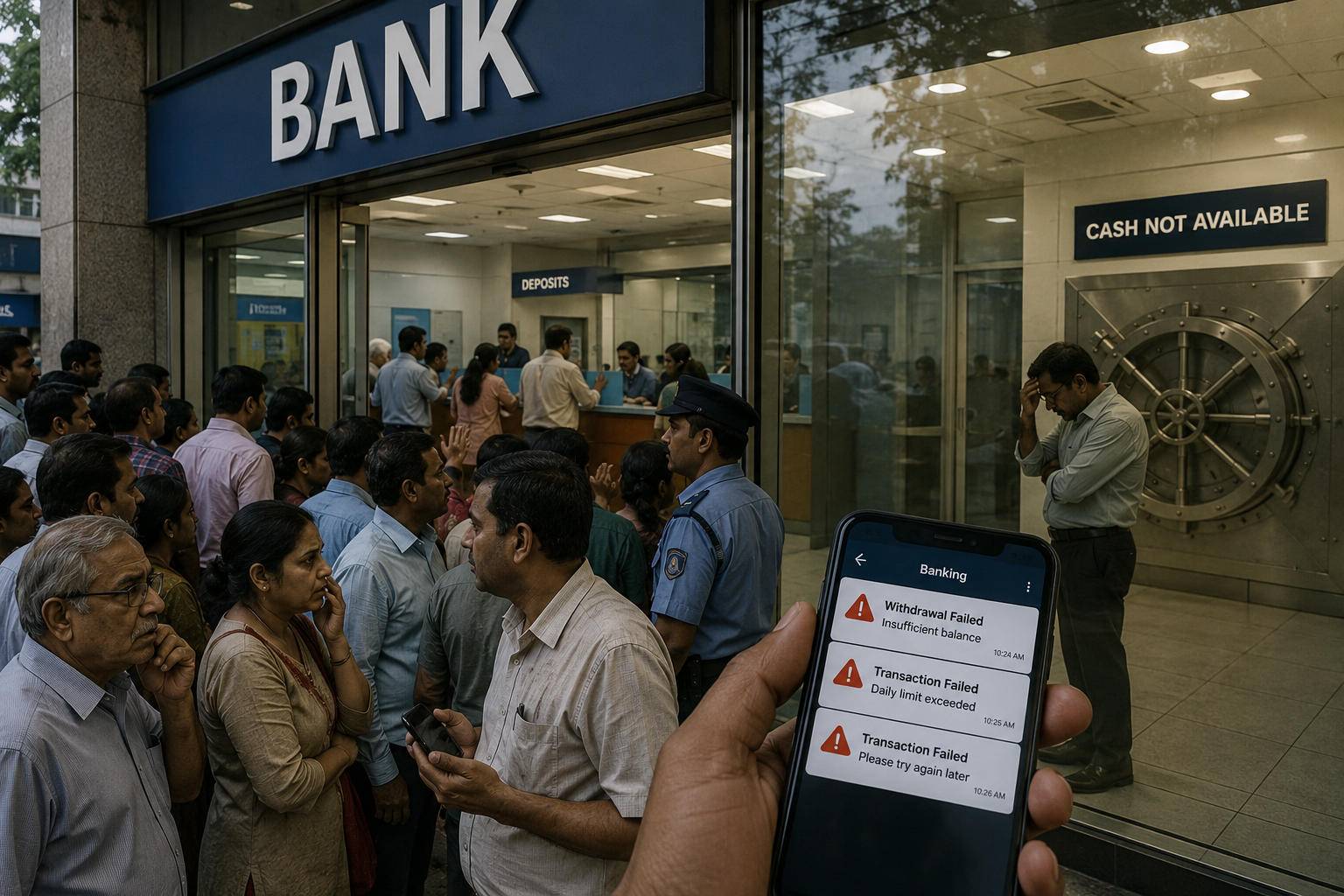
Fear can break a bank faster than losses
A bank run begins with a simple human emotion: fear. Depositors start believing that their bank may not be able to return their money. Some withdraw to be safe. Others see the withdrawals and panic. Soon, the fear itself becomes the crisis. A bank that could have survived an ordinary day may struggle when thousands of customers demand cash at the same time.
This is what makes a bank run so dangerous. It is not always caused by confirmed insolvency. Sometimes it begins with a rumour, a bad news report, a viral message, a sudden restriction, or the visible weakness of a connected institution. Once confidence breaks, the bank is forced to answer a question no bank is designed to answer instantly: can every depositor take out every rupee at once?
The honest answer is no. Modern banking does not work by keeping every deposit locked in a vault. Banks accept deposits, keep some money liquid, and use the rest to make loans and investments. This process allows credit to flow through the economy. But it also creates a fragile dependence on trust.
How modern banking creates the possibility of a run
Banks perform maturity transformation. Depositors usually want immediate access to money, but borrowers need money for months, years or decades. A bank may accept savings deposits that can be withdrawn today and use part of that funding to make home loans, business loans or infrastructure loans that will be repaid slowly.
This is not a scam; it is the basic business of banking. The economy needs it because savers alone cannot directly fund every borrower efficiently. Banks collect dispersed savings, assess credit risk, lend to households and firms, and manage payment systems. In return, they earn interest spreads and fees.
The weakness is liquidity. A bank may be solvent in the sense that its assets are worth more than its liabilities over time, but it may not have enough cash immediately available if too many depositors rush to withdraw together. A run turns a long-term balance-sheet question into a same-day cash question.
Confidence is the real foundation
Banking is built on capital, regulation, accounting and risk management. But beneath all of that sits confidence. Depositors leave money in a bank because they believe the bank will honour withdrawals when needed. Businesses accept bank transfers because they trust the payment system. Other banks lend to a bank because they trust its liquidity and solvency.
When confidence is high, deposits are stable. When confidence collapses, behaviour changes. People stop thinking like long-term savers and start thinking like people near a narrow exit. Even depositors who personally believe the bank may survive may withdraw because they fear others will withdraw first.
This creates a self-fulfilling danger. If everyone stays calm, the bank may remain healthy. If everyone runs, the bank may become unhealthy precisely because they ran. The crisis is not only financial; it is psychological and social.
How a bank run usually starts
A bank run can begin from several triggers. The first is visible financial weakness: rising bad loans, sudden losses, weak governance, or questions about asset quality. The second is reputation damage: fraud allegations, regulatory action, failed audits or management instability. The third is contagion: depositors fear their bank because another similar bank failed.
The fourth trigger is misinformation. In the age of instant messaging and social media, a rumour can travel faster than an official clarification. A photograph of a queue, a forwarded claim, or an unverified screenshot can create anxiety even before facts are established. Digital banking makes withdrawals easier, so panic can move at the speed of a mobile app.
The fifth trigger is policy confusion. If depositors hear words like moratorium, restriction, merger, liquidity support or reconstruction without understanding them, uncertainty can increase. Communication therefore matters. Regulators and banks must explain not only what is happening, but what depositors can and cannot do.
Liquidity crisis versus solvency crisis
Every bank run forces observers to distinguish between liquidity and solvency. A liquidity problem means the bank does not have enough cash immediately available, even if its assets may be good over time. A solvency problem means the bank’s assets are genuinely insufficient to cover liabilities. The first is about timing; the second is about value.
The distinction matters because the solution differs. A liquidity-stressed but solvent bank may need emergency funding, central-bank support, asset sales, or reassurance. An insolvent bank may need resolution, merger, recapitalisation or liquidation. Treating a solvency crisis as a temporary liquidity problem merely postpones the truth.
Depositors, however, rarely have the tools to judge this distinction quickly. They see queues, hear rumours and react defensively. That is why the burden of diagnosis lies with regulators, auditors, bank management and supervisors.
Why bank runs spread beyond one bank
Bank runs can become contagious because depositors use shortcuts. If one bank fails, customers of other banks ask whether their bank has similar weaknesses. If one cooperative bank faces restrictions, depositors may become nervous about other cooperative banks. If one lender is exposed to risky borrowers, markets may reprice the entire sector.
Financial institutions are connected through interbank lending, payment systems, government securities, wholesale funding, common borrowers and public confidence. A problem in one institution can therefore become a question about the system. The more opaque the information, the more powerful the fear.
This is why regulators often move quickly to contain panic. Delay may appear cautious, but in a confidence crisis, silence can be costly. A clear statement, credible liquidity backstop, transparent resolution plan or orderly merger can stop fear from becoming systemic.
The role of deposit insurance
Deposit insurance exists partly to reduce the incentive to run. If small depositors know that their deposits are insured up to a defined limit, they are less likely to rush to the bank because of every rumour. Insurance converts panic into a rule-based expectation.
But deposit insurance is not unlimited. It does not mean every rupee in every financial product is guaranteed. It usually applies to eligible bank deposits, subject to limits, rights, capacities and regulatory conditions. Depositors must understand what is covered and what is not covered.
Insurance also creates a policy balance. If protection is too weak, depositors panic easily. If protection is unlimited and poorly priced, banks may take excessive risk because depositors stop caring about discipline. Good deposit insurance protects trust without removing the need for supervision.
The role of the central bank and regulator
Central banks and banking regulators are critical during runs. They monitor liquidity, impose prudential rules, supervise banks, restrict unsafe practices and act as lenders of last resort where appropriate. Their goal is not to protect every bank manager or shareholder; it is to protect financial stability and depositors within the framework of law.
A regulator may arrange liquidity support, push a merger, place restrictions, approve reconstruction, or require capital infusion. In severe cases, it may permit orderly resolution. The aim is to prevent disorderly collapse, especially where payment systems, small depositors and public confidence are at risk.
However, regulatory action must be credible. If depositors believe supervision failed for years, emergency statements may not restore confidence. Trust is built before crisis, not during crisis alone.
The India lens
In India, bank-run anxiety often becomes visible when depositors hear about restrictions on withdrawals, stress in cooperative banks, fraud investigations or sharp deterioration in asset quality. The formal banking system is heavily regulated, but depositors still need financial literacy. The difference between a scheduled bank, a cooperative bank, an NBFC, a credit society and an informal deposit-taking entity can be crucial.
A common mistake is to treat all institutions offering interest as if they carry the same protection. They do not. Deposits in eligible banks are subject to deposit insurance rules, while many other products or entities may not have the same protection. Higher promised returns often come with higher risk, even when the marketing language sounds safe.
For Indian households, the practical lesson is simple: do not place trust only in interest rate. Check whether the institution is regulated, whether deposits are insured, how much protection applies, and whether the total exposure to one bank is sensible for your circumstances.
What depositors should and should not do
Depositors should keep records of accounts, nominees, fixed deposits, joint holdings and bank communications. They should avoid relying on unverified social media claims. They should understand deposit insurance limits and spread deposits where appropriate, especially when large sums are involved.
At the same time, depositors should not create panic by forwarding rumours. A false rumour can harm other depositors, employees and the institution itself. Responsible financial behaviour includes verifying official communication from the bank, regulator or deposit insurer before reacting publicly.
No depositor can eliminate all risk. But basic discipline reduces vulnerability: avoid chasing unusually high rates, read bank notices, diversify intelligently, keep emergency liquidity accessible, and use regulated channels.
Final takeaway
A bank run is a crisis of confidence that becomes a crisis of liquidity and can become a crisis of solvency. It exposes the central paradox of banking: the system works because not everyone asks for money at once, yet everyone has the right to ask for money when needed.
This does not make banking inherently unsafe. It means banking depends on regulation, transparency, capital, liquidity, deposit insurance and public trust. The stronger these foundations are, the less likely fear is to become self-fulfilling.
For readers, the most important lesson is not to live in fear of banks. It is to understand how banks work. A financially literate depositor is neither careless nor panicked. They know that trust is essential, but they also know that trust must be supported by rules, records and risk awareness.