Breathing sits at the boundary between automatic and voluntary control
You do not have to remember to breathe while sleeping, yet you can deliberately hold, speed or slow your breathing while awake. Few bodily processes are so continuously automatic and so immediately accessible to voluntary control.
That makes breathing a useful tool for changing arousal. But the familiar instruction to “take a deep breath” can be misleading. If “deep” means repeatedly inhaling as much air as possible, some people will over-breathe, lower carbon dioxide too quickly and become dizzy or tingly. In relaxation practice, slow and comfortable is usually a better description than maximum depth.
What changes when breathing slows
Respiration interacts mechanically and neurally with the cardiovascular system. Heart rate naturally varies across the breathing cycle, and slower paced breathing can influence measures such as heart-rate variability. Breathing also changes how strongly a person notices chest and abdominal sensations.
This does not mean that one breathing rate “activates the vagus nerve” like an electrical switch. The autonomic nervous system is a network, and breathing effects depend on rate, depth, timing, posture and individual physiology.
What controlled studies show
A 2023 randomised controlled trial by Balban and colleagues compared three five-minute daily breathwork exercises with mindfulness meditation for one month. The breathing groups included cyclic sighing, box breathing and cyclic hyperventilation with breath retention. Positive affect improved across interventions, and cyclic sighing produced the largest numerical improvement in positive affect and reduction in respiratory rate.
Another randomised study of slow breathing over 12 weeks reported reductions in psychological stress and anxiety measures. More recent experimental work continues to examine whether specific timing patterns add benefit.
The responsible conclusion is that structured breathwork can influence short-term mood and stress-related outcomes. It is not that one branded pattern has been proved to cure anxiety or other disease.
Why the exhalation is often emphasised
Many calming exercises use an exhalation that is as long as or longer than inhalation. Longer exhalation tends to reduce the tendency to stack large inhalations and can make the breathing rhythm feel less effortful.
But exact ratios such as 4-7-8 should not be treated as physiological laws. A 2025 comparison of square breathing, 4-7-8 breathing and six breaths per minute found differences in heart-rate variability and also highlighted the possibility of over-breathing. Comfort and tolerability therefore matter.
A simple low-risk practice
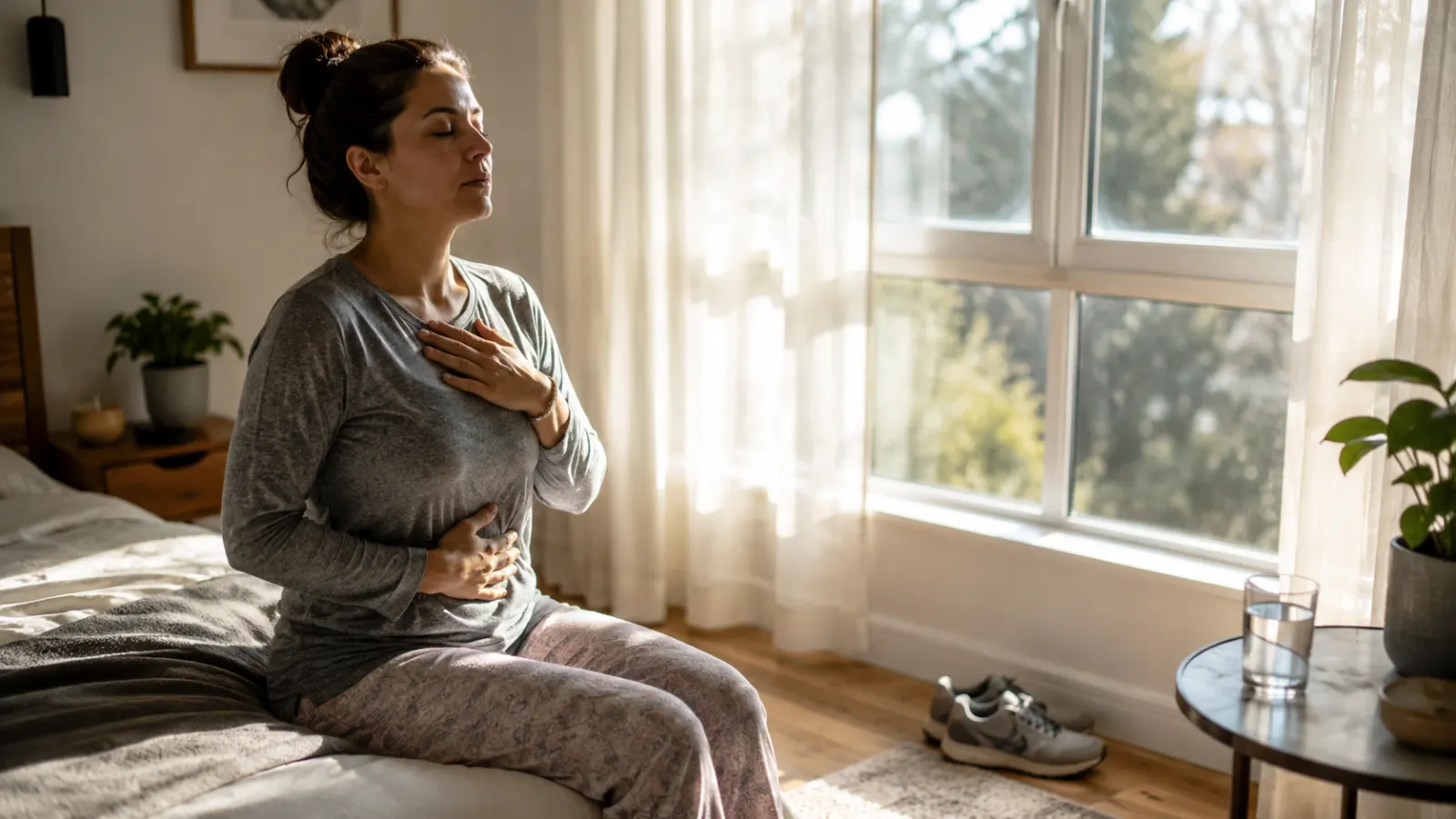
Sit in a supported position. Let the shoulders remain loose. Breathe in gently through the nose if comfortable and allow the lower ribs or abdomen to expand without forcing them outward. Exhale slowly and easily. Repeat at a pace that feels calm rather than air-hungry.
A five-minute practice is enough to learn the pattern. If counting helps, use an easy rhythm such as roughly four seconds in and five or six seconds out, but abandon the count if it creates strain. The aim is reduced respiratory effort and a slower rhythm, not breath-holding endurance.
Why breathing can help during anxiety—but can also become a safety behaviour
An anxious person may breathe rapidly, sigh repeatedly or become intensely aware of respiratory sensations. Slow breathing can reduce some of that arousal and restore a sense of control.
However, people with panic disorder sometimes become frightened of normal bodily sensations. If a person comes to believe, “I am only safe if I control my breathing perfectly,” the exercise can become a ritual. Evidence-based panic treatment often includes learning to tolerate feared sensations rather than eliminating every sensation immediately.
When not to assume the problem is anxiety
Shortness of breath can accompany anxiety, but it can also result from asthma, infection, heart disease, anaemia, pulmonary embolism and many other conditions. New, severe or unexplained breathing difficulty deserves medical assessment.
The same applies to chest pain, fainting, blue lips, severe wheezing or sudden neurological symptoms. A breathing exercise is not a diagnostic test.
The practical benefit is control, not magic
Deep-breathing advice is useful when translated into something more precise: breathe more slowly, more gently and with less unnecessary upper-chest effort. Practised regularly, that can become a portable way to reduce arousal.
Its limitation is equally clear. Breathing can change the state in which a person meets a problem. It does not necessarily solve the problem itself, and it is not a replacement for medical or psychological treatment when treatment is needed.
Diaphragmatic breathing does not mean pushing the belly out as far as possible
The diaphragm is the principal muscle of quiet breathing. During inhalation it contracts and descends, allowing the lower rib cage and abdomen to move. “Belly breathing” cues are meant to reduce excessive upper-chest effort, not to create exaggerated abdominal movement.
A person can therefore practise by allowing rather than forcing expansion. The shoulders do not need to rise dramatically. A quiet breath that feels sustainable is more consistent with relaxation than repeated maximal inhalations.
Carbon dioxide explains why over-breathing can feel alarming
When ventilation rises more than metabolism requires, carbon dioxide in the blood can fall. That can produce light-headedness, tingling, chest sensations or a feeling of unreality—sensations that can be particularly frightening to someone prone to panic.
This is why advice to take repeated huge breaths can backfire. Slowing and reducing unnecessary ventilation is different from inhaling the largest possible volume of air.
Heart-rate variability is a measurement, not a health score
Slow breathing often increases respiratory-linked variation in heart rate. Wearables and biofeedback systems may display this as heart-rate variability, or HRV. Higher short-term HRV during paced breathing can indicate strong respiratory modulation, but a single number should not be treated as a universal measure of stress resilience or overall health.
HRV varies with age, fitness, illness, medications, measurement method, posture and time of day. The meaningful question in a breathing exercise is usually whether the practice is comfortable and helpful, not whether a consumer device awards a particular score.
Breathing practices differ
Box breathing uses equal phases of inhalation, holding, exhalation and holding. Cyclic sighing emphasises a pattern of inhalation followed by an additional smaller inhalation and a prolonged exhalation. Resonance-style breathing often targets a slow rate near six breaths per minute, though an individual’s comfortable rate varies.
Research comparing these methods is still developing. The existence of several plausible protocols is itself a reason not to market one timing pattern as the only scientifically correct way to breathe.
Use breathing as a bridge to action
The most practical role of breathing may be transitional. A person can use two or three minutes of slower breathing before making a difficult phone call, entering a medical appointment, beginning an exposure exercise or returning to a task after an argument.
In that role, the breathing exercise is not the destination. It lowers arousal enough to make the next useful behaviour easier.
Should you breathe through the nose or mouth?
Many slow-breathing instructions favour nasal inhalation because it naturally limits airflow and can feel quieter. Exhalation may occur through the nose or gently through the mouth depending on the technique. There is no need to turn this preference into a rigid rule for everyone.
Nasal congestion, respiratory illness or individual comfort may make another pattern more practical. The core elements for stress regulation are usually gentleness, a slower rhythm and avoidance of forced hyperventilation—not loyalty to one route of airflow.
Practise before the crisis
Breathing skills are easier to use under pressure when the rhythm has already been learned in calmer moments. A few minutes of practice once or twice a day can make the technique familiar enough that it does not require complex instructions during stress. Familiarity, rather than an elaborate protocol, is often what makes a simple breathing exercise usable in real life.
Practising while calm also makes it easier to notice whether a particular pace causes strain, dizziness or air hunger before trying to use it during a difficult moment.
Medical note: This article provides general educational information and is not a substitute for individual medical or mental-health assessment. Stop a practice that repeatedly worsens symptoms and seek professional advice when distress is severe, persistent or functionally impairing.
Sources / Further Reading
• Balban et al. — Brief structured respiration practices enhance mood and reduce physiological arousal (2023) — https://pubmed.ncbi.nlm.nih.gov/36630953/
• Birdee et al. — Slow breathing for reducing stress: extended exhale trial (2023) — https://pubmed.ncbi.nlm.nih.gov/36871835/
• Marchant et al. — Comparison of square, 4-7-8 and six-breaths-per-minute breathing (2025) — https://pubmed.ncbi.nlm.nih.gov/39864026/
• NCCIH — Relaxation Techniques: What You Need To Know — https://www.nccih.nih.gov/health/relaxation-techniques-what-you-need-to-know
• NHLBI — How the Lungs Work — https://www.nhlbi.nih.gov/health/lungs/breathing-benefits
Suggested Internal Links
• The Science of Relaxation Techniques — Article 26 in this batch
• Understanding the Fight or Flight Response — Article 24
• Understanding Anxiety and How to Manage It — Article 30 in this batch
• Why Breathing Techniques Reduce Stress — Planned internal link