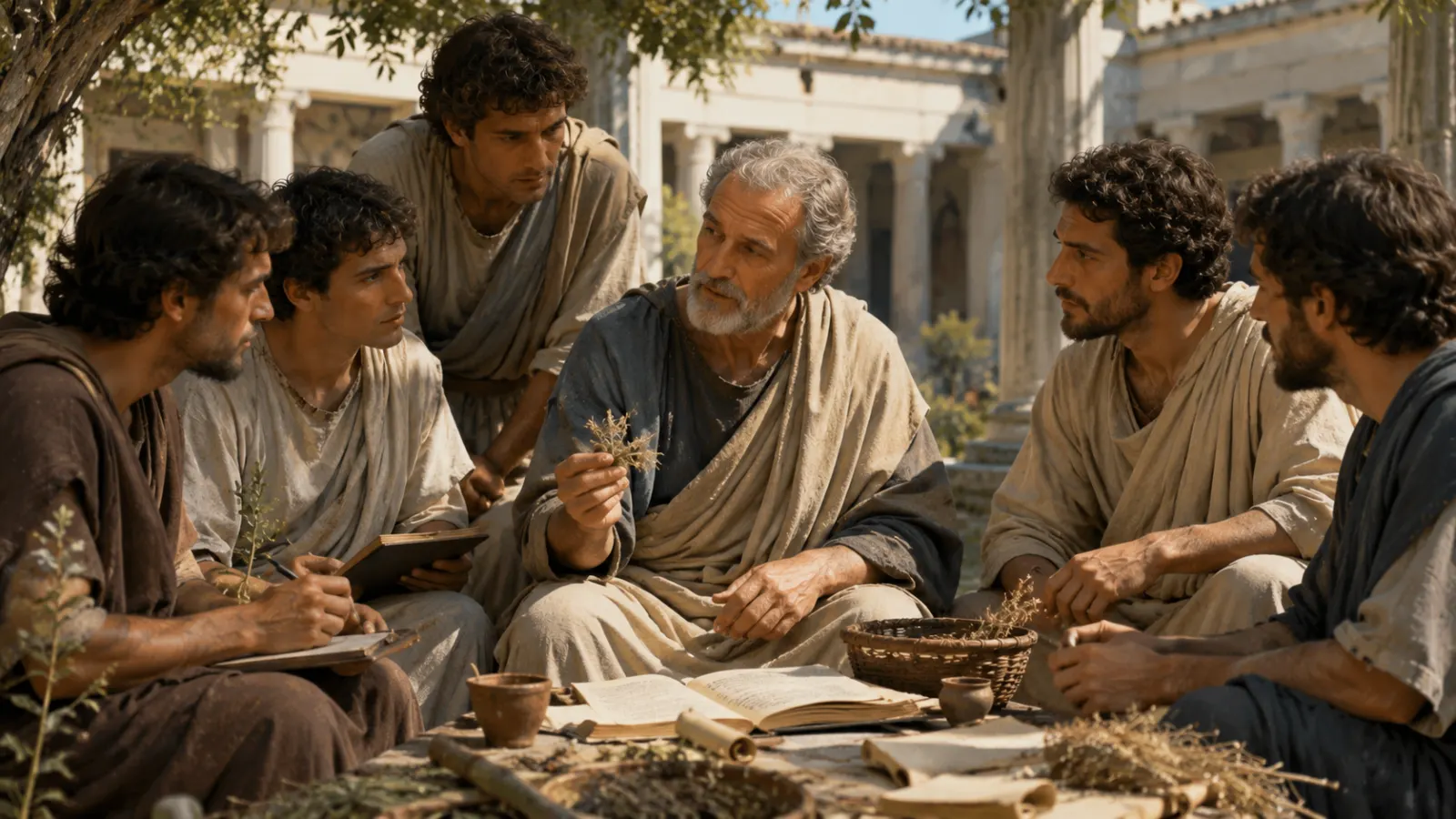
Aristotle: The Philosopher Who Turned Explanation Into a System
Aristotle is often introduced through a list of roles: philosopher, logician, scientist, student of Plato, teacher of Alexander the Great. Every label is accurate, but the list hides the scale of his project. Aristotle did not divide knowledge into the modern university departments we know today. Logic, ethics, politics, biology, metaphysics, rhetoric, poetics and natural philosophy formed parts of one larger attempt to understand what counts as a good explanation, how different kinds of things should be studied and what distinguishes one form of knowledge from another.
That ambition made him extraordinarily influential. For centuries, Aristotelian logic shaped the study of reasoning across Europe and parts of the Islamic intellectual world. The Nicomachean Ethics became foundational to virtue ethics, the Politics to the comparative study of constitutions, the Rhetoric to theories of persuasion and the Poetics to literary criticism. Medieval philosophers absorbed, transformed and disputed his physics and metaphysics; early modern science later rejected major parts of his natural philosophy while still inheriting some of his questions about causation and explanation. Yet the most interesting Aristotle is not simply the authority later generations made him. It is the thinker who repeatedly begins from puzzles, observed differences and ordinary beliefs, then asks what distinctions are needed to explain them.
From Stagira to Plato’s Academy
Aristotle was born in 384 BCE in Stagira, in northern Greece. His father, Nicomachus, is traditionally described as a physician associated with the Macedonian court, although the surviving evidence does not justify detailed claims about Aristotle’s childhood education or an early scientific curriculum. As a young man, Aristotle travelled to Athens and joined Plato’s Academy, remaining associated with the institution for roughly twenty years.
That long apprenticeship matters because simplified textbook contrasts often present Plato as a pure idealist and Aristotle as an empiricist who rejected him completely. The historical relationship was far more productive. Aristotle learned philosophy inside Plato’s intellectual world. He inherited questions about knowledge, form, causation, ethics and politics before developing sharply different answers.
After Plato’s death in 347 BCE, Aristotle left Athens and spent time in Assos and Lesbos. He became associated with Hermias of Atarneus and with Theophrastus, who would later succeed him at the Lyceum. Work connected with marine biology is often linked to the Lesbos period, reinforcing the broader point that Greek intellectual life extended across networks of cities, courts and schools rather than existing only in Athens.
Aristotle and Alexander the Great
Ancient tradition connects Aristotle with the education of the young Alexander, son of Philip II of Macedon, around the 340s BCE. The relationship later became legendary because Alexander went on to conquer the Persian Empire and become one of antiquity’s most famous rulers.
The evidence does not allow historians to reconstruct a detailed curriculum or claim that Aristotle created Alexander’s political worldview. Later stories tend to magnify the philosopher’s influence over the future conqueror.
Still, the relationship placed Aristotle close to Macedonian power during a period when Macedonia was transforming the Greek political order. It also produced a striking contrast. Aristotle’s Politics is deeply concerned with constitutions, civic communities and the structure of the polis, while Alexander created a monarchy operating on a vastly larger imperial scale.
The safest conclusion is therefore modest: Aristotle’s role as tutor was historically significant, but its intellectual consequences cannot be mapped directly onto Alexander’s later career.
The Lyceum Turned Philosophy Into Organized Research
Aristotle eventually returned to Athens and established his own school at the Lyceum. His followers became known as Peripatetics, a name later associated with walking while teaching, though the popular image of philosophers endlessly strolling should not substitute for evidence about the actual institution.
The Lyceum appears to have supported broad research and collection. Aristotle and his collaborators gathered political constitutions, biological observations, historical materials and literary examples. The surviving Constitution of the Athenians, transmitted separately from much of the Aristotelian corpus, reflects this documentary interest.
This institutional practice reflects Aristotle’s intellectual style. In politics, he compares constitutions. In biology, he compares species and organs. In rhetoric, he classifies forms of persuasion. In poetics, he analyses different kinds of dramatic structure.
This was not modern empirical science, but it was also far from pure speculation. Aristotle repeatedly asks what observed differences require explanation.
Like Plato’s Academy, the Lyceum also reveals something larger about ancient intellectual history: philosophy was becoming an institutional and collaborative practice rather than merely a sequence of isolated teachers.
Logic as an Instrument of Thought
Aristotle’s logical works were later grouped under the title Organon, meaning instrument or tool. The title captures the later role of logic in Aristotelian education: it became a method for evaluating reasoning across many different disciplines.
His most famous contribution is the theory of the syllogism. A syllogism is a structured argument in which, given premises of certain forms, a conclusion follows necessarily. The familiar example—“All humans are mortal; Socrates is human; therefore Socrates is mortal”—captures the basic idea but barely represents the complexity of Aristotle’s system.
In the Prior Analytics, he analyses valid forms of categorical deduction. The Posterior Analytics asks what distinguishes demonstration from ordinary deduction. The Categories and On Interpretation investigate terms, predication and propositions.
The intellectual achievement was enormous because reasoning itself became an object of systematic classification.
Yet saying “Aristotle invented logic” is too broad if it implies that no one reasoned formally before him or that other traditions lacked logical thought. Greek mathematics and argument already existed, and other civilizations developed independent logical traditions. Aristotle’s distinctive achievement lies in the systematic formalisation of deduction within the Greek philosophical tradition and the extraordinary longevity of that framework.
Valid Reasoning Is Not the Same as Scientific Knowledge
For Aristotle, a conclusion can follow validly from premises without providing genuine scientific understanding. A correct deduction does not automatically explain why something is the case.
The Posterior Analytics therefore develops a more demanding account of demonstration. Scientific knowledge requires premises that are appropriately prior, explanatory and connected with the causes of the thing being understood.
This distinction remains philosophically important. Prediction and explanation are not identical. A model may correctly predict that an event will occur without telling us what mechanism produces it.
Aristotle also confronts a fundamental regress problem. If every premise needs demonstration from an earlier premise, explanation can never begin. He therefore allows for first principles reached through processes involving perception, memory, experience and intellectual insight.
The details remain heavily debated, but the architecture is clear: knowledge is not just having facts; it is understanding why those facts belong together.
The Four Causes: Different Answers to “Why?”
Aristotle’s theory of the four causes is one of his best-known explanatory schemes. The English word “cause” can mislead because the four categories are better understood as different kinds of explanatory factors.
The material cause concerns what something is made from. The formal cause concerns what structure or form makes the thing what it is. The efficient cause concerns the source of change or production. The final cause concerns the end, purpose or function toward which something is directed.
A statue, for example, can be explained by the bronze from which it is made, the shape it possesses, the sculptor whose activity produced it and the purpose for which it was created.
Modern science does not generally retain Aristotle’s full teleological framework, especially when natural purpose is interpreted as conscious design. Yet biology still uses functional language: hearts pump blood, eyes support vision, roots absorb water.
The lasting significance of the four causes lies in Aristotle’s refusal to assume that every “why?” question demands the same kind of answer.
Aristotle Did Not Reject Form—He Relocated It
Aristotle’s metaphysics is often described as a rejection of Plato’s theory of Forms, but that description is incomplete. Aristotle does not reject form itself. He rejects the idea, associated with simplified Platonism, that the forms needed to explain things must exist separately from the particular things we encounter.
Concrete substances can instead be understood through matter and form. A bronze statue is not simply bronze, nor simply an abstract shape. It is material organised in a particular way. A living organism is likewise not merely a quantity of matter but a structured, functioning unity.
This framework later became known as hylomorphism, from Greek words for matter and form.
Aristotle’s account of substance is difficult and develops across different works. The Categories emphasises individual substances such as a particular person or horse, while the Metaphysics investigates essence, form and what it means for something to be.
The important point is that Aristotle’s disagreement with Plato is not a rejection of intelligible structure. It is an insistence that explanation begin from the organised beings present in the world rather than a separate realm of Forms.
Aristotle’s Biology Was Observational and Often Wrong
Aristotle’s biological writings are among the clearest demonstrations that ancient philosophy could involve sustained attention to the natural world. He and his school described animals, reproduction, anatomy, habitats and classifications on a remarkable scale for antiquity.
Many conclusions are wrong. Aristotle lacked modern instruments, genetics, evolutionary theory and experimental standards. He accepted spontaneous generation for some organisms and made significant errors in reproductive biology.
But dismissing the work because later science corrected it would be equally misleading. Aristotle compares species, examines differences in organs and functions, and records details suggesting direct familiarity with animal structures. Marine observations associated with Lesbos, including descriptions of cephalopods, have often been cited as evidence of close observation.
The deeper methodological lesson is important: Aristotle believed explanations about living things should be informed by what organisms actually do.
That makes his biology a useful corrective to the stereotype of ancient philosophy as purely abstract speculation.
Aristotle’s Physics Was Revolutionary—and Later Obsolete
Aristotle’s Physics asks foundational questions: What is change? What is motion? What are place, time and causation?
His broader cosmology described a finite and ordered universe with Earth at the centre and different principles governing terrestrial and celestial motion.
Much of this physical picture was later rejected. Copernican astronomy displaced the geocentric framework. Galileo challenged major Aristotelian assumptions about motion, and Newtonian mechanics transformed the conceptual structure of physics.
Because Aristotelian natural philosophy became so influential in medieval education, later histories often cast Aristotle as the obstacle that modern science had to defeat. That story is too simple. Medieval thinkers debated, modified and criticised Aristotle, and Aristotle himself had emphasised the importance of reasoning from available phenomena.
What failed were specific assumptions, methods and explanatory frameworks—not the idea that nature should be investigated systematically.
The better history is therefore not “Aristotle versus science.” It is the history of changing standards for what counts as a satisfactory scientific explanation.
The Nicomachean Ethics: Flourishing Rather Than Feeling Good
In the Nicomachean Ethics, Aristotle asks what human beings ultimately seek. His answer is eudaimonia, often translated as happiness or flourishing.
The word should not be understood as a passing emotional state. Eudaimonia concerns a whole human life going well through excellent activity. Wealth, pleasure and honour can matter, but none by itself defines the good life.
Virtue is central. Moral virtues such as courage and generosity are developed through habituation. People become just by doing just actions, although full virtue requires more than repetition; it involves knowledge, deliberate choice and stable character.
This makes ethics practical rather than merely theoretical. Understanding the definition of courage does not make a person courageous.
Character is built through practice.
The Doctrine of the Mean Is Not a Call for Mediocrity
Aristotle’s famous doctrine of the mean is frequently oversimplified into the idea that moderation is always best.
That is not the argument.
Virtue involves finding the appropriate response relative to the situation, determined through reason. Courage, for example, lies between cowardice and rashness, but the correct response is not automatically a mathematically equal midpoint.
Sometimes the virtuous action can be intense. The “mean” concerns appropriateness, not blandness.
This is why Aristotle’s ethics depends heavily on judgment. Moral life cannot be reduced to fixed numerical rules.
Practical Wisdom: Why Rules Are Not Enough
Aristotle distinguishes different intellectual virtues, and phronesis, usually translated as practical wisdom, is especially important for ethics.
Practical wisdom is the ability to deliberate well about action in circumstances where general principles alone do not determine the answer.
A generous action depends on who is giving, who receives, how much is given, for what reason and in what situation. The relevant judgment cannot be generated mechanically by a universal formula.
This insight remains highly influential because law, medicine, leadership and ordinary moral life all involve the same problem: rules matter, but applying them requires judgment.
Aristotle also insists that this judgment develops through experience. Young people can learn principles, but mature practical wisdom requires encountering enough concrete cases to see what matters.
Habituation Makes Moral Education Social
Aristotle’s emphasis on habit means character develops within institutions and communities rather than in isolation.
Families, laws, customs and political systems repeatedly reward some behaviours and discourage others. Over time, these patterns shape what people find easy, difficult, admirable or shameful.
This remains one of the strongest parts of Aristotelian ethics.
It also creates a serious weakness. If an unjust society trains people into unjust habits, habituation can reinforce wrongdoing rather than virtue.
Aristotle’s own defence of slavery and hierarchical social assumptions demonstrates that cultivated judgment does not automatically escape the prejudices of its environment.
The lesson is not that character formation is unimportant.
It is that character formation itself must be subjected to moral criticism.
Friendship Is Central to a Good Life
The Nicomachean Ethics devotes unusually extensive attention to friendship. Aristotle distinguishes friendships of utility, pleasure and virtue.
Friendships of utility exist because the people involved benefit from one another. Friendships of pleasure are organised around enjoyment. The highest kind involves people who value each other for character and who share life over time.
The discussion matters because Aristotle does not imagine flourishing as solitary achievement. Human beings develop and live well within relationships.
This links ethics directly with politics.
Humans Are Political Animals
Aristotle’s famous description of the human being as a political animal reflects his conviction that flourishing occurs within organised communities.
People require language, law, education, friendship and shared institutions. Ethical life therefore cannot be separated completely from political structure.
This does not mean every political community is just. Politics is precisely an attempt to classify and compare different regimes.
The enduring insight is that personal character and public institutions influence one another.
People shape political systems.
Political systems shape people.
Politics: Compare Constitutions Before Designing Utopia
Aristotle’s Politics differs from Plato’s Republic in both tone and method. Plato constructs an idealised political order through philosophical argument; Aristotle spends much more time comparing existing constitutions and examining why different political systems succeed or fail.
He distinguishes rule by one, few or many and asks whether rulers govern for the common benefit or primarily for private advantage. Monarchy can degenerate into tyranny, aristocratic rule into oligarchy, and broader constitutional forms can also become distorted.
Aristotle often shows interest in mixed political arrangements and in the stabilising role of a substantial middle class.
This comparative method helped make the Politics foundational to later political analysis.
But the work also contains some of Aristotle’s most morally indefensible positions.
Aristotle’s Defence of Slavery Must Not Be Minimized
Aristotle argues for a category of “natural slavery” and accepts political systems in which enslaved people and women lack equal civic standing.
These positions cannot simply be dismissed as irrelevant historical background surrounding an otherwise modern political theory. They reveal that rigorous philosophical argument can be used to rationalise unjust social hierarchies.
This matters for how Aristotle should be read today.
His methods of classification, causal analysis and institutional comparison remain historically and philosophically valuable. His conclusions must still be evaluated independently rather than granted authority because of his status.
A philosopher can improve the tools of reasoning while using those tools badly in particular moral cases.
Rhetoric: Persuasion Can Be Studied Systematically
Aristotle’s Rhetoric treats persuasion as a subject capable of analysis. Modern communication courses frequently summarise his framework through ethos, pathos and logos: the perceived character or credibility of the speaker, the emotional state of the audience and the argument itself.
The categories are useful, but Aristotle’s work is richer than the modern three-word formula suggests.
For Aristotle, rhetoric is not merely manipulation. It is a practical art concerned with identifying available means of persuasion in situations where exact scientific demonstration is often impossible. Public decisions frequently depend on probabilities, contested evidence and judgments about character.
He therefore analyses emotions as well as argument because persuasion cannot be separated from how audiences perceive situations.
The ethical ambiguity remains obvious. The ability to understand persuasion can improve public reasoning or enable sophisticated manipulation.
Aristotle maps the mechanism without giving modern democracies a complete ethical solution.
Poetics: Why Stories Can Reveal General Truths
The surviving Poetics examines tragedy, epic and imitation. Aristotle’s treatment differs sharply from Plato’s suspicion of mimetic art.
For Aristotle, tragedy is a structured representation of action. Plot is central because what matters is not simply the presence of impressive characters but the organisation of events.
Concepts such as reversal, recognition and catharsis became foundational to later literary criticism, although the precise meaning of catharsis remains disputed.
Aristotle also makes a striking comparison between history and poetry. History records what happened, while poetry can represent what might plausibly happen according to probability or necessity.
That gives imaginative literature a kind of intellectual value.
A story does not need to be a literal historical record to illuminate recurring patterns of human action.
Aristotle and Plato Disagreed About Art as Well as Metaphysics
The difference between Plato and Aristotle is particularly visible in their theories of representation.
Plato worries that imitation can distance audiences from truth and shape emotion in dangerous ways. Aristotle investigates how imitation itself can produce intelligibility.
Both take art seriously.
The difference lies in what they believe representation can do.
For Plato, imitation often becomes politically and epistemically suspicious.
For Aristotle, carefully structured imitation can reveal general patterns that raw historical reporting may not make as visible.
This is another example of Aristotle inheriting Platonic questions while reorganising the answer.
Aristotle’s Surviving Books May Not Be “Books” in the Modern Sense
Many surviving Aristotelian works read differently from polished literary compositions such as Plato’s dialogues. They can be dense, compressed and highly technical.
This has led scholars to treat much of the corpus as deriving from lecture materials, school texts or teaching notes rather than finished publications in the modern sense. Later editors also played important roles in the transmission and organisation of Aristotle’s writings.
That matters because modern readers often imagine Aristotle personally publishing a shelf of books exactly in the form we now possess.
The textual history is more complicated.
The corpus we call “Aristotle” is partly the result of ancient philosophical work and partly the history of preservation, editing and transmission.
Aristotle’s Final Years
After Alexander the Great died in 323 BCE, anti-Macedonian sentiment intensified in Athens. Aristotle’s association with Macedonia made his position potentially vulnerable, and he left the city for Chalcis.
A later tradition claims that Aristotle said he would not allow Athens to “sin twice against philosophy,” supposedly comparing his departure with the execution of Socrates. The phrase is famous, but its documentary status is uncertain and it should not be presented as an unquestionably authentic quotation.
Aristotle died in 322 BCE.
Theophrastus succeeded him at the Lyceum, ensuring the continuation of the Peripatetic intellectual tradition.
Aristotle’s Afterlife Passed Through Many Civilisations
The history of Aristotle cannot be told as a simple line from ancient Greece to modern Europe. His works were preserved, translated, commented upon and transformed across several linguistic and religious traditions.
Thinkers writing in Arabic, including al-Farabi, Avicenna and Averroes, engaged deeply with Aristotelian logic, metaphysics and natural philosophy. Jewish philosophers such as Maimonides operated within related intellectual worlds.
Later Latin translations and commentaries made Aristotle central to medieval European universities, while Thomas Aquinas famously integrated major Aristotelian ideas into Christian theology while modifying important parts of them.
This history demonstrates that “Aristotelianism” was never one fixed doctrine.
Aristotle became powerful partly because different traditions could use him as a shared language for disagreement.
The Scientific Revolution Did Not Simply “Defeat Aristotle”
Galileo and other early modern thinkers overturned major elements of Aristotelian physics. New instruments, mathematical methods and experimental practices changed what counted as convincing evidence.
It is tempting to summarise this transformation as modern science finally escaping Aristotle.
That description confuses the later authority of Aristotelian texts with Aristotle’s own intellectual method.
Aristotle had insisted that explanations should begin from phenomena and that causes should be investigated. What changed in the scientific revolution were standards of measurement, mathematical formulation, experimentation and acceptable explanation.
The more accurate history is therefore not Aristotle versus science.
It is the transformation of what science requires from an explanation.
Aristotle’s Greatest Habit Was Distinction
Aristotle repeatedly separates things that are easy to confuse. A valid argument differs from a scientific demonstration. Different causes answer different explanatory questions. Friendships based on pleasure differ from friendships grounded in character. Constitutions fail in different ways. Ethical judgment differs from mathematical certainty.
This can make his writings seem heavily taxonomic.
But the classifications have a philosophical purpose: confusion often begins when different phenomena are treated as if they belonged to one category.
His intellectual habit is therefore analytical before it is doctrinal.
What kind of thing is this?
What distinguishes it from nearby cases?
What kind of explanation would actually answer the question?
Frequently Asked Questions
Who was Aristotle? Aristotle was an ancient Greek philosopher born in 384 BCE whose work covered logic, ethics, politics, biology, metaphysics, rhetoric, poetics and natural philosophy.
Was Aristotle a student of Plato? Yes. He spent roughly twenty years associated with Plato’s Academy in Athens.
Did Aristotle reject Plato completely? No. Aristotle inherited many Platonic questions while criticising major elements of Plato’s metaphysics and developing different methods.
Was Aristotle Alexander the Great’s teacher? Ancient tradition connects Aristotle with the education of the young Alexander, but the evidence is too limited to reconstruct a detailed curriculum or claim that Aristotle determined Alexander’s political worldview.
What was Aristotle’s Lyceum? It was the philosophical school and research community Aristotle established in Athens, associated with the Peripatetic tradition.
Did Aristotle invent logic? Aristotle systematised formal deduction in an extraordinarily influential way within the Greek tradition, but it is too broad to claim that logical reasoning itself began with him.
What is a syllogism? A syllogism is a structured deductive argument in which a conclusion follows necessarily from premises of particular forms.
What are Aristotle’s four causes? Material cause, formal cause, efficient cause and final cause are four different kinds of explanation Aristotle uses to answer different “why?” questions.
What is hylomorphism? Hylomorphism is the Aristotelian idea that many concrete things can be understood through matter and form together.
Was Aristotle a scientist? He conducted extensive investigations of nature, especially biology, although his methods and conceptual frameworks differ substantially from modern science.
Was Aristotle’s biology accurate? Some observations were impressive for antiquity, while many conclusions were incorrect by modern scientific standards.
Was Aristotle’s physics wrong? Major parts of Aristotelian physics and cosmology were later overturned by early modern science.
What is eudaimonia? Eudaimonia is usually translated as happiness or flourishing and refers to a whole life characterised by excellent activity rather than a temporary pleasant feeling.
What is Aristotle’s doctrine of the mean? It is the idea that virtue often consists in an appropriate response between deficient and excessive reactions, relative to circumstances and guided by reason.
Does the mean always mean moderation? No. Aristotle’s mean is not a mathematical midpoint. The appropriate action can sometimes be intense.
What is phronesis? Phronesis, or practical wisdom, is the capacity to deliberate well about action in particular circumstances.
Why is habit important in Aristotle’s ethics? Aristotle believes moral virtues develop through repeated action and habituation rather than through theoretical knowledge alone.
What kinds of friendship does Aristotle identify? He distinguishes friendships based mainly on utility, pleasure and virtue or character.
What does Aristotle mean when he calls humans political animals? He means human flourishing occurs within organised communities and social relationships rather than in isolation.
What did Aristotle think about democracy? His political thought compares multiple constitutional forms and examines when rule serves the common good or private interests rather than simply defending one modern democratic model.
Did Aristotle defend slavery? Yes. Aristotle defended a theory of “natural slavery,” a position that is morally indefensible and should be treated as a serious failure within his political philosophy.
What are ethos, pathos and logos? They are modern shorthand for important elements in Aristotle’s analysis of persuasion: speaker credibility or character, audience emotion and argument.
What is Aristotle’s Poetics about? It analyses tragedy, epic, imitation, plot, recognition, reversal and other elements of literary structure.
What is catharsis? Catharsis is a famous concept associated with Aristotle’s account of tragedy, but its exact meaning remains debated.
Did Aristotle write finished books exactly as we have them today? Many surviving texts may reflect teaching materials, lecture notes or school texts transmitted and organised by later editors rather than polished publications in the modern sense.
How did Aristotle influence Islamic philosophy? Thinkers including al-Farabi, Avicenna and Averroes engaged extensively with his logic, metaphysics and natural philosophy.
How did Aristotle influence medieval Christianity? Latin Aristotelianism became central to medieval education, and Thomas Aquinas famously incorporated and modified many Aristotelian concepts within Christian theology.
Why is Aristotle still important today? His specific conclusions are often outdated, but his methods of classification, causal explanation, logical analysis and attention to distinctions continue to shape philosophy and other fields.
Aristotle’s Errors Are Part of His Importance
Aristotle’s reputation can create two opposite mistakes. One is to treat him as an authority whose conclusions deserve respect because of his historical status. The other is to dismiss him because modern science has corrected his biology and physics or because some of his political beliefs are morally unacceptable.
Both approaches miss what makes him historically useful.
Aristotle demonstrates how systematic reasoning can generate extraordinary intellectual advances while still being constrained by available evidence, inherited assumptions and social prejudice.
His biology can be observational and wrong.
His political analysis can be subtle while defending slavery.
His physics can ask powerful questions within an incorrect cosmology.
This is not a contradiction to be hidden.
It is one of the central lessons of intellectual history.
The Central Idea
Aristotle’s philosophy is best understood as a system for asking what kind of explanation a subject requires. Logic asks what follows from what. Science asks not merely whether a conclusion follows but why the phenomenon occurs. The four causes distinguish different explanatory dimensions. Metaphysics asks what makes concrete beings the kinds of things they are. Biology compares structures and functions. Ethics asks what human flourishing requires. Politics compares institutions. Rhetoric studies persuasion, and poetics investigates the structure of represented action.
This enormous project explains why Aristotle became so influential. Later traditions could adopt parts of the system while rejecting others. Islamic philosophers transformed his metaphysics. Medieval Christians integrated selected Aristotelian ideas with theology. Early modern scientists overturned his physics. Contemporary virtue ethicists still engage his account of character and practical wisdom.
His authority did not survive unchanged.
His questions did.
Many of his conclusions now fail by modern scientific or ethical standards. His cosmology is obsolete. His biology contains significant errors. His defence of slavery cannot be justified. His hierarchical assumptions expose the limits of reasoning when social prejudice is treated as natural fact.
But Aristotle’s more durable legacy lies in the discipline of distinction.
Different claims require different evidence.
Different questions require different explanations.
Valid deduction does not automatically produce understanding.
Rules cannot replace judgment in every circumstance.
Observed differences should be explained rather than ignored.
And inherited categories themselves may need to be examined before they can organise knowledge properly.
Aristotle did not create modern science, modern logic, modern ethics or modern political science.
He did something historically more foundational.
He helped establish the expectation that reasoning itself can be organised, classified and criticised—and that explanation should be judged by whether it fits the kind of thing we are trying to understand.
That is why a philosopher whose physical universe was eventually overturned still remains central to the history of explanation.