The cost that does not arrive all at once
Many financial mistakes begin with a simple misunderstanding: not every cost belongs entirely to the day it is paid. A business may buy software that will be used for five years. A borrower may take a home loan that will be repaid over two decades. A company may acquire a licence, patent or customer contract that creates benefits over time. In each case, money moves at one point, but the economic effect stretches across many periods. Amortisation is the discipline of recognising that spread.
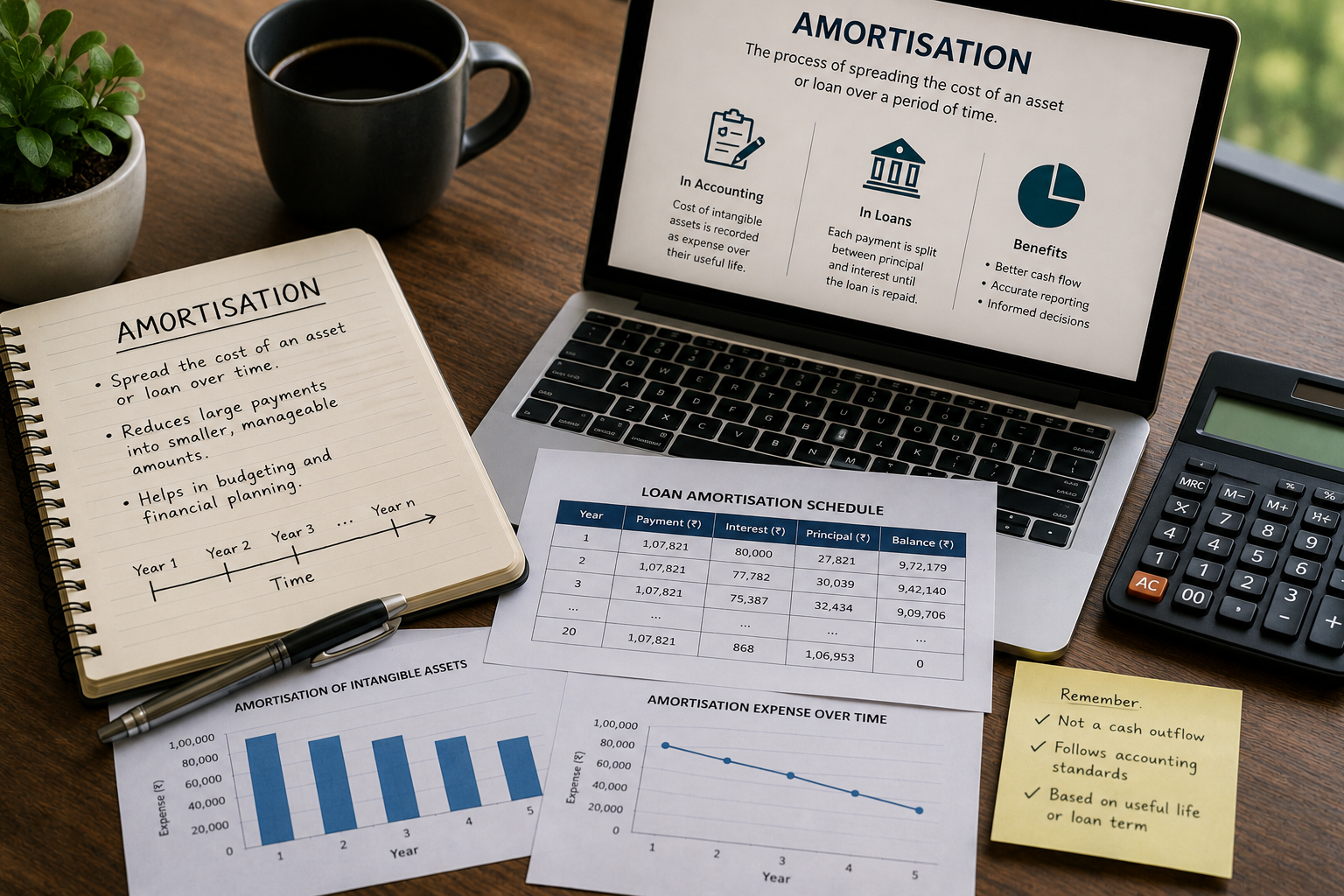
At its simplest, amortisation means distributing a cost or repayment over time. In accounting, it usually refers to spreading the cost of an intangible asset across its useful life. In lending, it refers to paying off a loan through scheduled instalments that gradually reduce principal and interest. The same word is used in both contexts because the underlying logic is similar: a large financial event is broken into smaller, time-linked parts so that its burden can be understood more clearly.
This matters because financial reality is rarely visible from cash movement alone. A company that pays upfront for a valuable asset may not be worse off in that year if the asset will produce benefits for years. A borrower who pays an EMI every month may not realise how much of the early payment goes toward interest rather than principal. Amortisation helps readers see the shape of cost, time and value instead of looking only at the immediate transaction.
What amortisation means in accounting
In accounting, amortisation applies mainly to intangible assets. These are assets that do not have a physical form but can still create economic benefits. Examples include software licences, patents, copyrights, trademarks acquired through purchase, customer relationships, technical know-how and certain contractual rights. If such an asset is expected to benefit the business for several years, accounting does not usually treat the entire cost as one period expense. Instead, the cost is allocated over the useful life of the asset.
Suppose a company purchases a software licence for Rs 50 lakh and expects to use it for five years. If the full cost were charged in the first year, profit for that year would look unusually weak while later years would look artificially strong. Amortisation corrects this mismatch by recognising, for example, Rs 10 lakh each year as an expense if a straight-line approach is appropriate. This does not mean cash leaves the company every year. The cash may have gone out at the beginning. The accounting expense is spread because the benefit is spread.
The deeper principle is matching. Financial statements should try to match expenses with the periods in which related benefits are earned. If an intangible asset supports revenue across multiple years, its cost should also appear across those years. Without amortisation, profitability would become noisy, misleading and vulnerable to timing distortion.
Amortisation and depreciation: similar logic, different assets
Amortisation is often compared with depreciation. The comparison is useful, but the two are not identical. Depreciation usually applies to tangible assets such as buildings, machinery, vehicles, computers and equipment. Amortisation usually applies to intangible assets. Both methods allocate asset cost over time, but the nature of the asset differs.
A machine wears out physically. A truck loses usefulness because of kilometres, age and maintenance. A laptop becomes obsolete as technology changes. Depreciation captures this consumption of tangible assets. An intangible asset, by contrast, may lose value because a legal right expires, software becomes obsolete, a licence period ends, or a customer contract runs out. Amortisation captures this gradual consumption of intangible value.
The distinction matters for analysis. A business rich in physical assets will show depreciation as a regular cost. A software-led or acquisition-led business may show amortisation because much of its economic value lies in rights, code, contracts or purchased intangibles. Investors who ignore amortisation may overestimate the profitability of businesses that depend on such assets.
Useful life: the judgement behind the number
Amortisation depends heavily on the useful life assigned to the asset. Useful life is the period over which the asset is expected to generate economic benefit. This number is not always obvious. A patent may have a legal life, but its commercial life may be shorter if technology changes. Software may be licensed for several years, but it may become outdated earlier. A customer contract may technically run for years, but customer churn may reduce its real value.
Because useful life requires judgement, amortisation is not a purely mechanical calculation. Management must estimate how long the asset will be useful. Auditors must evaluate whether that estimate is reasonable. Investors must remain alert to whether useful lives are being stretched to reduce annual expenses and inflate profits.
For example, if an asset costing Rs 100 crore is amortised over ten years, annual expense is Rs 10 crore. If the same asset is amortised over five years, annual expense becomes Rs 20 crore. Nothing changes in cash terms, but reported profit changes significantly. This is why the assumptions behind amortisation deserve attention.
Loan amortisation: how EMIs quietly work
Outside accounting, amortisation is also used in loans. A loan amortisation schedule shows how each instalment is divided between interest and principal repayment. This is especially important for home loans, vehicle loans, education loans and long-term business loans.
A common borrower mistake is to assume that every EMI reduces the loan equally. In reality, early EMIs in a long loan often contain a large interest component and a smaller principal component. As time passes, the interest component usually falls and the principal component rises, assuming the rate and repayment structure remain stable. The monthly payment may look constant, but its internal composition changes.
This has practical consequences. If a borrower prepays early in the loan tenure, the interest saving may be much larger than a late prepayment, because more principal remains outstanding in the early years. If a borrower checks only the EMI and ignores the amortisation schedule, the true cost of the loan remains hidden. A loan is not just a monthly affordability question; it is a long-term cost structure.
Why amortisation matters for businesses
For businesses, amortisation affects profit, asset values, ratios and management decisions. A company that invests in intangible assets may look less profitable because amortisation charges reduce reported earnings. But this does not automatically mean the business is weak. The key question is whether the intangible asset is genuinely creating revenue, efficiency or competitive advantage.
Amortisation also affects balance sheets. As an intangible asset is amortised, its carrying value declines. This should broadly reflect the reduction in remaining economic benefit. If the asset becomes obsolete faster than expected, the company may need to test for impairment or accelerate recognition of loss. If the asset continues to generate strong value, the amortisation expense may look conservative but still necessary for disciplined reporting.
In acquisition-heavy companies, amortisation can become material. When companies buy businesses, they may recognise identifiable intangible assets such as customer relationships, technology, brands or contracts. These assets can later generate amortisation expenses. Analysts often adjust earnings to study operating performance, but completely ignoring amortisation can be dangerous if acquisitions are a recurring strategy.
Why investors should care
Investors should care about amortisation because it sits at the intersection of accounting judgement and business reality. A company can appear attractive on cash profit while carrying large intangible assets that will be amortised over time. Another company may appear less profitable because it is responsibly recognising the cost of intangible assets that genuinely support long-term growth.
The right question is not whether amortisation is good or bad. The right question is whether the underlying asset is real, useful and fairly valued. If a company spends heavily on software, licences or acquired intangibles, investors should ask what those assets do, how long they will remain useful, and whether the amortisation period is credible.
Amortisation should also be compared with cash flows. If a company reports profit but must constantly spend large sums to replace intangible assets, free cash flow may be weaker than earnings suggest. Conversely, if amortisation is mostly related to a past acquisition and the asset continues to perform well, current cash flow may be stronger than reported profit. The interpretation depends on context.
Common mistakes in understanding amortisation
The first mistake is treating amortisation as fake because it is non-cash in the current period. It may be non-cash today, but it represents a real cost incurred earlier. Ignoring it completely can make profits look better than economic reality.
The second mistake is assuming amortisation always reflects actual value decline precisely. Accounting is an approximation. An asset may lose value faster or slower than the amortisation schedule. This is why impairment reviews and management judgement matter.
The third mistake is confusing loan amortisation with investment return. A borrower may feel richer because outstanding principal is falling, but the loan still carries opportunity cost, interest cost and liquidity implications. Understanding the repayment schedule helps borrowers make better prepayment and refinancing decisions.
Final reader takeaway
Amortisation is the financial language of time. It recognises that costs, assets and repayments often do not belong to one moment alone. In accounting, it spreads the cost of intangible assets across the periods they benefit. In lending, it shows how a loan is gradually repaid through interest and principal components.
For readers, the concept is powerful because it exposes hidden timing. It explains why profit may differ from cash flow, why early EMIs behave differently from later EMIs, why intangible-heavy businesses require careful reading, and why financial statements should be judged beyond surface numbers.
A serious understanding of amortisation makes finance less mysterious. It teaches that money is not only about amount, but also about timing. The same rupee can mean different things depending on when it is spent, when it is recognised, and how long the benefit lasts. That is why amortisation is not merely an accounting word. It is a way of seeing financial life across time.