Albert Einstein: Biography, Discoveries, Relativity, Nobel Prize and the Man Behind the Genius
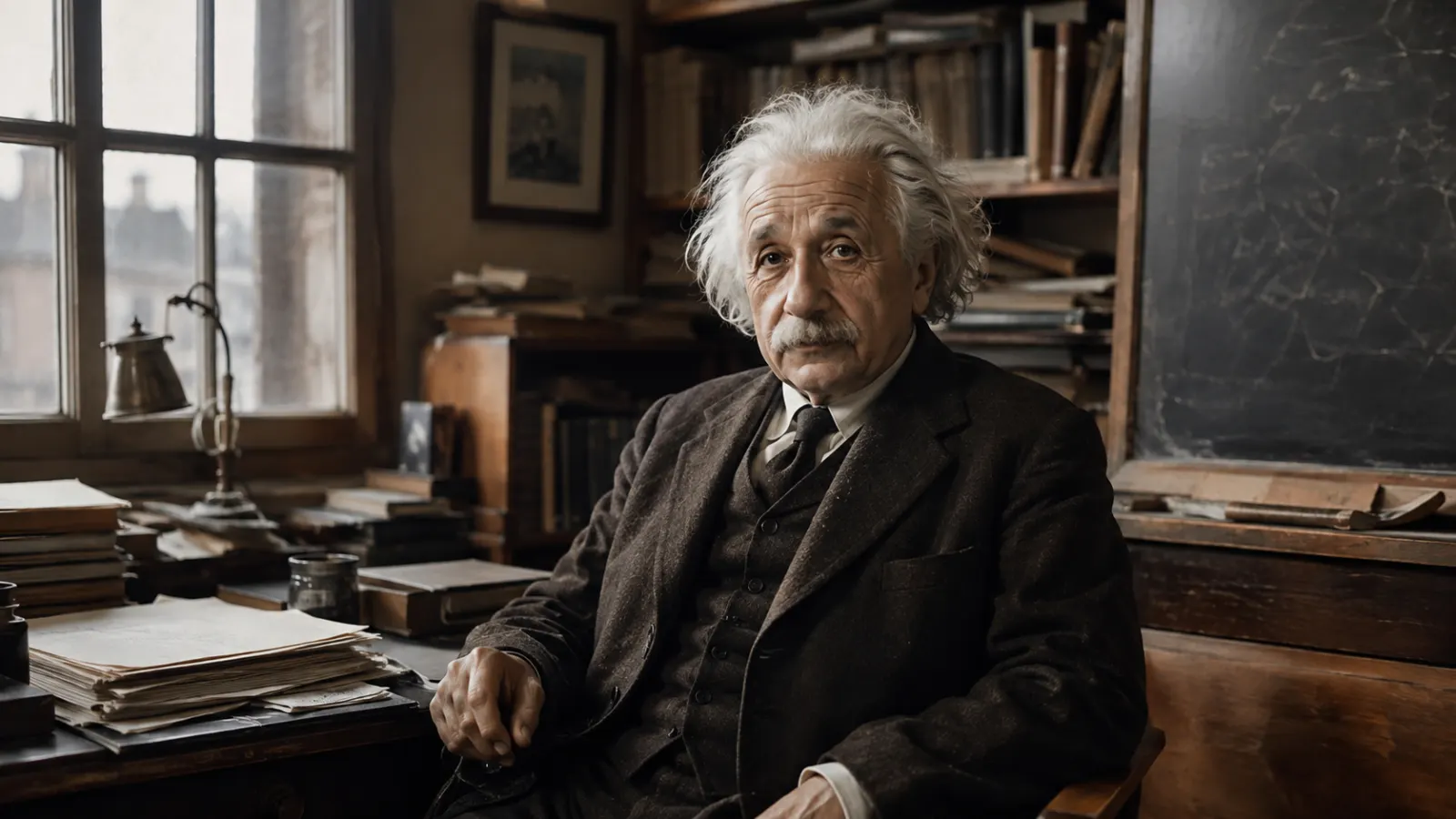
Albert Einstein is difficult to separate from the image of Albert Einstein.
Wild white hair.
A moustache.
A blackboard.
A complicated equation.
The expression:
E = mc².
His name has become a synonym for intelligence.
A gifted student is called “an Einstein.”
Advertisements borrow his face.
Motivational quotations circulate under his name whether he said them or not.
Popular biographies describe a school failure who suddenly overturned physics while working as an obscure patent clerk.
The real Einstein was more complicated—and considerably more interesting.
He was mathematically talented from childhood.
He struggled professionally after university but remained deeply engaged with physics.
In 1905, while working at the Swiss Patent Office, he published a remarkable sequence of papers dealing with:
light,
atoms,
motion,
space and time,
and
mass and energy.
A decade later, he completed general relativity, replacing Newton's description of gravity with a geometrical theory of spacetime.
His Nobel Prize, however, was awarded not specifically for relativity but for his contributions to theoretical physics, especially his discovery of the law of the photoelectric effect. Nobel records identify the award as the 1921 Nobel Prize in Physics, presented to Einstein in 1922.
Then comes the great irony.
Einstein helped create quantum physics.
He later became one of the most sophisticated critics of the idea that quantum mechanics, in its standard probabilistic form, provided a complete description of physical reality.
He contributed to the nuclear age without building an atomic bomb.
He supported internationalist and pacifist causes but eventually warned the United States about the possibility of Nazi Germany developing nuclear weapons.
He became a scientific celebrity yet spent the final decades of his career pursuing a programme of physical unification that never achieved the breakthrough he hoped for.
Einstein therefore deserves neither worship nor deflation.
His scientific achievement remains extraordinary precisely because he was not an infallible magician.
He was a scientist who repeatedly found problems deep enough to force physics to reconsider what its basic concepts actually meant.
Albert Einstein at a Glance
| Question | Short answer |
|---|---|
| Who was Albert Einstein? | A German-born theoretical physicist whose work transformed modern understanding of light, atoms, space, time, gravity and energy. |
| When was Einstein born? | 14 March 1879. |
| Where was Einstein born? | Ulm, in the German Empire. |
| When did Einstein die? | 18 April 1955 in Princeton, New Jersey. |
| Did Einstein fail mathematics? | No. Contemporary and institutional accounts describe him as particularly strong in mathematics. |
| What happened in Einstein's miracle year? | In 1905 he published major papers on light quanta, Brownian motion, special relativity and mass-energy equivalence. |
| What is Einstein most famous for? | Special relativity, general relativity and the mass-energy relationship represented by E = mc². |
| What did Einstein win the Nobel Prize for? | His services to theoretical physics, especially the law of the photoelectric effect. |
| Did Einstein win the Nobel Prize for relativity? | Not in the formal prize citation. |
| What is special relativity? | A theory connecting space, time and motion while preserving the same physical laws and the same vacuum speed of light for inertial observers. |
| What is general relativity? | Einstein's geometric theory of gravitation, in which matter and energy affect spacetime geometry. |
| Did Einstein invent E = mc²? | His 1905 work established the modern mass-energy relationship from special relativity, although the history of mass-energy ideas includes important predecessors. |
| Did Einstein invent the atomic bomb? | No. He did not work on the Manhattan Project. |
| What was Einstein's role in the atomic-bomb story? | He signed the 1939 letter warning President Franklin D. Roosevelt that uranium chain reactions might make extremely powerful weapons possible. |
| Did Einstein reject quantum mechanics? | He accepted its extraordinary predictive success but doubted that its standard formulation was a complete fundamental description of reality. |
| Was Einstein offered the presidency of Israel? | Yes. He was invited to become Israel's second president in 1952 and declined. |
| Where did Einstein spend his final career? | At the Institute for Advanced Study in Princeton. |
Albert Einstein's Early Life
Albert Einstein was born on 14 March 1879 in Ulm.
His parents were Hermann Einstein and Pauline Koch.
The family moved to Munich when Albert was still young.
His father and uncle were involved in electrical engineering businesses, so Einstein grew up during a period in which electricity was moving rapidly from scientific curiosity toward practical technological infrastructure.
His family was Jewish, though his upbringing was not conventionally devout.
What fascinated the young Einstein were problems of order.
One frequently documented formative experience involved geometry.
Einstein later remembered being deeply impressed as a child by the certainty of geometrical proofs.
The American Institute of Physics describes him as an excellent mathematics student who pursued independent reading in mathematics, physics and philosophy.
Did Albert Einstein Fail Mathematics?
No.
This is probably the most persistent false story about his childhood.
The basic narrative goes:
Einstein failed mathematics at school but later became the world's greatest physicist.
It is emotionally appealing because it offers reassurance to struggling students.
It is not good history.
AIP's historical account says Einstein generally received good grades and was outstanding in mathematics.
Einstein did have problems with aspects of formal schooling.
He disliked:
- rote learning;
- authoritarian teaching;
- rigid discipline;
- and the militarised culture he associated with his German school environment.
But disliking school authority is not the same as failing mathematics.
The better lesson from Einstein's education is not:
“Bad maths students can secretly be geniuses.”
It is:
formal educational performance and independent intellectual curiosity are not always the same thing.
Einstein Leaves Germany
When Einstein was a teenager, his family's business difficulties led his parents to move to Italy.
Einstein eventually left his Munich school and joined them.
He later continued his education in Switzerland.
He attended school at Aarau, whose educational culture was considerably more compatible with his preferences than the rigid environment he had disliked in Germany.
In 1896, he enrolled at the Swiss Federal Polytechnic in Zurich, now ETH Zurich.
He trained to become a teacher of mathematics and physics.
Einstein Was Not Always the Perfect University Student
Einstein's later fame can create the impression that he dominated every university class.
He did not.
He was highly capable but intellectually independent.
He sometimes:
- skipped lectures;
- preferred private study;
- read outside the formal curriculum;
- and relied on other students' notes.
AIP describes his graduation record as relatively unexceptional despite the intensity of his independent intellectual interests.
This created a practical problem.
After graduating in 1900, Einstein could not immediately obtain the academic position he wanted.
For roughly two years, he relied on temporary work and tutoring.
Mileva Marić
One of Einstein's fellow students in Zurich was Mileva Marić, a Serbian student of physics and mathematics.
They developed:
- an intellectual relationship;
- a romantic relationship;
- and eventually a marriage.
They married in 1903.
The couple later had sons Hans Albert and Eduard. Correspondence also reveals an earlier daughter, Lieserl, whose later fate is uncertain.
The relationship between Einstein and Marić has become one of the most contested topics in modern popular Einstein biography.
Did Mileva Marić Secretly Create Einstein's Theories?
There is no strong documentary basis for claiming that Marić was the hidden co-author of Einstein's major 1905 papers.
Their surviving correspondence makes clear that they:
- discussed physics;
- shared intellectual interests;
- and were close companions during Einstein's formative period.
Some letters use expressions such as “our work.”
Those expressions have sometimes been expanded into claims that Marić:
- invented relativity;
- performed Einstein's mathematics;
- or should formally be considered co-author of the 1905 papers.
The available historical evidence does not establish those stronger claims.
AIP's historical catalogue summarising modern scholarship describes the secret-coauthor interpretation as unsupported by the evidence reviewed by historians.
That does not require reducing Marić's importance.
She was among the relatively small number of women attempting advanced scientific education in Europe at the time and clearly belonged to Einstein's early intellectual environment.
But historical fairness works in both directions.
We should not erase women from scientific history.
Nor should we solve that problem by assigning undocumented authorship retrospectively.
Einstein's Marriage Was Difficult
Einstein and Marić's marriage deteriorated badly.
They separated in 1914.
They divorced in 1919.
By then Einstein had become romantically involved with his cousin Elsa Löwenthal, whom he married later that year.
AIP's historical material preserves evidence of the strain inside Einstein's first marriage and notes that his expanding scientific career and personal choices placed severe pressure on family life.
This part of Einstein's biography matters because celebrity creates moral simplification.
The friendly, absent-minded public Einstein could also be:
- emotionally distant;
- demanding;
- and difficult in intimate relationships.
Scientific genius does not automatically produce personal wisdom.
The Swiss Patent Office
In 1902, Einstein obtained employment at the Swiss Patent Office in Bern.
The patent-office years have become almost mythical.
The usual story says:
an unknown clerk sat at his desk and transformed physics during his spare time.
There is truth in the contrast.
Einstein did not yet hold an academic physics position.
But describing the patent office as intellectually irrelevant goes too far.
Patent examination required analysing proposed technical systems clearly enough to determine what was genuinely new.
Einstein also maintained a serious intellectual life outside work.
He read physics and philosophy and discussed scientific problems with friends.
The Olympia Academy
Einstein's circle in Bern jokingly called itself the Olympia Academy.
It was not an official institution.
It consisted largely of friends gathering to discuss:
- science;
- philosophy;
- literature;
- epistemology;
- and contemporary intellectual problems.
The group reminds us that formal institutional status does not determine whether intellectual collaboration exists.
Einstein may have lacked a university office.
He did not lack ideas or intellectual companionship.
1905: Einstein's Miracle Year
Then came 1905.
Einstein was 26.
AIP's chronology records an extraordinary sequence of publications submitted to Annalen der Physik during the year.
The four papers most commonly associated with the miracle year concerned:
1. Light quanta and the photoelectric effect
2. Brownian motion and molecular theory
3. Special relativity
4. Mass-energy equivalence
A fifth important piece of work was his doctoral dissertation dealing with molecular dimensions.
The remarkable point is not merely that Einstein published frequently.
Each paper attacked a foundational problem.
Einstein's 1905 Papers at a Glance
| Topic | Basic contribution |
|---|---|
| Light quanta | Proposed that electromagnetic radiation could behave as discrete energy packets |
| Brownian motion | Connected observable particle motion with molecular collisions |
| Special relativity | Reconstructed concepts of space and time for inertial observers |
| Mass-energy equivalence | Established the deep connection between a body's energy and inertia/mass |
| Molecular dimensions | Developed methods related to determining molecular size and Avogadro's number |
AIP describes the four best-known 1905 papers as transforming contemporary understanding of light, atoms, motion and mass-energy.
Einstein and the Photoelectric Effect
By 1905, light was strongly understood through the electromagnetic wave theory associated with James Clerk Maxwell.
Wave theory was extraordinarily successful.
But some phenomena did not fit comfortably into the existing classical picture.
One was the photoelectric effect.
When sufficiently energetic light strikes certain materials, electrons can be emitted.
The details of this process did not behave the way a simple classical-wave treatment suggested.
Light Quanta
Einstein proposed something radical.
Light could behave as though its energy were concentrated into discrete packets.
AIP explains that Einstein went significantly beyond Max Planck's earlier use of quantised energy in black-body radiation by treating radiation itself as possessing a particulate or quantum character in relevant circumstances.
These packets later came to be called:
photons.
Einstein's idea helped explain why the energy transferred to electrons depended crucially on the frequency of the incident light rather than simply the total intensity.
This was a foundational step toward quantum physics.
Einstein's Nobel Prize Was Not Formally for Relativity
This surprises many readers.
The Nobel Prize in Physics for 1921 was awarded to Einstein:
“for his services to Theoretical Physics, and especially for his discovery of the law of the photoelectric effect.”
Einstein actually received the prize in 1922, because the 1921 award had been reserved and announced the following year.
So the sentence:
“Einstein won the Nobel Prize for relativity”
is inaccurate if presented as the Nobel Committee's formal reason.
Relativity obviously contributed enormously to his scientific stature.
But the prize citation singled out the photoelectric effect.
Brownian Motion and the Reality of Atoms
Atoms are so basic to modern science that it is difficult to imagine serious scientists doubting whether they physically existed.
Around the beginning of the twentieth century, however, atomic theory still had influential critics.
Einstein's Brownian-motion paper helped change that debate.
Brownian motion refers to the irregular movement of microscopic particles suspended in a fluid.
Einstein showed how this visible motion could arise from innumerable collisions with invisible molecules.
AIP describes the paper as turning Brownian motion into a quantitative test of molecular theory.
Einstein Did Not Single-Handedly “Prove Atoms Exist”
That phrase is too simple.
Einstein provided theoretical relationships that could be tested experimentally.
Work by experimental scientists—notably Jean Perrin—then helped confirm predictions associated with molecular theory.
The important story is therefore:
theory → measurable prediction → experiment → stronger evidence for atoms.
This is how science usually works.
The theorist and experimenter are part of the same evidential chain.
Special Relativity
Einstein's most famous 1905 paper was:
On the Electrodynamics of Moving Bodies.
It introduced what later became known as the special theory of relativity.
The theory emerged from deep tensions between:
- Newtonian mechanics;
- electromagnetism;
- the behaviour of light;
- and the meaning of simultaneity.
Einstein began from two powerful principles.
The Two Principles of Special Relativity
In simplified form:
1. Principle of relativity
The laws of physics take the same form in all inertial frames.
2. Constancy of the speed of light
The speed of light in vacuum is the same for inertial observers regardless of the motion of the emitting source.
AIP explains how Einstein used these principles to reconcile electromagnetism with the principle of relativity by reconsidering the concepts of space and time themselves.
Relativity Does Not Mean “Everything Is Relative”
This is one of the most common misunderstandings.
Einstein's theory did not say:
truth is subjective
or
everything depends entirely on perspective.
In fact, the theory identifies physical quantities and structures that remain invariant while other measurements depend on the observer's state of motion.
The same laws of physics apply to all inertial observers.
The speed of light remains invariant.
What changes between observers can include measurements of:
- time intervals;
- lengths;
- and simultaneity.
The Relativity of Simultaneity
This is one of the deepest conceptual changes Einstein introduced.
Suppose two events occur at different locations.
An observer moving one way may judge them simultaneous.
Another observer moving relative to the first may not.
There is no universal cosmic clock assigning one absolute simultaneity to every spatially separated event.
This is not an optical illusion.
It is built into the structure of special relativity.
Time itself had to be rethought.
Time Dilation
Special relativity predicts that clocks moving relative to an observer can accumulate different amounts of elapsed time.
This is time dilation.
It is not merely a philosophical idea.
Relativistic time effects must be taken into account in high-precision technologies and experiments.
The theory therefore transformed time from something assumed to be universally identical into something connected to motion and spacetime structure.
Length Contraction
Likewise, lengths measured along the direction of relative motion differ between frames according to relativistic transformations.
This does not mean objects merely “look shorter” because of visual perspective.
It concerns how spatial intervals are physically measured between observers in different inertial frames.
Einstein Did Not Create Relativity From Nothing
Einstein's achievement was extraordinary.
It also belonged to an existing scientific conversation.
Important predecessors and contemporaries included:
James Clerk Maxwell
Hendrik Lorentz
Henri Poincaré
and others.
Lorentz transformations already played a major role in electromagnetic theory.
Einstein's distinctive contribution was to reconstruct the conceptual basis of the problem so that the transformations expressed a new structure of space and time rather than merely mathematical adjustments inside an ether theory.
AIP's historical treatment emphasises that scientific theories emerge from networks of existing problems and concepts rather than appearing without predecessors.
E = mc²
Later in 1905, Einstein published another short paper concerning the relationship between a body's energy and inertia.
The result eventually became represented in its famous form:
E = mc²
where:
E = energy
m = mass
c = speed of light
The equation tells us that mass and energy are deeply connected.
AIP's 1905 chronology records the mass-energy paper as being received in September 1905.
What E = mc² Actually Means
The equation is often interpreted as:
“matter can be turned into energy.”
That captures part of the idea but can be misleadingly narrow.
The deeper point is that mass contributes to the energy content of a physical system.
The factor c² is enormous.
Therefore a relatively small change in mass can correspond to a large amount of energy.
This became dramatically important in nuclear physics.
But:
E = mc² is not an atomic-bomb blueprint.
Einstein Did Not Invent the Atomic Bomb
Einstein was not:
- a Manhattan Project scientist;
- a nuclear-weapons engineer;
- or the designer of the bombs used in 1945.
His equation became symbolically associated with the nuclear age because mass-energy conversion is relevant to nuclear processes.
But building a nuclear weapon required enormous developments in:
- nuclear physics;
- chain reactions;
- uranium and plutonium production;
- neutron physics;
- explosives;
- engineering;
- and industrial infrastructure.
Einstein did not perform that work.
From Special Relativity to Gravity
Special relativity applies naturally to inertial frames—observers not undergoing acceleration.
Gravity created a much harder problem.
Einstein spent years trying to develop a theory capable of incorporating gravitation.
One of his most powerful ideas became the equivalence principle.
The Equivalence Principle
Imagine being inside a sealed elevator.
Under some circumstances, the physical effects of:
acceleration
and
gravity
can be locally difficult to distinguish.
This observation led Einstein toward a radically different account of gravity.
Rather than treating gravity simply as an ordinary force acting across fixed space, general relativity describes gravitation through the geometry of spacetime.
Marcel Grossmann and the Mathematics of General Relativity
Einstein did not perform every stage alone.
His friend and former classmate Marcel Grossmann, a mathematician, played an important role in helping Einstein engage with advanced mathematical tools—particularly tensor mathematics and differential geometry—needed for the developing theory.
This is another reason the “solitary genius” model misleads.
Einstein's conceptual insight was extraordinary.
Turning it into general relativity also required mathematical resources developed by generations of mathematicians.
General Relativity
In 1915, Einstein arrived at the field equations associated with his general theory of relativity.
AIP's historical chronology records his presentation of the gravitational field equations in 1915 and the broader exposition of the theory in 1916.
The conceptual shift was enormous.
Matter and energy influence spacetime geometry.
That geometry influences the motion of matter and light.
Gravity as Geometry
Popular explanations often say:
“Mass bends spacetime.”
That is useful as a first approximation.
But general relativity is more precise than a rubber-sheet analogy.
The gravitational field is represented through the geometry of four-dimensional spacetime.
Objects moving freely follow paths determined by that geometry.
What appears in Newtonian physics as a gravitational force can therefore emerge as motion through curved spacetime.
Did Einstein Prove Newton Wrong?
Not in the simplistic sense.
Newtonian gravity remains extraordinarily accurate within a large domain.
For:
- ordinary engineering;
- many planetary calculations;
- moderate gravitational fields;
- everyday velocities
Newton's equations work extremely well.
General relativity becomes essential where:
- gravitational fields are strong;
- precision is extremely high;
- light interacts with gravity;
- or spacetime effects become significant.
Einstein did not make Newtonian physics useless.
He showed where it is an approximation to a deeper theory.
Mercury's Orbit
One of general relativity's early successes concerned Mercury.
Astronomers had long known that Mercury's orbit exhibited a small residual precession that could not be completely explained through Newtonian gravitational calculations using known planetary influences.
General relativity accounted for the anomalous portion.
This was an especially important result for Einstein because the theory explained an already known astronomical discrepancy rather than merely predicting an entirely new phenomenon.
Gravity Bends Light
General relativity also predicted that light passing near a massive body would be deflected.
A total solar eclipse offered a possible test.
When the Moon blocked the Sun, astronomers could photograph stars appearing close to the Sun's position and compare their apparent locations with measurements taken when the Sun was elsewhere.
In 1919, British expeditions collected observations interpreted as supporting Einstein's predicted gravitational deflection of light.
The 1919 Eclipse Did Not Settle Everything as Cleanly as Newspapers Claimed
This is an important historical qualification.
The eclipse measurements were made near the limits of available techniques.
AIP notes that the early eclipse experiments were not as overwhelmingly precise as their cultural reputation later suggested, and much better observations accumulated over subsequent decades.
So the headline version:
“One eclipse proved Einstein correct and Newton wrong overnight.”
is misleading.
But the 1919 result still mattered enormously.
It provided striking evidence for a prediction associated with general relativity.
And it transformed Einstein's public life.
Einstein Becomes a Global Celebrity
News of the eclipse results spread rapidly.
Relativity became an international media sensation.
AIP describes how Einstein became a public symbol of the new physics and of intellectual genius more broadly.
The timing mattered.
The First World War had just ended.
Einstein was German-born.
The eclipse observations had been organised by British scientists.
The story could therefore be portrayed as international science transcending recent national conflict.
Newspapers amplified the drama.
Einstein's face became famous.
Celebrity Changed Einstein's Life
From this point forward, Einstein was no longer merely a theoretical physicist.
He became:
- a public intellectual;
- a political symbol;
- a media personality;
- a fundraising asset;
- and eventually one of the world's most recognisable people.
Journalists asked him about subjects far beyond physics.
His name gave statements authority.
That helped create a problem that continues today:
fake Einstein quotations.
Be Suspicious of Perfect Einstein Quotes
Einstein is one of history's most misquoted people.
If a sentence sounds:
- inspirational;
- concise;
- perfectly suited to social media;
- and conveniently attributed to Einstein,
it deserves verification.
AIP itself warns readers that many internet quotations attributed to Einstein are not genuine.
This is a useful editorial rule:
fame attracts invented quotations.
Attribution should be checked against:
- letters;
- published works;
- speeches;
- interviews;
- or reliable quotation scholarship.
Einstein and Quantum Physics
Popular history sometimes presents Einstein as:
the relativity scientist who rejected quantum mechanics.
This badly understates his contribution.
Einstein was one of the founders of quantum theory.
His light-quantum paper was radical.
He later made additional quantum contributions involving:
- specific heat;
- radiation;
- stimulated emission;
- and quantum statistics.
The Nobel Prize itself recognised his photoelectric work.
Einstein's later disagreement was therefore not an outsider attacking a theory he failed to understand.
He was one of the people who helped create the problem.
Stimulated Emission
Einstein's work on radiation included the concept of stimulated emission.
That idea later became foundational to laser physics.
AIP's chronology records Einstein's 1916–17 work on quantum theory of radiation and stimulated emission.
Einstein obviously did not invent the modern laser.
But theoretical concepts from his radiation work became part of the physical foundation on which laser technology was later built.
Satyendra Nath Bose and Bose-Einstein Statistics
In the 1920s, Indian physicist Satyendra Nath Bose developed a new statistical treatment of light quanta.
Einstein recognised the significance of Bose's work and extended related statistical reasoning to material particles.
The resulting framework became known as:
Bose-Einstein statistics.
Much later, the term:
Bose-Einstein condensate
would describe a remarkable state of matter associated with particles obeying these statistics.
The episode is another strong correction to the solitary-genius story.
Modern physics grew through international intellectual exchange.
Einstein vs Niels Bohr
As quantum mechanics developed during the 1920s, Einstein became increasingly dissatisfied with interpretations that treated fundamental events probabilistically.
His debates with Niels Bohr became legendary.
But the disagreement is commonly misrepresented.
Einstein did not simply say:
“Quantum mechanics is false.”
By the 1930s, he acknowledged its enormous predictive success.
His objection was deeper.
Was quantum mechanics the complete underlying description of reality?
AIP notes that Einstein recognised quantum mechanics as an extraordinarily successful physical theory while continuing to believe that a deeper description might exist.
“God Does Not Play Dice”
Einstein's famous objection to fundamental randomness is often compressed into the phrase:
“God does not play dice.”
The sentiment reflects his discomfort with treating probability as the final fundamental description of individual physical events.
But it should not be interpreted as:
Einstein rejected quantum experiments.
He did not.
His concern was philosophical and theoretical:
Was quantum probability fundamental, or did it reflect an incomplete description?
Einstein, Podolsky and Rosen
In 1935, Einstein, Boris Podolsky and Nathan Rosen published the famous EPR paper.
They argued that quantum mechanics appeared incomplete if certain intuitively powerful assumptions about:
- locality;
- physical reality;
- and measurement
were maintained.
The thought experiment helped sharpen what later became one of the deepest questions in physics.
Einstein's Quantum Objections Became Productively Wrong
Later work—particularly associated with physicist John Bell—showed that questions raised by Einstein could be reformulated into experimentally testable inequalities.
Experiments have strongly challenged the kind of local hidden-variable picture Einstein hoped might underlie quantum mechanics.
That does not make the EPR argument historically useless.
Almost the opposite.
Einstein's resistance helped clarify the exact conceptual strangeness of quantum theory.
A scientist can be wrong about the preferred answer while asking an extraordinarily productive question.
Einstein the Cosmologist
General relativity did not merely describe planets and stars.
Its equations could be applied to the universe as a whole.
In 1917, Einstein constructed a cosmological model.
At the time, a static universe seemed plausible to many physicists.
But Einstein's equations did not naturally yield the stable static universe he wanted.
So he introduced an additional term.
The Cosmological Constant
This term became known as the cosmological constant.
Einstein used it to support a static cosmological model.
Later theoretical and observational developments established expanding-universe models.
AIP notes that Einstein became uncomfortable with the artificial role the constant had played in his original static model.
Was the Cosmological Constant Einstein's “Greatest Blunder”?
The phrase is famous.
Its documentary history is less secure than popular retellings imply.
The “biggest blunder” attribution is strongly associated with physicist George Gamow's later recollection rather than a straightforward surviving Einstein document using the famous phrase in the familiar way. AIP specifically attributes the remark through Gamow.
Editors should therefore avoid presenting:
“Einstein said the cosmological constant was the greatest blunder of his life”
as an uncomplicated direct quotation.
The Cosmological Constant Came Back
Late-twentieth-century observations indicated that cosmic expansion is accelerating.
Modern cosmological models therefore again include a cosmological-constant-like component associated with dark energy.
This does not mean:
Einstein predicted dark energy correctly in 1917.
His original purpose was to create a static model.
It does mean that a mathematical term introduced for one reason later acquired a new physical relevance in a dramatically different context.
Science has a long memory.
Nazi Germany Changes Einstein's Life
Einstein was:
- Jewish;
- internationally famous;
- publicly political;
- and strongly identified with liberal and internationalist causes.
This made him a prominent target as Nazism rose in Germany.
In 1933, Hitler's regime took power.
Einstein was outside Germany at the time.
He did not return to live there.
He eventually settled permanently in the United States.
The Institute for Advanced Study records that Einstein joined the Princeton institution in 1933 after deciding he could no longer live under the Nazi government.
Einstein at Princeton
Einstein joined the Institute for Advanced Study in Princeton, New Jersey.
Unlike a conventional university teaching position, the Institute allowed scholars to pursue research with substantial intellectual freedom.
Einstein remained associated with Princeton for the rest of his life.
His move belonged to a much larger historical migration.
Nazism and antisemitic persecution drove enormous numbers of:
- physicists;
- mathematicians;
- doctors;
- philosophers;
- writers;
- artists;
- and other intellectuals
out of continental Europe.
The consequences reshaped research in the United States and elsewhere.
Einstein and Pacifism
Einstein had long been associated with:
- pacifism;
- international cooperation;
- opposition to militarism;
- and political liberalism.
The rise of Hitler complicated his position.
Strict pacifism became difficult to maintain when facing an expansionist dictatorship using racial persecution and military force.
IAS describes Einstein as turning away from strict pacifism and warning political leaders about the Nazi threat.
This is another example of Einstein changing his position when historical circumstances changed.
The 1939 Letter to Franklin D. Roosevelt
In 1938–39, nuclear fission created the possibility that a uranium chain reaction could release enormous energy.
Physicists including Leo Szilard feared that Nazi Germany might develop a nuclear weapon.
Szilard and colleagues approached Einstein because his scientific reputation could give a warning political weight.
Einstein signed a letter addressed to U.S. President Franklin D. Roosevelt.
The Library of Congress documents how Szilard, Einstein and others developed the warning concerning uranium chain reactions and the potential for extremely powerful weapons.
Did Einstein Tell Roosevelt to Build the Atomic Bomb?
The history deserves more precision.
The letter warned that recent nuclear physics might make extremely powerful bombs possible and drew attention to German access to uranium.
It encouraged U.S. government attention to uranium research.
The eventual Manhattan Project emerged through a much larger chain of:
- scientific developments;
- government decisions;
- military planning;
- and wartime escalation.
Einstein's signature mattered.
But:
Einstein did not run the Manhattan Project.
Einstein Was Not Part of the Manhattan Project
Einstein was not a Los Alamos bomb scientist.
He did not design:
- Little Boy;
- Fat Man;
- plutonium implosion systems;
- or uranium-enrichment infrastructure.
Other scientists—including:
- J. Robert Oppenheimer;
- Enrico Fermi;
- Leo Szilard;
- Edward Teller;
- Hans Bethe;
- and many thousands of others
played direct roles in wartime nuclear work.
Einstein's role was political and symbolic rather than technical bomb development.
Einstein After Hiroshima and Nagasaki
Following the atomic bombings of Japan, Einstein became strongly associated with efforts to prevent nuclear catastrophe.
IAS archival material records his postwar concern with:
- nuclear weapons;
- international control;
- and proposals for supranational government.
He increasingly used his fame to argue that the existence of nuclear weapons created a political problem that could not be solved by scientific progress alone.
Science could release nuclear energy.
It could not decide how human societies should govern that power.
Einstein and Zionism
Einstein supported Jewish cultural and educational causes.
He was especially associated with the development of the Hebrew University of Jerusalem.
But his relationship with Zionism was more complex than a simple modern political label.
He supported Jewish communal and cultural development while also expressing concern about:
- nationalism;
- coexistence;
- and relations between Jewish and Arab communities.
His political views evolved and do not map neatly onto every later ideological category.
Was Einstein Offered the Presidency of Israel?
Yes.
In 1952, after the death of Israel's first president, Chaim Weizmann, Einstein was invited to become the country's second president.
He declined.
The Institute for Advanced Study includes the offer in its biographical chronology.
This is one of the strangest consequences of Einstein's celebrity.
A theoretical physicist had acquired such symbolic international prestige that he was considered for a head-of-state role.
Einstein's Search for a Unified Field Theory
Einstein spent a major part of his later scientific life trying to find a deeper mathematical unification.
He hoped to bring together:
gravitation
and
electromagnetism
within one coherent field framework.
The effort did not succeed in the form he pursued.
AIP's historical exhibit records Einstein's decades-long work on unified field theories and notes that these programmes never achieved the empirically successful unification he sought.
Were Einstein's Final Decades a Scientific Failure?
That judgement is too simple.
Einstein did not produce another revolution comparable to 1905 or general relativity.
His preferred route toward unification did not become mainstream twentieth-century particle physics.
But the underlying problem never disappeared.
Modern physics still seeks a satisfactory reconciliation among:
- general relativity;
- quantum mechanics;
- and fundamental interactions.
A successful theory of quantum gravity remains one of physics' deepest unresolved goals.
Einstein did not solve the problem.
He was not wrong to think unification mattered.
Einstein Was Not a Lone Genius
Einstein's public image often encourages the most misleading possible model of science:
one brilliant man thinks alone and rewrites reality.
Einstein's originality was real.
His dependence on a scientific community was equally real.
His work existed within intellectual traditions shaped by:
- Maxwell;
- Lorentz;
- Planck;
- Boltzmann;
- Mach;
- Poincaré;
- Riemann;
- Minkowski;
- Grossmann;
- Bose;
- Bohr;
- and many others.
Experiments came from still more people.
General relativity required advanced mathematics Einstein had not invented.
The 1919 test required astronomical expeditions.
Brownian-motion evidence required experimental confirmation.
Scientific revolution is individual and collective at the same time.
Hermann Minkowski and Spacetime
One particularly important later development came from Einstein's former mathematics teacher Hermann Minkowski.
Minkowski reformulated special relativity using a unified four-dimensional geometry of:
space + time.
The concept of spacetime became fundamental to relativity.
Einstein did not initially embrace every aspect of Minkowski's mathematical treatment enthusiastically.
But geometrical spacetime later became indispensable to general relativity.
Even revolutionary theories continue evolving after their initial publication.
Common Myths About Albert Einstein
Myth 1: Einstein failed mathematics
False.
He was particularly strong in mathematics from a young age.
Myth 2: Einstein was a terrible student
Misleading.
He disliked rigid educational systems and had an unexceptional university record in some respects, but he was intellectually advanced and pursued substantial independent study.
Myth 3: Einstein created relativity completely alone
False.
His originality was exceptional, but relativity developed from problems and mathematics shaped by many predecessors and contemporaries.
Myth 4: Einstein won the Nobel Prize for relativity
The formal Nobel citation emphasised his services to theoretical physics and especially the law of the photoelectric effect.
Myth 5: E = mc² is the formula for an atomic bomb
False.
It expresses a fundamental mass-energy relationship, not a weapons design.
Myth 6: Einstein invented the atomic bomb
False.
He did not work on the Manhattan Project.
Myth 7: Einstein rejected quantum mechanics because he did not understand it
False.
He was one of quantum theory's founders and understood its foundations extraordinarily well. His disagreement concerned completeness and interpretation.
Myth 8: Mileva Marić secretly wrote Einstein's major papers
The surviving evidence does not establish her as an uncredited co-author of the 1905 papers.
Myth 9: The 1919 eclipse perfectly proved general relativity
Too strong.
The early measurements supported Einstein's prediction but had substantial observational limitations; later evidence became much stronger.
Myth 10: Einstein spent his entire later career doing nothing important
False.
Although his unified-field programme did not succeed, he remained deeply engaged with quantum foundations, cosmology, unification and political questions.
Myth 11: Einstein believed “everything is relative”
False.
Special relativity actually identifies invariant laws and quantities while explaining how some measurements depend on reference frame.
Myth 12: Every inspirational Einstein quote online is genuine
Definitely false.
Even AIP warns that many circulating quotations are incorrectly attributed.
Albert Einstein Timeline
| Year | Event |
|---|---|
| 1879 | Born on 14 March in Ulm |
| 1880 | Family moves to Munich |
| 1895 | Studies in Aarau, Switzerland |
| 1896 | Enters Swiss Federal Polytechnic in Zurich |
| 1900 | Graduates |
| 1902 | Begins work at Swiss Patent Office |
| 1903 | Marries Mileva Marić |
| 1905 | Miracle year: light quanta, Brownian motion, special relativity and mass-energy papers |
| 1909 | Leaves patent office era and moves fully into academic physics |
| 1914 | Moves to Berlin |
| 1915 | Completes gravitational field equations of general relativity |
| 1916 | Major general-relativity exposition published |
| 1917 | Introduces cosmological term in cosmology; major radiation work |
| 1919 | Eclipse observations support gravitational light bending; Einstein becomes world-famous |
| 1919 | Divorces Mileva and marries Elsa |
| 1921 | Nobel Prize in Physics officially associated with this year |
| 1922 | Receives Nobel Prize |
| 1924–25 | Extends Bose's work into Bose-Einstein statistics |
| 1927 | Famous quantum debates intensify at Solvay Conference |
| 1933 | Leaves Germany permanently after Nazi rise; settles at Institute for Advanced Study |
| 1935 | Einstein-Podolsky-Rosen paper published |
| 1939 | Signs letter to President Roosevelt warning about possible nuclear weapons |
| 1940 | Becomes U.S. citizen |
| 1952 | Offered presidency of Israel; declines |
| 1955 | Dies in Princeton on 18 April |
AIP's detailed chronology supports the major scientific and biographical dates across this sequence.
Frequently Asked Questions
Who was Albert Einstein?
Albert Einstein was a theoretical physicist whose work transformed modern understandings of light, matter, space, time, gravity and energy.
When was Albert Einstein born?
Einstein was born on 14 March 1879 in Ulm, Germany.
When did Albert Einstein die?
He died on 18 April 1955 in Princeton, New Jersey.
Did Albert Einstein fail maths?
No. Reliable biographical accounts describe him as particularly strong in mathematics.
Where did Einstein study?
He studied at the Swiss Federal Polytechnic in Zurich, now ETH Zurich.
Where did Einstein work in 1905?
He was employed at the Swiss Patent Office in Bern.
Why is 1905 called Einstein's miracle year?
Because he published major papers on:
- light quanta;
- Brownian motion;
- special relativity;
- and mass-energy equivalence.
AIP documents the sequence of submissions throughout 1905.
What did Einstein discover?
His major achievements include foundational contributions to:
- quantum theory;
- Brownian motion;
- special relativity;
- mass-energy equivalence;
- general relativity;
- radiation theory;
- Bose-Einstein statistics;
- and modern cosmology.
What is Einstein most famous for?
He is most famous publicly for:
E = mc²
and
relativity.
Scientifically, his contributions extend far beyond those two items.
What does E = mc² mean?
It expresses the deep relationship between mass and energy, with the speed of light squared acting as the conversion factor in the familiar rest-energy relation.
Did Einstein invent E = mc²?
Einstein's 1905 relativity work established the modern mass-energy relationship associated with the famous equation, although the wider historical development of mass and electromagnetic energy involved earlier physicists.
What is special relativity?
Special relativity describes physics in inertial frames and radically revises the relationship among space, time and motion while preserving the same vacuum speed of light.
What is general relativity?
General relativity is Einstein's theory of gravitation, describing gravity through the geometry of spacetime.
What is the difference between special and general relativity?
Special relativity focuses on inertial motion without a complete treatment of gravity.
General relativity incorporates gravitation and accelerated frames through spacetime geometry.
What did Einstein win the Nobel Prize for?
The Nobel citation recognised his services to theoretical physics, especially the law of the photoelectric effect.
When did Einstein win the Nobel Prize?
The award is the 1921 Nobel Prize in Physics, but it was presented in 1922.
What did Einstein contribute to quantum physics?
He made major contributions involving:
- light quanta;
- the photoelectric effect;
- radiation;
- stimulated emission;
- quantum statistics;
- and foundational debates.
Why did Einstein disagree with quantum mechanics?
He accepted its predictive success but believed its standard probabilistic description might not represent the complete underlying physical reality.
What did Einstein mean by “God does not play dice”?
The expression reflects his resistance to treating fundamental physical randomness as the final description of nature, rather than a rejection of all quantum phenomena.
Did Einstein invent the atomic bomb?
No.
Was Einstein part of the Manhattan Project?
No.
What was Einstein's connection to the atomic bomb?
He signed the 1939 letter warning President Roosevelt that developments in nuclear fission might make extremely powerful weapons possible.
Who actually wrote the Einstein-Roosevelt letter?
The warning emerged through the work of Leo Szilard and collaborating physicists, with Einstein's participation and signature giving it extraordinary political weight. The Library of Congress documents their role in developing the letter.
Did Einstein regret the Roosevelt letter?
Later accounts record his regret in light of the subsequent atomic-bomb programme and his strong postwar advocacy for nuclear control, although his original decision was motivated by fear that Nazi Germany might obtain such a weapon first.
Why did Einstein leave Germany?
The Nazi rise to power in 1933 made Germany unsafe and politically unacceptable for Einstein, who was Jewish and publicly opposed to militarism and authoritarianism. He settled in the United States.
Where did Einstein live in America?
He lived in Princeton, New Jersey, and worked at the Institute for Advanced Study.
Was Albert Einstein Jewish?
Yes. His Jewish background and identity became especially important politically as antisemitism intensified in Europe and he became involved with Jewish educational and humanitarian causes.
Was Einstein offered the presidency of Israel?
Yes. He was asked to become Israel's second president in 1952 and declined.
Who was Einstein's first wife?
Mileva Marić.
Did Mileva Marić help Einstein with relativity?
Their correspondence shows a shared intellectual relationship and discussion of physics, but the available documentary evidence does not establish Marić as an uncredited co-author of Einstein's major papers.
Who was Einstein's second wife?
Elsa Einstein, his cousin.
What was Einstein's cosmological constant?
It was an additional term Einstein introduced into his gravitational equations while constructing a static cosmological model.
Did Einstein call the cosmological constant his greatest mistake?
The famous “biggest blunder” wording comes chiefly through George Gamow's later attribution and should not be treated as an uncomplicated verified direct quotation.
Was Einstein wrong about quantum mechanics?
Experiments have not supported the type of local-realist completion Einstein preferred, but his objections generated important theoretical questions and helped drive foundational research.
What was Einstein's unified field theory?
It was his long-running attempt to develop a deeper field framework unifying gravitation with electromagnetism. He never produced the successful theory he wanted.
Why is Albert Einstein considered a genius?
Not because he knew every answer.
His distinction came from repeatedly identifying foundational assumptions—about:
- light;
- atoms;
- time;
- simultaneity;
- inertia;
- gravity;
- and physical reality
that could be reformulated at a deeper level.
Why Einstein's 1905 Achievement Was So Unusual
Scientists frequently spend careers transforming one specialised field.
Einstein's 1905 work touched several different foundations almost simultaneously.
The light-quantum paper challenged the classical treatment of radiation.
The Brownian-motion paper strengthened atomic theory.
Special relativity changed space and time.
Mass-energy equivalence changed the relationship between matter and energy.
AIP's miracle-year chronology makes clear how rapidly these papers appeared within a single year.
That concentration of foundational work is one reason 1905 remains so extraordinary.
But Einstein Was Not Finished in 1905
The popular biography can accidentally make the patent-office year seem like the complete Einstein story.
In reality, general relativity was arguably an even more difficult intellectual achievement.
Einstein spent years struggling with:
- acceleration;
- gravitation;
- geometry;
- coordinates;
- mathematical formalism;
- and physical interpretation.
His eventual gravitational theory did not simply extend special relativity.
It required a much deeper reconstruction of what gravity meant.
The period from special relativity to the 1915 field equations shows a scientist working through years of uncertainty rather than experiencing one miraculous revelation.
Einstein's Fame Can Hide Einstein's Method
Einstein is commonly associated with thought experiments.
Imagine:
riding beside a beam of light;
standing inside an accelerating elevator;
comparing clocks carried by moving observers.
These imagined situations allowed him to isolate conceptual contradictions.
But thought experiments did not mean:
Einstein ignored experimental evidence.
His physics was deeply connected to:
- electromagnetism;
- thermodynamics;
- radiation experiments;
- spectroscopy;
- Brownian motion;
- astronomical observations;
- and experimental constraints on physical theories.
The distinction is important.
A thought experiment is not an alternative to empirical science.
It can be a tool for discovering what an empirical theory logically implies.
Einstein's Greatest Strength May Have Been Asking Better Questions
Consider some of the questions underlying his work.
Instead of asking only:
How does light move through the ether?
Einstein eventually challenged whether the ether was needed in the first place.
Instead of asking:
How can Newtonian gravity be adjusted to relativity?
he reconsidered gravity through spacetime geometry.
Instead of accepting:
time is universal,
he asked how distant observers actually define simultaneous events.
Instead of accepting quantum success as the final word, he asked:
What does the theory claim exists when nobody measures it?
These are conceptual questions.
They become physical questions because the answers change predictions and theories.
The Myth of the Flawless Genius Makes Einstein Less Interesting
If Einstein is treated as somebody who was always right, several important parts of his life have to disappear.
His preferred interpretation of quantum foundations was not vindicated in the form he hoped.
His static cosmological model failed.
His unified field programme never succeeded.
Some of his political expectations changed.
His personal relationships could be painful.
He sometimes resisted developments younger physicists considered essential.
Those limitations do not reduce the scientific revolutions he achieved.
They reveal what actual intellectual greatness looks like.
Great scientists are capable of being wrong.
What distinguishes them is not permanent correctness.
It can be the ability to make even disagreement intellectually productive.
Why Albert Einstein Still Matters
Einstein died on 18 April 1955.
Yet enormous parts of modern science continue to live inside questions he transformed.
Relativity is essential to modern gravitational physics.
General-relativistic corrections matter in technologies requiring sufficiently precise timing and positioning.
Gravitational lenses allow astronomers to study distant objects.
Black-hole physics depends on general relativity.
Modern cosmology begins from Einstein's gravitational equations.
Photons belong to quantum theory.
Stimulated emission underlies lasers.
Bose-Einstein statistics has become fundamental to quantum physics.
EPR-type questions lie close to the foundations of quantum information science.
The scientific legacy is therefore far broader than:
E = mc².
The Central Idea
Albert Einstein did not become historically important because he was born knowing more physics than everybody else.
He inherited a science already experiencing profound tension.
Maxwell's electromagnetic theory had transformed light.
Thermodynamics and statistical physics were challenging old ideas about matter.
Experiments were producing puzzles.
Planck had introduced energy quanta.
Lorentz had developed crucial mathematics.
Newtonian physics remained enormously successful but could not simply absorb every new result without conceptual difficulty.
Einstein entered this landscape and repeatedly asked whether the problem lay not in the evidence but in the concepts physicists were using to organise it.
Perhaps:
time itself was not absolute.
Perhaps:
light behaved quantum mechanically.
Perhaps:
mass and energy were not fundamentally separate.
Perhaps:
gravity was geometry.
Perhaps:
the successful quantum formalism was still not the final description of reality.
Some of those challenges transformed physics.
Others did not develop the way Einstein expected.
That is precisely why his life should not be presented as the story of a magical genius whose intuition never failed.
The historical Einstein was better than the myth.
He read.
He argued.
He collaborated.
He struggled with mathematics.
He relied on experimenters.
He changed his mind.
He pursued unsuccessful theories.
He became famous.
He became politically influential.
He worried about what scientific knowledge could do to civilisation.
And repeatedly, across more than half a century, he asked questions that made physicists redefine the basic vocabulary of reality.
The strongest measure of Einstein's genius is therefore not that he always had the correct answer.
It is that he repeatedly discovered when the old question itself was no longer good enough