Ahilyabai Holkar: Biography, Reign, Achievements and the Making of a Remarkable Maratha Queen
Ahilyabai Holkar is frequently remembered through superlatives.
A compassionate queen.
An ideal administrator.
A builder of temples.
A protector of pilgrims.
A patron of artisans.
A ruler who personally heard the grievances of ordinary people.
A woman who governed successfully in a political world dominated by men.
Much of that reputation has a historical foundation.
But praise alone does not explain why she mattered.
Ahilyabai ruled the Holkar dominions for almost three decades during one of the most politically fragmented periods of eighteenth-century India. Mughal imperial authority had weakened. Maratha influence had expanded across much of the subcontinent but remained distributed among competing houses and commanders. The devastating Third Battle of Panipat in 1761 remained a recent memory. Revenue, military service, dynastic alliances, merchant credit and personal loyalty all shaped political survival.
Into that world stepped a widow whose husband, father-in-law and son had all died.
Her position could easily have collapsed.
Instead, she established an enduring political order.
She governed from Maheshwar on the Narmada, worked with Tukoji Rao Holkar as the leading military commander of the Holkar establishment, cultivated merchants and crafts, supported religious and public works across a remarkable geographical range, and created a reputation for justice that survived long after the political system in which she ruled disappeared.
Her significance therefore lies not simply in being “good.”
It lies in understanding how authority was constructed.
Ahilyabai made sovereignty visible through:
administration,
public access,
religious patronage,
commercial security,
architecture,
military capacity,
and
a carefully maintained image of righteous rulership.
That is far more interesting than the halo.
Ahilyabai Holkar at a Glance
| Question | Short answer |
|---|---|
| Who was Ahilyabai Holkar? | An eighteenth-century Maratha ruler who governed the Holkar domains from 1767 until her death in 1795. |
| When was Ahilyabai Holkar born? | 31 May 1725. |
| Where was she born? | Chondi in present-day Maharashtra. |
| Who was her father? | Mankoji Shinde, described in government accounts as the village head or Patil. |
| Who was her husband? | Khanderao Holkar, son of Malhar Rao Holkar. |
| When did Khanderao die? | He was killed during the siege of Kumbher in 1754. |
| When did Ahilyabai become ruler? | In 1767 after the deaths of Malhar Rao and her son Male Rao. |
| Where was her capital? | Maheshwar on the Narmada became the principal seat of her rule. |
| Who commanded her military forces? | Tukoji Rao Holkar became the crucial military partner of her regime. |
| How long did she rule? | Roughly 28 years, from 1767 to 1795. |
| What is she best known for? | Administration, public works, religious patronage, Maheshwar, Maheshwari weaving and her unusually durable reputation for just government. |
| Did she rebuild Kashi Vishwanath Temple? | Official Varanasi sources credit her with constructing the present eighteenth-century temple structure. |
| Did she patronise Maheshwari textiles? | Yes. Government craft records associate her court with major patronage and the settlement or encouragement of skilled weavers at Maheshwar. |
| When did she die? | 13 August 1795. |
| Why was 2025 important? | It marked her 300th birth anniversary, officially commemorated across India. |
Who Was Ahilyabai Holkar?
Ahilyabai Holkar was a ruler of the Holkar house, one of the important Maratha political families that rose to prominence during the eighteenth century.
Calling her simply the “Queen of Indore” or “Queen of Malwa” is convenient, but it can create a misleadingly modern image of a neatly bounded independent kingdom.
The Holkars emerged within the larger Maratha political system.
Malhar Rao Holkar rose through military service under the Peshwas and acquired:
- territorial influence;
- revenue rights;
- military command;
- and increasingly dynastic authority
in Malwa and elsewhere.
This was not a modern nation-state with fixed bureaucratic borders.
Power was layered.
The Peshwa remained important.
Other Maratha houses—including the Scindias, Gaekwads and Bhonsles—possessed their own military and territorial bases.
Regional rulers, zamindars, military commanders and revenue intermediaries all had to be managed.
Understanding this system helps explain why Ahilyabai's accession was remarkable.
She did not simply inherit a throne under an automatic constitutional rule of succession.
She had to make the political system accept her authority.
Ahilyabai Holkar's Birth and Childhood
Ahilyabai was born on 31 May 1725 at Chondi, in the Jamkhed area of present-day Maharashtra.
The Government of India's 2025 commemorative account identifies her father, Mankoji Rao Shinde, as the village head and states that he taught her to read and write.
The detailed stories of her childhood are harder to establish.
The most famous describes Malhar Rao Holkar passing through the village and seeing the young Ahilya worshipping at a temple.
Impressed by her character, he supposedly decided that she should marry his son Khanderao.
The story is deeply embedded in popular biography.
It may preserve a historical memory.
But polished childhood episodes attached to famous rulers should be distinguished from events documented by contemporary administrative records.
The historically secure fact is more important:
Ahilyabai married into one of the rising military houses of the Maratha world.
That marriage placed her inside the political structure she would eventually lead.
Marriage to Khanderao Holkar
Ahilyabai married Khanderao Holkar, son of Malhar Rao Holkar, while still very young.
Government commemorative material dates the marriage to 1733.
Khanderao belonged to a family whose power rested heavily on military activity.
The Holkar household was therefore not simply a royal domestic environment.
It was connected to:
- campaigns;
- revenue collection;
- correspondence;
- estate administration;
- troop maintenance;
- and negotiations with other Maratha authorities.
Later accounts describe Ahilyabai increasingly participating in administrative matters under Malhar Rao's guidance.
This becomes important after 1754.
The Death of Khanderao Holkar
Khanderao was killed in 1754 during the siege of Kumbher.
This transformed Ahilyabai's political and personal life.
One of the best-known stories about the episode says she intended to perform sati, but Malhar Rao stopped her.
The story appears in modern official narratives as well as older biographical traditions.
It should nevertheless be handled with the same care applied to any highly moralised personal episode from eighteenth-century biography.
What is historically more consequential is what happened afterward.
Ahilyabai did not disappear from public life as a widow.
She remained within the Holkar political household.
Her father-in-law continued to involve her in administration.
Widowhood became the beginning of her independent political significance rather than the end of it.
Malhar Rao Holkar and Ahilyabai's Political Education
Malhar Rao Holkar was one of the important Maratha commanders of his generation.
His career provided the territorial and military foundation on which later Holkar authority rested.
Ahilyabai's relationship with him mattered because she gained experience within an already functioning political system rather than beginning to rule without preparation.
Later accounts describe her dealing with:
- revenue;
- correspondence;
- estates;
- military instructions;
- and administrative questions.
The exact boundaries of her early authority remain difficult to reconstruct in every instance.
But when the dynastic crisis arrived after Malhar Rao's death, Ahilyabai was not politically inexperienced.
That distinction explains much of what followed.
A Succession Crisis
Malhar Rao died in 1766.
Ahilyabai's son Male Rao Holkar succeeded him but died the following year after a very short tenure.
Within little more than a decade, Ahilyabai had lost:
her husband,
her father-in-law,
and
her son.
For the Holkar establishment, this was not only a family tragedy.
It was a succession crisis.
Military households depended heavily on recognised leadership.
Officials, commanders, rival Maratha factions and neighbouring powers all had reasons to ask:
Who now controlled the Holkar resources?
Government accounts state that Ahilyabai petitioned the Peshwa for authority to govern and faced opposition from some nobles before receiving recognition in 1767.
That political negotiation matters more than any simple coronation story.
She had to turn dynastic association into actual sovereignty.
When Did Ahilyabai Holkar Become Queen?
Official commemorative material dates her assumption of formal ruling authority to 1767, giving 11 December 1767 as her accession date.
She then governed until her death in 1795.
That means Ahilyabai ruled for approximately 28 years.
The duration is important.
Her achievement was not surviving one dramatic succession dispute.
It was maintaining authority for nearly three decades afterward.
Ahilyabai and Tukoji Rao Holkar
One of the most important relationships in her reign was with Tukoji Rao Holkar.
Popular biography sometimes creates a misleading choice:
Either Ahilyabai personally controlled everything,
or
Tukoji commanded the army and therefore she was only symbolic.
Neither interpretation is satisfactory.
Their arrangement was closer to a division of political functions.
Ahilyabai remained the central dynastic and administrative ruler.
Tukoji carried much of the responsibility for:
- military campaigns;
- troop command;
- and Holkar participation in the wider military politics of the Maratha system.
This was not weakness.
It was political organisation.
Eighteenth-century rulers routinely depended on:
- generals;
- ministers;
- accountants;
- district officers;
- bankers;
- and local elites.
The test of sovereignty was not whether the ruler personally performed every function.
It was whether those functions remained coordinated under an accepted political order.
For most of Ahilyabai's reign, they did.
A Female Ruler in an Eighteenth-Century Maratha World
Ahilyabai's gender is central to her historical importance.
But the story becomes misleading if told as:
a modern feminist ruler defeats patriarchy.
She operated inside a dynastic system whose legitimacy remained deeply structured by:
- marriage;
- family;
- lineage;
- widowhood;
- male military networks;
- and Maratha political institutions.
She did not abolish that system.
She used it.
Her authority derived partly from being:
Khanderao's widow,
Malhar Rao's daughter-in-law,
and
Male Rao's mother.
But those identities did not automatically entitle her to rule.
She still had to demonstrate political competence.
That is the historically significant achievement.
She converted roles usually associated with dynastic dependence into an independent basis of sovereignty.
Why Maheshwar Became Ahilyabai's Capital
Ahilyabai made Maheshwar, on the Narmada River, the principal seat associated with her reign.
The Government of Madhya Pradesh's Khargone district portal still identifies Maheshwar with Holkar rule and with the ghats and Maheshwari textiles for which the town remains famous.
This choice deserves more attention than it usually receives.
Maheshwar was not simply a scenic palace location.
It gave Ahilyabai several forms of political capital at once.
Sacred geography
The Narmada already possessed enormous religious significance.
Court identity
Maheshwar offered a distinct dynastic centre.
Trade and craft
A court could attract artisans, merchants and specialised producers.
Architecture
Fort, palace, temples and ghats made rulership physically visible.
Communication
The river and overland networks linked the region with wider commercial and pilgrimage routes.
In other words, Maheshwar combined:
administration, economy, religion and symbolism.
Maheshwar Was More Than a Palace
The physical landscape associated with Ahilyabai remains one of the strongest pieces of evidence for her political legacy.
Visitors encounter:
- the fort;
- riverfront ghats;
- temples;
- royal spaces;
- and the dense built environment associated with Holkar patronage.
But attribution needs care.
Not every structure visible today can automatically be dated to Ahilyabai.
Buildings were:
- repaired;
- expanded;
- altered;
- and reconstructed
during later periods.
Historical claims should therefore rely on:
- inscriptions;
- architectural studies;
- archival records;
- and well-supported official documentation
rather than tourist repetition.
The broader conclusion is nevertheless secure.
Under Ahilyabai, Maheshwar became a major centre of Holkar political and cultural life.
Maheshwari Sarees and Ahilyabai Holkar
Ahilyabai is strongly associated with the development of Maheshwari weaving.
This is one area where government archival material provides unusually useful evidence.
A Census of India handicraft survey reproduces a 1944 Holkar government note stating that saree weaving at Maheshwar was traditionally credited to Ahilyabai, who invited or encouraged weavers from Gujarat and supported the industry through royal patronage.
A more recent government report similarly says that she patronised the craft and invited master weavers from places including Surat and Mandu.
This does not mean no textile production existed in the Narmada region before Ahilyabai.
Indeed, older textile traditions predated her reign.
The stronger historical claim is:
her court helped transform Maheshwar's weaving into a prestigious court-supported industry whose identity survived.
Why Textile Patronage Was Political
It is tempting to describe Ahilyabai as an eighteenth-century “industrial development” reformer.
That language can become anachronistic.
Her economic world was not organised like a modern industrial economy.
Production depended on:
- artisan households;
- hereditary skills;
- merchant networks;
- credit;
- court demand;
- gifts;
- taxation;
- and regional trade.
But royal craft patronage served several practical purposes.
It could:
attract skilled workers,
create employment,
increase trade,
produce luxury goods for court exchange,
and
associate the capital with a distinctive economic identity.
A Maheshwari textile was therefore not simply clothing.
It became part of Maheshwar's political economy.
Ahilyabai Holkar's Administration
Ahilyabai's reputation for good government is one of the most persistent elements of her legacy.
Modern official narratives emphasise:
- accessible justice;
- public audiences;
- concern for subjects;
- trade;
- agriculture;
- and administrative discipline.
Historical writing should still distinguish broad patterns from perfect anecdotes.
Stories in which a ruler personally:
- hears every complaint;
- catches every corrupt official;
- or solves every local problem
often belong partly to the literary ideal of just kingship.
No eighteenth-century ruler could personally administer every village.
A functioning government required:
- scribes;
- accountants;
- ministers;
- revenue officers;
- military officials;
- local headmen;
- and intermediaries.
The more important question is therefore:
What expectations did the ruler establish for those officials?
Justice as Political Legitimacy
In an eighteenth-century state, “good governance” did not mean democracy or modern constitutional rights.
It meant something appropriate to a different political order.
Subjects expected a ruler to provide some combination of:
- protection;
- predictable taxation;
- dispute resolution;
- defence;
- property security;
- access to authority;
- religious patronage;
- and restraint on abusive officials.
A ruler who became known for hearing grievances gained political value.
The reputation told:
peasants,
merchants,
village officers,
and
local elites
that arbitrary action could potentially be appealed upward.
That did not create modern equality before law.
It did create a meaningful form of political legitimacy.
Letters and Orders Matter More Than Legends
Ahilyabai's administrative world survives partly through correspondence.
That evidence is especially valuable because it reveals sovereignty in its ordinary form.
Government was made through instructions concerning:
- revenue;
- officials;
- military requirements;
- religious grants;
- local disputes;
- security;
- and financial obligations.
A queen could not govern thousands of people through personal virtue alone.
She required a chain of communication.
This corrects the romantic image of Ahilyabai sitting alone and solving every petition personally.
Her real achievement was more institutional.
She had to create a system in which her authority could travel through other people.
Revenue Was the Foundation of the State
Temples dominate modern memory.
But a state could not survive on religious patronage.
Ahilyabai needed revenue to support:
- the military;
- administration;
- officials;
- court expenditure;
- charitable projects;
- and political obligations.
Agricultural taxation remained fundamental.
Commercial activity mattered too.
Malwa occupied an important position in overland networks connecting:
- northern India;
- western India;
- Rajasthan;
- Gujarat;
- and the Deccan.
Security for trade therefore had fiscal value.
Merchants did not merely enrich themselves.
They helped sustain:
- credit;
- transport;
- markets;
- and taxation.
Trade and Political Stability
A conquering ruler could gain wealth by expansion.
A ruler interested in internal consolidation could gain from making existing territory productive and commercially attractive.
Ahilyabai's reputation is strongly associated with the second model.
That should not be romanticised into a claim that her state was peaceful in the modern sense.
Holkar military forces remained active across the wider Maratha sphere.
But inside the domains she directly governed, political stability had economic value.
Merchants preferred predictable routes.
Artisans preferred reliable patronage.
Cultivators preferred manageable extraction to constant military disruption.
Administrative stability itself could therefore become a source of power.
Was Ahilyabai Holkar a Warrior Queen?
Modern commemorative language often calls Ahilyabai a warrior queen.
Official government material even describes her as having military training and participating in military action.
Those claims deserve a little caution when moved from commemorative writing into critical biography.
Her historical importance does not depend on proving that she personally fought a large number of battles.
What is unquestionably true is that her state retained military power.
Tukoji Rao and Holkar troops operated within the wider conflicts of the Maratha world.
Ahilyabai therefore governed a military-fiscal polity, even though battlefield conquest was not the central feature of her later reputation.
Her political innovation may lie precisely there.
She did not need personal battlefield glory to legitimise her sovereignty.
Peaceful Queen Does Not Mean Pacifist State
It is common to contrast Ahilyabai with military rulers:
They conquered. She built.
The distinction is too simple.
Her government could build because it also possessed coercive capacity.
Revenue could be collected because authority ultimately had military backing.
Territory could be protected because forces existed.
Political rivals had to know that resistance had consequences.
The Holkar state did not stop being military because the queen became famous for temples.
What changed was the public emphasis of rulership.
Ahilyabai's memory became associated more strongly with:
administration
than
conquest.
Ahilyabai Holkar and Religious Patronage
This is the most geographically extensive part of her legacy.
Ahilyabai funded or supported:
- temples;
- ghats;
- wells;
- rest houses;
- pilgrimage facilities;
- and related religious infrastructure
across many parts of India.
Modern government accounts list projects associated with centres such as:
- Kashi;
- Somnath;
- Haridwar;
- and Rameswaram.
Individual claims should still be verified separately.
Long lists of “hundreds of temples built by Ahilyabai” often grow through repetition.
But the wider pattern is beyond serious doubt:
she used Holkar resources for sacred and charitable construction on a scale extending well beyond the territories she directly governed.
Ahilyabai Holkar and Kashi Vishwanath Temple
Her connection with Kashi Vishwanath Temple in Varanasi is especially important.
The official Kashi portal states that the present temple structure was built by Ahilyabai Holkar in the eighteenth century, dating it to around 1780.
Another official Kashi service uses 1777 for the rebuilding sequence.
Rather than pretending that every official page agrees perfectly on the year, the historically safe formulation is:
Ahilyabai Holkar reconstructed the present Kashi Vishwanath temple complex in the late eighteenth century, around the late 1770s–1780.
That contribution remains one of the most visible examples of her religious patronage.
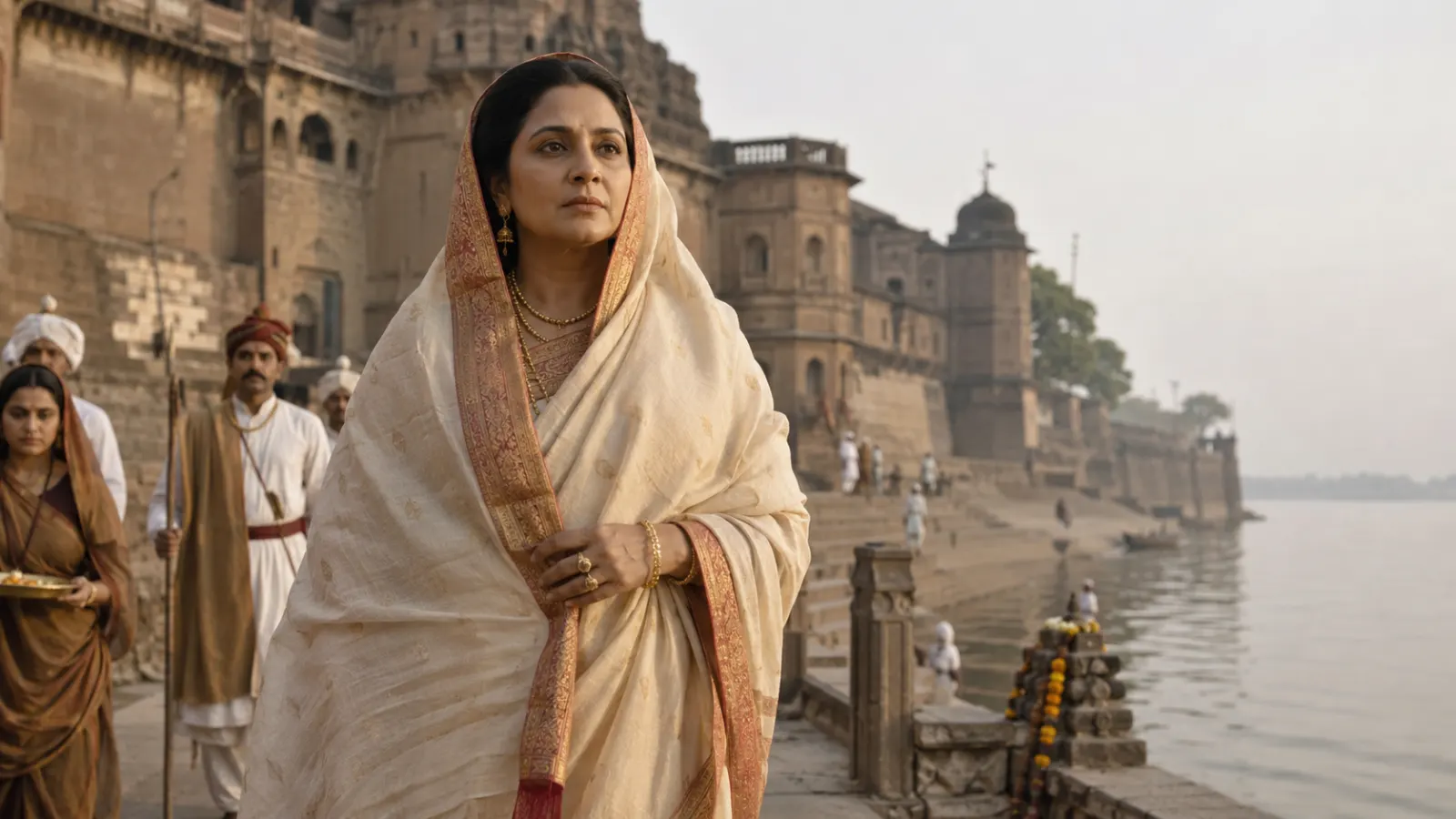
Ahilyabai Ghat in Varanasi
Her presence in Varanasi extended to the riverfront.
The official Kashi portal states that Ahilyabai Ghat was constructed under her patronage in 1785, together with associated structures.
This illustrates an important feature of her patronage.
She was not only funding ritual structures.
Ghats and rest facilities supported:
- pilgrims;
- movement;
- ritual access;
- lodging;
- and urban infrastructure.
Religious charity and public utility often overlapped.
Why Build Temples Outside Her Own Territory?
This is one of the most interesting questions about Ahilyabai's reign.
Why should a ruler based in Maheshwar spend money at sacred centres she did not govern?
The answer lies partly in the geography of premodern power.
A temple endowment could project reputation through:
- pilgrims;
- priests;
- merchant communities;
- religious institutions;
- and regional networks.
A ruler's name could therefore become present in places far beyond her administrative boundaries.
A ghat in Varanasi could make Ahilyabai politically memorable in northern India.
A temple in western India could carry Holkar prestige in another region.
Religious patronage functioned simultaneously as:
devotion,
charity,
public infrastructure,
and
reputation.
A Networked Form of Sovereignty
Modern political maps encourage us to imagine influence as something contained inside borders.
Eighteenth-century India worked differently.
Authority moved through overlapping networks of:
- taxation;
- military service;
- pilgrimage;
- credit;
- marriage;
- trade;
- temple patronage;
- and personal allegiance.
Ahilyabai's projects created what might be called a networked legacy.
Maheshwar remained her capital.
But the Holkar name became embedded across distant sacred landscapes.
This helps explain why her reputation became much larger than the geographical scale of the territory she directly ruled.
Was Ahilyabai Holkar Religious?
Yes.
Her Hindu devotion was a major feature of her life and rule.
It shaped:
- temple patronage;
- charitable giving;
- pilgrimage infrastructure;
- and the language through which her kingship was remembered.
There is no need to minimise this religious commitment in order to praise her administration.
The more interesting historical question is:
How did a strongly devotional Hindu ruler govern a socially diverse population?
Was Ahilyabai Holkar “Secular”?
Using the modern word without explanation is risky.
The eighteenth-century Holkar state did not operate under a contemporary constitutional model of secularism.
Ahilyabai did not separate:
religion
from
government
in the modern institutional sense.
She financed religious institutions directly.
Her political legitimacy incorporated Hindu sacred patronage.
At the same time, ruling a commercially and socially diverse region required practical cooperation among people belonging to different communities.
A better historical formulation is therefore:
Ahilyabai was a deeply religious Hindu ruler whose administration operated pragmatically within a plural society.
That is more precise than retroactively converting her into either:
a modern secular constitutionalist
or
a purely sectarian ruler.
Religious Patronage Was Also Public Infrastructure
Modern readers often divide government spending into categories such as:
religious
or
public.
Premodern patronage often crossed those boundaries.
A pilgrimage complex could require:
- wells;
- roads;
- ghats;
- lodging;
- kitchens;
- shelters;
- and water access.
These facilities served religious travellers.
But they were also infrastructure.
Ahilyabai's patronage should therefore be understood within an economy of mobility.
Pilgrimage created movement.
Movement created markets.
Markets connected merchants and towns.
Religious networks were also economic networks.
Ahilyabai Holkar and Women
Because Ahilyabai was an exceptionally successful female ruler, modern commemorations often present her as a pioneer of women's empowerment.
There is a legitimate connection.
Her own career proves that a woman could exercise:
- sovereign authority;
- administrative control;
- property power;
- and political judgment
inside an overwhelmingly patriarchal environment.
But broader claims require evidence.
One successful female ruler does not automatically mean ordinary women acquired equal rights under her reign.
Her historical significance should not depend on projecting twenty-first-century gender policy backward into the eighteenth century.
Her achievement is already extraordinary:
a widow successfully claimed, defended and exercised sovereignty for almost three decades.
Did Ahilyabai Holkar Have a Women's Army?
Modern government commemorative accounts state that Ahilyabai organised women for military or security roles and describe a women's force.
This claim has become popular in recent retellings.
It should nevertheless be handled cautiously unless supported by stronger contemporary military documentation.
A responsible biography can say:
Later and modern official accounts credit Ahilyabai with organising women for military or defensive purposes, although the exact structure and scale of such a force require careful historical documentation.
That is better than presenting a modern image of a formally organised women's regiment without qualification.
Architecture as Evidence of State Capacity
Stories about virtuous rulers can be exaggerated.
Buildings are harder to invent.
A major ghat, temple complex or capital project requires:
- money;
- labour;
- stone;
- transport;
- administrative coordination;
- craftsmen;
- land;
- and continued maintenance.
That makes architecture a useful source for understanding Ahilyabai.
Her built legacy demonstrates not simply generosity.
It demonstrates capacity.
To finance repeated projects across distant regions, her government needed:
- functioning revenue;
- reliable agents;
- financial transfers;
- political relationships;
- and institutional continuity.
Charity itself required administration.
Ahilyabai's Capital as Political Theatre
Maheshwar also made power visible.
A ruler's authority was experienced not only through written orders.
It appeared physically through:
- fortifications;
- palace spaces;
- temples;
- ghats;
- ritual;
- court audiences;
- and public construction.
This was political communication in stone.
The riverfront communicated:
order
and
patronage.
The palace communicated:
dynastic continuity.
Religious construction communicated:
dharma and legitimacy.
Artisan communities communicated:
economic vitality.
The capital was therefore part of government.
Ahilyabai and the Maratha Confederacy
Calling the eighteenth-century system the Maratha Confederacy is useful but should not imply that it functioned like a modern federal constitution.
Power was distributed among major Maratha houses.
The Peshwa remained a central figure.
But powerful families increasingly operated with substantial autonomy.
Among the major houses were:
- Holkar;
- Scindia;
- Gaekwad;
- Bhonsle;
- and others.
These families simultaneously:
cooperated,
competed,
fought,
and
negotiated.
Ahilyabai's success depended partly on navigating this unstable environment rather than attempting to dominate the whole system.
The Political Shadow of Panipat
The Third Battle of Panipat in 1761 devastated Maratha forces.
Malhar Rao survived the period, but the defeat changed the political atmosphere into which Ahilyabai later emerged as ruler.
The Maratha system recovered remarkably.
But power became increasingly concentrated in major regional houses and powerful individuals.
Her reign therefore belongs to the history of post-Panipat reconstruction.
That makes her reputation for internal stability more meaningful.
She was not governing during an era of uncontested peace.
She created a relatively durable political centre inside a larger unstable system.
Why Ahilyabai Did Not Build Her Reputation Through Conquest
Many rulers are remembered according to the territory they captured.
Ahilyabai's reputation developed differently.
She certainly required military protection.
But her political memory rests on:
justice,
patronage,
construction,
economic activity,
and
religious charity.
This provided another form of legitimacy.
A conqueror demonstrates power by taking territory.
A patron ruler demonstrates power by making resources visible through:
- buildings;
- institutions;
- endowments;
- and stable administration.
Both are political strategies.
Ahilyabai became unusually successful at the second.
Was Ahilyabai Holkar a “Good Ruler”?
Historical judgments like good require criteria.
If by good governance we mean modern:
- democratic elections;
- universal citizenship;
- constitutional rights;
- independent judiciary;
- representative institutions,
then the question is anachronistic.
She was an eighteenth-century dynastic ruler.
If instead we assess her against political expectations of her own environment, we can ask:
Did she maintain political stability?
Was commerce encouraged?
Were administrative grievances addressed?
Did her regime avoid constant succession chaos?
Did it finance major public works?
Did the state survive?
Did subjects and later observers preserve an unusually favourable memory of her government?
By those standards, the strength of her reputation becomes historically meaningful.
The Ideal Queen and the Problem of Legend
Ahilyabai's reputation became extraordinarily positive after her death.
Different generations contributed to it:
- Holkar dynastic memory;
- regional traditions;
- religious institutions;
- colonial writers;
- Indian historians;
- nationalist narratives;
- governments;
- popular television;
- and contemporary political commemorations.
Each had reasons to emphasise particular qualities.
For some, she was:
the ideal Hindu ruler.
For others:
the ideal woman ruler.
For others:
the model administrator.
For others:
the protector of sacred heritage.
For others:
the patron of Maheshwar.
The historical person became several symbols at once.
Legend Does Not Mean False
This is important.
Historians sometimes become so suspicious of heroic memory that they create the opposite distortion.
If a ruler is heavily praised, that does not mean every positive tradition is fabricated.
Ahilyabai's surviving:
- architecture;
- patronage networks;
- government memory;
- weaving tradition;
- administrative reputation;
- and long reign
provide real evidence.
The task is not to destroy the reputation.
It is to separate:
what can be documented
from
what has been polished by later storytelling.
That produces a stronger biography.
Ahilyabai Holkar's Death
Ahilyabai died on 13 August 1795, aged 70.
The date is confirmed in modern Government of India commemorative material.
Her death ended a reign of roughly 28 years.
Tukoji Rao Holkar succeeded her and ruled briefly before his own death in 1797.
The political history of the Holkar house would become substantially more turbulent in the years that followed.
That contrast further strengthened the retrospective image of Ahilyabai's period as one of stability.
Ahilyabai Holkar Timeline
| Year | Event |
|---|---|
| 1725 | Born on 31 May at Chondi |
| 1733 | Married Khanderao Holkar according to official commemorative accounts |
| 1754 | Khanderao killed during the siege of Kumbher |
| 1761 | Third Battle of Panipat reshapes wider Maratha politics |
| 1766 | Malhar Rao Holkar dies |
| 1767 | Male Rao dies; Ahilyabai assumes ruling authority |
| 1767 | Formal accession associated with 11 December |
| 1767–1795 | Ahilyabai's reign |
| Late 1770s–1780 | Reconstruction of Kashi Vishwanath Temple under her patronage |
| 1785 | Official Kashi sources associate her with construction of Ahilyabai Ghat |
| 1795 | Dies on 13 August |
| 2025 | India commemorates her 300th birth anniversary |
Ahilyabai Holkar's Major Achievements
Her achievements can be grouped more usefully than by simply listing monuments.
Political
- Successfully asserted authority after a serious succession crisis.
- Maintained Holkar dynastic continuity.
- Developed a workable division between civil rule and military command.
Administrative
- Built a lasting reputation for accessible justice.
- Maintained relative internal stability.
- Managed revenue and political relationships across the Holkar domains.
Economic
- Encouraged commerce and craft production.
- Strongly patronised Maheshwar's textile industry.
- Helped establish Maheshwari weaving as part of the town's identity.
Urban
- Developed Maheshwar as the political and cultural centre of her rule.
- Supported ghats, temples and related infrastructure.
Religious
- Financed projects across major pilgrimage centres.
- Reconstructed Kashi Vishwanath Temple in the late eighteenth century.
- Supported facilities serving pilgrims and religious institutions.
Cultural
- Supported artisans, scholars and religious networks.
- Created an architectural and craft legacy that remains visible.
Historical
- Established one of the most durable reputations of any eighteenth-century Indian regional ruler.
Frequently Asked Questions
Who was Ahilyabai Holkar?
Ahilyabai Holkar was an eighteenth-century Maratha ruler who governed the Holkar domains from 1767 until 1795 and became famous for administration, religious patronage and the development of Maheshwar.
When was Ahilyabai Holkar born?
She was born on 31 May 1725.
Where was Ahilyabai Holkar born?
She was born in Chondi, in present-day Maharashtra.
Who was Ahilyabai Holkar's father?
Her father was Mankoji Shinde, described in official sources as the head or Patil of Chondi village.
Who was Ahilyabai Holkar's husband?
She married Khanderao Holkar, son of Malhar Rao Holkar.
How did Khanderao Holkar die?
He was killed during the siege of Kumbher in 1754.
Did Ahilyabai Holkar attempt sati?
Later and official accounts say she intended to perform sati after her husband's death but was prevented by Malhar Rao Holkar. The story is widely accepted in biographical tradition, though highly personal episodes from this period should be treated with normal source caution.
Who was Malhar Rao Holkar?
Malhar Rao Holkar was a major Maratha commander and the founder of the political power of the Holkar house in Malwa.
When did Ahilyabai Holkar become queen?
She assumed ruling authority in 1767, after the deaths of Malhar Rao Holkar and her son Male Rao.
How long did Ahilyabai Holkar rule?
She ruled for approximately 28 years, from 1767 to 1795.
Where did Ahilyabai Holkar rule from?
Her principal capital was Maheshwar, situated on the Narmada River in present-day Madhya Pradesh.
Why did Ahilyabai move the capital to Maheshwar?
Maheshwar combined religious importance, court identity, communication routes, craft production and the ability to create a distinctive Holkar political centre.
Who was Tukoji Rao Holkar?
Tukoji Rao Holkar was the major military commander associated with Ahilyabai's reign. He managed much of the Holkar military activity while she remained the central ruler and administrative authority.
What is Ahilyabai Holkar famous for?
She is famous for:
- good governance;
- Maheshwar;
- Maheshwari sarees;
- temples and ghats;
- pilgrimage infrastructure;
- accessible justice;
- and successful female rulership.
Did Ahilyabai Holkar build Kashi Vishwanath Temple?
She financed the late-eighteenth-century reconstruction associated with the present Kashi Vishwanath Temple structure. Official Kashi sources date the rebuilding to around the late 1770s–1780.
What is Ahilyabai Ghat?
Ahilyabai Ghat is a Varanasi riverfront ghat associated with her patronage. The official Kashi portal dates its construction under her to 1785.
Did Ahilyabai Holkar create Maheshwari sarees?
It is more accurate to say that her court strongly patronised and helped develop Maheshwar's weaving industry. Government craft records associate her with bringing or supporting skilled weavers and expanding the prestige of Maheshwari textiles.
Was Ahilyabai Holkar a warrior?
She ruled a military Maratha state and is described in later and official accounts as having military training and participating in defence. However, her enduring reputation rests more strongly on administration than on personal battlefield conquest.
Was Ahilyabai Holkar secular?
“Secular” in the modern constitutional sense is not an ideal historical category for her rule. She was a devout Hindu ruler and major Hindu religious patron who governed a socially diverse eighteenth-century state.
Did Ahilyabai Holkar support women's empowerment?
Her own exercise of sovereign authority is historically important for women's political history. Broader claims about modern-style women's empowerment programmes should be made only where specific evidence exists.
When did Ahilyabai Holkar die?
She died on 13 August 1795.
Why is Ahilyabai Holkar called Lokmata?
“Lokmata,” meaning roughly mother of the people, reflects the later and modern public memory of her as an accessible, caring and just ruler.
What happened on Ahilyabai Holkar's 300th birth anniversary?
On 31 May 2025, the Government of India and Government of Madhya Pradesh held major commemorations. A special coin and postage stamp were also released in her honour.
The 300th Birth Anniversary and Ahilyabai's Modern Legacy
Ahilyabai's reputation is not confined to history books.
Her 300th birth anniversary in 2025 became a major official commemoration.
The Government of India organised events in Bhopal, released a commemorative postage stamp and special coin, and presented her life through exhibitions and public programmes.
That commemoration itself is historically interesting.
Three centuries after her birth, different parts of her reputation remain politically useful:
good governance,
women's leadership,
cultural restoration,
public welfare,
and
religious heritage.
Modern India continues to reinterpret Ahilyabai because her life can support several narratives at once.
That makes source criticism especially important.
Why Ahilyabai Holkar Still Matters
Ahilyabai offers an alternative image of eighteenth-century power.
Many rulers survive in public memory through:
wars won,
territories conquered,
and
enemies defeated.
Her reputation is built differently.
It rests on:
places improved,
institutions supported,
crafts encouraged,
pilgrims assisted,
disputes adjudicated,
and
buildings constructed.
That should not lead us to imagine a ruler detached from warfare.
Her state still depended on soldiers, revenue and Maratha military networks.
But she turned the benefits of that power inward and outward in unusually visible ways.
The Buildings Outlasted the Battles
Architecture helps explain the unusual endurance of her reputation.
A battle can transform politics and eventually disappear from everyday memory.
A ghat remains in use.
A temple continues receiving pilgrims.
A textile tradition becomes part of a town's identity.
A capital preserves a ruler's name in physical space.
That gave Ahilyabai a form of historical afterlife that many more territorially aggressive rulers never achieved.
People do not need to read an eighteenth-century chronicle to encounter her legacy.
They can:
- walk through Maheshwar;
- use the ghats;
- visit Kashi Vishwanath;
- or purchase Maheshwari textiles.
History survives through practice.
The Queen Behind the Legend
The weakest version of Ahilyabai's story is:
She was perfect.
The second weakest is:
Her reputation is only myth.
The historical evidence supports something more interesting.
She was a ruler who faced extraordinary political vulnerability.
Her husband died.
Her principal political mentor died.
Her son died.
Her dynasty lacked an obvious male successor.
Rival political actors had reasons to intervene.
She nevertheless acquired recognition and remained in authority for almost three decades.
She managed a state whose military commitments extended into wider Maratha politics.
She developed Maheshwar.
She supported artisans and merchants.
She financed religious and public works across enormous distances.
And she created an enduring reputation for justice.
None of that requires sainthood.
It requires political ability.
The Central Idea
Ahilyabai Holkar's historical achievement can be expressed simply:
she converted vulnerability into legitimacy.
A widowed woman in a military dynasty could easily have become politically marginal.
Instead, she became the centre of the state.
She did so not through one spectacular conquest but through repeated demonstrations that her government could:
raise revenue,
maintain order,
support military power,
protect commerce,
respond to grievances,
patronise sacred institutions,
and
build things people continued to use.
Maheshwar gave that authority a capital.
Tukoji Rao helped give it military reach.
Revenue gave it resources.
Merchants and weavers gave it economic life.
Temples and ghats gave it geographical memory.
Her gender made the achievement exceptional.
Her longevity made it durable.
The resulting reputation became so successful that the historical ruler has sometimes disappeared behind an image of faultless maternal kingship.
A stronger biography does not need to destroy that admiration.
It explains how it was created.
Ahilyabai Holkar matters not because history can objectively crown her India's greatest queen.
History cannot measure rulers that way.
She matters because, in the fragmented political world of eighteenth-century India, she made a comparatively regional state memorable far beyond its territorial scale.
And she did it largely through forms of power that outlived armies:
administration, patronage, infrastructure and reputation.
That is why the buildings lasted longer than the battles.
And it is why, three centuries after her birth, Ahilyabai Holkar remains one of the most recognisable rulers of eighteenth-century India.