When Equality Requires More Than Equal Words
A Constitution may promise equality, but society may still carry deep historical disadvantages. Some communities may have faced caste exclusion, untouchability, social humiliation, educational denial, economic deprivation, gender barriers or lack of representation in public life for generations. If the law treats everyone identically without recognising this history, formal equality may protect existing inequality.
Affirmative action is the constitutional method of responding to such disadvantage. It allows the State to take special measures for groups that need support to reach real equality. In India, affirmative action is most commonly discussed through reservations in education, public employment and political representation, but the idea is wider than reservation alone.
Meaning of Affirmative Action
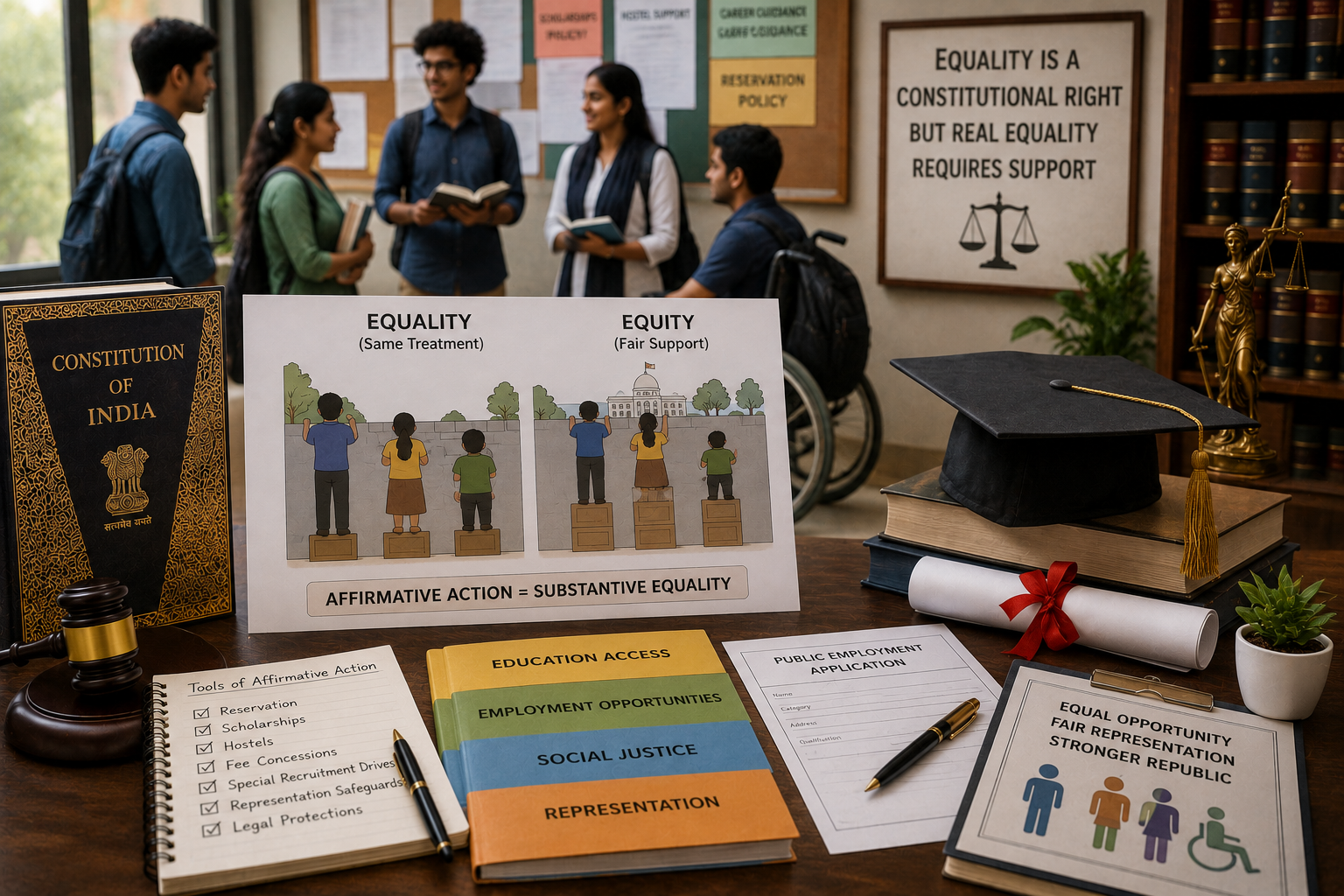
Affirmative action means special steps taken by the State to improve the position of disadvantaged or under-represented groups. These steps may include reservation, scholarships, hostels, fee concessions, special recruitment drives, targeted welfare schemes, representation safeguards and legal protections.
The purpose is not charity. It is constitutional correction. It recognises that some disadvantages are not individual failures but social and historical barriers.
Affirmative action tries to ensure that opportunity is not monopolised by groups that already possess social, educational or institutional advantage.
Constitutional Basis
The Indian Constitution contains several provisions that support affirmative action. Article 15 prohibits discrimination on grounds such as religion, race, caste, sex and place of birth, but it also allows special provisions for women, children, socially and educationally backward classes, Scheduled Castes and Scheduled Tribes. Later constitutional amendments also enabled special provisions relating to admission in educational institutions and economically weaker sections.
Article 16 guarantees equality of opportunity in public employment, but Article 16(4) allows reservation for backward classes that are not adequately represented in State services. Article 16(4A), 16(4B) and 16(6) deal with specific reservation-related contexts. Article 46 directs the State to promote the educational and economic interests of weaker sections, especially Scheduled Castes and Scheduled Tribes, and protect them from social injustice and exploitation.
These provisions show that the Constitution does not see equality as blind sameness. It allows targeted correction where disadvantage is real.
Reservation as a Form of Affirmative Action
Reservation is the most visible form of affirmative action in India. It reserves a percentage of seats or posts for eligible members of specified categories such as Scheduled Castes, Scheduled Tribes, Other Backward Classes and Economically Weaker Sections, depending on the context and applicable law.
Reservation can apply in educational institutions, public employment and legislatures under different constitutional and statutory provisions. Political reservation for Scheduled Castes and Scheduled Tribes in legislatures has a different constitutional logic from reservation in jobs or education.
It is important to understand that reservation is not the whole of affirmative action. It is one tool within a wider equality framework.
Why Affirmative Action Is Needed
Affirmative action is needed because discrimination can survive even after formal legal equality. A community historically denied schooling cannot compete equally with communities that enjoyed education for generations. A caste group excluded from public institutions may remain under-represented even after open competition begins. Women may face structural barriers that law alone does not immediately remove.
The Constitution recognises that equal opportunity sometimes requires unequal support. The aim is not to punish any group. The aim is to make public opportunity more inclusive.
Without affirmative action, the language of merit may sometimes hide inherited privilege.
Affirmative Action and Merit
The most common debate around affirmative action concerns merit. Critics argue that reservation may reduce merit. Supporters respond that merit is not created in a vacuum. School quality, family income, social confidence, caste networks, language, urban access and historical privilege all shape performance.
A constitutional approach must ask not only who scored higher today, but also whether the conditions of competition were fair. Affirmative action does not reject merit; it questions whether merit can be measured fairly without recognising unequal starting points.
At the same time, affirmative action policies must be carefully designed so that they actually reach the disadvantaged and do not become permanent political slogans without review.
Creamy Layer and Targeting
For Other Backward Classes, the creamy layer principle excludes the advanced section of the community from reservation benefits. The idea is that benefits should reach those who remain socially and educationally disadvantaged, rather than being repeatedly captured by the better-off section.
The creamy layer concept was developed in the context of OBC reservation and is linked with the Supreme Court’s Indra Sawhney judgment. Its application beyond OBCs remains a legally sensitive and debated issue.
This targeting principle shows that affirmative action is not meant to be unlimited. It must be connected to backwardness, representation and constitutional purpose.
Institutions and Safeguards
Several institutions are connected with affirmative action. The National Commission for Scheduled Castes, National Commission for Scheduled Tribes and National Commission for Backward Classes examine safeguards, complaints and welfare concerns relating to their respective communities. Article 338B gives constitutional status to the National Commission for Backward Classes.
Governments also maintain central and State lists, issue caste and non-creamy layer certificates, frame reservation rosters and set recruitment or admission rules.
The legal framework is therefore not only about broad constitutional principles. It involves administrative verification, eligibility rules and institutional monitoring.
Citizen Impact
Affirmative action affects students, job applicants, public institutions, political representation and social mobility. For a first-generation learner from a disadvantaged community, reservation or targeted scholarship may open access to education. For under-represented groups, public employment can create dignity and representation.
It also affects citizens outside reserved categories because public opportunity is limited and competitive. This is why the debate must be handled carefully, with constitutional reasoning rather than resentment.
The purpose is to build a more representative republic, not to divide citizens permanently.
Limits and Debates
Affirmative action raises difficult questions. How should backwardness be identified? Should economic disadvantage receive separate treatment? How long should reservation continue? How should data on representation be collected? Should benefits be reviewed periodically? How should internal inequality within reserved groups be addressed?
The Supreme Court has developed important limits and principles over time, including discussions around reasonable limits, creamy layer, adequate representation and equality. But the subject remains politically and socially contested.
A serious debate must recognise both historical injustice and the need for fairness in implementation.
Misunderstandings
One misunderstanding is that affirmative action is only about poverty. Poverty matters, but Indian reservation policy has historically responded mainly to social and educational backwardness, caste exclusion and inadequate representation.
Another misunderstanding is that affirmative action is against equality. In constitutional terms, affirmative action is often a method of achieving substantive equality.
A third misunderstanding is that every member of a reserved category automatically receives every benefit. Eligibility depends on category recognition, certificate validity, income or creamy layer rules where applicable, institutional rules and legal conditions.
Final Takeaway
Affirmative action is the Constitution’s method of correcting structural inequality. It recognises that real equality sometimes requires special support for those historically excluded from education, employment, representation and dignity.
Its legitimacy depends on purpose, evidence, fairness and careful implementation. Affirmative action is not a rejection of equality. It is an attempt to make equality real.
Disclaimer: This article is for general information and educational understanding only. It is not personal legal advice. For specific legal problems, consult a qualified legal professional.