White Revolution: How Operation Flood Transformed Indian Dairy
India’s White Revolution was not created by a single high-yielding animal breed, processing technology or government subsidy. Its most important innovation was institutional. Milk production was scattered across millions of small households, while processing capacity, refrigeration, transport and access to large urban markets required scale. Operation Flood attempted to bridge that gap by allowing small producers to aggregate their milk through farmer-owned cooperatives while professional organisations handled processing, logistics and marketing.
When Operation Flood began in 1970, milk was a difficult development commodity. It was highly perishable, produced in small quantities, sensitive to seasonal fluctuations and often sold through local intermediaries. Farmers could not easily postpone a sale while searching for a better buyer because fresh milk had to move quickly. At the same time, rapidly growing cities needed regular supplies of safe milk, while India still relied partly on imported dairy products.
The programme that followed became one of the world’s largest rural-development efforts. The National Dairy Development Board describes its objectives as increasing milk production, raising rural incomes and supplying consumers at reasonable prices. Its National Milk Grid eventually connected producers across India with consumers in more than 700 towns and cities, reducing some of the seasonal and regional imbalances that had previously fragmented the market. (nddb.coop)
Yet the production statistics tell only part of the story. The deeper significance of the White Revolution was the attempt to change who controlled the dairy value chain. Instead of treating small farmers only as suppliers to a government plant or private buyer, the Anand model sought to make them owners of institutions responsible for procurement, processing and marketing.
The Anand Model Turned Small Producers Into a Commercial Network
The national programme grew from an earlier cooperative experiment in Kaira district, Gujarat. Farmers there had objected to the weak bargaining position they faced when selling milk through private contractors supplying the Bombay market. With political support from leaders including Vallabhbhai Patel and organisational leadership from Tribhuvandas Patel, producers established a cooperative system in which village societies collected milk and a district-level union processed and marketed it. The organisation later became closely associated with the Amul brand.
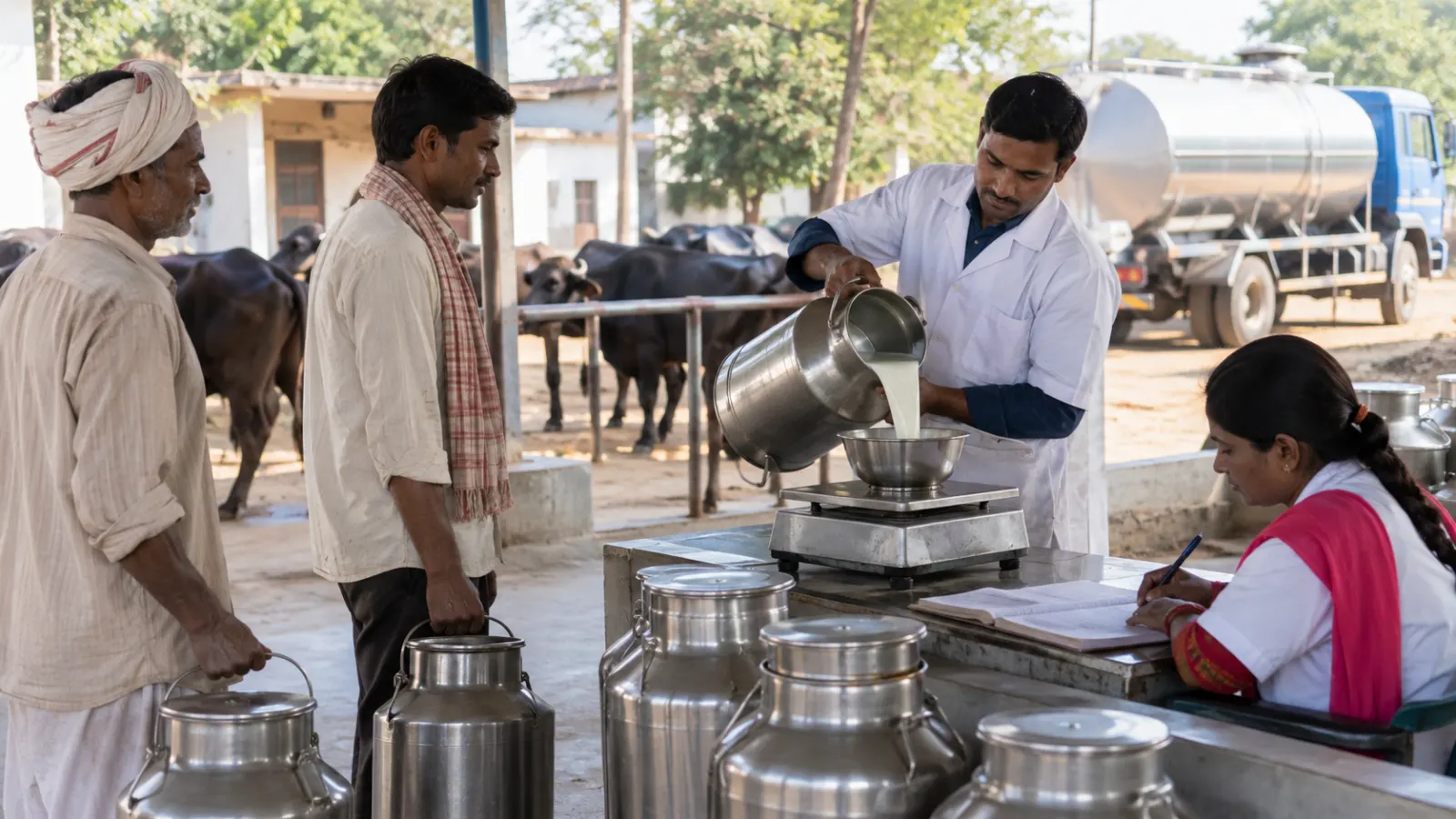
The important innovation was not simply registering a cooperative. The system linked daily milk collection to quality testing, payment, processing, veterinary support and access to consumers. A producer with only a few litres of milk had little capacity to finance a processing plant, laboratory or refrigerated transport independently. Thousands of producers acting collectively could support all of them.
This arrangement evolved into what NDDB calls the Anand Pattern, a three-tier structure consisting of village dairy cooperative societies, district milk unions and state federations. Village societies procure milk from members and test it for quality; district unions process the milk and often provide services such as veterinary care, feed and artificial insemination; state federations coordinate marketing and other activities across member unions. NDDB describes the central principle as producer ownership combined with professional management, with managers accountable to representatives elected by farmers. (nddb.coop)
This structure tried to solve two problems at once. Farmers needed bargaining power, but dairy enterprises also needed commercial discipline. Producer ownership by itself could not guarantee efficient processing, branding or distribution. Professional management without meaningful farmer control, meanwhile, could recreate the same distance between producer and market that the cooperative was supposed to eliminate.
The model therefore depended on the quality of governance. Payment had to be reliable. Milk testing had to be credible. Managers had to operate commercially. Cooperative elections had to reflect member control rather than political capture. These apparently mundane details determined whether the institutional promise was real.
The daily milk collection centre was especially important. For a farmer, the cooperative was not an abstract philosophy of collective ownership; it was the place where milk was weighed, tested and converted into cash. NDDB’s Anand Pattern links member payment to milk quantity and quality, including fat and solids-not-fat content. (nddb.coop) When testing was transparent and payment dependable, households had stronger incentives to improve animal feeding and milk quality. When either failed, trust in the cooperative could erode quickly.
The success of this system in Gujarat attracted national attention. In 1965, the National Dairy Development Board was established, with Verghese Kurien as its founding chairman. NDDB describes Kurien as the architect of India’s White Revolution and notes that he chaired the organisation from 1965 to 1998. (nddb.coop)
The new challenge was much larger than running one successful dairy union. Could the institutional architecture of Anand be replicated across a country with very different political systems, farming patterns, social hierarchies and local markets?
Operation Flood Used Markets, Food Aid and a National Milk Grid
Operation Flood began in 1970 with an unusual financing mechanism. Skimmed milk powder and butter oil donated by the European Economic Community through the World Food Programme were sold in Indian markets, and the proceeds helped finance dairy infrastructure and cooperative development. The objective was not to maintain permanent dependence on imported dairy commodities but to use temporary food aid to build domestic capacity.
NDDB records that Phase I, from 1970 to 1980, linked 18 major milksheds with the four metropolitan markets of Delhi, Mumbai, Kolkata and Chennai. Processing plants, transport systems, marketing networks and village cooperatives were developed as the programme began integrating rural production with large urban demand. (nddb.coop)
This connection mattered because dairy production depends on confidence that tomorrow’s milk will also have a buyer. A farmer is more likely to invest in feed, animal health or another milk animal when procurement operates every day at a reasonably predictable price. An urban distribution system is more likely to rely on domestic production when supply is consistent enough to support regular retail networks.
The National Milk Grid reduced dependence on purely local supply and demand. Milk from one region could reach consumers elsewhere, while processing milk into products such as powder helped manage seasonal fluctuations. NDDB says the grid eventually connected milk producers with consumers in more than 700 towns and cities and helped reduce seasonal and regional price variation. (nddb.coop)
Phase II, from 1981 to 1985, expanded the programme dramatically. NDDB reports that the number of participating milksheds increased from 18 to 136 and that 290 urban markets became outlets for milk. By the end of 1985, approximately 43,000 village cooperatives covered 4.25 million producers. Domestic milk-powder capacity also expanded substantially, reducing reliance on imported powder as a balancing mechanism. (nddb.coop)
Phase III, from 1985 to 1996, concentrated on strengthening the cooperative network and the production services supporting it. Procurement and marketing infrastructure expanded, but veterinary care, animal nutrition, artificial insemination, member education and research also became increasingly important. The programme recognised that marketing reform could raise incentives, but sustained production still depended on animal health and productivity.
The World Bank later described Operation Flood as a farmer-controlled cooperative programme whose associated reforms coincided with a major acceleration in dairy production. A 1998 World Bank evaluation reported that dairy production growth increased substantially after the programme and emphasised that Operation Flood differed from earlier livestock strategies by focusing heavily on creating a reliable market for existing small producers.
That distinction helps explain why Operation Flood differed from a conventional agricultural technology programme. It did not assume that the main constraint was simply low biological productivity. If farmers had no reliable market, additional production could itself become a problem. Procurement, processing and demand therefore had to expand alongside production.
Technology Worked Because It Was Embedded in Institutions
The White Revolution is sometimes narrated as a technological story involving artificial insemination, better feed, chilling plants, milk powder or modern dairy factories. All were important, but none explains the transformation alone. A chilling centre without enough dependable milk is an underused asset. Better breeding delivers limited benefits if animals lack feed or veterinary care. A processing plant does not empower farmers if procurement prices are opaque or payments are repeatedly delayed.
Operation Flood’s distinctive contribution was to combine technology, market access and organisation. The village society aggregated small quantities. The district union created processing scale. The federation built brands and distribution. Technical services attempted to improve production. Urban sales generated the revenue from which farmers could ultimately be paid.
This makes comparisons with the Green Revolution useful but incomplete. Higher-yielding cereal varieties, irrigation and fertiliser could raise crop productivity, but milk required a continuous institutional relationship. Crops are harvested periodically; milk arrives every day and deteriorates quickly. The institution that collects it therefore becomes part of the production system itself.
Technology also had to adapt to Indian conditions. Buffaloes contributed heavily to the country’s dairy economy, and Indian dairying could not simply reproduce European cow-milk systems. Processing methods, feed systems, breeding programmes, transport arrangements and product mixes had to work with local animals, climate and consumer preferences. Milk-powder capacity was particularly useful because it allowed part of the seasonal surplus to be stored and later used when liquid supply tightened.
Urban consumers were equally important to the model. Producer ownership could survive only if cooperative enterprises sold products effectively. Packaging, pasteurisation, quality control, branding and distribution therefore belonged to rural development rather than sitting outside it. A cooperative that could not win consumer trust could not sustainably improve producer incomes.
This relationship also created an unavoidable tension. Farmers wanted remunerative milk prices, while consumers wanted affordable food. The programme could not permanently maximise one at the expense of the other. NDDB explicitly lists both improved producer income and reasonable consumer prices among Operation Flood’s goals. (nddb.coop)
The system also demonstrated the value of small volumes. A commercial dairy model requiring every supplier to operate a large farm would have excluded much of rural India. Cooperative aggregation made it possible for households owning one or a few animals to participate in a modern processing and marketing chain.
For land-poor families, dairy could provide a regular cash flow that crop farming did not always offer. Milk could be sold daily rather than only after harvest. Livestock could also diversify household income, reducing dependence on one crop or agricultural season.
Women performed much of the routine labour involved in feeding, cleaning and milking animals, making dairying potentially important for women’s economic participation. But household income and institutional power were not automatically distributed according to labour contribution. Membership, animal ownership and cooperative leadership could remain male dominated even when women performed much of the work.
Later efforts to establish women’s dairy cooperative societies and increase female participation attempted to narrow that gap. The history therefore contains both genuine opportunities for greater economic agency and a reminder that raising household income is not identical to changing power within the household.
National Success Concealed Uneven Local Performance
Operation Flood became a national programme, but the Anand Pattern did not perform identically everywhere. Gujarat possessed its own history of cooperative organisation, commercial dairy experience and leadership. Other states had different political institutions, existing government milk schemes, private traders, landholding structures and social hierarchies.
This made replication much harder than reproducing a three-tier organisational chart. A village society could formally exist while remaining weakly governed. A union could be nominally farmer-owned while heavily influenced by state agencies or local elites. Payments could be delayed, veterinary services unreliable or elections politicised.
NDDB itself has emphasised that the Anand system depends on elected producer leadership supported by accountable professional management. (nddb.coop) When either element weakened, the institutional form could remain while the economic substance deteriorated.
World Bank assessments similarly presented Operation Flood as a major success while recognising variation in implementation. One evaluation noted that comparable attempts to reproduce Anand-type systems outside India did not automatically succeed, illustrating that organisational design cannot simply be transplanted without the supporting policy, management and local institutional conditions.
Food aid generated another serious debate. Donated milk powder and butter oil provided resources for investment, but development critics reasonably worried that imported dairy products could depress domestic prices, create dependence or encourage centralised processing at the expense of local production.
Those concerns cannot be dismissed merely because Operation Flood later expanded domestic output. Food aid can harm local producers when commodities are simply released into markets without attention to incentives. The important question is how it is used.
Operation Flood’s defence was that dairy commodities were monetised and the proceeds invested in infrastructure and cooperative institutions intended eventually to reduce import dependence. The World Bank’s retrospective assessment described the approach as an unusual use of food aid to help establish a domestic farmer-controlled dairy industry rather than a permanent substitute for domestic production.
The result therefore supports neither a simple claim that food aid is always beneficial nor one that it is inherently destructive. Its impact depends on pricing, duration, programme design and whether the investment strengthens or undermines domestic producers.
The expansion of Indian milk production also cannot be attributed exclusively to Operation Flood. Rising incomes increased demand. Roads, electrification and refrigeration improved. Private dairies expanded. Feed availability, veterinary science, breeding and wider agricultural change affected supply. Informal milk markets remained significant.
The most defensible historical claim is therefore not that Operation Flood produced every additional litre of Indian milk. Its stronger contribution was to reshape the institutional environment in which milk was produced and marketed by expanding organised procurement, processing capacity, cooperative ownership and access to urban markets.
The White Revolution’s Lasting Lesson Is About Institutional Design
By the time the third phase of Operation Flood ended in 1996, the structure of Indian dairying had changed substantially. Village cooperatives had expanded across many states, domestic processing capacity had increased, organised procurement reached millions of producers and producer-owned brands had become significant participants in large consumer markets.
The World Bank later described the programme as comparable in significance to the Green Revolution and credited it with helping transform the structure and growth of India’s dairy industry. But the programme is more useful as a case study when it is examined as an institutional experiment rather than as a national success slogan.
Its central insight was that very small producers could participate in a large modern commodity market when an institution aggregated their output and returned commercial power toward them. A farmer with two litres of milk could become part of a system containing laboratories, processing plants, feed factories, tanker fleets and national marketing because those assets did not need to be owned individually.
The model also showed that democratic ownership and commercial performance have to coexist. A cooperative that cannot sell effectively cannot protect producers for long. A commercially efficient enterprise that no longer responds to its farmer-members may cease to function meaningfully as a cooperative.
The rise of private dairy companies makes that lesson even more important. Producer-owned institutions cannot rely indefinitely on historical loyalty or political protection. If a competing buyer provides faster payment, better service or a stronger price, farmers have practical reasons to shift. Cooperative legitimacy therefore has to be reproduced through performance every day.
Environmental pressures add another modern challenge. Expanding livestock production raises questions about feed, water, manure, methane emissions, animal health and the sustainability of breeding and production systems. The institutional achievements of the twentieth-century White Revolution do not automatically answer the environmental problems of twenty-first-century dairying.
That does not weaken the programme’s historical importance. It clarifies what its most transferable lesson actually was.
Operation Flood did not succeed because India discovered one perfect dairy technology. It succeeded where farmers, managers, infrastructure, public policy and consumer markets were linked into institutions capable of making millions of tiny transactions reliable.
The most important unit in that transformation was therefore not the cow, buffalo, factory or tanker considered separately.
It was the relationship connecting producer to market.
That is why the White Revolution remains relevant beyond dairy economics. It provides a case study in how small producers can aggregate bargaining power, how modern logistics can serve dispersed rural production, how public policy can help build commercial institutions without permanently replacing markets, and how ownership structures can influence the distribution of value along a supply chain.
Its weaker cooperatives reveal the other side of the lesson: institutional architecture on paper is never enough. Transparency, competent management, reliable payment, member participation and protection from political capture have to be maintained continuously.
The enduring legacy of Operation Flood and India’s White Revolution is therefore not simply that India produced more milk.
It is that a development programme attempted to reorganise an entire commodity chain so that millions of small producers could participate in—and own part of—the system linking their daily production to national markets.