Ram Manohar Lohia: Socialism, Caste and Democratic Opposition
Ram Manohar Lohia occupies an unusual place in twentieth-century Indian politics because he belonged fully to the freedom struggle yet spent much of his later life attacking the political arrangements that emerged from independence. He helped build the Congress Socialist Party, served in the foreign department of the Indian National Congress, worked underground during the Quit India Movement, challenged Portuguese authority in Goa and later became one of Parliament's most persistent critics of Congress dominance. But a list of movements and offices does not explain why his ideas continued to influence Indian politics after his death.
Lohia's central problem was more difficult: could socialism developed largely from European industrial experience adequately explain an Indian society structured simultaneously by class, caste, gender, colonialism, language and unequal access to political power?
His answer was no.
He admired Marx's analysis of exploitation but rejected the reduction of history to class conflict. He absorbed Gandhi's decentralism, civil resistance and suspicion of concentrated power without accepting Gandhian economics as a complete programme for modern India. He opposed laissez-faire capitalism but also attacked excessively centralised versions of socialism. He criticised Jawaharlal Nehru's development model and elite political culture while remaining committed to science, technological change and the elimination of mass poverty.
What emerged was neither orthodox Marxism nor conventional Gandhism. Lohia tried to construct an Indian socialism in which economic redistribution could not be separated from caste destruction, women's equality, opposition to racial discrimination, linguistic democracy, civil liberty, decentralisation and international peace.
That breadth made him unusually original.
It also made his politics difficult to reduce to one doctrine.
From Akbarpur and Berlin to Underground Resistance
Lohia was born on 23 March 1910 at Akbarpur in present-day Uttar Pradesh. Parliamentary records identify him as a founder-member of the Congress Socialist Party, later secretary of the All India Congress Committee's Foreign Department, a leader of the underground movement during Quit India and eventually a Lok Sabha member.
His mother died when he was very young, and his father, Hiralal, was involved in nationalist politics. After studying in Bombay, Banaras and Calcutta, Lohia travelled to Germany and studied political economy in Berlin. His years there, from 1929 into 1933, coincided with the breakdown of the Weimar Republic and the rise of Nazism. He completed doctoral work examining India's salt taxation—a subject that connected economic analysis directly with colonial power and the politics surrounding Gandhi's Salt Satyagraha.
The choice was revealing. Salt was an ordinary necessity, but the colonial tax transformed it into evidence of how imperial government penetrated everyday economic life. Lohia's socialism would repeatedly return to this relationship between large systems and ordinary experience: national income and the expenditure of a poor household, central bureaucracy and the village, official language and the citizen unable to use it.
Berlin exposed him to European socialism and Marxism in a period when ideological conflict was becoming violently political. Yet the lesson he drew was not that India needed to reproduce European ideological models. His later writing repeatedly challenged attempts to treat European historical development as a universal sequence through which every society must pass.
On returning to India, he became part of the generation trying to give the freedom movement a socialist programme. The Congress Socialist Party, established in 1934 within the Indian National Congress, brought together figures including Acharya Narendra Deva, Jayaprakash Narayan and Lohia. They wanted independence from British rule to become the beginning of economic and social transformation rather than the final objective.
Lohia's international interests also led him into the Foreign Department of the All India Congress Committee, where parliamentary archival material records him as secretary from 1936 to 1938. For him, Indian anti-colonialism formed part of a wider global struggle against empire, racial domination and militarism.
The Quit India Movement placed those convictions under far more dangerous conditions. After the British government arrested much of the senior Congress leadership in August 1942, Lohia became involved in underground resistance. Government commemorative material records his role in establishing an underground radio operation during the movement, while parliamentary records identify him as a leader of the clandestine struggle before his detention from 1944 to 1946.
This part of his biography matters because the later image of Lohia as a parliamentary critic can conceal the fact that his politics had been formed under colonial repression. Civil resistance for him was not an abstract constitutional theory. He had experienced clandestine organisation, arrest and imprisonment before entering the institutions of independent India.
His anti-colonial politics also extended beyond British rule. In June 1946, Lohia publicly challenged restrictions imposed by Portuguese authorities in Goa. Goa government histories commemorate 18 June as the moment when he defied restrictions on public assembly at Margao and helped initiate a new phase of mass agitation for civil liberties and eventual liberation.
It would be an exaggeration to say that Lohia alone created the Goan freedom movement. Goan resistance had a much longer history and local activists such as Tristão de Bragança Cunha and Juliao Menezes were indispensable. But Lohia's intervention helped turn restrictions on civil liberties into a public confrontation and gave the movement renewed national visibility.
Independence in 1947 therefore did not end his political project.
It changed the object of criticism.
Why Lohia Thought India Needed a New Socialism
After independence, Indian socialists confronted an uncomfortable problem. The Congress had led the anti-colonial struggle and now governed the country. Could socialists remain within the organisation and still challenge the economic and political system being created by Congress governments?
Lohia increasingly believed they could not.
The socialist movement subsequently passed through repeated mergers, divisions and organisational experiments involving the Socialist Party, Praja Socialist Party and later socialist formations. These splits are sometimes treated as unfortunate background noise, but they reveal an important weakness in Lohia's politics: he was often more successful at defining intellectual and strategic disagreements than at building durable organisations capable of containing them.
His ideas nevertheless became clearer through those conflicts.
Lohia rejected the assumption that socialism meant simply taking European Marxism and applying it to India. He regarded economic inequality as fundamental but argued that history contained forms of hierarchy that could not be explained by ownership of capital alone. Caste could survive economic change. Patriarchy could operate within poor and wealthy families alike. Racial domination could coexist with class solidarity. Colonial and linguistic hierarchies could create privileged elites even without straightforward ownership of factories.
His socialism therefore pursued what he called maximum attainable equality while also emphasising social ownership, decentralised technology and the dispersal of political power. Academic summaries of his “new socialism” identify the Four-Pillar State and small-unit technology among its characteristic components.
This placed him in sharp disagreement with the dominant prestige surrounding large-scale industrialisation and central planning in early independent India.
But Lohia's argument should not be simplified into opposition to machines or modern industry.
He was interested in which kinds of technology distributed economic power. He argued for smaller machines and more decentralised forms of production capable of combining technological advance with widespread employment. Large enterprises might be necessary in sectors such as railways or steel, but he resisted the assumption that scale itself demonstrated progress.
His concern was partly economic and partly political.
Large concentrations of production required large concentrations of capital, administration and decision-making. For Lohia, economic centralisation could therefore reproduce political hierarchy even within a formally socialist economy.
This was also the point at which his differences with Nehru became most visible. Nehru associated planning, heavy industry and scientific modernisation with India's escape from poverty and colonial backwardness. Lohia feared that the same model could produce an elite bureaucratic economy too distant from the lives of most citizens.
Neither argument can be settled simply by declaring one man correct. India's development required infrastructure, industrial capacity and technological growth on a scale that small production alone was unlikely to provide. But Lohia identified a problem that remains recognisable: economic growth can coexist with highly unequal access to power, employment and public resources.
His socialism was therefore less a theory of state ownership than a theory of dispersed equality.
That distinction became even clearer in his analysis of caste.
Caste, Gender and Language Expanded the Meaning of Equality
Lohia's most consequential departure from orthodox class politics was his refusal to treat caste as a secondary expression of economic inequality.
Two people with the same income could occupy very different positions in Indian society if caste affected whom they could marry, whose home they could enter, which occupations carried dignity, who possessed cultural authority and which communities historically gained access to education and administration.
Redistributing income would therefore not automatically dismantle inherited status.
Lohia argued that political representation had to be altered deliberately so that communities historically excluded from power could enter administration, education and leadership. His language around backward classes and affirmative representation later influenced socialist and backward-caste politics, particularly in north India. A 2015 vice-presidential lecture on his legacy described him as a major source of later OBC politics and a champion of backward-caste representation.
Later political movements often inherited only part of this argument. Representation could become an objective in itself even when Lohia's wider programme also demanded economic redistribution, gender equality and the destruction of social hierarchy in everyday life.
For Lohia, caste did not survive merely through government appointments.
It survived through society itself.
Marriage was especially important because caste reproduces across generations through rules concerning intimacy and family. His political challenge to caste therefore extended beyond electoral representation toward breaking barriers surrounding shared social life and inter-caste marriage.
This was one reason his socialism could not be confined to economic policy.
The same was true of gender.
Lohia placed inequality between women and men within his wider idea of Sapta Kranti, or the Seven Revolutions. Exact formulations varied across summaries of his speeches and writings, but the programme brought together struggles against gender inequality, caste hierarchy, racial discrimination, foreign domination and economic inequality while defending individual freedom and opposing militarism or the arms race.
The significance of Sapta Kranti lies less in memorising a canonical list than in understanding the intellectual move behind it.
Lohia was arguing that emancipation has several dimensions.
A society could redistribute property while leaving women subordinate.
It could win national independence while preserving caste.
It could achieve economic growth while creating new forms of bureaucratic domination.
It could proclaim collective equality while suppressing individual liberty.
This refusal to rank all injustice beneath one “primary contradiction” distinguished him from more orthodox Marxist traditions.
It also made his programme harder to institutionalise. A political movement capable of fighting simultaneously against caste, patriarchy, economic inequality, racial hierarchy, militarism and centralised power requires far more than a single policy instrument. Lohia's politics was often strongest at identifying interconnected injustices and weaker at specifying exactly how a government should resolve trade-offs among them.
His campaign against the dominance of English illustrates both the strength and weakness of this approach.
Lohia argued that a democracy cannot be socially equal when courts, administration, higher education and prestige operate through a language inaccessible to most citizens. English, in his analysis, was not merely a communication medium. It functioned as a gatekeeping mechanism that could reproduce an elite even after the British had left.
This was an important democratic insight.
Language distributes opportunity.
A citizen who cannot understand the proceedings of a court or compete for public employment because of language has a different relationship with the state from someone educated inside the language of power.
Yet Lohia's anti-English politics created another difficulty. India is not divided simply between English and one national vernacular. It contains many major languages with their own literary, political and administrative traditions. A programme interpreted as replacing English with Hindi could appear emancipatory in parts of north India and majoritarian in Tamil Nadu, Bengal, Karnataka or other non-Hindi regions.
English also later acquired roles Lohia could not completely anticipate. For some socially marginalised Indians, it became a tool of mobility precisely because it could provide access outside older regional hierarchies. It remained important for science, higher education and international communication.
Lohia's enduring insight was therefore not that India had to eliminate English.
It was that the language of public power should never become an invisible qualification for full citizenship.
The Four-Pillar State and the Strategy of Non-Congressism
Lohia's suspicion of concentrated power extended from language and economics directly into constitutional organisation.
His proposal for a Four-Pillar State sought to disperse authority among the village, district, province or state, and national centre. Rather than treating local governments as administrative agents carrying out decisions made elsewhere, he wanted each level to possess genuine political and economic authority. Academic accounts of the proposal emphasise that it involved legislative as well as executive decentralisation and extended to questions of planning, production, ownership and public revenue.
This went beyond administrative efficiency.
Lohia believed democracy should place meaningful decision-making close enough to citizens that participation was not reduced to voting periodically for distant representatives.
His position resembled Gandhian decentralism but did not simply reproduce the ideal of an economically self-sufficient village. Lohia wanted modern technology and wider political institutions alongside decentralised control.
He was also aware of the obvious objection.
Local power is not automatically democratic power.
A village can be dominated by caste elites, landlords or patriarchal authority just as a central government can be dominated by bureaucratic or political elites. Decentralisation can move power closer to ordinary people, but it can also move coercive authority closer to those who already dominate them locally.
Any modern application of Lohia's decentralism therefore requires institutions he did not always describe in sufficient detail: constitutional rights, independent courts, anti-discrimination enforcement, fiscal equalisation and accountability capable of checking domination at every level.
His political strategy toward the Congress followed the same distrust of concentrated authority.
By the 1960s, Congress dominated both national politics and a large share of state governments. Lohia concluded that parliamentary democracy could not develop properly if opposition parties remained fragmented while one organisation effectively functioned as the permanent party of government.
His answer was non-Congressism.
Opposition parties with substantial ideological differences should cooperate where necessary to defeat Congress candidates and demonstrate that governments could actually be removed through elections. Parliamentary publications later described Lohia as a key architect of this strategy, which helped shape opposition cooperation before the 1967 elections.
The democratic logic was powerful.
Competition requires the realistic possibility of alternation.
A ruling party that expects permanent power can blur distinctions between state, government and party. Breaking that dominance could make legislatures more competitive and create space for political alternatives.
The strategy also contained an equally obvious risk.
If defeating the dominant party becomes the highest political objective, socialists may enter alliances with forces whose substantive programmes contradict socialist principles. A coalition united only by what it opposes may struggle to govern coherently once that opponent has been removed.
Indian politics would repeatedly confront this dilemma after Lohia's death.
In that sense, non-Congressism anticipated a recurring feature of Indian coalition politics: ideological rivals cooperating to prevent one dominant party from monopolising power.
Lohia did not solve the contradiction.
He made it strategically unavoidable.
Parliament, Internationalism and the Limits of National Power
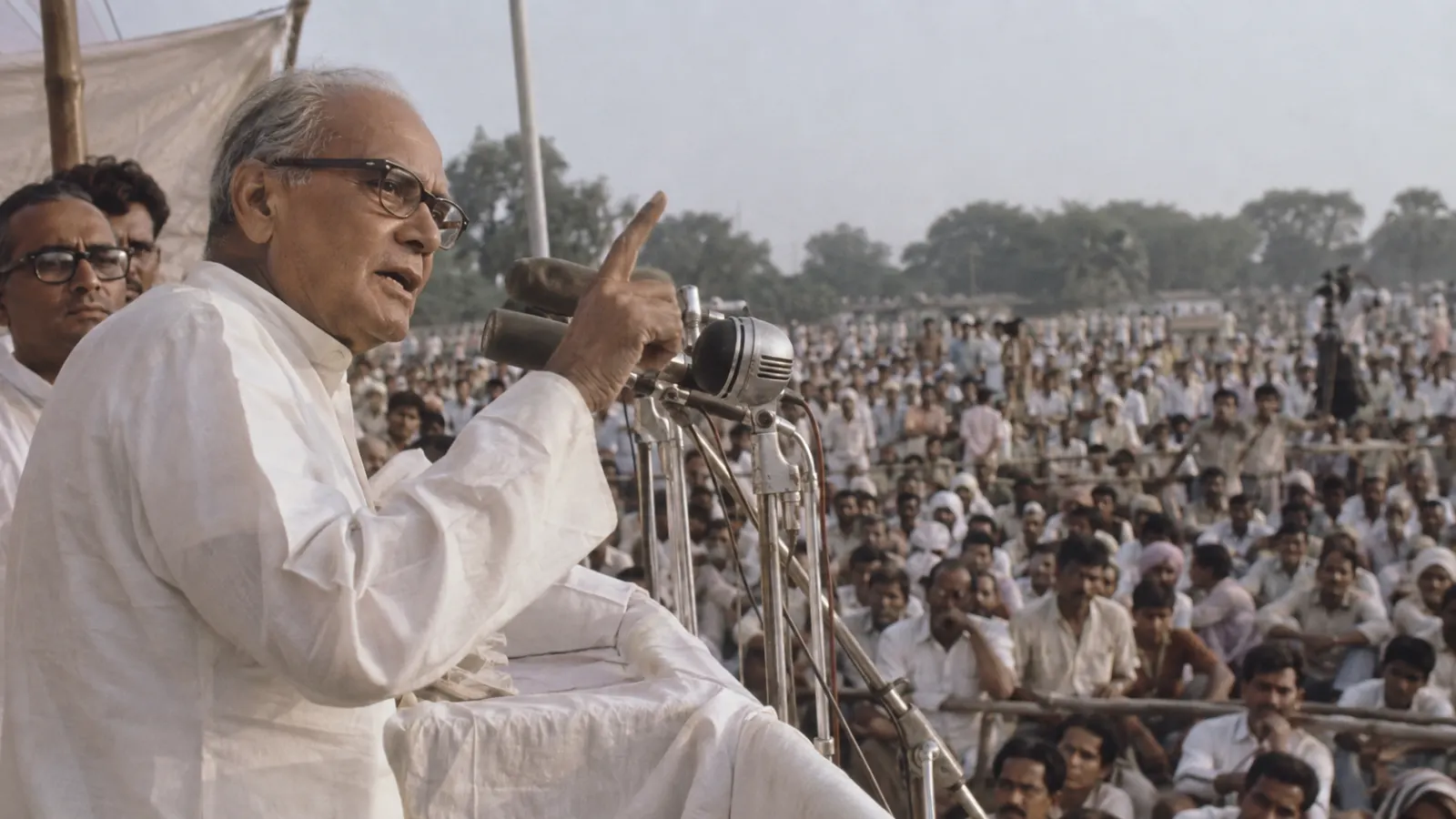
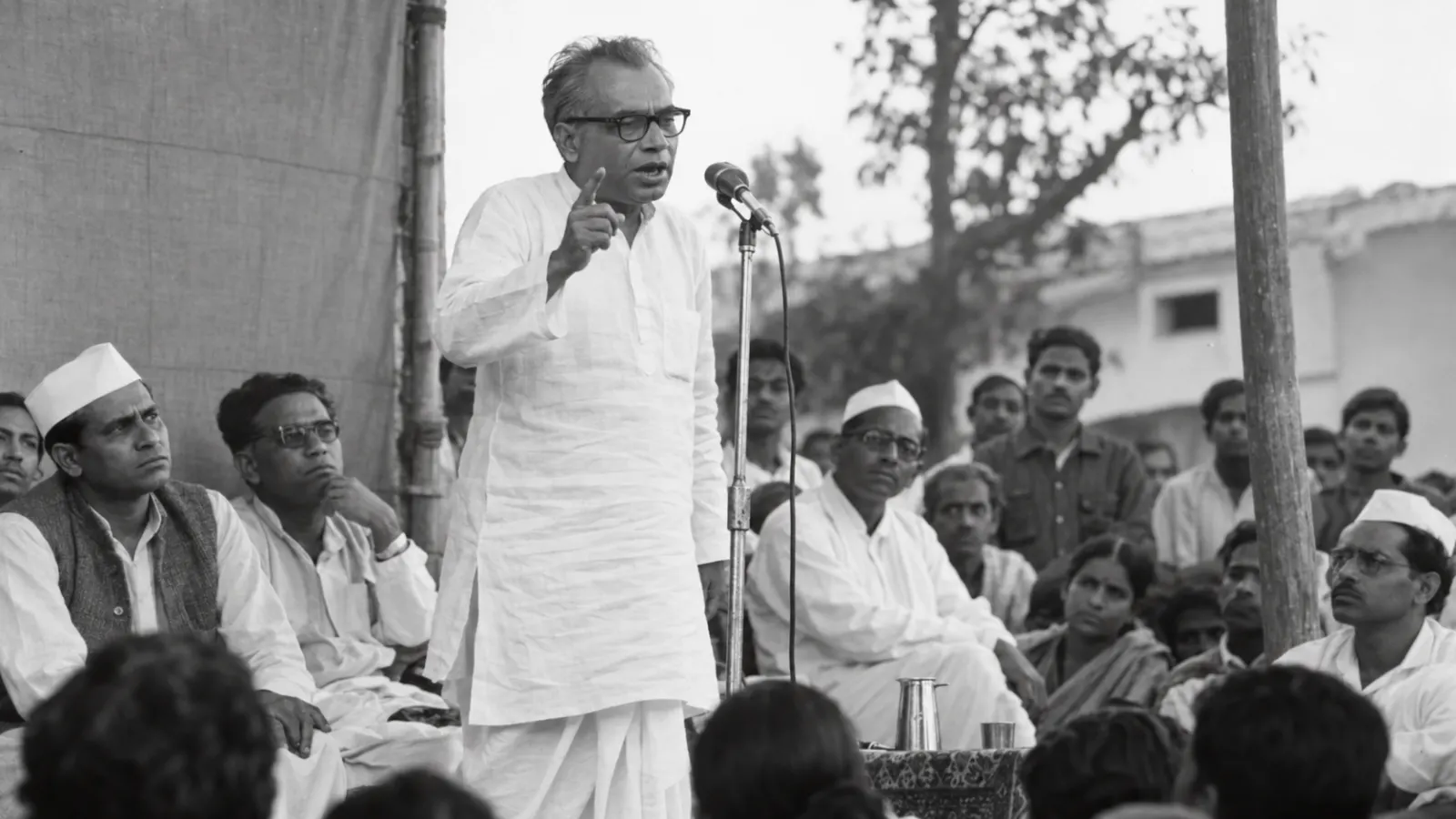
Lohia entered the Lok Sabha through a 1963 by-election from Farrukhabad and was re-elected in 1967. Parliamentary records portray him as an unusually combative opposition voice who combined constitutional politics with a continuing belief in civil resistance.
His parliamentary politics was designed to translate large questions into language ordinary citizens could understand.
He challenged government claims about poverty and public expenditure, questioned elite privilege and attacked the growing distance between rulers and the ruled. Statistics were political objects for him rather than neutral administrative facts. A claim about national development had to be tested against what an ordinary Indian could eat, earn or access.
This style could be polemical and sometimes deliberately provocative. But it reinforced an important principle: expertise in a democracy must remain answerable to public argument.
Lohia's distrust of concentrated authority also extended beyond India.
Colonialism had convinced him of the importance of national freedom, yet fascism and world war made him sceptical of treating national sovereignty as the final political value. His socialist writings therefore entertained the possibility of world government or a world parliament, stronger international institutions and disarmament. New-socialism summaries place world government alongside decentralisation and equality among his major political ideas.
The apparent contradiction is revealing.
Lohia wanted decentralisation below the nation and stronger political organisation above it.
The consistent principle was not the administrative level itself.
It was opposition to unchecked concentrations of power.
A central government should not dominate villages and districts.
A few military powers should not dominate the world.
A sovereign state should not possess unlimited moral authority simply because colonial rule had made national independence necessary.
The proposal for world government remained far less institutionally developed than his critique of national power. Yet it reveals that his socialism was never simply an Indian domestic programme. Anti-colonial nationalism was essential to him, but it was not his final political horizon.
An Unfinished Argument About Equality
Lohia died on 12 October 1967, aged fifty-seven, only months after elections had significantly weakened Congress dominance in several states. His parliamentary career had been short, but many political tendencies associated with him expanded dramatically after his death.
Backward-caste mobilisation, socialist parties, anti-Congress coalitions, demands for decentralisation and arguments over Hindi and English all drew selectively from his politics.
The word selectively matters.
No major later movement inherited the whole Lohia programme.
Parties inspired by his caste politics did not always reproduce his feminism.
Those invoking non-Congressism did not necessarily share his socialism.
Advocates of Hindi could detach his language politics from his wider attack on social privilege.
Decentralisation could be celebrated without his economic egalitarianism.
This fragmented inheritance reflects both the richness and weakness of Lohia's thought.
He recognised problems that political ideologies organised around a single axis often failed to see. Class did not erase caste. National independence did not abolish patriarchy. State ownership did not guarantee freedom. Modern technology did not automatically distribute prosperity. Democracy did not become socially representative simply because everyone had the vote.
Yet Lohia also left fewer detailed institutional answers than the breadth of his critique demanded. Small-machine economics raised difficult questions about productivity. Local democracy could reproduce local domination. Anti-English politics underestimated some advantages of multilingualism. Non-Congressism could strengthen democratic competition while weakening ideological coherence.
These contradictions are not reasons to dismiss him.
They are part of why he remains worth reading.
Ram Manohar Lohia's most enduring contribution may not be a specific economic model or electoral strategy. It was his insistence that political freedom has to be tested against the distribution of power inside society.
Who holds public office?
Who can enter elite institutions?
Whose language carries prestige?
Which caste networks reproduce authority?
Who controls economic resources?
How much power remains concentrated in capitals and bureaucracies?
Can women claim equality inside the household as well as the constitution?
Can individual liberty survive movements that claim to act for collective emancipation?
These questions prevented his socialism from becoming a theory concerned only with ownership.
They also explain why his thought continues to reappear in debates far beyond explicitly socialist politics.
Lohia spent his life rejecting ready-made answers: capitalism against communism, Gandhi against Marx, central planning against village romanticism, nationalism against internationalism.
His alternative was often incomplete.
But the question behind it remains powerful.
If independence changes who governs without changing who possesses social, economic and cultural power, how complete is freedom?
That unfinished argument about equality is Ram Manohar Lohia's most durable political legacy.