Jayaprakash Narayan: Socialism, Total Revolution and the Defence of Democracy
Jayaprakash Narayan occupies an unusual place in modern Indian political history because his influence repeatedly exceeded the formal offices he held. He was a Marxist-influenced socialist, an organiser of the Congress Socialist Party, an underground activist during the Quit India movement, a democratic socialist, a participant in Vinoba Bhave's Sarvodaya and Bhoodan movements and, late in life, the moral centre of the mass agitation that challenged Indira Gandhi's government before the Emergency.
These phases were connected by a recurring question: how can political and economic power be prevented from becoming domination?
Narayan's answers changed dramatically over time. In the 1930s he believed socialist transformation was necessary to overcome exploitation. After independence he became increasingly suspicious of both party competition and concentrated state power. In the Sarvodaya years he looked toward decentralised communities, voluntary action and nonviolent social reconstruction. By the 1970s he argued that elections alone could not protect democracy when parties, bureaucracy and executive authority became unresponsive or excessively centralised.
That intellectual movement makes him difficult to reduce to a single label.
Calling him “Lok Nayak”—the people's leader—captures the scale of his reputation but can make his politics appear more coherent than they actually were. His ideas contained genuine tensions. He distrusted charismatic and centralised authority but eventually became the symbolic centre of an enormous national movement. He criticised political parties while relying on opposition parties to translate protest into electoral change. He advocated decentralised democracy but never produced a fully worked institutional alternative to party-based representative government.
Those contradictions do not make his career less important.
They make it more useful for understanding the permanent difficulties of democracy: how citizens should respond to governments they believe are abusing power, where legitimate protest ends and destabilisation begins, and whether moral authority can transform institutions without itself becoming another form of concentrated power.
Government of India biographical material records Narayan's birth on 11 October 1902 in Sitabdiara in present-day Bihar, his participation in the freedom struggle, his role in the Congress Socialist Party, his later commitment to Sarvodaya and his leadership of the movement for “Total Revolution”. He died on 8 October 1979 and was posthumously awarded the Bharat Ratna in 1999.
From Sitabdiara to Marxism: Freedom Had to Mean More Than Independence
Jayaprakash Narayan's early political life was shaped by colonial India and the expanding mass nationalist movement.
He abandoned conventional education during the Non-Cooperation era and later studied at Bihar Vidyapith before leaving for the United States in 1922. He remained there for several years, moving through different universities while supporting himself through manual and service work. Government biographical accounts place his American period between 1922 and 1929.
The experience altered his political imagination.
The United States exposed him simultaneously to industrial productivity, labour conflict, poverty and enormous concentrations of wealth. He read Marxist literature seriously and became convinced that political independence without economic transformation would leave much of the underlying structure of exploitation intact.
This was a crucial distinction.
For Narayan, freedom could not simply mean replacing British officials with Indian rulers. A society in which millions remained poor, workers possessed little economic power and property was concentrated in relatively few hands could be politically independent while remaining deeply unequal.
His 1936 book Why Socialism emerged from this period of thought. The socialist Narayan placed class, ownership and economic exploitation near the centre of the political problem. Independence mattered, but it had to become freedom from poverty and exploitation as well as freedom from foreign rule.
When he returned to India in 1929, however, he did not attempt to construct a separate revolutionary movement outside the national struggle. He entered the Congress political world, where nationalism provided the broadest available vehicle for anti-colonial mobilisation.
That decision produced a tension that would follow him throughout his life: how could radical structural change be pursued without destroying the broad democratic coalition necessary to achieve it?
The Congress Socialist Party, established in 1934, represented one answer. Narayan became one of its central organisers and general secretary. The organisation sought to strengthen socialist ideas within the Congress while participating in the wider struggle against imperial rule. Accounts of the CSP's formation emphasise Narayan's role in organising workers, peasants and socialist groups while attempting to construct a broad anti-imperialist front.
The arrangement was inherently difficult.
Congress included liberals, conservatives, socialists, Gandhians and regional interests. Communists had their own ideological and organisational priorities. Socialists themselves disagreed about revolution, elections, class strategy and relations with Gandhi.
Narayan was therefore learning two political lessons simultaneously.
The first was that organised power was necessary.
The second was that organisations could quickly develop interests of their own.
His later distrust of party politics did not emerge from ignorance of political organisation. It emerged partly from having spent years inside it.
Quit India Revealed a More Radical Jayaprakash Narayan
The elder Jayaprakash Narayan is often remembered as a Gandhian advocate of peaceful democratic transformation. That image can obscure how radical his anti-colonial politics had once been.
During the Second World War he opposed Indian cooperation with the British war effort without freedom and was repeatedly imprisoned. After the launch of the Quit India movement in August 1942, much of the senior Congress leadership was detained, leaving underground activists to maintain resistance.
Narayan became one of the most prominent.
On 9 November 1942, he escaped from Hazaribagh Central Jail with five other prisoners and began working to revive underground resistance. A Gandhi heritage account records that after the escape he travelled across India and later moved into Nepal as part of efforts to organise resistance.
Government accounts also associate him with efforts to establish the Azad Dasta, an underground formation intended to continue the struggle against British rule. He was eventually rearrested in 1943 and remained imprisoned until 1946.
This period matters because it complicates any attempt to present his political development as a simple straight line toward Gandhian nonviolence.
Narayan had experienced clandestine organisation, prison escape and forms of resistance substantially more militant than his later Sarvodaya politics. His subsequent movement toward nonviolence therefore represented a genuine reassessment of political means rather than a lifelong refusal to consider revolutionary confrontation.
The question increasingly became not only who should possess power, but what particular kinds of political action did to the people and institutions using them.
If a movement seeking equality reproduced coercion, hierarchy and concentrated power, Narayan gradually came to doubt whether the final society would truly escape those same characteristics.
That concern would ultimately push him away from orthodox Marxism.
Independence Changed His Theory of Socialism Rather Than Ending It
Independence in 1947 answered the question of foreign rule, but it did not solve the inequalities that had originally drawn Narayan toward socialism.
He remained involved in democratic socialist politics and efforts to construct an alternative to the Congress. Yet conventional party competition increasingly frustrated him. Electoral politics required fundraising, factional negotiation, organisational discipline, candidate selection and the continuous pursuit of office. Narayan came to believe that parties could cease being instruments of social change and become organisations primarily concerned with obtaining and retaining power.
This diagnosis led him toward a radical conclusion.
Perhaps social transformation required politics outside the competition for state office.
By the early 1950s he was moving toward Sarvodaya, the Gandhian idea of the welfare or uplift of all, and toward the Bhoodan movement led by Vinoba Bhave. The movement sought voluntary land donations from landowners for redistribution to the landless.
Narayan's involvement gave the movement substantial political stature. Gandhi-related historical accounts describe him leaving conventional party politics and committing himself increasingly to Bhoodan, Gramdan and Sarvodaya during the 1950s.
At first glance this can appear to be a rejection of his earlier socialism.
The continuity was deeper than that.
Narayan remained concerned with inequality, poverty, land, exploitation and social hierarchy. What changed was his theory of the mechanism through which transformation should occur.
The young Marxist had placed greater faith in structural change through organised political power. The later Narayan feared that concentrating power in a revolutionary party or centralised state could reproduce another hierarchy. He became more interested in voluntary action, decentralised institutions, local self-government and changes in social relationships.
His own later writings explicitly presented Sarvodaya as a development beyond the limitations he had come to see in both communism and conventional democratic socialism. Gandhi-related scholarship on his ideological evolution records his belief that socialism required transformation toward a nonviolent and decentralised social order if freedom and equality were to be preserved together.
This was philosophically ambitious.
It was also politically vulnerable.
Voluntary land redistribution could expose the moral illegitimacy of extreme inequality, but voluntary generosity could not reliably substitute for enforceable land reform. Community cooperation could strengthen local power, but villages were themselves structured by caste, class and gender hierarchies. Removing formal party structures would not necessarily remove informal elites.
Narayan understood some of these problems but never fully solved them.
His concept of partyless democracy was therefore both a warning and an unresolved institutional theory.
Partyless Democracy Asked a Real Question Without Fully Answering It
Narayan's critique of political parties emerged from his belief that representative democracy could become too distant from ordinary citizens.
Elections every few years did not, in his view, exhaust democratic participation. Parties could select candidates from above, reduce citizens to voting blocs and concentrate decision-making in professional political organisations. Bureaucracy could become equally remote, producing government that acted upon communities rather than through them.
His alternative emphasised decentralisation and what might be called continuous democracy: local institutions, direct participation and greater citizen involvement between elections.
The attraction remains obvious.
Modern democracies routinely struggle with alienation, low trust, bureaucratic distance and party systems dominated by professional political elites. Narayan's insistence that democracy requires more than voting therefore anticipated concerns that remain familiar.
Yet partyless democracy contains its own risks.
Large societies contain conflicts over taxation, religion, class, language, development and distribution. Political parties aggregate these interests and publicly compete to govern. Removing formal parties does not remove disagreement. It may merely move political competition into less visible networks of caste, wealth, bureaucracy, religious organisation or local influence.
Informal power can be harder to hold accountable than a political party whose leaders and programme are publicly identifiable.
Narayan never produced a fully convincing solution to that problem.
This limitation is central to understanding his later career. By the 1970s he remained distrustful of conventional party politics, but when a national confrontation developed with Indira Gandhi's government, organised opposition parties became indispensable to transforming public agitation into an electoral alternative.
His career would eventually demonstrate both the weakness of parties and their necessity.
Bihar 1974 Turned a Moral Critic Back Into a Mass Political Leader
Jayaprakash Narayan's return to mass national politics emerged from a wider crisis rather than from a single personal rivalry with Prime Minister Indira Gandhi.
India in the early 1970s faced serious inflation, unemployment, shortages and allegations of corruption. Student-led protests had already shaken Gujarat. In Bihar, student organisations mobilised around corruption, education, prices and failures of administration and eventually appealed to Narayan for leadership.
His reputation mattered precisely because he had spent years outside the competition for government office.
To supporters, he appeared capable of criticising power without attempting simply to replace the person occupying it.
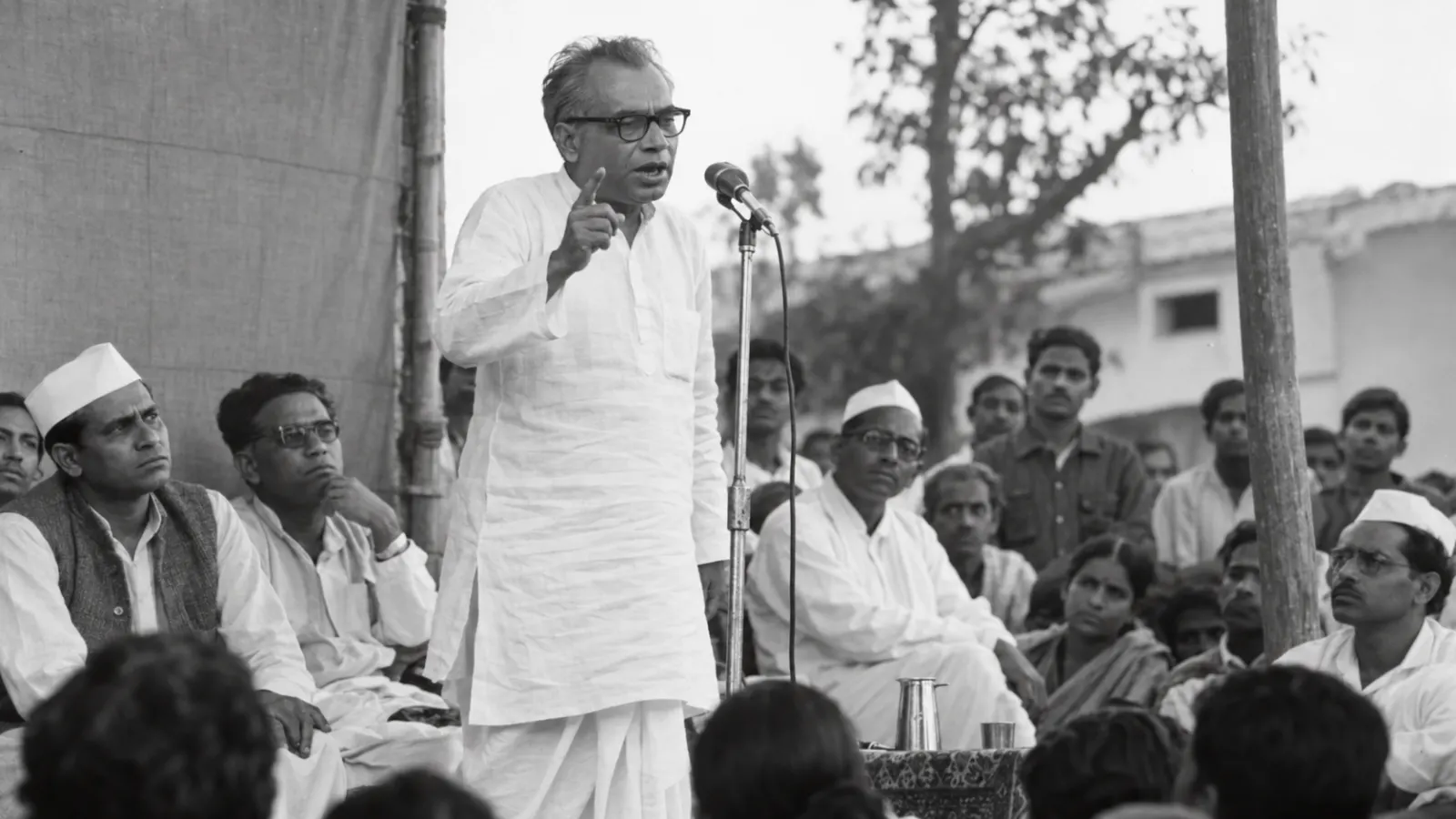
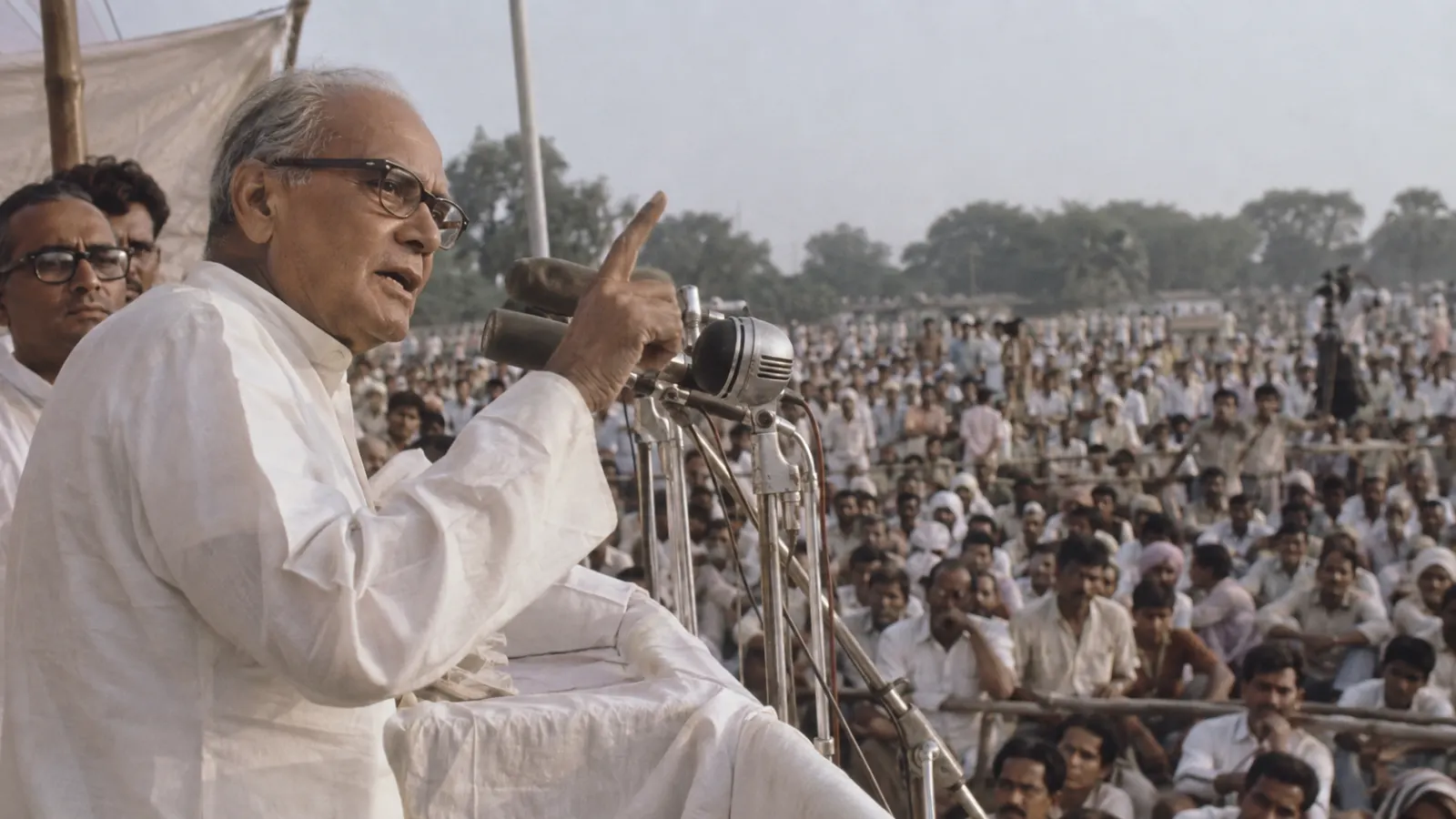
The Bihar agitation expanded rapidly under his influence. Narayan insisted on nonviolence and gradually gave the movement a broader political language. On 5 June 1974 at Gandhi Maidan in Patna, he called for Sampoorna Kranti—Total Revolution.
The phrase was far more ambitious than a demand for a state government's resignation.
Narayan later explained that Total Revolution meant transforming society and individuals across political, economic and social life rather than merely replacing one government. His 1975 explanation emphasised that such change would be long-term, peaceful and accompanied by constructive work as well as struggle.
This breadth explains the concept's power.
Almost every dissatisfied constituency could locate its grievance within Total Revolution. Corruption, caste hierarchy, economic inequality, education, administrative failure and centralisation could all be incorporated.
But what made the slogan inspiring also made it institutionally imprecise.
Who would implement a “total” transformation?
What democratic mandate would authorise it?
Which existing institutions would survive?
How would disagreement within the movement be resolved?
Narayan's writings contain proposals involving decentralisation, social change, nonviolence and popular participation, but Total Revolution remained stronger as a democratic ethic and mobilisation strategy than as a constitutional blueprint.
That distinction is important because the movement soon raised a deeper question: what kinds of pressure may citizens legitimately use against an elected government?
The Pre-Emergency Movement Exposed a Genuine Constitutional Dispute
Narayan believed democratic citizenship included the right to organise resistance between elections.
Elections, legislatures and courts mattered, but he argued that citizens should not become passive until the next polling date if institutions were corrupt or authoritarian. His conception of democratic action included peaceful protest, non-cooperation, civil disobedience and satyagraha. In his writings on Total Revolution he explicitly argued that peaceful popular action was necessary alongside elections and legislative government.
Supporters regarded this as democratic accountability in its most active form.
Critics saw a danger.
An elected government retains constitutional authority until defeated, removed through lawful procedures or deprived of legislative confidence. If mass movements can demand that governments resign whenever enough citizens mobilise outside Parliament, opponents argued, electoral mandates could become permanently vulnerable to street pressure.
That disagreement sharpened dramatically in 1975.
On 12 June 1975, the Allahabad High Court set aside Indira Gandhi's 1971 election from Rae Bareli after finding electoral malpractice. On 24 June, Supreme Court Justice V. R. Krishna Iyer granted a conditional stay that allowed her to continue as prime minister while her appeal proceeded. The following day, opposition leaders led a major rally at Delhi's Ramlila Maidan.
At that rally, Narayan announced further satyagraha and repeated an appeal to government employees, police and armed forces not to obey what he called “illegal and immoral orders.” Contemporary accounts record the statement clearly.
The remark remains one of the most controversial moments of his career.
Supporters interpreted it as a principle familiar to constitutional government: state personnel are obligated by law, not by personal loyalty to a ruler, and should not carry out unlawful commands.
Critics argued that inviting police and military personnel to judge which government instructions they considered legitimate risked undermining the chain of command and encouraging insubordination. The Indira Gandhi government portrayed the opposition agitation more broadly as a threat to order and constitutional governance.
A serious assessment should preserve that disagreement.
Narayan consistently presented the movement as nonviolent and democratic. Yet mass civil resistance deliberately seeks to make ordinary governing more difficult. The boundary between legitimate democratic pressure and destabilisation is not always obvious simply because a movement rejects violence.
That ambiguity forms part of the history.
It does not, however, erase what followed.
The Emergency Changed the Meaning of the Conflict
During the night of 25–26 June 1975, a national Emergency was proclaimed under Article 352 of the Constitution on the ground of “internal disturbance”. Opposition leaders were arrested, including Jayaprakash Narayan. Press censorship was imposed and civil liberties were severely curtailed. Government historical material describing the period records widespread detention of political opponents and restrictions on fundamental freedoms.
Whatever one's judgment of the preceding agitation, the Emergency transformed the dispute.
The question was no longer merely whether Narayan had pushed opposition politics too far.
It became whether a democratically elected government could use emergency powers to suppress political opposition, censor the press and restrict civil liberties on such a scale.
For millions of Indians who opposed the Emergency, Narayan's warnings about concentrated executive authority now appeared vindicated.
His personal circumstances intensified the symbolism.
A man who had been imprisoned by British colonial authorities during the freedom struggle was now detained by the government of independent India. His health deteriorated severely during this period, and his ability to organise directly was reduced. Yet physical weakness increased rather than diminished his symbolic role.
The Emergency also reveals why the government's justification and the opposition's criticism should be distinguished analytically.
The government argued that disorder, economic disruption and political agitation required extraordinary measures to restore stability. Opposition figures argued that those measures destroyed precisely the civil liberties and institutional constraints that made democratic government legitimate.
In retrospect, the scale of censorship, detention and executive control has made the Emergency one of the defining warnings in India's constitutional history.
Narayan became inseparable from that memory.
1977 Demonstrated Both the Power and the Limits of His Politics
When Indira Gandhi announced elections in 1977, opposition forces were able to compete electorally again.
Several anti-Congress parties merged into the Janata Party, bringing together organisations and leaders with very different ideological histories. Narayan's prestige helped encourage this unity. Government accounts credit him with playing a major role in bringing non-Congress forces together before the election.
The electorate then delivered the decisive verdict.
The Congress was defeated at the national level, and India received its first non-Congress government at the Centre.
For Narayan, there was a striking consistency in what happened next.
He did not seek the prime ministership.
The most influential figure associated with the opposition movement declined to convert that influence into the highest executive office.
This reinforced the aspect of his reputation that made “Lok Nayak” meaningful: political leadership did not have to culminate in possession of state power.
The peaceful transfer of government was also democratically significant.
Narayan had helped lead extra-parliamentary agitation. Opposition parties had engaged in protest and civil resistance. The Emergency had temporarily closed ordinary democratic channels. Yet the ultimate transfer of power occurred through an election.
The ballot, rather than armed revolt or military intervention, settled the conflict.
But the Janata experience soon exposed the limitations of moral unity.
The coalition contained former Congress politicians, socialists, Bharatiya Jana Sangh leaders and other groups united substantially by opposition to the Emergency and Congress dominance. Once in government, ideological differences, leadership ambitions and factional struggles became much harder to suppress.
The Janata government collapsed before completing a full term.
For Narayan, already in poor health, this must have represented a bitter demonstration of an old problem.
It was possible to unite parties around what they opposed.
Governing required agreement about what should replace it.
Moral authority could encourage cooperation but could not substitute indefinitely for party organisation, coalition management, policy coherence and constitutional institutions.
The failure therefore complicates triumphalist interpretations of the JP movement without diminishing the importance of the democratic transfer of 1977.
His Alliances Also Remain Part of the Debate
The breadth of the anti-Emergency coalition has remained one of the most politically contested parts of Narayan's legacy.
He worked with socialists, Congress dissidents, the Bharatiya Jana Sangh and activists associated with organisations from ideological traditions that did not share his own socialist or Sarvodaya worldview.
Supporters argued that defending democratic freedoms required a coalition wider than ordinary ideological alliances.
Critics—particularly on parts of the Left and among secular opponents of the Jana Sangh—argued that Narayan's prestige helped legitimise organisations whose long-term political objectives differed significantly from his own.
This disagreement should not be resolved by pretending either that the coalition had no ideological contradictions or that cooperation proved Narayan had simply adopted every belief of those who supported him.
Anti-authoritarian coalitions routinely create this problem.
Groups can share an immediate objective—ending emergency rule, defending civil liberties or defeating an incumbent—without agreeing about the society they wish to build afterward.
The Janata Party's later divisions demonstrated how real those disagreements were.
Narayan's movement was powerful precisely because it gathered people who normally would not have acted together.
That strength contained the seeds of its later fragmentation.
The Most Important Continuity Was His Suspicion of Concentrated Power
Viewed across five decades, Narayan's ideological changes can look extreme.
He moved from Marxism toward democratic socialism, then Sarvodaya, decentralisation and ultimately Total Revolution. One interpretation is that he was politically inconsistent.
Another is that the underlying question remained remarkably stable.
He was repeatedly concerned with forms of power that allowed some people to dominate others.
During the socialist phase, economic ownership and class inequality occupied the centre of the problem.
During the Sarvodaya phase, he became increasingly concerned that centralised state power—even when exercised in the name of socialism—could itself become oppressive.
During the 1970s, his central concern became the concentration of political authority, corruption and the weakness of democratic accountability.
What changed was his understanding of where the danger lay and what institutional response might contain it.
His evolution also reflected a growing insistence that means shape ends.
A society supposedly pursuing equality through coercive political structures might reproduce domination. A democratic government could not defend democracy by destroying civil liberties. A protest movement claiming to defend freedom also had an obligation to remain nonviolent and accountable.
This is why his politics ultimately became as much ethical as institutional.
Yet ethics could not eliminate institutional problems.
Voluntary redistribution did not make legislation unnecessary.
Local democracy did not remove the need for national government.
Partyless politics could not prevent faction.
Moral leadership could not make coalition management disappear.
Narayan's great strength was identifying the danger of concentrated power.
His recurring weakness was underestimating how difficult it is to design durable institutions that disperse power without sacrificing coordination and accountability.
Why Jayaprakash Narayan Still Matters
Jayaprakash Narayan died on 8 October 1979, three days before his seventy-seventh birthday. Two decades later, the Government of India posthumously awarded him the Bharat Ratna in 1999.
His legacy is strongest when neither sanctified nor dismissed.
He was not a saint standing outside politics. He made strategic choices, entered controversial alliances and advanced institutional ideas that were sometimes incomplete. Total Revolution could inspire democratic renewal, but it could not by itself specify how a complex modern state should be governed. Partyless democracy exposed genuine weaknesses in representative systems without convincingly eliminating the need for organised political parties.
Nor was he merely an impractical idealist.
He identified problems that remain central to democratic life: excessive centralisation, corruption, bureaucratic distance, weak local participation, parties becoming disconnected from citizens and executives using legality to stretch or undermine constitutional restraint.
The Emergency gave those concerns lasting historical force.
But perhaps the most useful part of his legacy is not the slogan “Total Revolution”.
It is the democratic tension his life forces us to confront.
Elections give governments legitimacy, but they do not give governments unlimited authority.
Citizens possess the right to protest, but public mobilisation does not automatically carry the same mandate as an election.
Political parties are often self-interested and hierarchical, yet democracy cannot easily function without organisations capable of aggregating interests and accepting responsibility for governing.
Decentralisation can empower communities, but communities themselves may contain inequalities that require higher institutions to correct.
Moral leadership can challenge entrenched power, but no democracy should depend permanently on the virtue of one moral leader.
Narayan lived these contradictions rather than merely writing about them.
He spent his youth trying to overthrow colonial rule, his middle years searching for alternatives to conventional party politics and his final political phase warning that independent India itself could become dangerously centralised.
Few Indian leaders travelled across such different ideological worlds while returning so consistently to the same fundamental concern:
Who holds power, and who can hold that power accountable?
That question is why Jayaprakash Narayan remains historically important.
His answers were sometimes unfinished.
The question was not.