What Is Overfishing? Why Productive Seas Can Be Depleted
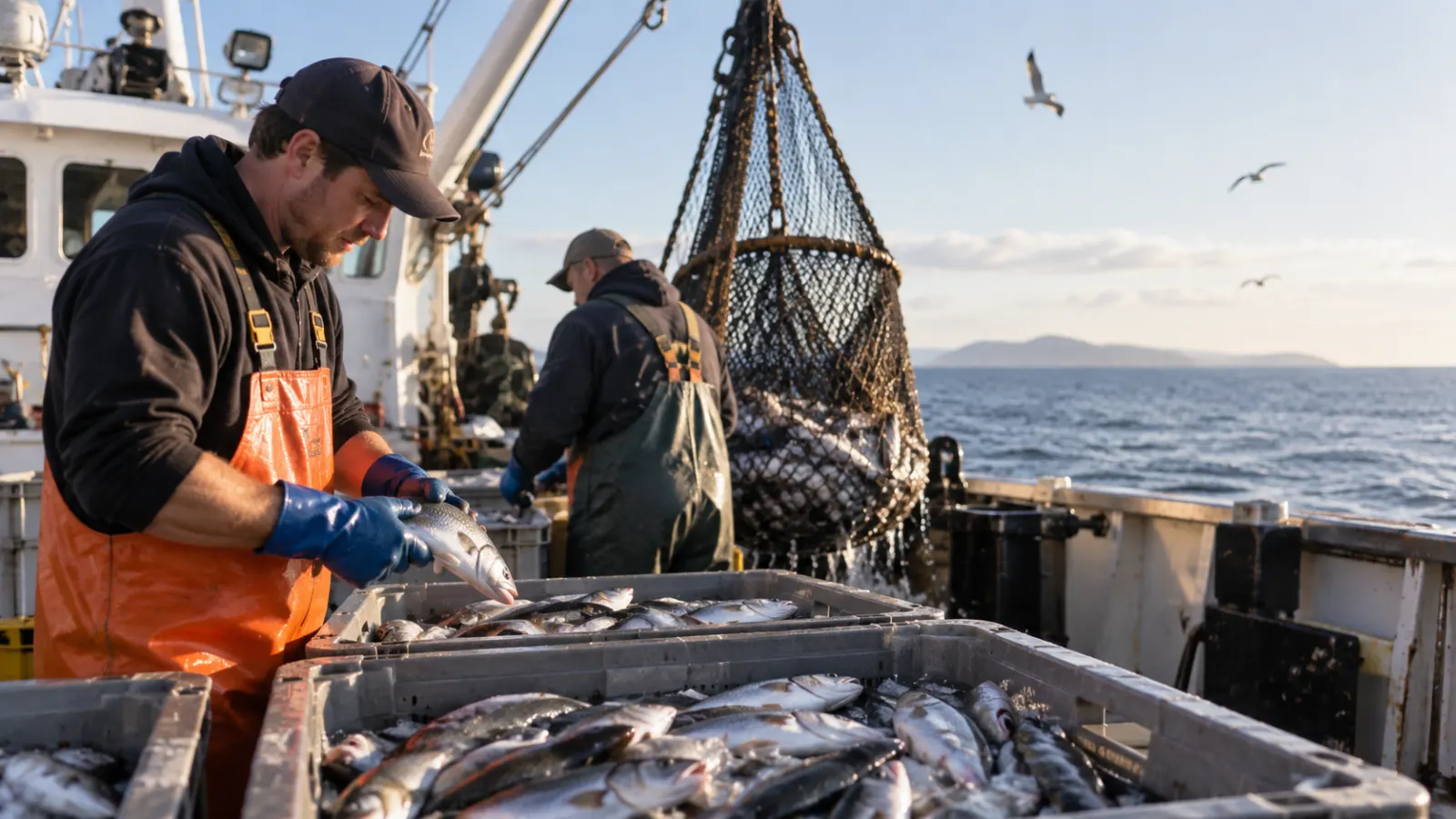
Overfishing can occur while a fishing port still looks prosperous. Boats return with fish, markets remain stocked and restaurants continue serving seafood. None of those observations alone tells us whether the population being harvested can replace what fishing removes.
That is the central biological problem.
Overfishing occurs when fishing mortality—the rate at which fish are removed by fishing—is too high to maintain a stock's productive capacity over time. If excessive fishing pressure continues, the number of breeding fish can decline, catches may eventually require more effort, and a stock can become depleted.
The problem is serious but should not be described as though every fishery is collapsing. FAO's 2025 Review of the State of World Marine Fishery Resources, the organisation's most comprehensive global stock assessment to date, evaluated 2,570 marine fish stocks. It found that 64.5% were exploited within biologically sustainable levels and 35.5% were classified as overfished. When results were weighted by production, 77.2% of global fishery landings came from biologically sustainable stocks. (fao.org)
Those numbers reveal two realities at once.
More than one-third of assessed stocks are in an overfished condition, which represents a major global sustainability problem. At the same time, most marine landings by volume come from stocks FAO considers biologically sustainable, and regions with strong fisheries management perform substantially better than the global average.
Overfishing is therefore not an unavoidable consequence of catching wild fish.
It is a problem of harvest exceeding biological renewal, shaped by how effectively fishing pressure is measured, allocated and controlled.
Overfishing Is a Rate; an Overfished Stock Is a Condition
Two fisheries terms that sound almost identical describe different things.
Overfishing refers primarily to fishing pressure. NOAA Fisheries defines it as a harvest rate above the level compatible with maximum sustainable yield under its management framework. Put more simply, fish are currently being removed too quickly. (fisheries.noaa.gov)
Overfished describes the condition of the population. The stock's biomass, or population size, has fallen below a management threshold. (fisheries.noaa.gov)
The distinction is important because the two conditions do not always occur simultaneously.
A stock may have been depleted by years of excessive fishing but no longer be experiencing overfishing because managers have subsequently reduced catches. Its population can still remain too small while rebuilding.
The reverse is also possible. A relatively abundant stock can begin experiencing excessive fishing pressure before its biomass has fallen below the overfished threshold. If that pressure continues, depletion may follow.
The management response therefore depends on what is wrong.
If the fishing rate is excessive, managers need to reduce mortality through catch limits, effort controls, gear restrictions or other measures. If the stock is already depleted, fishing pressure may need to remain lower for years while the population rebuilds.
Population recovery is not instantaneous because fish need time to survive, mature and reproduce.
This distinction also helps explain why a harbour can continue landing substantial quantities while scientists warn about overfishing. Current catch can remain commercially attractive during the early stages of excessive harvest because the underlying biological decline has not yet translated into collapse.
Fisheries management therefore cannot rely only on how many fish arrive at the dock today.
It has to estimate what is happening to the population beneath the water.
A Species Is Not the Same Thing as a Fish Stock
Statements such as “cod is overfished” or “tuna is sustainable” are often too broad to be useful.
Fisheries scientists usually manage stocks: biologically or geographically distinguishable populations that can be assessed and managed as units. One species can contain several stocks experiencing very different fishing pressure, productivity and environmental conditions.
A population in one ocean region may be healthy while another population of the same species is severely depleted.
This is why sustainable seafood claims become more meaningful when they identify the species, stock, location, gear and management system, rather than naming the species alone.
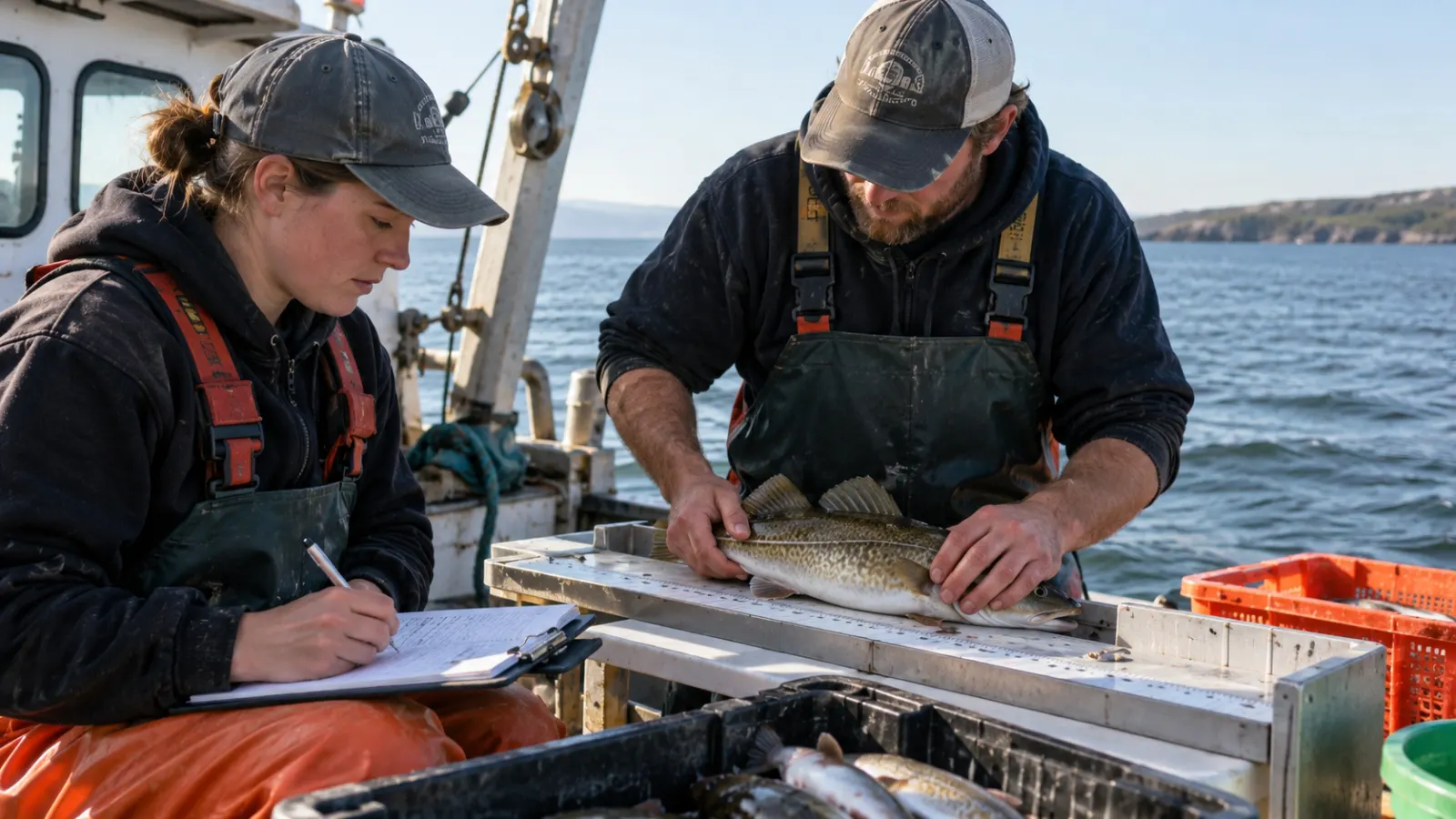
Scientists estimate stock condition using several kinds of evidence. Commercial catches show how many fish fisheries remove. Scientific surveys provide information independent of fishing fleets. Age and size data reveal population structure. Reproductive biology helps estimate how much spawning capacity remains. Fishing-effort data show how much activity is required to produce the catch.
Stock assessment models combine such information to estimate quantities such as biomass and fishing mortality.
Not every fishery has the same data quality.
Some major commercial fisheries have decades of scientific surveys, detailed catch records and sophisticated assessment models. Many smaller, tropical or data-limited fisheries have far less information.
That uncertainty does not mean managers should do nothing.
FAO's precautionary fisheries guidance recommends using provisional reference points and conservative management where information is poor, updating them as better evidence becomes available. It also emphasises target and limit reference points rather than treating fisheries estimates as perfectly precise biological constants. (fao.org)
Uncertainty is therefore part of responsible fisheries management.
The important question is how much risk managers are willing to take when the consequences of being wrong can include stock depletion.
The Global Numbers Show Both Pressure and the Value of Management
FAO's 2025 review considerably expanded the evidence base used for global marine-fishery assessment. More than 650 experts from over 200 institutions and more than 90 countries contributed to the review of 2,570 stocks. (fao.org)
The headline finding—64.5% of assessed stocks within biologically sustainable levels and 35.5% overfished—is concerning because it means a substantial share of assessed marine populations have been pushed beyond sustainable biological limits.
But an equally important result appears when catch volume is considered.
FAO reports that 77.2% of global landings come from biologically sustainable stocks. The stock-status assessments use information through 2023, while the review's official catch statistics extend through 2021. (fao.org)
The difference between the stock-count and landing-weighted measures is useful.
The 64.5% figure gives each assessed stock equal importance regardless of whether it supports a huge commercial fishery or a small one.
The 77.2% figure gives greater weight to stocks producing larger catches.
Neither measure should replace the other.
Together they show that poor stock status is widespread while also demonstrating that major fisheries can remain highly productive when effectively managed.
Regional comparisons make the management effect particularly visible. FAO reports that 92.7% of assessed stocks in the Northeast Pacific were sustainably fished, compared with the global average of 64.5%. (fao.org)
That does not prove that every management measure used in one region can simply be copied elsewhere. Fisheries differ ecologically, economically and institutionally.
It does undermine the fatalistic idea that wild fisheries inevitably destroy themselves.
Management changes outcomes.
Overfishing Usually Has Economic and Institutional Causes Behind the Biology
At the biological level, the problem sounds straightforward: too many fish are being removed.
The harder question is why fishing pressure remains excessive.
Fishing technology can substantially increase the ability of fleets to locate and capture fish. Sonar, satellite navigation, larger vessels, refrigeration, efficient gear and detailed knowledge of fishing grounds allow fleets to operate farther offshore and maintain catches under conditions in which less efficient fleets would have had to stop.
Greater efficiency is economically valuable.
Without effective management, it can also allow fishing pressure to remain high while natural abundance declines.
Shared access creates another difficulty.
A fish remaining in the sea today may grow, reproduce and become more valuable tomorrow. But an individual vessel may have little incentive to leave it there if another vessel can catch it first.
This is the classic logic of a shared-resource problem.
What makes sense for one operator—catch the fish while it is available—can become destructive when many operators respond to the same incentive.
Fishing capacity matters for similar reasons. A fleet containing far more vessels and gear than required to harvest the sustainable catch creates economic and political pressure to keep fishing.
Illegal, unreported and unregulated fishing can further undermine management because catches that escape monitoring weaken quotas and disadvantage fishers following the rules.
Subsidies require more careful treatment than simply describing them as inherently harmful. Some public support funds research, safety, infrastructure or small-scale livelihood development. Other forms of support can contribute to excess capacity or maintain fishing effort that would otherwise be economically unsustainable.
The institutional question is therefore not merely how much technology or money enters a fishery.
It is whether incentives reward operators for maintaining the stock or for extracting as much as possible before someone else does.
Management tries to change that incentive structure.
Catch shares, community-based management, territorial rights, effort controls, vessel limits, catch quotas and cooperative arrangements can work differently in different fisheries, but they share an objective: constrain individual extraction so that the collective resource remains productive.
Maximum Sustainable Yield Is a Reference Point, Not a Guarantee
One of the most familiar concepts in fisheries management is maximum sustainable yield, or MSY.
NOAA defines it as the largest long-term average catch that can be taken from a stock under prevailing environmental and fishery conditions. (fisheries.noaa.gov)
The idea reflects a basic feature of renewable resources.
A fish population can produce new biomass through growth and reproduction. If fishing removes only part of that production, catches can theoretically continue indefinitely. If mortality consistently exceeds the population's ability to replace those losses, the stock declines.
But MSY should not be interpreted as a perfectly stable number written into nature.
Fish recruitment—the number of young fish surviving into the population—can vary dramatically from year to year. Ocean temperature changes. Predators and prey fluctuate. Habitat quality changes. Stock-assessment models contain uncertainty.
FAO's precautionary approach therefore treats MSY within a wider system of biological reference points, uncertainty and pre-agreed management responses rather than assuming one calculation can safely determine every future catch. (fao.org)
Modern harvest-control rules can reduce fishing automatically when indicators deteriorate and allow more catch when stocks are stronger.
This approach acknowledges that fisheries management is a repeated decision under uncertainty, not a one-time calculation.
The central principle remains simple even when the mathematics becomes complicated:
Fishing cannot sustainably remove fish faster than the population and ecosystem can replace them.
Which Fish Are Removed Can Matter Alongside How Many
A population is not simply a pile of interchangeable kilograms.
Age and size structure can influence reproduction.
NOAA Fisheries notes that older or more diverse age structures can matter for reproductive success and that research has challenged the assumption that equal biomass of young and old fish necessarily produces equal reproductive output. In many species, larger and older females can produce disproportionately more offspring, and some evidence indicates that offspring from older mothers can have higher survival prospects. (fisheries.noaa.gov) (fisheries.noaa.gov)
This does not produce a universal rule that every fishery should protect all large fish.
Fish species have extremely different life histories.
Some mature quickly and reproduce frequently.
Others grow slowly, mature late and may take years to replace breeding adults.
The management tools therefore differ.
Minimum-size rules can allow juveniles to reproduce before capture. In other cases, protecting very large breeding individuals may also be useful. Seasonal closures can protect spawning periods. Area closures can protect spawning aggregations or nursery grounds. Gear modifications can change which sizes or species are caught.
A fast-growing sardine population should not be managed identically to a long-lived shark.
Sustainable fishing depends on the biology of the stock being harvested.
Bycatch and Habitat Damage Are Real Problems, but They Are Not Synonyms for Overfishing
A fishery can maintain its target stock at sustainable abundance and still create other environmental problems.
Bycatch refers broadly to marine animals caught incidentally or discarded during fishing. NOAA's operational definition includes discarded catch and some unobserved mortality caused by encounters with fishing gear. Bycatch can include non-target fish, marine mammals, seabirds and sea turtles. (fisheries.noaa.gov)
The severity depends on what is caught and how frequently.
Incidental mortality of an abundant fish population may have different ecological consequences from catching a highly endangered marine mammal or turtle.
Fishing gear can also interact with habitats. Some gears contact the seabed, and lost or abandoned gear can continue trapping or entangling animals.
These impacts should not be collapsed into the technical definition of overfishing because they describe different environmental mechanisms.
The distinction matters for management.
Reducing target-stock fishing mortality does not automatically eliminate turtle bycatch.
A sustainable target population does not prove that seabed impacts are acceptable.
Likewise, improving gear selectivity may greatly reduce bycatch while doing little to solve excessive total harvest of the target stock.
Environmental responsibility therefore requires several questions at once:
Is the target stock sustainably harvested?
What non-target species are being killed?
What habitats are affected?
How much gear is lost?
What broader ecosystem role does the harvested species perform?
A fishery cannot be evaluated completely with one biomass indicator.
Climate Change Makes Historical Fisheries Rules Less Reliable
Fisheries management has traditionally depended heavily on past observations.
Where did the stock occur?
How productive was it?
When did it spawn?
Which fishing communities historically caught it?
Climate change is making some of those relationships less stable.
NOAA reports that changing ocean conditions are already affecting the location and productivity of fish stocks, along with bycatch and interactions among fisheries. Stocks can become less productive or move outside the areas where traditional fishing fleets have historically encountered them. (fisheries.noaa.gov)
Temperature is especially important because many marine organisms occupy preferred thermal ranges. As waters warm, some populations are shifting poleward or deeper.
This can create ecological effects and governance problems simultaneously.
A stock historically concentrated inside one country's waters may increasingly occur in another country's jurisdiction. Fishing communities may find traditional grounds less productive while new species arrive. Quota-sharing agreements negotiated around historical distributions may become politically contentious.
Stock assessments can also become harder. Surveys designed around historical spawning or migration patterns may need to change when fish behaviour and distribution shift.
Climate change therefore does not make catch limits irrelevant.
It makes adaptive management more important.
Managers increasingly need climate-informed surveys, ecosystem indicators, flexible harvest-control rules and cooperation across jurisdictions.
The basic sustainability equation still applies: harvest must remain compatible with biological renewal.
But the renewal rate itself may be changing.
Overfishing Can Damage Economies Before a Stock Completely Collapses
A fish population does not have to disappear for overfishing to become economically costly.
An early warning can be declining catch per unit of effort. Fishers need more fuel, time, gear or searching to produce the same catch.
That increases costs.
If abundance continues falling, total catch may decline. Processing plants receive less product. Fishing income becomes less predictable. Employment and businesses in coastal communities can suffer.
The consequences can be particularly serious where households rely heavily on fisheries for both food and income.
Overfishing can also create ecological effects because fish species occupy different positions in marine food webs.
Depleting a predator can change the abundance or behaviour of prey.
Removing large quantities of forage fish can affect predators that depend on them.
Reducing herbivorous fish on reefs can influence competition between algae and corals.
These ecosystem responses are context-dependent and should not be described as though every depleted fishery produces the same cascade.
The broader point is that a commercially targeted population does not exist in isolation.
A sustainable fishery needs to consider the stock as part of an ecosystem as well as an economic resource.
This is one reason ecosystem-based fisheries management has become increasingly important. NOAA describes such approaches as considering ecological, economic and social variables across fisheries and habitats rather than evaluating each target stock in complete isolation. (fisheries.noaa.gov)
Depleted Fish Stocks Can Recover When Mortality Falls Enough
Overfishing is serious precisely because continued excessive mortality can deplete renewable populations.
The encouraging counterpart is that many fish stocks retain the biological ability to rebuild if enough breeding capacity remains, fishing mortality falls and environmental conditions allow successful reproduction.
Recovery is not automatic.
Some species reproduce quickly and can respond relatively rapidly to lower fishing pressure. Long-lived species that mature late can require much longer. Severe habitat damage, poor recruitment or climate-driven environmental change can slow recovery further.
But management can work.
FAO's 2025 global assessment found markedly better stock conditions in regions with long-term investment in monitoring, scientific assessment and effective fisheries management. In the Northeast Pacific, 92.7% of assessed stocks were within biologically sustainable levels; in the Southwest Pacific, the figure was 85%. (fao.org)
Those outcomes do not come from one universal policy.
Science-based catch limits may work in one fishery.
Effort limits may be easier to enforce in another.
Community or territorial management may be appropriate in small-scale coastal fisheries.
Seasonal closures can protect spawning periods.
Protected areas can protect important habitats.
Electronic monitoring and observers can improve compliance information.
Gear modifications can reduce unwanted catch.
International agreements become necessary where stocks move across national boundaries or spend part of their lives on the high seas.
The common principle is credible control of mortality.
A paper quota means little if catches are not monitored.
A protected season means little if illegal fishing is widespread.
A scientifically excellent stock assessment has limited value if political institutions repeatedly ignore its findings.
Fisheries management therefore combines biology with governance.
Scientists estimate what the stock can sustain.
Institutions determine whether human behaviour stays within those limits.
Consumers Can Support Better Fisheries, but They Cannot Govern the Ocean
Seafood certifications, sustainability labels and consumer guides can provide useful information.
Where reliable traceability exists, they can help buyers distinguish among fisheries using different stocks, gear types and management systems.
But the supermarket cannot carry the full burden of fisheries governance.
Consumers often do not know precisely which stock supplied a product. Seafood supply chains can involve processors, distributors, imports and mixed sources. Even an unusually informed consumer cannot independently enforce catch limits at sea.
Overfishing is fundamentally governed through stock assessment, access rules, monitoring, enforcement and cooperation among fishers and governments.
Consumer demand can reinforce responsible systems.
It cannot substitute for them.
This distinction is important because environmental problems are often reframed as individual purchasing choices even when the decisive institutions operate much further upstream.
Whether a stock is being overfished depends primarily on what happens on the water.
Overfishing Is a Solvable Renewable-Resource Problem
Fish are renewable resources.
Renewable does not mean unlimited.
A forest can regrow while still being cut faster than trees mature. Groundwater can recharge while still being pumped faster than an aquifer replenishes. Fish populations can reproduce while still being harvested faster than reproduction replaces them.
Overfishing is the marine version of that mismatch.
The latest global evidence should produce neither complacency nor fatalism.
FAO finds 35.5% of assessed marine stocks overfished, a substantial sustainability failure. Yet 77.2% of global landings come from stocks within biologically sustainable levels, and regions with strong management perform considerably better than the global average. (fao.org)
That means the choice is not between unlimited fishing and abandoning wild fisheries altogether.
It is between systems that allow extraction to outrun biological renewal and systems capable of keeping fishing mortality within limits that stocks can sustain.
Achieving the second outcome requires good biological information, precaution where information is weak, control of fishing capacity, credible monitoring, enforcement, cooperation with fishing communities and increasingly climate-responsive management.
Bycatch and habitat impacts must be addressed alongside target-stock abundance.
Shared stocks require cooperation across political boundaries.
Depleted stocks need enough time and reproductive capacity to rebuild.
And catch targets need to respond when ecosystems change rather than assuming past productivity will continue forever.
The most important lesson from fisheries science is therefore not that catching fish empties the ocean.
It is that catching fish faster than populations can replace themselves eventually undermines the productivity on which fishing depends.
A productive sea can support food and livelihoods for generations.
But only if today's catch leaves enough biological capacity to produce tomorrow's.