Waste Management: Meaning, Types, Process and What Happens After We Throw Things Away
You finish a bottle of water.
You place it in a bin.
For you, the object is gone.
For the waste system, its journey has only begun.
It may be:
collected by a municipal truck;
carried to a transfer station;
sorted at a materials recovery facility;
sold to a recycler;
washed and processed into secondary raw material;
burned for energy;
buried in an engineered landfill;
picked from the waste stream by an informal recycler;
or, where collection systems fail, dumped or burned in the open.
A food scrap may follow a completely different route.
A battery should follow another.
A broken refrigerator, construction debris, infectious medical material and industrial chemical waste require still different systems.
That is why waste management is not simply garbage collection.
It is the system through which societies decide:
what becomes waste,
whether it is collected,
whether useful materials are recovered,
how dangerous materials are controlled,
what happens to organic matter,
who performs the work,
who pays for it,
and ultimately,
what must be disposed of safely.
The most successful systems begin even earlier.
They ask whether the waste needed to exist at all.
Waste Management at a Glance
| Question | Short answer |
|---|---|
| What is waste management? | The collection, transport, sorting, treatment, recovery and safe disposal of waste, together with the policies and financing that make those services possible. |
| What happens after rubbish is collected? | It may go to a transfer station, sorting facility, composting or digestion plant, waste-to-energy facility or landfill depending on the local system and material. |
| What is the best way to manage waste? | Prevention and reuse generally rank above recycling, energy recovery and disposal in waste hierarchies. |
| Is all waste recyclable? | No. Recyclability depends on material, contamination, technology, collection systems and markets. |
| What is source segregation? | Separating waste into appropriate streams where it is generated, such as organics, recyclables and residual waste. |
| What happens to food waste? | Depending on the system, it may be composted, anaerobically digested, used in another recovery process or landfilled. |
| What is a materials recovery facility? | A facility that sorts mixed recyclable materials into marketable streams such as paper, metal, glass and some plastics. |
| Is incineration the same as open burning? | No. Controlled waste-to-energy facilities use engineered combustion and pollution controls; open burning does not. |
| What is a sanitary landfill? | An engineered disposal facility with systems for waste containment, leachate, stormwater and often landfill gas. |
| Why are waste pickers important? | Informal workers recover significant quantities of recyclable material in many cities, particularly where formal systems are incomplete. |
| What is extended producer responsibility? | A policy approach that assigns producers responsibility for some costs or management of products after consumers discard them. |
| Why is waste management a climate issue? | Waste can generate methane and other emissions, while reuse and recycling can reduce demand for virgin materials and manufacturing. |
What Is Waste Management?
A useful definition is:
Waste management is the organised prevention, collection, transport, sorting, recovery, treatment and environmentally controlled disposal of unwanted materials.
But even that definition is incomplete.
A functioning waste system also requires:
- laws;
- municipal budgets;
- vehicles;
- workers;
- land;
- processing facilities;
- markets for recycled material;
- environmental monitoring;
- public participation;
- product standards;
- and reliable data.
This makes waste management simultaneously:
an engineering problem,
a public-health service,
a labour system,
an environmental system,
and
a municipal-finance problem.
How Much Waste Does the World Produce?
The latest World Bank assessment provides one of the broadest current datasets.
What a Waste 3.0 draws on information from 217 countries and economies and 262 cities.
It estimates that the world generated approximately:
2.56 billion tonnes of municipal solid waste in 2022.
Without major changes, the World Bank projects:
3.86 billion tonnes annually by 2050.
That represents roughly a 50% increase in less than three decades.
This is important because the growth of waste is not simply following population.
Urbanisation, rising incomes and consumption patterns are also increasing the quantity of material entering municipal waste systems.
What Counts as Municipal Solid Waste?
The phrase municipal solid waste, or MSW, does not mean every form of waste produced by society.
It usually refers broadly to everyday solid waste from sources such as:
- households;
- shops;
- offices;
- institutions;
- restaurants;
- and similar municipal sources.
It should not automatically be confused with:
- mining waste;
- industrial process waste;
- agricultural residues;
- sewage sludge;
- hazardous chemical waste;
- construction and demolition waste;
- or specialised medical waste.
EPA similarly distinguishes MSW from waste streams such as construction and demolition debris and some industrial materials.
This distinction matters when comparing global waste statistics.
Why Different Global Waste Reports Give Different Numbers
Readers may encounter another major statistic:
UNEP's Global Waste Management Outlook 2024 estimated municipal solid waste at around:
2.1 billion tonnes in 2023
and projected approximately:
3.8 billion tonnes by 2050.
Meanwhile, the newer World Bank dataset reports:
2.56 billion tonnes for 2022
and
3.86 billion tonnes by 2050.
These figures should not simply be treated as one organisation being “wrong.”
Global waste estimates depend on:
- definitions;
- country reporting;
- data gaps;
- modelling;
- coverage;
- estimation methods;
- and publication timing.
The responsible approach is to identify the dataset being used and avoid mixing figures from different methodologies as though they belong to one statistical series.
For this article, the newest headline global generation figures come from What a Waste 3.0.
What Happens to Waste After You Throw It Away?
There is no single pathway.
A simplified municipal chain may look like:
Generation
↓
Source separation
↓
Collection
↓
Transfer or direct transport
↓
Sorting / treatment
↓
Material recovery / composting / energy recovery
↓
Residual disposal
But the exact journey depends heavily on:
- the city;
- the material;
- local infrastructure;
- regulation;
- household behaviour;
- contamination;
- and market demand.
Let's follow the system from the beginning.
Step 1: Waste Prevention
The most effective waste-management action can happen before anything reaches a bin.
EPA's non-hazardous materials hierarchy ranks:
source reduction and reuse
above:
recycling and composting,
followed by:
energy recovery,
then:
treatment and disposal.
The logic is straightforward.
If a product is never unnecessarily created or discarded, society avoids impacts associated with:
- raw-material extraction;
- manufacturing;
- packaging;
- transport;
- collection;
- processing;
- and final disposal.
What Is Waste Prevention?
Waste prevention can include:
- reducing unnecessary packaging;
- repairing products;
- reusing containers;
- donating usable goods;
- designing longer-lasting products;
- remanufacturing;
- reducing food waste;
- avoiding disposable products where appropriate;
- and using fewer materials in manufacturing.
EPA describes source reduction as the most environmentally preferred waste-management strategy.
This is why a serious waste strategy cannot begin only at the recycling bin.
Reuse Comes Before Recycling for a Reason
Suppose a glass bottle can be cleaned and used again.
Recycling it requires:
- collection;
- sorting;
- crushing;
- transport;
- melting;
- and remanufacturing.
Reuse may preserve more of the original item's value with less processing.
That does not mean reuse is automatically superior in every real-world life-cycle assessment.
Transport distance, cleaning requirements and product design matter.
But the broader hierarchy reflects an important principle:
preserving an existing product can require fewer resources than destroying it and recovering only its material.
Step 2: Source Segregation
Once waste is generated, one of the most important decisions happens at the point of disposal.
Do different materials enter the same bin?
Or are they separated?
This is source segregation.
A local system might ask households to separate:
- food and garden waste;
- paper;
- cardboard;
- glass;
- metals;
- plastics;
- residual waste;
- batteries;
- or hazardous household items.
The categories vary between cities.
That is not necessarily a problem.
The important rule is:
segregation should match the infrastructure that actually exists downstream.
Why Mixing Waste Creates Problems
Imagine putting:
- leftover curry;
- cardboard;
- broken glass;
- batteries;
- aluminium cans;
- and plastic film
inside the same bag.
The food contaminates the paper.
Broken glass creates safety risks.
Batteries can cause fires.
Plastic films can interfere with some sorting machinery.
Recoverable material loses value.
Source segregation improves the chance that individual material streams remain usable.
Cleaner Waste Is More Valuable Waste
A bale of relatively clean cardboard has a potential buyer.
Wet cardboard soaked in food residue may not.
Clean separated glass can be easier to process.
Mixed fragments contaminated with ceramics or other materials may be more difficult.
The same general principle applies to compost.
Food scraps free of plastic packaging can become useful feedstock.
Food mixed with:
- plastic;
- glass;
- chemicals;
- and other contamination
creates a much more difficult treatment problem.
Source segregation therefore affects both:
environmental performance
and
economics.
Step 3: Waste Collection
Collection is easy to overlook in wealthy cities because it often happens reliably in the background.
But it is one of the most basic pieces of urban infrastructure.
Waste that is not collected cannot reliably reach:
- recycling facilities;
- composting plants;
- controlled landfills;
- or other treatment systems.
Instead, it may accumulate in:
- streets;
- informal dumping areas;
- drains;
- rivers;
- or open fires.
Global Waste Collection Is Highly Unequal
What a Waste 3.0 reports collection rates as low as:
31% in Sub-Saharan Africa
and
67% in South Asia.
Those figures reveal why sophisticated recycling targets cannot be the first priority everywhere.
A city cannot create a high-performing circular economy if a substantial share of households do not receive basic waste collection.
In many rapidly growing cities, the immediate environmental priority may be:
universal collection + controlled disposal
before advanced recovery systems can operate at scale.
Collection Is a Public-Health Service
Uncollected waste can contribute to:
- blocked drainage;
- uncontrolled fires;
- unsafe scavenging;
- water contamination;
- vermin;
- neighbourhood pollution;
- and direct contact with hazardous materials.
That makes waste collection more comparable to:
- water supply;
- sanitation;
- drainage;
- or road maintenance
than to an optional environmental programme.
Before recycling is a circular-economy ambition, waste management is a basic urban service.
Why Waste Collection Is Expensive
A collection system requires:
- trucks;
- fuel;
- drivers;
- loaders;
- maintenance;
- depots;
- bins;
- route planning;
- transfer facilities;
- and management.
Collection must happen repeatedly.
A recycling plant may be constructed once and operated for years.
But trucks must still visit neighbourhoods every week—or more frequently.
This recurring service cost helps explain why municipal waste management is financially difficult, especially where local governments have:
- weak tax bases;
- rapid population growth;
- informal settlements;
- narrow roads;
- and limited capital.
Step 4: Transfer Stations
Not every collection truck drives directly to a landfill or recycling facility.
That can be inefficient if disposal sites are far from the city.
Instead, municipal trucks may unload at a transfer station.
Waste is then:
- consolidated;
- compacted;
- and loaded into larger vehicles
for long-distance transport.
Transfer stations can reduce:
- collection-truck travel time;
- fuel use;
- and operating costs.
They may also include limited sorting or material recovery.
Step 5: Materials Recovery Facilities
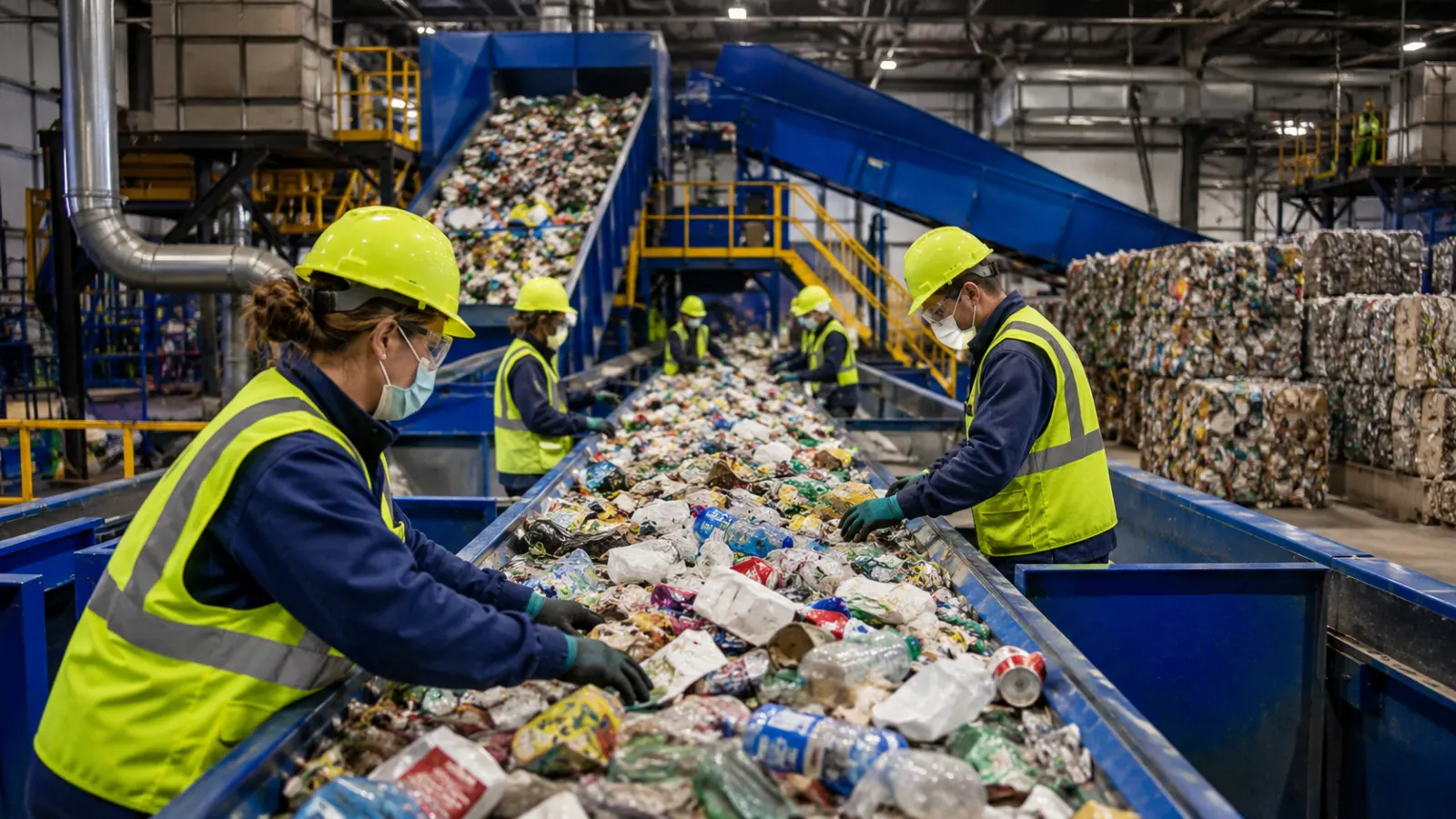
Dry recyclables often travel to a materials recovery facility, commonly called an MRF.
An MRF does not magically turn mixed rubbish into new products.
Its purpose is to separate potentially recyclable material into usable commodity streams.
Depending on the facility, sorting technologies may include:
- conveyor belts;
- screens;
- magnets;
- eddy-current separators;
- optical sorters;
- air classification;
- and manual sorting.
What Happens Inside a Recycling Facility?
A simplified process might look like this:
Cardboard and paper
Separated by screens or sorting systems.
Steel cans
Recovered using magnets.
Aluminium
Can be separated with eddy-current systems.
Plastics
May be identified by resin type, shape or optical properties.
Glass
Can be separated, crushed and cleaned depending on the system.
Contaminants
Removed for disposal.
The resulting materials are often compressed into bales and sold to processors or manufacturers.
Recycling Does Not End at the Sorting Facility
This is a major misconception.
Putting an item in a recycling bin is only the beginning.
A functioning recycling chain needs:
collection
→ sorting
→ processing
→ manufacturing
→ a market for recycled products.
EPA explicitly describes recycling as a chain that includes collecting, sorting and processing materials into feedstock and manufacturing them into new products.
Without buyers for the recovered material, recycling becomes economically unstable.
Is Everything With a Recycling Symbol Recycled?
No.
An item may be technically recyclable under certain conditions but not economically or practically recyclable in your local system.
Actual recycling depends on:
- local collection rules;
- sorting technology;
- contamination;
- material composition;
- colour;
- additives;
- markets;
- transport cost;
- and processing capacity.
That is why the correct household instruction is:
follow your local recycling system
rather than assuming every object marketed as recyclable belongs in the same bin everywhere.
Wishcycling Can Make Recycling Worse
Wishcycling describes putting questionable items into a recycling bin because you hope they can be recycled.
Examples can include:
- plastic bags in systems that do not accept them;
- contaminated food packaging;
- mixed-material products;
- broken household objects;
- batteries;
- hoses;
- cables;
- or electronics.
This can increase:
- contamination;
- sorting costs;
- equipment problems;
- and worker risk.
More items in a recycling bin does not necessarily mean more recycling.
Contamination Is One of Recycling's Biggest Problems
Imagine a load containing mostly recyclable paper.
Then liquid waste contaminates it.
Or glass shards become mixed through other materials.
Or food remains coat packaging.
The physical presence of recyclable material is not enough.
Material quality matters because recyclers are effectively producing secondary raw materials.
Manufacturers need those materials to meet specifications.
This makes recycling partly an industrial-quality-control system.
Recycling Is Also a Commodity Market
Recovered aluminium has a market value.
So does cardboard.
So do some plastics and metals.
Those prices change.
If the market price of recovered material falls while:
- collection;
- sorting;
- cleaning;
- and transport
remain expensive, municipal recycling programmes can face financial pressure.
This is why recycling policy increasingly looks beyond simply asking households to separate waste.
It also asks:
Who creates demand for recycled material?
Step 6: What Happens to Food Waste?
Organic materials require a different pathway from bottles and metal cans.
Municipal organics can include:
- food scraps;
- garden waste;
- leaves;
- grass;
- and some other biodegradable material.
Two major treatment options are:
composting
and
anaerobic digestion.
Composting
Composting relies on biological decomposition under oxygen-rich conditions.
Microorganisms break down suitable organic material.
Managed correctly, the result becomes a stable organic material that may be used to:
- improve soil;
- add organic matter;
- or support landscaping and agriculture depending on quality standards.
EPA includes composting with recycling in its preferred material-recovery tier.
Why Compost Needs Clean Inputs
Imagine trying to produce agricultural compost from food waste mixed with:
- batteries;
- glass;
- plastic fragments;
- cleaning chemicals;
- and metal.
The result becomes difficult to use safely.
This is why organics separation matters.
Composting is not simply:
“put food in a giant pile.”
Good systems manage:
- moisture;
- oxygen;
- temperature;
- carbon-to-nitrogen balance;
- contamination;
- odour;
- and maturation.
Anaerobic Digestion
Anaerobic digestion uses microorganisms in an oxygen-poor environment.
Organic materials are broken down and can produce biogas, containing methane that may be captured for energy.
A remaining digestate can potentially be used as a nutrient-containing material depending on:
- feedstock;
- contamination;
- treatment;
- and local regulation.
This makes anaerobic digestion both:
a waste-treatment process
and
an energy-recovery process.
Why Keeping Organics Out of Landfills Matters
When biodegradable material decomposes under anaerobic conditions inside landfills, it can generate methane.
Methane is a powerful greenhouse gas.
Modern landfills may collect part of this gas and:
- flare it;
- generate electricity;
- or use it as fuel.
But preventing suitable organic waste from entering landfill in the first place can reduce methane generation while potentially recovering:
- nutrients;
- compost;
- or biogas.
Step 7: Waste-to-Energy and Incineration
Some waste systems use controlled thermal treatment.
The most familiar example is municipal solid-waste incineration with energy recovery.
Waste is burned under controlled conditions.
The heat can produce:
- steam;
- electricity;
- district heating;
- or combinations of these.
EPA places energy recovery below recycling and composting but above treatment and disposal in its hierarchy.
Why Incineration Is Controversial
Supporters point to advantages such as:
- major reduction in waste volume;
- energy generation;
- reduced dependence on landfill space;
- and controlled treatment of residual waste.
Critics raise issues including:
- high construction cost;
- air emissions;
- ash management;
- long-term feedstock contracts;
- and the risk of creating competition with recycling or prevention.
The correct role depends heavily on:
- waste composition;
- regulation;
- energy markets;
- land availability;
- financing;
- and available alternatives.
Incineration Is Not the Same as Open Burning
This distinction is essential.
A modern engineered combustion facility can include systems for:
- controlled combustion;
- particulate removal;
- acid-gas control;
- continuous monitoring;
- and ash management.
An open waste fire has none of these safeguards.
Open burning can release uncontrolled:
- smoke;
- particulates;
- toxic compounds;
- and other pollutants.
Using the same word—“burning”—for both can conceal enormous differences in technology and environmental control.
Incineration Still Produces Residue
Waste does not disappear when burned.
Combustion produces:
- bottom ash;
- fly ash;
- air-pollution-control residues;
- and gases.
EPA notes that after energy recovery, a remaining ash fraction still requires disposal or other controlled management.
This is why waste-to-energy does not eliminate the need for landfill completely.
Step 8: Landfills
For many people, landfill means a giant pile of rubbish.
An engineered sanitary landfill is much more complicated.
Modern regulated facilities may incorporate:
- liners;
- leachate collection;
- stormwater controls;
- waste compaction;
- daily cover;
- groundwater monitoring;
- landfill-gas systems;
- final caps;
- and post-closure monitoring.
EPA describes modern landfills as engineered facilities subject to design, operation and closure requirements.
What Is Leachate?
Rainwater and moisture can move through waste and pick up dissolved or suspended contaminants.
The resulting liquid is called leachate.
A modern landfill therefore requires systems designed to:
- collect;
- contain;
- and treat or otherwise manage
this liquid.
Without such controls, leachate can threaten:
- groundwater;
- soil;
- and surface water.
What Is Landfill Gas?
Organic waste decomposing in landfill generates gases including:
- methane;
- carbon dioxide;
- and other compounds.
Engineered facilities may collect landfill gas through wells and piping.
The gas may then be:
- flared;
- treated;
- used for electricity;
- or upgraded for other energy uses.
Collection reduces uncontrolled release, although capture is not perfect.
Sanitary Landfill vs Open Dump
These terms should not be used interchangeably.
Sanitary landfill
Designed, operated and monitored to control environmental impacts.
Open dump
Waste is deposited without adequate environmental containment or operating controls.
Open dumps may experience:
- uncontrolled burning;
- scavenging under dangerous conditions;
- windblown litter;
- animal access;
- polluted runoff;
- and unstable waste slopes.
Where resources are limited, replacing open dumping with controlled disposal can itself produce major public-health benefits.
Does a Good Waste System Still Need Landfills?
Usually, yes.
Even highly effective recycling and composting systems generate residues.
Examples include:
- contaminated materials;
- sorting rejects;
- incinerator ash;
- non-recyclable products;
- and treatment residues.
The realistic goal is therefore generally not:
“nothing ever goes to landfill tomorrow.”
It is:
reduce unnecessary waste and safely minimise the residual fraction requiring final disposal.
What Happens to Plastic Waste?
Plastic does not have one single pathway.
Depending on the polymer and local system, plastic may be:
- reused;
- mechanically recycled;
- chemically processed;
- burned for energy;
- landfilled;
- dumped;
- or leaked into the environment.
The word plastic covers many materials with different properties.
A clear PET beverage bottle and a multilayer snack wrapper are not the same recycling problem.
Why Plastic Recycling Is Difficult
Plastic products can vary in:
- polymer;
- additives;
- pigments;
- layers;
- adhesives;
- labels;
- contamination;
- and shape.
Products may also combine:
plastic + metal + paper + adhesive
in one package.
Separating those materials may be technically difficult or uneconomic.
This is why product design affects waste-management performance.
A poorly designed package can become unrecyclable long before the consumer reaches the bin.
What Happens to Glass?
Where infrastructure exists, glass can be:
- sorted;
- cleaned;
- crushed into cullet;
- and remelted into new glass products.
But transport economics matter because glass is heavy.
Different colours and contamination can also affect processing.
A functioning glass-recycling programme therefore depends on both:
technical recyclability
and
local economics.
What Happens to Metal?
Metals are among the more economically valuable materials in many waste streams.
Steel can often be separated magnetically.
Aluminium can be recovered using eddy-current separation.
Recovered metals can then return to industrial processing.
This economic value explains why metal collection often occurs even in weak formal waste systems.
Informal recyclers have strong incentives to recover high-value metals.
What Happens to Paper and Cardboard?
Paper fibres can be:
- sorted;
- pulped;
- cleaned;
- and incorporated into new paper products.
But fibres degrade through repeated recycling.
Paper is therefore not infinitely recyclable.
Contamination also matters.
Cardboard soaked in:
- food;
- grease;
- chemicals;
- or water
may lose recovery value depending on local specifications.
Special Waste Cannot Simply Enter the Household Bin
A modern city generates many waste streams requiring specialised systems.
These can include:
- batteries;
- electronic waste;
- paint;
- solvents;
- fluorescent lamps;
- used oil;
- medical sharps;
- infectious material;
- tyres;
- construction debris;
- industrial chemicals.
Mixing them into ordinary municipal waste can create:
- fires;
- toxic exposure;
- contamination;
- or worker injury.
Why Batteries Are a Waste-System Problem
Rechargeable lithium-ion batteries are now present in:
- phones;
- laptops;
- power tools;
- e-bikes;
- toys;
- and many other products.
When damaged or crushed, some batteries can ignite.
A battery entering an ordinary recycling sorting facility can therefore create a serious fire hazard.
This is one reason dedicated battery-collection systems matter.
What Happens to Electronic Waste?
Electronic waste may contain both:
valuable materials
and
hazardous substances.
Potentially recoverable materials include:
- copper;
- gold;
- aluminium;
- steel;
- and specialised components.
But unsafe dismantling or burning can expose workers and communities to dangerous substances.
E-waste therefore requires specialised collection and processing rather than treatment as ordinary household rubbish.
Medical and Hazardous Waste Need Different Rules
Used syringes, infectious materials and certain chemicals create risks that ordinary municipal waste systems are not designed to manage.
Proper systems may require:
- separate containers;
- secure collection;
- specialised transport;
- disinfection;
- high-temperature treatment;
- or hazardous-waste disposal.
The phrase waste management therefore describes a family of systems rather than one universal disposal process.
What Is Extended Producer Responsibility?
Most traditional waste systems place end-of-life responsibility mainly on:
households + municipalities.
Extended producer responsibility, or EPR, changes that allocation.
Under EPR approaches, producers or importers may be made financially or operationally responsible for some aspects of collecting or managing products after use.
Common EPR targets include:
- packaging;
- electronics;
- batteries;
- tyres;
- and other specialised products.
The underlying principle is:
the cost of disposal should not fall entirely on municipal governments after products have been designed and sold by somebody else.
Why Product Design Belongs in Waste Management
Consider two products.
Product A:
- one material;
- easily separated;
- reusable;
- clearly labelled.
Product B:
- five bonded materials;
- non-removable battery;
- mixed adhesives;
- no repairability;
- no recovery route.
Both may be useful products.
But Product B has created a waste-management problem before it leaves the factory.
This is why modern waste policy increasingly intersects with:
- design;
- repairability;
- durability;
- packaging;
- recycled content;
- and producer responsibility.
EPA's sustainable materials-management framework similarly emphasises looking across the entire material life cycle rather than only end-of-life disposal.
Waste Pickers and the Informal Recycling Economy
One of the biggest omissions in simplistic waste diagrams is the worker.
In many cities, enormous quantities of material are recovered by:
- waste pickers;
- itinerant buyers;
- scrap dealers;
- informal sorters;
- and small recycling businesses.
What a Waste 3.0 estimates that the urban waste sector employs about 18 million workers globally, with informal workers particularly important in lower-income countries.
Informal Does Not Mean Unimportant
A waste picker recovering:
- aluminium;
- cardboard;
- PET bottles;
- or metal
is performing a material-recovery service.
That work may reduce the quantity reaching:
- streets;
- dumps;
- landfills;
- or municipal collection systems.
Yet workers can face:
- dangerous sorting conditions;
- unstable prices;
- injuries;
- smoke;
- contaminated materials;
- stigma;
- and lack of social protection.
A modernisation programme that simply bans informal workers can therefore destroy livelihoods while also eliminating an existing recycling system.
Formalisation Should Not Mean Erasure
A more inclusive strategy can involve:
- cooperatives;
- contracts;
- protective equipment;
- identification;
- access to sorting facilities;
- guaranteed collection zones;
- social protection;
- fairer commodity chains;
- and integration into municipal services.
The goal should be:
safer, more secure recovery work
rather than assuming every informal actor is merely part of the problem.
Why Waste Management Costs So Much
Waste services do not generate enough direct revenue to pay for themselves automatically.
Residents produce waste every day.
Collection therefore requires a continuous system.
What a Waste 3.0 reports that global municipal waste management already costs more than US$250 billion per year and projects direct costs of around US$426 billion by 2050 under business-as-usual conditions.
Those costs include only part of the real economic burden.
Poor Waste Management Is Expensive Too
The tempting political response to expensive waste management is:
spend less.
But failure also creates costs.
The World Bank points to economic losses associated with:
- uncollected waste;
- open burning;
- illegal dumping;
- pollution;
- and flooding from waste-blocked drains.
It reports that these wider costs can exceed the expenditure required to operate proper waste systems.
So the relevant question is not:
“Does waste management cost money?”
Of course it does.
It is:
“What does society pay when it fails?”
Municipal Finance Is at the Centre of the Waste Crisis
The World Bank estimates that achieving basic universal collection and environmentally sound disposal in middle-income countries can require roughly 0.3–0.5% of GDP, while reported public expenditure across many low- and middle-income countries remains below 0.15% of GDP.
That is a large financing gap.
Waste management therefore depends on combinations of:
- local taxation;
- user charges;
- national grants;
- producer fees;
- private investment;
- development finance;
- and revenue from recovered materials.
No recycling technology can compensate for a municipality that cannot pay its collection workers.
Waste Management and Climate Change
Waste affects climate through several pathways.
The most direct is methane from decomposing organic material.
But climate impacts also occur upstream.
When a product is discarded and replaced, new materials may need to be:
- mined;
- harvested;
- refined;
- manufactured;
- and transported.
Waste prevention and material recovery can therefore reduce emissions when they avoid more resource-intensive production.
Why Recycling Can Reduce Upstream Emissions
Suppose aluminium is recovered from discarded cans.
That recycled metal can potentially displace part of the need for aluminium made from virgin ore.
The climate effect therefore does not come simply from:
“keeping a can out of landfill.”
It can also come from:
avoiding part of the upstream extraction and manufacturing chain.
This life-cycle perspective is why EPA's sustainable materials approach looks beyond the waste facility itself.
Waste Prevention Can Be More Powerful Than Disposal Technology
Imagine two cities.
City A
Generates enormous amounts of disposable material but operates an advanced disposal system.
City B
Generates substantially less unnecessary waste and safely manages the remainder.
City A may have impressive technology.
City B may still produce the better overall materials outcome.
That is why waste hierarchies put prevention first.
The most advanced incinerator or landfill is still managing a material that has already become waste.
What Is the Circular Economy?
Traditional material systems are often described as:
take → make → use → discard.
A circular economy tries to keep:
- products;
- components;
- and materials
in productive use for longer.
Strategies can include:
- durability;
- repair;
- reuse;
- remanufacturing;
- sharing;
- recycling;
- and material redesign.
Waste management is therefore only one part of circularity.
A circular economy that begins at the recycling bin has begun too late.
Zero Waste Does Not Literally Mean No Residue Tomorrow
The phrase zero waste can create unrealistic interpretations.
In policy and planning, it generally refers to dramatically reducing:
- unnecessary material use;
- disposal;
- and uncontrolled waste
through prevention, reuse and circular systems.
Real economies still create difficult residual streams.
The useful question is therefore not whether one city has achieved mathematical zero.
It is whether the system is progressively:
preventing waste,
recovering value,
and
reducing harmful disposal.
What Does UNEP Say About the Economics of Waste?
UNEP's 2024 global outlook provides a complementary perspective.
It estimated direct global municipal waste-management costs at approximately US$252 billion in 2020.
When wider costs from:
- pollution;
- poor health;
- and climate impacts
were included, the figure rose to about US$361 billion.
Under business as usual, UNEP projected combined annual costs could exceed US$640 billion by 2050.
Its modelling also found that stronger circular-economy approaches could dramatically improve the economics of the waste system.
The larger lesson is clear:
waste prevention is not merely an environmental preference; it can also be an economic strategy.
Why Data Is Part of Waste Infrastructure
Cities cannot manage waste effectively if they do not know:
- how much they generate;
- what it contains;
- where it is produced;
- what is collected;
- what is recycled;
- what is dumped;
- and what services cost.
Waste data therefore belongs alongside:
- trucks;
- bins;
- transfer stations;
- and landfills
as part of the management system.
EPA similarly emphasises measurement as essential to identifying opportunities for better materials management.
Waste Composition Matters
Suppose City A's municipal waste is:
very high in food and organic matter.
City B generates much larger quantities of:
paper, packaging and plastics.
Giving both cities the exact same infrastructure plan would make little sense.
City A may benefit greatly from:
- composting;
- digestion;
- and organics separation.
City B may need greater:
- dry-recyclables capacity;
- packaging policy;
- and material markets.
The correct technology follows the waste stream.
Not the other way around.
Seasonal Changes Matter Too
Waste composition can change during:
- festivals;
- tourist seasons;
- harvests;
- university terms;
- extreme weather;
- holidays;
- or construction cycles.
A city that designs its entire system from one short waste audit may misjudge capacity requirements.
Regular characterisation studies can reveal:
- material proportions;
- contamination;
- density;
- moisture;
- and seasonal trends.
Weighbridges Are More Important Than They Look
A landfill or transfer station weighbridge provides basic information:
how much material entered?
Without reliable weighing, cities may be forced to estimate based on:
- truck volume;
- number of trips;
- or rough assumptions.
That reduces the quality of:
- planning;
- billing;
- emissions estimates;
- and facility design.
Good waste data often begins with something as mundane as weighing trucks correctly.
Illegal Dumping Is a System Performance Indicator
A city can report a respectable recycling percentage while some neighbourhoods still receive unreliable collection.
That is why system performance should not be reduced to one number.
Useful measures include:
- collection coverage;
- missed collections;
- illegal dumping;
- contamination;
- recycling yield;
- compost quality;
- residual disposal;
- facility emissions;
- worker injuries;
- service affordability;
- and geographical equity.
A 70% recycling rate means little to a neighbourhood where waste is still burned in the street.
Recycling Rate Can Be Misleading
Suppose two cities both report a 50% recycling rate.
City A prevented large amounts of waste and has low total generation.
City B generates twice as much waste but sorts half of it.
The recycling percentage alone can hide this difference.
Likewise, reporting the quantity collected for recycling is not necessarily the same as reporting what was successfully recycled into usable material.
Measurement definitions matter.
Waste Management Is Also an Equity Issue
Waste infrastructure has a physical location.
That means someone lives near:
- landfills;
- transfer stations;
- recycling facilities;
- incinerators;
- or dumping areas.
Environmental burdens are not always distributed equally.
Low-income and politically marginalised communities can bear disproportionate exposure to:
- odour;
- traffic;
- smoke;
- litter;
- noise;
- and pollution.
A high-performing system therefore needs to ask not only:
“Is the waste managed?”
but
“Who bears the cost of managing it?”
Exporting Waste Does Not Make the Problem Disappear
Some recyclable or mixed waste is traded internationally.
That trade can be legitimate when:
- materials have genuine commodity value;
- receiving facilities meet environmental standards;
- and processing is transparent.
It can become problematic when countries effectively export:
- contamination;
- disposal;
- or hazardous processing risk
to places with weaker controls.
Moving waste across a border does not erase responsibility for what happens next.
Open Burning Is Not Waste Management
Where collection is unreliable, households sometimes burn waste because it is the only available way to remove it.
This can reduce the visible pile.
It does not make the material environmentally disappear.
Burning mixed household waste can release:
- particulate matter;
- toxic smoke;
- and combustion products
directly into neighbourhood air.
The long-term solution therefore cannot simply be:
tell households to stop burning.
If no collection service exists, the system must provide a practical alternative.
Public Behaviour Matters—but Infrastructure Comes First
Consumers can help by:
- following sorting rules;
- avoiding unnecessary waste;
- keeping recyclables clean;
- composting where suitable;
- using designated battery or e-waste collection;
- and choosing reusable products.
But household behaviour cannot compensate for absent systems.
A perfectly separated bag of recyclable material still cannot be recycled if:
- the truck mixes everything together;
- no sorting facility exists;
- or no processor will buy it.
Individual responsibility and infrastructure must align.
Why Recycling Education Sometimes Fails
Cities often respond to contamination by producing more posters.
Education can help.
But confusion may come from system design.
If packaging contains:
- dozens of symbols;
- unclear labels;
- inconsistent rules;
- and different instructions between neighbouring municipalities,
even motivated residents make mistakes.
Better systems should therefore make the correct action:
clear, convenient and consistent.
There Is No Single Best Waste Technology
EPA explicitly states that no one waste-management approach is suitable for every material and circumstance.
This principle is crucial.
A city should not begin by saying:
“We need an incinerator.”
or
“We need a recycling plant.”
or
“We need composting.”
It should begin by asking:
What waste do we generate?
How much is collected?
What could be prevented?
What can be separated cleanly?
What markets exist?
What can the municipality afford to operate?
What residual waste remains?
Technology comes after diagnosis.
What Does a High-Performing Waste System Look Like?
A strong system usually combines several layers.
1. Prevention
Reduce unnecessary material generation.
2. Reuse
Keep products and components in service.
3. Universal collection
Ensure households and businesses can safely remove waste.
4. Source segregation
Keep useful and hazardous streams separate.
5. Material recovery
Recover economically and environmentally useful recyclables.
6. Organics management
Compost, digest or otherwise appropriately manage biodegradable material.
7. Special-waste systems
Provide dedicated routes for batteries, electronics and hazardous material.
8. Controlled residual treatment
Use appropriate energy recovery or other treatment where justified.
9. Environmentally sound disposal
Safely landfill residual waste.
10. Worker protection
Include both formal and informal workers in system design.
11. Sustainable finance
Pay for the system continuously.
12. Reliable data
Measure what actually happens.
No single facility can perform all twelve functions.
What Happens to Your Rubbish: A Simple Example
Imagine a household separates four streams.
Food waste
Collected → composting or anaerobic digestion.
Paper, metal, glass and accepted plastics
Collected → MRF → sorted → processors → manufacturers.
Batteries
Taken to specialised collection → battery recovery or hazardous treatment.
Residual waste
Collected → possible treatment or energy recovery → engineered landfill.
That is the idealised version.
Real systems contain:
- contamination;
- losses;
- rejected material;
- transport;
- economics;
- and human decisions.
Waste management is therefore a chain in which failure at one stage affects every stage after it.
Common Myths About Waste Management
Myth 1: Once rubbish leaves my house, it disappears
False.
It has simply entered another physical system.
Myth 2: Everything in the recycling bin gets recycled
False.
Contamination, sorting losses and lack of markets can send material to disposal.
Myth 3: Anything labelled recyclable belongs in my recycling bin
False.
Local system capability determines what is accepted.
Myth 4: Landfills are simply holes in the ground
Modern sanitary landfills are engineered containment systems.
Myth 5: Incineration makes waste disappear
It reduces waste volume but still creates emissions and ash that must be managed.
Myth 6: Composting is just letting food rot
Managed composting controls biological decomposition to produce a stable material.
Myth 7: Recycling is always the best option
Prevention and reuse generally rank higher, and the best treatment depends on material and circumstances.
Myth 8: Waste pickers are outside the recycling system
In many cities they are central to material recovery.
Myth 9: Waste is only an environmental problem
It is also a public-health, labour, finance, engineering and governance issue.
Myth 10: One new technology can solve the waste crisis
No technology eliminates the need for prevention, collection, financing and safe residual disposal.
Waste Management Hierarchy
A simplified hierarchy looks like this:
| Priority | Approach | Basic idea |
|---|---|---|
| 1 | Prevention | Avoid creating unnecessary waste |
| 2 | Reuse | Use products or components again |
| 3 | Recycling / composting | Recover materials and nutrients |
| 4 | Energy recovery | Recover usable energy from suitable residual waste |
| 5 | Treatment | Reduce toxicity or manage waste before disposal |
| 6 | Disposal | Safely isolate remaining residual material |
EPA uses this hierarchy while emphasising that no one approach is appropriate for every stream.
Frequently Asked Questions
What is waste management?
Waste management is the system used to prevent, collect, transport, sort, recover, treat and safely dispose of unwanted materials.
What are the main stages of waste management?
Typical stages include:
generation;
source separation;
collection;
transport or transfer;
sorting;
recycling or biological treatment;
energy recovery where appropriate;
and final disposal.
How much municipal waste does the world produce?
The World Bank's What a Waste 3.0 estimates approximately 2.56 billion tonnes in 2022, potentially rising to 3.86 billion tonnes annually by 2050 under business as usual.
What is the waste-management hierarchy?
It ranks preferred strategies broadly from prevention and reuse to recycling, energy recovery and finally treatment and disposal.
Why is waste prevention better than recycling?
Prevention can avoid impacts associated with producing, transporting, collecting and processing the material in the first place.
What is source segregation?
It means separating different waste streams at the point where waste is generated.
What happens to recyclables after collection?
They may be sorted at a materials recovery facility, processed into secondary raw materials and sold to manufacturers.
Does everything put in a recycling bin get recycled?
No. Some material is contaminated, incorrectly sorted, technically unsuitable or lacks a viable recycling market.
What happens to food waste?
Depending on local infrastructure, it may be composted, anaerobically digested, treated through another process or landfilled.
What is anaerobic digestion?
It is biological decomposition without oxygen that can generate biogas and a nutrient-containing digestate.
What happens to rubbish in a landfill?
Waste is placed and compacted in an engineered disposal facility. Modern sites manage factors such as leachate, stormwater and landfill gas.
What is landfill methane?
Methane is produced when biodegradable material breaks down under oxygen-poor landfill conditions.
Can landfill methane be used?
Some engineered landfills capture the gas and use it for energy or flare it.
What is waste-to-energy?
Waste-to-energy describes processes that recover usable heat, electricity or fuel from waste, commonly through controlled combustion.
Is waste-to-energy better than recycling?
Not generally for materials that can be effectively reused or recycled. Waste hierarchies usually place material recovery above energy recovery.
What is the difference between incineration and open burning?
Engineered incineration uses controlled processes and pollution-control systems. Open burning lacks those controls.
Why is illegal dumping dangerous?
It can contribute to fires, blocked drains, polluted water, pests, unsafe working conditions and environmental leakage.
Who are waste pickers?
Waste pickers are workers who recover reusable or recyclable materials from waste streams, often within informal economies.
How many people work in the waste sector?
What a Waste 3.0 estimates around 18 million urban waste workers globally, with informal workers playing an important role in many lower-income countries.
What is extended producer responsibility?
EPR assigns producers responsibility for some financial or operational aspects of products after consumers discard them.
Why are batteries kept out of normal bins?
Some contain hazardous substances or can create serious fires when damaged in collection and sorting systems.
What is e-waste?
E-waste is discarded electrical and electronic equipment such as computers, phones, televisions and appliances.
Is waste management related to climate change?
Yes. Landfilled organic waste can generate methane, and production of replacement goods creates upstream emissions that prevention and recycling may reduce.
What is a circular economy?
A circular economy attempts to keep products, components and materials in productive use rather than repeatedly extracting resources and discarding them.
What is zero waste?
It is a strategy aimed at preventing waste and minimising disposal through better design, reuse, recovery and circular systems rather than necessarily achieving literal zero residue immediately.
Why can't cities just recycle everything?
Materials differ in technical recyclability, contamination, economics and available markets. Some residual waste will still require treatment or disposal.
What is the most important waste-management service?
In communities without reliable collection, universal basic collection and environmentally sound disposal may produce more immediate public-health benefit than sophisticated recycling targets.
The Most Important Waste-Management Question Comes Before the Bin
Most discussions begin too late.
They ask:
Which bin?
Which recycling facility?
Which landfill?
Which incinerator?
Those questions matter.
But by the time they are asked, a product has already been:
designed;
manufactured;
packaged;
sold;
used;
and discarded.
Many of the environmental consequences were already determined upstream.
Was the product:
repairable?
reusable?
over-packaged?
made from one recoverable material?
or permanently bonded from several incompatible materials?
Could the food have been eaten instead of discarded?
Could the container have been refilled?
Could the manufacturer have designed the product for disassembly?
This is why the future of waste management is increasingly connected to materials management.
The Final Test of a Waste System
A city should not judge its waste system using only:
tonnes collected
or
recycling percentage.
A stronger evaluation asks:
Does every community receive reliable collection?
Is uncontrolled dumping declining?
Are workers safe?
Are organic materials kept out of unmanaged disposal?
Are recovered materials actually becoming useful feedstock?
Are hazardous streams separated?
Are landfills properly controlled?
Can the municipality afford the system next year?
Is waste generation itself beginning to fall?
These questions measure the system rather than one facility.
Why Waste Management Matters
Waste management is often described as the final stage of consumption.
It is more accurate to describe it as part of a materials cycle.
The bottle in your hand began with:
- raw materials;
- extraction;
- energy;
- manufacturing;
- packaging;
- transport;
- and retail.
Its environmental story does not suddenly begin when you throw it away.
Likewise, the waste truck does not make that story disappear.
It simply moves the material into the next stage.
A good waste system protects people from the unavoidable residues of modern life.
A better materials system also asks how to create fewer residues in the first place.
The Central Idea
The journey from bin to final destination reveals why waste management is far more complicated than rubbish collection.
One discarded product can involve:
a household,
a collection worker,
a truck,
a transfer station,
a sorter,
an informal recycler,
a processor,
a commodity trader,
a manufacturer,
an environmental regulator,
and eventually,
a landfill operator.
If any part of that chain fails, the material can lose value or escape into the environment.
That is why the strongest waste-management system is not the one with the most impressive disposal technology.
It is the one that:
prevents unnecessary waste,
collects what remains,
keeps valuable materials clean,
recovers them where sensible,
protects workers,
controls hazardous materials,
treats organics appropriately,
finances the service reliably,
and
safely isolates what cannot be recovered.
The bin is not the end of the story.
It is the point at which responsibility moves from one part of the materials system to another.
And the long-term goal should not merely be to become better at handling ever-growing mountains of rubbish.
It should be to make those mountains smaller.