Sustainable Fishing: How Fisheries Stay Productive
Sustainable fishing is sometimes reduced to a simple formula: catch fewer fish, use less damaging gear and avoid endangered species. Those principles can help, but a fishery can follow one of them and still be unsustainable.
A functioning fishery has to solve several problems at once. The target population must reproduce fast enough to replace what fishing removes. Bycatch and habitat damage have to remain within acceptable ecological limits. Fishing rules need enough monitoring and enforcement to influence what actually happens at sea. Communities that depend on fisheries need a credible economic reason to conserve the resource rather than race to capture it first. And all of those rules increasingly have to operate in an ocean where temperature, productivity and species distributions are changing.
That is why sustainable fishing is best understood as a management outcome rather than a particular fishing technique.
FAO's 2025 global assessment of 2,570 marine fish stocks demonstrates both the scale of the challenge and the possibility of success. It found that 64.5% of assessed stocks were exploited within biologically sustainable levels, while 35.5% were classified as overfished. When weighted by production, 77.2% of global marine fishery landings came from biologically sustainable stocks. In the Northeast Pacific, where long-term scientific assessment and fisheries management are well established, 92.7% of assessed stocks were sustainably fished. (fao.org)
Those figures do not mean global fisheries are in good condition everywhere. More than one-third of assessed stocks being overfished is a substantial sustainability failure.
They do show that depletion is not an inevitable consequence of catching wild fish.
Where harvest is measured, fishing pressure is controlled and rules remain credible over time, fisheries can continue producing food without systematically consuming the biological resource on which future catches depend.
Sustainability Begins With the Fish Stock
The most basic requirement is biological: a target population cannot consistently lose fish faster than it can replace them.
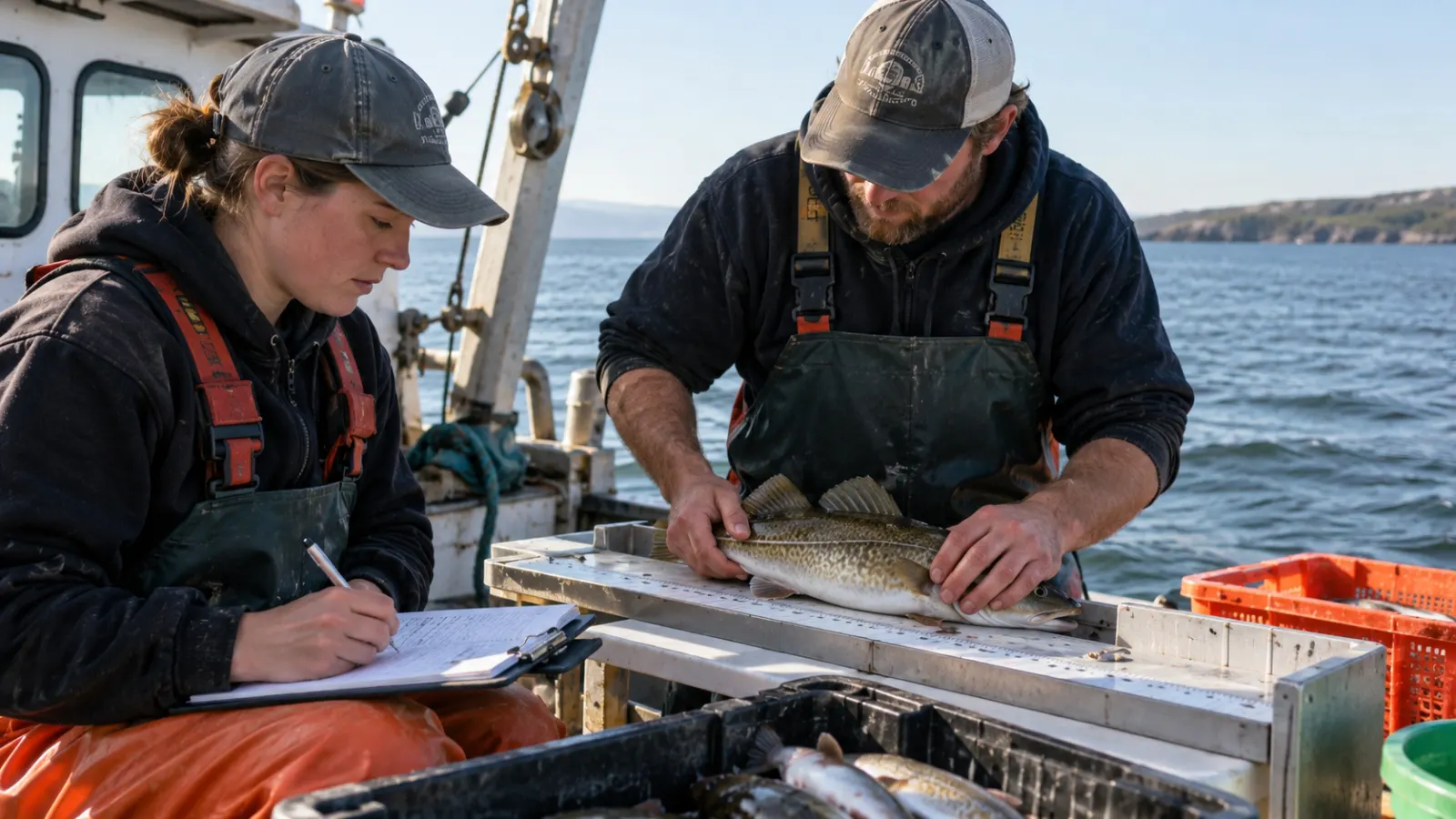
Fisheries scientists therefore try to estimate stock abundance, fishing mortality, growth, reproduction, recruitment and age or size structure. Information can come from scientific surveys, commercial catches, onboard observers, electronic monitoring, vessel tracking and biological samples.
The resulting estimates are never perfectly certain.
Fish populations naturally fluctuate. The survival of young fish can vary dramatically from year to year. Ocean conditions change, and data quality differs greatly between fisheries.
Sustainable management does not require perfect prediction.
It requires enough evidence to establish reference points and rules for responding when the stock changes.
Catch limits are one familiar tool. Managers may set a total allowable catch and divide it among vessels, communities or sectors. But restricting the weight of fish landed is not the only way to control mortality. Fisheries can instead or additionally limit vessel numbers, fishing days, gear, fishing areas, seasons or the size of fish that may be retained.
The specific tool matters less than the biological outcome.
Total fishing mortality has to remain compatible with the stock's capacity to reproduce and grow.
This is also why sustainable fishing should not mean extracting the theoretical maximum every year.
Fisheries often use reference points related to concepts such as maximum sustainable yield, but those calculations depend on estimated population dynamics and environmental conditions. A management system operating directly at an estimated maximum with no buffer can become vulnerable if recruitment is unexpectedly poor or stock productivity changes.
Precaution therefore has practical value.
Leaving more fish in the water than a narrow mathematical maximum might permit can provide resilience against scientific uncertainty and environmental variability.
The principle becomes particularly important for slow-growing species, stocks with highly variable reproduction and fisheries where information is limited.
Sustainability is not only about preventing collapse under average conditions.
It is about preserving enough biological capacity to survive bad years as well as good ones.
Sustainable Fishing Has to Protect More Than the Target Species
A fishery can keep its target stock productive and still damage the broader marine ecosystem.
Fishing gear may capture animals that were never intended to be caught. Fishing in sensitive areas can disturb seabed habitats. Heavy removal of predators, herbivores or forage fish can alter ecological relationships even when the harvested population itself remains above a management threshold.
FAO's Ecosystem Approach to Fisheries addresses this problem by treating fisheries as interactions among ecosystems, economies and human communities rather than simply machines for extracting target stocks. FAO's small-scale fisheries guidance similarly describes ecosystem health and human well-being as interconnected parts of sustainability. (fao.org)
This does not require pretending that harvesting wild food has no ecological effect.
Any fishery removes organisms from an ecosystem.
The question is whether those effects remain compatible with the long-term functioning and resilience of that ecosystem.
Bycatch provides one of the clearest examples.
Different fishing methods interact with non-target animals in different ways. Hook type, mesh size, net depth, bait, fishing location, time of day and season can all change what is caught alongside the intended species.
Technical modifications can sometimes produce large improvements.
Turtle excluder devices, for example, create an escape route for sea turtles accidentally entering shrimp trawl nets. NOAA reports that properly installed current designs can exclude approximately 97% of turtles from affected trawls while allowing the target shrimp catch to continue. (fisheries.noaa.gov)
Other fisheries may use changes in hook design, bait, net configuration, fishing depth or time-and-area restrictions to reduce interactions with seabirds, marine mammals, turtles or unwanted fish.
The lesson is broader than any one device.
Fishing gear is designed, which means it can often be redesigned.
But technological solutions need governance behind them. An escape device does little if it is incorrectly installed or deliberately disabled. A gear rule cannot reduce bycatch if compliance is rarely monitored.
This is why FAO's responsible-fishing framework combines technical measures with monitoring, enforcement and an ecosystem-based approach rather than treating gear innovation as a complete solution. (fao.org)
Protected Areas Can Help Without Replacing Fisheries Management
Marine protected areas can contribute to sustainable fisheries by protecting spawning grounds, nursery habitats, sensitive ecosystems or populations particularly vulnerable to fishing.
Fully protected areas can allow fish to survive longer and reach larger sizes inside their boundaries. Depending on species movement and local ecology, adults or larvae may also move beyond protected areas and contribute to populations available to fisheries elsewhere.
But a protected area is not automatically a sustainable-fishing system.
Fish can cross its boundary.
Migratory species may travel hundreds or thousands of kilometres.
Fishing pressure removed from one location may simply concentrate somewhere else.
A protected spawning ground cannot prevent excessive mortality after the same fish leave the protected area.
Enforcement can also be weak where protected areas exist mainly on paper.
Spatial protection is therefore most useful when matched to a specific ecological purpose and embedded inside a broader management system.
Catch or effort controls determine how much fishing mortality occurs.
Gear rules influence which animals are affected.
Protected areas influence where fishing can occur and which habitats or life stages receive additional protection.
These tools solve related but different problems.
Treating one of them as a universal replacement for the others usually oversimplifies fisheries ecology.
Fisheries Are Social Systems as Well as Biological Ones
Fishery rules ultimately regulate people.
That makes social design unavoidable.
FAO's small-scale fisheries guidance emphasises that sustainable resource management should consider not only ecosystems but the people who depend on fisheries for food, livelihoods and culture. It specifically encourages participatory management and co-management, in which fishing communities work with government institutions and other stakeholders to design and implement rules. (fao.org)
Participation matters for several reasons.
Fishers can possess detailed knowledge about seasonal movements, spawning areas, gear performance and local environmental change.
Involving communities can improve the information available to managers.
It can also increase legitimacy.
A closure designed without understanding how households earn income may face resistance even if its biological rationale is strong. A rule perceived as protecting industrial fleets while restricting small-scale fishers may be technically enforceable yet politically unstable.
None of this means every local preference is automatically sustainable.
Fishing communities can also face short-term incentives to overuse resources.
Co-management is valuable not because local knowledge replaces science or regulation, but because rules work better when biological evidence, institutional authority and the people expected to follow the rules are connected.
Social effects also influence which conservation measures are realistic.
A sudden multi-year closure may accelerate stock rebuilding but devastate a community with no alternative income. Governments may therefore need transitional support, alternative livelihood opportunities or phased restrictions.
At the same time, social hardship cannot justify allowing a stock to collapse indefinitely. A fishery that destroys its biological base eventually destroys the livelihood it was supposed to protect.
The difficult policy task is to reduce fishing pressure early enough that ecological recovery does not require far more painful restrictions later.
Rights and Incentives Determine Whether Fishers Race or Conserve
Many fishery problems emerge because the fish remain a shared resource until somebody catches them.
Imagine an open-access fishery in which every vessel knows the stock is declining.
Leaving fish in the water would benefit the stock.
But an individual fisher may reasonably ask: Why should I leave the fish when another vessel can catch them tomorrow?
If everyone responds to the same incentive, the stock can be depleted even though individual fishers understand perfectly well that continued overfishing damages their long-term interests.
Sustainable management therefore often tries to change the structure of access.
Licences can limit how many vessels participate.
Territorial-use rights can give communities recognised responsibility over specific fishing areas.
Individual or community quotas can allocate shares of an overall sustainable catch.
Co-management can distribute authority between governments and resource users.
None of these arrangements is automatically fair or successful.
Quota systems can become concentrated in a small number of companies if trading rules permit consolidation. Community rights can exclude neighbouring groups or migrants. Licensing systems can become politicised. Territorial rights are difficult for highly migratory species.
The relevant principle is therefore not “privatise the fish” or “put communities in charge”.
It is that fishing institutions should reduce incentives to capture the resource as quickly as possible.
People are more likely to conserve a renewable resource when they have some confidence that fish left in the water today will still contribute to their community or fishery tomorrow.
Rights and responsibilities have to be connected.
FAO's small-scale fisheries guidance makes this relationship explicit, linking rights to use fisheries resources with responsibility for their sustainable management. (fao.org)
Monitoring and Enforcement Turn Sustainability From a Rulebook Into Reality
A government can design an excellent catch limit and still have an unsustainable fishery if nobody knows how much is actually being caught.
Monitoring is therefore one of the least glamorous and most important parts of fisheries management.
Depending on the fishery, authorities may use vessel monitoring systems, satellite-based identification, onboard observers, electronic cameras, logbooks, landing inspections, catch documentation and remote-sensing technologies.
Different systems answer different questions.
Vessel tracking can indicate where a boat travelled.
Observers and cameras can document catch composition and bycatch.
Port inspections can compare landed fish with licences and quotas.
Catch-documentation systems can help trace seafood through supply chains.
The purpose is not surveillance for its own sake.
It is to determine whether actual fishing remains consistent with the rules used in stock assessments and management plans.
Monitoring also protects fishers who comply.
Illegal, unreported and unregulated fishing can take fish outside agreed limits while responsible operators absorb the economic cost of compliance. If rule-breaking becomes widespread and rarely punished, following regulations begins to look irrational.
FAO's Small-Scale Fisheries Guidelines therefore call for monitoring, control and surveillance systems while also urging the prevention of illegal and destructive fishing practices. (fao.org)
The chain is straightforward:
science estimates sustainable mortality → rules allocate fishing opportunities → monitoring measures what actually happens → enforcement gives the rules credibility → new biological data update the next management decision.
Break any part of that chain and sustainability becomes harder.
This is why the best fisheries-management system is not necessarily the one with the most sophisticated scientific model.
It is the one capable of translating sufficiently good science into behaviour on the water.
Shared Fish Stocks Require Shared Governance
Fish do not recognise national borders.
Some commercially important species move between neighbouring countries' exclusive economic zones. Highly migratory species such as tuna can cross vast ocean areas and spend part of their lives on the high seas.
One government can therefore reduce fishing while vessels elsewhere capture more of the stock.
This creates another commons problem, but at the international level.
Regional fisheries management organisations and bilateral or multilateral agreements attempt to address this by coordinating scientific assessment, catch allocation and conservation measures among countries fishing the same resources.
Agreement can be politically difficult.
Countries may disagree about historical catch rights.
Coastal states may argue that stocks occurring in their waters should provide greater local benefit.
Distant-water fleets may defend established access.
Developing countries may seek a larger share of resources previously harvested primarily by richer nations.
Scientific uncertainty can become entangled with distributional conflict.
Climate change is making these negotiations even more difficult.
NOAA reports that changing ocean conditions are already affecting both the location and productivity of fish stocks. Species may shift away from the areas where historical fishing fleets encounter them, creating economic and governance consequences for fishing-dependent communities. (fisheries.noaa.gov)
A quota-sharing agreement designed around where a stock lived thirty years ago may become politically unstable when the population moves.
Sustainable fishing under climate change therefore requires more than reducing emissions globally.
Fisheries institutions themselves need to become adaptive.
Surveys may need to cover new areas.
Stock assessments may need new environmental variables.
Quota-sharing agreements may need renegotiation.
Management rules may need to reduce catch more quickly when environmental productivity deteriorates.
Historical abundance can no longer always be treated as a reliable description of future carrying capacity.
Climate Change Turns Sustainability Into a Moving Target
The traditional idea of fisheries management assumes that biological productivity fluctuates around conditions that can be estimated from historical data.
Climate change increasingly challenges that assumption.
Warming water can affect growth, reproduction and species distribution. Ocean acidification and deoxygenation can alter habitats and food webs. Marine heatwaves can produce abrupt ecosystem changes.
NOAA notes that fish stocks can become less productive or move out of range of the fishers who traditionally depend on them, creating social and economic consequences as well as biological ones. (fisheries.noaa.gov)
This matters because a catch level is not sustainable in isolation.
It is sustainable relative to the productivity of the stock under actual environmental conditions.
If a population begins producing fewer recruits each year, yesterday's safe catch may become tomorrow's excessive one.
Management therefore needs feedback.
Scientific assessment must be repeated.
Harvest rules need the ability to respond.
Institutions must accept that sustainable catch is not an entitlement fixed permanently by historical precedent.
This is also why resilience matters.
A fishery maintained with larger spawning biomass and lower pressure may have more capacity to absorb environmental shocks than one continuously managed at the edge of depletion.
Climate adaptation and fisheries conservation are increasingly the same management problem.
Seafood Certification Can Support Management Without Defining Sustainability
Consumers encounter sustainable fishing most often through labels.
Certification systems can create market incentives for better practices by requiring fisheries to demonstrate aspects of stock management, environmental performance, traceability or governance.
They can be useful.
They are not identical to sustainability itself.
Certification standards differ. Scientific interpretation can change. Some fisheries may be difficult or expensive to certify even when they have relatively low impacts. A certified fishery can still face debate over bycatch, habitat effects or the assumptions used in its assessment.
A logo should therefore be treated as one piece of evidence, not as a replacement for understanding the fishery.
The deeper questions remain the same:
Which stock?
Where was it caught?
How much fishing mortality occurs?
Which gear was used?
What happens to non-target species?
How credible are the management and monitoring systems?
Certification can make some of that information easier for consumers and businesses to use.
It cannot govern the resource itself.
The decisive actions still occur upstream through scientific assessment, fishing rights, catch rules, monitoring and enforcement.
This is why solving overfishing cannot primarily be delegated to shoppers choosing the correct product in a supermarket.
Consumers can reward better fisheries.
They cannot set or enforce a national catch limit.
Aquaculture Changes the Seafood System but Does Not End the Sustainability Question
Farmed seafood is sometimes presented as the simple alternative to catching wild fish.
The comparison is too broad.
Aquaculture can produce seafood without directly removing the farmed species from wild populations, and well-designed systems can be highly productive.
But aquaculture has its own environmental questions.
Feed ingredients can have ecological footprints. Waste can affect surrounding water. Disease can spread within dense production systems. Escaped farmed animals can interact with wild populations. Coastal ponds or cages can alter habitats depending on where and how they are constructed.
The impact varies greatly among species and farming methods.
Growing shellfish in one setting is environmentally different from producing carnivorous finfish in another.
The meaningful comparison is therefore not simply wild versus farmed.
It is one production system versus another, considering resource use, pollution, feed, habitat effects, disease, climate impacts and social consequences.
Future seafood supply will almost certainly contain both capture fisheries and aquaculture.
Sustainability requires improving each on its own terms.
What Successful Sustainable Fishing Actually Looks Like
FAO's 2025 stock assessment provides perhaps the most important reason for cautious optimism.
Globally, only 64.5% of assessed marine stocks were within biologically sustainable levels, and overfishing has continued to rise gradually. Yet areas with sustained investment in science and management perform much better. The Northeast Pacific recorded 92.7% of stocks within sustainable levels, while the Southwest Pacific reached 85%. (fao.org)
These numbers should not be interpreted as proof that one region has discovered a universal fisheries formula.
They demonstrate something more important:
governance can change biological outcomes.
Successful sustainable fishing usually combines several elements.
Scientists monitor stock condition and environmental change.
Managers establish precautionary reference points and harvest rules.
Fishing access and incentives discourage races to capture the resource.
Bycatch and habitat effects are monitored and reduced.
Fishing communities have meaningful roles in decisions that affect their livelihoods.
Monitoring verifies what occurs at sea.
Enforcement makes rule-breaking costly enough that responsible fishing remains economically rational.
International institutions coordinate management where stocks cross borders.
And the entire system changes when new evidence shows that previous assumptions are no longer adequate.
No individual component guarantees sustainability.
Together they create a system capable of learning and adjusting.
That adaptability is essential because sustainability is not a permanent certification that a fishery earns once.
A stock healthy today can become overfished if catches increase.
A gear considered acceptable today may become problematic when a vulnerable species enters the fishing area.
Climate change can alter stock productivity.
Political pressure can weaken catch limits.
Monitoring can deteriorate.
Maintaining a sustainable fishery is therefore a repeated institutional achievement.
Sustainable Fishing Is an Institution, Not a Slogan
A seafood package can display the word sustainable.
A boat can use modified gear.
A government can declare a marine protected area.
None of those actions alone proves that a fishery will remain productive.
Sustainable fishing exists when the total management system repeatedly keeps extraction within ecological limits while maintaining a workable social basis for stewardship.
That means protecting the target stock without ignoring bycatch and habitat.
It means recognising fishing communities without assuming every level of current fishing pressure can continue.
It means using science without pretending science eliminates uncertainty.
It means establishing rights and incentives that make conservation rational for resource users.
It means monitoring what actually happens rather than relying entirely on rules written on paper.
And increasingly it means adapting quickly enough to an ocean whose biological conditions no longer remain fixed.
FAO's global data show why both urgency and optimism are justified. More than one-third of assessed marine stocks are overfished. Yet fisheries operating under strong management systems demonstrate that productive wild fisheries can persist. (fao.org)
The sea can continue producing food because fish populations are renewable.
But renewable resources remain renewable only when extraction leaves enough biological capacity for renewal to occur.
That is the central principle beneath every sustainable fishery.
Today's catch has to leave enough fish, habitat and ecological resilience to produce tomorrow's.