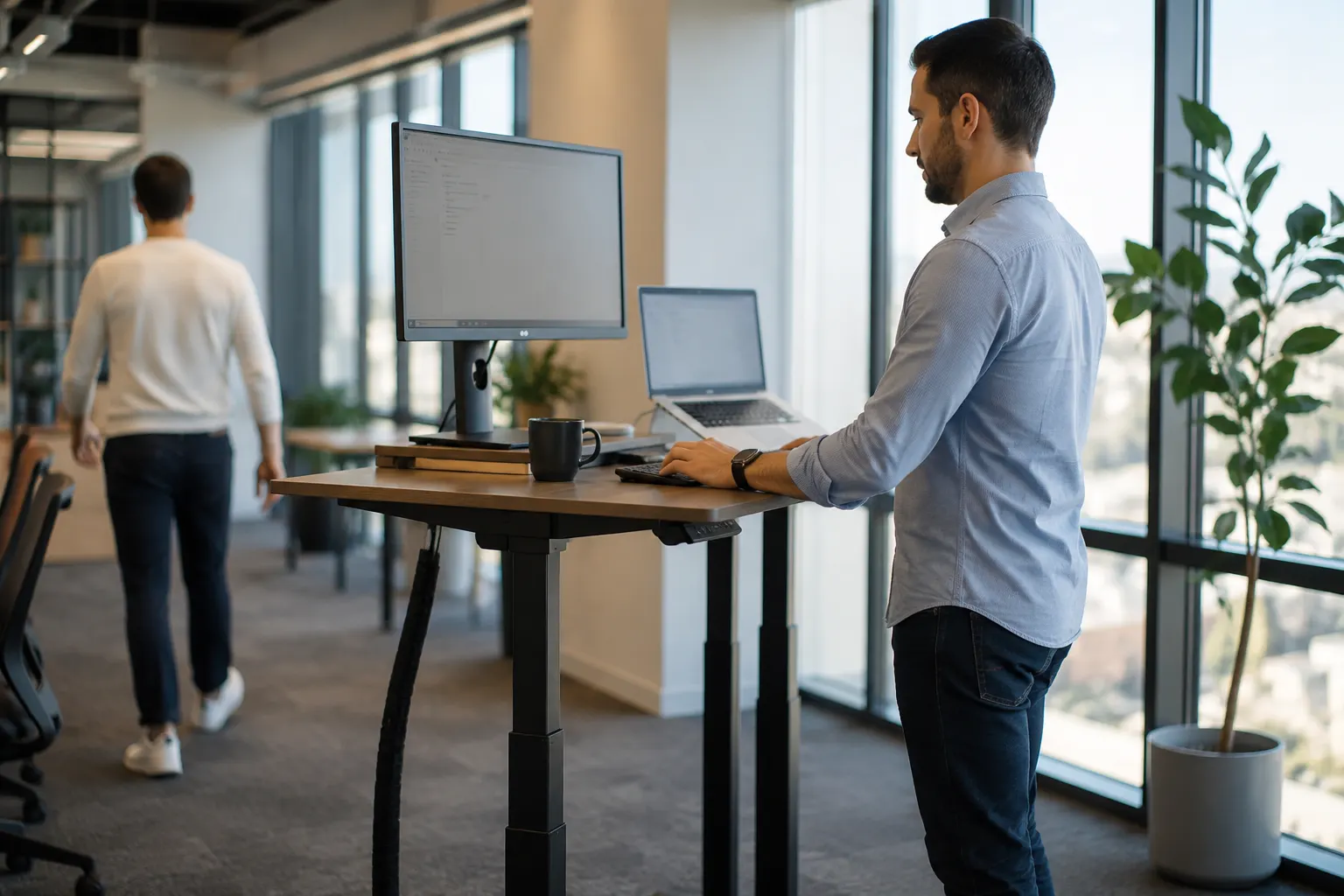
Standing Desk Benefits: What the Evidence Shows, Risks and How to Use One Properly
Standing desk benefits are real, but they are often exaggerated. A height-adjustable desk can help office workers spend less time sitting, change posture more frequently and make short periods of movement easier to incorporate into the workday. What it does not do is transform standing into exercise, guarantee weight loss, cure back pain or make several hours of motionless standing healthy.
The distinction matters because standing desks became popular as a response to another genuine problem: many people now spend large parts of their working and waking lives sitting. Higher levels of sedentary behaviour are associated with poorer health outcomes, and the World Health Organization recommends limiting sedentary time and replacing some of it with physical activity of any intensity.
But replacing eight hours of sitting with eight hours of standing is not the logical conclusion.
OSHA's computer-workstation guidance specifically recommends giving workers opportunities to alternate between sitting and standing and states that prolonged sitting or prolonged standing should be avoided. The healthiest lesson is therefore not “standing good, sitting bad.” It is that the body generally benefits from variation and movement rather than remaining in one position for hours.
Standing Desk Benefits at a Glance
| Question | Evidence-based answer |
|---|---|
| Can a standing desk reduce sitting time? | Yes. This is its clearest demonstrated benefit |
| Does standing burn more calories than sitting? | Yes, but only modestly |
| Can a standing desk help with back discomfort? | It may help some workers, especially by increasing posture variation |
| Does standing improve blood sugar? | Short standing breaks can have modest effects, but light walking appears more effective |
| Does a standing desk improve productivity? | It does not appear inherently harmful to cognitive performance; productivity effects vary |
| Is standing all day healthy? | No. Prolonged static standing has its own risks |
| Does standing replace exercise? | No |
| Is there a perfect sitting-to-standing ratio? | No universally established ratio |
| What is the best strategy? | Alternate sitting and standing and include frequent actual movement |
What Is a Standing Desk?
A standing desk is a workstation that allows someone to work while upright. Some are fixed at standing height, but the more useful design for most office workers is an adjustable sit-stand desk that can move between seated and standing positions.
That distinction is important.
A fixed standing desk can simply replace prolonged sitting with prolonged standing. An adjustable workstation gives the worker another option and makes it easier to change posture throughout the day.
OSHA's workstation guidance places particular emphasis on adjustability and the ability to make frequent changes in working position. It does not identify one universal posture that everyone should maintain.
The real value of a standing desk is therefore choice.
Why Sitting Became the Problem
Modern work increasingly concentrates activity around computers, meetings, commuting and screens. A person may sit while travelling to work, sit at a desk for most of the day, sit during lunch, travel home sitting and then spend additional evening hours on a sofa.
WHO defines sedentary behaviour as waking behaviour characterised by low energy expenditure while sitting, reclining or lying. Higher amounts of sedentary behaviour in adults are associated with greater risks of all-cause mortality, cardiovascular disease, type 2 diabetes and some cancers.
That does not mean sitting itself is inherently dangerous or that people should avoid chairs.
Sitting is a normal human posture. The concern is high volumes of sedentary time, particularly when they coexist with insufficient physical activity and long uninterrupted periods of inactivity.
A standing desk can help interrupt that pattern, but it addresses only one part of the problem.
Benefit 1: Standing Desks Can Reduce Sitting Time
This is the strongest and most consistent benefit.
A 2025 systematic review examined sit-stand desk interventions in office workers and found meaningful reductions in sedentary behaviour during both the workday and the full day. Compared with controls, workplace sedentary time was reduced by approximately 88 minutes per day at three months, 81 minutes at six months and 48 minutes at twelve months in the included studies.
Those numbers should not be interpreted as a guaranteed effect from buying a particular desk. Most successful interventions involve more than furniture. They can also include prompts, education, behavioural support and workplace changes.
Still, the evidence supports a clear conclusion:
sit-stand workstations can make it easier for office workers to spend less of the workday sitting.
That is a much stronger claim than saying they automatically make people healthy.
Benefit 2: They Make Posture Variation Easier
One of the most practical advantages of an adjustable desk is that changing posture no longer requires stopping work.
Someone can write or type while sitting, raise the workstation for a short standing period, sit again for detailed work and later take a phone call while walking.
This matters because even a well-adjusted seated posture can become uncomfortable when held for too long.
OSHA states that regardless of how good a working posture is, remaining in the same posture or sitting still for prolonged periods is undesirable. Its guidance recommends changing position frequently, including standing and walking periodically.
A standing desk therefore works best as a transition device rather than a destination.
Benefit 3: Some People Experience Less Musculoskeletal Discomfort
Sit-stand workstations may improve comfort for some desk workers.
A systematic review and meta-analysis of sit-stand workstations found small reductions in lower-back discomfort among sedentary workers, while more recent workplace research has also investigated reductions in musculoskeletal discomfort and post-work fatigue.
The effect should not be oversold.
Back pain has many causes, and a standing desk is not a treatment for every type. Someone with knee osteoarthritis, symptomatic spinal stenosis, foot problems or another condition may tolerate prolonged standing poorly.
Even among otherwise healthy workers, standing with the screen too low, wrists extended or shoulders elevated can create new discomfort.
The more defensible conclusion is that alternating posture may reduce discomfort for some people who otherwise remain seated for long uninterrupted periods.
Benefit 4: Standing Uses Slightly More Energy Than Sitting
Standing requires more muscular activity than sitting, so energy expenditure increases slightly.
A systematic review and meta-analysis involving 46 studies found that standing used about 0.15 kilocalories per minute more than sitting, on average.
That difference is real but modest.
Over an hour, it amounts to roughly 9 additional calories on average. Even several hours of standing therefore produces far less energy expenditure than meaningful walking or exercise.
This is why standing desks should not be marketed as serious weight-loss tools.
If the goal is calorie expenditure, cardiorespiratory fitness or metabolic health, moving the body matters far more.
Standing Is Not Exercise
This point deserves emphasis because standing desks are sometimes marketed as though working upright turns the office into a fitness intervention.
It does not.
Standing still is generally a low-energy activity. It engages postural muscles differently from sitting but does not provide the same stimulus as brisk walking, cycling, running or resistance exercise.
WHO recommends that adults accumulate meaningful moderate- or vigorous-intensity physical activity and muscle-strengthening activity in addition to limiting sedentary behaviour.
A person can therefore stand at work for several hours and still be physically inactive overall.
Standing and exercise solve different problems.
Standing vs Walking: Walking Changes More
The physiological difference becomes especially clear when standing is compared with light walking.
A systematic review and meta-analysis of experimental trials found that interrupting prolonged sitting with standing produced a modest improvement in post-meal glucose compared with continuous sitting. But short light-intensity walking breaks produced larger improvements in both glucose and insulin responses.
That suggests a useful hierarchy:
Sitting → standing changes posture.
Standing → walking changes activity.
This does not make standing useless. Standing can be a convenient first interruption when work makes walking difficult.
But when possible, a short walk often creates a larger physiological change than merely raising the desk and remaining motionless.
Can Standing Desks Help Blood Sugar?
The answer is: possibly, but walking appears more powerful.
Acute studies suggest that replacing uninterrupted sitting with frequent standing breaks can reduce post-meal glucose modestly under some conditions. However, the effect is smaller and less consistent than the effect of light-intensity walking.
This distinction is important because commercial claims sometimes jump from short laboratory measurements to sweeping statements such as “standing desks prevent diabetes.”
The evidence does not justify such certainty.
Standing desks may help people break up prolonged sedentary periods, which is useful. But long-term metabolic health depends on total physical activity, body composition, diet, sleep, genetics, medication and many other variables.
Are Standing Desks Good for Your Heart?
A standing desk should not be treated as a cardiovascular treatment.
Higher sedentary time is associated with poorer cardiovascular outcomes, and replacing some sedentary time with activity is beneficial. But simply standing is not equivalent to cardiovascular exercise.
The strongest public-health advice remains to reduce excessive sedentary behaviour and obtain adequate physical activity.
A standing desk can support the first objective. It cannot replace the second.
Does a Standing Desk Improve Posture?
Sometimes—but this claim is frequently oversimplified.
A standing workstation can make it easier for a worker to escape one repetitive seated position. It may also reduce some patterns of slouching if properly adjusted.
But standing does not automatically create “good posture.”
Someone can stand while:
-
leaning heavily on one side;
-
hunching toward the monitor;
-
extending the wrists;
-
elevating the shoulders;
-
locking the knees;
-
craning the neck.
The correct ergonomic principle is not that standing is automatically good posture. It is that the workstation should allow relatively comfortable, neutral positions and make it easy to change them.
OSHA explicitly states that there is no single correct workstation posture that fits everyone.
Does a Standing Desk Help Back Pain?
For some people, yes. For others, no.
Sitting for long uninterrupted periods can aggravate discomfort in certain workers. Allowing regular changes between sitting and standing may reduce that exposure and provide temporary relief.
Research on sit-stand workstations suggests small potential improvements in lower-back discomfort, although effects vary among individuals.
However, standing can aggravate symptoms in some conditions.
A person with spinal stenosis may prefer sitting or leaning forward. Someone with knee arthritis or significant foot pain may find extended standing difficult. Workers with persistent neurological symptoms or severe pain should not attempt to solve the problem entirely through workstation furniture.
A standing desk is an ergonomic option, not a diagnosis or treatment plan.
Does Standing Improve Focus or Productivity?
The evidence is much less definitive than marketing claims suggest.
Some workers report feeling more alert or productive when they change posture. A small 2025 workplace study found reduced self-reported sedentary time and improved perceived productivity among office workers using sit-to-stand desk converters. However, the study was small and relied partly on self-report.
Other research suggests that standing does not substantially impair certain cognitive tasks. A meta-analysis examining Stroop-task performance found no significant difference between standing and sitting in healthy young adults.
The safest conclusion is therefore that alternating posture does not appear inherently incompatible with productive knowledge work, but claims that a standing desk automatically makes people smarter, more creative or significantly more productive go beyond the evidence.
The Risks of Standing Too Long
One of the biggest mistakes in standing-desk culture is assuming that if sitting is undesirable, standing longer must always be better.
Prolonged standing has its own risks.
A major occupational-health review associated extended standing at work with outcomes including:
-
lower-back discomfort;
-
leg pain;
-
fatigue;
-
cardiovascular or circulatory problems;
-
discomfort in the lower limbs.
The review also found support for interventions such as sit-stand workstations, mats, appropriate footwear and other changes designed to reduce prolonged static standing.
OSHA likewise warns against prolonged standing and recommends alternating postures and activities.
The lesson is simple: static standing is still static.
Standing All Day Is Not the Goal
Imagine a worker who previously sat for eight hours and then buys a standing desk.
If that person now stands almost motionless for eight hours, they have solved only one part of the original problem. Muscular loading has changed, but movement has not increased very much.
The healthier goal is usually something like:
sit → stand → walk → sit → stand → move again.
That pattern changes both posture and muscular activity.
The standing desk is useful because it makes one of those transitions easy.
Is There a Perfect Sit-to-Stand Ratio?
No universal evidence-based ratio has been established for every worker.
Online advice often gives highly specific formulas such as:
-
30 minutes sitting, 30 minutes standing;
-
20 minutes sitting, 8 minutes standing, 2 minutes walking;
-
1 hour sitting followed by 1 hour standing.
These schedules may be useful reminders, but they should not be presented as biological laws.
Tolerance varies according to age, footwear, workstation setup, pregnancy, disability, vascular health, joint conditions, previous injuries and work demands.
The more useful principle is to change before one posture becomes uncomfortable and include actual movement throughout the day.
A Practical Way to Use a Standing Desk
For someone new to a sit-stand workstation, gradual adaptation is usually more comfortable than suddenly attempting to stand for half the day.
A practical approach is to begin with short standing periods during tasks that suit standing, such as:
-
checking email;
-
brief phone calls;
-
reading;
-
short meetings;
-
simple administrative work.
Return to sitting when standing becomes uncomfortable.
Add actual walking whenever practical.
Over time, the goal is not to accumulate the highest possible standing total. It is to prevent one posture from dominating the entire workday.
How High Should a Standing Desk Be?
A standing desk should allow the keyboard and mouse to be used without raising the shoulders or forcing the wrists into awkward angles.
OSHA's purchasing guidance recommends keyboard height at roughly elbow level and emphasises workstation adjustability.
In practice, when standing:
-
shoulders should remain relaxed;
-
elbows should stay near the body;
-
forearms should be roughly parallel to the floor;
-
wrists should remain relatively neutral;
-
the monitor should be positioned so the neck does not need to bend sharply up or down.
These are design goals rather than rigid geometric requirements.
Comfort and individual proportions matter.
Monitor Position Matters Too
Raising the work surface while leaving the monitor in the wrong position can create neck discomfort.
OSHA recommends positioning the monitor in front of the user at a height that does not require repeatedly tilting the head forward or backward.
Laptop users face a particular problem because the screen and keyboard are attached.
When the laptop is raised to improve screen height, the keyboard becomes too high. When it is lowered for comfortable typing, the screen becomes too low.
For longer work periods, an external keyboard and mouse can make an adjustable setup much easier to configure.
Footwear and Flooring Matter
Standing comfort is influenced by more than desk height.
Hard flooring and unsupportive footwear can increase discomfort during prolonged standing. Occupational evidence supports interventions such as appropriate shoes, inserts and floor mats in some standing-intensive jobs.
Workers may also find it comfortable to shift weight periodically or use a footrest to elevate one foot.
Again, variation matters more than achieving a perfect statue-like posture.
Anti-Fatigue Mats: Useful but Not Magic
Anti-fatigue mats are commonly promoted with standing desks.
They can improve comfort for some people working on hard surfaces, particularly when standing for meaningful periods.
But a mat does not make unlimited standing healthy.
It addresses one part of the physical environment. A worker still needs posture changes, walking opportunities and a workstation that fits.
The best intervention is rarely one accessory used in isolation.
Walking Breaks Matter More Than Complicated Stretching Routines
Workers do not necessarily need elaborate exercise sessions every hour.
Simply leaving the workstation for a few minutes can change muscle recruitment and circulation.
Useful opportunities include:
-
walking to get water;
-
walking to another office;
-
using stairs where appropriate;
-
taking a phone call while walking;
-
speaking with a colleague in person;
-
taking a short movement break.
WHO's core message is that replacing sedentary time with physical activity of any intensity, including light activity, provides health benefits.
The routine does not need to look like a workout to count as movement.
Walking Meetings Can Work—When the Task Fits
Walking meetings are sometimes presented as the ideal solution for every office.
They are not.
They work particularly well for:
-
informal discussion;
-
brainstorming;
-
one-to-one conversations;
-
check-ins that do not require screens.
They work poorly when participants need:
-
detailed documents;
-
confidential information;
-
complex spreadsheets;
-
visual presentations;
-
extensive note-taking.
The principle is not that every meeting should become a walk.
It is that movement works best when it fits naturally into the task.
Standing Desks Do Not Replace Exercise
Even a highly active workstation routine should be separated from structured physical activity.
WHO recommends regular aerobic activity and muscle-strengthening exercise because these provide physiological benefits that standing cannot reproduce.
A worker might create a much better day by:
-
sitting less;
-
alternating posture;
-
taking frequent light-movement breaks;
-
walking more;
-
completing regular aerobic exercise;
-
performing strength training.
These behaviours complement one another.
There is no need to choose between them.
What About People Who Already Stand All Day?
The standing-desk discussion is heavily influenced by office workers, but millions of people have the opposite occupational problem.
Retail staff, teachers, factory workers, healthcare professionals, hairdressers, hospitality workers and others may already spend large parts of the day on their feet.
Telling them to “stand more” makes little sense.
Their ergonomic needs may include:
-
opportunities to sit;
-
task rotation;
-
supportive footwear;
-
appropriate floor surfaces;
-
breaks;
-
movement variation;
-
reduction of static standing.
This reveals the broader ergonomic principle:
healthy workplaces should reduce excessive exposure to any single posture rather than imposing the same solution on everyone.
People With Pain Need Individual Variation
Workplace wellness advice should also account for medical differences.
Someone with knee osteoarthritis may tolerate sitting better than standing. Another person with hip stiffness may feel better when frequently changing position. A worker with foot problems may need shorter standing periods.
Back pain is particularly variable.
Pain during one posture does not prove that the posture is inherently harmful. It may reflect individual tolerance, an existing condition or how long the posture is being maintained.
Workers with persistent, severe or neurological symptoms should seek appropriate assessment rather than repeatedly modifying desk height in search of a cure.
Standing During Pregnancy
Pregnancy can change comfort, balance, fatigue and circulation.
Some pregnant workers may prefer frequent posture changes, while prolonged standing may become increasingly uncomfortable.
Workplace adjustments should therefore be flexible rather than based on a fixed standing target.
The general principle remains the same: allow people to alternate positions and adapt work to individual tolerance.
Organisations Matter More Than Furniture Alone
A workplace can spend heavily on adjustable desks and still leave employees sedentary.
Imagine a worker whose day consists of six hours of video meetings, constant productivity monitoring and a culture in which leaving the screen is interpreted as not working.
The desk may move up and down, but the job itself still suppresses meaningful movement.
Successful workplace interventions often combine equipment with behavioural or organisational changes. The systematic review of sit-stand interventions found reductions in sitting, but many programmes included prompts, education or other support alongside the desks.
Employers can help by making short movement breaks socially acceptable and operationally realistic.
How Workplaces Can Build Movement Into the Day
Movement should not depend entirely on individual discipline.
Organisations can design work so that ordinary tasks naturally create variation.
Options include placing shared printers or water stations a short walk away, allowing employees to stand or walk during suitable meetings, encouraging task rotation and avoiding unnecessarily rigid expectations of continuous desk presence.
The objective is not to interrupt work constantly.
It is to remove unnecessary barriers to movement.
Standing Desks and Remote Work
Working from home can make movement either easier or harder.
On one hand, remote workers may have more freedom to stand, walk during calls or perform brief household tasks between work blocks.
On the other hand, home workers may have fewer natural transitions than office workers. There is no commute through a building, no walk to a meeting room and no colleague's desk to visit.
A sit-stand desk can be useful in this environment, but the same principle applies: moving the desk upward is not a substitute for getting away from the desk periodically.
Are Expensive Standing Desks Better?
Price does not automatically determine health benefit.
An expensive electric desk may offer:
-
wider height adjustment;
-
greater stability;
-
memory settings;
-
easier transitions;
-
better accommodation for different users.
Those features can make frequent position changes more convenient.
But an expensive desk that remains at one height all day provides little advantage over a cheaper workstation used intelligently.
The key question is whether the setup allows the user to work comfortably and switch positions easily.
Furniture is an enabler.
Behaviour determines how much of the potential benefit is realised.
Standing Desk Converter vs Full Sit-Stand Desk
A desk converter sits on top of an existing workstation and raises the keyboard and monitor. It can be less expensive and easier to add to an existing office.
A full adjustable desk raises and lowers the entire work surface.
Converters can work well, but users should check whether the keyboard, mouse and monitor remain at suitable heights in both positions. Some converters also reduce usable desk area.
The health principle does not change according to which mechanism is used.
The workstation should allow comfortable variation.
Common Standing Desk Mistakes
Mistake 1: Standing for Most of the Day Immediately
Suddenly changing from prolonged sitting to several hours of standing can produce foot, leg and back discomfort.
Increase standing time gradually.
Mistake 2: Treating Standing as Exercise
Standing is not a replacement for walking, aerobic exercise or strength training.
Mistake 3: Buying the Desk but Never Raising It
Furniture cannot reduce sitting if it is never used.
Mistake 4: Standing Without Moving
Static standing for long periods creates its own problems.
Shift position, sit periodically and walk.
Mistake 5: Ignoring Monitor and Keyboard Height
A poorly adjusted standing workstation can simply move discomfort from one part of the body to another.
Mistake 6: Believing Standing Will Cause Major Weight Loss
The energy-expenditure difference between sitting and standing is small.
Mistake 7: Following a Fixed Ratio Despite Discomfort
There is no universal schedule everyone must follow.
Mistake 8: Assuming Everyone Needs a Standing Desk
Workers who already stand extensively may need more opportunities to sit rather than additional standing.
A Better Workday: Sit, Stand and Move
For many desk workers, the most practical strategy is not complicated.
Use sitting for tasks that benefit from support and stability. Stand periodically when it feels comfortable and when the task suits it. Walk whenever movement can be incorporated naturally.
A typical pattern might involve sitting for focused typing, standing for a short call, walking to get water, returning to seated work and later raising the desk again.
The exact timing can vary.
The objective is frequent variation rather than hitting a standing quota.
Frequently Asked Questions About Standing Desk Benefits
What are the main standing desk benefits?
The clearest benefits are reduced sitting time and easier posture variation. Some users may also experience improvements in comfort, while short standing breaks can modestly affect post-meal glucose.
Are standing desks actually good for you?
They can be useful when they help you alternate between sitting and standing and encourage more movement. They are less useful when standing simply replaces sitting as another prolonged static posture.
Is standing healthier than sitting?
Neither posture is universally healthier when held for long periods. Alternation and movement are more important than choosing one posture for the whole day.
How long should you stand at a standing desk?
There is no universally proven standing duration that works for everyone. Start with shorter periods, change position when discomfort develops and include walking throughout the day.
Is standing for eight hours better than sitting for eight hours?
No. Prolonged standing has its own musculoskeletal and circulatory risks.
Does a standing desk burn calories?
Yes, standing generally uses slightly more energy than sitting, but the difference is small—about 0.15 kcal per minute on average in one meta-analysis.
Can you lose weight using a standing desk?
A standing desk alone is unlikely to produce meaningful weight loss. Diet, total physical activity and other metabolic factors matter far more.
Does a standing desk help back pain?
It may reduce discomfort in some workers by allowing posture changes, but it is not a universal back-pain treatment.
Can standing desks cause back pain?
Yes. Prolonged standing, poor desk setup or inappropriate footwear can contribute to back, leg or foot discomfort.
Do standing desks improve posture?
They may encourage posture variation, but standing does not automatically create good posture. Workstation setup still matters.
Can a standing desk improve blood sugar?
Short standing breaks may modestly improve some post-meal glucose responses compared with uninterrupted sitting, but light walking generally produces larger effects.
Is walking better than standing?
For increasing physical activity and producing larger metabolic changes, generally yes. Standing remains useful as a posture change.
Does a standing desk count as exercise?
No. Standing is not a substitute for aerobic or strength exercise.
Do standing desks improve productivity?
Some workers report productivity or alertness benefits, but evidence is not strong enough to guarantee improvement. Standing also does not appear to substantially impair some cognitive tasks.
Should I stand after eating?
Changing posture and especially taking a short walk after meals may help interrupt prolonged sitting. Walking has stronger evidence for acute glucose effects than standing alone.
Should I use an anti-fatigue mat?
A mat can improve standing comfort for some people, especially on hard floors, but it does not remove the need to change position.
What shoes should I wear at a standing desk?
Comfortable, supportive footwear may reduce discomfort if you spend meaningful time standing. Individual needs vary.
How high should a standing desk be?
The work surface should generally allow your elbows to remain comfortably near your sides and your wrists relatively neutral, with the keyboard around elbow height.
Where should the monitor be?
Position it so that you can view the screen comfortably without repeatedly bending the neck sharply up or down.
Is there a recommended sitting-to-standing ratio?
Research does not establish one universal ratio for every worker. Frequent changes and actual movement matter more than following a rigid formula.
Can I stand all day if I am comfortable?
Comfort is useful information, but prolonged static standing is still not the ideal goal. Regular variation and movement remain preferable.
Are standing desks useful for working from home?
Yes, particularly when they help break long periods of uninterrupted sitting. Remote workers still need actual movement breaks.
Are standing desks worth buying?
They can be worthwhile for people who spend many hours at a computer and will genuinely use the adjustability. Their value comes mainly from enabling posture changes rather than from standing itself.
The Real Benefit of a Standing Desk Is the Next Position
The most useful conclusion about standing desk benefits is surprisingly simple.
A standing desk is not healthier because standing is a superior posture.
It is useful because an adjustable desk can make it easier to stop doing the same thing for hours.
Sitting can be comfortable and appropriate. Standing can be comfortable and appropriate. Walking creates a larger change in physical activity than either static posture.
Problems arise when one position becomes the default for most of the day.
The best workstation therefore does not force a person to sit or force them to stand. It gives them choices.
Sit when the task benefits from support. Stand when it feels comfortable. Walk when the work allows it. Change position before stiffness or fatigue becomes substantial. Continue to obtain regular physical activity away from the workstation.
For employers, the same lesson applies at organisational scale. Do not simply buy standing desks and call the workplace healthy. Create jobs in which employees can realistically move, take short breaks and vary tasks without being treated as unproductive.
The evidence points away from one “perfect posture” and toward something much more practical:
the healthiest posture is often the one you have not been holding for the last several hours.
A standing desk can help make that transition easier.
That—not standing all day—is its most defensible benefit.
Medical Note
This article provides general health and ergonomic information and is not a substitute for individual medical advice. Persistent or severe back, joint or leg pain, numbness, weakness, significant swelling, balance problems or other concerning symptoms should be assessed by an appropriately qualified healthcare professional.