Particulate Matter (PM2.5 and PM10) Explained: Sources, Health Effects and Safe Levels
Air can look perfectly clear while containing millions of particles too small for the human eye to see.
It can also look visibly smoky, dusty or hazy while containing a mixture of particles with very different sizes, chemical compositions and sources.
Scientists group much of this airborne material under the term particulate matter, usually abbreviated PM and sometimes called particle pollution.
The two measurements people encounter most often are PM2.5 and PM10.
PM10 refers broadly to inhalable particles with aerodynamic diameters of about 10 micrometres or smaller. PM2.5 refers to the much finer fraction measuring 2.5 micrometres or smaller.
The distinction matters because particle size affects how long pollution can remain airborne, how far it can travel, where it deposits in the respiratory system and how it affects health.
But size is only part of the story.
Particulate matter is not one chemical substance. It can contain soot, mineral dust, sulfates, nitrates, ammonium, organic compounds, metals, salt, smoke and water.
That makes PM fundamentally different from pollutants such as carbon monoxide or ozone.
PM describes a class of airborne particles primarily by size rather than by one chemical identity.
PM2.5 vs PM10: What Is the Difference?
The simplest comparison is:
| Feature | PM2.5 | PM10 |
|---|---|---|
| Maximum aerodynamic diameter | About 2.5 µm | About 10 µm |
| Common description | Fine particulate matter | Inhalable particulate matter |
| Typical examples | Combustion particles, smoke, soot, secondary sulfate/nitrate particles | Dust, pollen fragments, road dust, construction particles plus PM2.5 |
| How deeply particles can penetrate | Can reach deep regions of the lungs | Can enter the respiratory tract and lungs |
| Health concern | Particularly important for cardiovascular and respiratory health | Also associated with respiratory and other health effects |
| Visibility | Usually invisible individually | Larger particles may sometimes contribute to visible dust |
| Can travel long distances? | Often yes | Depends strongly on size and weather |
One important point is frequently misunderstood:
PM2.5 is not completely separate from PM10.
PM2.5 is contained within the broader PM10 size fraction.
Conceptually:
PM10 = fine PM2.5 + the larger inhalable coarse fraction between roughly 2.5 and 10 µm.
Air-quality agencies report both because fine and coarse particles often come from different sources, behave differently and have different implications for pollution control.
How Small Is PM2.5?
A micrometre, written µm, is one-millionth of a metre.
The average human hair is roughly 70 micrometres across.
That makes a hair around 30 times wider than the upper size limit used for PM2.5.
Individual fine particles are therefore far too small to see with the naked eye.
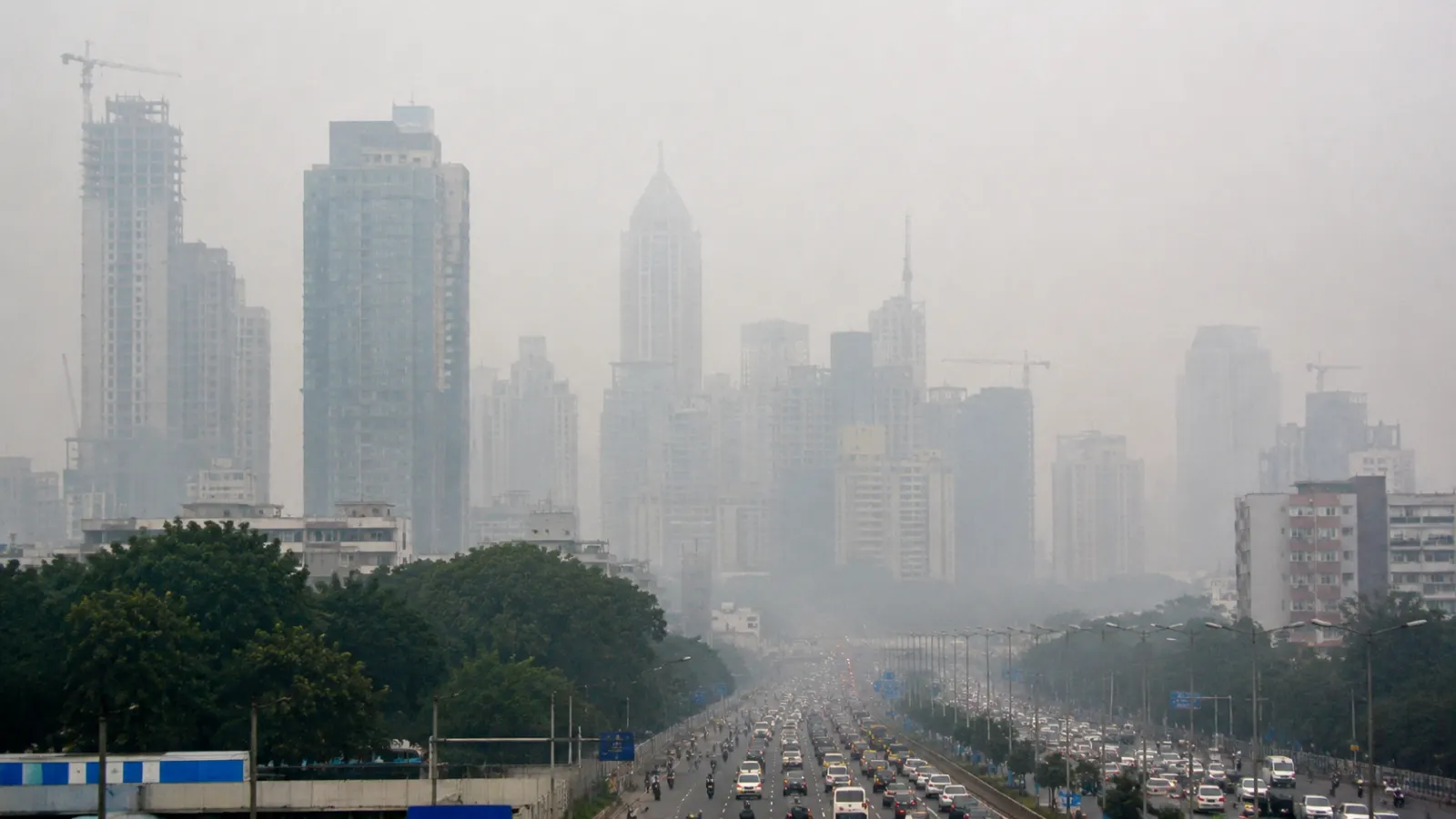
A polluted sky may appear hazy because huge numbers of particles scatter and absorb light, but you cannot determine PM2.5 concentration simply by looking at the air.
A clear day can still have unhealthy fine-particle pollution.
Why Scientists Use “Aerodynamic Diameter”
Airborne particles are not all perfect spheres.
They can be irregular, elongated, porous or dense.
A physically large but low-density particle may move through air differently from a compact particle of the same visible width.
Scientists therefore commonly classify PM using aerodynamic diameter.
Aerodynamic diameter describes how a particle behaves in air compared with a standard spherical particle of known density.
This makes the measurement useful for air-sampling instruments and for understanding how particles travel through the respiratory system.
So when an air-quality report says “PM2.5,” it is referring to aerodynamic behaviour as well as physical size.
What Is Particulate Matter Made Of?
There is no universal chemical recipe for PM2.5 or PM10.
The composition changes by location, season, weather and pollution source.
Particulate matter can include:
-
black carbon or soot;
-
organic carbon compounds;
-
sulfates;
-
nitrates;
-
ammonium;
-
mineral dust;
-
metals;
-
sea salt;
-
smoke particles;
-
biological material;
-
water; and
-
other chemical compounds.
Urban traffic pollution may have a very different chemical profile from wildfire smoke.
Desert dust differs from secondary nitrate pollution produced through atmospheric chemistry.
This is why two cities with the same PM2.5 mass concentration may not have exactly the same particle mixture.
Particle size, concentration, chemistry and exposure duration all contribute to the health picture.
Where Does PM2.5 Come From?
PM2.5 comes from both direct emissions and chemical reactions in the atmosphere.
Common direct sources include:
-
vehicle and diesel combustion;
-
coal and other fossil-fuel burning;
-
industrial combustion;
-
household cooking and heating with polluting fuels;
-
wood burning;
-
wildfires;
-
waste burning; and
-
some industrial processes.
Fine particles can also form secondarily from gases released by entirely different sectors.
For example, sulfur dioxide, nitrogen oxides, ammonia and volatile organic compounds can undergo atmospheric reactions that produce fine sulfate, nitrate, ammonium and organic particles.
This is why PM2.5 control cannot focus only on visible soot.
A gas released from a power station, farm, vehicle or industrial facility may later become part of measured particulate pollution.
For the broader sector-by-sector picture, see Sources of Air Pollution Explained.
Where Does PM10 Come From?
PM10 contains PM2.5 plus larger inhalable particles.
Common sources of the coarser fraction include:
-
road dust;
-
construction;
-
demolition;
-
quarrying;
-
mining;
-
agriculture;
-
unpaved surfaces;
-
windblown soil;
-
sea spray; and
-
some biological materials.
Traffic can contribute to PM10 even without exhaust.
Tyre wear, brake wear and the repeated lifting of settled road dust can all generate or resuspend particulate pollution.
Dust storms can also push PM10 concentrations sharply upward across very large regions.
Primary vs Secondary Particulate Matter
Understanding particulate matter requires another important distinction.
Primary PM
Primary particulate matter enters the atmosphere already in particle form.
Examples include:
-
soot from combustion;
-
smoke particles;
-
construction dust;
-
road dust;
-
windblown soil; and
-
ash.
Secondary PM
Secondary particulate matter forms later.
Gases emitted into the atmosphere react chemically and create new particles or condense onto existing ones.
Important precursor gases include:
-
sulfur dioxide;
-
nitrogen oxides;
-
ammonia; and
-
volatile organic compounds.
This chemistry can take place while polluted air travels.
As a result, fine particles affecting one city may partly originate from emissions tens, hundreds or even thousands of kilometres away.
Why PM2.5 Is Especially Important for Health
The respiratory tract has several defences against inhaled material.
The nose, mucus, airway structures and clearance mechanisms remove some larger particles.
Smaller particles can penetrate farther.
PM2.5 can reach deep into the lungs, including the small airways and alveolar regions where oxygen exchange occurs.
Fine particulate pollution can trigger inflammation, oxidative stress and other biological responses.
Some components or very small particles associated with PM exposure may also cross lung barriers and contribute to effects beyond the respiratory system.
This helps explain why PM2.5 is associated not only with lung disease but also with cardiovascular and cerebrovascular outcomes.
What Health Problems Are Linked to PM2.5?
Both short-term and long-term exposure are associated with adverse health outcomes.
Major concerns include:
-
worsening asthma;
-
respiratory symptoms;
-
reduced lung function;
-
respiratory infections;
-
chronic obstructive pulmonary disease;
-
cardiovascular disease;
-
heart attacks;
-
stroke;
-
lung cancer; and
-
premature mortality.
The health effects are not confined to the lungs because inflammatory and physiological responses to particle exposure can affect several organ systems.
The World Health Organization considers particulate matter one of the pollutants with the strongest evidence linking air pollution to disease.
Its 2026 health evidence summary continues to identify air pollution as the world's leading environmental health risk factor, with cardiovascular and other noncommunicable diseases accounting for most attributable deaths.
Does PM2.5 Enter the Bloodstream?
This statement needs careful wording.
Fine particles can penetrate very deeply into the lungs, and evidence supports systemic effects associated with particulate exposure.
Some very small particles or particle components may cross biological barriers and enter circulation.
But it would be inaccurate to imagine that every PM2.5 particle someone inhales simply passes directly into the blood.
Several mechanisms may contribute to cardiovascular harm, including lung inflammation, oxidative stress, changes in autonomic nervous-system activity and effects involving circulating particle components.
The clinically important point is that particulate pollution can affect the body well beyond the place where the particles first enter.
PM2.5 and Heart Disease
One of the most important developments in air-pollution science has been recognition that PM2.5 is not merely a respiratory pollutant.
Exposure is associated with cardiovascular effects including increased risk of:
-
ischaemic heart disease;
-
heart attacks;
-
stroke;
-
disturbances in vascular function; and
-
premature cardiovascular death.
That means someone does not need to have asthma or chronic lung disease for particulate pollution to matter.
Cardiovascular disease accounts for a substantial share of the health burden attributed to ambient air pollution.
PM2.5 and Lung Cancer
Long-term particulate exposure is also associated with lung cancer.
The International Agency for Research on Cancer classified outdoor air pollution as carcinogenic to humans in 2013 and separately evaluated particulate matter within outdoor air pollution as carcinogenic.
This does not mean that breathing PM2.5 guarantees cancer.
Cancer risk is probabilistic.
At the population level, however, long-term exposure increases risk, which is why reducing average concentrations across entire populations matters.
Who Is Most Vulnerable to Particle Pollution?
Everyone breathes particles when concentrations rise, but some people may experience greater health effects.
Higher-risk groups can include:
-
children;
-
older adults;
-
pregnant people;
-
people with asthma;
-
people with chronic lung disease;
-
people with cardiovascular disease;
-
people with diabetes or other chronic illness;
-
outdoor workers;
-
people performing prolonged strenuous exercise outdoors; and
-
communities experiencing high chronic pollution exposure.
Children deserve particular attention because their lungs and other organs are developing and they breathe more air relative to their body size than adults.
People exercising outdoors also inhale more air because breathing rate rises with exertion.
Short-Term vs Long-Term PM2.5 Exposure
A severe smoke episode lasting several hours or days is not the same exposure pattern as living for years in a polluted city.
Both matter.
Short-Term Exposure
Short-term increases in particulate pollution can aggravate respiratory symptoms, trigger asthma problems and place additional stress on the cardiovascular system.
Wildfire-smoke episodes are an obvious example.
Long-Term Exposure
Repeated exposure over months and years contributes to chronic disease risk.
A city that rarely experiences spectacular smog emergencies can still have an important health problem if its annual average PM2.5 concentration remains persistently elevated.
This is why air-quality policy uses both short-term and annual concentration metrics.
What Is a Safe PM2.5 Level?
There is no single concentration that can be interpreted as guaranteeing zero health risk for every person.
WHO's 2021 Global Air Quality Guidelines recommend the following health-based PM2.5 levels:
| Averaging period | WHO PM2.5 guideline |
|---|---|
| Annual average | 5 µg/m³ |
| 24-hour average | 15 µg/m³ |
For PM10:
| Averaging period | WHO PM10 guideline |
|---|---|
| Annual average | 15 µg/m³ |
| 24-hour average | 45 µg/m³ |
These are guideline values, not a declaration that concentrations immediately below them are perfectly harmless.
WHO's evidence review found adverse health effects at concentrations lower than had previously been understood.
The practical public-health principle is therefore:
Lower long-term exposure is generally preferable.
WHO Guidelines vs Legal Air-Quality Standards
WHO guideline values and national legal standards are not the same thing.
WHO guidelines are health-based recommendations intended to inform policy.
Governments set legally enforceable standards according to their regulatory systems, scientific assessments and implementation frameworks.
For example, the U.S. EPA strengthened its primary annual PM2.5 air-quality standard in 2024 from 12.0 µg/m³ to 9.0 µg/m³.
The U.S. 24-hour PM2.5 standard remains 35 µg/m³.
These values are different from WHO's guideline values.
That does not mean one of the numbers was accidentally calculated incorrectly.
They serve different policy and regulatory functions.
PM2.5 Standards in India
India's National Ambient Air Quality Standards use different regulatory thresholds from WHO's guidelines.
India's annual standards include:
PM2.5: 40 µg/m³ annual average
PM10: 60 µg/m³ annual average
India's AQI also uses its own pollutant breakpoints.
This is why someone should not compare a WHO guideline value, U.S. legal standard and Indian AQI category as though they were the same measurement framework.
For day-to-day public interpretation, see Air Quality Index (AQI) Explained.
PM2.5 vs AQI: What Is the Difference?
PM2.5 is a pollutant concentration.
AQI is a communication index.
For example:
PM2.5 = 30 µg/m³
describes the mass of fine particles in a cubic metre of air over the relevant averaging period.
An AQI system takes that concentration and converts it into a numerical health category.
Because countries use different AQI formulas and breakpoints, the same PM2.5 concentration can produce different AQI numbers in different systems.
For scientific comparisons across countries, pollutant concentration is often more informative than the headline AQI number.
For everyday health decisions, local AQI guidance is usually easier to interpret.
Why Does PM2.5 Sometimes Rise at Night or in Winter?
Particle concentration depends on emissions and weather.
In winter, several factors can increase pollution:
-
household heating;
-
seasonal biomass burning;
-
weaker atmospheric mixing;
-
lower boundary layers;
-
temperature inversions; and
-
favourable conditions for some secondary particle formation.
A temperature inversion can trap cooler air and pollution near the surface beneath warmer air above it.
This limits vertical mixing.
Pollution that might normally disperse can therefore accumulate close to where people breathe.
Night-time conditions can produce similar reductions in atmospheric mixing in some locations.
This is one reason emissions may remain relatively stable while measured pollution changes dramatically.
How Wildfire Smoke Affects PM2.5
Wildfire smoke contains a complex mixture of gases and particles.
PM2.5 is one of its most important public-health components.
Fine smoke particles can travel very long distances.
A city hundreds or even thousands of kilometres from a major fire may experience elevated particle concentrations.
Smoke can also change rapidly as winds shift.
That is why wildfire conditions can cause current AQI or PM2.5 readings to rise and fall significantly within hours.
During smoke events, checking current official air-quality data becomes especially useful.
Dust Storms and PM10
Dust storms often have a particularly strong effect on PM10.
Wind can lift large amounts of mineral dust from dry soils and carry it across regions or continents.
Fine fractions of dust can also contribute to PM2.5.
Natural dust is not harmless simply because it did not come from a vehicle or factory.
High concentrations can irritate the respiratory system and worsen disease.
But policy responses differ from those used for combustion pollution.
A government can regulate an industrial source.
It cannot switch off a desert.
Dust management therefore combines forecasting and exposure reduction with efforts to reduce human contributions such as land degradation and disturbed soil where possible.
What About Ultrafine Particles?
PM2.5 is not the smallest airborne particle category.
Ultrafine particles, or UFPs, are commonly described as particles smaller than about 0.1 micrometre, or 100 nanometres.
They can be produced by combustion sources including engines and other high-temperature processes.
Because ultrafine particles have extremely small mass, they may contribute relatively little to PM2.5 mass concentration even when huge numbers of them are present.
This highlights an important limitation of mass-based PM measurements:
the same mass concentration can contain very different numbers and sizes of particles.
WHO provides good-practice guidance concerning ultrafine particles but does not currently give them the same type of quantitative global guideline value used for PM2.5 and PM10.
What Is PM1?
PM1 generally refers to particles with aerodynamic diameters of roughly 1 micrometre or smaller.
Some sensors and research studies report PM1 because it can help distinguish smaller combustion-related particles.
However, PM1 is not as widely used in major national regulatory frameworks as PM2.5 and PM10.
For most members of the public, PM2.5 remains the more useful fine-particle metric to monitor.
What Is Black Carbon?
Black carbon is a strongly light-absorbing component of particulate pollution produced by incomplete combustion.
Major sources can include:
-
diesel engines;
-
biomass burning;
-
household solid fuels; and
-
some industrial combustion.
Black carbon matters both for health and climate.
It contributes to fine-particle pollution and absorbs solar energy.
When deposited on snow or ice, it can also darken the surface and increase heat absorption.
WHO provides good-practice statements for black carbon and elemental carbon, although they are not regulated globally through one universal concentration threshold.
How Is PM2.5 Measured?
Air-quality agencies use instruments designed to determine the mass concentration of particles inside defined aerodynamic size ranges.
Results are commonly reported as:
micrograms of particles per cubic metre of air — µg/m³.
Regulatory monitoring methods use quality-control and calibration procedures so measurements can be compared reliably.
Different technologies may estimate particle mass using:
-
filter-based methods;
-
beta attenuation;
-
oscillating microbalances;
-
optical properties; or
-
combinations of measurement and correction techniques.
For the public, the important distinction is between a reference or regulatory measurement and an estimate produced by a lower-cost sensor.
Are Cheap PM2.5 Sensors Accurate?
Low-cost particle sensors can be extremely useful.
They can reveal local patterns, provide dense neighbourhood monitoring and help track rapidly moving smoke.
But their readings are not automatically equivalent to regulatory measurements.
Performance can be influenced by:
-
humidity;
-
temperature;
-
particle composition;
-
calibration;
-
sensor ageing;
-
placement; and
-
local airflow.
A sensor placed beside a stove, exhaust outlet or dusty window may report conditions very different from the wider neighbourhood.
Where official monitoring is available, it remains an important reference point.
Low-cost sensors are best treated as useful additional information rather than unquestionable laboratory instruments.
Why Indoor PM2.5 Can Be High
People sometimes assume indoor air is automatically cleaner than outdoor air.
That is not always true.
Outdoor PM2.5 can enter buildings through:
-
windows;
-
doors;
-
ventilation systems;
-
air leaks; and
-
infiltration through the building envelope.
Indoor activities can also generate particles.
Important sources can include:
-
cooking;
-
smoking;
-
candles;
-
incense;
-
fireplaces;
-
wood stoves;
-
poorly vented combustion; and
-
some cleaning or hobby activities.
During a wildfire episode, closing windows may reduce infiltration, but indoor particle levels still depend on the building and filtration.
During ordinary conditions, cooking can temporarily create substantial indoor PM even when outdoor air is relatively clean.
Can Air Purifiers Reduce PM2.5?
A properly selected and operated particle filter can reduce airborne particle concentrations indoors.
HEPA filtration is widely used because high-efficiency filters can capture particles across a broad range of sizes.
Effectiveness depends on:
-
room size;
-
airflow;
-
filter quality;
-
operating time;
-
placement;
-
outdoor infiltration;
-
indoor sources; and
-
maintenance.
A purifier that is too small for the room may have limited impact.
A clogged filter may perform poorly.
Filtration also does not replace source control.
If someone is generating heavy indoor smoke continuously, removing or reducing the source is generally more effective than relying entirely on a purifier.
Do Masks Protect Against PM2.5?
Respiratory protection can reduce particle exposure when the correct respirator fits properly.
Well-fitted particulate respirators such as N95-class respirators are designed to filter airborne particles.
Loose cloth coverings and ordinary surgical-style masks should not automatically be assumed to provide the same level of filtration and fit.
Fit is critical because polluted air travelling around the edges of a respirator bypasses the filter.
Respirators also do not solve every air-pollution problem.
A particle respirator is designed primarily for particles and does not provide equivalent protection from every gas, such as carbon monoxide.
During severe smoke or dust events, follow official public-health advice for the local conditions.
Exercise and PM2.5 Exposure
Exercise increases ventilation.
A person running or cycling vigorously can inhale far more air per minute than someone sitting quietly.
If outdoor PM2.5 is high, increased breathing can therefore increase the inhaled dose.
That does not mean exercise becomes unhealthy in general.
Physical activity has major long-term health benefits.
The practical response during severe pollution may be to:
-
move exercise indoors;
-
reduce intensity;
-
shorten duration;
-
exercise at a cleaner time;
-
choose a location farther from traffic; or
-
follow local AQI recommendations.
The goal is exposure management, not permanent inactivity.
Why PM2.5 Can Be High Far From Pollution Sources
Particulate pollution is often regional.
Fine particles can remain suspended long enough to travel substantial distances.
Secondary PM can also form while precursor gases move through the atmosphere.
Wildfire smoke, agricultural ammonia, power-sector emissions and urban pollution can therefore influence areas far from the original source.
This has important policy consequences.
A city may reduce local vehicle emissions yet continue to experience high PM2.5 because a large share originates regionally.
That is why effective pollution control often requires cooperation across city, state and national boundaries.
How Scientists Determine Where PM Comes From
Researchers use source-apportionment methods to estimate which sources contribute to measured particulate matter.
Approaches can include:
-
emissions inventories;
-
chemical analysis of particles;
-
receptor models;
-
atmospheric transport models;
-
meteorological data;
-
satellite observations; and
-
source-specific chemical tracers.
Different particle sources can leave characteristic chemical signatures.
For example, mineral elements may indicate dust, while certain carbon patterns can point toward combustion.
Source apportionment is important because a city dominated by road dust needs a different strategy from one dominated by household fuel use or secondary nitrate particles.
For more detail, see Sources of Air Pollution Explained.
PM2.5 and Visibility
Particulate matter affects more than health.
Fine particles scatter and absorb light.
When concentrations become elevated across a large region, this produces haze.
Buildings, mountains and distant landscapes become harder to see because light is repeatedly scattered before reaching the observer.
This explains why fine particles can significantly reduce visibility even though individual particles remain invisible.
Dark particles such as black carbon can also absorb light and affect atmospheric heating.
PM and Acid Deposition
Some secondary particles are linked to the same chemistry involved in acid deposition.
Sulfur dioxide can be converted into sulfate compounds.
Nitrogen oxides can contribute to nitrate compounds.
These substances can eventually be removed from the atmosphere through wet or dry deposition.
The environmental effects can involve soils, water bodies, vegetation and ecosystems.
This connection is explored further in What Causes Acid Rain?
PM2.5, Climate and Air Quality
Air pollution and climate change are different problems, but they overlap.
Some particle components influence Earth's energy balance.
Black carbon tends to contribute to warming because it absorbs sunlight.
Other particles, such as some sulfate aerosols, can reflect sunlight and produce cooling effects.
This does not make particulate pollution beneficial.
Air-pollution controls are designed primarily to protect health and ecosystems.
But the varying climate effects of different particle components help explain why climate and air-quality policy must consider chemical composition rather than treating every particle as identical.
Why “Visible Smoke” Is a Poor Air-Quality Test
Human perception is useful for recognising extreme pollution.
Thick smoke clearly signals a problem.
But appearance has limits.
Fine particles can reach concerning concentrations without producing dramatic visible haze.
Conversely, a dusty environment can look terrible because of larger particles while PM2.5 levels follow a different pattern.
Air quality should therefore be measured rather than estimated visually.
Official PM measurements and AQI systems exist because the atmosphere cannot reliably be judged by sight or smell.
Frequently Asked Questions
What is particulate matter?
Particulate matter is a mixture of solid particles and liquid droplets suspended in air. It includes particles from combustion, dust, smoke, atmospheric chemistry and natural sources.
What does PM stand for?
PM stands for particulate matter.
What does PM2.5 mean?
PM2.5 refers to fine inhalable particles with aerodynamic diameters generally 2.5 micrometres or smaller.
What does PM10 mean?
PM10 refers to inhalable particles with aerodynamic diameters generally 10 micrometres or smaller.
What is the difference between PM2.5 and PM10?
PM2.5 is the finer fraction. PM10 includes PM2.5 plus larger inhalable particles between roughly 2.5 and 10 micrometres.
Is PM2.5 more dangerous than PM10?
PM2.5 receives particular public-health attention because fine particles can penetrate more deeply into the lungs and are strongly associated with cardiovascular and respiratory disease. PM10 is also harmful, and risk depends on concentration, composition and exposure.
What causes PM2.5 pollution?
Sources include vehicle and industrial combustion, power generation, household fuels, wildfires and waste burning. PM2.5 can also form secondarily from gases such as sulfur dioxide, nitrogen oxides, ammonia and volatile organic compounds.
What causes PM10 pollution?
PM10 can come from construction, road dust, mining, agriculture, windblown soil and other mechanical processes as well as the fine particles included within PM2.5.
Can PM2.5 enter your lungs?
Yes. Fine particles can penetrate deep into the respiratory system.
Can PM2.5 affect the heart?
Yes. Long-term and short-term exposure are associated with cardiovascular effects, including increased risks of heart disease, heart attacks and stroke at the population level.
What PM2.5 level is safe?
There is no universally guaranteed zero-risk threshold. WHO's health-based guideline is 5 µg/m³ as an annual average and 15 µg/m³ for a 24-hour average. Lower long-term exposure is generally preferable.
Is PM2.5 the same as AQI?
No. PM2.5 is a measured pollutant concentration. AQI converts pollutant concentrations into a health-communication index.
Why does PM2.5 increase in winter?
Winter heating emissions, stagnant air, temperature inversions and atmospheric chemistry can all contribute to higher particle concentrations.
Does rain reduce PM2.5?
Rain can remove some airborne particles, but the effect varies with rainfall intensity, particle size, atmospheric conditions and pollution sources.
Can PM2.5 be high indoors?
Yes. Outdoor particles can enter buildings, and cooking, smoking, candles, fireplaces and other indoor activities can generate particles.
Can an air purifier reduce PM2.5?
Yes. Properly sized particle filtration can reduce indoor PM concentrations, especially when used consistently and combined with source control.
Does an N95 protect against PM2.5?
A properly fitted N95-class particulate respirator can reduce inhalation of airborne particles. Fit and correct use are important.
Can plants remove PM2.5 indoors?
Ordinary houseplants should not be treated as a substitute for ventilation, source control or effective particle filtration. Their real-world impact on room-scale particulate concentrations is generally far smaller than commercial claims often suggest.
Is wildfire smoke PM2.5?
Wildfire smoke contains many gases and particles, and PM2.5 is one of its most important health-relevant components.
What are ultrafine particles?
Ultrafine particles are generally smaller than about 0.1 micrometre. They can occur in very large numbers despite contributing relatively little to the mass measured as PM2.5.
Why do PM2.5 readings differ between sensors?
Sensors can differ because of calibration, humidity, particle composition, placement, update time and measurement technology. Official regulatory monitors generally use stricter quality-assurance procedures.
The Most Important Thing About PM Is Exposure
Particulate matter is easy to misunderstand because it looks like one pollutant on an air-quality app.
It is really a moving mixture.
PM10 includes inhalable particles up to roughly 10 micrometres.
PM2.5 identifies the much finer fraction that can penetrate deep into the lungs and is associated with particularly important cardiovascular and respiratory risks.
The particles may come directly from engines, fires, household combustion, industry or dust.
Or they may not have existed as particles at the source at all.
Sulfur dioxide from one region, nitrogen oxides from another and ammonia from agriculture can interact in the atmosphere and eventually become part of the fine-particle concentration measured somewhere else.
That is why the most useful questions are not simply:
“Is there PM2.5 in the air?”
There almost always is.
Instead ask:
How much is present?
How long are people exposed?
What is producing it?
Who is breathing the highest concentrations?
And which interventions can lower exposure most effectively?
Personal actions such as checking AQI, changing outdoor activity, using suitable respiratory protection during severe events and improving indoor filtration can reduce exposure.
But they do not eliminate the source.
Long-term protection requires cleaner transport, cleaner energy, industrial controls, clean household fuels, better waste management, dust control, agricultural emission reduction and coordinated wildfire and regional air-quality policy.
The particles may be microscopic.
The public-health problem is not.