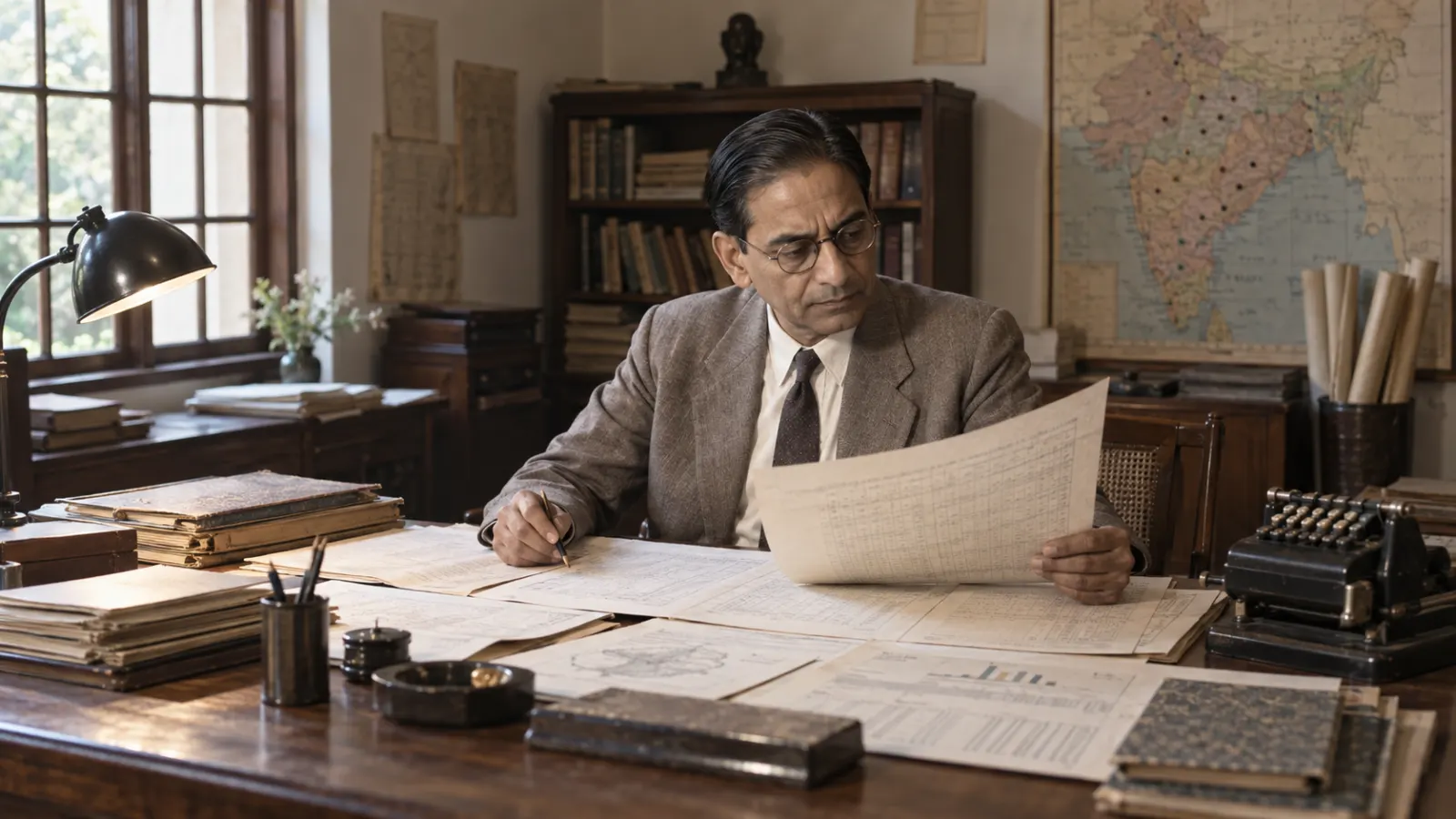
P. C. Mahalanobis: Statistics, Surveys and the Making of Modern India
Modern government depends on numbers that most citizens never see being produced. How much food is being grown? What do households consume? How many people are working? Which regions are becoming poorer or richer? How much industrial capacity exists, and how quickly is it changing?
A census can answer some questions, but counting an entire population is expensive and too infrequent for many decisions. Administrative records can be incomplete, inconsistent or collected for purposes that do not match the question policymakers later want to ask. Statistical sampling offers another possibility: observe a carefully designed fraction of a population and use it to estimate characteristics of the whole.
Few people did more to turn that principle into an institution of government in India than Prasanta Chandra Mahalanobis.
To statisticians, his name survives most visibly in the Mahalanobis distance, a multivariate measure that accounts for differences in scale and correlation among variables. In India, his institutional legacy is considerably larger. He founded the Indian Statistical Institute, established the journal Sankhya, pioneered methods for large-scale sample surveys, helped create the National Sample Survey and later became deeply involved in post-independence economic planning.
The unifying idea was not planning or mathematics by itself.
It was measurement.
Mahalanobis believed that public decisions could be improved when governments possessed systematic evidence about the society they were trying to govern. Today that principle sounds almost routine. In the first half of the twentieth century, applying it to a vast, poor, administratively uneven and socially diverse country required new statistical methods, trained investigators, computing capacity and durable institutions.
His biography is therefore not simply the story of a statistician who developed an important equation.
It is the story of how statistics became part of the infrastructure of the modern Indian state.
From Physics to Statistics
Prasanta Chandra Mahalanobis was born in Calcutta on 29 June 1893. He studied at Presidency College before travelling to King's College, Cambridge, where his formal academic training centred on the natural sciences rather than statistics. Cambridge's account of his career notes that he graduated in natural science and performed particularly strongly in physics. (cam.ac.uk)
This beginning matters because Mahalanobis did not enter professional life through a conventional statistics department. Statistics itself was still emerging as a distinct modern discipline, and many of its important early applications were being developed inside biology, anthropology, agriculture and experimental science.
Accounts of his Cambridge years frequently mention his encounter with Biometrika, the journal associated with some of the major developments in mathematical statistics. The anecdote has acquired almost mythic status in retellings of his life, but the more important point is intellectual: Mahalanobis began to see statistical methods as tools for solving scientific problems that involved large quantities of variable, imperfect data.
After returning to India, he joined Presidency College and remained professionally connected with physics while statistical questions increasingly occupied his attention.
The interdisciplinary path shaped his later career.
Mahalanobis did not treat statistics as an isolated branch of pure mathematics. He moved between anthropometry, meteorology, crop measurement, economics and public administration. The same statistical logic could, in principle, help compare human populations, estimate agricultural production or describe household consumption.
That breadth eventually led to an institutional insight.
India did not merely need occasional calculations performed by isolated experts.
It needed a community capable of developing statistical methods, training practitioners, collecting data and subjecting results to professional criticism.
The Mahalanobis Distance Began With a Problem of Multivariate Comparison
Mahalanobis's most famous mathematical contribution grew out of attempts to compare populations using several measurements simultaneously.
Suppose researchers compare two groups using height, arm length and several other body measurements. Simply calculating the ordinary distance between the group averages creates a problem: the variables are not necessarily independent. Taller people may also tend to have longer arms, and some measurements naturally vary much more than others.
Counting every difference as though it carried independent information can therefore exaggerate or distort how different the groups actually are.
The Mahalanobis distance addresses this problem by taking the covariance structure of the variables into account. Informally, it measures how far an observation or group lies from another after adjusting for the ordinary patterns of variation and correlation in the data.
A difference along a direction where observations normally vary widely should count differently from the same numerical difference along a direction where such variation is unusual.
Mahalanobis developed these ideas through work on anthropometric data and published his classic paper, “On the Generalised Distance in Statistics,” in 1936. The historical literature connects the development of the statistic to his earlier studies of anthropometric measurements and population differences. (cir.nii.ac.jp)
The concept became far more general than its original application.
Mahalanobis distance is now used in multivariate statistics, classification, pattern recognition, anomaly detection, quality control and machine learning. A modern data scientist may use it to identify an unusual transaction or classify observations without knowing anything about the anthropometric questions from which the measure emerged.
That history captures something important about Mahalanobis's intellectual style.
He was interested in mathematical abstraction, but the abstraction often began with a concrete empirical problem.
The equation mattered because it improved the ability to reason from complicated observations.
Building the Indian Statistical Institute and Sankhya
Mahalanobis gradually gathered a group of researchers and collaborators around statistical work in Calcutta. On 17 December 1931, the Indian Statistical Institute was formally established. ISI's own institutional history identifies Mahalanobis as its founder and records its origins in this early statistical community. (isical.ac.in)
The significance of ISI was not simply that India acquired a new research organisation.
The institute combined theory, teaching and application.
Statistical research could develop as an intellectual discipline, while the same institution worked on agricultural, industrial, demographic and economic problems. Students and researchers could move between mathematical theory and the practical difficulties of data gathered outside laboratories.
This structure helped create a professional statistical community in India.
A national survey requires more than someone who knows sampling formulas. It needs investigators, supervisors, statisticians, data processors and institutions capable of maintaining standards across thousands of observations. Building that capacity requires training.
ISI became one of the places where such expertise could be accumulated.
The institute's scientific ambition was reinforced by the launch of Sankhya: The Indian Journal of Statistics. ISI records that Mahalanobis founded the journal in 1933 and remained its editor until his death in 1972. The first volume appeared in June 1933. (isical.ac.in)
The choice of name itself reflected the larger project. Mahalanobis explained Sankhya through the Sanskrit association with number and “determinate knowledge”, connecting an Indian intellectual term with a modern international scientific discipline. (isical.ac.in)
A journal may appear less consequential than a government survey, but journals perform essential institutional work.
They create a place where methods can be examined, challenged and extended. They connect researchers who might otherwise remain isolated. They make scientific criticism part of a community rather than a private conversation.
For a country still under colonial rule, producing a statistical research journal also had symbolic significance. Indian researchers would not merely consume methods developed elsewhere; they could participate directly in international statistical science.
Mahalanobis's nationalism in science was therefore not intellectual isolation.
ISI built relationships with researchers abroad and attracted major statistical figures. Scientific autonomy was pursued through international exchange, not withdrawal from it.
That approach became a recurring feature of Indian institution-building in the twentieth century: the objective was not to choose between national capacity and global science, but to create institutions capable of participating in global science from a position of greater independence.
Why Sample Surveys Became Mahalanobis's Largest Public Contribution
The problem that increasingly occupied Mahalanobis was straightforward to state and difficult to solve: how can a country learn about millions of people without measuring every one of them?
India made the question especially demanding.
Its population was enormous. Villages were numerous and geographically dispersed. Roads and communications were uneven. Agricultural and household conditions varied widely between regions. Administrative records were incomplete.
A complete enumeration could be extraordinarily expensive and slow.
Sample surveys offered a different strategy.
Instead of measuring every farm, household or person, statisticians could select a carefully designed sample and estimate the characteristics of the larger population, while also estimating uncertainty.
But representative sampling is not the same as simply visiting a few convenient places.
A badly selected sample can produce an answer that appears precise while systematically missing important parts of the population. The probabilities by which units enter the sample matter. Regional differences matter. The size and organisation of the sample matter.
Mahalanobis's contribution went beyond advocating sampling in principle.
He treated survey design and field operations as statistical problems themselves.
This was crucial because large surveys contain errors that cannot be solved through elegant mathematical formulas alone.
An investigator may misunderstand a question.
Respondents may interpret questions differently.
Measurements may be taken inconsistently.
A supervisor may apply procedures differently from another team.
Data may be transcribed incorrectly.
These are non-sampling errors. Increasing the sample size does not necessarily eliminate them. In some cases, collecting more badly measured data simply produces a larger dataset containing the same systematic mistake.
Mahalanobis's survey work therefore focused heavily on methods for detecting and controlling the process by which observations were created.
One particularly important technique was the interpenetrating network of subsamples.
The idea was to divide a sample into two or more independently selected subsamples and assign them to different investigative teams. If the same sampling design produced systematically different results across teams, researchers gained evidence that field procedures themselves might be introducing error.
MoSPI's historical account of the National Sample Survey identifies the interpenetrating network of subsamples as a method developed by Mahalanobis and notes that it was used in the NSS from its second round. Earlier work had applied the technique to Bengal crop surveys. (mospi.gov.in)
The principle remains highly modern.
Data quality has to be designed into the process that produces the data.
Today governments and companies possess enormous digital databases. The volume can create an illusion that scale guarantees accuracy.
Mahalanobis's survey practice suggests the opposite.
A billion observations collected through a biased or poorly understood process can provide less useful knowledge than a smaller sample whose selection and measurement procedures are transparent.
The National Sample Survey Made Society Statistically Visible
After independence, India's demand for reliable socioeconomic information became urgent.
The government was attempting to estimate national income, address food shortages, allocate resources and plan economic development, yet basic information on household consumption, employment, agriculture and other aspects of life remained incomplete.
The institutional background is important.
MoSPI's National Statistical Commission history records that the National Income Committee was created in 1949 and identified serious gaps in the country's statistical base. The Central Statistical Unit was also established in 1949, followed by the Directorate of the National Sample Survey in 1950. (nsc.mospi.gov.in)
Mahalanobis chaired the National Income Committee, working alongside economists D. R. Gadgil and V. K. R. V. Rao. MoSPI's historical account says that both the National Income Committee and the contemporary statistical coordination efforts found major deficiencies in available data. Prime Minister Jawaharlal Nehru supported the idea of organising a nationwide large-scale sample survey, and the National Sample Survey was established in 1950. (mospi.gov.in)
Mahalanobis became the central methodological figure in its formative period.
The importance of the NSS extended well beyond one government programme.
Repeated sample surveys created a new way for the state, economists and researchers to observe Indian society. Household consumption could be estimated. Employment patterns could be studied. Agricultural and demographic questions could be revisited at intervals rather than waiting for the next decennial census.
Cambridge's retrospective account describes the NSS as a major source for research on consumption, inequality, education and health, reflecting how deeply its later rounds became embedded in Indian policy analysis. (cam.ac.uk)
This was not merely a technical change.
It altered what could become a matter of public argument.
Once household consumption is measured, economists can debate poverty estimates.
Once employment patterns are measured, policymakers can argue about labour-market change.
Once educational or health outcomes are measured, inequalities that had previously been described impressionistically can become objects of systematic analysis.
Numbers do not settle such debates.
They make certain kinds of debate possible.
That is why the development of a survey system can be understood as part of the construction of modern public knowledge.
But statistical visibility is never completely neutral.
Every questionnaire contains definitions.
Who counts as employed?
What counts as household consumption?
Which time period should respondents remember?
How should unpaid family work be classified?
These choices influence the reality the survey is able to display.
Mahalanobis helped build the machinery, but later generations continuously revised the classifications as Indian society changed.
A statistical system therefore cannot be completed once and preserved unchanged.
It has to evolve alongside the society it measures.
From Measuring the Economy to Modelling Its Future
Mahalanobis's role in independent India eventually moved beyond measuring existing conditions.
He became involved in deciding how development itself should be organised.
India's leadership adopted Five-Year Plans as a framework for public investment and structural transformation. During the 1950s Mahalanobis developed economic models intended to explore how allocating investment among sectors could influence long-run growth.
ISI's Economic Research Unit records that studies on planning began at the institute in 1954 at Nehru's initiative and that Mahalanobis submitted a draft plan framework to the prime minister in March 1955. (isical.ac.in)
The resulting approach became closely associated with the Second Five-Year Plan, 1956–61.
At the core of the simplified Mahalanobis model was a distinction between sectors producing capital goods and sectors producing consumer goods.
The intuition was powerful.
If an economy spends too little on the capacity to manufacture machinery, equipment and other capital goods, future investment remains constrained by what the country can import or produce with its existing industrial base.
Directing more investment toward capital-goods industries can therefore reduce the immediate availability of consumer goods but expand the economy's future ability to invest.
The Second Plan itself was considerably broader than one mathematical model. Planning Commission material lists objectives including increased national income, rapid industrialisation with emphasis on basic industries, employment expansion and social justice. (niti.gov.in)
Still, Mahalanobis's framework helped provide an intellectual justification for giving substantial priority to heavy industry and domestic capital-goods capacity.
The strategy addressed a genuine postcolonial problem.
India lacked much of the industrial infrastructure required to produce steel, heavy engineering equipment and machinery at the scale policymakers believed development would require. Dependence on imported capital goods also created vulnerability to foreign-exchange constraints and international supply conditions.
Building domestic productive capacity could therefore be understood as both an economic and strategic objective.
Yet the strategy also generated major criticism.
A capital-intensive industrial programme could create industrial capacity without generating employment rapidly enough for a labour-abundant country. Agricultural investment remained essential because most Indians still depended on rural livelihoods and food supply constrained the entire economy. Industrial projects themselves could require substantial imports before domestic capacity expanded, worsening foreign-exchange pressures.
Later economists also criticised the broader system of licensing, controls and public-sector dominance that developed around India's planned economy.
These debates should not be collapsed into a simple verdict on Mahalanobis.
He was neither the sole creator of India's industrial base nor the individual author of every institutional weakness later associated with the so-called licence raj.
The Second Plan was a political and administrative programme shaped by the Planning Commission, government ministries, state governments, economists, businesses and competing ideological priorities.
Mahalanobis's influence was nevertheless unusually large.
His role demonstrates what can happen when statistical expertise moves from describing reality to recommending the structure of future development.
Expertise, Nehru and the Limits of Numerical Authority
Mahalanobis's relationship with Jawaharlal Nehru gave his ideas unusual access to political authority.
Nehru's broader vision of development placed considerable confidence in science, technical expertise and public planning. Mahalanobis could offer all three: statistical methods, institutions capable of collecting national data and mathematical models for thinking about investment.
The partnership produced enduring institutions.
It also raises a question that remains relevant whenever governments rely heavily on economists, epidemiologists, climate scientists or data specialists:
What can technical expertise legitimately decide?
Models are useful precisely because they simplify reality.
A model can show how investment assumptions interact.
It can estimate trade-offs.
It can make consequences visible.
But the simplification also means something has been excluded.
A model cannot decide by itself how much present consumption should be sacrificed for future investment. It cannot derive the morally correct distribution of resources between regions or classes. It cannot determine whether industrial independence should take priority over employment growth simply by manipulating equations.
These are political and ethical choices as well as technical ones.
Mahalanobis's career therefore represents both the promise and the limits of technocratic government.
The promise is that public decisions can become more disciplined when assumptions are explicit and evidence replaces intuition.
The danger appears when the authority of mathematics makes contested social priorities look as though they were technical conclusions rather than choices.
Statistics can measure uncertainty.
It cannot decide what a society ought to value.
The strongest relationship between expertise and democracy therefore requires experts not only to produce numbers but to make the assumptions behind them visible.
Computing, Data Processing and the Infrastructure Behind Statistics
Large-scale statistical systems generate an additional problem: even when information has been collected successfully, someone has to process it quickly enough to remain useful.
Survey ambition therefore creates computational demand.
ISI became involved early in mechanical and electronic data processing and later in computing. Its institutional history records work on early analogue and digital computers during the 1950s and 1960s, reflecting the natural connection between large-scale statistical analysis and computational technology. (isical.ac.in)
The significance goes beyond a claim about which machine was “first”.
Mahalanobis understood statistics as a chain.
A question has to be defined.
A sample has to be designed.
Investigators need training.
Data have to be collected.
Field errors need detection.
Responses must be coded and processed.
Statistical uncertainty has to be estimated.
Only then can results become evidence for policy.
Failure anywhere in that chain can damage the final number.
This perspective is particularly relevant in the age of big data.
Modern governments can access tax records, payment systems, satellites, mobile networks and digital administrative databases on a scale Mahalanobis could never have imagined.
But large data are not automatically representative data.
Administrative records may exclude people who never interacted with the programme generating the database.
Digital data can underrepresent populations with weaker access to technology.
Measurement definitions can change over time.
Algorithms can process errors faster as easily as they process accurate observations.
The question Mahalanobis confronted has therefore not disappeared.
Technology has changed the volume and speed of data.
It has not removed the need to understand how those data were produced.
His Institutional Legacy Outlasted His Planning Model
Mahalanobis died on 28 June 1972, one day before his seventy-ninth birthday. ISI records that he remained its director and editor of Sankhya until his death. (isical.ac.in)
By then, different parts of his legacy had acquired very different lives.
The Mahalanobis distance had entered the international vocabulary of multivariate statistics.
The Indian Statistical Institute had become a major research and teaching institution and was designated an Institute of National Importance under an Act of Parliament in 1959. (isical.ac.in)
Sankhya had established itself as an international statistical journal.
The National Sample Survey had become an enduring component of India's official statistical system, surviving institutional reorganisation and changing survey designs long after its founder's death. MoSPI's 2025 review of the NSS describes its development over 75 years and continues to identify Mahalanobis's methods as foundational to the survey's early culture. (mospi.gov.in)
The planning model had a different trajectory.
It belongs to a specific period of development economics when newly independent countries were debating how rapidly to industrialise, how much investment should be directed by the state and how domestic productive capacity could be created under severe capital constraints.
India eventually moved away from the economic regime associated with central Five-Year planning.
That does not make the Mahalanobis model historically irrelevant.
It makes it a historical argument that can be assessed against the problems policymakers believed they were trying to solve and the consequences that followed.
This difference among his legacies is important.
Not every major contribution survives in the same way.
Some become mathematical tools.
Some become institutions.
Some remain methods.
Others become contested episodes in economic history.
Mahalanobis's Deeper Legacy Is the Idea That Data Require Institutions
It would be easy to end Mahalanobis's biography with the formula that bears his name.
That would miss the larger achievement.
His most important public contribution may have been recognising that reliable national statistics cannot be created simply by ordering officials to collect more numbers.
Credible evidence requires methods, organisations and professional norms.
Sampling frames have to be constructed.
Investigators need training.
Field errors have to be measured.
Definitions must be made explicit.
Results need professional scrutiny.
Surveys have to be repeated often enough to identify change.
Statistical institutions must retain enough credibility that researchers, policymakers and the public can take inconvenient findings seriously.
That final requirement is especially important.
Official statistics operate close to political power because they measure things governments care about: inflation, unemployment, poverty, output, inequality and programme performance.
The same governments that need reliable statistics may sometimes dislike what the statistics reveal.
A strong statistical system therefore requires professional independence as well as technical competence.
Mahalanobis could not solve this permanently because no founder can.
Institutions have to recreate their credibility generation after generation.
Economic structures change.
Definitions become obsolete.
Governments change.
New technologies create new sources of information and new ways to misuse it.
Survey methods must adapt without sacrificing comparability and transparency.
This is why Mahalanobis's legacy should not be treated as proof that India's statistical problems were solved in the middle of the twentieth century.
It is better understood as a demanding standard.
Public decisions require evidence, and evidence requires institutions capable of producing trustworthy measurements.
The principle applies far beyond India.
Governments now collect more information than at any previous point in history. Businesses analyse customer behaviour in real time. Satellites observe crops and cities. Administrative databases contain millions of records.
Yet the core questions remain remarkably similar to those Mahalanobis confronted:
Who was measured?
Who was missed?
How was the sample or database created?
What does the variable actually mean?
How much uncertainty exists?
Could the measurement process itself introduce bias?
And how much confidence should policymakers place in a number before using it to make decisions affecting millions of people?
Mahalanobis's answer was to combine mathematical inference with fieldwork, computing, institutional development and a belief that public reasoning could become more empirical.
That belief did not make statistics politically neutral or economic planning infallible.
It did something more durable.
It established the proposition that a modern state should be able to explain how it knows what it claims to know.
That is why P. C. Mahalanobis remains important far beyond the equation carrying his name.