Few famous thinkers are harder to write about biographically than Lao Tzu. The name appears everywhere: in histories of Chinese philosophy, translations of the Tao Te Ching, discussions of “going with the flow,” leadership manuals, martial-arts culture and modern spirituality. Yet the closer historians move toward the earliest evidence, the less certain the person becomes. There is no securely contemporary biography, no dated archive of a teacher called Lao Tzu, and no manuscript in which a clearly identifiable author signs the work now called the Daodejing.
That uncertainty is not a reason to abandon the subject. It is the subject. “Laozi,” usually translated as “Old Master,” can be approached as three overlapping realities: a traditional sage described in later historical accounts; the authorial persona attached to one of early China's most influential texts; and a figure who, in later religious Daoism, became far more than a philosopher. The history of Lao Tzu is therefore also a history of how texts acquire authors, how communities construct exemplary lives and how philosophical ideas change as they move across centuries.
The result is more interesting than the popular image of an old man leaving China on an ox after writing eighty-one chapters of timeless wisdom. That image belongs to a long cultural tradition, but it should not be mistaken for a photograph of the sixth century BCE.
The traditional biography — and why historians hesitate
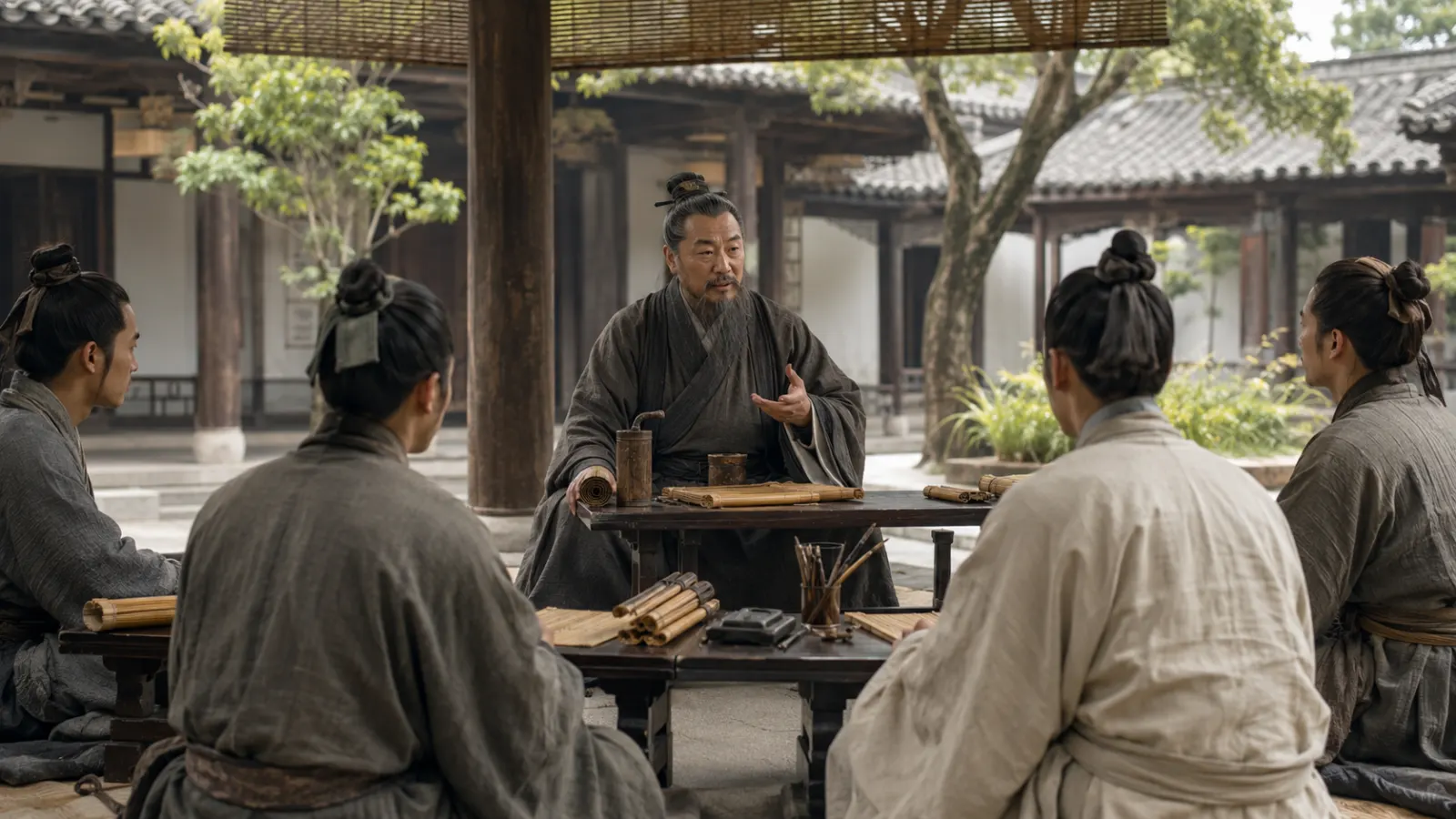
The most influential early biography of Laozi appears in Sima Qian's Records of the Grand Historian, composed during the Han dynasty, centuries after the period in which Laozi was traditionally said to have lived. Sima Qian associates Laozi with a man usually called Li Er or Li Dan, describes him as a keeper of archival records at the Zhou court and includes the famous tradition that Confucius consulted him about ritual.
The account does not behave like a simple modern biography. Sima Qian reports alternatives and uncertainties. Other figures are discussed as possible bearers of the Laozi identity, and chronology is difficult to reconcile. That alone should warn against presenting the narrative as settled fact. The later story in which Laozi leaves civilization, reaches a frontier pass and is persuaded by a guard to write down his teachings before disappearing into the West is culturally powerful, but it is a literary and religious memory rather than securely contemporary evidence.
Traditional dates often place Laozi in the sixth century BCE and make him an older contemporary of Confucius. Modern scholarship has frequently moved the composition of the Daodejing much later, into the Warring States environment of the fourth and third centuries BCE, although debates continue over how individual sayings may preserve older material. The historical question is therefore not merely “When was Laozi born?” It is whether a single individual corresponding to the traditional portrait can be recovered at all.
Some scholars prefer to speak of Laozi as a textual persona or a “collective entity”: a name under which a body of teachings was organized and given the authority of an ancient master. This does not mean the tradition is fraudulent. Ancient intellectual cultures often transmitted teachings through lineages, sayings, schools and editorial layers rather than through the modern expectation of a single author producing a final book in one sitting.
A text formed before the biography became fixed
The Daodejing is short, compact and unusually resistant to paraphrase. In its received form it contains eighty-one chapters divided conventionally into sections associated with Dao and De. Yet excavated manuscripts demonstrate that the text did not always circulate in precisely the received order or wording.
The Mawangdui silk manuscripts, discovered in a Han tomb and dating from the second century BCE, preserve versions in which the order of the two main parts differs from the familiar received arrangement. Even more significant are the Guodian bamboo manuscripts, excavated from a tomb dated to the late fourth or early third century BCE. They contain groups of passages closely related to portions of the received Daodejing but not the entire text in its later form.
These discoveries changed the way scholars could talk about authorship. They made it harder to imagine a single, unaltered book dictated at a frontier gate and transmitted unchanged. They instead suggest a textual history involving selection, arrangement, copying and development. A later manuscript may represent a more stabilized work built from materials that had circulated in smaller units.
That does not dissolve the Daodejing into chaos. The text has a recognizable philosophical voice: suspicious of aggressive striving, attentive to reversal, drawn to images of water and emptiness, and interested in forms of power that operate without display. But “voice” does not automatically prove a single historical author. The safest biography of Lao Tzu begins by respecting that distinction.
Dao: a “Way” that cannot be reduced to a definition
The most famous difficulty in the Daodejing appears immediately: the dao that can be fully put into words is not the constant Dao. Even without quoting the line at length, its function is clear. The text distrusts the idea that ultimate order can be captured by naming it as though it were an ordinary object.
Dao can mean way, path, method or course. In early Chinese thought, many thinkers spoke of a dao: a way of governing, cultivating oneself or ordering society. The Daodejing pushes the term toward a broader philosophical role. The Dao is associated with the generative process through which the world takes form, yet it is not described as a personal creator god. It is prior to fixed distinctions and cannot be possessed by the ruler, scholar or priest who claims privileged access to it.
This produces a distinctive intellectual style. Instead of constructing a formal system through explicit premises and conclusions, the text uses compressed images and reversals. What is soft may overcome what is hard. What appears empty may be useful. The desire to grasp and display power may destroy the very effectiveness it seeks.
Modern readers sometimes translate this into vague advice to “relax” or “accept everything.” That is too simple. The Daodejing contains a demanding critique of coercive action, social competition, overregulation and political vanity. Its calmness is not indifference. It asks what kinds of action actually work when force, ego and excessive intervention are stripped away.
Wuwei: “non-action” is not doing nothing
No concept associated with Lao Tzu is more easily misunderstood than wuwei. English translations often render it as “non-action,” which can sound like passivity. In context, however, wuwei is closer to action that does not impose itself through unnecessary forcing, contrivance or self-advertisement.
A skilled ruler acting through wuwei does not mean a ruler who never makes decisions. It means one who does not constantly disturb social life in order to demonstrate authority. A cultivated person does not become inert; rather, action becomes less distorted by compulsive striving. The ideal is effectiveness without theatrical domination.
This helps explain why the text repeatedly uses water as an image. Water does not attack in the manner of an army, yet it moves around obstacles, settles in low places and can wear away what appears harder than itself. The political implication is subtle. Strength need not announce itself as strength. Leadership that depends on constant commands and punishments may reveal weakness rather than power.
The concept also complicates attempts to classify the Daodejing as purely mystical. Its chapters repeatedly address rulers, war, taxation, social order and the dangers of ambition. The work can be read as metaphysical poetry, self-cultivation teaching and political reflection at the same time.
Ziran, simplicity and the suspicion of artificial desire
Another central term is ziran, often translated as “naturalness” or “spontaneity,” literally carrying the sense of being “so of itself.” The ideal is not a return to nature in the modern environmental sense. It is a condition in which life is less deformed by artificial pressures, status competition and compulsive desire.
The text values the uncarved block, the valley and other images of what has not been excessively shaped for display. Such language can sound anti-civilizational, and some chapters imagine very small communities with limited technologies and desires. Yet it would be misleading to treat the work as a straightforward political programme for dismantling all institutions. Its rhetoric often functions through exaggeration and paradox, forcing readers to reconsider the assumption that more knowledge, more rules, more weapons and more wealth necessarily produce better order.
The critique of desire is similarly specific. Desire becomes dangerous when it is manufactured through comparison, luxury and prestige. A society that teaches people to compete over rare goods may create theft and disorder and then respond by adding punishment. The Daodejing reverses the usual logic: disorder may be produced by the very systems that claim to control it.
Laozi and Confucius: rivalry is partly a later map
Popular histories often stage Lao Tzu and Confucius as opposites. Confucius stands for ritual, hierarchy and disciplined social responsibility; Lao Tzu stands for nature, freedom and escape from convention. There are real philosophical contrasts, but the simple rivalry is partly produced by later categorization.
Early Chinese intellectual life did not begin with neatly bounded “schools” in the modern sense. Texts responded to shared problems: political disorder, the collapse of inherited authority, war among states, moral education and the formation of effective rulers. The Daodejing can criticize ritualized display and moral preaching, but it also shares with Confucian traditions an intense concern for how rulers should behave and how personal cultivation affects public order.
The story that Confucius personally consulted Laozi is therefore best read as a later narrative about intellectual authority. By making the revered Confucian master seek instruction from the older sage, tradition could place Laozi above him in age and depth. Whether such a meeting occurred cannot be established from contemporary evidence.
This is a useful example of how biography functions in ancient philosophy. Stories of meetings, journeys and conversations often organize relationships among ideas. Their cultural meaning can be important even when historians cannot verify them as events.
The politics of weakness, war and the small state
The Daodejing is deeply skeptical of military glory. Weapons are treated as instruments of misfortune rather than objects worthy of celebration. Victory does not erase the deaths required to achieve it. In a Warring States world of expanding armies and increasingly centralized governments, such language carried political force.
At the same time, it would be wrong to make Laozi into a modern pacifist activist. The text accepts that conflict may occur and often speaks from the standpoint of rulers. Its goal is to reduce coercion, ambition and unnecessary intervention rather than to present a detailed institutional theory of international law.
The famous ideal of a small state with few people can be read as a critique of imperial scale and restless expansion. People live near one another without needing constant movement; tools exist but are not endlessly exploited; ordinary life is valued over conquest. Whether this represents a literal utopia or a rhetorical counter-image, it challenges the assumption that greatness is measured by territorial reach and administrative activity.
That critique has helped make the Daodejing attractive to readers suspicious of bureaucracy and militarism. But it can also be politically ambiguous. “Non-interference” can serve humane restraint; it can also be invoked to justify rulers who do little about injustice. The text does not provide a simple policy manual. Its concepts require judgment.
The language of paradox and the problem of translation
Much of Lao Tzu's global reputation rests on translation, and translation is unusually consequential here. Terms such as dao, de, wuwei and ziran do not map neatly onto single English equivalents. De, for example, has been rendered as virtue, power, integrity or potency. Each choice nudges interpretation.
The received text is also terse. Classical Chinese can omit subjects and grammatical markers that English normally requires. A translator must decide where ambiguity should remain and where a sentence needs to be made explicit. Two responsible translations can therefore sound strikingly different without either being careless.
This matters because modern popular editions sometimes smooth the work into contemporary therapeutic language. Such versions may be readable, but they can detach the text from early Chinese political vocabulary and from its difficult textual history. A historically responsible approach compares translations and, where possible, checks how key terms function elsewhere in early Chinese writing.
The Daodejing has survived partly because it supports multiple readings. Its compression is not a defect to be solved once and for all. The text invites interpretive participation, but that freedom should not become permission to make it say anything.
From “Old Master” to divine Lord Lao
Centuries after the philosophical text took shape, Laozi became central to organized religious Daoist traditions. This development transformed the sage's status. He could be understood as an incarnation or manifestation of the Dao, called Lord Lao and placed within a sacred history far larger than the biography of a human philosopher.
The process should not be described as a simple corruption of an originally “pure philosophy.” Religious Daoism developed sophisticated ritual, cosmology, meditation, community organization and sacred texts. The deification of Laozi shows how philosophical authority could be integrated into religious institutions.
Art preserved the transformation. Later images show Laozi as an aged sage, an immortal or a traveler riding an ox toward the western pass. These are not documentary portraits. They are visual theology and cultural memory. Museums today can display them as evidence for how later communities imagined Laozi, not for what a Warring States philosopher looked like.
This distinction is especially important for editorial images. A Ming-dynasty bronze of Laozi may be historically authentic as a Ming object while being completely non-contemporary as a likeness of Laozi.
Why the absence of a firm biography does not diminish the legacy
Modern biography often depends on individuality: a birth certificate, education, career decisions, correspondence and personal relationships. Lao Tzu resists that form. The evidence instead reveals a tradition whose authority became concentrated in a name.
That can seem disappointing only if influence requires a recoverable personality. The Daodejing shaped Chinese philosophy, political thought, religious Daoism, poetry, painting and later global philosophy regardless of whether all of its sentences came from one historical man. Its ideas about non-coercive power, reversal, humility, naturalness and the limits of language have repeatedly been reinterpreted because they address recurring problems of human control.
The most responsible conclusion is therefore double. The traditional Lao Tzu should not be erased: his biography, meeting with Confucius and journey through the pass are major parts of Chinese cultural memory. But those traditions should be labelled as traditions. The historical evidence points to a more complex formation in which a text, a sage persona and later religious memory grew together.
Lao Tzu's importance does not depend on proving that an archivist wrote eighty-one chapters at a gate. It lies in the durable intellectual challenge associated with the Old Master: whether wisdom might begin where the impulse to dominate, define and display begins to weaken.
What the manuscripts changed about the Laozi question
Modern understanding of the Daodejing changed sharply when archaeologists recovered early manuscript versions that predate the standard received text. The Mawangdui silk manuscripts, excavated in the 1970s from a tomb sealed in the second century BCE, place the material in a form recognizably related to the later classic but with significant differences in order and wording. The Guodian bamboo slips, excavated in the 1990s from a tomb usually dated to the late fourth century BCE, preserve clusters of sayings that overlap with portions of the received Laozi without reproducing the complete later book.
These discoveries matter because they make a simple author-and-publication model difficult to sustain. Instead of imagining one philosopher composing eighty-one finished chapters and handing them to posterity, scholars can see a textual tradition taking shape through selection, arrangement, commentary and transmission. Some sayings may be older than others. Different communities may have preserved different clusters. The division into chapters and the ordering of the two large sections known as Dao and De were not necessarily original features.
The manuscript record therefore supports a more historically cautious way of talking about Lao Tzu. The person and the text cannot simply be collapsed into one another. A traditional sage may stand behind part of the material, or the name may have become a convenient authority for a body of teachings whose formation stretched across generations. What can be studied with confidence is the evolving text, its concepts and its reception. The uncertainty is not an embarrassment to be hidden; it is one of the most interesting facts about the tradition.
This also explains why translation disputes are not merely arguments over English style. Translators are working with a compact classical language, variant manuscripts and concepts whose meanings were themselves contested in ancient China. Every fluent modern rendering is therefore partly an interpretation.
Sources / Further Reading
Stanford Encyclopedia of Philosophy, “Laozi,” on the traditional biography, textual history and philosophy of the Daodejing: https://plato.stanford.edu/entries/laozi/
Stanford Encyclopedia of Philosophy, “Religious Daoism,” on Laozi's later religious status and the distinction between early texts and organized Daoist traditions: https://plato.stanford.edu/entries/daoism-religion/
Chinese Text Project, Dao De Jing — searchable classical Chinese text and translation resources: https://ctext.org/dao-de-jing
Daniel J. Lebovitz, scholarship in Early China on the textual identity and manuscript history of the Laozi, including Guodian and Mawangdui evidence: https://www.cambridge.org/core/journals/early-china/
Sima Qian, Records of the Grand Historian — principal early biographical tradition for Laozi; use critically because it is much later than the period traditionally assigned to him.
Metropolitan Museum of Art, “Daoism and Daoist Art,” for later visual and religious representations of Laozi: https://www.metmuseum.org/essays/daoism-and-daoist-art
Suggested Internal Links
The Philosophy of Confucius
The Tao of Lao Tzu — Planned companion deep dive
Planned internal link: What Wuwei Means in Early Chinese Philosophy
Planned internal link: The Daodejing and the Warring States World
Planned internal link: Zhuangzi and the Philosophy of Spontaneity
The Wisdom of Socrates