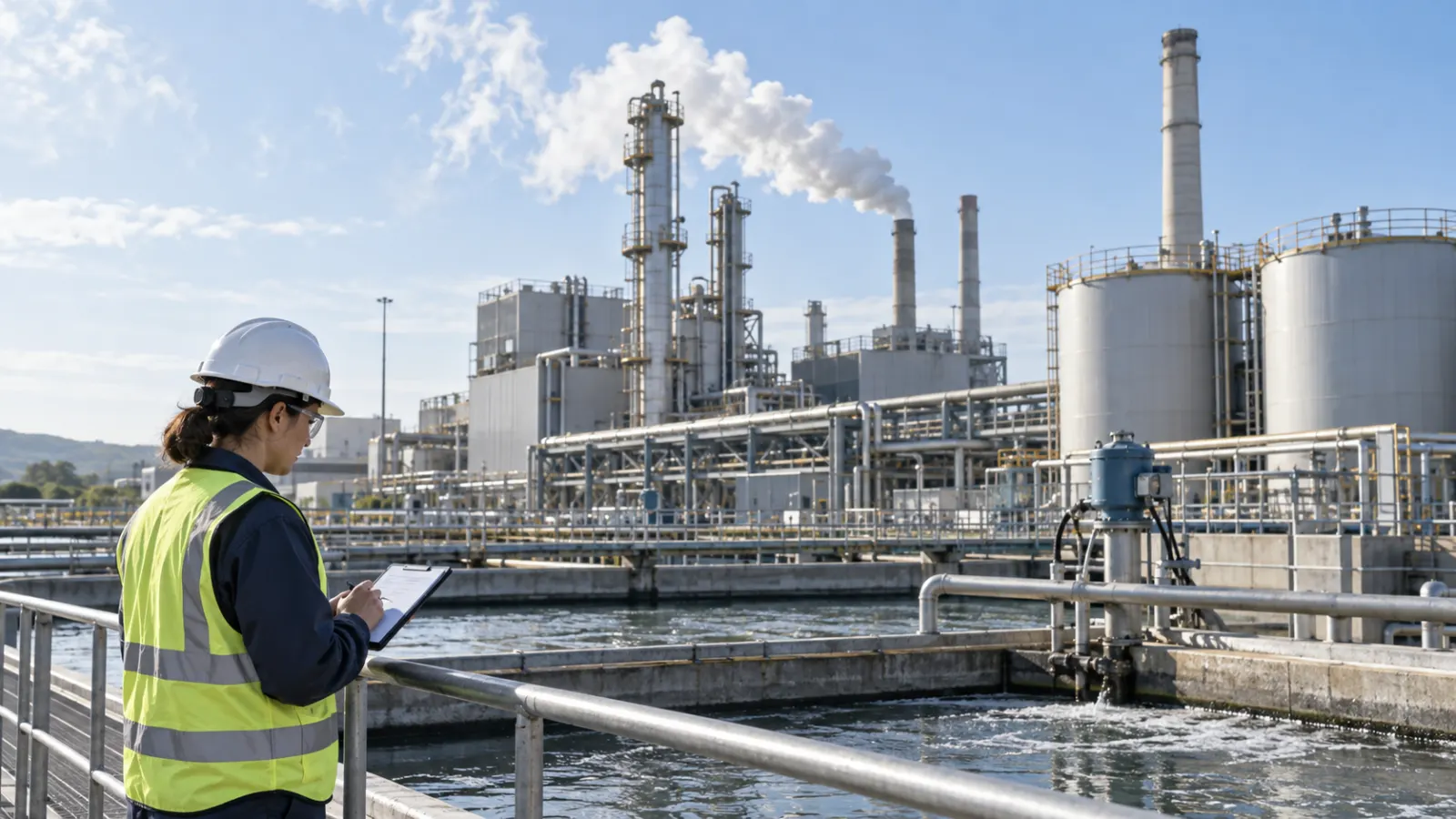
Industrial Pollution: How Production Contaminates Air, Water and Soil
Industrial pollution is often represented by one familiar image: a factory chimney releasing dark smoke. That is certainly one form of industrial pollution, but it captures only a fraction of the ways production can affect the environment.
Industrial facilities can release gases and particles into the atmosphere, discharge contaminated wastewater, leave chemicals or metals in soil, produce hazardous solid waste, generate excessive heat and noise, and create risks through fires, leaks or accidental spills. Pollution can arise while raw materials are extracted, processed and manufactured, during storage and transport, and again when industrial products or wastes are discarded.
The environmental footprint also varies enormously among facilities making similar products. An older plant using inefficient combustion, hazardous inputs and poorly controlled wastewater can create substantially different impacts from a modern facility using closed systems, cleaner energy, material recovery and effective pollution controls.
Industrial pollution is therefore not an unavoidable feature of every factory. It results from combinations of materials, production processes, energy sources, waste management, technology, regulation and operational discipline.
UNEP treats pollution across air, water and soil as a major threat to both ecosystems and human health, while UNIDO increasingly frames cleaner industrial development around preventing emissions and waste, improving resource efficiency and designing circularity into production rather than treating pollution only after it has been created.
Different Industries Create Different Pollution Profiles
The term industry covers activities with very different environmental characteristics. Cement, steel, chemicals, mining, textiles, pulp and paper, electronics, pharmaceuticals, oil and gas, food processing and power generation do not produce the same pollutants or expose communities through the same pathways.
A cement plant can release particulate matter, nitrogen oxides, sulfur compounds and carbon dioxide. Metal processing may create dust, acidic wastewater, slag and residues containing metals. Textile production can generate highly variable wastewater containing dyes, salts, surfactants and processing chemicals. Chemical manufacturing can involve solvents, acids, bases and compounds with very different toxicity and persistence. Mining can produce enormous quantities of waste rock or tailings and, under some conditions, expose sulfide minerals that generate acidic drainage capable of mobilising metals.
This variation is why simply calling an industry “dirty” or “clean” provides little useful environmental information.
The more important questions are: What pollutant is being produced? In what quantity? How does it move through the environment? How long does it persist? Who is exposed? And what control measures are operating?
UNEP notes that pollutants released through air, water, soil and waste streams can damage ecosystems, accumulate through food webs and reduce ecological resilience. Chemical manufacturing, extractive activity and energy production can each create different combinations of chemical, physical and ecological pressures.
This pollutant-pathway-exposure framework also prevents environmental analysis from confusing the existence of a hazardous substance with actual exposure.
A chemical can be extremely hazardous while remaining effectively contained inside a closed industrial process. Another substance may be less intrinsically toxic but create substantial risk because large quantities are released continuously into air or drinking-water sources.
Hazard describes the potential to cause harm. Risk depends on hazard together with exposure.
Workers, nearby residents and ecosystems may also experience very different exposures from the same facility.
Good industrial regulation therefore needs more than a list of dangerous substances. It needs measurement of releases, environmental concentrations, occupational exposure and the communities or ecosystems actually receiving the pollution.
Air Pollution Can Travel Beyond the Factory Boundary
Industrial air pollution can include particulate matter, sulfur dioxide, nitrogen oxides, carbon monoxide, volatile organic compounds, metals and other hazardous air pollutants. Some pollutants leave the facility directly, while others react in the atmosphere and contribute to secondary pollutants such as ground-level ozone or fine particles.
The environmental consequences depend on far more than the number of tonnes emitted.
Stack height influences where pollution disperses. Wind direction and atmospheric stability determine where a plume travels. Terrain can trap pollution or redirect it. Chemical reactions can transform pollutants after release. Population density determines how many people may be exposed.
This means that two facilities producing identical annual emissions can create very different local health risks.
Industrial air-pollution control can operate at several levels. Cleaner fuels and production processes can prevent certain emissions from forming. Enclosed equipment and vapour-recovery systems can reduce releases of volatile compounds. Filters, baghouses and electrostatic precipitators can capture particles. Scrubbers can remove particular gases or particles from exhaust streams. Leak-detection and repair programmes can identify unintended releases from valves, seals, tanks and pipelines.
These technologies remain essential, but prevention usually has an important advantage over capture.
A pollutant that is never created does not need to be captured, transported, treated or disposed of later.
That is why industrial environmental management increasingly combines conventional control equipment with process redesign and cleaner production.
Air pollution and climate change also overlap without being identical problems.
Industrial facilities can emit carbon dioxide, methane, nitrous oxide and fluorinated greenhouse gases. The same facilities may emit particulate matter, sulfur dioxide, nitrogen oxides or toxic chemicals that create more immediate local health or ecological effects.
Carbon dioxide is environmentally important primarily because of its accumulation in the atmosphere and effect on climate; it is not managed in the same way as a toxic local air pollutant at ordinary outdoor concentrations. Conversely, a substance can create severe local toxicity while making little contribution to global warming.
Policies can create important co-benefits. Improving industrial energy efficiency or replacing coal combustion can reduce greenhouse-gas emissions while also reducing several conventional air pollutants.
But a serious industrial strategy needs to measure climate emissions and local pollution separately, because success against one does not automatically imply success against the other.
Industrial Wastewater Can Carry Complex Chemical Mixtures
Water is used throughout industry for cooling, washing, rinsing, chemical reactions, product formulation, dyeing, plating, transport of materials and cleaning equipment. During those processes it can acquire contaminants that make direct discharge environmentally damaging.
Industrial wastewater may contain suspended solids, oils, organic matter, nutrients, salts, acids, alkalis, solvents, dyes, metals and other hazardous substances. The composition can vary not only between industries but between production lines inside the same facility.
Water temperature can itself become a pollutant. Heated cooling water discharged into rivers or lakes can alter oxygen levels and affect aquatic organisms even if it contains relatively few chemical contaminants.
Wastewater treatment therefore cannot be reduced to one universal technology.
Physical treatment may remove solids, oils or suspended material. Chemical processes can adjust pH, oxidise contaminants or precipitate dissolved metals. Biological systems can break down biodegradable organic substances. Membranes, adsorption, advanced oxidation and other specialised processes may be needed where contaminants are persistent, toxic or difficult to separate.
Regulation often reflects these sector differences. In the United States, for example, EPA maintains industrial effluent guidelines for more than 50 categories of industrial and commercial activity, setting discharge requirements according to the technologies and pollution-control practices achievable within particular sectors.
Treatment, however, is only one part of good wastewater management.
Imagine a factory using a hazardous chemical in several rinsing stages. One strategy is to mix all contaminated water together and construct a larger treatment system. Another is to reduce the chemical requirement, keep concentrated waste separate from relatively clean water, reuse rinse water and recover useful material before wastewater reaches the treatment plant.
The second approach can reduce both pollution and treatment demand.
This is the logic of cleaner production: investigate why pollution exists before deciding how to treat it.
Soil and Groundwater Pollution Can Outlive the Factory
Air emissions are often visible and wastewater may be identifiable through a discharge pipe. Soil contamination can remain hidden for years.
Leaks from underground tanks, repeated spills, ash disposal, mine tailings, poorly designed hazardous-waste areas and deposition of airborne contaminants can leave pollutants in soil long after production has ended. Those contaminants can remain near the surface, migrate downward into groundwater or enter plants and food chains.
The consequences may therefore emerge slowly.
An industrial property can change ownership several times before contamination is discovered. A chemical released decades earlier may later appear in groundwater. Polluted sediments can continue affecting rivers after the original discharge has stopped.
Cleaning such sites can be technically difficult and expensive.
Depending on the contaminant and location, remediation may involve excavating contaminated soil, isolating it behind barriers, treating soil chemically or biologically, stabilising metals so they are less mobile, pumping and treating groundwater, or maintaining containment and monitoring for many years.
Remediation is valuable where historical pollution already exists.
It is rarely preferable to preventing the contamination in the first place.
This is one reason environmental management includes storage standards, secondary containment, monitoring, maintenance and spill-prevention systems. A leaking chemical tank is much cheaper to repair before thousands of litres enter soil than after contamination spreads through groundwater.
Industrial pollution therefore has a strong legacy dimension.
The environmental performance of a factory cannot always be evaluated only from what leaves its gates today. Historical wastes, old infrastructure and contaminated land may continue creating costs long after production techniques have improved.
Supply Chains Can Move Pollution Without Eliminating It
Modern manufacturing is geographically fragmented.
Raw materials may be mined in one country, refined in another, transformed into components somewhere else and assembled into a finished product thousands of kilometres away. A consumer buying a relatively clean-looking electronic device can therefore be separated from mining waste, chemical processing and manufacturing emissions by several countries and multiple corporate suppliers.
This creates an important accounting problem.
A country may reduce pollution from domestic manufacturing partly because pollution-intensive production has moved elsewhere. Local environmental quality improves, but the environmental footprint of consumption may remain substantial.
The same issue can occur inside individual companies.
A brand may operate efficient final-assembly facilities while purchasing metals, chemicals or components from suppliers with much weaker environmental controls.
Local regulation remains indispensable because pollution creates real effects where production occurs. Communities living beside a refinery, industrial park or mine experience local exposure regardless of where the final products are sold.
But companies trying to understand their full environmental footprint increasingly need to examine supply chains as well as their own facilities.
Chemical restrictions, supplier standards, traceability, lifecycle assessment and environmental disclosure can help identify impacts that would otherwise disappear beyond the factory gate.
UNIDO's current circular-production approach similarly looks across value chains, encouraging resource efficiency, safer material substitution, reuse of industrial by-products and designs that reduce waste throughout production systems.
This does not mean every environmental impact can be reduced to one lifecycle score. Local toxicity, carbon emissions, water scarcity and biodiversity loss may require different indicators.
Supply-chain accounting expands the boundary of analysis.
It does not eliminate the need to understand what is happening in each place.
Cleaner Production Goes Beyond End-of-Pipe Treatment
For much of industrial environmental policy, pollution control followed a relatively simple logic: produce first, then clean the waste.
Smoke passed through filters or scrubbers.
Wastewater went through treatment plants.
Hazardous wastes were transferred to specialised disposal facilities.
These end-of-pipe controls remain indispensable. Modern cities and industrial economies could not function safely without them.
But treatment frequently changes the form or location of pollution rather than eliminating material entirely.
A scrubber can remove contaminants from exhaust while creating a sludge or wastewater stream that then requires management. Wastewater treatment can produce contaminated sludge. Incineration reduces waste volume but leaves ash and creates air-emission control requirements.
Cleaner production asks a different first question:
Why is the pollutant being produced at all?
Could a hazardous solvent be replaced with a safer substance?
Could material losses be recovered and returned to production?
Could rinse water circulate through several stages before discharge?
Could waste heat be recovered?
Could a reaction be redesigned to produce fewer unwanted by-products?
Could equipment prevent evaporation or leaks?
Could the finished product be designed for easier repair, disassembly or recycling?
UNIDO describes cleaner production and circular economy approaches as central to sustainable industrial development, with resource efficiency, safer material substitution, emission reduction, industrial waste management and designing waste out of production among its major priorities.
The economic logic can reinforce the environmental one.
Material discharged as waste was often purchased first.
Water requiring treatment had to be obtained and pumped.
Heat released unused required energy to create.
Reducing those losses can lower operating costs as well as emissions.
This does not mean every cleaner-production investment pays for itself immediately. New equipment, redesign, training and process changes can require significant capital.
The broader point is that pollution prevention and industrial competitiveness are not necessarily opposites.
UNIDO's eco-industrial park programme, for example, has documented facilities saving energy, water and materials through resource-efficiency and industrial-symbiosis measures.
The most advanced pollution strategy therefore combines prevention, reuse and recovery with effective treatment for pollution that cannot reasonably be eliminated.
Regulation Matters Because Pollution Costs Can Be Shifted to Other People
Pollution presents a classic economic problem.
A factory can gain financially from production while some environmental costs are borne by people who never agreed to the transaction.
Residents may pay through poorer air quality.
Farmers may lose access to clean water.
Governments may finance contaminated-site cleanup.
Health systems may treat pollution-related disease.
Future generations may inherit contaminated soil or long-lived wastes.
If companies can release pollution without paying for those consequences, firms investing in cleaner production may face higher private costs than competitors that externalise more of their environmental burden.
Regulation creates a minimum floor.
Emission limits, wastewater permits, chemical restrictions, hazardous-waste rules, technology standards, monitoring requirements and cleanup liability can require facilities to internalise at least part of the environmental cost of production.
But writing rules is not enough.
Monitoring determines whether emissions are measured accurately. Inspection can reveal equipment failures and illegal discharge. Enforcement changes incentives when violations occur. Public reporting can allow communities, regulators, investors and researchers to see whether facilities are meeting requirements.
The design of regulation also matters.
Some standards set maximum pollutant concentrations. Others limit total loads. Technology-based approaches establish performance levels achievable using recognised control systems. Risk-based regulation may focus more directly on environmental or health consequences.
There is no single ideal instrument for every industry or pollutant.
Effective systems often combine several.
The basic principle is simpler: companies should not gain a competitive advantage merely because the environmental consequences of production can be transferred to the public.
Environmental Justice Changes the Question From “How Much?” to “Who Is Exposed?”
National averages can hide extreme local exposure.
Industrial zones, waste facilities, ports, power plants, mines and heavily trafficked freight corridors are not distributed randomly. Low-income communities and politically marginalised populations may experience several pollution sources simultaneously while having fewer resources to relocate, obtain healthcare or influence regulatory decisions.
UNEP notes that pollution can have disproportionate effects on poor, disadvantaged and vulnerable populations.
This creates an environmental justice question: who receives the economic benefits of industrial production, and who carries the health and environmental costs?
A country could reduce total industrial emissions while leaving one highly exposed community surrounded by several major pollution sources.
A facility might individually comply with its permit while residents experience cumulative exposure from that facility, road traffic, another factory and an old contaminated site.
This is why environmental-justice approaches increasingly examine cumulative impacts instead of evaluating every source in complete isolation. EPA guidance, for example, explicitly discusses the need to consider combined pollution and non-pollution stressors affecting overburdened communities.
Workers require separate attention as well.
Employees inside a facility can experience concentrations of chemicals or physical hazards far higher than surrounding residents. Occupational protection therefore overlaps with environmental policy but cannot be replaced by it.
The appropriate question is not merely whether a factory meets a national emissions target.
It is whether real people and ecosystems remain adequately protected where pollution actually accumulates.
Accidents Show Why Average Emissions Are Not Enough
Industrial risk has both routine and accidental components.
A plant may operate within normal air and wastewater limits throughout most of the year yet store large quantities of flammable, corrosive or toxic substances capable of causing severe harm if containment fails.
Chemical fires, pipeline ruptures, mine-tailings failures, explosions and tank leaks can release large quantities of pollutants in a short period.
Annual emissions averages say little about this type of risk.
Prevention depends on engineering and organisational discipline: equipment inspection, secondary containment, process-safety analysis, alarm systems, emergency shutdowns, worker training, maintenance, evacuation planning and communication with local authorities.
Low-probability events can deserve substantial attention when their potential consequences are large.
Climate change can also alter industrial risk. Flooding can affect waste storage areas, extreme heat can stress infrastructure, storms can interrupt power and cooling systems, and sea-level rise can affect coastal industrial facilities.
Industrial environmental management therefore increasingly needs to consider not only pollution created during normal operations but whether facilities remain safe when conditions move outside the historical range for which they were designed.
Cleaner Industry Is Possible, but “Zero Impact” Is a High Bar
Industrial environmental performance can improve dramatically.
Modern filters can capture pollutants that once entered the atmosphere. Closed-loop systems can reduce water consumption. Process chemistry can replace some hazardous substances. Material recovery can turn one industry's by-product into another's input. Energy efficiency can reduce both costs and emissions.
UNIDO now places resource-efficient cleaner production and circular economy approaches at the centre of its industrial environmental work precisely because production systems can be redesigned to reduce waste and pollution while retaining economic value.
But claims of “zero pollution” or “zero environmental impact” should be treated carefully.
Industrial production requires materials and energy. Mining, construction, equipment manufacturing, transportation and eventual disposal create impacts somewhere in the lifecycle. Recycling itself requires energy and can generate residues.
The realistic objective is therefore not to pretend that industry can always become impact-free.
It is to prevent avoidable pollution, substitute safer materials where possible, keep necessary releases within protective limits, reduce resource intensity and continue lowering environmental burdens as technology improves.
Industrial pollution is ultimately a material-flow problem.
Resources enter a production system. Some become useful products. Some leave as gases, wastewater, heat, sludge, waste rock, discarded chemicals or other residues.
Traditional pollution control concentrated on the final pipe, stack or waste container.
Modern industrial environmental management increasingly moves upstream.
What material entered the process?
Why was so much of it lost?
Could the chemistry change?
Could energy be recovered?
Could water be reused?
Could one facility's by-product become another facility's feedstock?
Could the product itself be designed so fewer hazardous materials are required and more value remains recoverable at the end of its life?
Treatment still matters.
Monitoring still matters.
Regulation and enforcement remain essential.
But the strongest industrial pollution strategy begins before the pollutant becomes waste.
The cleanest emission is the one the production process never creates.