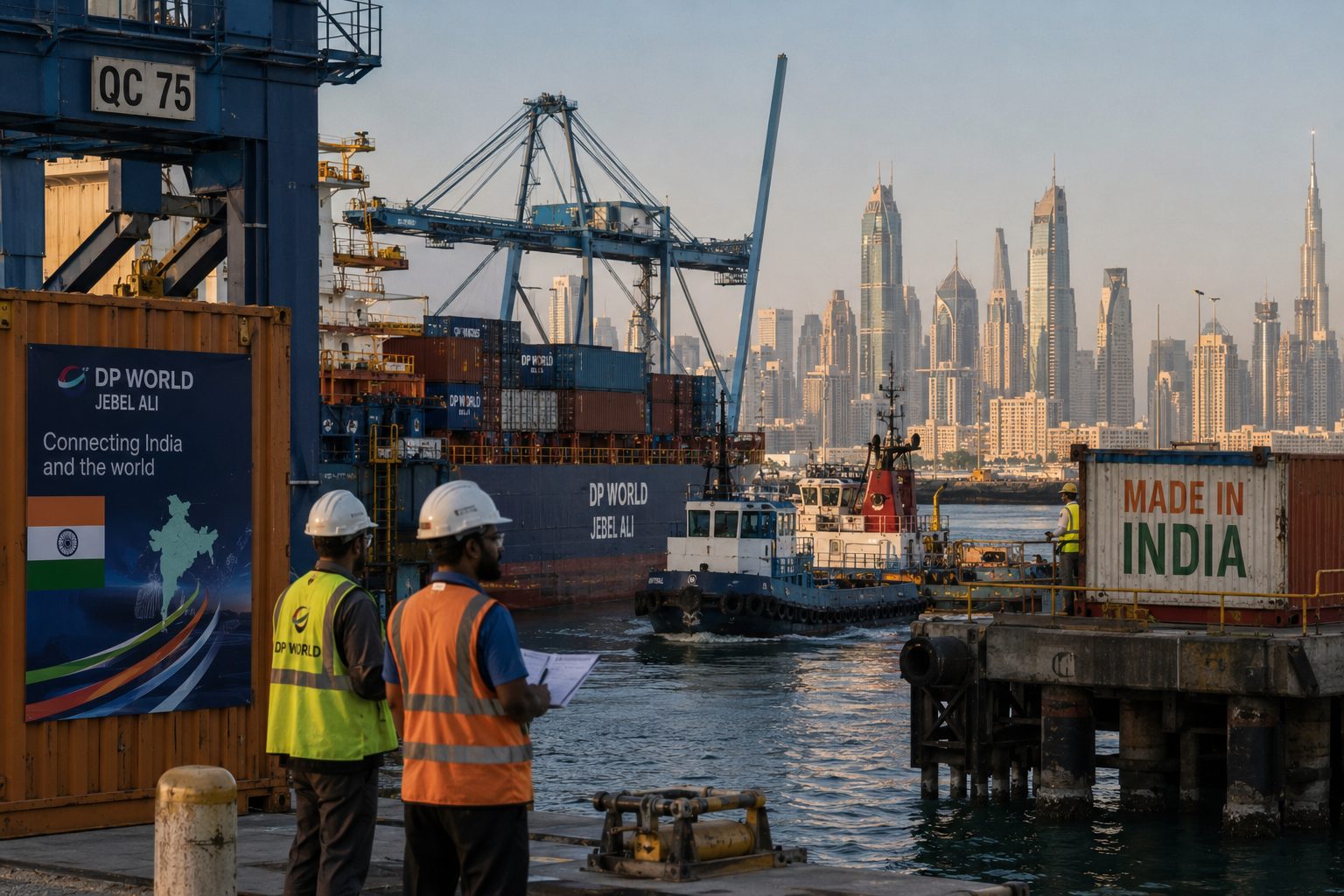
The Gulf was once described in Indian foreign policy mainly through three words: oil, workers and remittances. That description is now too small. The Gulf is becoming a centre of money, power and diplomacy. It is a region where energy exporters are turning into investors, sovereign wealth funds are becoming strategic actors, old rivalries are being managed through pragmatic diplomacy, and middle powers are reshaping the balance between the United States, China, India, Russia and Europe.
Why the issue matters now
For India, the Gulf is not a distant external region. It is one of the most important external extensions of India's domestic economy. Millions of Indians live and work there. Gulf energy supplies power India's cities, industries and transport networks. Gulf capital is entering Indian infrastructure, ports, renewables, logistics, technology and real estate. Indian food exports, pharmaceuticals, services and construction firms depend on Gulf markets. When tensions rise in the Strait of Hormuz, Indian inflation feels the heat. When Gulf labour policies change, Indian households feel it.
The numbers show the depth of the relationship. India's bilateral trade with the GCC reached USD 178.56 billion in FY 2024-25, according to information published by the Consulate General of India in Jeddah. The GCC accounted for a significant share of India's global trade, and the region is also a major source of investment. Around 8.9 million Indian expatriates live in GCC countries. These facts make the Gulf a domestic economic issue for India, not merely a foreign policy theatre.
The first driver of Gulf power is energy, but even energy is changing. Saudi Arabia, the UAE, Qatar, Kuwait and other Gulf states remain central to oil and gas markets. Qatar is a major LNG player. Saudi Arabia and the UAE influence oil-market psychology through production capacity and diplomacy. But Gulf states know that the world is slowly moving toward cleaner energy systems. That is why they are investing in green hydrogen, solar power, petrochemicals, logistics, artificial intelligence, tourism and finance. They are trying to convert hydrocarbon wealth into post-hydrocarbon influence.
The strategic geography
The second driver is capital. Sovereign wealth funds from the Gulf are no longer passive financial pools. They are instruments of national strategy. They invest in ports, airlines, sports, technology, logistics, energy transition, food systems and global companies. This gives Gulf states influence without needing traditional empire. Money becomes diplomacy. Investment becomes access. A port deal, a refinery stake or a technology investment can create relationships more durable than a communique.
The third driver is diplomatic agility. The Gulf states have become more comfortable talking to rivals simultaneously. The UAE can deepen ties with India, China, the United States, Israel and Russia. Saudi Arabia can manage ties with Washington while engaging Beijing and Tehran. Qatar can host negotiations and retain relations with actors others refuse to speak to. Oman continues to play a quiet mediation role. This diplomatic flexibility gives the Gulf relevance in a fragmented world.
India's Gulf policy has evolved accordingly. Earlier, India often maintained a cautious, low-profile approach to West Asia because of the sensitivity of Arab-Israel politics, energy dependence and the presence of its diaspora. Today, India has built stronger relations with the UAE and Saudi Arabia while maintaining ties with Iran, Israel, Qatar and others. This multi-alignment is not easy, but it reflects India's broader strategic autonomy. India cannot afford a one-sided Gulf policy.
India angle
The Gulf also matters for connectivity. The India-Middle East-Europe Economic Corridor, though still uncertain and affected by regional conflict, reflects the idea that the Gulf can become a bridge between India and Europe. Ports, rail links, energy pipelines, data cables and logistics chains are being imagined as instruments of geopolitics. Whether such projects succeed will depend on stability, financing and political will. But the concept itself shows how the Gulf is no longer only a source of oil; it is becoming a platform for global connectivity.
There is also a security layer. The Gulf sits near the Strait of Hormuz and the Bab el-Mandeb, two maritime chokepoints that affect global trade and energy flows. Conflict involving Iran, Israel, Yemen or regional militias can quickly affect shipping insurance, freight rates and energy prices. India cannot be indifferent to Gulf security because much of its trade and energy flows through these waters. The Indian Navy's role in maritime security, evacuation operations and anti-piracy missions will remain increasingly relevant.
The diaspora dimension gives the relationship a human core. Indian workers, professionals, doctors, engineers, accountants, drivers, technicians and entrepreneurs are deeply embedded in Gulf economies. They send money home, sustain families, build social mobility and deepen cultural familiarity. But they also create vulnerabilities. Labour reforms, visa changes, wage disputes, conflict, heat stress, health risks and localisation policies can affect Indian citizens directly. A serious Gulf policy must therefore combine high diplomacy with strong consular protection.
Counter-view and complexity
The counter-view is that the Gulf's rise is fragile because it still depends heavily on hydrocarbons and external security guarantees. Regional rivalry has not disappeared. Iran-Saudi tensions can revive. Israel-Palestine conflict can destabilise public opinion. Yemen, Syria, Lebanon and Iraq remain fragile. Oil-price volatility can pressure budgets. Ambitious diversification plans may not all succeed. This is true. But even fragile power is power when it sits on energy chokepoints, capital surpluses and strategic geography.
For India, the challenge is to move beyond transactionalism. Buying oil, exporting labour and receiving remittances are important, but they are not enough. India should pursue long-term energy contracts, renewable partnerships, food security arrangements, defence dialogue, digital infrastructure cooperation, fintech links, health services, education hubs and investment platforms. It should also prepare contingency plans for evacuation and shipping disruption.
What happens next
What happens next will depend on three variables. First, whether Gulf diversification creates genuine economic transformation or remains concentrated in elite projects. Second, whether regional de-escalation survives future shocks. Third, whether India can position itself as a trusted partner in both old energy and new economy sectors.
A deeper look at the Gulf shows that its transformation is not accidental. Gulf states are trying to solve a strategic paradox: they are wealthy because of hydrocarbons, but long-term survival requires preparing for a world in which hydrocarbons no longer guarantee power. This is why diversification plans, sovereign wealth investments, futuristic cities, logistics hubs, sports diplomacy, artificial intelligence, tourism and renewable energy have become central to Gulf statecraft.
Saudi Arabia's transformation under Vision 2030 is the largest example, but the UAE has been the most agile model of post-oil positioning. Qatar uses LNG wealth and mediation diplomacy. Oman uses quiet diplomacy and strategic location. Kuwait and Bahrain have their own political and economic constraints. India must avoid treating the Gulf as one uniform bloc. GCC unity matters, but bilateral strategies matter more because each Gulf state has a distinct economic model and foreign policy style.
The Gulf's financial power is changing global politics through sovereign wealth funds. These funds invest in infrastructure, technology, sports, clean energy, ports, financial markets and strategic industries. Their decisions can shape corporate governance, national development plans and diplomatic access. For India, attracting Gulf capital is not only about receiving investment; it is about aligning that investment with infrastructure, manufacturing, green energy, logistics and technology priorities.
Energy interdependence will remain strong even during transition. India cannot suddenly replace Gulf oil and gas. Meanwhile, Gulf producers need reliable Asian buyers as Western demand patterns gradually change. This creates mutual dependence. But India should not be complacent. Long-term energy security will require flexible contracts, strategic reserves, LNG diversification, refinery partnerships and cooperation in hydrogen and ammonia. The goal is not to abandon Gulf energy; it is to modernise the energy relationship.
The Gulf also sits at the centre of food security debates. Many Gulf countries import most of their food and invest abroad in agriculture, logistics and storage. India, with its agricultural scale and food-processing potential, can become a partner in resilient food corridors. At the same time, India must protect its own food security and avoid export volatility that damages trust. Food, fertiliser and energy are increasingly linked in West Asian strategy.
Defence and security cooperation is growing but remains sensitive. India conducts naval engagement, anti-piracy operations, exercises and security dialogues with Gulf partners. However, the Gulf is also a region of rivalries involving Iran, Israel, Yemen, militias and great powers. India must maintain a careful balance. It should protect sea lanes and citizens without becoming a party to regional conflicts. Strategic autonomy in the Gulf means active engagement without military entanglement.
The diaspora gives India influence but also limits freedom. During a crisis, the safety of millions of Indians becomes an immediate priority. Evacuations from West Asia have shown that consular planning is a core national-security function. India should continuously update evacuation databases, labour registries, insurance systems and embassy outreach. The Gulf workforce is not a statistical category; it is a strategic community whose welfare affects India's domestic politics and economy.
A new issue is technology. Gulf states are investing in AI, data centres, digital governance, cybersecurity and smart-city infrastructure. India has strong digital public infrastructure and technology talent. Cooperation in fintech, payments, digital identity, health tech and AI governance can take the relationship beyond oil. This is especially important because young Gulf citizens are entering new labour markets while India seeks high-value services exports.
The Israeli-Palestinian issue remains a political stress test. India has built strong relations with Israel while maintaining ties with Arab states and supporting Palestinian aspirations. Gulf normalisation debates and regional conflicts can force delicate choices. India's success will depend on whether it can maintain credibility with multiple sides while prioritising its citizens, energy security and long-term partnerships.
The deeper conclusion is that the Gulf is becoming a strategic operating system for India's external economy. Energy, remittances, investment, logistics, food, technology and maritime security all connect there. India should therefore upgrade Gulf policy from relationship management to strategic architecture. The Gulf is no longer just a region India reacts to during crises; it is a region India must help shape through sustained economic and diplomatic design.
India should also build stronger state-level links with the Gulf. Kerala, Telangana, Andhra Pradesh, Tamil Nadu, Uttar Pradesh, Bihar, Rajasthan and other states have large migrant links or trade interests. Migration policy, skill certification and reintegration of returning workers require coordination between New Delhi and state governments. Foreign policy toward the Gulf is therefore also federal governance.
Skill diplomacy will become more important as Gulf economies move up the value chain. Demand may shift from low-skilled construction labour toward healthcare, engineering, digital services, hospitality, logistics and renewable energy. India must prepare workers for this transition through certification, language training, financial literacy and legal awareness. Otherwise other labour-sending countries may capture future opportunities.
The Gulf's role in India's financial future deserves more attention. Sovereign wealth funds can support infrastructure pipelines, green hydrogen, industrial corridors, ports, warehousing and data centres. But India must create bankable projects, regulatory stability and dispute-resolution confidence. Gulf money will not flow at scale merely because relations are warm. It will follow credible returns.
The region will also test India's crisis diplomacy. A Hormuz closure, wider Iran-Israel escalation, cyberattack on energy infrastructure or migrant emergency would require rapid coordination across ministries, embassies, navy, airlines and state governments. The Gulf should be treated as a permanent contingency-planning zone, not only a ceremonial partnership.
The Gulf matters because it is where India's external economy, energy security, diaspora welfare and strategic autonomy intersect. A crisis in the Gulf reaches Indian petrol pumps, household budgets and financial markets faster than many people realise. The editorial insight is simple: the Gulf is no longer just India's energy backyard. It is becoming one of the main stages on which India's rise will be negotiated.
Internal Links to Add
Related regional explainer articles from the Master Article Shell should be added during CMS upload based on topical proximity.