Africa is no longer a continent that major powers discuss only through poverty, aid or conflict. It is becoming one of the central theatres of twenty-first century geopolitics. The reason is not sentimental. Africa has population, minerals, ports, votes, markets, military bases, food systems and energy potential. In a world where great powers are competing for supply chains, technology minerals, maritime routes and diplomatic legitimacy, Africa is no longer peripheral. It is a prize, a partner and a battlefield of influence.
Why the issue matters now
The change is visible in the behaviour of outside powers. China has built roads, railways, ports, mines and political networks across the continent. The United States has returned to strategic competition in Africa after years of relative neglect. Europe wants energy, migration management and influence in its southern neighbourhood. Russia has used security partnerships and private military networks to gain leverage in fragile states. Turkey has expanded diplomatic missions, defence exports and commercial ties. The Gulf states are investing in ports, agriculture, logistics and political mediation. India, which has old civilisational and anti-colonial links with Africa, now faces a more crowded field.
Africa matters because demography is destiny when combined with markets and resources. The continent has the world's youngest population profile and will account for a major share of future global labour force growth. That makes it a future consumer market, a manufacturing base and a political force. Countries that build trust with African states today may shape trade, education, technology and diplomatic patterns for decades. Those that treat Africa only as an extraction zone will face resistance.
The second reason is critical minerals. The green transition is not possible without minerals such as cobalt, lithium, manganese, copper, graphite, nickel and rare earth elements. Several African countries hold large reserves of these inputs. The Democratic Republic of Congo is central to cobalt. Zambia and the Congo matter for copper. Namibia, South Africa, Mozambique, Tanzania and other states matter for energy transition minerals and strategic resources. As electric vehicles, batteries, solar panels, wind turbines and digital infrastructure expand, mineral supply chains become foreign policy.
The strategic geography
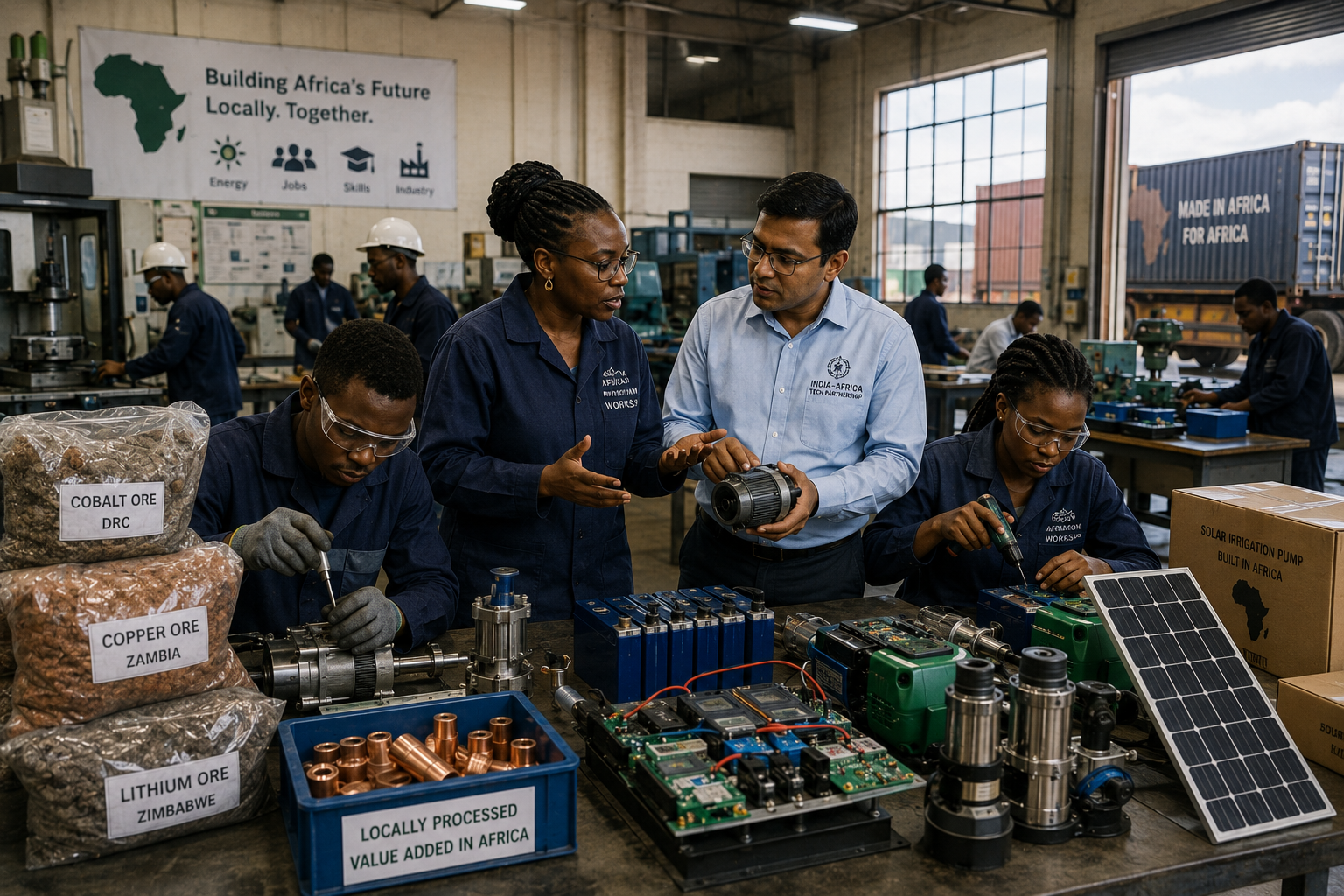
The problem is that mineral wealth has often produced exploitation rather than broad development. African states are increasingly demanding local processing, value addition, better contracts and technology transfer. This is a major shift. The old model in which raw materials left Africa and value was created elsewhere is under pressure. Whoever offers fairer industrial partnerships will have an advantage. India can benefit here because it can frame cooperation around manufacturing, skill development, pharma, digital infrastructure and small business ecosystems rather than only resource extraction.
The third reason is maritime geography. Africa touches the Atlantic, the Indian Ocean, the Mediterranean and the Red Sea. The Horn of Africa sits near the Bab el-Mandeb, one of the world's most sensitive chokepoints. East African ports matter for the western Indian Ocean, which is central to India's maritime security. Piracy, illegal fishing, trafficking, drone threats, port control and naval access are all part of the same equation. For India, Africa is not far away; the eastern coast of Africa is part of India's maritime neighbourhood.
The fourth reason is diplomacy. Africa has 54 countries, and those countries matter in the United Nations and other multilateral forums. Debates on climate justice, trade rules, debt restructuring, global health, digital governance and reform of international institutions cannot be settled without African voices. The African Union's inclusion in the G20 under India's presidency was therefore not just a symbolic gesture; it reflected the changing weight of African agency in global governance.
India angle
India has a foundation to build on. The Ministry of External Affairs describes India-Africa ties as rooted in historical, civilisational and development priorities. India's approach has emphasised partnership based on African priorities, capacity building, defence and maritime cooperation, trade and investment, and people-to-people links. India has also expanded its diplomatic footprint in Africa, and the India-Africa Forum Summit process has provided a structured platform for engagement.
Yet India cannot assume goodwill is enough. China has a larger infrastructure footprint. Europe has capital and historical access. The United States has technology and security weight. The Gulf has money and speed. Turkey has visibility and defence exports. Russia has security influence in parts of the continent. India's challenge is to convert trust into scale. Scholarships, training programmes and development lines of credit are valuable, but they must be joined with private investment, logistics, manufacturing partnerships and high-level political follow-through.
India's strongest opportunity lies in being a practical development partner. African countries need affordable healthcare, vaccines, generic medicines, digital payment systems, education platforms, agricultural technology, solar energy, low-cost housing, irrigation, rail and port services, and vocational training. India's experience as a large developing democracy gives it credibility. It has built digital public infrastructure at scale, managed complex food systems, developed a major pharmaceutical industry and created low-cost service delivery models. These are not abstract advantages; they are exportable capabilities.
Counter-view and complexity
The security dimension is equally important. Defence training, maritime domain awareness, anti-piracy cooperation, humanitarian assistance and disaster relief can deepen India's presence in the western Indian Ocean and the African littoral. India does not need to build an imperial network. It needs reliable partnerships that make the Indian Ocean safer and reduce the risk of hostile external control over strategic ports.
The counter-view is that Africa's rise is often overstated. Many African states face debt distress, conflict, weak institutions, climate shocks and political instability. Coups in parts of West Africa, civil war in Sudan and insecurity in the Sahel remind the world that opportunity and fragility exist together. Investors may remain cautious. Great-power competition may intensify local conflicts rather than solve them. The point is valid. But it does not reduce Africa's importance; it increases it. Fragile regions that hold critical resources and strategic geography become even more geopolitical.
What happens next
For India, the next phase must be selective and serious. It should identify priority countries and corridors rather than spreading itself too thin. East Africa and the western Indian Ocean should receive high attention because they connect directly with India's maritime security. Resource-rich African states should be approached with value-addition partnerships, not extraction logic. Education, health and digital infrastructure should remain India's soft-power pillars. Indian private firms need risk support, financing and diplomatic backing.
What happens next will depend on whether Africa can use global competition to negotiate better terms. If African states coordinate more effectively, they can move from being price-takers to agenda-setters. If external powers treat Africa as a chessboard, resentment will grow. If India treats Africa as an equal strategic partner, not a stage for speeches, it can build durable influence.
A deeper analysis of Africa must begin by rejecting two outdated frames. The first frame sees Africa only as a continent of crises. The second sees Africa only as a market of the future. Both are incomplete. Africa contains conflict and opportunity, state weakness and innovation, debt stress and entrepreneurship, poverty and strategic wealth. The real story is not a simple rise or decline; it is a struggle over who will shape Africa's transformation and on what terms.
The age of passive African diplomacy is fading. African governments increasingly compare offers. They ask whether a partner brings finance, technology, training, market access, security assistance or political respect. They also ask whether the partner listens. This matters for India because its historical goodwill can open doors, but goodwill will not win contracts, ports, mining rights or technology partnerships unless it is backed by execution. African agency is now stronger, and India must treat it seriously.
Debt is one of the continent's most important strategic issues. Many African states need infrastructure but cannot afford unsustainable borrowing. The choice is not between infrastructure and no infrastructure; it is between transparent, productive and locally beneficial infrastructure on one side and opaque, debt-heavy projects on the other. India can differentiate itself by supporting smaller, high-impact projects, capacity building and locally employable infrastructure rather than prestige projects that create political headlines but weak economic returns.
Health diplomacy remains one of India's strongest cards. During the pandemic, vaccines, medicines and pharmaceutical supply chains demonstrated how health can become strategic. Africa needs affordable medicines, diagnostics, hospitals, telemedicine, vaccine capacity and medical training. India has a credible record in low-cost healthcare and generics. A serious India-Africa health partnership could combine private hospitals, public-health training, pharma manufacturing, digital health records and disease surveillance.
Agriculture is another underused pillar. African countries have land and young labour forces, while India has experience in smallholder agriculture, dairy cooperatives, irrigation, seeds, farm machinery, fertiliser management and digital advisory systems. Food insecurity in Africa cannot be solved by imports alone. It requires productivity, storage, market access, climate resilience and rural finance. India can offer technologies suited to developing-country conditions rather than expensive systems designed for rich economies.
Security cooperation should be handled carefully. Some African states need counter-terrorism support, maritime capacity and peacekeeping training. India has a strong record in UN peacekeeping and can provide military training without appearing neo-colonial. However, India should avoid being pulled into internal conflicts or regime-protection politics. The emphasis should remain on capacity building, maritime security, humanitarian assistance, cyber resilience and institutional training.
Africa's urban future is also a geopolitical issue. Rapid urbanisation will require housing, water, sanitation, transport, energy and jobs. Indian companies can participate in affordable housing, digital payments, metro systems, solar mini-grids, waste management and municipal technology. This is where India's own urban challenges become a source of practical knowledge. India does not have to present itself as perfect; it can present itself as a country that understands scale, constraints and affordability.
The competition for African influence will increasingly move into narrative space. China presents itself as a builder. Europe presents itself as a regulatory and climate partner. The United States presents itself through technology, security and democracy. Russia presents itself as an anti-Western security alternative in some regions. India should present itself as a co-development partner: democratic but not preachy, capable but not domineering, civilisationally connected but future-focused.
India's biggest risk is underinvestment. Too many Indian discussions of Africa remain aspirational. The continent needs patient capital, embassies with commercial capacity, better shipping links, risk insurance, language skills and sector-specific strategies. Without these, India will continue to be liked but outpaced. Africa is not waiting for India; the world is already there.
The deeper conclusion is that Africa's geopolitical rise will reward partners who understand complexity. It is not one market, one political system or one strategic problem. It is a continent of regions: North Africa, the Sahel, West Africa, Central Africa, East Africa, Southern Africa and the island states. India's Africa policy must become region-specific, sector-specific and implementation-driven.
India should also recognise the role of African regional organisations. The African Union, regional economic communities and sub-regional security mechanisms all influence decision-making. Working only bilaterally may not be enough. India should engage the AU more systematically and support African priorities on institution building, climate adaptation and fair representation in global governance.
Climate politics will be central to Africa's future. African states have contributed relatively little to historical emissions but face severe climate consequences. Droughts, floods, food stress and displacement can destabilise regions. India's own climate diplomacy, built around equity and development rights, can align with African concerns. Joint positions on climate finance, technology transfer and adaptation can strengthen Global South bargaining power.
Media and knowledge gaps remain a major weakness in India-Africa relations. Indian public debate often notices Africa only during crises, coups or evacuation operations. African perspectives are underrepresented in Indian universities, media and business schools. Without knowledge, policy becomes episodic. India should invest in African studies, language training, journalist exchanges, business intelligence and cultural literacy.
The next big test will be whether India can combine values and interests. It should support African agency, avoid paternalism and still compete seriously for strategic space. A partnership that respects African priorities while advancing Indian interests is not contradictory; it is the only sustainable model.
The editorial insight is clear: Africa is not becoming important because the world has suddenly discovered moral responsibility. Africa is becoming important because the future of population, minerals, food, maritime security and global legitimacy runs through it. For India, Africa is not a charity file. It is a strategic frontier.
Internal Links to Add
Related regional explainer articles from the Master Article Shell should be added during CMS upload based on topical proximity.