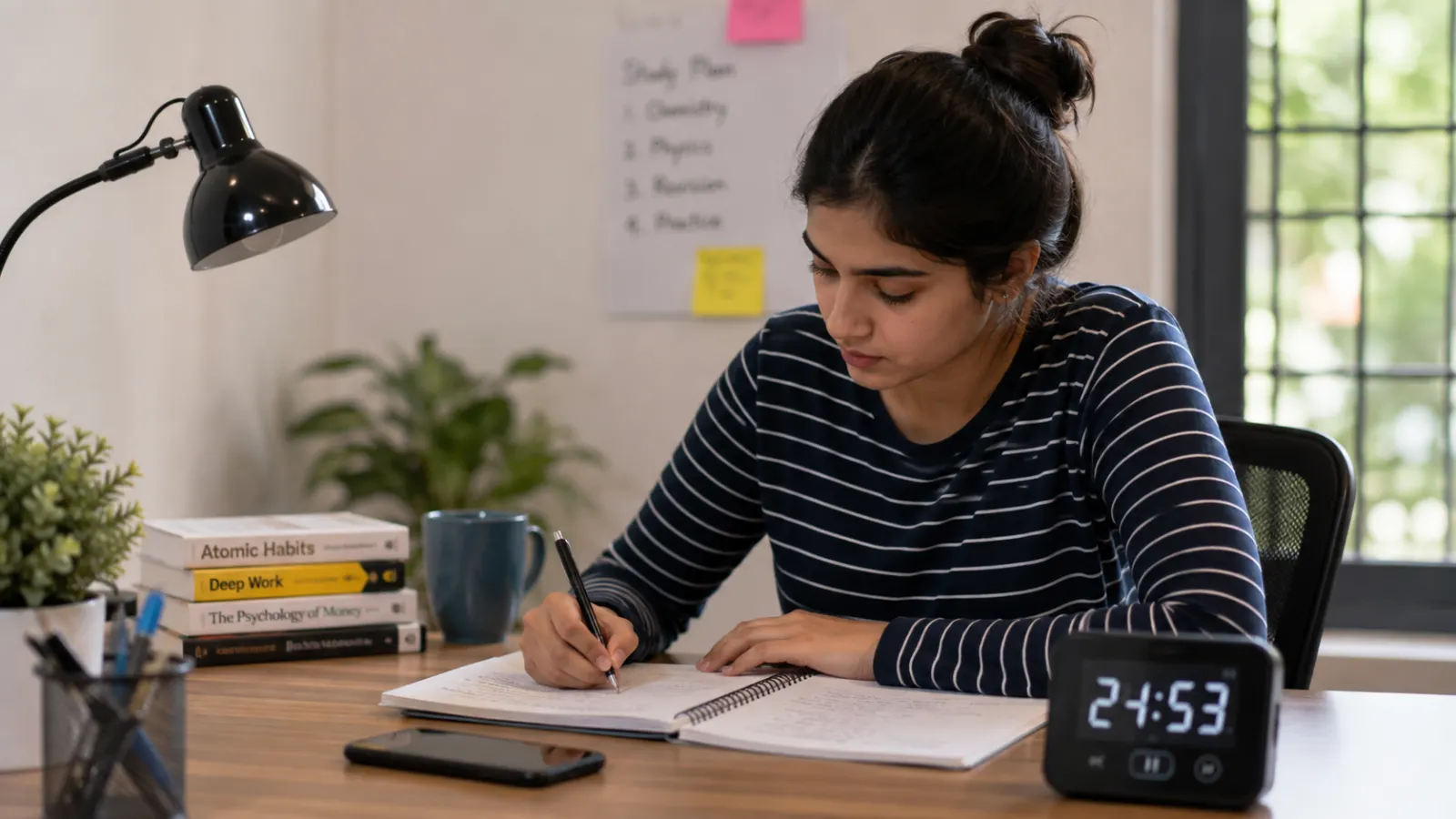
How to Avoid Distractions While Learning: Design Your Attention Before You Study
Most people do not begin a study session intending to lose concentration.
Attention drifts because other possibilities remain available.
A notification appears.
A message can be answered.
Another browser tab is already open.
Someone begins talking nearby.
An unrelated thought suddenly feels urgent.
The study task itself may be so vague that almost anything else feels easier.
This is why distraction should not be understood only as a failure of willpower.
Concentration is partly a design problem.
The more competing cues you leave available, the more often your attention has to resist them. The clearer the task and the harder distractions are to access, the less work self-control has to do.
Research on learning and attention supports this general picture. Mind-wandering and external distraction are common during educational activities, while mobile-phone interruptions and multitasking can reduce learning under some conditions.
But the evidence also requires precision.
A phone sitting silently nearby is not automatically proven to “drain” cognition. A 2024 meta-analysis of 33 studies found no significant overall effect of the mere presence of a smartphone on cognitive performance.
The stronger problem is interruption and competing activity: checking messages, responding to notifications, switching between apps or using the phone for unrelated activity while trying to learn.
The practical principle is therefore:
Do not rely on concentration to defeat every distraction after it appears. Design the study session so fewer distractions get a chance to compete.
Distraction control at a glance
| Question | Better study condition |
|---|---|
| What exactly am I doing? | Define one specific study action |
| What counts as finished? | Set a visible completion point |
| Can my phone interrupt me? | Disable unnecessary notifications and reduce access |
| Are unrelated digital options visible? | Close them before studying |
| Am I doing two demanding things at once? | Use serial rather than simultaneous work |
| Is background sound competing with the material? | Reduce speech and other attention-grabbing audio |
| How long am I studying? | Use a bounded block rather than an undefined session |
| What happens when unrelated thoughts appear? | Capture them and return |
| Is distraction too easy? | Add friction |
| How will I know whether I actually learned? | Test retrieval rather than relying on a feeling of focus |
Distraction is not one thing
The word distraction can describe several different processes.
External distraction
Something in the environment captures attention.
Examples include:
-
a phone notification,
-
conversation nearby,
-
television,
-
movement,
-
music,
-
another browser window,
-
or someone interrupting you.
Self-interruption
You voluntarily leave the study task.
You might:
-
check a message,
-
open social media,
-
look at the news,
-
search an unrelated question,
-
or begin reorganising files.
The important point is that the interruption can feel voluntary while still being highly habitual.
Mind-wandering
Attention moves away from the task without an external trigger.
You may suddenly be thinking about:
-
tomorrow,
-
an argument,
-
dinner,
-
a future plan,
-
something embarrassing from five years ago,
-
or almost anything except the paragraph in front of you.
Research by Nash Unsworth and Brittany McMillan examining everyday educational settings found that both mind-wandering and external distraction were common forms of attentional disengagement.
Different sources of distraction may therefore require different solutions.
Turning off notifications will not stop every intrusive thought.
Meditating for ten minutes will not silence the people talking beside you.
Effective attention management starts by identifying what kind of distraction is actually occurring.
1. Define the exact task before you begin
“Study chemistry” is not a good study instruction.
It describes a subject, not an action.
Compare it with:
“Complete questions 1–15 on chemical equilibrium without notes, mark the answers, and write down every concept I miss.”
The second version tells you:
-
what to do,
-
what material to use,
-
when the task is finished,
-
and what happens afterward.
That matters because vague tasks repeatedly force the learner to make decisions.
What chapter should I start?
Should I reread or practise questions?
Should I make notes?
How much should I finish?
Every unresolved decision creates another opportunity to leave the work.
Before beginning, write four things:
Topic: What am I studying?
Activity: What am I actually doing?
Completion point: How will I know this block is finished?
Next action: What will I do if I finish early?
For example:
Topic: Cell division
Activity: Answer 20 retrieval questions without notes
Completion point: All 20 answered and checked
Next action: Review errors only
You have now given attention somewhere specific to go.
2. Decide what evidence of learning you want
Students sometimes judge study sessions by duration.
“I studied for three hours.”
That tells you how long you were near the material.
It does not tell you what you learned.
A better target is an observable outcome.
For example:
-
explain the process without notes,
-
solve five problems correctly,
-
recall 20 flashcards,
-
summarise an argument from memory,
-
identify every incorrect answer,
-
or teach the concept aloud.
This matters for distraction because an active target gives attention repeated feedback.
Passive activities can make mind-wandering difficult to detect.
You can look at a page for ten minutes before realising you absorbed almost nothing.
Retrieval, problem-solving and explanation expose the lapse much faster.
The question therefore becomes not simply:
“Was I sitting there?”
but:
“Can I now do something I could not do before?”
3. Manage the phone according to the actual evidence
Smartphones deserve attention because they combine communication, entertainment, news, games and social reinforcement in a device that is almost always nearby.
But claims about phones should be precise.
Earlier studies suggested that simply having a phone visible could reduce available cognitive capacity.
More recent pooled evidence is much less convincing.
A 2024 meta-analysis synthesised 166 effect sizes from 33 studies involving 4,368 participants and found no statistically significant overall effect of the mere presence of a smartphone on cognitive performance.
That means the advice:
“Your phone must always be in another room because its presence automatically reduces intelligence”
goes beyond the evidence.
However, this should not be confused with evidence about phone distraction.
A 2025 meta-analysis of 27 experiments involving 2,245 participants found that mobile-phone distraction during learning produced a medium negative effect on immediate recall.
Experimental studies have also found that smartphone notifications can interfere with attention even when the user does not respond to them.
So the practical concern is not the object itself.
It is what the phone makes likely:
-
notifications,
-
checking,
-
messaging,
-
app switching,
-
divided attention,
-
or anticipatory monitoring.
4. Move the phone when moving it helps you not use it
Physical separation can still be useful.
The reason is behavioural rather than magical.
If your phone is beside your hand, checking it takes almost no effort.
If it is inside a zipped bag, across the room or outside the study space, checking requires a deliberate break in the session.
That added friction can matter.
A useful hierarchy is:
Minimum: Put the phone on silent and disable nonessential notifications.
Better: Use Do Not Disturb or Focus mode and keep only genuinely necessary contacts available.
Stronger: Put the phone out of immediate reach.
Strongest when needed: Leave it in another room for the study block.
Choose the level required by your own behaviour.
If you routinely ignore a silent phone, moving it may add little.
If you touch it automatically every few minutes, physical separation may be one of the simplest effective interventions.
5. Do not use your phone as a timer if the timer becomes a doorway
Many learners place the phone beside them because they need:
-
a timer,
-
calculator,
-
dictionary,
-
flashcard application,
-
or study music.
That is reasonable.
But ask whether the useful function reliably leads to unrelated use.
You open the timer.
You notice a notification.
You reply.
You check one other thing.
Ten minutes disappear.
If this repeatedly happens, separate the functions.
Use:
-
a simple clock or timer,
-
a physical calculator,
-
a desktop dictionary,
-
downloaded audio,
-
or a dedicated study device where practical.
The rule is not “never use technology.”
It is:
Do not make the path to the study tool identical to the path to the distraction.
6. Close unrelated digital environments before starting
A computer can contain your study material and your entire entertainment environment in the same rectangle.
That creates constant optionality.
Before beginning a serious study block:
-
close email,
-
close messaging applications,
-
close social media,
-
close unrelated tabs,
-
silence desktop notifications,
-
remove unnecessary windows,
-
and open only the files required for the task.
If you repeatedly visit the same distracting websites, use temporary blocking software or a study-specific browser profile.
This is not an admission of weak self-control.
You are simply implementing a decision you already made.
You have decided:
“For the next 45 minutes, I am not using this site.”
A blocker prevents you from having to remake the same decision every three minutes.
7. Understand the difference between multitasking and task switching
People often describe themselves as multitasking when they are rapidly switching.
For many demanding cognitive activities, this is the more accurate description.
Consider:
-
reading a difficult chapter while replying to messages,
-
watching a lecture while browsing social media,
-
solving mathematics problems while participating in a group chat,
-
writing an essay while repeatedly checking email.
The tasks compete for attention.
Each switch requires you to disengage from one context and rebuild another.
You may still complete both activities.
That does not mean performance was unaffected.
The problem is particularly important during learning because the objective is not simply to produce visible activity.
It is to encode, understand and later retrieve information.
For demanding study, prefer:
study first → communication later
rather than:
study + communication + study + communication + study.
8. Do not confuse familiarity with learning
Digital distraction becomes especially easy during passive study.
Rereading familiar material often feels productive because the words become easier to recognise.
Recognition is not the same as recall.
You may feel as though you know a chapter because it looks familiar when the textbook is open, then struggle to explain it without the page.
This matters for attention because passive familiarity provides few signals that your mind has wandered.
Active study creates more frequent checkpoints.
Instead of merely rereading, ask:
What can I retrieve without looking?
Can I solve the problem independently?
Can I explain the idea clearly?
What did I get wrong?
Distraction becomes easier to detect when the study method continually asks the brain to produce something.
9. Reduce background speech when the task requires language
Complete silence is not mandatory for every person or every task.
But the common idea that background sound never matters is also incorrect.
A meta-analysis of 65 studies on auditory distraction during reading found small but reliable negative effects of background sound on reading performance.
The largest disruption was associated with intelligible speech and lyrical music.
That makes cognitive sense.
If you are reading language while another stream of meaningful language is entering through your ears, the two can compete.
This does not mean music always ruins studying.
The effect depends on:
-
the task,
-
the person,
-
the music,
-
volume,
-
familiarity,
-
and whether the audio contains meaningful speech.
But when you are learning dense verbal material, reading difficult arguments or writing, silence or low-information sound is generally a safer starting point than a podcast, television programme or lyrical music.
10. Test your environment instead of relying on preference
People are not always good judges of how much an environment affects their performance.
You may genuinely prefer studying with television in the background.
That preference does not prove comprehension is unchanged.
Instead of asking:
“Do I like studying this way?”
ask:
“What happens to my learning?”
Run a small personal test.
Study comparable material under two conditions.
For example:
Day A: music with lyrics
Day B: silence
After each session, test yourself without notes.
Compare:
-
recall,
-
accuracy,
-
reading time,
-
number of errors,
-
and how often you lost your place.
Do not turn one personal experiment into scientific proof.
But for practical self-management, objective performance is more useful than assumption.
11. Use bounded study sessions
An undefined instruction such as:
“I am going to study all afternoon”
gives attention no visible endpoint.
A bounded block creates a clearer commitment.
For example:
25 minutes
40 minutes
50 minutes
60 minutes
There is no universally optimal number.
The popularity of the 25-minute Pomodoro interval does not make 25 minutes a biological law of attention.
Choose a period appropriate to:
-
the difficulty of the material,
-
your experience,
-
available time,
-
and the type of work.
A learner doing complex mathematics may benefit from a longer uninterrupted block than someone beginning a difficult task after a tiring day.
The useful feature is not the exact number.
It is the boundary:
Until this time, this task has priority.
12. Do not interrupt deep concentration just because the timer rings
Timed methods should support attention rather than mechanically destroy it.
Suppose you schedule a 40-minute block.
At minute 40 you are deeply engaged in solving a difficult problem.
You do not necessarily need to stop immediately because the timer has spoken.
The timer is a planning device.
It is not your supervisor.
Use it to prevent endless, vague sessions and to create realistic breaks.
But when productive concentration is already occurring, extending the block can make sense.
Likewise, if you are exhausted after 25 minutes, insisting on another 35 minutes because your chosen system says “one-hour blocks” may produce little useful learning.
Study structure should remain responsive to actual performance.
13. Make breaks genuinely different from study
Breaks are useful partly because they interrupt sustained effort.
But a break can accidentally become another high-stimulation attention task.
You finish a study block and immediately open short-form video.
Twenty minutes later, the break has become the dominant activity.
Possible lower-friction breaks include:
-
standing up,
-
walking,
-
drinking water,
-
stretching,
-
using the bathroom,
-
looking outside,
-
having a brief conversation,
-
or simply leaving the screen.
This does not mean social media is forbidden during every break.
The practical issue is re-entry.
Ask:
“Will this break make returning to the study task easier or harder?”
A break that repeatedly prevents the next study block is not functioning well.
14. Capture unrelated thoughts instead of obeying them
Not every distraction arrives through a device.
You suddenly remember:
I need to email someone.
I should buy toothpaste.
What time does that shop close?
I need to check tomorrow's weather.
I wonder what happened to that actor.
I should reorganise my notes.
These thoughts can create a small sense of urgency.
The natural response is to deal with them immediately.
Instead, keep a later list beside you.
Write:
“Email Sam”
“Buy toothpaste”
“Check appointment”
and return to the task.
This has two advantages.
First, you do not need to keep rehearsing the thought because you are afraid of forgetting it.
Second, recording the thought takes seconds rather than allowing a minor memory to become a long digital detour.
15. Plan for distraction as an obstacle
A useful 2024 study among introductory biology students adds an important nuance.
Researchers examined a planning intervention in which students identified goals, anticipated obstacles and formed plans for how to respond.
Distraction was the most frequently reported study obstacle.
Importantly, simply stating “I want to be less distracted” was not enough to guarantee improvement.
Students who explicitly planned for distraction as an obstacle were more successful at reducing their reported distraction.
This supports a more concrete form of planning.
Instead of:
“I will focus better tonight.”
use:
“If I feel the urge to check social media during this block, I will write it on my later list and continue until the timer ends.”
Or:
“If someone messages me while I am studying, I will reply during the break unless it is genuinely urgent.”
A distraction plan converts a vague intention into a response.
16. Add friction to repeated distractions
Behaviour becomes easier when the environment makes it easy.
The reverse is also useful.
If a distracting behaviour keeps winning, make it slightly harder.
Examples:
-
log out of social media,
-
remove applications from the home screen,
-
delete saved passwords from a study browser,
-
switch off autoplay,
-
keep the television remote outside the room,
-
use a separate browser profile,
-
leave the gaming controller elsewhere,
-
keep distracting devices outside arm's reach,
-
or block a website temporarily.
A barrier does not need to make the behaviour impossible.
Its purpose is to interrupt automaticity.
If opening social media requires:
unlock → search → log in → enter password
instead of one tap, you have created a moment in which conscious choice can return.
17. Use a consistent setup as a behavioural cue
A dedicated study space can be useful.
But not because your memory becomes magically attached to one chair.
Research on context-dependent memory shows that environmental context can influence recall under some conditions, but those effects vary and can be overcome by stronger retrieval cues.
The more practical advantage of a consistent study location is behavioural.
It reduces setup decisions.
When you sit down there, the expected sequence becomes familiar:
materials out,
phone controlled,
required files open,
study begins.
The environment starts functioning as a cue for the routine.
This can be a particular desk, library seat or quiet corner.
It does not need to be beautiful.
It needs to make starting easier.
18. Do not study in a location that repeatedly produces the wrong behaviour
Sometimes the location itself is working against you.
Studying in bed may repeatedly turn into sleep.
Studying beside a television may turn into viewing.
Studying in a kitchen during a busy household period may produce constant interruptions.
Studying in a highly social library area may become conversation.
Do not turn this into a moral problem.
Change the location when possible.
The right question is:
“What behaviour does this environment repeatedly produce?”
If the answer is not studying, the environment may need redesign rather than more self-criticism.
19. Reduce setup friction for the study behaviour too
Adding friction to distraction is only half of environmental design.
Make studying easier to begin.
Before stopping for the day:
-
leave the next chapter identified,
-
put required materials together,
-
write tomorrow's first task,
-
save the correct document,
-
charge the required device,
-
and identify the first problem to solve.
Then tomorrow's session does not begin with:
“What should I do?”
It begins with an action.
This is particularly useful when motivation is low.
The less energy required to start, the less opportunity there is for a distraction to become the default activity.
20. Use notifications selectively rather than declaring all notifications evil
Notifications differ.
An emergency message from a parent is not equivalent to a shopping promotion.
A security alert is not equivalent to a social-media reaction.
The practical objective is not necessarily to eliminate every notification from your life.
It is to decide which interruptions deserve the right to interrupt learning.
Most phones allow:
-
priority contacts,
-
repeated-call exceptions,
-
emergency bypass,
-
scheduled Focus modes,
-
and application-specific notification controls.
Use them.
Attention management is stronger when interruption is intentional.
21. Expect attention to drift
A common but unrealistic goal is:
“I will concentrate perfectly for the next two hours.”
Human attention does not work like that.
Mind-wandering occurs.
External events capture attention.
Fatigue develops.
The important skill is not permanent concentration.
It is returning.
When you notice that you have drifted:
-
Identify what captured attention.
-
Remove or record it if necessary.
-
Restate the next concrete study action.
-
Continue.
For example:
“I was thinking about tomorrow's meeting. It is now on my later list. Next action: solve question seven.”
This makes recovery procedural rather than emotional.
22. Do not turn a lapse into abandonment
One distracted moment often causes a second problem.
The learner thinks:
“I've already ruined the session.”
Then:
“I'll start properly tomorrow.”
A three-minute distraction becomes an abandoned evening.
This is unnecessary.
Attention can be restarted.
You do not need a new day, new notebook, new productivity application or fresh burst of motivation.
Return to the smallest visible action.
Read the next paragraph.
Answer the next question.
Write the next sentence.
The ability to resume is part of concentration.
23. Notice patterns rather than individual failures
If distraction happens repeatedly, collect information.
For one week, record:
When did I become distracted?
What triggered it?
What was I studying?
How long had I been working?
Was I tired?
Which device or environment was involved?
Patterns may emerge.
Perhaps distraction increases:
-
during passive reading,
-
after 45 minutes,
-
when the phone is visible,
-
when studying late at night,
-
when the task is vague,
-
or when another person is nearby.
Now the problem becomes specific enough to redesign.
“I'm bad at focusing” is difficult to solve.
“I open social media whenever I reach a difficult problem” gives you something to work with.
24. Distinguish distraction from genuine fatigue
Sometimes repeated loss of focus is not primarily a technology problem.
You may be:
-
sleep deprived,
-
hungry,
-
physically uncomfortable,
-
emotionally preoccupied,
-
or cognitively exhausted.
No browser blocker can fully solve sleep deprivation.
If your concentration reliably collapses at a particular point, ask whether you need:
-
rest,
-
food,
-
movement,
-
a change of task,
-
or a longer recovery period.
Productivity advice can become unrealistic when it assumes attention can be indefinitely increased through discipline.
The brain is part of a body.
25. Use retrieval to test whether your focus strategy is working
You cannot directly measure learning by how concentrated you felt.
The session may have felt smooth because the material was familiar.
Or it may have felt difficult precisely because you were doing cognitively demanding retrieval.
At the end of the block, close the material and test yourself.
Ask:
What are the three main ideas?
Can I explain the process?
What did I get wrong?
Can I solve a new example?
What do I still not understand?
This gives you a better basis for judging the study environment.
If changing the environment improves actual recall or problem-solving, that is more useful than simply feeling productive.
A practical distraction-control routine
Before each study session, run through six checks.
Task
Do I know exactly what I am doing?
Write the action and completion point.
Phone
Can it interrupt me unnecessarily?
Control notifications and move it if needed.
Computer
Are unrelated applications, messages and tabs closed?
Remove unnecessary digital options.
Environment
Is there meaningful speech, movement or another predictable interruption?
Change location or reduce it where possible.
Time
When does this study block begin and end?
Use a realistic boundary.
Recovery
Where will I put thoughts and tasks that appear while I am studying?
Keep a later list.
The purpose of the checklist is simple:
make decisions about distraction before your attention is under pressure.
What not to overclaim about distraction
Popular productivity advice often presents stronger scientific claims than the evidence justifies.
Several deserve caution.
“A phone in the room automatically makes you less intelligent”
Not supported consistently.
Recent meta-analytic evidence found no significant overall cognitive effect from mere smartphone presence.
“Everyone should study in total silence”
Too strong.
Background sound can impair reading on average, particularly meaningful speech and lyrical music, but individual and task differences exist.
“The brain can only focus for exactly 25 minutes”
There is no universal 25-minute biological attention limit.
Pomodoro-style intervals are organisational tools.
“Multitasking makes you incapable of learning anything”
Too absolute.
The more defensible claim is that dividing or repeatedly switching attention during demanding learning can impose performance costs.
“Getting distracted means you lack discipline”
Not necessarily.
Task design, notifications, noise, sleep, interest, difficulty, habit and environment can all affect attention.
Good study advice should improve conditions rather than turn every lapse into a character judgement.
When concentration problems may need more than study techniques
Occasional distraction is normal.
Persistent and severe concentration difficulty is a different issue.
Attention can be affected by many factors, including:
-
insufficient sleep,
-
chronic stress,
-
anxiety,
-
depression,
-
medication effects,
-
substance use,
-
physical health problems,
-
and attention-related disorders.
A productivity article cannot diagnose the cause.
If concentration difficulties are persistent, occur across several areas of life and substantially interfere with education, work or everyday functioning, professional assessment may be more appropriate than continually adding new focus hacks.
Frequently Asked Questions
How can I avoid distractions while studying?
Start by defining one specific study task, controlling unnecessary phone notifications, closing unrelated digital tools, reducing attention-grabbing background noise and studying for a bounded period. Make distractions less accessible before the session begins.
Should I keep my phone in another room while studying?
It can help if having the phone nearby makes you check it habitually. However, recent meta-analytic evidence does not show a reliable overall cognitive impairment from the mere presence of a silent smartphone. The more important problems are checking, notifications and unrelated phone use.
Do smartphone notifications affect concentration?
Research indicates that notifications can interrupt attention even when a person does not immediately interact with the phone. Disabling nonessential notifications during demanding study is therefore a reasonable precaution.
Is multitasking bad for studying?
Trying to combine two cognitively demanding activities generally creates divided attention or repeated task switching. If learning and retention matter, completing the study task before switching to messages or unrelated media is usually safer.
Is music bad for studying?
Not universally, but research on reading suggests background sound can slightly reduce comprehension on average, with intelligible speech and lyrical music among the more disruptive forms. Effects vary with the task and individual.
Is silence always best for studying?
Not necessarily for every task or every person. But for language-heavy activities such as difficult reading or writing, reducing meaningful background speech is a sensible starting point.
How long should I study before taking a break?
There is no scientifically established universal interval. Twenty-five, 40, 50 or 60 minutes can all be reasonable depending on the task and learner. Use a period long enough for sustained work but short enough that you can realistically protect it.
Does the Pomodoro Technique improve attention?
Pomodoro can be a useful organisational method because it creates bounded periods of work and breaks. The specific 25-minute interval should not be treated as a scientifically proven attention limit.
What should I do when an unrelated thought appears while studying?
Write it briefly on a later list and return to the current task. This preserves the thought without requiring you to follow it immediately.
How do I stop opening social media automatically?
Add friction: log out, remove shortcuts, use a blocker, move the phone away or use a separate study browser profile. The objective is to make the habitual action require a conscious decision.
Why do I lose focus while reading?
Possible reasons include mind-wandering, external noise, phone interruptions, fatigue, passive study, vague goals or difficulty understanding the material. Testing recall can help distinguish actual learning from simply spending time with the text.
What should I do if I keep getting distracted despite removing my phone?
Look beyond the phone. Examine task clarity, noise, sleep, fatigue, stress, study method and internal mind-wandering. Different causes require different interventions.
The central idea
Avoiding distraction is not primarily about becoming a person who never loses focus.
That person does not exist.
The more realistic objective is to construct study sessions in which:
the target is clear,
irrelevant options are less accessible,
interruptions are controlled,
the task has a boundary,
learning is actively tested,
and returning after a lapse is easy.
Attention is limited.
You can spend that limited capacity repeatedly resisting distractions, or you can remove some of the competition before the session starts.
That is why the best moment to manage a distraction is often before it appears.
Design the conditions first.
Then ask your attention to do its job.