How Landfills Work: Design, Methane, Leachate and Their Environmental Impact
A rubbish bag can disappear from your life in minutes.
Its environmental life may continue for decades.
When municipal waste is sent to a modern landfill, it is not simply thrown into a hole and forgotten. A properly designed landfill is an engineered containment system built to control several problems at once:
waste must remain physically stable; rainwater must be managed; contaminated liquid must be collected; methane and other gases must be controlled; groundwater must be monitored; and the site must remain maintained even after it stops accepting rubbish.
That last point is especially important.
A landfill is not finished when the final truck leaves.
Buried waste continues to settle and decompose. Landfill gas can continue forming. Leachate may still need collection. Cover systems can erode. Monitoring wells remain necessary.
The best way to understand landfills is therefore to see them not merely as disposal sites, but as long-term environmental infrastructure created by today's waste and inherited by future communities.
What Is a Landfill?
A landfill is a facility where solid waste is permanently placed on or in land under controlled conditions.
Modern regulated municipal solid-waste landfills are engineered and monitored to reduce the movement of contaminants into surrounding:
-
soil;
-
groundwater;
-
surface water; and
-
air.
They commonly include systems for:
-
waste placement and compaction;
-
bottom liners;
-
leachate collection;
-
stormwater control;
-
landfill-gas management;
-
groundwater monitoring;
-
daily or intermediate cover;
-
final capping; and
-
long-term post-closure care.
Design details differ according to national regulations, climate, geology, landfill size and the types of waste being accepted.
The principle remains consistent:
keep the waste contained and control what comes out of it.
Landfill vs Open Dump: What Is the Difference?
The words landfill and dump are often used interchangeably.
They should not be.
| Feature | Modern sanitary landfill | Open dump |
|---|---|---|
| Waste placement | Controlled and planned | Often uncontrolled |
| Compaction | Normally systematic | May be limited or absent |
| Bottom liner | Required in many modern regulated systems | Often absent |
| Leachate collection | Engineered collection may be required | Often absent |
| Landfill-gas management | Monitoring and/or collection may be required | Frequently uncontrolled |
| Daily/intermediate cover | Common operating practice | Often absent |
| Groundwater monitoring | Required in many regulatory systems | Often absent |
| Access controls | Managed | May be weak |
| Waste burning | Generally controlled/prohibited | Open burning may occur |
| Post-closure responsibility | Long-term management required | Often unclear |
An open dump may allow waste to burn, blow into surrounding areas, attract animals, block drainage or release contaminated liquids directly into soil and water.
A sanitary landfill attempts to isolate waste and manage those pathways deliberately.
This difference is crucial in global waste policy.
In many rapidly growing regions, simply moving from uncontrolled dumping and open burning to universal collection and controlled disposal can produce major public-health and environmental improvements.
How Does a Modern Landfill Work?
A modern municipal landfill generally operates through a sequence:
site selection → liner construction → waste placement → compaction → cover → leachate management → landfill-gas management → monitoring → final closure → post-closure care
Each step solves a different environmental problem.
1. The Landfill Site Is Chosen Carefully
Landfill engineering begins before construction.
Where a landfill is located can determine how serious a failure would become.
Site assessment may consider:
-
groundwater depth;
-
geology;
-
soil permeability;
-
rainfall;
-
flood risk;
-
wetlands;
-
nearby rivers and lakes;
-
seismic conditions;
-
surrounding land use;
-
airports;
-
roads;
-
population;
-
future development; and
-
ecological sensitivity.
A good liner does not make location irrelevant.
If a disposal facility is placed where groundwater is shallow, flooding is frequent or surrounding communities are highly exposed, engineering systems face greater consequences if something goes wrong.
Modern landfill safety therefore depends on both:
where the landfill is built
and
how it is built.
2. A Liner System Separates Waste From the Ground
Before waste is placed in a new landfill cell, the base is prepared.
Modern landfill designs commonly use a low-permeability liner system.
Depending on local regulation and design, this can include combinations of:
-
compacted clay;
-
synthetic geomembranes;
-
geotextiles;
-
drainage materials; and
-
protective layers.
The liner creates a barrier between waste and the surrounding soil and groundwater.
But the liner's purpose is not to make a landfill magically leak-proof forever.
It is one part of a multi-barrier system.
That distinction matters.
Good landfill design does not rely on a single sheet of plastic underground and assume the problem is solved.
It combines containment, drainage, monitoring and long-term maintenance.
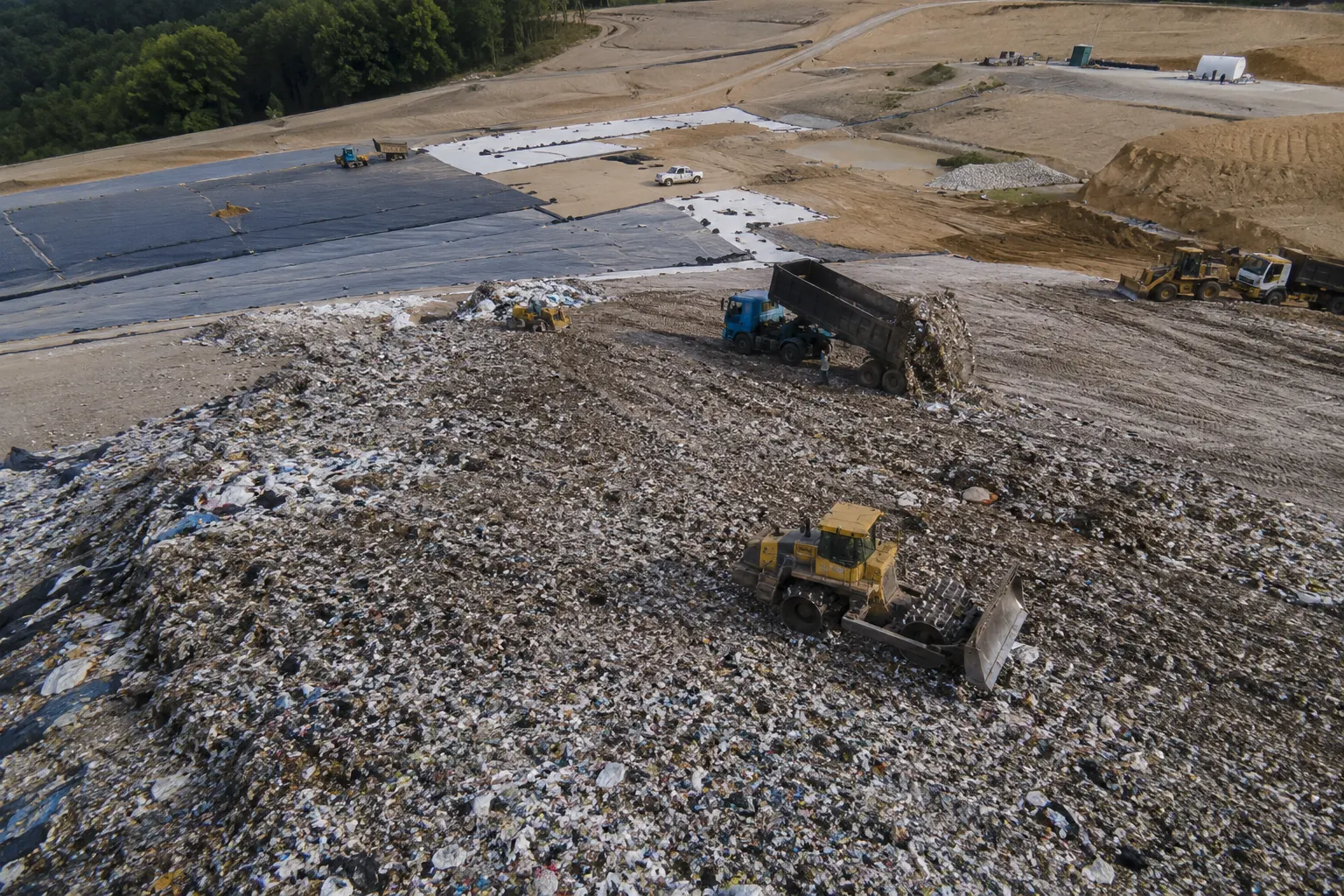
3. Waste Is Placed in Cells
A landfill usually develops section by section rather than filling the entire site simultaneously.
These sections are called cells.
Waste trucks deliver material to the active working area.
Heavy equipment then spreads and compacts the waste.
Compaction serves several purposes.
It:
-
reduces empty space;
-
allows more waste to fit within the permitted volume;
-
improves operational stability; and
-
helps control the working face.
The goal is to use landfill capacity efficiently.
This matters because once a landfill fills, developing additional disposal capacity can require years of siting, approvals, engineering and community consultation.
4. Waste Is Covered
Exposed rubbish creates immediate operational problems.
Wind can blow lightweight waste away.
Animals and birds can reach it.
Odours can become stronger.
Fire risk can increase.
Rain can contact more waste.
For these reasons, active waste areas are commonly covered with soil or approved alternative materials according to the site's operating requirements.
Cover systems can help reduce:
-
litter;
-
odours;
-
pests;
-
fire risk; and
-
direct exposure.
Different types of cover may be used during daily operations, intermediate stages and final closure.
5. Stormwater Is Kept Away From Waste
Rain itself is not necessarily contaminated.
The problem begins when it moves through waste.
Landfill design therefore attempts to keep clean stormwater separate from the waste mass wherever possible.
Drainage channels, slopes, ponds and other controls can route rainfall away from active or closed waste areas.
This reduces the quantity of contaminated liquid the site eventually has to manage.
The principle is straightforward:
the less clean water that enters the waste, the less leachate the landfill has to handle.
What Is Leachate?
Leachate is contaminated liquid that has passed through or contacted waste.
Rainwater can infiltrate waste.
Waste itself can contain moisture.
Decomposition can release additional liquids.
As this liquid moves through buried material, it can dissolve or carry:
-
organic compounds;
-
salts;
-
nutrients;
-
metals;
-
suspended material; and
-
other contaminants.
The exact composition depends on:
-
what was buried;
-
landfill age;
-
rainfall;
-
waste chemistry;
-
temperature;
-
moisture; and
-
decomposition stage.
Leachate is therefore not one universal liquid with one fixed composition.
6. Leachate Is Collected
A modern landfill commonly includes a drainage layer above the bottom liner.
Perforated pipes collect liquid and direct it toward sumps or other collection points.
From there, leachate may be:
-
sent to wastewater treatment;
-
treated on site;
-
transported elsewhere for treatment; or
-
managed through another approved process.
The objective is to prevent contaminated liquid from accumulating and migrating uncontrolled into surrounding soil and groundwater.
This is one reason the liner and leachate system work together.
The liner limits downward movement.
The drainage system removes the liquid sitting above it.
Why Leachate Can Threaten Groundwater
Groundwater moves slowly through underground soil and rock formations.
Once contamination enters an aquifer, cleanup can be technically difficult, expensive and extremely slow.
That makes groundwater protection one of the central goals of landfill engineering.
Risk depends strongly on local hydrogeology.
A landfill above deep, protected groundwater in relatively dry conditions faces a different setting from one with high rainfall and shallow groundwater.
This is why groundwater monitoring wells are placed around regulated landfills in many jurisdictions.
Monitoring asks an essential question:
Is anything escaping the containment system?
Landfill Liners Reduce Risk—They Do Not Make Risk Disappear
It is tempting to imagine a modern liner as a permanent sealed bowl.
Real engineering is more complicated.
Materials age.
Pipes can clog.
Waste settles.
Construction defects are possible.
Chemical environments can affect materials.
Extreme weather can stress drainage and cover systems.
The engineering response is therefore redundancy.
A well-managed landfill may combine:
-
site-selection controls;
-
liner systems;
-
leachate drainage;
-
groundwater monitoring;
-
gas monitoring;
-
stormwater management;
-
final cover;
-
inspections;
-
maintenance;
-
corrective-action requirements; and
-
financial assurance.
Environmental protection comes from the whole system working over time.
What Happens to Rubbish After It Is Buried?
People sometimes imagine a landfill as a giant underground compost heap.
It is not.
A landfill is designed primarily for containment, not rapid biological decomposition.
Soon after waste is buried, some decomposition occurs while oxygen remains.
As oxygen is consumed, conditions become increasingly anaerobic, meaning decomposition continues without oxygen.
Microorganisms then break down biodegradable materials such as:
-
food;
-
paper;
-
cardboard;
-
garden waste;
-
wood; and
-
other organic matter.
One major result is landfill gas.
What Is Landfill Gas?
Landfill gas is produced as microorganisms decompose organic waste under anaerobic conditions.
Typical landfill gas is composed roughly of:
about 50% methane
and
about 50% carbon dioxide
with smaller quantities of other gases and compounds.
The exact composition varies by:
-
landfill age;
-
waste composition;
-
moisture;
-
temperature;
-
gas-management system; and
-
stage of decomposition.
Gas production does not begin at exactly the same moment throughout a landfill.
Different cells may contain waste deposited years apart.
A large landfill can therefore behave like several generations of buried waste operating simultaneously.
Why Does Landfill Methane Matter?
Methane matters for two major reasons:
climate
and
safety.
Methane is a powerful greenhouse gas.
EPA describes methane as at least around 28 times more effective than carbon dioxide at trapping heat over a 100-year period using the assessment basis referenced in its landfill-gas programme.
Landfills containing large quantities of biodegradable waste can therefore become major methane sources.
In the United States, municipal solid-waste landfills accounted for roughly 14.4% of human-related methane emissions in 2022 according to EPA's landfill methane programme.
That does not mean landfills represent the same share globally.
Waste composition, landfill practices and gas controls differ considerably between countries.
Methane Can Also Create Fire and Explosion Risks
Methane is combustible.
If landfill gas migrates and accumulates in confined spaces, it can create safety hazards.
For that reason, landfill-gas monitoring is not only a climate measure.
It is also a site-safety measure.
Gas can move through:
-
waste;
-
soil;
-
cracks;
-
pipes;
-
utility corridors; and
-
other pathways.
Modern landfill management therefore attempts to control both atmospheric emissions and lateral gas migration.
7. Landfill Gas Can Be Collected
Gas-collection systems commonly use networks of:
-
vertical wells;
-
horizontal collectors;
-
pipes;
-
blowers; and
-
control equipment.
The system creates suction and draws gas toward a central collection point.
Collected gas can then be managed in several ways.
What Happens to Captured Landfill Gas?
Flaring
Landfill gas can be burned in a flare.
Flaring converts methane primarily into carbon dioxide and water.
Although carbon dioxide is also a greenhouse gas, destroying methane substantially reduces the near- and medium-term climate impact compared with releasing the methane directly.
Electricity Generation
Collected gas can fuel engines, turbines or other systems that generate electricity.
Direct Heat Use
Some facilities use treated landfill gas as a fuel for industrial or heating applications.
Renewable Natural Gas
Landfill gas can be processed to remove impurities and increase methane concentration.
The upgraded gas may then be used in pipelines or as vehicle fuel where infrastructure permits.
Using landfill gas can recover energy from waste already buried.
But this does not make burying biodegradable waste environmentally preferable to preventing that waste in the first place.
Why Gas Collection Does Not Capture Every Molecule of Methane
A landfill-gas system can substantially reduce emissions.
It is not perfect.
Methane can escape:
-
before collection infrastructure becomes operational;
-
through cover material;
-
around wells;
-
through leaks;
-
during equipment downtime; and
-
from areas where collection is less effective.
Collection efficiency also varies over time and from site to site.
This creates an important waste-policy distinction:
capturing methane after food and other organics are buried reduces a problem; preventing or diverting suitable organic waste can prevent part of that methane-generating process from occurring in the landfill at all.
Why Food Waste Matters So Much in Landfills
Food waste contains biodegradable organic material and substantial moisture.
When buried under anaerobic conditions, it contributes to landfill methane production.
Preventing edible food waste can avoid impacts throughout the entire food system:
-
farming;
-
processing;
-
refrigeration;
-
transport;
-
cooking; and
-
disposal.
Where appropriate systems exist, separating unavoidable food scraps for composting or anaerobic digestion can also reduce the amount of rapidly biodegradable material buried in landfills.
This connects directly with the waste hierarchy.
Prevent food waste first.
Then recover value from unavoidable organic material where suitable infrastructure exists.
See Understanding How to Reduce Food Waste and What Is Composting and Why It Helps for the upstream options.
Do Things Decompose Quickly in Landfills?
Not necessarily.
Landfills are designed to contain waste, not create ideal composting conditions.
Composting generally depends on carefully managed:
-
oxygen;
-
moisture;
-
temperature;
-
carbon-to-nitrogen balance; and
-
biological activity.
Buried landfill conditions are different.
Decomposition occurs, particularly for organic materials, but rates can be slow and uneven.
Some materials may remain recognisable for many years.
Plastic, glass and other highly persistent materials may change physically or chemically but do not decompose like food or paper.
This is another reason a landfill should not be imagined as a giant machine that quickly makes waste disappear.
It stores material while controlling its environmental consequences.
What Happens When a Landfill Is Full?
When an individual cell reaches capacity, it is closed and covered.
Eventually, the entire permitted landfill reaches its final capacity.
Closure then begins.
A final cover or cap is constructed over the waste.
The final cover is designed to:
-
reduce rain infiltration;
-
limit erosion;
-
control gas;
-
support vegetation where appropriate; and
-
physically isolate the buried waste.
Closure changes the landfill from an active waste-receiving facility into a long-term monitoring and maintenance site.
It does not eliminate environmental responsibility.
What Does a Landfill Cap Contain?
Final cover design differs among regulatory systems and locations.
It may include combinations of:
-
low-permeability barrier material;
-
drainage layers;
-
soil;
-
erosion-control layers;
-
vegetation; and
-
gas-management features.
The surface is generally shaped so rainfall runs away rather than ponding and infiltrating into the waste.
Vegetation can help control erosion.
But deep-rooted plants or construction can be restricted where roots or foundations could damage containment systems.
What Happens to a Landfill After It Closes?
After closure, several processes continue.
Waste settles
The waste mass compresses and decomposes.
This can make the ground surface settle unevenly.
Methane continues forming
Organic matter does not stop decomposing because the gate closes.
Leachate may continue
Rain infiltration and moisture inside the waste can continue generating liquid.
Groundwater still requires monitoring
Monitoring systems look for evidence of contamination.
Cover systems need maintenance
Erosion, settlement or other damage may require repair.
Gas equipment may continue operating
Gas collection can continue for years.
This is why post-closure planning is a central part of landfill regulation.
How Long Must a Closed Landfill Be Monitored?
There is no universal worldwide duration.
Regulations differ.
In the United States, federal municipal solid-waste landfill rules generally require 30 years of post-closure care, although the period can be shortened or extended by the relevant approved authority depending on site conditions.
Post-closure requirements include maintaining:
-
the final cover;
-
leachate collection;
-
groundwater monitoring; and
-
methane monitoring.
The 30-year figure should therefore be understood as a U.S. regulatory baseline, not a universal natural endpoint after which buried waste suddenly becomes harmless.
Actual environmental processes can continue longer.
Financial Assurance Matters
Long-term engineering requires long-term funding.
A landfill operator may earn revenue while waste is being accepted.
Years later, the site may no longer generate the same income even though monitoring and maintenance remain necessary.
Regulatory systems therefore often require financial assurance.
The objective is to ensure money is available for:
-
closure;
-
post-closure maintenance; and
-
corrective action if releases occur.
This is a critical but often overlooked sustainability principle:
the generation using the disposal service should not leave all future maintenance costs to the next generation.
Can Old Landfills Be Turned Into Parks?
Sometimes.
Closed landfills have been reused for:
-
parks;
-
sports fields;
-
walking areas;
-
solar-energy facilities;
-
habitat; and
-
other relatively low-load land uses.
But former landfill land is not ordinary land.
Designers must account for:
-
settlement;
-
gas migration;
-
cap integrity;
-
drainage;
-
underground infrastructure; and
-
restrictions on excavation or heavy foundations.
A building placed on settling waste creates much more complicated engineering challenges than a lightweight recreational use.
Post-closure reuse therefore requires careful design and regulatory approval.
Why Landfill Fires Happen
Landfill fires can begin for several reasons.
Potential ignition sources include:
-
hot material arriving in waste loads;
-
lithium-ion batteries;
-
electrical equipment;
-
chemical reactions;
-
deliberate burning;
-
external fires; and
-
landfill-gas ignition.
Some fires occur near the surface.
Others can develop deeper within the waste mass.
Deep landfill fires can be particularly difficult to extinguish because:
-
the burning material is buried;
-
access is difficult;
-
adding water may increase leachate;
-
excavation can expose more material to oxygen; and
-
unstable waste can make operations dangerous.
Poorly controlled dumpsites can face even greater fire risk because waste is exposed, mixed and unmanaged.
Why Batteries Are a Growing Waste-Fire Problem
Lithium-ion batteries are found in:
-
phones;
-
laptops;
-
power tools;
-
toys;
-
electronic cigarettes;
-
electric bicycles;
-
portable electronics; and
-
many other products.
When damaged, crushed or short-circuited, these batteries can ignite.
Waste compaction equipment can damage batteries hidden inside ordinary rubbish.
For this reason, batteries should generally follow appropriate local collection or hazardous/electronic-waste pathways rather than being placed casually into general rubbish or standard recycling streams.
This connects with What Is Hazardous Waste?, because some waste needs specialised management rather than ordinary disposal.
Landfill Slope Failures
A landfill is also a large geotechnical structure.
Waste has weight.
It contains water.
It settles.
It is placed on slopes.
Poorly controlled disposal can create unstable waste masses.
Slope failure risk can increase with:
-
excessive height;
-
steep slopes;
-
poor compaction;
-
weak underlying material;
-
heavy rainfall;
-
inadequate drainage; and
-
poorly understood waste properties.
Major dumpsite collapses have caused deaths in several parts of the world.
This demonstrates why controlled waste engineering is a public-safety issue as well as an environmental issue.
Extreme Weather Makes Landfill Design More Important
Landfills operate for decades.
Climate conditions can change during that period.
Extreme rainfall can:
-
increase leachate generation;
-
erode covers;
-
overwhelm drainage systems;
-
saturate waste;
-
increase slope instability; and
-
increase flood risk.
Flooding can spread waste from badly located or poorly controlled disposal sites.
Heat can influence biological processes and fire risk.
Landfill design should therefore consider not merely historic averages, but the range of conditions infrastructure may face during its operating and post-closure life.
Do Landfills Smell?
They can.
Odour can come from:
-
decomposing waste;
-
landfill gas;
-
sulfur-containing compounds;
-
exposed working areas;
-
leachate; and
-
certain industrial or construction wastes.
Modern landfill operations attempt to reduce odour through:
-
cover;
-
gas collection;
-
limiting the exposed working face;
-
leachate control;
-
rapid waste management; and
-
operational monitoring.
Odour is more than an inconvenience.
Persistent odour can become a major quality-of-life issue for surrounding communities and often influences public opposition to landfill siting.
Landfills and Environmental Justice
Waste disposal creates a geographic problem.
The waste generated by a large urban region may be concentrated in one much smaller community.
Residents near a landfill may experience:
-
truck traffic;
-
noise;
-
road damage;
-
dust;
-
odour;
-
visual impacts;
-
concern about water contamination;
-
concern about health; and
-
reduced enjoyment of surrounding land.
Historically, waste and other undesirable facilities in many countries have disproportionately affected communities with less economic or political power.
This makes landfill siting an environmental-justice issue as well as an engineering decision.
A facility meeting technical standards does not automatically answer the question:
Is the burden being distributed fairly?
Good planning therefore requires meaningful community consultation, transparent monitoring and accessible complaint systems alongside engineering compliance.
Are Modern Landfills Bad for the Environment?
A simple yes-or-no answer is misleading.
A well-designed regulated landfill is vastly different from uncontrolled dumping.
Modern landfills provide an important environmental service by isolating waste that would otherwise potentially be:
-
burned openly;
-
thrown into waterways;
-
dumped beside roads;
-
scattered across land; or
-
mixed into uncontrolled sites.
At the same time, landfills create real long-term impacts:
-
methane;
-
leachate;
-
land consumption;
-
transport emissions;
-
local nuisance;
-
monitoring requirements;
-
possible pollution risk; and
-
future maintenance obligations.
The correct comparison is therefore not:
landfill vs no environmental impact.
It is often:
engineered landfill vs alternative ways of managing the same waste.
Landfills vs Incineration
Landfill and waste incineration solve different problems and create different trade-offs.
Landfilling stores waste and requires long-term containment.
Incineration reduces waste volume dramatically and can recover energy, but requires combustion infrastructure, air-pollution controls and management of residual ash.
Neither option eliminates the need for waste prevention, reuse and recycling.
Technology choice depends on:
-
waste composition;
-
land availability;
-
energy systems;
-
economics;
-
emissions regulation;
-
public acceptance; and
-
institutional capacity.
The most important question remains upstream:
How much material needed disposal in the first place?
Where Landfills Sit in the Waste Hierarchy
Waste-management hierarchies generally place disposal near the bottom.
A simplified sequence is:
prevent → reduce → reuse → repair → recycle/compost → recover → dispose
This does not mean landfills have no role.
Some residual materials cannot safely or economically be reused or recycled.
Contaminated waste may need controlled disposal.
Recycling processes themselves create residues.
Even highly circular economies therefore need some form of safe final disposal.
The objective is:
make the residual fraction smaller and manage it well.
For the hierarchy itself, see Reduce, Reuse, Recycle: The 3 Rs of Sustainability Explained and What Is the Circular Economy?
Why Open Dumping Remains a Global Problem
The world's waste challenge is much larger than whether wealthy cities recycle enough plastic.
According to the World Bank's What a Waste 3.0, the world generated approximately 2.56 billion tonnes of municipal solid waste in 2022.
Without major changes, annual waste generation could rise to approximately 3.86 billion tonnes by 2050.
The problem is particularly serious where waste volumes are growing faster than collection and controlled-disposal infrastructure.
Collection rates remain especially low in some lower-income regions, and open dumping remains widespread.
This changes the immediate policy priority.
In a city where substantial waste is not collected at all, universal collection and controlled disposal may deliver greater immediate public-health gains than a sophisticated recycling programme serving only wealthier neighbourhoods.
The waste hierarchy still matters.
But safe basic infrastructure matters too.
Why Landfills Will Not Disappear Immediately
A perfectly circular economy is difficult to achieve.
Products can become:
-
contaminated;
-
degraded;
-
chemically mixed;
-
physically damaged;
-
hazardous; or
-
technically unrecoverable.
Recycling also produces residues.
Construction produces materials for which local reuse markets may not exist.
Disaster cleanup can generate enormous quantities of mixed waste.
Some waste will therefore continue requiring secure final disposal.
The realistic sustainability objective is not:
“No landfill anywhere tomorrow.”
It is:
“Use controlled landfills for a progressively smaller residual fraction while preventing and recovering much more material upstream.”
What Can Households Do to Reduce Landfill Waste?
Households cannot design liner systems or gas wells.
They can influence what enters disposal.
Useful actions include:
Prevent food waste
Buy, store and prepare food more carefully.
Reuse durable goods
Repair, donate, sell or pass on items that remain useful.
Follow local recycling rules
Incorrect sorting can contaminate recycling streams.
Separate organics where systems exist
Use municipal composting or suitable organic-waste services.
Handle batteries correctly
Do not place batteries into general waste if local specialised collection exists.
Use electronic-waste programmes
Phones, computers and electrical equipment may contain recoverable and hazardous materials.
Avoid unnecessary disposable products
Waste prevention remains higher in the hierarchy than disposal.
Individual action matters most when it connects to functioning local systems.
What Can Businesses Do?
Businesses influence landfill demand far upstream.
They can:
-
redesign products to use fewer materials;
-
eliminate unnecessary packaging;
-
improve inventory management;
-
prevent food waste;
-
increase repairability;
-
use reusable shipping systems;
-
recover production scrap;
-
refurbish equipment;
-
purchase recycled-content materials;
-
separate organics;
-
manage hazardous materials properly; and
-
analyse which residual waste streams are still going to landfill.
A useful business metric is not simply:
“What percentage of our waste was diverted?”
It is also:
“Why did this material become waste at all?”
Frequently Asked Questions
What is a landfill?
A landfill is a facility where solid waste is permanently disposed of on or in land. Modern regulated landfills use engineered systems to contain waste and manage leachate, landfill gas, stormwater and groundwater risk.
How does a landfill work?
Waste is placed in engineered cells, compacted and covered. Liners and drainage systems collect leachate, gas systems manage methane, and groundwater wells monitor for possible contamination. Filled sections are eventually capped and monitored after closure.
Is a landfill just a hole in the ground?
No. A modern sanitary landfill is an engineered facility. An uncontrolled dumping area without proper containment and monitoring is better described as an open dump or dumpsite.
What is the difference between a landfill and a dump?
A sanitary landfill uses controlled waste placement, engineering, environmental monitoring and closure systems. An open dump generally lacks many of these protections.
What is landfill leachate?
Leachate is contaminated liquid produced when water and other liquids move through waste and collect dissolved or suspended substances.
What happens to leachate?
Modern landfills collect leachate through drainage systems. It is then treated or managed through an approved wastewater process.
What is landfill gas?
Landfill gas is produced as organic waste decomposes under anaerobic conditions. It consists mainly of methane and carbon dioxide plus smaller quantities of other compounds.
Why do landfills produce methane?
Organic material such as food, paper and garden waste decomposes without oxygen after burial. Methane-producing microorganisms become active under these anaerobic conditions.
Is landfill methane harmful?
Methane is a powerful greenhouse gas and can create fire or explosion hazards when it accumulates. Landfills therefore monitor or collect gas depending on site and regulation.
Can landfill methane be used for energy?
Yes. Collected landfill gas can be burned for electricity or heat or upgraded into higher-quality renewable natural gas.
Does capturing methane solve the landfill climate problem?
It reduces emissions but does not capture every molecule. Preventing food waste and diverting appropriate organic material can reduce methane generation upstream.
Do things decompose in landfills?
Biodegradable material does decompose, but landfills are designed for containment rather than rapid composting. Decomposition can be slow and uneven.
How long does rubbish stay in a landfill?
There is no single timeframe. Different materials behave differently, and some persistent materials can remain for very long periods.
What happens when a landfill is full?
The site is closed using an engineered final cover. Gas, leachate, groundwater and cover conditions may continue to be monitored for many years afterward.
How long are closed landfills monitored?
Requirements differ by country. Under U.S. federal municipal-landfill rules, post-closure care generally lasts 30 years, although the period can be changed based on site conditions.
Can you build houses on an old landfill?
Development is possible only under carefully evaluated conditions. Settlement, gas, cap integrity and waste containment can make heavy construction difficult. Former landfills are more commonly considered for uses such as parks or solar facilities where appropriate.
Can old landfills become parks?
Yes, some closed landfills have been converted into parks and recreational areas, provided the new use does not damage the containment and monitoring systems.
Why do landfills catch fire?
Possible causes include hot waste loads, batteries, chemical reactions, surface fires or landfill-gas ignition. Deep waste fires can be especially difficult to extinguish.
Can landfills contaminate groundwater?
Poorly designed, damaged or uncontrolled disposal sites can threaten groundwater. Modern regulated landfills use liners, leachate collection and monitoring to reduce and detect this risk.
Why do landfills smell?
Odours can come from decomposing waste, landfill gas, leachate and exposed working areas. Cover, gas collection and good operating practices help reduce them.
Are landfills bad for climate change?
Landfills containing biodegradable waste can emit methane, a powerful greenhouse gas. Gas collection reduces emissions but does not eliminate them completely.
Are landfills better than open dumps?
A properly engineered and operated sanitary landfill provides substantially greater environmental control than uncontrolled open dumping.
Can everything be recycled instead of landfilled?
No. Some waste is contaminated, mixed, degraded or economically and technically difficult to recover. Safe disposal remains necessary for residual material.
What should not go into ordinary landfill rubbish?
Rules vary by location, but batteries, hazardous chemicals, certain electronics, oils, medicines and other hazardous materials may require specialised collection systems.
Will society always need landfills?
Some form of controlled final disposal is likely to remain necessary for residual waste even as prevention, reuse, recycling, composting and circular-economy systems improve.
A Landfill Stores More Than Rubbish
The easiest way to misunderstand a landfill is to think the environmental story ends when waste disappears beneath the ground.
It does not.
The waste remains.
Water must be controlled around it.
Contaminated liquid may need treatment.
Organic material produces gas.
The buried mass settles.
The final cover requires maintenance.
Groundwater must be watched for signs of failure.
And the community that hosts the site may live with the traffic, odour and infrastructure long after the people who generated much of the waste have forgotten it existed.
That is why a modern landfill should be understood in two ways simultaneously.
It is essential environmental infrastructure because controlled disposal is far safer than uncontrolled dumping and open burning.
But it is also evidence of material value that has reached the bottom of the waste hierarchy.
A functioning waste system therefore needs both approaches:
better landfills
and
less dependence on landfills.
Better landfills mean safe siting, liners, leachate control, gas management, groundwater monitoring, financial assurance and long-term post-closure responsibility.
Less dependence means preventing waste, keeping products in use, recovering recyclable materials, diverting appropriate organics and designing products so fewer materials become residual waste.
The best landfill is not the landfill capable of burying an unlimited amount efficiently.
It is a well-engineered facility receiving the shrinking residual fraction of a system that prevents, reuses and recovers far more upstream.