How Air Pollution Affects Health: From the Lungs to the Heart, Brain and Whole Body
Air pollution is easy to imagine as a lung problem because breathing is the route of exposure. That is only the beginning. Fine particles and reactive gases can irritate and inflame the respiratory tract, but research now links polluted air with effects extending far beyond the lungs—including the cardiovascular, cerebrovascular, reproductive and metabolic systems. The World Health Organization’s latest 2026 technical review describes air pollution as the leading environmental health risk factor, responsible for about 6.6 million deaths globally each year. Children, pregnant women, older adults, people with chronic diseases and socioeconomically disadvantaged populations are among those at greater risk.
This does not mean polluted air determines what will happen to one individual. Air pollution usually acts as one risk factor among many, alongside smoking, diet, occupation, genetics, existing disease and healthcare access. Its importance comes partly from scale: almost everyone breathes, exposure can continue for years, and even relatively modest increases in individual disease risk can translate into a large population burden. The central question is therefore not whether every polluted-air exposure causes illness, but how repeated exposure changes the probability of disease across millions of people.
Air Pollution Is a Mixture, Not One Substance
“Air pollution” describes many pollutants arising from different sources and behaving differently inside the body. WHO’s global air-quality guidelines focus particularly on fine particulate matter (PM2.5), PM10, ozone, nitrogen dioxide, sulfur dioxide and carbon monoxide because evidence linking these pollutants with health effects is extensive.
Particulate matter consists of tiny solid particles and liquid droplets suspended in air. Depending on its source, PM may contain sulfates, nitrates, soot or black carbon, organic chemicals, mineral dust and metals. PM10 refers to particles with an aerodynamic diameter of 10 micrometres or less, while PM2.5 refers to much smaller particles no more than 2.5 micrometres across.
Ground-level ozone is different. It is not emitted directly in the same way as soot from an exhaust. It forms through chemical reactions involving other pollutants in sunlight and is a powerful respiratory irritant.
Nitrogen dioxide is strongly associated with combustion, particularly traffic and other fuel-burning sources. Sulfur dioxide is produced largely from combustion of sulfur-containing fuels and some industrial processes. Carbon monoxide forms during incomplete combustion and interferes with the blood’s ability to transport oxygen.
People usually inhale mixtures of these pollutants rather than one isolated substance. That makes air-pollution science complicated because several pollutants can rise together and share the same source.
PM2.5 Matters Because of Its Size
Particle size strongly affects where particles can travel.
Larger particles are more likely to be trapped higher in the respiratory system. Fine particles can penetrate much deeper into the lungs. EPA notes that some of the smallest particles may even enter the bloodstream, and extensive research links particle pollution with effects on both the lungs and cardiovascular system.
PM2.5 receives particular attention because it can reach deep regions of the lung where gas exchange occurs and because exposure is widespread.
Its small size does not mean every particle behaves identically. Toxicity can also depend on chemical composition, source, concentration and duration of exposure.
That is why “PM2.5” is both a useful public-health measure and a simplification of a chemically diverse mixture.
The Lungs Receive the First Exposure
The respiratory system is the first major point of contact.
Ozone can inflame airways, reduce lung function and cause coughing, throat irritation, chest discomfort, wheezing and shortness of breath. These effects can become more pronounced during physical exertion because people breathe more deeply and inhale greater volumes of air. Ozone can also aggravate asthma and increase asthma attacks and hospital visits.
Particle pollution is associated with aggravated asthma, respiratory irritation, coughing, difficulty breathing and decreased lung function. People who already have respiratory disease may experience greater effects.
Children deserve particular attention because their lungs are still developing and they often spend substantial periods active outdoors. Air pollution during childhood can therefore intersect with a period when respiratory development is still occurring.
Air Pollution Can Aggravate Asthma
People with asthma may be particularly sensitive to several forms of air pollution.
Ozone can provoke airway inflammation and increase sensitivity to asthma triggers. Particulate matter and traffic-related pollutants can also worsen respiratory symptoms and contribute to exacerbations.
This does not mean everyone with asthma should avoid outdoor activity whenever pollution exists. Exercise itself is important for health.
The more practical strategy is to use reliable local air-quality information to adjust the timing, location or intensity of activity during unusually polluted periods, particularly when a person knows pollution worsens their symptoms.
People with significant asthma should follow an individual asthma-management plan developed with an appropriate healthcare professional.
Long-Term Exposure Can Contribute to Chronic Lung Disease
Air pollution is not only capable of triggering symptoms over several hours.
Exposure repeated over years is associated with chronic respiratory disease. WHO identifies chronic obstructive pulmonary disease, or COPD, among the major diseases contributing to the air-pollution burden.
Long-term exposure can coexist with other major risks such as tobacco smoking and occupational dust or chemical exposure.
That creates an important principle for interpreting environmental health research: causes are often cumulative rather than exclusive.
Someone who smokes and lives in an area with high PM2.5 exposure does not have to choose which risk “caused” future disease. Multiple exposures can contribute to the same disease process.
Air Pollution Is Also a Cardiovascular Problem
One of the most important advances in air-pollution research has been recognition that the health burden is not primarily limited to respiratory disease.
WHO’s burden estimates show that heart disease and stroke account for a large proportion of deaths attributed to outdoor air pollution.
The cardiovascular connection may initially seem strange. Polluted air enters the lungs, not the coronary arteries.
The biological pathways are more indirect.
Fine-particle exposure can promote pulmonary and systemic inflammation, oxidative stress and disturbances in autonomic nervous-system regulation. Some particle components can also move beyond the respiratory tract. EPA describes evidence linking PM2.5 exposure with changes in blood-vessel and heart function, atherosclerotic progression, heart attacks, stroke, cardiac arrest and heart failure.
The lungs can therefore act as the entry point for processes affecting the entire cardiovascular system.
A Pollution Episode Can Matter Even Without Obvious Breathing Problems
Because cardiovascular effects may occur without dramatic respiratory symptoms, pollution alerts are not relevant only to people who wheeze or cough.
Someone with coronary artery disease, heart failure or another cardiovascular condition may have increased vulnerability to particle pollution even when their lungs feel normal.
EPA links particulate pollution with nonfatal heart attacks, irregular heartbeat and premature death among people with heart or lung disease.
This changes the public-health meaning of dirty air.
A smog or wildfire episode is not simply an inconvenience for people with asthma.
It can become a cardiovascular exposure as well.
Air Pollution Is Linked With Stroke
Stroke is one of the major outcomes included in WHO’s global air-pollution burden.
Several mechanisms capable of affecting the cardiovascular system—such as vascular dysfunction, inflammation, altered autonomic control and effects on atherosclerosis—can also influence cerebrovascular risk. WHO’s latest health-effects review identifies cerebrovascular effects among the major systems affected by air pollution.
The risk attributable to any one pollution episode is generally small for an individual.
At population scale, however, small increases in risk matter when millions of people are exposed simultaneously.
This is one reason public-health regulation focuses on reducing exposure across entire populations rather than identifying exactly which individual future stroke was “caused” by air pollution.
Outdoor Air Pollution Is Carcinogenic
Long-term exposure has another important consequence.
The International Agency for Research on Cancer has classified outdoor air pollution as carcinogenic to humans. Its evaluation concluded that outdoor air pollution causes lung cancer and that particulate matter in outdoor air pollution is also carcinogenic to humans.
This does not mean air pollution is responsible for every lung-cancer case.
Smoking remains a dominant lung-cancer risk in many populations. Occupational exposures, radon, genetics and other factors also contribute.
The more accurate conclusion is that long-term exposure to outdoor air pollution adds another preventable carcinogenic exposure at population level.
Short-Term and Long-Term Exposure Are Different Problems
Air pollution operates across different time scales.
Short-term exposure may occur during a wildfire, dust storm, stagnant smog episode or period of unusually high traffic pollution. Concentrations can rise for hours or days, increasing respiratory symptoms and contributing to acute cardiovascular or respiratory events in susceptible populations.
Long-term exposure concerns repeatedly breathing polluted air for months or years. This pattern is particularly relevant to the development and progression of chronic diseases such as cardiovascular disease, COPD and lung cancer. WHO explicitly distinguishes acute and chronic health effects when describing air-pollution exposure.
These two patterns require different responses.
A short-term warning may lead someone to move exercise indoors today.
Reducing long-term exposure requires cleaner transport, energy, housing, industry and urban systems.
Air Pollution Does Not Have to Look Dramatic to Matter
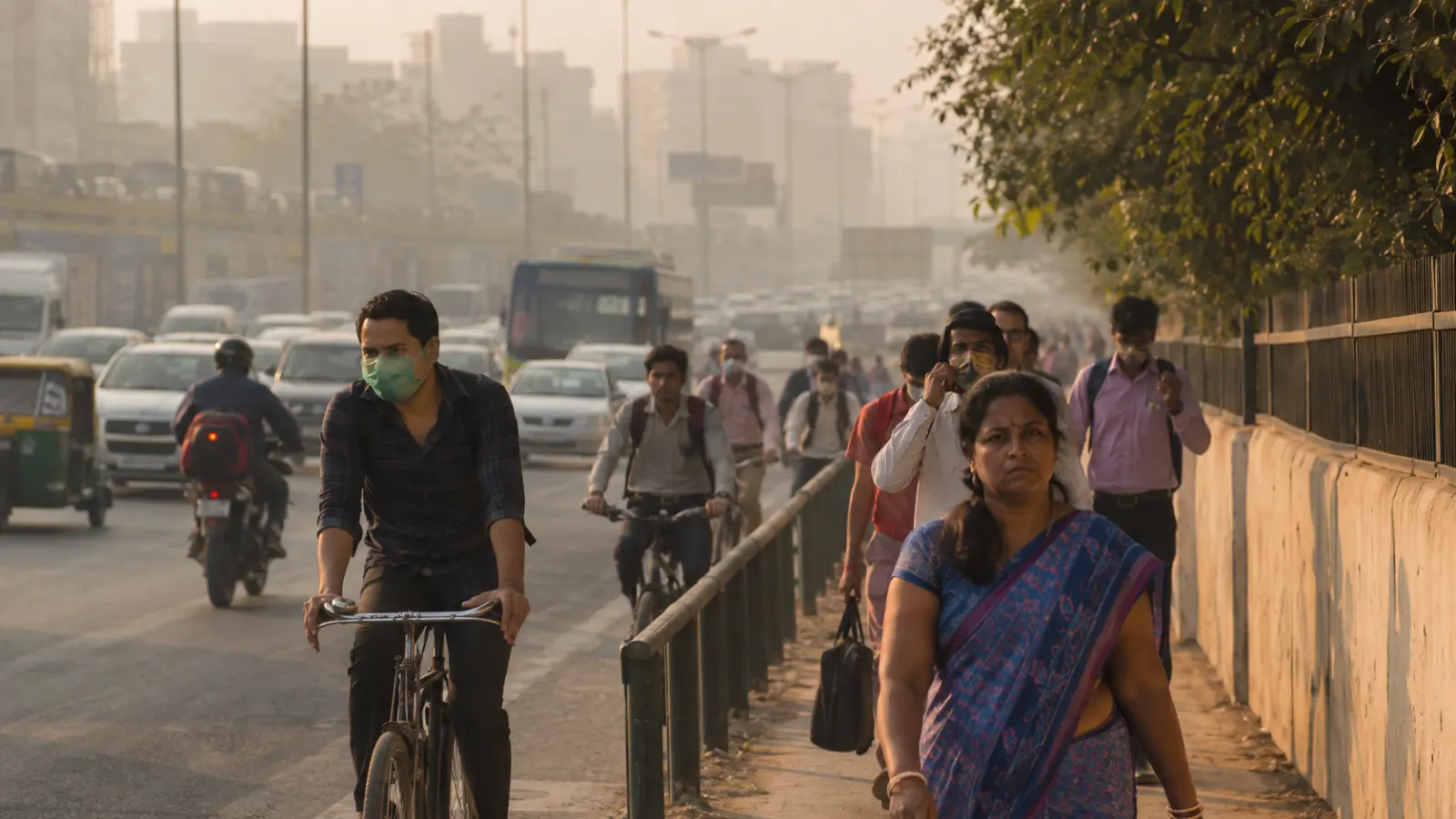
The most visually memorable pollution is obvious: smoke-filled streets, wildfire haze or thick urban smog.
Chronic exposure can be much less dramatic.
A city can have relatively clear skies while PM2.5 or nitrogen dioxide concentrations remain high enough to affect health. Much fine particulate matter is too small to see individually.
This matters because perception is a poor air-quality monitor.
If health decisions depend on whether the sky “looks polluted,” significant exposure can be missed.
Measured air-quality data is more useful than appearance or smell.
Household Air Pollution Is a Major Global Health Risk
Air pollution is not exclusively an outdoor urban problem.
WHO reported in December 2025 that around 2.1 billion people worldwide still cook using open fires or inefficient stoves fuelled by kerosene, biomass such as wood, animal dung and crop waste, or coal. WHO estimated that household air pollution was responsible for about 2.9 million deaths in 2021.
Smoke generated inside or close to the home can contain extremely high levels of fine particles and other combustion pollutants.
Exposure can be particularly substantial among people who spend long periods near cooking areas, frequently women and young children in affected communities.
Household emissions can also contribute to outdoor pollution.
Indoor and outdoor air quality are therefore connected rather than completely separate environmental problems.
Clean Cooking Is a Health Intervention
Replacing polluting fuels and inefficient stoves with cleaner energy can reduce household exposure substantially.
Potential solutions include electricity, cleaner gaseous fuels and appropriately designed technologies, but technical availability is not enough.
A cleaner stove that is too expensive to use, lacks reliable fuel supply or does not meet household cooking needs may be abandoned.
Clean-cooking policy therefore involves energy infrastructure, affordability, household behaviour and development policy alongside health.
The health objective is not merely to distribute equipment.
It is to produce sustained reductions in exposure.
Pregnancy Is a Period of Particular Concern
Pregnancy changes both maternal physiology and the relevance of environmental exposures to fetal development.
WHO states that maternal exposure to air pollution is associated with adverse birth outcomes including low birth weight, preterm birth and babies being small for gestational age.
Research continues into additional reproductive and developmental effects, and the strength of evidence varies between outcomes and pollutants.
This distinction matters.
It is appropriate to say that pregnancy is a period of increased vulnerability.
It is not appropriate to attribute an individual pregnancy complication automatically to air pollution when many other factors can contribute.
Children Can Receive a Different Dose From the Same Environment
Children are not simply small adults.
They breathe more air relative to body size, their lungs and other systems are still developing and they may spend substantial time physically active outdoors.
WHO and EPA therefore identify children among populations at increased risk from air pollution.
Schools and childcare facilities near major roads, industrial sources or recurrent wildfire smoke can consequently become important environments for exposure reduction.
Protection may involve building ventilation and filtration, air-quality monitoring, schedule adjustments during severe episodes and broader policies that reduce emissions near places where children spend time.
Older Adults and People With Existing Disease May Be More Vulnerable
The health consequences of pollution depend partly on baseline health.
Older adults are more likely to live with coronary artery disease, heart failure, COPD, diabetes or other conditions that can increase vulnerability.
WHO’s 2026 review identifies older people and those living with chronic diseases among groups at elevated risk from air pollution.
This means the same pollution concentration may not carry the same practical implications for every person.
A healthy young adult and an older person with severe cardiovascular disease may appropriately receive different advice during an extreme air-pollution episode.
Outdoor Workers Can Have Higher Exposure
Exposure depends on where people spend time, not only the average pollution concentration across a city.
Traffic police, delivery workers, construction workers, street vendors, drivers and other people who spend long periods outdoors or close to combustion sources may experience substantially different exposure from someone working in a filtered indoor environment.
Physical activity can also increase the inhaled dose because breathing becomes faster and deeper.
Occupational air-pollution protection therefore deserves separate attention from general population advice.
Workers may not have the freedom simply to remain indoors during unhealthy air conditions.
Employers and occupational-health systems have responsibilities too.
Air Pollution Is an Environmental-Justice Issue
Exposure is not distributed evenly.
WHO’s most recent global material highlights substantially higher pollution exposures and health burdens in lower-income populations and countries.
Within cities, lower-income communities may be more likely to live near major roads, industrial facilities, waste burning or other pollution sources while having fewer resources to reduce exposure.
Housing quality also matters. People with air conditioning and high-quality filtration can respond differently to wildfire smoke from people living in poorly sealed housing.
Health inequality therefore comes from two interacting questions:
Who is exposed?
And who has the resources to protect themselves?
Air Pollution May Affect More Than the Heart and Lungs
The strongest established global disease burden centres on cardiovascular disease, stroke, respiratory disease, lung cancer and respiratory infections.
Research is expanding into other outcomes.
WHO’s current health-impact material describes evidence concerning reproductive and metabolic effects and notes suggestive links with diabetes, cognitive impairment and neurological diseases.
NIEHS likewise describes research relating air pollution to neurological, reproductive, metabolic and immune-system outcomes.
This is an area where careful wording matters.
“Research links air pollution with” is not always equivalent to “air pollution is proven to cause” a particular condition with the same certainty established for the best-supported outcomes.
The evidence differs by pollutant, exposure window and disease.
What Does “Safe Air” Mean?
People naturally want a clear dividing line between safe and dangerous air.
Biology is less convenient.
WHO’s Global Air Quality Guidelines provide health-based recommended levels for major pollutants. They are designed to guide countries toward lower exposures and lower health risks. The guidelines themselves are not legally binding.
For annual PM2.5, WHO’s 2021 guideline is 5 micrograms per cubic metre.
But a guideline should not be interpreted as a magical concentration below which every health risk becomes zero.
Health risk generally changes along a continuum.
Reducing pollution from a very high concentration to a moderately high one can therefore produce meaningful health gains even before the ideal guideline level is reached.
Legal Air-Quality Standards and WHO Guidelines Are Not the Same Thing
National governments create legally enforceable air-quality standards through their own regulatory systems.
Those standards may differ from WHO guidelines because governments consider scientific evidence alongside legal structures, monitoring capacity, feasibility, economic circumstances and implementation timelines.
A concentration can therefore comply with a national legal standard without implying zero health risk.
Conversely, exceeding a WHO guideline does not automatically mean an individual exposed on one day will become ill.
The two concepts answer different questions.
A legal standard regulates.
A health guideline describes a level governments can use when attempting to reduce health risk.
What Does the Air Quality Index Actually Tell You?
An Air Quality Index, or AQI, translates measured or predicted pollution concentrations into categories intended to help the public make short-term decisions.
AQI systems differ between countries, so a numerical value from one national system is not always directly comparable with the same number elsewhere.
AQI is most useful for questions such as: Should a person with asthma reduce strenuous outdoor activity today? Is wildfire smoke severe enough that schools should alter outdoor schedules? Would moving a run to another time reduce exposure?
It is less useful for describing a person’s complete long-term pollution exposure.
A single “good” day does not erase years of elevated exposure.
Likewise, one unusually bad day does not represent the entire long-term risk.
Exercise Creates a Real Trade-Off on Polluted Days
Exercise is enormously beneficial to cardiovascular and respiratory health.
Air pollution complicates this because harder exercise increases breathing rate, potentially increasing the inhaled dose of pollutants.
That does not mean people should stop exercising whenever air pollution exists.
During unusually poor air quality, reducing exercise intensity, changing the time of day, choosing a route away from heavy traffic or exercising indoors can lower exposure while retaining some physical-activity benefits.
People with asthma, significant heart disease or other conditions may need more specific medical advice.
The sensible goal is usually lower exposure without abandoning physical activity unnecessarily.
Distance From Traffic Can Matter
Pollutant concentrations can vary substantially within the same city.
Exposure close to busy roads may differ from exposure on a parallel route several blocks away. Street configuration, weather, traffic volume and surrounding buildings all influence pollutant dispersion.
That means route choice can sometimes reduce exposure.
Walking or cycling through a quieter street rather than directly beside heavy traffic may be useful where practical.
Individual route changes will not solve urban air pollution.
They can still reduce one person’s exposure while broader policy addresses the source.
Wildfire Smoke Requires Different Short-Term Decisions
Wildfire smoke can produce extreme PM2.5 concentrations across large regions, sometimes far from the fire itself.
During severe smoke events, EPA recommends checking official air-quality information, reducing outdoor exposure, limiting smoke entering buildings and considering portable air cleaners or appropriate HVAC filtration.
People with cardiovascular or respiratory disease should make sure important medicines are available and follow disease-specific plans.
Smoke conditions can change rapidly.
Planning before wildfire season can therefore be more effective than trying to obtain filters or respirators after smoke arrives.
Do N95 Respirators Protect Against Air Pollution?
A properly fitted NIOSH-approved N95 or P100 respirator can substantially reduce exposure to airborne particles such as those present in wildfire smoke. EPA specifically recommends such respirators when prolonged outdoor exposure to smoke or ash cannot be avoided.
Several limitations are important.
A loose respirator provides less protection.
N95 respirators filter particles; they are not designed to remove every pollutant gas.
They may not be appropriate for every individual or situation.
Children require special consideration because standard occupational respirators are not designed around young children’s faces.
Respirators are therefore exposure-reduction tools, not a substitute for clean ambient air.
Indoor Air Filtration Can Reduce Particle Exposure
During severe outdoor smoke episodes, staying indoors helps only when indoor air is actually cleaner.
Particles can enter buildings through doors, windows and ventilation systems.
EPA recommends measures such as keeping windows and doors closed when conditions allow, using portable air cleaners and using efficient HVAC filtration where compatible with the system. During wildfire smoke, EPA suggests filters rated MERV 13 or higher where the HVAC system can accommodate them.
Portable filtration is particularly useful in rooms where people spend long periods.
Again, this works primarily for particles.
It should not be interpreted as a universal solution for every indoor pollutant or gas.
Indoor Air Can Also Have Its Own Pollution Sources
Closing windows against outdoor pollution can create another problem if indoor pollutant sources remain active.
Smoking, burning candles, some cooking methods, poorly vented combustion appliances and other activities can produce particles or gases indoors.
During wildfire events, EPA therefore recommends reducing activities that generate additional indoor particles.
Indoor-air protection is not simply about sealing a building.
It is about controlling both infiltration from outdoors and generation from indoors.
Personal Air Sensors Are Useful but Have Limits
Low-cost pollution monitors have made personal air-quality information much more accessible.
They can reveal how pollution changes between rooms, routes or times of day and can help people evaluate whether filtration is working.
But consumer sensors do not necessarily provide the same accuracy, calibration or regulatory validity as reference monitoring equipment.
They are best treated as additional information rather than perfect measurement devices.
For public-health alerts and regulatory decisions, official monitoring networks and validated modelling remain important.
Air Pollution and Climate Change Overlap—but They Are Not Identical
Many important sources of air pollution also emit greenhouse gases.
Burning fossil fuels for electricity, transport and industry can therefore affect both local air quality and the global climate.
Policies that reduce combustion can produce a health benefit relatively quickly through cleaner air while also contributing to longer-term climate goals.
But the problems are not identical. Carbon dioxide is a central greenhouse gas but is not treated like PM2.5 as a conventional toxic ambient pollutant at ordinary outdoor concentrations. Conversely, some air pollutants have complex effects on climate.
Keeping the concepts distinct makes policy analysis clearer.
Individual Behaviour Cannot Solve a Population Exposure
Personal actions matter most during specific high-exposure situations.
People can monitor air quality, change exercise timing, use appropriate filtration or respirators during smoke episodes and avoid creating unnecessary pollution indoors.
But these strategies have limits.
A schoolchild cannot choose the emissions standards for buses.
A street vendor may not be able to stop working during a smog episode.
A household cannot filter an entire polluted region.
The largest health gains therefore come from reducing pollution at source.
Cleaner Transport Produces Health Benefits Beyond Climate Policy
Road transport can contribute particulate matter, nitrogen oxides and other pollutants directly or indirectly.
Cleaner vehicles, lower-emission public transport, walking and cycling infrastructure, efficient urban design and reduced congestion can therefore affect population exposure.
The benefits extend beyond the people who switch transport modes.
When emissions decline, everybody breathing nearby air can potentially benefit.
This is the logic of population prevention.
One clean bus can alter exposure for thousands of people travelling or living along its route.
Energy Policy Is Health Policy
Electricity generation, industrial fuel combustion and household energy use are major pollution sources in many regions.
Cleaner energy systems therefore influence health even when they are discussed primarily as climate or infrastructure policy.
WHO explicitly identifies cleaner transport, power generation, homes, industry and waste management among strategies capable of reducing outdoor air pollution.
This is why clean-air policy sits at the intersection of health, energy, transport, urban planning and climate policy.
Hospitals cannot treat their way out of an exposure continuously recreated by the surrounding energy system.
Waste Burning Can Turn a Local Practice Into a Community Exposure
Open waste burning can release fine particles and a mixture of toxic compounds.
The person burning the waste is not the only one exposed.
Pollution can move through neighbourhoods depending on wind and atmospheric conditions.
Reducing open burning therefore requires practical waste-collection and disposal alternatives.
Simply telling households not to burn waste is unlikely to succeed if no workable waste-management system exists.
As with clean cooking, environmental-health interventions need infrastructure as well as advice.
Better Urban Design Can Reduce Exposure
Where homes, schools and hospitals are built affects who breathes pollution.
Land-use planning can reduce proximity to major emission sources. Transport systems can reduce congestion and vehicle use. Green space can support physical activity and improve urban environments, although vegetation is not a substitute for emission control.
NIEHS highlights strategies including land-use buffers, urban design and active-transport infrastructure as ways communities can address traffic-related air pollution.
The important principle is that exposure is partly designed into cities.
Urban planning is therefore also preventive health policy.
Cleaner Air Produces Benefits Across Entire Populations
Air-pollution control can sometimes appear less personal than medical treatment because no one receives a prescription saying “cleaner air.”
The intervention operates upstream.
A power plant reduces emissions.
Vehicle standards improve.
Cleaner cooking replaces smoke-producing fuels.
Industrial controls capture pollutants.
Millions of people then inhale slightly cleaner air each day.
No single individual may know which heart attack, asthma exacerbation or premature death did not occur.
That invisibility is characteristic of successful prevention.
Frequently Asked Questions
How does air pollution affect health? Air pollution can cause airway inflammation and respiratory symptoms while also contributing to systemic inflammation, blood-vessel dysfunction and other processes associated with cardiovascular disease, stroke, COPD, lung cancer and additional health outcomes.
How many deaths are caused by air pollution worldwide? WHO’s June 2026 technical brief estimates that air pollution causes about 6.6 million deaths globally each year. Estimates can differ slightly between WHO publications because they may use different underlying years and burden-of-disease updates.
What is PM2.5? PM2.5 is particulate matter with an aerodynamic diameter of 2.5 micrometres or less. Its small size allows it to penetrate deeply into the lungs, and some components can reach the circulation.
Is PM2.5 dangerous to the heart? Yes. Extensive research links short- and long-term PM2.5 exposure with cardiovascular effects including vascular dysfunction, heart attacks, stroke and cardiovascular mortality.
Can air pollution cause cancer? IARC has classified outdoor air pollution and particulate matter in outdoor air pollution as carcinogenic to humans, with lung cancer the clearest established cancer outcome.
Does air pollution worsen asthma? Yes. Ozone and particle pollution can aggravate asthma and increase respiratory symptoms and asthma attacks.
Are children more vulnerable to air pollution? Children can be particularly vulnerable because their lungs are developing, they breathe more air relative to body size and they often spend time physically active outdoors.
Does pollution affect pregnancy? WHO reports associations between maternal air-pollution exposure and outcomes including low birth weight, preterm birth and babies being small for gestational age.
Is indoor air pollution dangerous too? Yes. WHO estimates that household air pollution caused about 2.9 million deaths in 2021 and that approximately 2.1 billion people still cook using polluting fuels or inefficient technologies.
Is there a completely safe level of PM2.5? Health risk does not behave like a simple switch. WHO provides health-based guideline values designed to reduce risk, but lower exposure is generally preferable rather than interpreting the guideline as a boundary between zero risk and danger.
What is the WHO guideline for annual PM2.5? WHO’s current global guideline recommends an annual average PM2.5 concentration of 5 µg/m³ or lower.
Does a low AQI mean there is zero risk? No. AQI categories are communication tools for short-term conditions rather than proof of zero biological risk or a complete measure of long-term exposure.
Should I exercise outside when pollution is high? During unusually poor air quality, reducing intensity, changing the time or location of activity or exercising indoors may reduce exposure. People with heart or lung disease may require individual advice.
Do masks protect against air pollution? Properly fitted NIOSH-approved N95 or P100 respirators can reduce exposure to fine particles such as wildfire smoke, but they do not filter every pollutant gas and fit is important.
Do air purifiers help? Appropriate portable air cleaners and effective HVAC filtration can reduce indoor particle concentrations, particularly during smoke events. Their effectiveness depends on the device, room size, filter, airflow and pollutant involved.
Can air pollution be solved by individual behaviour? Individual exposure-reduction measures can help, but the largest health gains require emission reductions from transport, household energy, electricity generation, industry, waste and other major sources.
The Most Important Effects Are Not Always the Ones You Can Feel
Air pollution is often discussed through symptoms: coughing, eye irritation, wheezing or shortness of breath.
Those are important.
But some of the most consequential effects occur through processes people cannot feel directly.
An individual cannot feel systemic inflammation.
They cannot detect subtle blood-vessel dysfunction through sensation alone.
Atherosclerotic disease develops over years.
Lung-cancer risk accumulates long before symptoms.
This is why absence of immediate discomfort does not prove that an exposure is harmless.
Air Pollution Is Both an Environmental and a Medical Issue
Healthcare usually treats individuals after disease or when risk factors become detectable.
Air-quality policy acts earlier.
Reducing PM2.5 or nitrogen dioxide across a city changes an exposure shared by entire populations—including people who will never know that cleaner air reduced their personal risk.
That makes air-pollution control a form of preventive medicine delivered through environmental policy.
The hospital, transport department, energy ministry and urban planner may appear to work in separate systems.
From the perspective of the lungs and cardiovascular system, they do not.
The Central Idea
Air pollution enters through the respiratory system, but its health consequences can extend throughout the body. Fine particles can reach deep into the lungs and contribute to systemic processes affecting blood vessels and the heart. Ozone directly irritates and inflames airways. Long-term exposure contributes to chronic respiratory and cardiovascular disease, while outdoor air pollution and particulate matter are established carcinogenic hazards. WHO’s latest evidence review also highlights emerging or expanding evidence concerning reproductive, metabolic and neurological health.
The risk is shaped by what pollutant is present, how concentrated it is, how long exposure lasts, how much air a person inhales, baseline health and social conditions.
That complexity should make public communication more precise, not less urgent.
One polluted afternoon is different from living for twenty years beside a major emission source. Someone with severe asthma or coronary disease may be more vulnerable than a healthy young adult. Household smoke requires different interventions from urban traffic pollution. An N95 can reduce particle exposure during wildfire smoke but cannot solve regional air quality.
The same distinction applies to solutions.
Individuals can reduce exposure during severe episodes.
Buildings can filter some pollutants.
Clinicians can help vulnerable patients plan around air-quality events.
But the largest gains occur when the pollution is not created in the first place.
Cleaner transport.
Cleaner electricity.
Cleaner household energy.
Better industrial controls.
Effective waste management.
Thoughtful urban planning.
These interventions do something that personal protective equipment cannot: they reduce exposure for everyone simultaneously.
That is why air pollution should not be understood only as an environmental problem occurring outside the healthcare system.
It is a major determinant of respiratory, cardiovascular and population health.
Clean air is preventive healthcare delivered before a patient enters the clinic.