Cashless does not mean costless
The phrase cashless economy sounds clean, modern and efficient. It suggests a world where nobody waits for change, nobody carries bulky currency, nobody handles counterfeit notes and every payment moves instantly through a phone or card. The promise is attractive because cash has obvious costs: printing, transporting, guarding, counting, storing and replacing it. Digital money appears to remove those frictions.
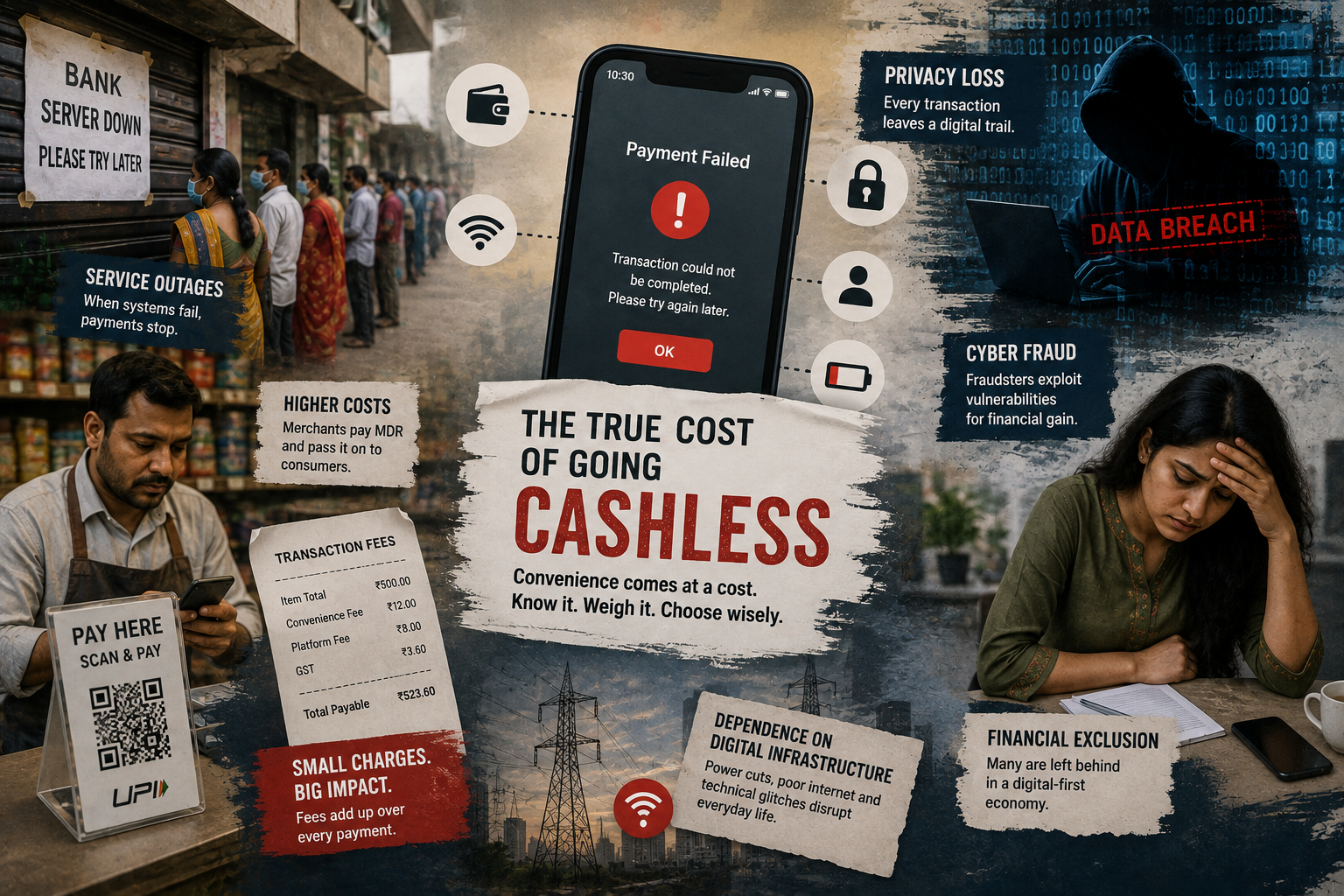
But going cashless does not eliminate the cost of payments. It changes where the cost appears and who bears it. Some costs become visible as merchant fees, app charges or device expenses. Some become invisible as data extraction, fraud exposure, platform dependence and loss of privacy. Some are borne by individuals; others are borne by small businesses, banks, governments or society. The real cost of going cashless is not one line item. It is a new economic architecture.
The direct cost: devices, data and access
To participate fully in a cashless economy, a person needs more than money. They may need a smartphone, SIM connection, data plan, bank account, app literacy, language comfort, identity verification and sometimes biometric or password access. These requirements seem ordinary to digitally comfortable users, but they are not costless for everyone.
For low-income users, the cost of device repair, data recharge, battery life and connectivity can be significant. For elderly users, the cost may be cognitive rather than financial. For people with disabilities, digital interfaces may be poorly designed. For migrants, documentation and language can become barriers. Cash works immediately. Digital money requires an ecosystem around the user.
Merchant costs and payment acceptance
Merchants may face costs for accepting digital payments. These can include payment terminal costs, QR setup, bank charges, settlement delays, reconciliation effort, internet connectivity, accounting changes and dispute handling. Some digital payment modes are cheaper than card networks, but the broader cost of becoming digitally ready still exists.
For large businesses, these costs may be absorbed as part of modern operations. For small merchants with thin margins, even small costs matter. A fruit seller, small grocer or tea vendor may value digital acceptance because customers demand it, but they may also worry about failed transactions, delayed settlement, mistaken payments or tax visibility. A cashless transition must therefore consider micro-business realities, not only urban consumer convenience.
The cost of fraud and mistakes
Cash can be stolen, but digital money can be manipulated in more complex ways. Users may fall for phishing, fake customer care numbers, fraudulent payment requests, screen-sharing scams, QR-code deception, malware or social engineering. Many frauds succeed not because the payment rail is technically broken, but because the user is tricked into authorising a transaction.
The emotional and financial cost of such fraud can be severe. Victims often blame themselves. Recovery may be uncertain. Complaint systems may be confusing. Banks and apps may dispute liability depending on whether the user shared credentials or authorised payment. The cost of going cashless therefore includes the burden placed on consumers to understand digital safety in real time.
The cost of failed transactions
In a cash transaction, failure is usually obvious. Either the money changes hands or it does not. In digital payments, failure can be ambiguous. The payer may see money debited while the merchant does not receive confirmation. A refund may take time. The bank may blame the app; the app may blame the bank; the merchant may ask the customer to pay again. Small failures create big trust issues.
For low-income users, a delayed refund is not a minor inconvenience. It can affect food, travel, medicine or daily business cash flow. Payment systems must therefore be judged not only by success rate but also by failure resolution. A truly inclusive digital economy must make failed transactions understandable and recoverable for ordinary users.
Privacy as an economic cost
Every digital payment creates data. That data can improve record keeping and fraud detection, but it can also reveal behaviour. Payment history can show consumption patterns, health choices, religious donations, political contributions, travel routes, financial stress and social relationships. This information has commercial and political value.
Privacy loss is difficult to price because people often give it away without immediate pain. But over time, transaction data can shape credit scoring, advertising, pricing, surveillance and institutional decisions. If users do not know who sees their payment data, how long it is stored and how it is combined with other information, they are paying for convenience with a currency they do not fully understand.
Platform dependence and market power
A cashless economy may shift power from public currency to private interfaces. Even when payment rails are public or regulated, the user often interacts through private apps. These apps can influence default choices, merchant discovery, offers, user behaviour and data flows. Over time, dominant platforms can become gatekeepers of everyday commerce.
This creates a competition concern. If a few platforms control access to consumers and merchants, they may gain bargaining power. They may monetise data, promote affiliated services, impose conditions or shape financial habits. Payment systems should remain open and interoperable so that convenience does not become dependency.
Cybersecurity and infrastructure costs
Digital payments require constant investment in cybersecurity. Banks, payment networks, fintech firms and governments must defend against hacking, data breaches, malware, denial-of-service attacks, identity theft and system manipulation. These costs are permanent. A cashless economy is not maintained once; it must be defended every day.
Infrastructure also requires reliability. Servers, telecom networks, power supply, settlement systems, APIs, fraud monitoring and customer support must function at scale. When transaction volumes rise, resilience becomes more important. The cost of going cashless therefore includes the cost of building systems that do not collapse under stress.
Exclusion as a social cost
The biggest cost may be borne by those who are least visible in digital policy debates. People without smartphones, stable documents, literacy, bank access or digital confidence may find themselves pushed out of normal economic life. If buses, hospitals, shops, schools or government counters become digital-first without alternatives, exclusion becomes structural.
Social cost is not measured only in money. It includes humiliation, dependency, delay and loss of autonomy. A person who must ask someone else to operate an app loses privacy and control. A truly modern payment system must protect dignity, not merely improve transaction speed.
The cost of losing cash discipline
Cash imposes a natural spending limit. A person can see how much is left in the wallet. Digital payments weaken that physical feedback. Small repeated transactions, subscriptions, one-click purchases and app-based offers can make spending less visible. The cost of cashlessness can therefore appear in personal budgets.
This is not an argument against digital payments. It is an argument for digital budgeting tools, transaction alerts, spending categories and financial education. If digital payments make spending easier, they must also make self-control easier. Otherwise, convenience quietly becomes consumption pressure.
When going cashless creates benefits
The costs of going cashless must be balanced against real benefits. Digital payments can reduce theft risk, improve accounting, support remote commerce, strengthen tax compliance, speed up welfare transfers and help small businesses build transaction history. They can make the economy more efficient and reduce dependence on physical cash logistics.
The policy goal should not be to reject digital payments because they have costs. Every payment system has costs. The goal should be to design digital payments so that costs are transparent, fairly distributed and reduced through competition, regulation and user protection.
Final takeaway
Going cashless is not free. It creates costs in devices, data, fraud, fees, privacy, resilience, platform power and exclusion. Some of these costs are visible immediately; others appear slowly as society becomes dependent on digital rails. A serious economy must count all of them.
The right question is not whether digital payments should grow. They should. The right question is how to make them safe, inclusive, competitive and resilient. A good payment future is not one where cash disappears before everyone is ready. It is one where digital payments become so trustworthy that people adopt them by choice, while alternatives remain available for those who need them.