Verghese Kurien: Building India’s Dairy Cooperative Movement
Verghese Kurien became the figure most closely associated with India’s dairy transformation even though he did not begin his career intending to work in milk, farming or cooperatives. He was a mechanical engineer sent to a government creamery in Anand, Gujarat, and initially wanted to leave. What kept him there was not enthusiasm for dairying itself but an institutional problem: local milk producers were trying to build a cooperative that could escape dependence on private traders and gain direct access to the valuable Bombay market.
That distinction is important because Kurien’s contribution was not primarily the invention of a new dairy technology. His larger achievement was helping build organisations capable of combining farmer ownership, professional management, engineering, processing, logistics and consumer marketing. The system that emerged around the Kaira cooperative eventually became associated with Amul, while the institutional structure became known as the Anand Pattern. Kurien later became the founding chairman of the National Dairy Development Board, which used Operation Flood to expand similar producer-owned dairy institutions across India. NDDB records that he chaired the organisation from 1965 to 1998.
The history is larger than one individual. Tribhuvandas Patel and the milk producers of Kaira had already organised the cooperative movement that Kurien later helped professionalise. Dairy technologist H. M. Dalaya played a crucial role in processing innovation. Veterinarians, plant workers, managers, cooperative leaders, government officials and millions of milk producers made national expansion possible. Kurien’s distinctive role was to connect these capabilities into institutions that could operate commercially without shifting ownership away from producers.
This makes his career important not only to agricultural history but also to business and institutional history. He repeatedly asked a practical question that remains relevant well beyond dairy: how can millions of small producers gain access to large markets without surrendering most of their bargaining power either to private intermediaries or to a distant bureaucracy?
From an Unwanted Posting to the Anand Cooperative Model
Kurien was born on 26 November 1921 in Kerala and trained in science and engineering. The World Food Prize records that he studied mechanical engineering before receiving government-supported training in the United States and specialised dairy-engineering training in India. After returning, he was posted in 1949 to the Government Research Creamery in Anand as part of his service obligation.
The posting placed him next to an institution already emerging from a farmer struggle. Milk producers in Kaira district had organised to challenge the system through which private traders controlled procurement and access to urban markets. NDDB traces the modern cooperative dairying movement in Anand to 1946, when milk producers organised village societies and established the Kaira District Cooperative Milk Producers’ Union. The movement was built around the principle that farmers should collectively market their milk rather than remain dependent on intermediaries.
Tribhuvandas Patel provided the farmer organisation and political legitimacy that made the cooperative possible. Any account that presents Kurien as the sole founder of Amul reverses that chronology. His contribution complemented the cooperative rather than originating it. Patel understood how to organise producers; Kurien brought engineering, managerial discipline and an insistence that a farmer-owned enterprise had to compete professionally if it wanted to survive.
The combination mattered because milk creates unusual bargaining problems. It is produced every day and cannot be stored indefinitely by an individual farmer while waiting for a better price. Whoever controls chilling, transport, testing, processing and access to consumers can acquire enormous leverage over producers. A farmer selling a few litres independently has limited negotiating power; thousands of farmers pooling their milk can finance laboratories, processing plants, cattle-feed operations, tanker networks and marketing.
The cooperative model therefore tried to change ownership of the chain rather than merely improve the price at one transaction point. Village societies collected milk. A district union processed it and supplied services. Larger federations coordinated marketing. Farmers remained owners through their cooperatives, while specialists were hired to manage technically demanding activities.
NDDB describes this institutional architecture as the Anand Pattern. Its present description emphasises a three-tier structure of village dairy cooperative societies, district milk unions and state federations. Village societies collect and test members’ milk; district unions process it and commonly provide services such as feed, veterinary care and artificial insemination; state federations market products across larger territories. NDDB explicitly defines the model as producer-controlled but professionally managed.
That final element was central to Kurien’s thinking. Cooperative ownership did not eliminate the need for commercial competence. A dairy plant had to control quality. A national brand had to understand consumers. Transport had to operate reliably. Accounts had to balance. Managers had to make difficult decisions about investment and product mix.
Kurien therefore rejected the idea that a cooperative should behave like a protected welfare department. Farmer ownership mattered precisely because the business had to generate value for its members.
Technology, Amul and the Discipline of Reaching the Consumer
Amul became the most visible expression of this model, but its importance was deeper than brand recognition. The commercial success of the cooperative demonstrated that producer ownership could coexist with modern technology, product diversification and national marketing.
One important technical challenge involved buffalo milk. Indian dairying could not simply copy European systems developed mainly around cow milk. Buffalo milk has different composition and required adaptation in processing. H. M. Dalaya played a major technical role in developing methods that allowed buffalo milk to be converted successfully into milk powder at commercial scale. That contribution should not be absorbed into a single-hero account of Kurien.
Kurien’s role was institutional: creating an organisation capable of taking such technical innovation from experiment to commercial production. Milk powder reduced some of the perishability problem because milk solids could be stored and used to help balance seasonal supply. Product diversification also allowed the cooperative to capture more value than it could earn by selling only raw liquid milk.
The wider principle was that technology worked only when embedded in an organisation capable of using it. A sophisticated processing plant is of little value if milk procurement is unreliable. Better cattle genetics accomplish little if veterinary care and feed are poor. A laboratory does not build farmer trust if testing is opaque or payments are delayed.
This is why the few minutes when a farmer delivers milk matter so much. NDDB’s Anand Pattern links member payment to milk quantity and quality, including fat and solids-not-fat content. Transparent testing and predictable payment convert an abstract promise of farmer ownership into a daily economic relationship.
Amul’s later growth into a major consumer brand also demonstrated another Kurien principle: marketing is part of rural development. Producer-owned institutions cannot improve farm income sustainably if they fail to understand consumers. Packaging, branding, distribution and product development are not distractions from farmer welfare; they are the commercial mechanisms through which value flows back toward producers.
This made the model fundamentally market-oriented without making it investor-owned. The cooperative had to compete with private businesses for consumers while remaining accountable to the producers supplying its milk.
That balance is difficult. Managers require operational autonomy, but too much distance from members can weaken cooperative accountability. Elected farmer leaders provide democratic legitimacy, but excessive interference in technical decisions can damage commercial performance. NDDB still defines effective producer governance and professional management as paired features of cooperative development.
The Anand Pattern should therefore not be understood as a guarantee of good governance. It is an institutional attempt to keep ownership democratic while management remains professional.
NDDB, Operation Flood and the Attempt to Scale Anand
The success of the Kaira experiment attracted national attention. In 1965, the National Dairy Development Board was established to help extend producer-owned dairy development across India, with Kurien as its founding chairman. NDDB describes him as the architect of India’s White Revolution and credits his leadership with shaping Operation Flood, which began in 1970.
Scaling the Anand model was a much harder problem than making one cooperative successful. India contained very different farming systems, political structures, existing milk schemes, private traders and local social hierarchies. Replication required far more than registering village cooperatives. Milk routes had to be created, chilling and processing plants built, veterinarians recruited, feed supplied, managers trained and urban markets developed.
Operation Flood attempted to create this larger network. Its first phase used donated skimmed milk powder and butter oil from the European Economic Community, routed through the World Food Programme, in an unusual financing arrangement. The imported dairy products were sold in India, and the proceeds were invested in infrastructure and cooperative development. The intention was not permanent dependence on imports but the construction of domestic capacity that could eventually reduce that dependence.
The strategy connected procurement with marketing. Producing additional milk is not automatically beneficial if farmers cannot sell it. Conversely, urban distribution cannot rely on domestic producers if collection and processing are unreliable. Operation Flood therefore treated the village producer, processing plant and city consumer as parts of the same economic system.
The National Milk Grid became the logistical expression of this idea. Milk-surplus regions could supply distant urban markets, while powder and other products helped manage seasonal variation. Larger market access reduced the extent to which an individual producer or cooperative remained dependent on one local buyer.
Kurien understood this as a bargaining-power problem as much as an engineering one. Infrastructure changes markets because it expands the number of feasible transactions. A village cooperative linked to processing and national distribution has more options than a farmer forced to sell immediately to the only trader available.
Operation Flood also expanded the role of veterinary services, artificial insemination, cattle feed, member education and technical support. The dairy system therefore became progressively more institutionalised. The cooperative was not merely a purchasing counter; it could become a gateway through which producers accessed inputs and services that would be expensive to obtain individually.
This expansion contributed to the transformation later described as the White Revolution, but Kurien should not be credited with every increase in national milk production. Demand growth, better roads, electrification, breeding, feed, state programmes, private dairies and wider economic changes also mattered. Production continued to rise after Operation Flood ended.
The stronger claim concerns institutions. Operation Flood created and strengthened organised procurement systems, processing capacity, cooperative networks and urban marketing structures. The World Food Prize, which named Kurien its 1989 laureate, highlighted precisely this organisational contribution: putting farmers in control of cooperatives capable of producing, processing and marketing milk.
IRMA, Management and the Problem of Building Institutions That Outlive Founders
As the cooperative system expanded, Kurien confronted another constraint: who would manage increasingly complex rural institutions?
Traditional management education largely prepared graduates for corporations, while development programmes often depended on administrators without specialised training in markets, finance or producer-owned organisations. Kurien concluded that cooperative expansion needed its own professional pipeline.
This led to the establishment of the Institute of Rural Management Anand in 1979. IRMA describes its founding purpose as bringing professional management to organisations serving underserved parts of the economy. Its institutional history explicitly connects the need for rural-management professionals with the experience of implementing Operation Flood at large scale.
The idea reveals another important aspect of Kurien’s approach. Institutions cannot remain dependent forever on an exceptional founder or one generation of managers. If a cooperative system needs competent accountants, marketers, operations specialists, field managers and leaders, those capabilities must be reproduced deliberately.
IRMA therefore represented something larger than another management school. It was an attempt to create human infrastructure for rural institutions.
Kurien applied a related logic to commodity sectors beyond milk. NDDB and associated organisations attempted cooperative approaches in areas such as edible oils, fruit and vegetables. These experiments did not simply reproduce Amul’s trajectory, which is itself instructive. Different commodities have different storage properties, market structures and transaction frequencies. Milk’s daily perishability creates unusually strong incentives for producers to maintain a continuous relationship with a cooperative.
The lesson is that institutional principles travel more easily than exact institutional forms. Producer ownership, aggregation, professional management and market access can be useful in many sectors, but they must be adapted to the economics of the commodity involved.
The same caution applies geographically. Cooperatives developed unevenly across Indian states. Some became commercially strong and deeply rooted among producers. Others suffered from political interference, delayed payment, weak services or poor governance. The Anand Pattern could be copied legally without reproducing the relationships that made Anand successful.
This unevenness is central to evaluating Kurien’s legacy. Institutional design creates possibilities; it does not guarantee outcomes.
The Limits of the Model and the Problem of Founder Power
Kurien’s public style was forceful and often combative. He challenged bureaucratic control, private monopolies and political interference, and that aggressiveness helped protect institutions during periods when their autonomy was vulnerable. Admirers saw independence and clarity; critics sometimes saw centralisation and an unwillingness to accommodate competing authority.
This tension matters because institution builders often become closely identified with the organisations they defend. Strong personal authority can help an institution survive its formative years while also making succession difficult.
Kurien’s later disputes over institutions associated with Anand illustrate this problem. A cooperative system ultimately has to place authority in rules, elected members and accountable management rather than in the continuing presence of its founder.
That is also why heroic titles such as “Milkman of India” and “Father of the White Revolution” should be used carefully. The World Food Prize and other institutions use such descriptions to recognise his exceptional contribution, and he unquestionably played a central leadership role. But the very institutional model he championed was based on collective producer ownership. Turning a cooperative transformation into a one-man story obscures the farmers, organisers, technologists and professionals whose participation made it possible.
Tribhuvandas Patel deserves particular attention because the cooperative political foundation preceded Kurien’s managerial leadership. Dalaya deserves recognition because technical advances in buffalo-milk processing were not Kurien’s inventions. Producer-members themselves were not passive beneficiaries; the economic logic depended on their ownership and repeated participation.
The model also faces twenty-first-century questions that its original designers could not fully resolve. More intensive dairy production raises concerns involving feed and fodder, water use, methane emissions, manure, animal welfare and the suitability of breeding systems under different climatic conditions. Dairy development today cannot be assessed only through milk volume or household income.
Gender adds another complication. Women have performed a large share of daily livestock work in many Indian households, yet cooperative membership, asset ownership and control over milk income have not always reflected that labour. NDDB now explicitly includes greater women’s participation among its cooperative-development priorities.
Producer ownership therefore remains a starting principle, not an automatic guarantee of equal participation within farming households or village institutions.
What Verghese Kurien Actually Built
Kurien did not invent milk, cooperatives or rural enterprise. He did something more specific: he helped assemble them into institutions capable of operating at extraordinary scale.
He recognised that perishability weakened individual producers and that processing infrastructure could change bargaining power. He insisted that farmer ownership had to coexist with professional management. He supported technical adaptation rather than simply importing dairy systems designed for different animals and markets. He treated branding and consumer distribution as part of producer welfare rather than as activities morally separate from rural development.
Through NDDB and Operation Flood, he helped move the cooperative principle from one district toward a national dairy network. Through IRMA, he attempted to create managers capable of running such institutions after the founding generation had gone. The World Food Prize’s 1989 recognition focused on exactly this combination of management, distribution and small-producer organisation rather than on a single scientific discovery.
His career therefore belongs equally to business history, development economics and agricultural history.
The underlying problem he confronted remains familiar. Small producers frequently operate in markets where processors, distributors or platforms are far larger than they are. Individually, each producer has little negotiating leverage. Collectively, they may achieve scale—but only if the organisation they build remains commercially competent, democratically accountable and resistant to capture.
Kurien’s answer was ownership plus organisation.
Let producers own the institution.
Aggregate enough supply to create scale.
Hire professionals rather than assuming democracy substitutes for expertise.
Use technology to expand what producers can sell.
Build brands and distribution capable of reaching the final customer.
And ensure that value created downstream can flow back toward the people supplying the product.
The model was never perfect. Some cooperatives became weak or politicised. Dairy expansion created new environmental pressures. Regional outcomes differed, and private enterprise remained an important part of India’s dairy economy.
But those limits make the institutional lesson more useful rather than less.
Kurien’s greatest achievement was not creating a flawless cooperative system or single-handedly producing India’s White Revolution. It was demonstrating that a farmer-owned organisation could combine democratic ownership with engineering, professional management, sophisticated processing and mass-market competition.
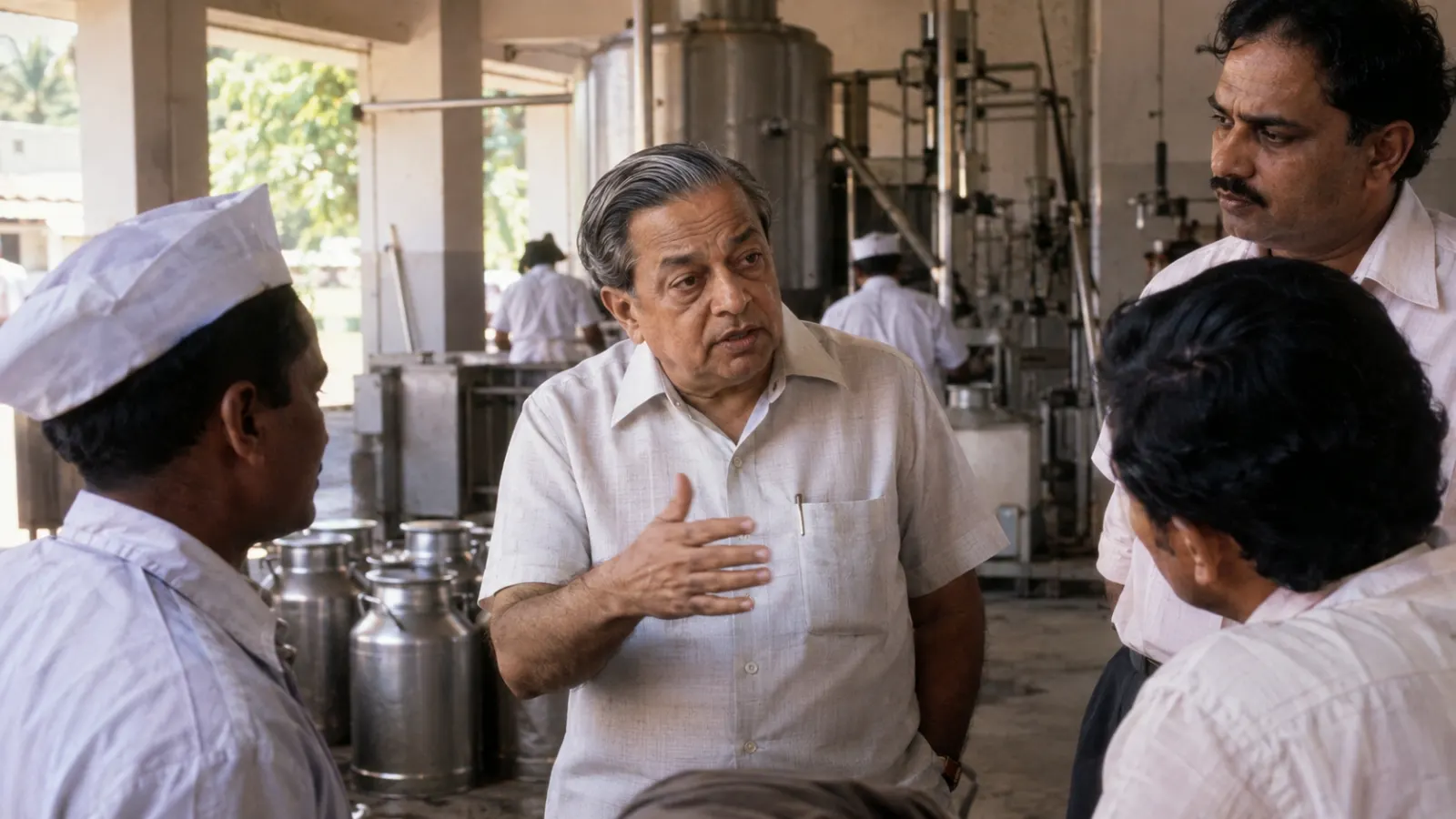
That is why the strongest legacy of Verghese Kurien is not a heroic portrait of one man surrounded by milk cans.
It is a functioning system in which a small producer can deliver milk, have its quality measured transparently, receive reliable payment, elect representatives, employ professional managers and share in the economic value created between the village and the consumer.