Money is changing, but society is not changing equally
The cashless economy debate is often presented as a simple story of progress. Digital payments are faster, cleaner, easier to track and more convenient than cash. A shopkeeper can receive money instantly. A worker can send money home without standing in a queue. A government can transfer benefits directly. A business can reduce cash handling and improve records. On the surface, the case looks obvious: if money can move through phones, cards and payment networks, why should society remain dependent on notes and coins?
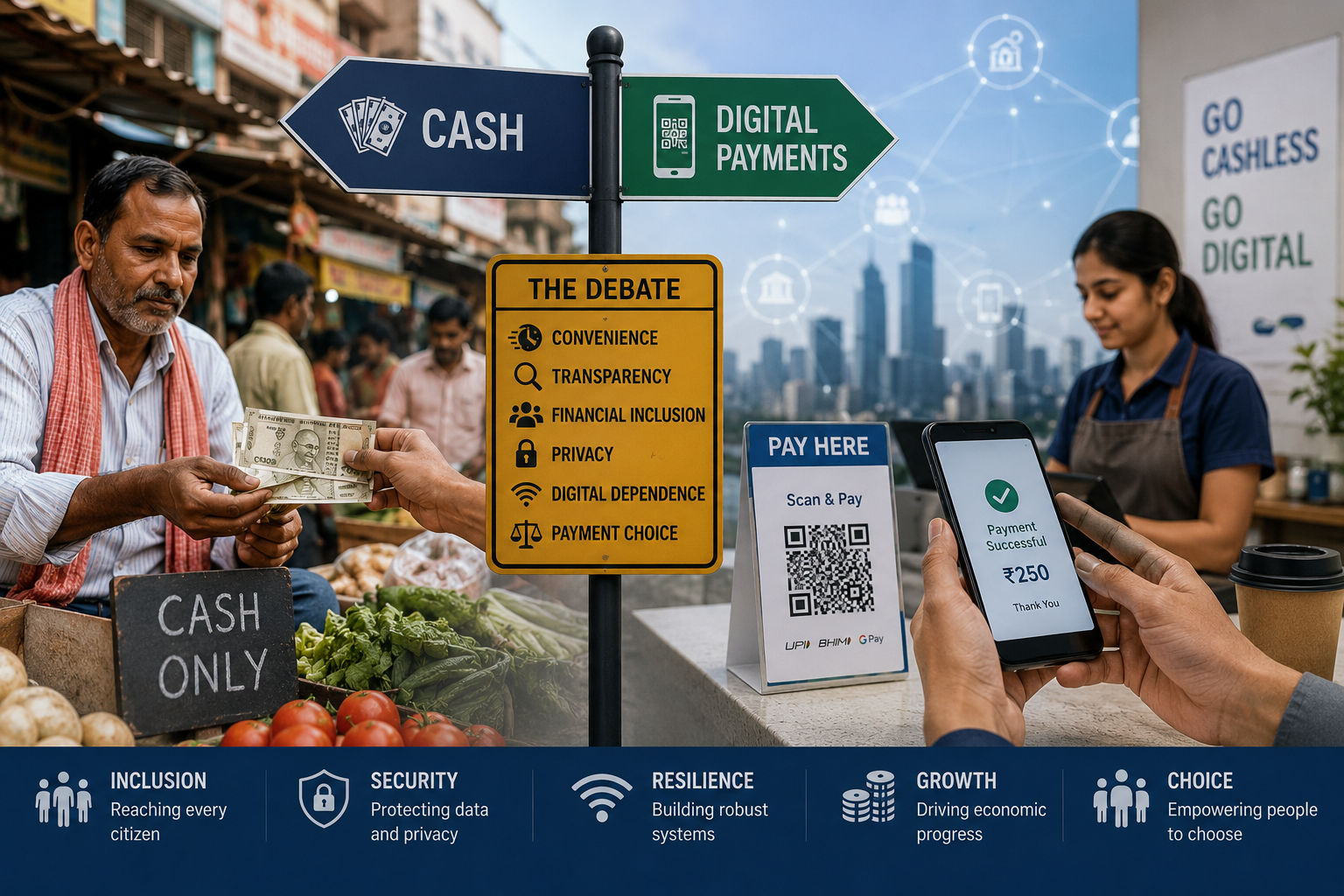
The real debate begins when convenience meets inequality. A cashless economy is not only a technical change in payment method. It changes privacy, access, power, fees, resilience and the relationship between citizens, firms and the state. Cash is slow, but it is universal. Digital money is efficient, but it needs devices, connectivity, literacy, electricity, authentication and trust. The question is not whether digital payments are useful. They are. The deeper question is whether an economy should become fully cashless, or whether payment choice remains an essential part of economic freedom.
What a cashless economy actually means
A cashless economy is not an economy where money disappears. It is an economy where transactions are settled mainly through digital instruments rather than physical currency. These instruments can include cards, mobile wallets, UPI, bank transfers, prepaid instruments, QR-code payments, internet banking, real-time payment systems and other electronic rails. The value is still money; the form and movement of money become digital.
No serious modern economy is completely cashless. Even highly digital societies usually retain some cash because cash performs functions that digital systems cannot fully replace. It works during network failure. It protects some degree of anonymity. It helps people outside the formal banking system. It is easy to understand. It does not require a password, app update or battery. The cashless debate is therefore not cash versus progress. It is about the balance between digital efficiency and economic resilience.
Why governments like digital payments
Governments often support digital payments because they make economic activity more visible. When transactions leave electronic trails, tax compliance can improve, leakages can reduce, welfare transfers can be tracked more effectively and public services can collect fees more efficiently. Digital payments can also support formalisation because businesses that receive digital receipts create better records for accounting, lending and taxation.
For a country like India, digital payments can strengthen financial inclusion when they connect Jan Dhan accounts, mobile phones, Aadhaar-enabled systems, UPI, direct benefit transfers and small merchant acceptance. A cash-heavy economy can hide income, encourage informal wages, increase security costs and make government delivery less transparent. From the state’s point of view, digital payments can widen the fiscal and administrative map.
Why businesses like digital payments
Businesses value digital payments because they reduce friction. A merchant does not need exact change, physical cash management or repeated bank deposits. Online businesses cannot function efficiently without electronic payments. Subscription models, refunds, remote billing, invoices, payroll, gig work and cross-city commerce all become easier when money moves digitally.
Digital records can also improve credit access. A small business that receives regular digital payments can show cash flow to lenders. A lender may be more willing to assess a business with transaction history than a business whose sales exist only in memory. In this sense, digital payments can convert invisible enterprise into measurable enterprise. That measurement can help entrepreneurs grow.
Why consumers adopt digital payments
Consumers adopt digital payments for speed and convenience. Paying bills, sending money, buying tickets, shopping online, paying vendors and splitting expenses become easier. Digital payment history can help with budgeting and dispute tracking. For younger users, digital payments may feel more natural than cash because much of their commerce already happens through apps.
But convenience can create new behavioural problems. When payment becomes frictionless, spending becomes less painful. A tap or scan does not feel like handing over cash. This can increase impulsive consumption, subscription leakage and poor budget awareness. Digital money is efficient, but it can also make money feel less real. Financial literacy must therefore evolve with payment technology.
The inclusion problem
The strongest argument against a fully cashless economy is exclusion. Not everyone has a smartphone. Not everyone has stable internet. Not everyone is comfortable using apps. Elderly citizens, informal workers, migrants, people with disabilities, rural consumers, low-literacy groups and people with irregular documentation can face barriers. A system that works beautifully for urban professionals may become stressful for those at the margins.
A payment system is not inclusive merely because it is available. It is inclusive when people can use it confidently, understand errors, resolve failed transactions, protect themselves from fraud and access help in their own language. If digital payments become mandatory before these conditions exist, the poor do not become modern; they become dependent on intermediaries who may exploit them.
Privacy and surveillance concerns
Cash has one feature that digital money struggles to preserve: privacy. When a person pays in cash, the transaction does not automatically create a data trail available to platforms, banks, advertisers or the state. Digital transactions create records. These records can be useful for compliance and convenience, but they can also expose intimate details about a person’s life: where they travel, what they buy, which doctor they visit, which causes they support and how they spend their time.
A mature cashless economy requires strong data protection, limited data collection, transparent consent, cybersecurity, accountability for misuse and clear separation between legitimate oversight and excessive surveillance. Economic efficiency should not become a justification for building a society where every small transaction becomes permanently observable.
The resilience question
Cash works without electricity, telecom networks, app servers or payment gateways. Digital payments depend on infrastructure. When systems fail, even briefly, the effect can be immediate. A network outage, cyberattack, bank downtime, app failure or natural disaster can interrupt everyday commerce. In a cashless society, a technical failure becomes an economic failure.
This does not mean digital payments are bad. It means payment systems must be redundant. A resilient economy needs multiple rails: cash, bank transfers, cards, UPI, offline modes, emergency protocols and fallback mechanisms. Progress should reduce friction, not create a single point of failure. The best payment architecture is not the one that eliminates all alternatives. It is the one that keeps commerce moving under stress.
Costs, fees and hidden economics
Digital payments look free to many users, but payment systems are never costless. Infrastructure, cybersecurity, dispute resolution, fraud monitoring, servers, compliance, customer support and settlement systems all require investment. Someone pays: banks, merchants, platforms, governments or consumers. The distribution of that cost becomes a policy question.
If merchants bear high costs, small businesses may resist digital acceptance or pass costs to consumers. If platforms subsidise payments for years, the question becomes what business model eventually replaces subsidy. If governments support infrastructure, public money funds private and public benefits together. A serious cashless debate must therefore ask not only whether digital payments are convenient, but who pays for the convenience.
India angle: UPI changed the terms of the debate
India’s digital payment story is distinctive because UPI created interoperable public payment rails. A small merchant could accept payment through a QR code. A user could send money across apps and banks. The result was not merely digitisation of cards; it was a mass payment network that reached street-level commerce. This gave India a stronger foundation for digital adoption than closed wallet ecosystems alone could have provided.
Yet India’s own success makes the policy debate more important. As digital payments become ordinary, users need stronger fraud protection, grievance redressal, privacy safeguards, offline options and financial education. The next challenge is not only more transactions. It is safer transactions, fairer access and deeper trust.
Final takeaway
The cashless economy debate should not be reduced to enthusiasm or fear. Digital payments are a major improvement in economic life. They can reduce friction, improve records, support small businesses, strengthen welfare delivery and make commerce more efficient. But cashless should not mean choiceless.
A wise economy encourages digital payments while preserving payment freedom. It expands access without excluding vulnerable citizens. It builds data trails without destroying privacy. It improves transparency without creating surveillance. It promotes efficiency without sacrificing resilience. The future of money is digital, but the future of economic freedom still depends on choice.