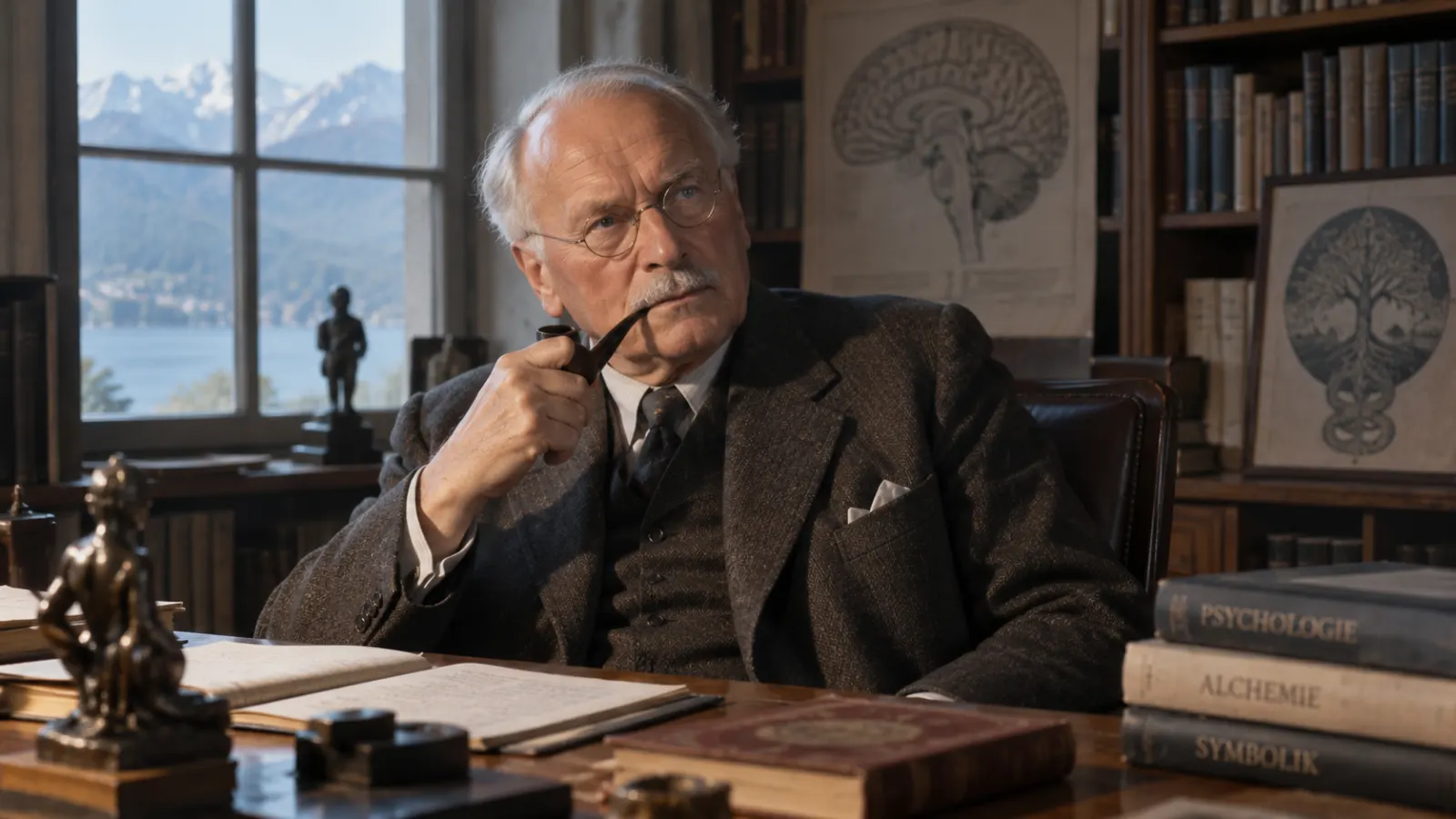
Carl Jung Biography: Archetypes, Freud and the Divided Self
Any serious Carl Jung biography has to hold together several versions of the same man.
Carl Gustav Jung began as a physician and psychiatrist working in one of Europe's most important psychiatric hospitals. He conducted word-association experiments, studied severe mental illness and became one of the most prominent early allies of Sigmund Freud. Yet the Jung remembered most widely today is the theorist of archetypes, the collective unconscious, the shadow, individuation, synchronicity and symbolic meaning.
That later Jung travelled far beyond conventional psychiatry. He wrote about mythology, Christianity, Gnosticism, alchemy, Eastern religious traditions and the psychological significance of dreams. His vocabulary entered psychotherapy, literature, religion, film, management and popular personality culture. Terms such as introvert and extravert became so ordinary that many people who use them have never read Jung.
His influence, however, is easier to establish than the scientific status of many of his theories. Concepts such as archetypes and the collective unconscious can generate rich interpretations, but they are difficult to define and test using the methods of modern empirical psychology. Synchronicity goes further still, proposing meaningful connections that are not explained by ordinary causality.
Jung's historical legacy is also morally complicated. His writings and professional roles during the 1930s, when psychotherapy in Germany was being transformed under National Socialism, generated lasting accusations of antisemitism and political accommodation. Later scholarship has resisted both simple exoneration and the claim that Jung can straightforwardly be described as a Nazi ideologue.
The most useful way to understand him is therefore not to choose between “scientist” and “mystic,” or between “visionary” and “pseudoscientist.” Jung's career moved across those boundaries. He began inside medical psychiatry and gradually constructed a psychology in which clinical experience, personal introspection, mythology and cultural interpretation became increasingly difficult to separate.
From a Swiss pastor's household to experimental psychiatry
Carl Gustav Jung was born on 26 July 1875 in Kesswil, Switzerland. His father was a Swiss Reformed pastor, and his wider family included several clergy. Religion was therefore not an abstract intellectual subject in his childhood; it belonged to the social and emotional world in which he grew up.
Jung later described himself as having an unusually intense inner life from an early age, filled with dreams, fantasies and a sense that his ordinary social personality did not exhaust who he was. These autobiographical recollections were written and organised much later, so they should not be treated as neutral childhood records. But they reveal how Jung eventually interpreted his own development.
He entered the University of Basel to study medicine and graduated in 1900. Instead of entering a more prestigious medical specialty, he chose psychiatry and joined the Burghölzli psychiatric hospital in Zurich, working under Eugen Bleuler. The Library of Congress notes that Jung began there in 1900 and that his work under Bleuler helped shape his theories of schizophrenia and psychological complexes.
The Burghölzli mattered because it placed Jung inside a serious medical and research environment. Bleuler was one of the leading psychiatrists of the era and later introduced the term schizophrenia. Jung worked with patients experiencing psychosis at a time when many psychiatrists regarded delusional speech largely as meaningless evidence of disease. Jung instead became interested in whether apparently bizarre statements might contain psychologically intelligible associations.
His doctoral dissertation concerned so-called occult or mediumistic phenomena observed in a young woman. The subject foreshadowed Jung's lifelong willingness to examine experiences that mainstream science often regarded as marginal. Yet his early professional reputation did not rest only on unusual subjects. It also rested on experimental work that could produce observable measurements.
At Burghölzli, Jung and his colleagues used word-association tests. A participant heard a stimulus word and responded with the first word that came to mind. Researchers recorded response times, repetitions, unusual answers, forgetting and other disruptions. Jung argued that certain disturbances occurred when a word touched an emotionally charged network of memories or ideas.
He called these networks complexes.
In Jung's early usage, a complex was not simply a hidden secret. It was a cluster of emotionally loaded associations capable of influencing attention, behaviour and interpretation, sometimes without conscious awareness. His experimental work was substantial enough to become an important part of his early scientific reputation; the surviving Jung corpus includes large association studies involving families and thousands of recorded responses.
Modern psychology does not accept every inference Jung drew from reaction times or association disturbances. But it is historically misleading to describe him as someone who began as a mystic and later happened to enter psychology. The sequence was closer to the reverse: Jung began in clinical psychiatry and experimental research, then gradually expanded his explanatory system far beyond what experimental methods could easily test.
He also built a family during these years. Jung married Emma Rauschenbach, who later became an important analyst and intellectual figure in her own right, and they had five children. Their marriage endured until Emma's death in 1955, although Jung's long relationship with Toni Wolff and other aspects of his private life created substantial strain. The International Association for Analytical Psychology records that Emma died six years before Jung and that their five children survived him.
Freud, psychoanalysis and a partnership that could not last
Jung encountered Sigmund Freud's ideas while trying to understand hysteria, dreams, repression and severe mental illness. Their direct relationship developed in 1906–07, and when Jung visited Freud in Vienna in 1907, later accounts described their first extended discussion as lasting for many hours.
The attraction was powerful on both sides.
Freud had constructed a radically ambitious psychology in which symptoms and dreams could be interpreted as meaningful expressions of unconscious conflict. Jung had experimental and psychiatric evidence suggesting that emotionally important material could disturb apparently ordinary thought. Freud's theory of repression seemed to offer a framework for what Jung was observing.
Jung also offered Freud something strategically important. He was younger, medically established, based in Switzerland and outside Freud's immediate Viennese circle. Freud hoped that Jung could help psychoanalysis become an international medical movement rather than remain identified with a small group surrounding him.
Jung rapidly became one of psychoanalysis's most visible leaders. He travelled with Freud to Clark University in the United States in 1909 and became the first president of the International Psychoanalytical Association in 1910.
Yet their agreement concealed increasingly serious differences.
Freud assigned enormous importance to sexuality in the development of neurosis and in his theory of libido. Jung gradually broadened libido into something more like general psychic energy. He also became increasingly interested in mythology, religion and symbolic material that he believed could not always be adequately explained through childhood sexual conflict.
The disagreement became both intellectual and personal.
Freud feared that weakening the sexual theory would dissolve the distinctive foundations of psychoanalysis. Jung believed Freud was reducing too much of psychological life to sexuality and family history. Questions of authority inside the movement intensified the conflict.
Jung's Wandlungen und Symbole der Libido, later substantially revised and known in English as Symbols of Transformation, marked a decisive theoretical departure. By 1912–13 the relationship had largely collapsed. The Library of Congress preserves their correspondence from this period, including Freud's January 1913 letter effectively ending their friendship.
It is tempting to retell the split as a clean philosophical drama: Freud represented sex, materialism and scientific severity, while Jung represented religion, imagination and freedom.
That version is too simple.
Freud himself developed highly speculative theories. Jung remained a physician and psychotherapist. And recent scholarship on the development of The Red Book complicates the assumption that Jung had already become an uncomplicated defender of religion before the split; some of his 1912 writing still interpreted religious symbolism in strongly psychological terms.
The more important difference was that the two men increasingly wanted different kinds of depth psychology.
Freud's psychoanalysis remained organised around repression, sexuality, development and conflict rooted primarily in the individual's biography. Jung increasingly wanted a psychology capable of interpreting the individual within larger symbolic, mythological and cultural patterns.
The Red Book and the creation of analytical psychology
After the break with Freud, Jung entered the strangest and perhaps most consequential period of his intellectual life.
Beginning around 1913, he experienced unusually vivid fantasies, dreams and inner images. Instead of attempting simply to suppress them, he deliberately engaged with them. He recorded material in notebooks, developed dialogues with figures appearing in his imagination and later transferred much of this work into an elaborate illustrated manuscript now known as The Red Book or Liber Novus.
Jung later regarded these experiences as foundational to his mature psychology. The Library of Congress describes him as facing what he called “assaults of the unconscious” after his rupture with Freud and building The Red Book from notebooks documenting those encounters.
The book was not made broadly available during Jung's lifetime. A major scholarly facsimile edition edited by Sonu Shamdasani appeared only in 2009, transforming modern understanding of how Jung's mature theories developed.
Jung described this phase as a confrontation with the unconscious. He experimented with a technique that later became known as active imagination, allowing internal images to unfold while maintaining a conscious relationship with them rather than treating them simply as meaningless fantasies.
From this period emerged much of the conceptual architecture of analytical psychology, the name Jung gave his independent school.
Like Freud, Jung divided psychic life into conscious and unconscious processes. But he expanded the unconscious beyond personal memories, conflicts and repression. He proposed a personal unconscious containing material particular to the individual and a deeper collective unconscious, which he believed consisted of inherited structural tendencies shared across humanity.
These tendencies were expressed through archetypes.
Popular culture often treats archetypes as a ready-made list of characters: the Hero, Mother, Trickster, Wise Old Man, Shadow and so forth. Jung's theory was more complicated. He generally treated an archetype as an underlying organising pattern or disposition, while the particular image through which it appeared would depend on culture and individual experience.
The International Association for Analytical Psychology summarises Jung's collective unconscious as a deeper level expressed through recurring archaic images in dreams, mythology, religion and fairy tales.
This idea became one of Jung's most influential contributions to twentieth-century culture.
It also became one of his greatest scientific problems.
Jung argued that recurring symbols across widely separated cultures suggested inherited structures of imagination. But cultural similarity can arise for many reasons: common human bodies, recurring family and social arrangements, diffusion between cultures, similar environmental pressures, convergent storytelling and shared cognitive tendencies.
Modern psychology does not treat a biologically inherited collective unconscious populated by Jungian archetypes as an empirically established mechanism.
The distinction is important.
An idea can be interpretively productive without being scientifically demonstrated.
Archetypal analysis can give readers, therapists or literary critics a language for comparing narratives and psychological conflicts. That does not prove that the similarities originate in the inherited psychic structures Jung proposed.
Shadow, persona, individuation and the idea of becoming whole
Jung's psychology became especially influential because it did not present the psyche merely as a collection of symptoms to eliminate. He increasingly described psychological life as an encounter between opposing or partially independent tendencies.
The persona is one example.
Jung used the term for the social role through which an individual adapts to collective expectations. A doctor, parent, teacher, executive or politician necessarily develops a public identity. The persona is not inherently false. Social life would be impossible without roles.
The problem begins when a person identifies with the role so completely that it becomes confused with the whole personality.
The shadow refers broadly to aspects of the personality that the conscious ego fails to recognise, rejects or does not wish to identify with. These may include aggression, envy and selfishness, but Jung's shadow was not simply an inner collection of evil traits. It could also contain undeveloped capacities excluded because they conflict with the person's conscious self-image.
A person who defines themselves entirely as rational may disown emotional life. Someone committed to appearing endlessly kind may refuse to recognise anger. Someone organised around obedience may suppress independence.
Jung believed psychological development required becoming more conscious of these excluded aspects rather than pretending they did not exist.
The broader process was individuation.
In Jungian theory, individuation is the gradual development of a more integrated personality in which conscious and unconscious aspects come into a more workable relationship. The American Psychological Association still defines Jungian individuation as the development of a unified personality incorporating increasing awareness of personal and collective unconscious material.
Jung distinguished the ordinary conscious ego from the Self, which represented a larger organising totality of the psyche. In his symbolic interpretations, mandalas and other images of centred wholeness could express the movement toward this larger integration.
For some psychotherapists and readers, this remains one of Jung's most compelling ideas. Mental health becomes more than the absence of symptoms; it includes the ability to tolerate internal contradiction, recognise disowned tendencies and live with greater psychological flexibility.
But the interpretive openness that gives the concept power can also make it difficult to test.
If virtually any conflict, dream or major life change can be interpreted as part of individuation, what evidence would show that the interpretation is wrong?
That question applies repeatedly to mature Jungian theory.
Introversion, extraversion and the Jung everyone uses without knowing it
Of Jung's concepts, introversion and extraversion travelled most successfully into mainstream psychological language.
In Psychological Types, published in German in 1921, Jung described introversion and extraversion as broad orientations. The introverted attitude places greater weight on subjective processes and the inner world; the extraverted attitude is more strongly oriented toward external objects, people and events. He then combined these attitudes with four psychological functions: thinking, feeling, sensation and intuition.
Modern popular culture often simplifies this into:
introverts like being alone;
extraverts like parties.
Jung's theory was broader than that.
At the same time, contemporary personality psychology does not simply preserve Jung's typology unchanged. The APA now describes introversion–extraversion as a continuum, and extraversion is one of the major dimensions in Big Five and five-factor personality models.
So Jung's terminology survived while its scientific framework changed.
The same distinction matters for the Myers-Briggs Type Indicator.
The MBTI was inspired by Jung's theory, but Jung did not create it. Katharine Cook Briggs and her daughter Isabel Briggs Myers developed the system later, with Myers creating the assessment that became widely used in the mid-twentieth century. The Myers & Briggs Foundation itself traces the instrument explicitly from Jung's theory through Briggs and Myers.
Whatever one thinks of the MBTI's psychometric value, calling it “Jung's personality test” is historically inaccurate.
His contribution was the psychological-type theory from which later developers drew.
Religion, alchemy and synchronicity: where psychology became increasingly speculative
Jung differed from Freud particularly sharply in his treatment of religion.
He generally did not approach religious images primarily by asking whether their supernatural claims were factually true. Instead, he asked what psychological functions those images might serve.
God images, rituals, myths and mystical experiences were psychologically real in the sense that they could organise behaviour, identity and emotional life whether or not psychology could establish their metaphysical truth.
Jung's comparative interests became enormous.
He wrote about Christianity and Gnosticism, engaged with Hindu and Buddhist materials, studied Chinese texts and became increasingly absorbed by alchemy.
Alchemy interested Jung because its imagery seemed to him to describe symbolic processes of transformation. Separation and combination, purification, death, conjunction and rebirth could be read as projections of processes occurring within the psyche.
This was an imaginative interpretive move.
It was not conventional history of science.
Historians studying alchemy reconstruct it within its own material, religious and intellectual contexts. Jung frequently reorganised historical material around his psychological theory. This allowed striking comparisons while also risking the loss of cultural and historical specificity.
The same tendency appeared in his comparative treatment of religion. Symbols from very different traditions could become evidence for universal archetypal patterns. The approach generated cross-cultural insight for some readers, but it could also flatten traditions by treating them primarily as expressions of Jungian structures.
His collaboration with Nobel Prize–winning physicist Wolfgang Pauli pushed these interests toward the relationship between mind and matter. Their correspondence, beginning in the 1930s, included extensive discussion of dreams, symbolism, physics and the possibility of deeper organising principles connecting psychological and physical reality. Princeton's publication of their correspondence documents this unusual intellectual relationship.
Out of this broader project came Jung's theory of synchronicity.
He used the term for coincidences that appear meaningfully connected even though no ordinary causal relationship explains why they occurred together. His mature essay described synchronicity as an acausal connecting principle and was shaped in part by his exchanges with Pauli.
The concept became enormously popular because human beings routinely experience coincidences that feel charged with personal significance.
Its scientific status is far weaker.
There is no generally accepted empirical evidence demonstrating a universal acausal principle of the kind Jung proposed. Psychology can also explain many striking coincidences through probability, selective attention, memory, confirmation bias and the human tendency to detect meaningful patterns.
That does not mean a coincidence cannot matter psychologically to the person experiencing it.
It means subjective meaning and evidence for a new law of nature are not the same claim.
This distinction captures much of Jung's mature intellectual legacy.
He was unusually interested in experiences that people find meaningful but that conventional scientific explanation handles cautiously. Sometimes that produced genuinely fertile psychological questions. At other times his explanations extended well beyond what evidence could support.
Jung in the 1930s: antisemitism, psychotherapy and a controversy that cannot be removed
Jung's relationship to National Socialism remains one of the most difficult parts of his biography.
After Hitler came to power in 1933, German professional and academic institutions underwent rapid Nazification. Jewish physicians and psychotherapists were progressively excluded, while psychoanalysis was attacked as a “Jewish” discipline.
Jung accepted the presidency of the International General Medical Society for Psychotherapy, an international professional body based in Germany that was being drawn into this politically transformed environment. Historical studies of psychotherapy under the Third Reich show that non-Freudian schools, including Jungian and Adlerian approaches, continued to operate while Jewish psychoanalysts faced exclusion and persecution.
The problem was not limited to institutional proximity.
Some of Jung's writings from this period discussed supposed differences between “Jewish” and “Aryan” psychology using racial categories and generalisations that were objectionable at the time and are even clearer as antisemitic today. Scholarly discussions of Jung's legacy explicitly identify his antisemitic writings and professional involvement in 1930s German psychotherapy as a serious problem that later Jungians had sometimes minimised rather than confronting directly.
At the same time, the historical record is more complicated than the claim that Jung simply became a Nazi ideologue.
He was Swiss rather than German and was not a member of the Nazi Party. The international society he led created mechanisms through which some Jewish and non-German psychotherapists could retain international affiliation even as the German national organisation became increasingly exclusionary. Historical researchers continue to debate Jung's motives, political judgement, opportunism and later attempts to explain his conduct.
Even a newly published 2025 edition of Jung's 1933 Berlin seminar describes Jewish Jungians attending while already distressed by his decision to accept leadership in an organisation rapidly becoming Nazified.
The responsible conclusion is therefore uncomfortable but clear.
It is inadequate to say accusations of antisemitism were simply invented by Jung's enemies.
Some of his own language justifies criticism.
It is equally inadequate to reduce every aspect of his political conduct to straightforward ideological Nazism without examining the complex institutional record.
Jung's 1930s behaviour deserves to remain part of his biography because intellectual achievement does not erase moral and political responsibility.
What survives of Jung in modern psychology—and what belongs more to culture
Jung died at his home in Küsnacht on 6 June 1961, aged 85. By then he had become far more than the Swiss psychiatrist who once measured word-association reaction times.
He had founded a worldwide psychotherapeutic movement. The International Association for Analytical Psychology, created in 1955 by analysts close to Jung, was established partly to maintain training standards and ensure the continuation of analytical psychology beyond his personal authority.
His influence on twentieth-century culture spread even further.
The Library of Congress notes that by the 1940s and 1950s his concepts of archetypes and the collective unconscious had become influential across depth psychology, comparative religion and the arts. His cultural legacy reached writers, filmmakers and artists and eventually became part of popular storytelling vocabulary.
But influence should not be confused with empirical validation.
Some aspects of Jung's early work fit comfortably into the history of psychiatry and experimental psychology. His association experiments were observable procedures. His idea that emotionally charged networks can influence responses helped shape the history of thinking about unconscious processes.
His language of introversion and extraversion became enduring, although modern personality psychology transformed these ideas into dimensional traits rather than simply preserving Jung's complete type system.
Other concepts occupy a different position.
The collective unconscious is not an established mechanism in contemporary empirical psychology.
Archetypes are difficult to operationalise in a way that permits clear tests capable of disproving the theory.
The shadow, persona and individuation remain clinically and culturally influential concepts, but their value is often interpretive rather than experimental.
Synchronicity has not been established as a scientific acausal principle.
Jungian psychotherapy nevertheless did not disappear. It evolved. Later analysts incorporated developmental theory, attachment, trauma research, object relations and other ideas that Jung himself did not formulate in their modern forms.
That distinction matters because “Jungian psychology” today is not one fixed system mechanically reproducing everything Jung wrote.
Like psychoanalysis more broadly, it became a tradition with internal disagreements and revision.
Why Carl Jung still matters
Jung remains compelling because he asked psychological questions that are difficult to reduce to symptom checklists.
What happens when the identity someone presents to society becomes too narrow?
Why do disowned traits return in distorted forms?
Why are particular stories and images emotionally powerful?
How do people create meaning from dreams, religious traditions and personal crises?
Can psychological maturity involve becoming more capable of containing contradiction rather than simply becoming more consistent?
Those questions help explain why Jung survives so strongly in psychotherapy, literature, film and religion even though many of his central theoretical claims remain outside mainstream scientific psychology.
His weakness was closely related to his strength.
Jung was willing to connect psychiatry to fields that most psychologists would keep separate: mythology, comparative religion, alchemy, art and eventually speculative ideas about physics and meaningful coincidence.
That intellectual range allowed him to see patterns others ignored.
It also made it easier for interpretation to outrun evidence.
The same caution applies to Jung's own life.
He cannot accurately be reduced to the mystical grandfather of modern “shadow work.” His career began in experimental psychiatry.
He cannot simply be described as Freud's rebellious student. For several years he was one of the most important leaders of international psychoanalysis.
He cannot be praised for cross-cultural openness while ignoring the racialised thinking present in some of his work.
And he cannot be dismissed as scientifically irrelevant when concepts originating with him—most obviously introversion and extraversion—became part of the vocabulary through which later psychology described personality, even after changing the underlying theory.
Jung's enduring intellectual project was the idea that the conscious ego is only part of the personality.
A person, in his view, becomes psychologically more mature not by constructing a perfect public identity but by recognising the internal material that identity excludes.
Whether or not one accepts the collective unconscious, archetypes or synchronicity as Jung conceived them, that concern with the divided self and the problem of integration remains the thread connecting his clinical work, dreams, mythology and theories of personality.
That is why Jung continues to generate both devotion and criticism more than six decades after his death.
He created a psychology capable of speaking powerfully about meaning.
He never fully solved the problem of proving how much of that meaning existed in the structure of the psyche itself and how much came from the interpreter.
The most productive way to read Jung today is therefore neither as revealed truth nor as discarded pseudoscience.
It is to read him historically and critically: as a physician who began with measurable experiments, became one of Freud's most important collaborators, built an ambitious symbolic psychology of his own, crossed repeatedly from clinical observation into speculation, made serious ethical errors in a dangerous political period, and left behind a vocabulary that became far larger than the scientific system from which it emerged.