Breathing Techniques for Stress: How They Work, What the Evidence Shows and How to Practise Safely
Breathing techniques for stress can be useful because breathing occupies an unusual position in human physiology. You do not have to consciously remember to breathe while sleeping, walking or reading, yet you can deliberately slow your breathing, change its depth, pause it or alter the relative length of inhalation and exhalation.
That gives breathing a direct route into a system that is otherwise largely automatic.
Stress commonly changes respiration. Breathing may become faster, shallower or more irregular, while muscles in the chest, shoulders and neck become more active. Deliberately slowing the respiratory rhythm can alter some of that physiological arousal and give a person a simple action to perform while stress is rising.
The evidence is promising but should not be exaggerated. A systematic review examining 58 clinical studies found that many regulated-breathing interventions reduced self-reported stress or anxiety, although the protocols varied substantially and some studies reported null or negative results. Another systematic review published in 2024 found improvements in anxiety in 12 of 19 included studies and stress in nine, while noting that large, rigorous randomised trials remain limited.
The practical conclusion is therefore modest: slow, controlled breathing can be a useful stress-management tool for many people, but it is not a cure for anxiety disorders, a substitute for medical care or proof that one branded breathing ratio is physiologically perfect.
The safest starting principle is simpler than most internet breathing advice:
breathe more slowly, more comfortably and with less unnecessary effort rather than trying to inhale as much air as possible.
Why Breathing Can Influence Stress
Breathing normally happens automatically because respiratory centres in the nervous system continuously adjust ventilation according to the body's needs. Sensors respond particularly to carbon dioxide and oxygen levels, while the autonomic nervous system changes breathing according to activity and physiological state.
NHLBI explains that the sympathetic nervous system tends to increase breathing rate as part of heightened physiological activation, while parasympathetic activity tends to slow it. At the same time, breathing remains voluntarily controllable—you can intentionally change the pattern even though the underlying process continues automatically.
This is why breathing is often described as a bridge between voluntary behaviour and automatic physiology.
That description should not become mystical. A breathing exercise is not a switch that instantly moves the body from “sympathetic” to “parasympathetic mode.” The autonomic nervous system is a complex regulatory network, and respiratory effects depend on breathing rate, tidal volume, posture, emotional state, cardiovascular physiology and other factors.
What controlled breathing can do is change part of the physiological pattern accompanying stress.
If a person is breathing rapidly and irregularly, shifting toward a slower and more stable rhythm alters respiratory mechanics immediately. Attention may also move from racing thoughts toward one concrete physical process. The exercise may reduce a sense of helplessness because the person has something controllable to do.
Those effects can combine.
What Actually Happens When You Breathe
The diaphragm is the principal muscle involved in quiet breathing. During inhalation it contracts and moves downward, enlarging the chest cavity so the lungs expand. The muscles between the ribs also contribute to chest expansion. During ordinary exhalation, these muscles relax and the lungs recoil as air moves outward.
This is why instructions for diaphragmatic breathing often tell people to allow movement around the lower ribs or abdomen rather than repeatedly lifting the shoulders and upper chest.
The word allow matters.
“Belly breathing” does not mean forcing the stomach outward as far as possible. Nor does diaphragmatic breathing require filling the lungs to maximum capacity on every inhalation.
The goal in a calming exercise is usually to make breathing quieter and less effortful.
A comfortable inhalation may produce some lower-rib and abdominal movement because the descending diaphragm displaces abdominal contents. That movement does not need to be exaggerated.
Deep Breathing Does Not Mean the Biggest Breath Possible
The phrase deep breathing is potentially misleading because people often interpret “deep” as “take in as much air as your lungs can hold.”
That can create the opposite of the desired effect.
If ventilation becomes greater than the body's metabolic requirement, too much carbon dioxide is exhaled. This is over-breathing or hyperventilation. It can cause light-headedness, tingling, chest discomfort, a pounding heartbeat, difficulty thinking clearly and the paradoxical feeling that you cannot get enough air.
Those sensations are particularly unhelpful during anxiety because they can resemble symptoms people already fear.
Someone notices tingling or dizziness, interprets it as evidence that something is seriously wrong, becomes more frightened and takes even larger breaths. The additional breathing lowers carbon dioxide further and intensifies the sensations.
That creates a feedback loop.
The better instruction for stress regulation is therefore usually slow and comfortable breathing, not repeated maximal inhalation.
Current NHS guidance makes precisely this distinction. Its breathing exercise recommends allowing the breath to move toward the belly only as deeply as feels comfortable and explicitly says not to force it.
What the Research on Breathing and Stress Shows
Breathing exercises have been studied using many different methods, which makes sweeping conclusions difficult.
Researchers have tested slow breathing, diaphragmatic breathing, box breathing, cyclic sighing, alternate-nostril breathing, paced breathing, extended-exhale breathing and more intensive breathwork. Sessions vary from about one minute to much longer practices, and studies measure everything from self-reported anxiety to respiratory rate, heart-rate variability and blood pressure.
A systematic review of regulated breathing practices identified 58 studies containing 72 breathing interventions. Fifty-four of those interventions significantly reduced stress or anxiety according to the study's chosen psychological measure. Slow breathing was the most commonly studied method. The authors found that interventions consisting only of fast breathing and practices lasting under five minutes tended to perform less consistently, while repeated practice and training appeared more favourable.
That sounds impressive, but it should still be interpreted cautiously. The studies were heterogeneous, differed in quality and used many different populations and outcome measures.
A 2024 systematic review reached a similar broad conclusion: breathing exercises appear promising for anxiety and stress, but the field still needs larger and more rigorous randomised controlled trials.
The appropriate takeaway is therefore not “science proves breathing fixes anxiety.”
It is that controlled breathing has enough evidence to be considered a reasonable low-cost stress-management technique, especially when used gently and as one part of broader care.
What the Cyclic Sighing Study Actually Found
One of the most widely discussed modern breathwork studies was published by Melis Yilmaz Balban and colleagues in 2023.
Researchers randomly assigned participants to practise one of three five-minute daily breathing exercises—cyclic sighing, box breathing or cyclic hyperventilation with retention—or mindfulness meditation for one month.
The cyclic sighing condition emphasised relatively prolonged exhalations. The researchers reported improvements in mood across the interventions, with breathwork—particularly cyclic sighing—showing greater improvement in mood and reductions in respiratory rate compared with the meditation condition.
This is useful evidence.
It does not establish cyclic sighing as the scientifically superior breathing method for every person, condition or situation.
The trial lasted one month, involved one particular participant group and compared specific protocols. Other studies use different outcomes and produce different patterns.
A newer 2026 pilot study found that both one-minute box breathing and cyclic sighing were associated with greater reductions in state anxiety than a passive control condition during everyday acute-threat situations among university students. But some attention measures also produced mixed results, reinforcing the need to distinguish reduced anxiety from universal improvement in every cognitive outcome.
Breathing research is becoming more sophisticated.
That makes simplistic internet rankings such as “the one scientifically proven breathing method” increasingly difficult to justify.
Does a Longer Exhale Work Better?
Many calming exercises use an exhalation that lasts as long as or somewhat longer than inhalation.
There are reasonable physiological and practical reasons for this. A longer, relaxed exhalation can slow the overall breathing cycle and discourage repeated large inhalations.
But precise ratios should not be converted into universal biological laws.
A 12-week randomised trial compared slow breathing with a longer exhalation against slow breathing with equal inhalation and exhalation. Participants overall showed reduced psychological stress and anxiety measures after regular slow-breathing practice, but the researchers did not find evidence that the extended-exhale ratio produced superior outcomes to equal-ratio breathing.
That is an important corrective.
The useful element may often be slower, regular breathing itself, not one mathematically perfect inhale-to-exhale ratio.
If a slightly longer exhalation feels comfortable, it is reasonable to use.
If the ratio produces air hunger or makes someone preoccupied with counting, there is little reason to force it.
Is Six Breaths per Minute the Ideal Rate?
Slow-paced breathing research frequently uses approximately six breaths per minute, sometimes described as resonance-frequency breathing.
At this rate, respiratory changes in heart rate can become pronounced, which is one reason six breaths per minute appears frequently in heart-rate variability research.
But six is not a universal magic number.
A 2025 study compared square breathing, 4-7-8 breathing and two six-breaths-per-minute conditions. Six-breaths-per-minute breathing increased several HRV measures more than the other techniques, but none of the conditions produced meaningful changes in blood pressure or mood during the experiment. Importantly, the six-breaths-per-minute conditions also produced mild over-breathing.
That finding illustrates why physiological optimisation and practical stress relief should not be confused.
A breathing pattern can maximise a particular HRV measure without necessarily producing the best subjective experience.
For general stress management, the more useful target is often simply a noticeably slower rhythm that remains comfortable.
Heart-Rate Variability Is Not a Universal Stress Score
Slow breathing changes the relationship between respiration and heart rhythm.
Heart rate normally varies across the respiratory cycle. During slow breathing, this respiratory-linked variation can become larger, which often increases particular measurements of heart-rate variability, or HRV.
That has made HRV popular in breathing research, biofeedback and consumer wearables.
But HRV should not be treated as a single numerical grade for health or emotional resilience.
It varies with age, fitness, posture, medication, illness, measurement method and time of day. Different HRV metrics also capture different features of heart-rate variation.
The 2026 randomised study of slow-paced breathing in people with subclinical anxiety is a useful example. Participants reported immediate reductions in anxiety and perseverative thinking after breathing exercises, while the effects on ambulatory vagally mediated HRV remained inconclusive because of measurement concerns.
The person can therefore find a breathing exercise useful even if a wearable does not award the desired score.
The goal is stress regulation, not winning an HRV competition.
A Simple Breathing Technique for Stress
For most beginners, the best breathing exercise is one that requires little memorisation.
Sit in a supported position or stand comfortably. Let your shoulders remain loose. Breathe in gently through the nose if that feels natural. Allow the lower ribs and abdomen to expand without deliberately pushing them outward.
Then exhale slowly and easily.
Continue for several minutes.
If counting makes the rhythm easier, try something approximately like four seconds in and five or six seconds out. Do not treat those numbers as mandatory. Shorten the count if you feel air hunger. Remove the count entirely if paying attention to numbers creates more tension.
The NHS currently recommends a similarly simple exercise: comfortable posture, gentle breathing, inhalation through the nose and exhalation through the mouth, with optional counting and approximately five minutes of practice.
The main goals are a slower rhythm, reduced effort and comfort.
If the exercise repeatedly produces dizziness, tingling or a sense of needing larger and larger breaths, stop forcing the pattern and return to normal breathing.
Diaphragmatic or Belly Breathing
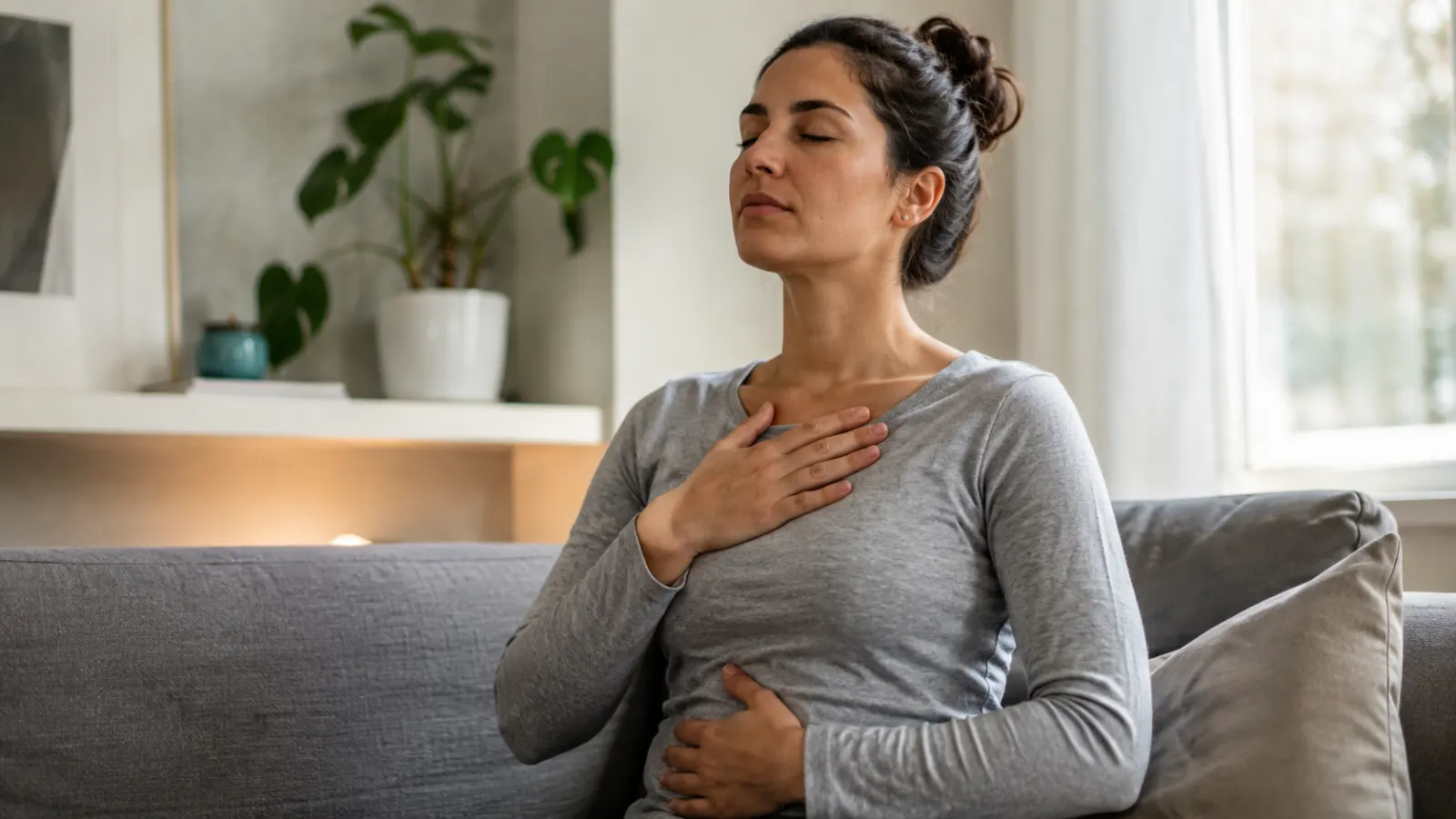
Diaphragmatic breathing is often taught by placing a hand over the abdomen or lower ribs and noticing the movement that accompanies inhalation.
This can be helpful for people who habitually tense their shoulders and upper chest during stress.
But there is no need to immobilise the chest completely. Normal breathing involves coordinated movement across the respiratory system.
A practical cue is simply:
let the lower ribs and abdomen participate while keeping the shoulders relatively relaxed.
NCCIH reports preliminary evidence that diaphragmatic breathing may reduce stress and notes that slow deep breathing may modestly affect outcomes such as blood pressure and cortisol. The agency also emphasises that relaxation techniques should complement rather than replace conventional healthcare.
Box Breathing
Box breathing usually divides the respiratory cycle into four equal parts: inhale, hold, exhale and hold.
A common version uses four counts for each phase.
The attraction is obvious. The structure gives an anxious mind a simple sequence to follow, and the equal phases make the technique easy to remember.
Balban's 2023 randomised trial included box breathing and found improvement across breathing interventions, although cyclic sighing produced the strongest numerical pattern for several outcomes.
A 2026 pilot study also found one-minute box breathing associated with reductions in acute state anxiety compared with a control condition.
However, breath holds are not necessary for stress reduction.
Someone who dislikes holding their breath, experiences respiratory disease or becomes more anxious when attention is focused intensely on breathing may prefer a simple slow inhale and exhale without pauses.
What About 4-7-8 Breathing?
The 4-7-8 technique typically involves inhaling for four counts, holding for seven and exhaling for eight.
It is widely promoted for relaxation and sleep.
The problem is not that the exercise is necessarily harmful for healthy people who find it comfortable. The problem is presenting the numbers as though extensive research has established that exact ratio as uniquely effective.
The 2025 comparison study specifically noted that square and 4-7-8 breathing are widely promoted despite relatively limited direct empirical support. In that experiment, six-breaths-per-minute breathing increased HRV more than square or 4-7-8 breathing, while none of the breathing patterns produced meaningful differences in mood or blood pressure.
If 4-7-8 breathing feels relaxing, it can be used as a structured breathing exercise.
If the seven-count breath hold feels uncomfortable, there is no evidence-based reason to treat discomfort as necessary for success.
Cyclic Sighing
Cyclic sighing received considerable attention after the 2023 Stanford-associated trial.
The pattern generally involves one inhalation followed by a second smaller inhalation, then a long exhalation.
Its appeal lies partly in the emphasis on prolonged exhalation.
The 2023 trial found five minutes per day of cyclic sighing especially promising for improving mood and reducing respiratory rate over one month.
That makes it a reasonable technique to experiment with.
It should still be practised gently. Repeatedly taking enormous double inhalations can become another form of excessive ventilation.
The objective is not to inflate the lungs as dramatically as possible.
Breathing Techniques for Anxiety
Stress and anxiety overlap, but they are not identical.
Anxiety can include cognitive worry, avoidance, muscle tension, autonomic arousal and changes in respiration. For some people, slow breathing reduces the physical intensity of the state enough to think more clearly.
The current research is supportive but mixed.
A 2026 randomised study tested slow-paced breathing delivered as a just-in-time intervention when participants with subclinical anxiety reported increased anxiety or repetitive thinking. Immediate anxiety and perseverative cognition fell substantially from just before to just after breathing. However, researchers found mixed effects across the longer daily-life outcomes, concluding that replication is needed.
This is a useful model for understanding breathing exercises.
They may work particularly well as state-management tools—something you do when arousal is interfering with your next action.
That is different from treating the underlying anxiety disorder.
Breathing and Panic Require Additional Care
Panic creates a special problem because bodily sensations themselves may become feared.
A person feels dizzy, breathless or notices a rapid heartbeat. They interpret the sensation catastrophically. Fear increases, which changes breathing further and produces additional sensations.
Slow breathing can sometimes interrupt that cycle.
But breathing can also become a safety behaviour if the person starts believing, “I can survive this situation only if I control my breathing perfectly.”
Evidence-based treatment for panic disorder often involves learning that feared bodily sensations can be experienced without catastrophe rather than building ever more elaborate methods for preventing those sensations.
This does not mean breathing exercises are prohibited during panic.
It means they should not become a compulsory ritual that reinforces the belief that normal physiological sensations are dangerous.
People with recurrent panic attacks may benefit from professional assessment and evidence-based treatment rather than relying exclusively on breath control.
Why Carbon Dioxide Matters During Panic and Over-Breathing
People often assume that breathlessness means they need more oxygen.
During anxiety-related hyperventilation, the problem can instead be excessive carbon dioxide loss.
Your body continually produces carbon dioxide during metabolism. Breathing removes it. When ventilation rises far above metabolic requirements, blood carbon dioxide can fall.
The resulting sensations can include dizziness, tingling around the mouth or hands, chest discomfort, weakness and a feeling of unreality. MedlinePlus lists anxiety, panic and stress among causes of hyperventilation but also lists important medical causes including heart and lung disease and infection.
This is why forced deep breathing can sometimes worsen panic.
Slow breathing aims to reduce unnecessary ventilation—not maximise it.
Nasal Breathing vs Mouth Breathing
Many relaxation exercises recommend inhaling through the nose.
That can be comfortable because nasal airflow is naturally somewhat restricted and humidified. It may also encourage a quieter respiratory rhythm.
Some techniques recommend exhaling gently through the mouth; others use nasal breathing in both directions.
There is no need to turn this into a universal rule.
A person with nasal congestion, respiratory illness or simple discomfort may need another pattern.
For stress reduction, the more important elements are generally comfort, slower rhythm and avoidance of forced breathing.
The route of airflow is secondary.
Practise Before You Are Highly Stressed
A breathing technique is easier to use during a stressful situation if you have already practised it when calm.
This is partly a skill-learning issue.
Trying to remember a complicated ratio during intense anxiety adds another cognitive demand. A familiar pattern requires less attention.
Current NHS guidance recommends practising breathing regularly as part of a routine rather than using it only during crisis.
A few minutes once or twice per day can be sufficient for learning the pattern.
Practising while calm also allows you to notice whether the breathing speed or depth makes you dizzy, air-hungry or uncomfortable before trying it in a more difficult situation.
Five Minutes Is a Reasonable Starting Point
There is no universally perfect duration.
But several strands of evidence make approximately five minutes a reasonable practical starting point.
The 2023 breathwork trial used five-minute daily sessions. The NHS recommends at least five minutes for its simple stress-breathing exercise. The systematic review of breathing interventions found that sessions shorter than five minutes were less consistently associated with positive outcomes across the included literature, although later pilot work suggests even one-minute practices can sometimes affect acute anxiety.
This is not evidence that four minutes fails and five minutes suddenly works.
It simply provides a practical duration that is long enough to establish a slower rhythm without becoming burdensome.
Use Breathing as a Bridge to the Next Useful Action
One of the most practical ways to understand breathing is as a bridge.
You are anxious about making an important call.
You breathe slowly for three to five minutes.
Then you make the call.
You are overwhelmed before a presentation.
You stabilise your breathing.
Then you walk onto the stage.
You become highly activated during an argument.
You step away, breathe more slowly and return when you can communicate more effectively.
In these situations, breathing is not the solution to the external problem.
It changes the state in which you approach the problem.
This distinction prevents breathing exercises from becoming avoidance.
A technique has served its purpose when it makes useful behaviour easier.
Breathing Cannot Solve the Source of Every Stressor
Imagine someone working eighty hours per week under an abusive manager.
Slow breathing might reduce acute arousal before an important meeting.
It does not make the workload reasonable or the abuse acceptable.
A person experiencing severe debt may benefit from five minutes of slower breathing before calling a creditor.
The exercise does not resolve the debt.
Someone living in an unsafe relationship may need enough emotional regulation to think clearly.
They may also need protection, practical support or legal intervention.
Stress management becomes distorted when every problem is treated as a nervous-system problem.
Some situations require emotional regulation.
Others require changing the situation itself.
Often both are necessary.
When Breathing Exercises Can Backfire
Most gentle relaxation breathing is considered low risk for healthy people, but adverse reactions can occur.
Over-breathing can create dizziness and tingling. Long breath holds can feel distressing. People highly sensitive to respiratory sensations may become more anxious when asked to monitor breathing closely.
Some individuals with trauma histories can also find inwardly focused relaxation exercises uncomfortable.
NCCIH notes that relaxation techniques are generally considered safe but that some people occasionally report increased anxiety, intrusive thoughts or fear of losing control. It also cautions against using relaxation practices as replacements for appropriate medical care.
If a breathing technique reliably makes you feel worse, there is no virtue in forcing it because it is popular online.
Try a simpler pattern, another relaxation strategy or professional guidance if needed.
Shortness of Breath Is Not Always Anxiety
This is the most important safety distinction in the article.
Breathlessness can occur during stress and panic.
It can also occur with asthma, pneumonia, COPD, heart problems, anaemia, pulmonary embolism and many other medical conditions.
MedlinePlus lists multiple medical causes of rapid breathing alongside emotional causes such as anxiety and panic.
New, severe, sudden or unexplained breathing difficulty should therefore not be self-diagnosed as anxiety.
Seek urgent medical evaluation for serious warning signs such as severe or rapidly worsening breathlessness, fainting, blue or grey lips or skin, major chest pain, severe wheezing, confusion or other signs of acute illness.
A breathing exercise is not a diagnostic test.
Who Should Be More Cautious With Breathwork?
Gentle slow breathing is very different from intensive breathwork involving prolonged breath holds, rapid ventilation or repeated hyperventilation.
People with significant heart or lung conditions, pregnancy-related concerns, fainting disorders or other relevant medical conditions should be cautious with intensive techniques and discuss them with a healthcare professional when appropriate.
This is particularly important because the word breathwork now covers an enormous range of practices.
Five minutes of comfortable slow breathing is not physiologically equivalent to repeated hyperventilation followed by long breath retention.
Advice about one should not automatically be applied to the other.
Breathing Techniques Compared
| Technique | Basic pattern | Main advantage | Main caution |
|---|---|---|---|
| Gentle slow breathing | Comfortable inhale and slow exhale | Simple and adaptable | Do not force depth |
| Diaphragmatic breathing | Encourage lower-rib/abdominal movement | Can reduce excessive upper-chest effort | Do not push the abdomen forcefully |
| Extended-exhale breathing | Exhale slightly longer than inhale | Naturally slows rhythm | Exact ratio is not proven superior |
| Box breathing | Equal inhale, hold, exhale, hold | Easy mental structure | Holds may feel uncomfortable |
| 4-7-8 breathing | 4 inhale, 7 hold, 8 exhale | Memorable structure | Exact timing has limited direct evidence |
| Cyclic sighing | Inhale, smaller second inhale, long exhale | Promising trial evidence for mood/arousal | Avoid exaggerated repeated inhalations |
| ~6 breaths/minute | Very slow paced breathing | Can strongly influence HRV | May cause over-breathing if breaths are too large |
The table should not be interpreted as a ranking.
The best technique is usually the one that slows breathing without producing strain, dizziness or excessive preoccupation with the technique itself.
Common Myths About Breathing Techniques for Stress
One myth is that deeper is always better. It is not. Excessive ventilation can lower carbon dioxide and cause uncomfortable symptoms.
Another is that one breathing ratio activates the vagus nerve. Breathing influences autonomic and cardiovascular physiology, but there is no simple on/off vagal switch controlled by one counting pattern.
A third myth is that a longer exhalation has been proved superior in every situation. Extended exhalation is widely used and can be comfortable, but the 12-week trial comparing extended and equal exhalation did not establish clear superiority of the longer-exhale condition.
Another myth is that six breaths per minute is ideal for everyone. It can increase HRV measures, but individual physiology and comfort vary, and a 2025 study also observed mild over-breathing at that pace.
Finally, breathing techniques are sometimes presented as though they treat the cause of anxiety. They can reduce arousal and support coping, but anxiety disorders may require psychotherapy, medication or other professional treatment.
Frequently Asked Questions About Breathing Techniques for Stress
What are the best breathing techniques for stress?
Gentle slow breathing, diaphragmatic breathing, extended-exhale breathing, box breathing and cyclic sighing all have some evidence or practical support. There is not enough evidence to declare one technique universally best.
How does breathing reduce stress?
Slow controlled breathing can alter respiratory rate and cardiovascular-respiratory interactions, focus attention and reduce some of the physiological arousal accompanying stress.
How slowly should I breathe?
There is no universal ideal rate. Research frequently uses approximately six breaths per minute, but a comfortable slower-than-usual rhythm is often more practical for general stress management.
Is deep breathing good for anxiety?
It can be helpful if “deep” means slow and comfortable. Repeated forced maximum breaths may cause over-breathing and worsen dizziness or tingling.
How long should I do breathing exercises?
Five minutes is a practical starting point supported by public-health guidance and several studies, although shorter exercises may also help during acute stress.
Is a longer exhale better?
It can be comfortable and can help slow breathing, but current evidence does not establish that one extended-exhale ratio is universally superior to equal inhalation and exhalation.
Does box breathing work?
Some controlled research has included box breathing and found reductions in anxiety or improvements across breathing interventions. More research is needed to determine whether it is superior to simpler slow breathing.
Does 4-7-8 breathing work?
It is a widely used structured breathing method, but the exact 4-7-8 ratio has relatively limited direct evidence compared with broader evidence for slow paced breathing.
What is cyclic sighing?
Cyclic sighing generally involves one inhalation followed by a smaller second inhalation and then a prolonged exhalation. A 2023 randomised trial found promising effects on mood and respiratory rate after daily five-minute practice.
Can breathing exercises cause dizziness?
Yes. If breathing becomes too deep or rapid relative to the body's needs, carbon dioxide can fall and produce dizziness, tingling, chest sensations and light-headedness.
Should I breathe through my nose or mouth?
Nasal inhalation is commonly recommended for slow breathing and may feel naturally quieter, but comfort matters. Nasal congestion or other conditions can make mouth breathing more practical.
What is diaphragmatic breathing?
It is breathing in which the diaphragm contributes normally to inhalation and movement is noticeable around the lower ribs and abdomen rather than relying excessively on upper-chest and shoulder muscles.
Does breathing activate the parasympathetic nervous system?
Breathing interacts with autonomic regulation and cardiovascular physiology, but describing it as a simple switch that “activates” one branch of the nervous system is an oversimplification.
Does slow breathing increase HRV?
It often increases respiratory-linked HRV measures during paced breathing. That does not mean every increase represents an improvement in overall health or emotional resilience.
Can breathing exercises stop a panic attack?
They may reduce respiratory arousal for some people, but panic treatment involves more than controlling breathing. Recurrent panic attacks should be assessed professionally when appropriate.
Can breathing exercises replace anxiety treatment?
No. They can be used as self-management tools or alongside treatment, but persistent or severe anxiety can require evidence-based psychotherapy, medication or other professional care.
When should breathlessness be medically assessed?
New, severe, sudden, unexplained or progressively worsening shortness of breath should not automatically be attributed to stress or anxiety. Serious associated symptoms require prompt medical assessment.
Breathing Works Best as a Skill, Not a Ritual
The most defensible conclusion about breathing techniques for stress is much simpler than much of the online advice surrounding breathwork.
Breathing can influence arousal because respiration is both automatically regulated and voluntarily adjustable. Slowing it changes part of the physiological pattern accompanying stress and gives the person one concrete process they can control.
Research supports that basic idea.
Structured breathwork and slow breathing have reduced stress or anxiety in numerous trials and systematic reviews. Cyclic sighing produced promising results in a 2023 randomised study. Slow-paced breathing continues to show useful short-term effects in newer research, although results across outcomes remain mixed.
But the evidence does not justify turning breathing into magic.
The largest possible inhalation is not necessarily the best inhalation.
A longer exhale is not a universal biological law.
Six breaths per minute is not the perfect rate for every body.
4-7-8 is not the only scientifically legitimate sequence.
A high wearable HRV score does not prove that stress has been solved.
The practical skill is quieter.
Sit comfortably.
Reduce unnecessary muscular effort.
Breathe somewhat more slowly.
Let the inhalation remain comfortable.
Allow the exhalation to be easy and unhurried.
Continue long enough for the rhythm to stabilise.
Then use the calmer state to do whatever needs to happen next.
That final step is important.
Breathing is most useful when it becomes a bridge to action rather than a requirement for feeling perfectly calm.
Use it before the conversation.
Use it before the presentation.
Use it while recovering from an argument.
Use it while waiting for an appointment.
Use it when stress has made your breathing fast enough that the breathing itself is becoming part of the problem.
Then return to life.
That is a more realistic role for breathwork than promising that a counting pattern can remove anxiety, cure disease or solve the conditions producing stress.
Medical Note
This article provides general educational information and is not a substitute for individual medical or mental-health assessment. Stop any breathing practice that repeatedly causes significant dizziness, pain, faintness, worsening breathlessness or other concerning symptoms. New, severe, sudden or unexplained breathing difficulty requires appropriate medical evaluation, particularly when accompanied by chest pain, fainting, severe wheezing, colour change, confusion or other signs of acute illness.