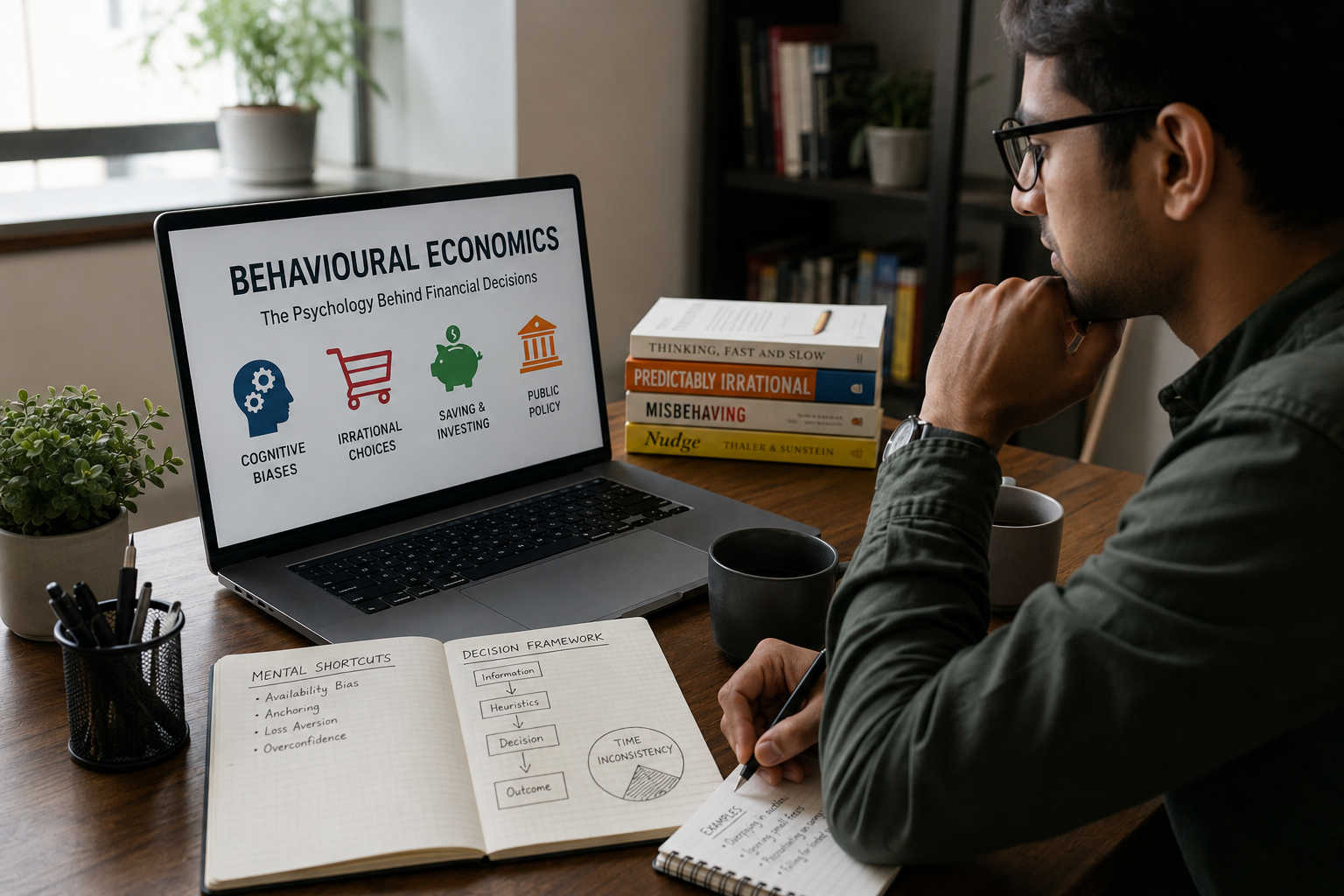
The problem with the perfectly rational human being
Traditional economics often begins with a useful fiction: people are rational decision-makers who compare costs and benefits, process information objectively and choose what maximises their welfare. This assumption helps build models. It simplifies complexity. It allows economists to predict demand, pricing, incentives and market behaviour. But anyone who has watched a person panic-sell an investment, buy things on discount that they did not need, avoid insurance, overspend on credit or delay retirement planning knows that real human beings are not perfectly rational calculators.
Behavioural economics begins with this uncomfortable truth. People are intelligent, but not always rational. They use shortcuts. They follow emotions. They fear loss more than they enjoy equivalent gain. They copy others. They overvalue the present. They avoid difficult choices. They frame the same problem differently depending on wording. Behavioural economics studies these patterns and asks how economic life changes when we analyse humans as they are, not as textbooks imagine them.
What behavioural economics means
Behavioural economics is the study of how psychological, emotional, social and cognitive factors influence economic decisions. It combines economics with psychology to understand why people save too little, borrow too much, chase market trends, ignore long-term risks, misjudge probabilities and respond differently to the same incentive depending on context.
The field does not say people are foolish. It says people are bounded. They have limited attention, limited information, limited self-control and limited time. Most decisions are made under uncertainty, stress, habit and social influence. Behavioural economics therefore shifts the question from “What should a rational person do?” to “What do real people actually do, and why?”
Why standard economics needed behavioural insights
Standard economic models are powerful, but they can miss repeated human errors. If people always acted rationally, they would rarely carry expensive credit-card debt while keeping low-interest savings. They would buy adequate insurance for serious risks. They would not sell good investments during panic. They would not be manipulated by default options, anchoring, scarcity messages or social proof. Yet all these behaviours are common.
Behavioural economics improves analysis by bringing these patterns into the model. It recognises that information alone is not enough. A person may know they should save, but still fail to save. They may understand that smoking is harmful, but still smoke. They may know diversification is sensible, but still put too much money into a familiar asset. Human decision-making has friction, and policy must account for it.
Loss aversion: why losses hurt more
One of the most important behavioural ideas is loss aversion. People often feel the pain of losing money more strongly than the pleasure of gaining the same amount. A loss of Rs 1,000 may hurt more than a gain of Rs 1,000 feels good. This affects investing, bargaining, insurance, consumption and public policy.
In markets, loss aversion can make investors hold losing stocks too long because selling would make the loss real. It can also make investors panic during downturns because temporary portfolio declines feel unbearable. In daily life, loss aversion explains why people resist change even when the new option is better. The fear of losing what one has often dominates the possibility of gaining something better.
Present bias: why today defeats tomorrow
Present bias is the tendency to give excessive weight to immediate pleasure or pain compared with future consequences. This is why saving for retirement feels less urgent than buying something today. It is why people postpone exercise, delay paperwork, ignore insurance and accumulate debt even when they understand the long-term cost.
Financial planning is largely a battle against present bias. Compound interest rewards patience, but human emotion prefers immediacy. A person may intellectually know that investing early is wise, yet still delay because the future feels abstract. Behavioural economics helps design systems that make the future more visible and saving more automatic.
Anchoring and framing
Anchoring occurs when people rely too heavily on the first number or reference point they see. A product marked down from Rs 10,000 to Rs 5,999 may appear attractive because the original price becomes the anchor, even if the real value is lower. In investing, the purchase price of a stock becomes an anchor, causing people to judge future decisions against an emotionally charged number.
Framing means that the same information can produce different choices depending on presentation. A medicine described as having a 90 percent survival rate may feel safer than one described as having a 10 percent mortality rate, even though both mean the same thing. In finance, framing affects insurance, tax decisions, loans, investment risk and public acceptance of policy.
Herd behaviour in markets
Humans are social creatures. We look to others for signals, especially under uncertainty. In markets, this creates herd behaviour. Investors buy because others are buying. They sell because others are selling. A rising price becomes evidence of quality. A falling price becomes evidence of danger. The crowd becomes the argument.
Herd behaviour can inflate bubbles and deepen crashes. It can make people ignore valuation, risk and fundamentals. It can also spread through social media, where narratives travel faster than analysis. Behavioural economics reminds investors that comfort in a crowd is not the same as safety. The majority can be wrong, especially when the majority is reacting to the majority.
Mental accounting
Mental accounting is the tendency to divide money into separate psychological buckets even when money is economically interchangeable. A person may treat salary, bonus, refund, gift money and lottery winnings differently. They may spend a bonus freely while being careful with monthly salary. They may keep expensive debt while protecting a savings account because the two are mentally separated.
Mental accounting can be harmful, but it can also be useful. Budget envelopes, emergency funds and goal-based investing use mental accounting productively. The problem is not creating categories. The problem is forgetting that all money ultimately belongs to the same financial life. Behavioural tools should use human psychology without allowing it to distort judgment.
Nudges and public policy
Behavioural economics has influenced public policy through the idea of nudges. A nudge changes the choice environment without removing freedom. Automatic enrolment in retirement savings, default organ donation rules, simplified tax forms, reminder messages, calorie labels and better disclosure formats are examples of behavioural design.
The power of nudges lies in recognising that design matters. If a good choice is made easier, more people choose it. If a harmful choice requires effort, fewer people choose it. But nudges also raise ethical questions. Who decides what is good for citizens? When does guidance become manipulation? Behavioural policy must be transparent, accountable and respectful of choice.
Behavioural economics in personal finance
Personal finance is full of behavioural traps. People chase returns after seeing past performance. They avoid budgeting because it feels restrictive. They take loans because monthly EMI looks affordable while ignoring total interest. They buy insurance as investment because the product feels safe. They overestimate their ability to time markets. They underestimate the effect of inflation.
The solution is not to become emotionless. That is impossible. The solution is to build systems that protect us from predictable weaknesses. Automatic SIPs, emergency funds, written financial goals, cooling-off periods before large purchases, diversified portfolios and periodic reviews are behavioural safeguards. They convert good intentions into routines.
India angle: behavioural economics in a changing economy
India’s financial landscape is changing quickly. Digital payments, trading apps, instant loans, social media finance advice, online shopping and easy investing have brought millions of people into formal financial activity. This is positive, but it also exposes people to faster decisions and sharper behavioural triggers.
A young investor can buy a stock in seconds. A consumer can take a loan instantly. A shopper can pay later. A worker can invest through an app without understanding risk. Behavioural economics is therefore especially relevant for India. Financial inclusion must be matched by behavioural protection: clearer disclosures, better defaults, fraud warnings, suitability checks and financial education that understands real human habits.
Final takeaway
Behavioural economics matters because money decisions are human decisions. People do not save, borrow, invest, insure or spend like machines. They act through fear, hope, habit, pride, regret, comparison and social pressure. Ignoring this does not make economics more scientific. It makes economics less realistic.
The value of behavioural economics is not that it exposes human weakness. It helps design better systems. It tells us that good financial behaviour should not depend only on willpower. It should be supported by defaults, reminders, transparency, friction where needed and simplicity where possible. The most practical lesson is clear: if you understand your biases, you can build a financial life that protects you from them.