Afghanistan has a way of punishing simple foreign-policy assumptions.
For decades, outside powers entered Afghanistan with confidence and left with unfinished consequences. The Soviet Union failed there. The United States failed to build a durable democratic order there. Pakistan believed the Taliban’s return would restore its “strategic depth”, only to face a more hostile and uncontrollable western frontier. China wants stability without entanglement. Russia has moved toward formal recognition. India, meanwhile, faces a difficult question: how does one deal with a Taliban-ruled Afghanistan without legitimising everything the Taliban represents?
This is not a theoretical dilemma. It is a live strategic concern.
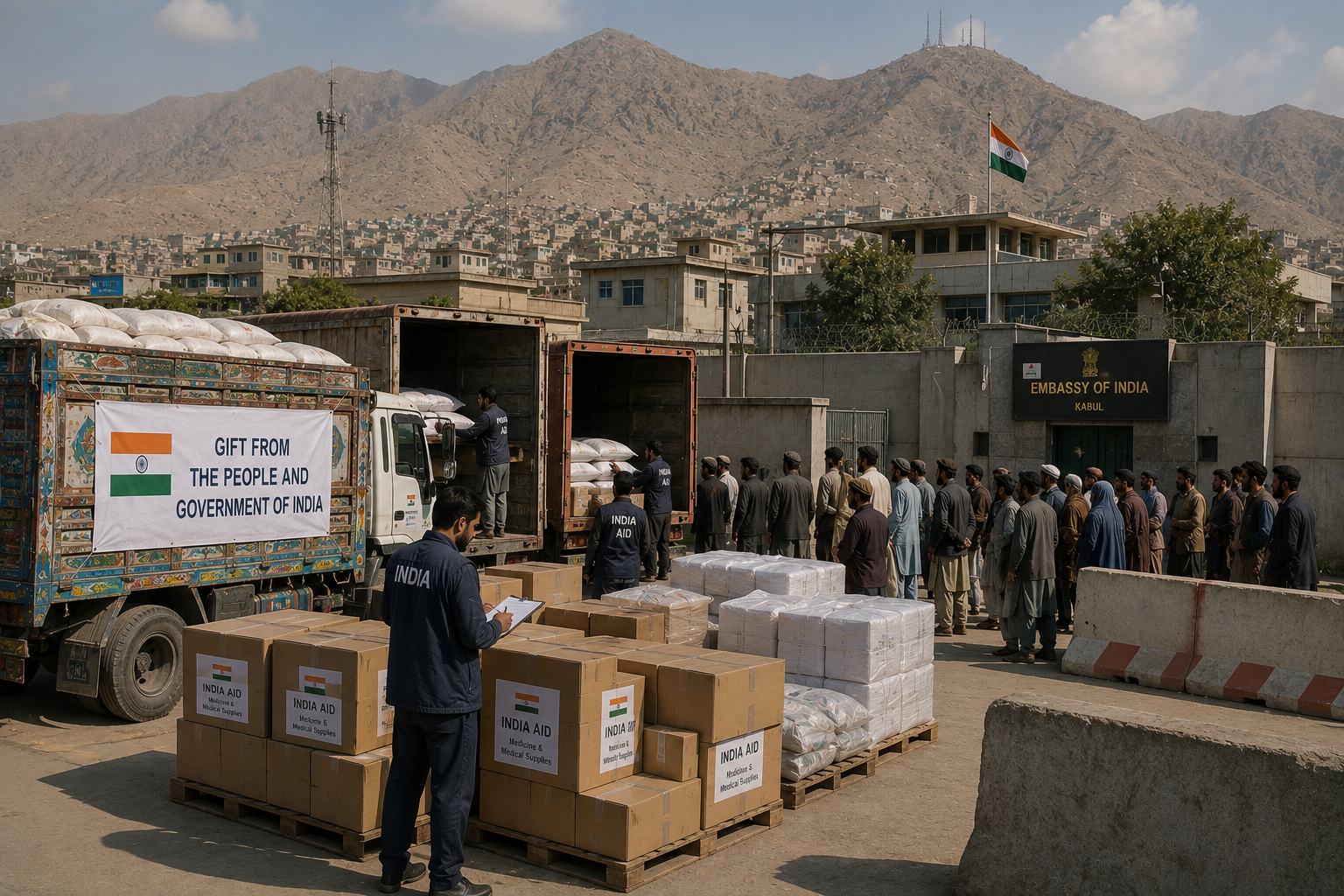
Afghanistan is no longer governed by the republic India supported for two decades. The Taliban controls Kabul. Women and girls face severe restrictions. Terrorist groups continue to operate in the wider Afghan-Pakistan space. Pakistan-Taliban relations have deteriorated sharply. China, Russia, Iran and Central Asian states are all engaging the Taliban in different ways. India has restored its mission in Kabul to embassy status, signalling deeper engagement while still avoiding a full moral embrace of the regime. India announced in October 2025 that it was restoring the status of its Technical Mission in Kabul to the Embassy of India in Afghanistan, saying this would deepen bilateral engagement and support development, humanitarian assistance and capacity-building.
That is the core of India’s Afghanistan policy today: engagement without illusion.
Afghanistan Still Matters to India
India does not share a direct land border with Taliban-controlled Afghanistan in practical terms because Pakistan blocks direct overland access. Yet Afghanistan remains strategically important to India.
First, Afghanistan affects terrorism. Groups operating from the Afghan-Pakistan region have historically threatened India’s security interests. Second, Afghanistan affects Pakistan. A Pakistan under pressure on its western frontier has less strategic comfort, but it may also become more unstable and dangerous. Third, Afghanistan affects Central Asia. India’s ambition to connect with Central Asian markets and energy corridors depends partly on routes through Iran and Afghanistan. Fourth, Afghanistan affects India’s image among Afghans. India invested heavily in development projects, education, infrastructure and goodwill after 2001. That soft-power capital still matters.
India cannot simply abandon Afghanistan because the Taliban returned. But India also cannot pretend the Taliban is an ordinary government.
That tension defines the policy.
India’s Old Afghanistan Policy Collapsed in 2021
Before the Taliban takeover, India’s Afghanistan policy was built on partnership with the Islamic Republic. India supported infrastructure, education, democracy, parliament-building, medical access and development. The Salma Dam, the Afghan Parliament building, scholarships, roads and medical visas became symbols of Indian goodwill.
The Taliban’s return in August 2021 disrupted this entire architecture. India evacuated personnel, shut down its embassy operations temporarily and had to reassess everything. The leadership India had worked with either fled, lost power or became irrelevant. Pakistan appeared to have gained advantage. China and Russia moved faster toward pragmatic engagement. India had to decide whether to wait, oppose, isolate or re-engage.
Complete isolation was not practical. Afghanistan’s humanitarian crisis was too severe, and India’s long-term interests were too deep.
India began cautiously with humanitarian assistance. In 2021, India said it had committed to provide 50,000 metric tonnes of wheat, essential life-saving medicines and COVID vaccines to the Afghan people. In June 2022, India said it had already dispatched several humanitarian consignments, including 20,000 metric tonnes of wheat, 13 tonnes of medicines, 500,000 doses of COVID vaccine and winter clothing, and that its approach would be guided by historical and civilisational ties with the Afghan people.
This was a careful formulation. India was helping Afghans, not endorsing the Taliban.
The Taliban Is Now a Reality India Cannot Ignore
The Taliban has not collapsed. This is the most important fact shaping India’s policy.
Many expected internal divisions, economic collapse, resistance groups or international pressure to weaken the Taliban. Those pressures exist, but the Taliban remains in control. It has built a functioning coercive state, even if not a legitimate inclusive one. It controls borders, ministries, security forces and diplomatic engagement. It has survived sanctions, criticism and non-recognition by most of the world.
Russia changed the diplomatic landscape in July 2025 by becoming the first country to formally recognise the Taliban government after accepting the credentials of a new Afghan ambassador. Reuters reported that Moscow framed the move around security, counter-terrorism and cooperation with Kabul. By May 2026, Russia was speaking of a “full-fledged partnership” with the Taliban and encouraging regional countries to expand cooperation with Kabul.
India cannot ignore that shift. If other regional actors deepen ties while India stays absent, India loses influence. But if India moves too fast, it risks appearing to reward a regime that violates basic rights and still raises security concerns.
That is why India’s policy has become calibrated engagement.
Terrorism Remains the Central Concern
The biggest Indian concern is terrorism.
Afghanistan under Taliban rule is not the same as Afghanistan under the old republic. The Taliban’s ideological history, its relationship with jihadist groups, the presence of the Haqqani network and the Afghan-Pakistan militant ecosystem all create security anxieties for India.
The United Nations Security Council’s sanctions-monitoring mechanism continues to track ISIL, Al-Qaida, the Taliban and associated entities; the latest listed Monitoring Team report is S/2026/44, dated 4 February 2026. CSIS, citing international assessments, noted in February 2026 that international terrorist groups, especially Al Qaeda and the Tehrik-e-Taliban Pakistan, receive at least safe haven from the Taliban, and that violence in Pakistan has risen sharply since the Taliban returned to power in August 2021.
For India, the concern is not only Afghanistan-based attacks. The concern is the ecosystem: training, ideological inspiration, financing, safe houses, documentation networks, narcotics, arms movement and connections to Pakistan-based groups.
India must watch whether anti-India groups gain space in Afghanistan, whether Pakistan-based jihadist networks use Afghan territory indirectly, and whether ISKP’s presence creates wider regional instability.
The Taliban may tell India that it will not allow Afghan soil to be used against India. India should listen, but verify.
ISKP Makes the Security Picture More Dangerous
The Islamic State Khorasan Province is one of the Taliban’s most serious internal enemies. It attacks Taliban officials, minorities, foreign interests and civilians. It also gives the Taliban an argument to present itself as a counter-terrorism partner.
But that argument is dangerous if accepted too easily.
The Taliban fighting ISKP does not automatically make the Taliban a reliable counter-terrorism actor. The Taliban may fight ISKP because ISKP threatens Taliban rule, while tolerating or protecting other groups that do not threaten its internal authority. This distinction matters for India.
In January 2026, an ISKP attack on a Chinese establishment in Kabul’s Shahr-e-Naw district showed that even heavily secured areas remain vulnerable, and Indian strategic analysts described it as proof of ISKP’s continued endurance. UNICEF and UN agencies have also warned that Afghanistan’s internal social collapse, especially restrictions on women’s education and employment, is weakening state capacity in education and healthcare, indirectly feeding instability.
A weak, repressive and internationally isolated Afghanistan is fertile ground for militant narratives. India cannot treat the security problem separately from the humanitarian and governance problem.
Pakistan’s Afghanistan Strategy Has Backfired
Perhaps the most dramatic change since 2021 is the deterioration of Pakistan-Taliban relations.
For decades, Pakistan’s security establishment treated the Afghan Taliban as a strategic asset. The assumption was that a Taliban government in Kabul would be friendly to Islamabad, restrict Indian influence and give Pakistan depth against India. That assumption has collapsed.
The Taliban has not accepted the Durand Line as a normal border. The Tehrik-e-Taliban Pakistan has intensified attacks against Pakistan. Islamabad now accuses Kabul of sheltering militants. Pakistan has carried out strikes inside Afghanistan. Taliban forces have retaliated at the border.
CSIS reported in February 2026 that Pakistan’s defence minister announced “open war” between Pakistan and the Taliban after escalating strikes and Taliban retaliation along the Durand Line. The same analysis noted that the conflict would likely remain limited to border skirmishes and air strikes, but could escalate further.
This creates a complicated situation for India.
On one hand, Pakistan’s loss of influence in Kabul reduces Islamabad’s old advantage. A Taliban government no longer fully controlled by Pakistan gives India some diplomatic room. On the other hand, a destabilised Pakistan-Afghanistan border can intensify terrorism, refugee flows, radicalisation and regional unpredictability.
India should not celebrate instability on Pakistan’s western frontier. Instability in nuclear-armed Pakistan’s neighbourhood is never risk-free.
The Taliban Wants India for Its Own Reasons
The Taliban’s outreach to India is not sentimental. It is strategic.
The Taliban wants recognition, trade, medical access, investment, connectivity, humanitarian aid and diplomatic legitimacy. It also wants to reduce dependence on Pakistan. India offers all of that in limited but valuable ways.
In January 2025, Reuters reported that Taliban officials described India as a “significant regional and economic partner” after high-level talks in Dubai between India’s Foreign Secretary and Afghanistan’s Acting Foreign Minister. The discussions included trade and use of Iran’s Chabahar Port, and Reuters noted that India maintained a mission in Kabul for trade and humanitarian efforts despite not officially recognising the Taliban administration.
By November 2025, Afghanistan’s Taliban government was urging India to scale up trade and expand use of Iran’s Chabahar Port, especially after border clashes with Pakistan disrupted Afghanistan’s main trade routes.
This is important. The Taliban is looking for alternatives to Pakistan. India can use this opening, but cautiously.
Chabahar Is India’s Strategic Gateway
Chabahar Port in Iran remains central to India’s Afghanistan strategy because it bypasses Pakistan. It gives India a route to Afghanistan and Central Asia without depending on Pakistani transit permission.
India told Parliament in February 2026 that the Chabahar Port project was conceptualised to provide much-needed connectivity to Afghanistan for reconstruction and economic development, while also boosting trade and economic linkages with Central Asia. In December 2025, India also stated that Chabahar has an important role in supporting Afghanistan’s reconstruction and economic development, including humanitarian and emergency assistance.
This makes Chabahar more than a port. It is India’s answer to Pakistan’s geography.
But Chabahar is vulnerable to sanctions politics, Iran-U.S. tensions, regional instability and slow infrastructure execution. India must treat it as a long-term strategic asset, not just a diplomatic talking point.
If India wants influence in Afghanistan, it needs a working route to Afghanistan.
China Is Watching Closely
China’s Afghanistan policy is pragmatic. Beijing wants security against extremist spillover into Xinjiang, access to minerals, regional influence, protection for Chinese nationals and infrastructure opportunities. It does not want Afghanistan to become a base for anti-China militant activity.
China has engaged the Taliban more openly than many Western states, though Russia became the first country to formally recognise the Taliban government. China’s interest in Afghanistan is not only economic; it is also strategic.
For India, China’s presence in Afghanistan matters because it can combine with Pakistan, Central Asia and Iran-linked connectivity to reshape regional influence. If China becomes the Taliban’s main infrastructure partner, India’s development legacy may weaken. If China gains mining and transport access, it can expand its regional footprint. If China works with the Taliban and Pakistan together, India may face a difficult strategic triangle.
But the situation is not one-sided. China also faces risk. ISKP has targeted Chinese interests. Afghanistan’s instability can damage Chinese projects. Taliban promises may not translate into reliable security.
India should not panic about China in Afghanistan. But it should not ignore it.
The Humanitarian Crisis Cannot Be Secondary
India’s Afghanistan policy must not be reduced to terrorism and geopolitics. The Afghan people remain central.
The Taliban’s restrictions on women and girls have created one of the world’s gravest human-rights crises. UNESCO said in August 2025 that Afghanistan was the only country where secondary and higher education were strictly forbidden to girls and women, and that nearly 2.2 million girls were barred from attending school beyond the primary level. UNICEF warned in April 2026 that Afghanistan could lose up to 20,000 women teachers and 5,400 healthcare workers by 2030 if restrictions on girls’ education and women’s employment continue.
This matters strategically too.
A country that educates only half its population cannot build a stable future. A health system without women professionals cannot serve women properly. A generation of girls denied education becomes a national tragedy and a long-term development collapse.
India’s assistance should therefore continue to focus on ordinary Afghans: food, medicines, scholarships where possible, health, capacity building, disaster relief and people-to-people contact. India must not allow its anger at the Taliban to become abandonment of Afghans.
Recognition Is the Hardest Question
Should India recognise the Taliban government?
At present, full recognition would be premature and politically costly. Recognition would be read as acceptance of a regime that excludes women, suppresses political opposition, restricts rights and has unresolved links with extremist networks.
But non-engagement would also be strategically costly.
The solution is a middle path: maintain diplomatic presence, talk to the Taliban where necessary, provide aid to Afghans, protect Indian security interests, use Chabahar for connectivity, coordinate with regional powers, and keep recognition conditional on behaviour.
India should not recognise the Taliban merely because Russia did. India’s interests are different. India’s democratic identity, domestic politics, security concerns and historical relationship with the Afghan republic all make recognition sensitive.
But India should also not confuse recognition with contact. Contact is necessary. Recognition is a political decision.
India’s Soft Power Still Matters
India retains goodwill among many Afghans because of its development record. Indian hospitals, scholarships, films, education, infrastructure projects and medical visas created a reservoir of trust.
That trust should not be wasted.
Even under Taliban rule, India can keep channels open with Afghan students, traders, doctors, civil society networks, cultural institutions and regional communities. It can support online education, medical assistance, food aid, earthquake relief, women-focused humanitarian work through international agencies, and limited trade corridors.
India’s strongest asset in Afghanistan has never been military power. It has been credibility among ordinary Afghans.
That credibility is still valuable.
What India Should Do Next
India needs a five-part Afghanistan strategy.
First, it should maintain diplomatic engagement without formal recognition. The restored Embassy of India in Kabul gives India eyes, ears and channels on the ground. That presence must be used carefully.
Second, India should make counter-terrorism verification central to all engagement. Taliban assurances are not enough. India must monitor groups, financing networks, propaganda and Pakistan-Afghanistan militant flows.
Third, India should strengthen Chabahar and Central Asian connectivity. Afghanistan’s request for more trade through Chabahar gives India an opening, but only if logistics, sanctions management and infrastructure improve.
Fourth, India should continue humanitarian assistance directly to Afghans through credible channels. Food, medicine, vaccines, women’s health, education support and disaster relief should remain central.
Fifth, India should coordinate with Russia, Iran, Central Asian states, the United States and Gulf countries, but keep its own independent assessment. No outside power’s Taliban policy should automatically become India’s policy.
The Counter-View: Should India Avoid the Taliban Entirely?
There is a legitimate argument that India should avoid engagement with the Taliban because engagement normalises repression. The Taliban has denied girls education beyond primary levels, restricted women’s employment, suppressed dissent and failed to create an inclusive political order. Critics argue that every diplomatic meeting gives the regime legitimacy without extracting real concessions.
This argument has moral force.
But foreign policy cannot be based only on moral distance. If India refuses contact, others will shape Afghanistan’s future. Pakistan, China, Russia, Iran and Central Asian states will not wait for India’s approval. India would lose access, intelligence, influence and goodwill.
The better position is conditional engagement: talk, but do not endorse; assist Afghans, but do not whitewash the Taliban; pursue security, but do not forget rights; use diplomacy, but keep red lines.
Isolation may feel clean. It is not always strategic.
The Editorial Line
The Taliban is not India’s natural partner. But Afghanistan is not a country India can ignore.
India’s task is to manage contradiction. It must engage a regime it does not fully trust. It must support Afghan people without strengthening Taliban repression. It must prevent anti-India terror space without believing every Taliban promise. It must use Pakistan’s loss of influence without celebrating regional instability. It must compete with China without rushing into reckless recognition. It must protect its old goodwill without pretending the old Afghanistan still exists.
This is hard diplomacy.
But Afghanistan has always required hard diplomacy.
The central Indian interest is clear: Afghanistan should not become a base for terrorism, a playground for hostile powers, a humanitarian disaster abandoned by the region, or a permanent extension of Pakistan’s security games.
India cannot control Afghanistan. No outside power has successfully done that.
But India can remain present, careful, useful and alert.
That may not sound dramatic. But in Afghanistan, strategic patience is often more valuable than dramatic ambition.
Premium geopolitical editorial illustration showing Afghanistan as a rugged mountain map under a dark sky, with Kabul faintly glowing, shadowy Taliban figures, India’s diplomatic route through Chabahar, Pakistan’s border tension, Central Asian corridors, and subtle icons of aid, terrorism risk and regional power competition. Use deep navy, desert brown, muted gold and restrained red. Serious magazine-style visual. No text.
Suggested Internal Links
Pakistan’s Instability Remains India’s Oldest Security Challenge
China’s Shadow Grows Across India’s Neighbourhood
South Asia’s Future Depends on Connectivity, Trust and Political Stability
India’s Regional Leadership Is Being Tested at Its Own Doorstep
Recent Context Sources
Reuters
Taliban say India is a 'significant regional partner' after meeting
Jan 9, 2025
Reuters
Afghanistan urges India to scale up trade, expand use of Iran's Chabahar Port
Nov 20, 2025
apnews.com
Russia becomes the first country to formally recognize Taliban's latest rule in Afghanistan
Jul 4, 2025
m.economictimes.com
Taliban inks maiden defence pact with Russia as Kabul seeks muscle
3 days ago
English correction: “Start writing the nineteenth article.” is correct.