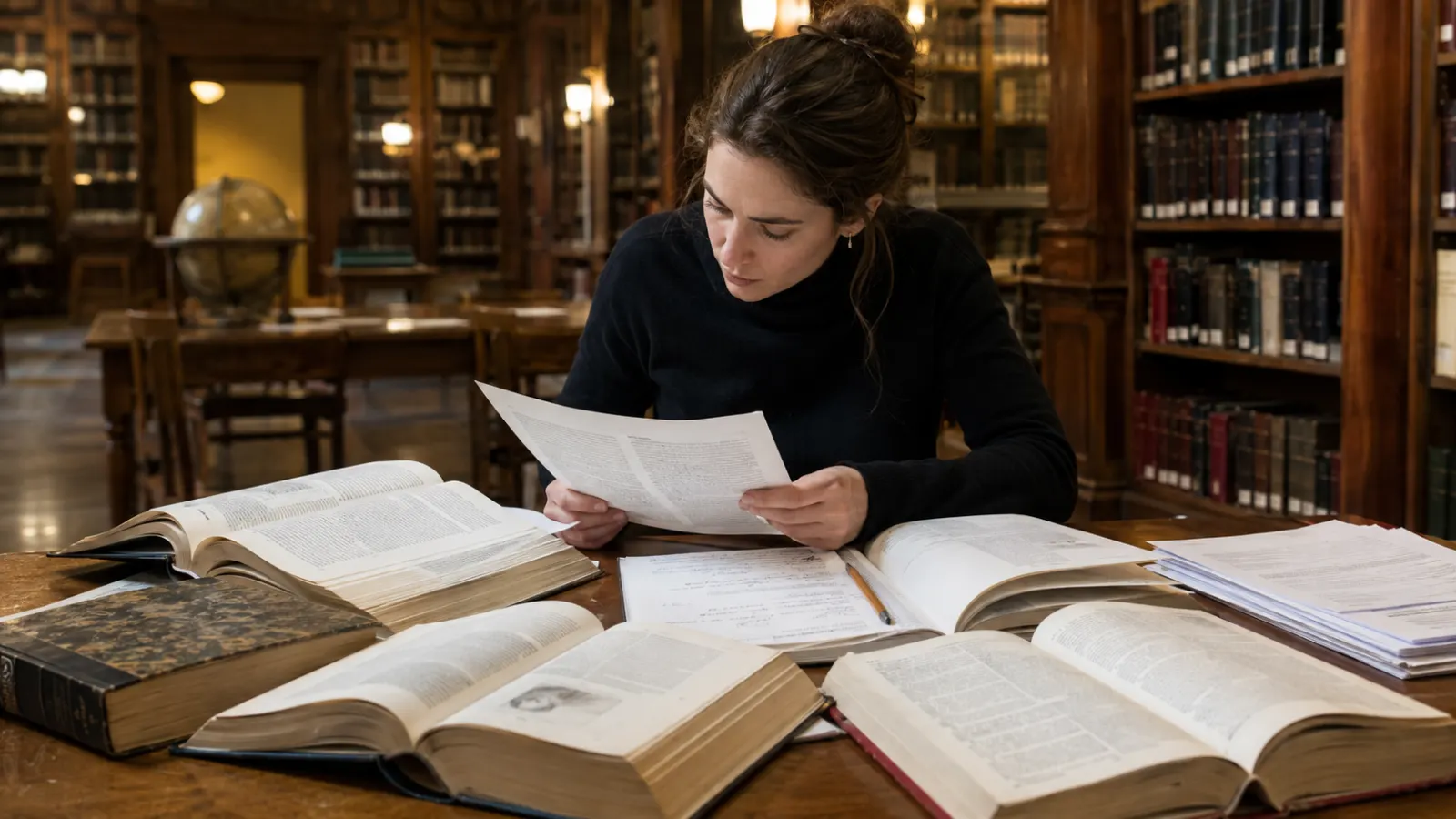
Why Citations Matter: Credit, Evidence and Academic Trust
A citation can occupy only a few characters on a page.
It may appear as a name and year inside parentheses, a superscript number, a footnote or an entry in a bibliography.
Its function is much larger than its physical size suggests.
A citation tells the reader that some part of the argument came from somewhere else. It identifies that source, gives credit to the person or organisation responsible for it and creates a route through which the reader can examine the underlying evidence.
That makes citation part of the infrastructure of research.
Harvard’s Guide to Using Sources identifies two central purposes clearly. Scholars cite to give credit for other people’s work and to provide readers with a roadmap into the wider conversation surrounding a subject.
But citation does even more than that.
It allows readers to distinguish evidence from interpretation. It reveals which intellectual traditions an argument belongs to. It makes disagreements visible. It allows later researchers to find earlier studies. It helps journals, databases and search systems connect one scholarly work with another.
Most importantly, a good citation makes a claim inspectable.
A reader should be able to ask:
Did this source really establish what the writer says it established?
That question lies at the centre of academic accountability.
Citation Is a Map of Intellectual Dependence
Very little serious research begins completely from zero.
Researchers inherit terminology, methods, datasets, theories, previous findings, historical records and unresolved questions from earlier work.
Even a genuinely original paper usually depends on an existing intellectual environment.
A scientist may develop a new experiment using a method established by another laboratory. A historian may reinterpret archival records first catalogued by previous scholars. An economist may analyse a new dataset using a theoretical framework developed decades earlier. A student may combine several existing studies to produce a new argument.
Citation makes those relationships visible.
Without it, the reader cannot easily tell which parts of the paper are established findings, which came from earlier scholars and which represent the current author’s own interpretation.
A well-cited paper therefore creates a clearer division between:
what was already known;
what evidence was borrowed;
and what the current writer is adding.
This is one reason citation is not merely decorative academic formatting.
It describes the architecture of the argument.
Citations Allocate Intellectual Credit
Ideas have histories.
So do methods, datasets, interpretations and discoveries.
When a writer builds on someone else’s distinctive contribution, citation recognises that intellectual debt.
Suppose a researcher uses a theoretical framework created by another scholar but expresses the framework entirely in new words.
No sentence has been copied.
Citation is still necessary because the idea did not originate with the current writer.
Harvard’s guidance is explicit that plagiarism can involve either language or ideas taken from another source without adequate acknowledgement.
The principle becomes especially important in research because reputation and professional advancement are often connected to intellectual contribution.
Publications, discoveries and methods help establish careers.
Citation is one of the mechanisms through which academic communities recognise who contributed what.
That does not mean every idea must be treated as private property forever.
It means distinctive contributions should remain connected to the people who produced them.
Citation Is Not Only About Avoiding Plagiarism
Students often encounter citation first through warnings.
Do not plagiarise.
Cite your sources.
Put quotation marks around copied wording.
Those rules matter.
But framing citation only as a plagiarism-prevention device makes the practice seem defensive.
The deeper purpose is constructive.
Citation allows knowledge to accumulate.
A scholar can publish a finding. Another researcher can inspect it, reproduce it, challenge it or apply it elsewhere. A third can combine that work with other studies. Later reviews can examine the entire body of evidence.
Each stage depends partly on being able to identify what came before.
Harvard describes citations as a roadmap for readers who want to learn more or participate in the continuing scholarly conversation.
That metaphor is useful.
Citation does not merely tell readers where a sentence came from.
It tells them where they can go next.
Citations Make Claims Traceable
Consider the statement:
“The intervention reduced hospital admissions by 18%.”
Without a citation, the reader has very little information about that number.
Which intervention?
Which patients?
Which hospital system?
How was the reduction measured?
Compared with what?
Over what period?
A citation gives the reader a path toward answering those questions.
The reader may discover that the study involved 50 participants rather than 50,000. They may find that the reported effect applied only to one subgroup. They may discover that the original study described an association while the current author described causation.
Citation therefore enables verification.
It does not guarantee that verification will support the writer.
That is precisely why it matters.
A research system becomes more trustworthy when its claims can be checked rather than merely accepted.
A Citation Should Support the Exact Claim Attached to It
Having a citation is not enough.
The source needs to support what the sentence actually says.
Suppose a study finds an association between short sleep duration and poorer academic performance among 300 university students.
A writer cites the study after saying:
“Sleeping less than seven hours causes poor academic performance in all young adults.”
The citation is real.
The claim is still overstated.
The original study may not establish causation, may not represent all young adults and may not justify a precise seven-hour threshold.
This problem can be called citation overreach.
A citation creates credibility only when the evidence and the claim match.
Strong academic writing therefore requires two separate questions:
Where did this claim come from?
and:
Does the source actually justify the claim as written?
The first is a citation question.
The second is an evidence-evaluation question.
Citations Do Not Guarantee Source Quality
A sentence followed by six references can look authoritative.
It can still be poorly supported.
The cited sources may be outdated, methodologically weak, irrelevant or repeatedly tracing back to the same original evidence.
Harvard’s source-evaluation guidance emphasises that researchers remain responsible for determining whether information comes from sources appropriate and reliable for the assignment or question.
This distinction is fundamental.
Citation answers provenance.
Source evaluation answers evidential weight.
A poorly designed study does not become strong because it is cited correctly.
A commercial advertisement does not become independent evidence because it appears in APA format.
A citation style cannot rescue a weak evidence base.
Five Citations May Still Represent One Source
Citation quantity can create another illusion.
Imagine five newspaper articles reporting the same statistic.
A writer cites all five.
The sentence now appears heavily corroborated.
But if every article obtained the figure from one corporate press release, there is only one underlying evidence stream.
This is why researchers need to understand source lineage.
The relevant question is not merely how many sources repeat the claim.
It is whether those sources provide genuinely independent evidence.
The same issue occurs in scholarly research.
Several review articles may all rely on one influential experiment.
If the experiment was flawed, the apparent number of supporting references can exaggerate the independence of the evidence.
Good citation practice therefore works together with careful source tracing.
Direct Quotations Require Visible Attribution
When another author’s exact language appears in a paper, the wording must normally be clearly identified as belonging to that source.
That usually means quotation marks for shorter quotations or an appropriate block-quotation format for longer ones, together with the required citation.
Simply placing a citation after copied wording does not automatically make the borrowing transparent if the reader cannot tell that the sentence itself was reproduced.
This is an important distinction.
Citation identifies the source.
Quotation formatting identifies the borrowed language.
Both perform different jobs.
The exception is extremely narrow and usually involves phrases so widely recognised that they genuinely function as common knowledge. Harvard advises that direct quotations should generally be cited and that uncertainty should be resolved in favour of attribution.
Paraphrasing Still Requires Citation
Paraphrasing often causes more confusion than quotation.
A writer reads another scholar’s argument, closes the source and explains the idea using completely different wording.
The sentences are now original.
The idea is not.
Citation remains necessary.
Changing the words does not transfer intellectual ownership of the underlying thought.
This is one of the most important distinctions in academic integrity.
A proper paraphrase demonstrates understanding by expressing an idea independently rather than mechanically substituting synonyms.
But the source still needs acknowledgement.
Harvard’s guidance similarly treats uncredited use of another person’s ideas as plagiarism whether or not the original wording is preserved.
Summaries Need Citation Too
Summary compresses a larger body of source material.
Suppose a writer reads a twenty-page report and reduces its argument to two sentences.
Those sentences may contain no wording from the report.
They still represent the report’s conclusions.
The reader needs to know that.
Citation therefore applies not only to individual facts or sentences but to larger intellectual dependence.
A paragraph summarising one scholar’s argument may need a citation even if every sentence has been written independently.
The relevant principle is straightforward:
if the information or idea came from somewhere else, make that relationship visible.
What Counts as Common Knowledge?
Not everything requires citation.
Some facts are so widely established that readers do not reasonably expect attribution to one particular source.
India became independent in 1947.
Earth revolves around the Sun.
Water consists of hydrogen and oxygen.
These facts normally do not require citation in ordinary academic writing.
Harvard defines common knowledge broadly as information generally known to educated readers and not uniquely attributable to one individual’s intellectual work. It also warns that the boundary can vary by discipline and audience.
That qualification matters.
A fact that counts as common knowledge among specialist physicists may not count as common knowledge in an undergraduate sociology paper.
Distinctive theories, interpretations, research findings and specialised claims usually require attribution even when experts in the field know them well.
When uncertainty remains, citation is usually safer.
Overcitation Can Become a Problem Too
The instruction “when in doubt, cite” is useful for avoiding unattributed borrowing.
It should not be transformed into the idea that every sentence requires a parenthetical reference.
A paragraph may introduce a source clearly, discuss that source for several sentences and then provide analysis.
Repeating the same reference after every sentence can make the writing difficult to read without adding meaningful transparency.
Citation density should reflect intellectual dependence.
If several sentences closely summarise one source, the placement should make that relationship clear.
If the paragraph synthesises several studies, the references should identify which evidence supports which part of the synthesis.
If the writer then explains the implication in their own reasoning, another citation may not be necessary unless new external information is introduced.
The objective is not maximum citation.
It is maximum clarity about provenance.
Undercitation Creates a Different Problem
Too few citations create ambiguity.
A reader encounters three factual claims, one interpretation and one quotation but cannot determine which source supports which part.
A citation appears at the very end of the paragraph.
Does it support everything above it?
Only the final sentence?
The quotation?
The data?
This is why citation placement matters.
References should appear close enough to the relevant material that readers can identify the source relationship without guessing.
Academic writing becomes difficult to verify when a paragraph contains multiple claims but provides only one ambiguous citation.
Citation Density Should Follow Intellectual Dependence
There is no correct mathematical number of citations per paragraph.
A literature review may contain many references because almost every sentence depends on previous scholarship.
A methodology section may repeatedly cite established techniques.
A discussion paragraph may contain one citation introducing a finding followed by several sentences of original interpretation.
A theoretical paper may rely heavily on one scholar for several pages before transitioning into critique.
The pattern should follow the structure of thought.
This is why citation cannot be reduced to rules such as “one citation every three sentences.”
Mechanical targets can produce formally dense but intellectually confusing writing.
A citation system should tell the truth about where the argument depends on other work.
Citations Can Preserve Scholarly Disagreement
Suppose Study A reports a strong relationship between two variables.
Study B finds almost none.
A writer should not write:
“Research consistently shows a strong relationship.”
and then cite both studies.
The citations are present.
The sentence has erased the disagreement.
A stronger treatment explains that findings differ and describes why.
Perhaps the studies used different populations.
Perhaps their measurements differed.
Perhaps one was much larger.
Perhaps the evidence genuinely remains uncertain.
Citation should preserve the shape of the evidence base rather than flatten it.
Agreement should appear as agreement.
Disagreement should appear as disagreement.
Uncertainty should remain uncertainty.
Primary Sources Are Often Preferable When Available
Suppose a textbook quotes a famous historical speech.
You want to use the quotation in your paper.
The textbook can provide a useful lead, but the stronger practice is often to consult the original speech if it is available.
This reduces the risk that the wording was truncated, mistranscribed or removed from context.
The principle applies beyond quotation.
If a news article reports a government statistic, the statistical release may be preferable for the exact figure.
If a blog describes the findings of a scientific paper, the paper itself is usually the stronger source for what the researchers actually found.
If a legal commentary explains a judgment, the judgment is preferable when precise wording matters.
Primary evidence does not automatically make interpretation unnecessary.
It simply reduces the number of intermediaries between the writer and the material being cited.
Secondary Citation Should Be Transparent
Sometimes the original source genuinely cannot be obtained.
An old manuscript may be inaccessible.
A historical work may exist only in an archive.
A paper may be unavailable despite reasonable attempts to locate it.
In those situations, disciplines often provide ways to cite a source indirectly through another source.
The key principle is honesty.
Do not cite the original work in a way that implies you personally consulted it when you only encountered a quotation inside another author’s book.
The reader should be able to distinguish direct consultation from secondary access.
This protects the evidence trail.
In-Text Citations and Reference Lists Perform Different Jobs
The citation inside the body of the paper points from a specific claim toward a source.
The reference list, works cited page or bibliography provides enough information to identify that source.
These components should connect.
If a paper uses an author-date system, the reader should be able to move from something like Patel, 2025 in the text to the corresponding Patel entry in the references.
A numbered citation should connect to the correct numbered reference.
A footnote should contain or lead toward sufficient bibliographic information.
The exact mechanics differ among citation styles.
The underlying relationship does not.
The body tells the reader which source supports the claim.
The reference entry tells the reader how to find it.
APA, MLA and Chicago Solve a Formatting Problem
Academic disciplines use different citation systems.
APA commonly uses author-date referencing and is widespread in social and behavioural sciences.
MLA is strongly associated with language and literary studies.
Chicago provides both author-date and notes-and-bibliography approaches and appears across history and other fields.
Vancouver-style numbered citations are common in medical and scientific publishing.
Law uses additional jurisdiction-specific citation systems.
These differences matter because scholarly communities need consistency.
But the style is not the intellectual foundation of citation.
A beautifully formatted APA reference attached to a source that does not support the sentence is still poor research.
A citation system should first be accurate.
Then it should be formatted correctly.
Citation Formatting Is a Form of Standardisation
Formatting conventions may appear arbitrary.
Why italicise one element?
Why place the year after the author in one system and elsewhere in another?
Why use footnotes in one discipline and parentheses in another?
The individual rules are conventional.
Their collective purpose is practical.
Standardisation lets readers scan citations quickly and know where to find the author, title, date, journal, volume, page range or other identifying information.
This reduces friction.
A familiar citation style functions somewhat like a standard scientific unit.
The formatting itself is not the research.
It makes information easier to interpret consistently.
DOIs Help Make Scholarly Sources Easier to Identify
Digital Object Identifiers, or DOIs, have become important components of scholarly citation.
A DOI is a persistent identifier associated with a particular research object.
Unlike an ordinary webpage address, which may change when a publisher reorganises its website, the DOI is designed to provide a stable identifier that can continue resolving to the object’s current location.
Crossref strongly encourages publishers to supply DOIs with references because persistent identifiers improve the ability to connect and match scholarly works.
This matters at scale.
Modern academic databases do not merely display bibliographies visually.
They analyse citation metadata to establish relationships among millions of scholarly outputs.
Accurate identifiers make those connections more reliable.
Citations Create Machine-Readable Scholarly Networks
For most students, a bibliography is something a human reader sees at the end of a paper.
In modern scholarly infrastructure, references also function as data.
Crossref’s Cited-by system works by matching deposited references with registered scholarly works and recording relationships between citing and cited publications.
These relationships support citation indexes, discovery tools and research-analysis systems.
That means a citation performs at least two functions simultaneously.
For the human reader, it creates a path toward the source.
For scholarly infrastructure, it can become part of a network connecting research objects.
A single reference may therefore contribute to a much larger map showing how ideas and findings move across disciplines and decades.
Citations Can Include Data and Software, Not Only Articles
Research increasingly depends on objects that traditional bibliographies sometimes ignored.
A scientific paper may rely on a dataset produced by another group.
A computational study may depend on specialised software.
A digital-humanities project may rely on an archive or database.
These contributions can also deserve citation.
Crossref describes data citation as an important component of open science because making datasets traceable supports transparency, verification, reuse and reproducibility.
This reflects a broader change in the concept of scholarly credit.
Research is not produced only through prose articles.
Datasets, software, protocols and other research outputs can make substantial intellectual contributions.
Citation systems increasingly need to recognise them.
Citation Helps Reproducibility
Suppose a paper reports a complicated statistical analysis.
To understand or reproduce the work, another researcher may need to know where the data originated, which analytical method was used and which previous procedures the authors followed.
Citation can provide those connections.
A method citation directs readers toward the detailed procedure.
A data citation directs them toward the dataset.
A software citation may identify the tool or package used for analysis.
This is one reason citation and reproducibility are closely connected.
The paper does not need to reproduce the complete history of every technique.
It needs to provide sufficient routes into the methodological evidence that another researcher can understand what was done.
Research Can Change After Publication
Publication does not freeze knowledge permanently.
An article may later receive a correction.
A dataset may be updated.
A paper may be withdrawn.
In serious cases, research can be retracted.
This creates another responsibility for people using citations:
the status of the cited work can matter.
Crossref emphasises that the scholarly record is dynamic and that corrections, retractions and withdrawals should remain connected to the works they update. Its Crossmark infrastructure allows readers and information systems to identify such changes.
A reference that was appropriate when a manuscript was drafted may therefore deserve another check before publication.
Researchers should not assume that because a paper still exists online, its status has never changed.
Retracted Research Can Still Be Cited—But Context Matters
Retraction does not mean that a paper must disappear from historical discussion.
A researcher studying scientific misconduct might need to cite a retracted study.
A historian examining the development of a mistaken theory may need to discuss it.
The problem occurs when a retracted paper continues being cited as valid evidence without acknowledging its status.
Citation is therefore not just about identifying the object.
The writer needs to understand what that object currently represents in the scholarly record.
Crossref’s versioning and update guidance specifically stresses the importance of making corrections and retractions visible so readers know which research can still be relied upon.
Citation Counts Are Not Quality Scores
Academic influence is often measured partly through citation counts.
A frequently cited paper may have shaped an important research conversation.
But citation frequency should not be confused with truth or quality.
A paper can be heavily cited because researchers disagree with it.
A methodological paper may accumulate enormous citation counts because thousands of researchers use the technique.
A controversial study may attract attention because of its flaws.
Older papers also have had more time to accumulate citations than newer work.
Citation counts therefore measure a form of scholarly attention or influence.
They do not prove that the underlying research is correct.
This distinction is important whenever citation metrics are used to compare researchers, journals or institutions.
Self-Citation Is Not Automatically Improper
Researchers frequently build on their own earlier work.
If a new paper extends a method introduced in a previous paper, citing that paper may be entirely appropriate.
If the authors previously published the dataset or preliminary analysis, the new article may need to make that relationship visible.
The problem begins when self-citation is included mainly to inflate citation metrics rather than because the earlier work is genuinely relevant.
The same principle applies to every reference:
citation should follow intellectual relevance.
The identity of the cited author does not determine whether the citation belongs.
Citation Managers Solve Mechanical Problems
Reference-management software can save enormous amounts of time.
Tools such as Zotero, EndNote, Mendeley and similar systems can store bibliographic information, attach PDFs, organise research libraries and generate reference lists in different citation styles.
That is useful, particularly when a project contains hundreds of sources.
But citation managers do not understand the argument.
They cannot determine whether the cited paper supports the sentence.
They cannot reliably decide whether a source should receive more evidential weight than another.
They cannot tell whether your paraphrase accurately represents the author.
And imported metadata can contain errors.
Crossref itself emphasises the importance of clean and accurate bibliographic metadata because incorrect author names, titles, dates and identifiers make citation matching and discovery more difficult.
Reference managers automate formatting.
They do not automate scholarly judgment.
Always Inspect Automatically Generated Citations
A reference exported from a database may contain incorrect capitalisation, missing page numbers, incomplete author lists or a malformed title.
A browser extension may import metadata from the wrong part of a webpage.
A DOI lookup can be attached to a slightly different version of a work.
These mistakes may seem minor.
They make the evidence trail less reliable.
Before submission, open several references and compare them with the actual publications.
Check names, title, year, journal, volume, pages and identifiers.
The larger the project, the more useful this audit becomes.
Generative AI Makes Citation Verification More Important
AI systems can now generate plausible-looking references almost instantly.
That creates obvious convenience.
It also creates risk.
A generated citation may combine a real author with the wrong title, invent a journal article, provide an incorrect DOI or accurately identify a paper while describing findings the paper never reported.
The result may look completely credible.
For that reason, AI-generated references should be treated as leads until verified.
Open the DOI.
Search the article title.
Confirm that the authors, publication and year exist.
Then inspect whether the source actually supports the claim.
Citation generation and citation verification are different tasks.
The easier the first becomes, the more important the second becomes.
AI Cannot Decide Whether an Idea Belongs to You
Generative AI also complicates the distinction between writing assistance and authorship.
Institutional policies vary widely.
One university may permit AI assistance for brainstorming with disclosure. Another may prohibit generated prose in assessed work. A journal may have separate rules regarding AI-generated text, images or analysis.
Citation alone does not solve these policy questions.
An AI system is not necessarily an appropriate scholarly source merely because it generated the wording used.
Researchers therefore need to follow the rules of the institution, course or publication involved and maintain traceability to the underlying evidence.
If an AI answer states that “research shows” something, locate the actual research.
The scholarly citation should normally lead to the evidence, not merely to a generated summary of the evidence.
A Bibliography Is Not a Trophy Case
Some papers appear designed to display how many sources the writer found.
Long reference lists can be appropriate.
They can also conceal weak research.
A bibliography should contain sources that contributed meaningfully to the work.
Adding unrelated prestigious references does not strengthen the argument.
Nor does citing an article merely because its title appears relevant.
A strong paper may have fewer references than another while using them much more carefully.
Research quality depends on what the sources contribute to the question.
Citation quantity is not a substitute for synthesis.
Citation Should Not Replace Analysis
A weak research paragraph may read like this:
Smith argues one thing.
Patel finds another.
Jones reports something else.
Each sentence has a citation.
What does the writer conclude?
The reader is left to decide.
Harvard’s source-integration guidance argues that sources should be incorporated in a way that makes clear both which ideas come from the source and what the source contributes to the writer’s own thinking.
This is the critical transition from citation to scholarship.
References bring other voices into the paper.
The author still has to analyse them.
Citation and Synthesis Work Together
Suppose five studies investigate the same intervention.
Three report benefits.
One reports no clear difference.
One finds benefits only in a particular subgroup.
A useful synthesis does not place all five citations after a sentence saying:
“Studies show the intervention works.”
It explains the pattern.
Most studies reported benefit, but the magnitude differed, and one study found no statistically clear overall effect. The subgroup analysis suggests that outcomes may depend on participant characteristics.
Now the citations perform a more honest function.
They map different pieces of the evidence rather than being used as decoration around an oversimplified conclusion.
Good synthesis requires good citation because the reader needs to know which source supports which part of the pattern.
Citation Can Reveal Intellectual Lineages
Academic ideas develop over time.
A researcher proposes a theory.
Another criticises it.
A third revises it.
Later researchers apply the revised theory elsewhere.
Following the citations can reveal that history.
This is particularly valuable in subjects where terminology or interpretation changed substantially.
A concept that appears obvious in a modern textbook may have emerged from decades of disagreement.
Citation allows readers to reconstruct that development.
This is one reason reference lists can be valuable even when the reader is not checking for plagiarism.
They provide a map of the intellectual ancestry of the paper.
Citation Chaining Can Become a Research Method
Once a particularly useful article has been identified, its references can help locate earlier work.
This is sometimes called backward citation searching.
Databases can also reveal later publications that cited the article, allowing researchers to move forward through the scholarly conversation.
Crossref’s Cited-by infrastructure is one example of the technical systems that record these relationships.
Citation chaining can be especially useful when searching by keywords becomes difficult.
Terminology changes.
A foundational paper may use older vocabulary.
Following the citation network can reveal important research that a modern keyword search would miss.
Good Citation Makes Scholarship Inspectable Over Time
A well-cited paper remains useful beyond its immediate reader.
Years later, someone may encounter the argument and want to understand its evidence.
The citation record provides access to the intellectual context in which the paper was written.
Researchers can identify what was considered established at the time.
They can see which findings the author relied upon.
They can determine whether later research overturned those assumptions.
Crossref’s work on connected scholarly metadata reflects this larger principle: publications, references, datasets, corrections and later citations form a network rather than isolated documents.
Citation helps preserve those relationships.
Citation Is Part of Research Integrity
Research integrity is larger than citation.
It includes honest methods, appropriate statistics, transparent reporting, ethical data collection and responsible handling of conflicts of interest.
Citation nevertheless plays an essential role because it prevents intellectual dependence from becoming invisible.
A reader can distinguish borrowed evidence from original interpretation.
A reviewer can examine whether an author represented earlier work fairly.
Another researcher can identify where a methodological choice originated.
Citation therefore creates accountability at the level of individual claims.
It does not guarantee honesty.
It makes dishonesty and error easier to detect.
Common Citation Mistakes
One common mistake is assuming that paraphrased ideas do not require citation. Another is citing a source after a quotation without making the borrowed wording visibly identifiable.
Writers may also attach one citation to an entire paragraph even though several claims come from different sources, or cite a secondary discussion while implying that they consulted the original work.
Another serious mistake is citation overreach: the reference exists, but the source does not support the strength, population or causal wording of the sentence.
Overcitation creates its own problems when repeated references make prose difficult to read without clarifying provenance.
Automatic tools add another category of error. Citation managers and AI systems can generate convincing reference information that still needs to be checked against the actual publication.
All of these problems return to one central question:
Can the reader accurately see where the information came from?
How to Audit Citations Before Submission
A useful final check is to choose several important claims at random and trace each one backwards.
Open the source.
Find the relevant passage, result, table or argument.
Check whether the claim in the paper accurately represents what the source says.
Then inspect the citation itself.
Is the author correct?
Is the publication year correct?
Does the reference list contain the corresponding entry?
Is the DOI or URL accurate where required?
Has the article received a correction or retraction that changes how it should be used?
This small exercise tests far more than formatting.
It tests whether the evidence chain actually works.
If you cannot follow your own citation back to the evidence, another reader will struggle too.
When Should You Cite?
The practical rule is broader than simply “cite quotations.”
Citation is normally appropriate when you use another person’s exact wording, paraphrase their distinctive ideas, summarise their argument, reproduce their data, use their research findings, rely on a specialised definition, employ a distinctive method or present information that is not reasonably common knowledge for the intended audience.
Your own analysis does not require a citation merely because it follows sourced evidence.
But if that analysis itself depends on another scholar’s distinctive interpretation, the dependence should be acknowledged.
The goal is not to cite everything.
It is to make intellectual borrowing visible.
When Is Citation Usually Unnecessary?
Ordinary common knowledge generally does not need attribution.
Neither does your own analytical transition or conclusion when it is genuinely derived from the already presented evidence.
You also do not normally need to cite a source for information you generated yourself through your own experiment, interview or analysis, although the methodology explaining how that information was produced may require its own references.
The boundary sometimes requires judgment.
Harvard’s advice is practical: when genuinely uncertain about whether specialised information counts as common knowledge, citing the source is generally the safer choice.
Why Citations Matter Outside Universities
Citation-like practices extend well beyond academic papers.
Journalists link to documents.
Courts cite earlier judgments.
Policy reports cite datasets.
Technical documentation references standards.
Wikipedia articles link claims to sources.
Scientific guidelines cite underlying evidence.
The formats differ, but the principle is similar.
Claims become more useful when readers can trace them.
This matters especially in environments filled with rapidly circulating information.
A screenshot saying “scientists found” provides very little verification.
A report linking directly to the underlying study provides much more.
Citation is therefore one form of information transparency.
Good Citations Make Disagreement Easier, Not Harder
An uncited assertion invites a binary response.
Believe it or reject it.
A cited assertion creates more options.
The reader can inspect the evidence.
They may agree with the source but disagree with the interpretation.
They may find that another study reaches a different conclusion.
They may discover that the evidence is stronger than they expected.
This is one reason citation supports productive disagreement.
It shifts discussion from:
“I think this is true.”
toward:
“Here is the evidence. Does it justify the conclusion?”
That is a healthier foundation for serious intellectual debate.
Frequently Asked Questions
What is a citation?
A citation is a reference identifying the source of information, wording, evidence or ideas used in a piece of writing. It normally connects material in the text with fuller bibliographic information.
Why are citations important?
They give intellectual credit, allow readers to trace evidence, distinguish sourced material from the writer’s contribution and connect a paper with the wider scholarly conversation.
Do paraphrases need citations?
Yes, when the underlying idea came from another source. Changing the wording does not make the idea your own.
Does every sentence need a citation?
No. Citation density should reflect intellectual dependence. Several sentences may clearly develop one sourced point, while other sentences may consist primarily of the writer’s analysis.
Do direct quotations need citations?
Normally yes. Exact borrowed wording should be visibly presented as quotation and connected with its source.
Does common knowledge require citation?
Usually not. Widely established facts that cannot reasonably be attributed to one distinctive source generally count as common knowledge, although the boundary varies by discipline and audience.
What is the difference between a citation and a reference?
A citation usually appears in or near the relevant passage and points to a source. A full reference provides the bibliographic information required to identify and locate that source.
What is the difference between citation and evidence?
A citation identifies where material came from. Evidence quality determines how strongly that material supports the claim.
Can a source be cited correctly but still be a bad source?
Yes. Accurate citation does not guarantee relevance, methodological quality or independence.
Should I cite the original source?
When practical, yes, particularly when exact wording, findings or data matter. If only a secondary source was consulted, the citation method should make that situation transparent.
What is a DOI?
A DOI is a persistent digital identifier used for research outputs and other objects. It helps identify sources even when their ordinary webpage locations change.
Can datasets be cited?
Yes. Data citation supports transparency, reuse and reproducibility, and modern scholarly infrastructure increasingly treats datasets as citable research outputs.
Can software be cited?
Yes, particularly when particular software or code materially contributed to the research.
Can I cite Wikipedia?
Whether it is acceptable depends on the assignment and purpose. For important research claims, the stronger practice is usually to follow Wikipedia’s references to the underlying scholarly or primary sources.
Can I cite AI?
Rules differ among institutions and publishers. For factual research, it is generally stronger to locate and cite the underlying evidence rather than relying on an AI-generated summary.
Can AI create fake citations?
Yes. Generative systems can produce plausible but incorrect bibliographic details, so AI-generated references should always be independently verified.
Are citation managers reliable?
They are useful for storing sources and formatting references, but imported metadata can contain errors and the software cannot determine whether a source actually supports your argument.
Is a highly cited paper automatically trustworthy?
No. Citation counts measure scholarly attention or influence, not truth or methodological quality.
What happens if a cited paper is retracted?
Its evidential status changes substantially. Researchers should verify whether important cited work has been corrected, withdrawn or retracted and represent that status accurately. Crossref systems such as Crossmark are designed to make these updates easier to identify.
What is overcitation?
Overcitation occurs when references are repeated more frequently than needed for provenance and begin to obstruct the prose without increasing clarity.
What is undercitation?
Undercitation occurs when readers cannot reliably determine where borrowed information or ideas came from.
Why do citation styles differ?
Different scholarly communities developed different conventions for presenting bibliographic information. The styles differ mechanically while serving the same underlying purposes of attribution and traceability.
Citation Is Part of the Evidence Chain
The most useful way to understand citation is as one link in a larger chain.
A researcher makes a claim.
Evidence supports the claim.
A source contains that evidence.
The citation identifies the source.
The reference gives enough information to locate it.
Another reader can follow the citation, examine the source and decide whether the evidence really supports the claim.
If that chain works, the paper becomes inspectable.
If it breaks, citation begins to lose its purpose.
A perfectly formatted reference that cannot be connected to the claim provides little accountability.
An excellent source that was never cited remains invisible to the reader.
Good scholarship needs both.
The Central Idea
Citation is not academic punctuation.
It is a system for making intellectual relationships visible.
It gives credit to the people whose ideas, language, methods and evidence contributed to the current work. Harvard’s Guide to Using Sources identifies precisely this combination of credit and scholarly traceability as one of the principal reasons academic writers cite.
Citation also makes claims verifiable.
A reader can follow the reference backwards, inspect the source and determine whether the evidence supports the statement attached to it.
That does not mean citations automatically make a paper trustworthy.
A source can be weak.
A study can be misrepresented.
Ten references can ultimately trace back to one original claim.
A paper can even be cited after it has been corrected or retracted.
This is why citation has to operate alongside source evaluation.
Modern scholarly infrastructure extends the same principle beyond the printed page. Crossref uses deposited references and persistent identifiers to connect publications through services such as Cited-by, while data citations make datasets easier to locate and reuse. Corrections and retractions can also be connected to original publications through systems such as Crossmark.
In this sense, citation helps create a network rather than merely a bibliography.
One research paper points backward toward earlier work and forward toward the scholarship that may later challenge or build on it.
The practical rule remains simple:
when language, evidence or a distinctive idea came from somewhere else, make that relationship visible.
Then make the citation accurate enough that another reader can actually follow it.
That is what citation ultimately provides:
not decoration;
not academic bureaucracy;
but a transparent boundary between what the source contributed and what the writer is adding.
That boundary is one of the foundations of trustworthy research.