Thomas J. Watson Sr.: Building IBM, Corporate Culture and Responsibility
On 14 February 1924, the Computing-Tabulating-Recording Company formally adopted a considerably more ambitious name: International Business Machines Corporation.
C-T-R was still a manufacturer of punched-card tabulating equipment, time-recording machines and scales. It was not yet the company that would dominate twentieth-century computing. But the new name expressed Thomas J. Watson Sr.'s conviction that the company should define itself more broadly than any particular machine.
“International” reflected geographical ambition. “Business Machines” left room for technologies that did not yet exist.
The decision captures something important about Watson. He was not primarily an inventor. He did not create Herman Hollerith's punched-card system, and he did not invent the electronic computer. His distinctive achievement was building an institution capable of selling, servicing, improving and eventually replacing complex technologies across several generations.
Watson turned sales training into an organisational system, customer service into a competitive strategy, employee education into corporate infrastructure and company culture into something approaching a management technology of its own. IBM's later dominance of computing depended not only on laboratories and engineers but on the organisation Watson had spent decades constructing around them.
That achievement also creates the central difficulty in assessing him.
The same international reach and administrative technologies that made IBM useful to businesses, universities and democratic governments also embedded its German operation within the economy of Nazi Germany. Hollerith punched-card systems were used in German census and administrative work, creating an enduring debate about corporate responsibility, parent-company control and what Watson knew or should have understood about the political uses of IBM technology.
Watson's life is therefore not simply a founder story about persistence.
It is a story about institutional power—how a company becomes trusted enough to enter the essential machinery of other organisations, and how responsibility grows when the systems it sells become part of government itself.
From NCR salesman to the man chosen to rebuild C-T-R
Thomas John Watson was born on 17 February 1874 in rural New York. His early career offered little indication that he would eventually lead one of America's most influential corporations.
He completed a business course rather than a university education and moved through several sales jobs. Later corporate biographies turned these years into a story of failure, persistence and self-discipline: an inexperienced salesman learns through rejection, develops confidence and eventually discovers that selling can be systematised rather than left to personality alone.
The institution that taught him this most powerfully was the National Cash Register Company.
Watson joined NCR in the 1890s. Under founder John H. Patterson, the company had developed one of the most sophisticated sales organisations of the period. Salespeople received formal training. Territories were managed systematically. Quotas were monitored. Conventions and awards reinforced performance. Representatives were expected to understand not merely the machine but the customer's business problem.
Watson absorbed those methods deeply.
He rose through NCR and became one of its most important executives, but he also participated in a corporate culture capable of extremely aggressive competition. Federal prosecutors accused NCR executives of using unlawful practices against rivals and dealers in second-hand cash registers.
Watson and other executives were convicted under the Sherman Antitrust Act in 1913. An appellate court later set the convictions aside and ordered a new trial; the retrial never occurred. The episode matters because Watson's later reputation as a champion of professional, ethical selling emerged from a career in which he had also seen how disciplined corporate competition could cross legal boundaries.
His relationship with Patterson had already deteriorated, and Watson left NCR.
In 1914, financier Charles Ranlett Flint recruited him as general manager of the Computing-Tabulating-Recording Company. C-T-R had been created in 1911 by combining businesses producing tabulating machines, time-recording equipment and commercial scales. The businesses had not yet developed a coherent identity, and the company carried substantial debt.
Watson was not hired to invent a new machine.
He was hired to make the organisation work.
Within a year he became president. He increasingly concentrated attention on the tabulating business, which had grown from Herman Hollerith's punched-card technology, while building a common sales culture across what had previously been separate enterprises. IBM's own history records that C-T-R's revenue roughly doubled within Watson's first four years.
His most enduring innovation was already becoming visible:
Watson believed management itself could be engineered.
IBM sold relationships, not merely machines
Watson understood something about complex business technology that would remain true through the mainframe, software and cloud-computing eras.
Installing a sophisticated information system creates dependencies that extend far beyond the initial purchase.
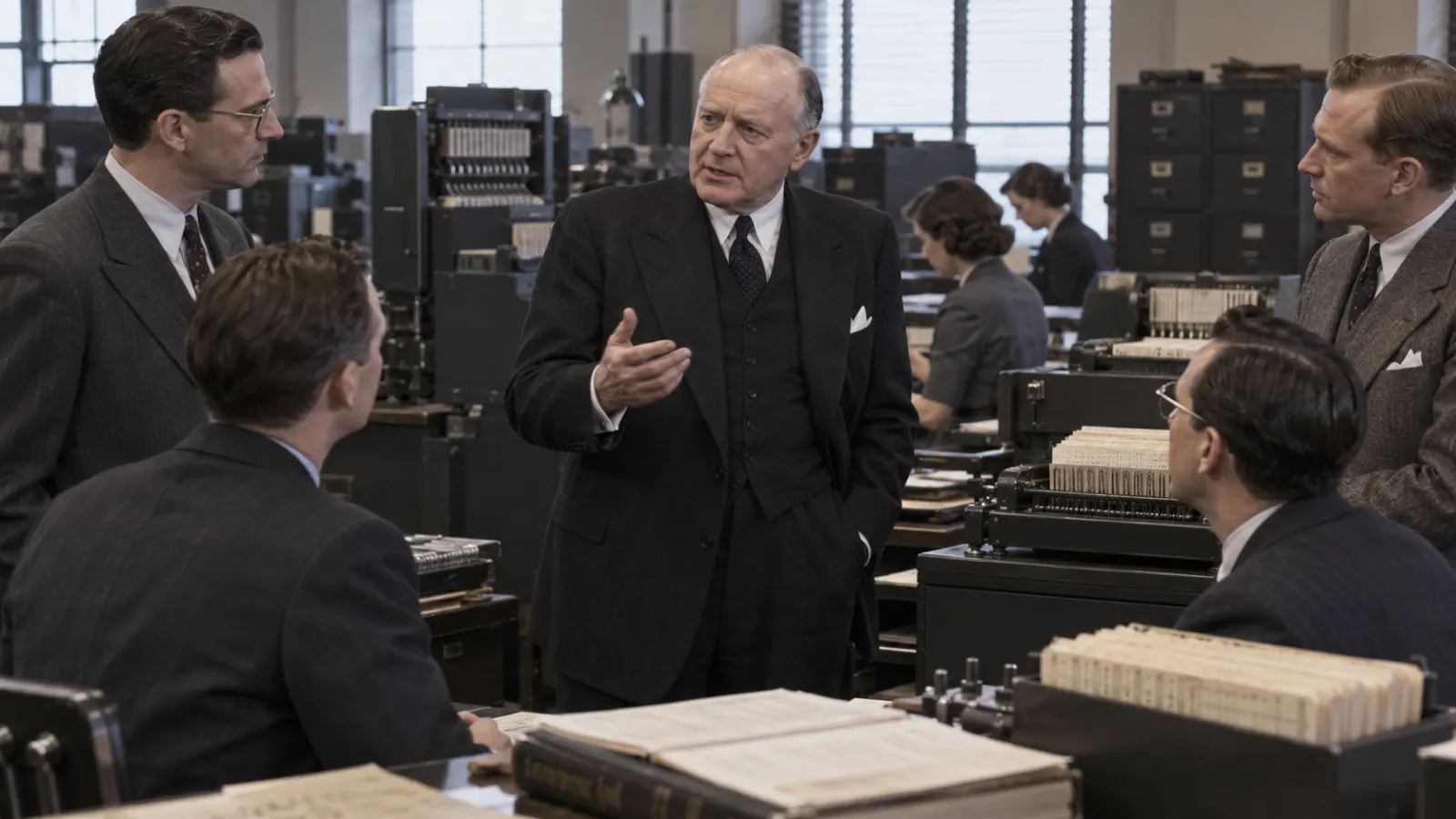
A punched-card installation involved machines, cards, operators, maintenance, training and redesign of administrative procedures. Once an organisation used the system for payroll, inventory, accounting, insurance records or statistics, replacing it meant changing much more than hardware.
Watson organised IBM around that reality.
Salespeople were trained intensively before being sent to customers. IBM's historical records describe six-week training programmes in which recruits learned not only how equipment worked but how businesses could apply it. Maintenance and service created repeated contact with customers, while education reduced the difficulty of adopting unfamiliar machinery.
The salesperson's task was therefore not simply:
“Convince the customer to buy this machine.”
It was closer to:
“Understand how the customer's organisation works, identify where information processing can improve it and then make IBM indispensable to that process.”
This was an early form of what would later be called enterprise systems selling.
IBM also relied heavily on leasing. Under the model that became central to its tabulating business, the company retained ownership of much of its installed equipment while customers paid for use. This strengthened recurring revenue and kept IBM closely involved in maintenance and upgrades. By the 1950s, the company's dominance of tabulating equipment was so closely associated with exclusive leasing that the practice became part of a major U.S. antitrust settlement.
Watson even experimented with another solution for organisations that could not justify owning or leasing their own tabulator. In 1922 he established what became IBM's Service Bureau, allowing customers to send punched-card jobs to shared IBM equipment and pay for processing rather than acquiring machines themselves.
The technical form was primitive compared with today's computing infrastructure.
The commercial logic was remarkably modern:
customers needed processing, not necessarily ownership of the machine providing it.
THINK, education and the carefully engineered IBM culture
Watson's business system required employees to behave consistently across offices and countries.
He responded by making corporate culture unusually explicit.
The most famous symbol was the word:
THINK.
Watson had used the motto at NCR and brought it with him to C-T-R. It appeared on office signs, stationery and notebooks and eventually became one of the most recognisable corporate slogans of the twentieth century. IBM's history records that Watson quickly established it as an official company mantra after arriving at C-T-R.
The slogan is easy to parody.
The surrounding system was more consequential.
Watson wanted employees to be educated continuously. Company libraries, sales schools, management programmes and technical training became normal parts of IBM life. The company opened specialised programmes for executives and sales representatives and eventually established what became an extensive internal educational apparatus.
Training served several purposes simultaneously.
Employees learned the technology.
They learned how to explain it.
They learned IBM's expectations about behaviour.
And they learned to see themselves as members of a professional organisation rather than simply people employed to manufacture or sell machines.
Watson reinforced this identity through conventions, sales clubs, songs, awards and ceremonies. Top performers received public recognition. Managers repeated company principles. Dress and conduct were regulated informally but powerfully.
To an outsider, parts of IBM culture could appear almost religious.
That intensity was intentional.
Watson was trying to solve the organisational problem created by scale: How do thousands of employees working far apart behave as though they belong to one company?
His answer was culture, training and repetition.
There was a more progressive side to the same paternalism.
Watson argued publicly for respect for employees and invested in benefits and long-term employment. IBM moved manufacturing workers away from piece-rate compensation to hourly wages in 1934, and the company developed insurance, education and other employee programmes unusually extensive for the period.
These policies could improve security and professional development.
They also strengthened management's influence over employees' working lives.
Watson's language of the IBM “family” reflected a genuine interest in workforce stability, but families have hierarchies. Employees were expected to display loyalty, discipline and conformity to a corporate culture heavily identified with one man.
The apparent contradiction is important.
Watson could believe sincerely in respect for the individual while simultaneously building an organisation in which individual behaviour was strongly prescribed.
The Depression showed both the power and the risk of institutional patience
The Great Depression tested Watson's willingness to invest for a future that could not be guaranteed.
As businesses failed and capital spending collapsed, manufacturers had strong reasons to reduce staff, production and research. Watson did not respond by simply maintaining every activity unchanged, but IBM's overall strategy was unusually expansionary.
The company continued developing equipment, training people and building capacity while competitors retrenched.
This was dangerous.
Unused production capacity ties up capital. Inventory becomes a liability if customers never return. A company can bankrupt itself by preparing for a recovery that arrives too late.
Watson's bet eventually intersected with a profound expansion of government administration.
The Social Security Act of 1935 created one of the largest data-processing challenges attempted by the U.S. government. Tens of millions of workers had to be identified, wage records processed and contributions tracked.
IBM had precisely the type of infrastructure required.
The company won a major Social Security contract on 16 September 1936 and supplied punched-card systems, including the IBM 077 Collator, for processing enormous quantities of records. IBM's own historical account says company revenue rose 81% between 1935 and 1939, while the Social Security work strengthened relationships not only with government but with employers that now had new payroll-reporting requirements.
This was more than a lucrative contract.
It demonstrated what Watson had built.
IBM possessed engineers who could modify machines, salespeople who understood administrative problems, technicians who could maintain systems and factories capable of producing equipment at scale.
That combination mattered more than any individual machine.
It also showed why information technology would become politically important.
Modern states administer populations through information.
Taxes require records.
Social insurance requires records.
Military logistics requires records.
Censuses require records.
Public-health systems require records.
As governments become administratively more capable, companies supplying the machinery for classification and calculation move closer to the infrastructure of state power.
For IBM, this became simultaneously one of its greatest opportunities and the source of its most difficult historical controversy.
IBM in Nazi Germany: where internationalism met corporate responsibility
Watson believed international commerce could reduce political conflict.
He promoted a philosophy sometimes summarised as “world peace through world trade.” IBM expanded aggressively across national markets, and Watson later argued that employees who could cooperate across countries demonstrated that commerce might encourage cooperation among states. IBM's international ambitions were therefore commercial but also wrapped in an idealistic theory of global business.
Nazi Germany exposed the limits of that idea.
IBM had a German affiliate, Deutsche Hollerith-Maschinen Gesellschaft, generally known as Dehomag. After Hitler became chancellor in 1933, Germany rapidly became a dictatorship characterised by political repression, antisemitic legislation and increasingly systematic persecution of Jews.
Dehomag continued supplying punched-card technology.
What those machines did is important to describe carefully.
Hollerith systems could sort and tabulate large bodies of information far faster than manual clerical methods. The United States Holocaust Memorial Museum notes that such machines were used in Nazi Germany to process census information, including the 1939 census, which recorded racial classifications under Nazi law. The museum also cautions against the stronger popular claim that modern punch-card technology itself located and rounded up the victims of the Holocaust; persecution depended on an enormous system of Nazi institutions, records, denunciations and coercive power.
That distinction does not make the technology ethically irrelevant.
Information systems increase administrative capacity.
They can make classification faster.
They can allow governments to organise complex populations at scales that would otherwise require far more labour.
The harder historical questions concern the relationship between Dehomag and IBM headquarters: how much operational autonomy the German company possessed at different times, what New York executives knew about individual applications, how control changed after war and legal restrictions disrupted international business, and what moral responsibility should attach to a multinational company supplying administrative technology to a dictatorship.
These questions have produced sharply different interpretations.
Edwin Black's IBM and the Holocaust argued that IBM headquarters exercised extensive control and that its technology materially facilitated Nazi persecution. Harvard Business School has subsequently treated Watson's German business explicitly as a case in the responsibilities of multinational companies operating under politically reprehensible regimes. The existence of the controversy itself should not be simplified into either total corporate innocence or the claim that IBM somehow created Nazi policy.
Watson's own conduct adds another layer.
As president of the International Chamber of Commerce, he travelled to Berlin in 1937 and met Adolf Hitler. The Nazi government awarded him the Merit Cross of the Order of the German Eagle with Star, a decoration given to prominent foreigners. Watson accepted it while German Jews were already experiencing systematic discrimination and persecution. He returned the decoration in 1940, after German aggression had dramatically widened the European war.
Accepting the medal does not by itself prove that Watson endorsed the Holocaust; mass extermination had not yet begun in 1937.
But that chronology does not remove the ethical problem either.
By 1937, the regime's dictatorship, racial laws and persecution of Jews were already visible.
The episode shows how Watson's faith in commercial internationalism could become a form of moral distance: a belief that business relationships could remain constructive even when the political system surrounding them had become profoundly destructive.
That is a much more useful lesson than treating the controversy as a simple accusation about one machine.
Enterprise technology companies regularly claim that they merely supply neutral infrastructure.
Watson's IBM demonstrates why neutrality becomes difficult once infrastructure changes what governments are capable of doing.
From punched cards toward electronic computing
Watson's historical importance would be much smaller if IBM had remained only a successful punched-card company.
The technology eventually became obsolete.
What survived was the institution.
Watson had invested for years in engineering and academic relationships. In 1944, IBM's collaboration with Harvard produced the Automatic Sequence Controlled Calculator, better known as the Harvard Mark I, an enormous electromechanical calculating machine.
In 1945, Watson funded the Watson Scientific Computing Laboratory at Columbia University. The laboratory was designed to bring IBM's computational equipment into contact with scientific researchers and became an important precursor of the company's later research organisation.
IBM followed with the Selective Sequence Electronic Calculator, unveiled in 1948. The SSEC combined electromechanical components with electronic computation and helped expose IBM engineers and the public to the possibilities of much faster calculation.
The transition was not smooth or inevitable.
IBM already possessed an enormously profitable business built around punched-card equipment. New electronic computers were expensive, technically immature and initially relevant to a relatively small group of scientific and military customers.
Established companies frequently fail at exactly this moment.
Their existing products work.
Customers still buy them.
Salespeople understand them.
Factories are designed around them.
Replacing a successful system therefore looks riskier than continuing to improve it.
Watson Sr. helped create the research capacity that allowed IBM to experiment beyond tabulation, but his son Thomas J. Watson Jr. became one of the strongest internal advocates for moving decisively into electronics.
The IBM 701, designed beginning in 1951 and entering production in 1952, became IBM's first production electronic computer and an important step toward the company's later mainframe dominance. It was initially aimed heavily at scientific and defence applications rather than the ordinary commercial data processing that punched-card systems already served.
This distinction is important when assessing Watson Sr.
He did not personally devise the technological strategy that would eventually produce System/360 and IBM's greatest mainframe successes.
Those achievements belong primarily to Watson Jr., IBM engineers and the next generation of management.
Watson Sr.'s contribution was more foundational.
He had created a company with enough money, technical capacity, customer trust, sales expertise and research infrastructure to survive the destruction of its original technological base.
Succession may have been Watson's final institutional achievement
Founder-led organisations often struggle when the founder's identity becomes inseparable from the company.
IBM faced exactly that risk.
Thomas Watson Jr. became company president in 1952, while his father remained the dominant senior figure. Their relationship was difficult, and they disagreed over management and the pace of technological change.
The younger Watson wanted IBM to become less dependent on the hierarchical structure built around his father's authority and more capable of responding rapidly to electronic computing.
Their tension was therefore not simply a family drama.
It reflected a broader institutional question:
Could the organisation Watson Sr. had built operate without Watson Sr.?
By the middle of the 1950s, the answer was increasingly yes.
Watson Jr. possessed enough authority to drive the company further into electronics, and IBM had developed professional managers, laboratories, engineers and sales organisations that did not depend on the founder handling every decision personally.
Thomas J. Watson Sr. died on 19 June 1956, aged 82. His son assumed full leadership of a company already positioned for the computing revolution but still years away from some of its greatest technological achievements.
The distinction between the two Watsons should remain clear.
Watson Sr. built the institutional machine.
Watson Jr. pushed that machine much more aggressively into the electronic-computer era.
IBM's extraordinary later success required both.
What Thomas J. Watson Sr. actually built
Watson's career is sometimes retold as though his great achievement was simply “founding IBM.”
That is imprecise.
The company that became IBM existed before he arrived. Hollerith's tabulating technology existed before him. Engineers produced the machines. Later generations drove the company deep into electronic computing.
Watson's contribution was organisational architecture.
He turned selling into a trained profession.
He built customer service into the commercial model.
He used leasing and recurring relationships to create unusually high switching costs.
He invested in employee education because complex products required knowledgeable employees.
He used culture to coordinate a geographically expanding workforce.
He maintained research relationships that allowed IBM to move beyond the technologies on which its early success depended.
And he defined the company broadly enough that it could replace its products without replacing its identity.
That helps explain why the 1924 name mattered.
“Computing-Tabulating-Recording Company” described what the business happened to manufacture.
International Business Machines described a much larger territory in which future products could fit.
Watson was effectively telling the organisation:
Do not confuse the current machine with the business we are actually in.
That is one of the enduring strategic lessons of his career.
But his history also supplies a second lesson that is harder to celebrate.
Organisational strength magnifies consequences.
A company that becomes embedded in payroll, census administration, government records, defence or scientific infrastructure gains more than revenue. It gains a role in what other institutions are capable of doing.
That creates responsibilities that cannot always be discharged by saying the customer decides how the machine is used.
Watson understood remarkably early that technology companies could build durable power by entering the operational systems of their customers.
His legacy demonstrates that the resulting power is not only commercial.
It is ethical.
Thomas J. Watson Sr.'s persistence helped transform an awkward federation of machine companies into IBM. His disciplined sales culture, investment in people, service model and willingness to prepare for technological change created an institution that survived long after the technologies that first made it successful disappeared.
The same global system also placed IBM inside political environments where commercial continuity demanded harder moral judgement than Watson consistently showed.
That makes his story more useful than a simple celebration of a successful executive.
Watson demonstrated how to build a company capable of surviving technological change.
He also demonstrated why the companies that make themselves indispensable cannot treat the consequences of that indispensability as somebody else's responsibility.