John D. Rockefeller: Standard Oil, Monopoly, Philanthropy and a Complicated Legacy
John D. Rockefeller did not discover petroleum, drill America's first commercial oil well or invent kerosene. His extraordinary contribution—and the source of much of the hostility eventually directed at him—was organisation.
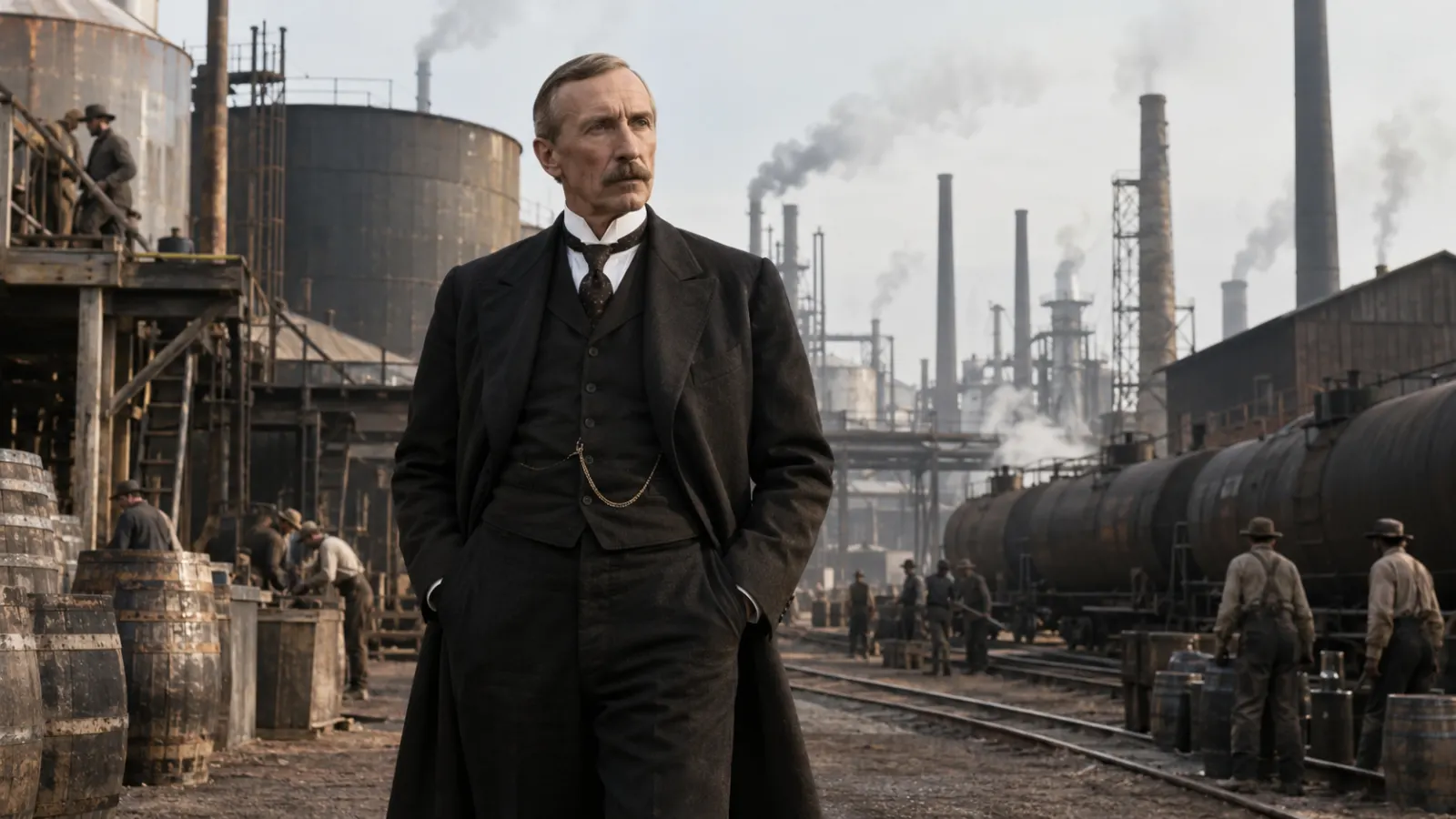
When Rockefeller entered oil refining in the 1860s, the industry was unstable and fragmented. Crude prices fluctuated violently, refineries opened and failed, transport costs could determine survival, fires were common and valuable by-products were frequently wasted. Rockefeller approached the disorder as a systems problem. Costs should be measured. Waste should be reduced. Supplies should become predictable. Transportation should be controlled wherever possible. Profits should be reinvested. Competitors should either be acquired or forced to operate against a company with lower costs and greater scale.
That logic created Standard Oil, one of the most efficient and powerful corporations of the nineteenth century. It standardised products, integrated refining with pipelines, storage, transport and distribution, and helped create the organisational architecture of the modern large corporation. By the late 1880s, Library of Congress material describes Standard Oil as controlling about 90% of American refining, while the Rockefeller Archive Center estimates that it held roughly three-quarters of the broader U.S. petroleum business during the 1890s. The numbers vary because market definitions and dates differ, but the conclusion does not: Standard Oil had achieved extraordinary concentration.
That scale brought genuine efficiencies. It also gave Standard Oil bargaining power unavailable to ordinary competitors. The company negotiated railroad rebates, purchased rival refiners, expanded into pipelines and distribution and used increasingly sophisticated corporate structures to coordinate businesses across state lines. In 1911 the U.S. Supreme Court held that Standard Oil's combination violated the Sherman Antitrust Act and ordered the structure broken apart. The decision became one of the foundational cases of American competition law.
Rockefeller's second empire was philanthropic rather than industrial. He became the founding benefactor of the University of Chicago, created the Rockefeller Institute for Medical Research, supported education and public-health programmes and established the Rockefeller Foundation in 1913. The Rockefeller Archive Center estimates that he gave about $540 million during his lifetime.
The philanthropy was real and historically consequential. It does not resolve the question raised by Standard Oil.
Rockefeller's life therefore remains a case study in one of capitalism's enduring dilemmas: when efficiency and control grow together, when does superior organisation become excessive market power?
Early Life and the Bookkeeper Who Learned to Measure Everything
John Davison Rockefeller was born on 8 July 1839 in Richford, New York, to William Avery Rockefeller and Eliza Davison Rockefeller. His family later moved to Ohio, and Rockefeller attended Central High School in Cleveland before entering the workforce while still a teenager.
His father was an itinerant salesman whose business practices and family presence were unreliable. His mother was deeply religious and emphasised thrift, work and discipline. Those influences created a household in which financial caution mattered.
At sixteen, Rockefeller began working as an assistant bookkeeper in Cleveland. The job was not glamorous, but it was unusually important preparation for his later career. He learned to follow cash, freight costs, credit, margins and accounts with precision. Rockefeller later treated the anniversary of receiving his first job as a personal milestone.
The habit of numerical control would become central to Standard Oil. Oil refining was an industry in which fractions of a cent in transport, barrel costs, wastage or refining yield could determine whether one company survived a price war while another failed.
Rockefeller increasingly viewed business not as a series of dramatic bets but as a system whose uncertainty could be reduced through accounting, scale and disciplined operations.
From Produce Trading to Oil Refining
In 1859 Rockefeller entered a produce commission business with Maurice Clark. The partnership traded commodities and gave him experience with credit, transport networks, buying and selling and relationships with lenders.
The timing was extraordinary. That same year, Edwin Drake completed the famous drilled oil well near Titusville, Pennsylvania, an event generally treated as the beginning of the modern American petroleum industry. The resulting boom drew speculators, drillers and refiners into Pennsylvania and neighbouring states.
Cleveland had significant advantages as a refining centre. It was connected to both rail and water transport, close enough to Pennsylvania's oil fields to receive crude and well positioned to ship refined products toward large eastern and western markets.
Rockefeller became involved in refining during the 1860s and increasingly concentrated his resources there.
The choice reflected his temperament.
Drilling was highly speculative. A producer could invest heavily and find little oil. Refining looked more controllable. If crude could be purchased reliably, a refinery could process it repeatedly, measure costs and improve operations.
Rockefeller preferred the part of the oil business that could most easily be turned into a repeatable industrial system.
Why Rockefeller Became So Good at Refining
Early oil refining was inefficient. Kerosene for illumination was the most important product, but refining crude also produced substances that could easily become waste.
Rockefeller's operations aggressively searched for uses and markets for by-products. Materials that another refinery might discard could be transformed into lubricants, petroleum jelly, paraffin products, paints or other commercial goods. The Library of Congress notes Standard Oil's emphasis on reducing waste and finding markets for refinery by-products.
Quality mattered too. Poorly refined kerosene could be dangerous, and customers needed confidence that a product would perform consistently. Standardisation allowed Standard Oil to build a reputation around reliability as well as price.
Rockefeller also reinvested heavily rather than extracting every available profit for personal consumption. New equipment could improve yields. Larger facilities could lower unit costs. Control over barrels, storage and transport could eliminate suppliers' margins.
This produced a powerful feedback loop.
Higher volume reduced costs.
Lower costs allowed lower prices.
Lower prices increased volume.
Greater volume strengthened Rockefeller's bargaining position with railroads and suppliers.
Those advantages were commercially rational individually.
Combined, they eventually became extremely difficult for competitors to overcome.
Standard Oil Is Created
On 10 January 1870, Rockefeller and his associates organised the Standard Oil Company of Ohio. His partners included his brother William Rockefeller, Samuel Andrews, Henry M. Flagler and Stephen Harkness.
Henry Flagler became particularly important. Rockefeller is so dominant in popular accounts that Standard Oil can appear to have been the product of one person's will. In reality, Flagler was a major strategist and administrator, while many other partners and executives helped build the business.
The company's early expansion was aggressive.
According to the Library of Congress, Standard Oil had acquired, shut or bankrupted 22 of Cleveland's 26 competing refiners within the first three months of 1872. Standard argued that much of this consolidation eliminated inefficient capacity and stabilised a chaotic industry. Critics argued that Rockefeller used advantages created partly by his size to make competitors' positions untenable and then bought them cheaply.
Both observations can be true.
A competitor may voluntarily accept Standard Oil shares because joining the larger organisation offers security.
That decision can still occur in a market where the larger company has made remaining independent increasingly difficult.
This ambiguity lies at the centre of Rockefeller's business legacy.
Railroad Rebates and Why Transportation Became So Controversial
Oil refining depended heavily on transportation. Crude had to move from wells to refineries, and refined kerosene had to reach distant consumers.
Railroads themselves were engaged in fierce competition. They wanted reliable traffic and frequently negotiated special rates with major customers.
Standard Oil's huge and predictable shipment volumes made it an attractive client. The company could promise railroads large quantities of freight, giving it leverage to secure rebates and lower transportation costs that smaller refiners often could not obtain.
Railroad rebates were not invented by Rockefeller. Discriminatory freight arrangements were common in nineteenth-century American commerce.
Standard Oil's scale nevertheless made the benefit unusually powerful. Lower transport costs helped the company undersell competitors. Greater market share then created even greater shipment volumes, strengthening its bargaining position again.
The arrangement illustrates the difference between an ordinary commercial discount and structural market advantage.
A large customer receiving a lower price because it buys more can be economically efficient.
But when the discount becomes so large that smaller firms cannot realistically compete—and when the dominant customer gains information or payments linked to rivals' shipments—the competition problem changes.
The South Improvement Company Scandal
The most politically damaging transportation episode occurred in 1872 with the South Improvement Company, often incorrectly called the Southern Improvement Company.
The proposed arrangement involved major railroads and selected refiners. Participating firms would receive preferential freight rates, while the system also contemplated information and financial advantages connected to shipments made by competitors. Historical Library of Congress material records the contracts and the intense controversy surrounding them.
Independent oil producers and refiners reacted furiously. They feared that Standard Oil and its allies would obtain a transportation structure that made independent competition impossible.
Public opposition became so intense that the arrangement collapsed before it operated as originally intended.
Its reputational effect lasted much longer.
To Rockefeller, railroad agreements were mechanisms for obtaining predictable rates and stabilising transport.
To opponents, the South Improvement plan exposed a willingness to use secret arrangements to obtain advantages competitors could never match.
Standard Oil continued expanding after the plan disappeared.
But the episode became a permanent part of the case against Rockefeller.
Horizontal Consolidation: Buying the Refiners
Rockefeller's first major strategy involved horizontal integration—bringing competing refiners under common control.
The logic was straightforward. Excess refining capacity created repeated price wars. If too many refineries competed for the available crude and customers, margins collapsed.
Rockefeller believed consolidation could rationalise the industry.
Standard Oil purchased refineries, sometimes offering their owners cash and sometimes Standard shares. Owners who accepted stock and remained associated with the enterprise could become wealthy as Standard expanded.
But critics argued that the bargaining process was not always an encounter between equal parties.
A refiner negotiating with Standard Oil knew that refusing could mean competing against a company with lower freight rates, deeper capital, superior infrastructure and the ability to sustain price pressure longer.
The distinction between acquisition and coercion therefore becomes difficult.
Rockefeller rarely needed to threaten competitors in a theatrical sense.
Structural power can make the alternative to selling unattractive enough on its own.
Vertical Integration: Controlling the System Around the Refinery
Standard Oil eventually reached far beyond refinery ownership.
The company developed or controlled pipelines, storage facilities, railroad tank cars, barrel production, terminals, distribution networks and marketing organisations. The Rockefeller Archive Center records that by 1872 Standard already had substantial storage capacity, warehouses and its own cooperage operation for manufacturing barrels.
This vertical integration improved efficiency.
Standard could reduce dependence on suppliers, coordinate shipments, obtain better information and remove external margins.
Pipelines were especially important because they offered an alternative to transporting crude in barrels by rail. Controlling pipelines could dramatically improve logistics.
But integration also increased entry barriers.
A new refiner no longer competed only against another refinery. It confronted an organisation linked to transport, storage, procurement and national distribution.
The same infrastructure that made Standard Oil efficient could make the market less contestable.
This is one reason Rockefeller's story remains relevant to modern competition debates. The difficult question is rarely whether integration creates efficiencies.
It often does.
The difficult question is whether the integrated company can then use control over essential infrastructure to weaken competition elsewhere.
How Standard Oil Became a Trust
Standard Oil's geographic expansion created a legal problem.
Nineteenth-century U.S. corporation law was largely organised at state level. Companies incorporated in one state faced restrictions on owning and controlling companies elsewhere.
Standard Oil wanted central management across a network of businesses operating under different legal identities.
In 1882, its lawyers developed the Standard Oil Trust. Shareholders in multiple Standard-affiliated corporations transferred their shares to a group of trustees and received trust certificates in return. The trustees could then exercise centralised control across companies that remained formally separate.
The Rockefeller Archive Center records an initial trust capitalisation of about $70 million and 42 original certificate holders.
The structure solved an organisational problem brilliantly.
It also transformed American political vocabulary.
“Trust” stopped being merely a technical legal term and became shorthand for enormous concentrations of economic power.
Reformers began talking about the sugar trust, tobacco trust, oil trust and other combinations threatening competition.
Standard Oil therefore helped invent not only a corporate structure but also the political category against which the early antitrust movement organised.
How Much of the Oil Industry Did Standard Oil Control?
This question frequently produces conflicting numbers because sources refer to different years and parts of the industry.
The Library of Congress states that by the late 1880s Standard Oil controlled approximately 90% of American refineries.
The Rockefeller Archive Center estimates that Standard controlled about 75% of the U.S. petroleum business during the 1890s.
The Smithsonian likewise describes Standard as controlling more than 90% of U.S. refinery capacity by the late 1870s in one historical overview.
These figures should not be collapsed into one supposedly precise market share.
Refining capacity, refined-product sales and the broader petroleum business are different measurements. Standard's position also changed over time as pipelines expanded, international competition developed and new oil fields opened.
The responsible conclusion is simpler:
Standard Oil achieved dominant control over American oil refining and related infrastructure during the late nineteenth century.
The exact percentage depends on what is being measured and when.
Did Standard Oil Make Kerosene Cheaper?
One reason Rockefeller remains difficult to place neatly into the “robber baron” category is that Standard Oil did not dominate a market while simply charging consumers ever-higher prices.
Its efficiency helped reduce refining and distribution costs. Kerosene became cheaper and more reliable during the period in which Standard expanded.
Scale enabled investment in technology, standardised quality and national distribution. Waste reduction allowed more of each barrel of crude to become saleable products.
These were genuine economic achievements.
They matter because monopoly cannot be evaluated solely by asking whether the dominant company was incompetent or whether customers immediately paid higher prices.
A company can create lower consumer prices and weaken competitive processes.
This tension eventually became one of the central problems of antitrust economics.
Should competition law intervene only when consumers are currently paying more?
Or should it also protect market structures in which competitors retain a realistic opportunity to challenge dominant firms?
Rockefeller's history helped force American law to confront that distinction.
Ida Tarbell and the Battle Over Rockefeller's Reputation
Rockefeller understood accounting and organisational power much better than public communication.
As Standard Oil became one of America's most controversial corporations, Rockefeller generally avoided the press. That allowed critics to define the company in public with relatively little direct response.
No critic became more influential than Ida M. Tarbell.
Tarbell had grown up in Pennsylvania's oil region, and her family had experienced the economic effects of Standard Oil's expansion. Beginning in 1902, she published a detailed investigation of the company in McClure's Magazine. The work later appeared as The History of the Standard Oil Company.
National Park Service material describes the depth of Tarbell's research, which involved documentary investigation and interviews across the petroleum industry. The Smithsonian credits her work with making Standard Oil's practices understandable to a much wider public and strengthening the reform campaign against monopolistic corporations.
Tarbell's work was not neutral corporate history. It was investigative journalism with a clear critical argument.
But dismissing it merely because she had a perspective would miss why it became so influential.
She translated complex issues—railroad rebates, acquisitions, corporate structures and competitive pressure—into a narrative ordinary readers could understand.
Standard Oil's problem was therefore no longer simply economic.
It had become a problem of legitimacy.
Standard Oil, the Sherman Act and the Rise of Antitrust
Public concern about Standard Oil belonged to a broader late nineteenth-century anxiety about concentrated corporate power.
Railroads, sugar, meatpacking, tobacco and finance were becoming dominated by larger organisations capable of coordinating markets across entire regions.
Congress responded in 1890 with the Sherman Antitrust Act.
The law prohibited certain restraints of interstate commerce and monopolisation, but its early interpretation and enforcement were uncertain.
Standard Oil became the most famous test.
The federal government eventually brought a major case against Standard Oil of New Jersey, associated corporations and individual defendants including Rockefeller.
The question before the courts was not simply:
Is this company large?
The government examined the historical pattern through which the Standard combination had been created and maintained.
That distinction remains fundamental in competition law.
Size can arise because a business serves customers extraordinarily well.
Antitrust law becomes particularly concerned when the company uses exclusionary conduct to prevent competitive challenge.
The 1911 Supreme Court Decision
In Standard Oil Co. of New Jersey v. United States, decided in 1911, the U.S. Supreme Court concluded that the Standard Oil combination violated the Sherman Act.
The opinion did not establish that every business agreement restricting commerce in any imaginable sense was automatically illegal. Chief Justice Edward Douglass White articulated what became known as the rule of reason, under which courts examined whether particular restraints were unreasonable or undue.
The Court ordered Standard Oil's holding-company structure dissolved.
The Library of Congress describes the result as the creation of 34 independent companies, several of which eventually became major petroleum corporations in their own right.
Among corporate descendants that later became familiar through mergers and renaming were companies associated with Exxon, Mobil, Chevron and others.
The ruling became historically significant not only because one giant company was broken apart.
It helped define how American law would approach the tension between ordinary business organisation and unlawful restraints on competition.
The Breakup Did Not Destroy Rockefeller's Wealth
One of the great paradoxes of the Standard Oil case is that Rockefeller did not emerge financially ruined.
He already owned substantial shares in the Standard Oil system. When the company was divided, shareholders received interests in the successor firms.
Investors subsequently valued many of those companies highly.
Rockefeller's combined holdings became extraordinarily valuable.
The Library of Congress notes that headlines in 1916 described him as the world's first billionaire.
This illustrates what antitrust breakup is—and is not.
The objective was not confiscating Rockefeller's fortune as punishment for being rich.
The remedy targeted market structure and corporate control.
Breaking a corporation into competing businesses can reduce one centre of control while leaving the owners of the original firm with valuable shares.
That distinction remains important whenever contemporary commentators equate antitrust enforcement with hostility toward business success.
Competition law is theoretically concerned with how markets function, not simply with how wealthy individual owners become.
Rockefeller Had Already Left Daily Management
By the time the Supreme Court acted, Rockefeller was no longer running Standard Oil day to day.
The Rockefeller Archive Center says he had retired from active leadership in 1896, although he retained the title of president until 1911. Other contemporary historical summaries place his practical withdrawal from daily operations around 1895.
That distinction matters.
Rockefeller deserves responsibility for the corporate system he built, the consolidation strategy he championed and the business practices implemented during his leadership.
He should not automatically be treated as the operational decision-maker behind every action taken by every Standard Oil executive in the years after he had withdrawn.
Historical responsibility should follow evidence rather than surname.
The same principle becomes especially important when examining later Rockefeller family controversies.
Rockefeller's Religious Life and Early Giving
Rockefeller did not begin giving money only after Standard Oil became unpopular.
He was a devout Baptist and gave to religious and charitable causes from relatively early in adulthood. His philanthropic habits expanded as his fortune expanded.
What changed was the scale of the organisational problem.
A man controlling hundreds of millions of dollars could not intelligently evaluate thousands of requests through occasional personal donations.
Rockefeller therefore began developing professional systems for philanthropy, eventually relying heavily on adviser Frederick T. Gates.
Gates encouraged him to think in terms of institutions capable of attacking underlying causes rather than repeatedly providing relief after a problem had occurred.
The Rockefeller Foundation still describes this early philosophy as “scientific philanthropy”—using evidence, expertise and large-scale institutions to address problems systematically.
The language reveals how similar Rockefeller's philanthropic and business instincts actually were.
Both relied on organisation.
Both valued measurement.
Both attempted to operate at scale.
Both concentrated decision-making.
The University of Chicago
One of Rockefeller's most important educational projects was the creation of the modern University of Chicago.
The university formally regards Rockefeller as its founder. Its own archival history records that his contributions ultimately totalled approximately $35 million between the early 1890s and 1910, allowing the institution to emerge rapidly as a major research university.
Rockefeller did not insist that the institution carry his name.
Nor did he try to act as university president or dictate faculty appointments. University records emphasise that he wanted academic leaders and trustees to assume responsibility for management.
This illustrates an important feature of his mature philanthropy.
Rockefeller could be extraordinarily controlling in business while sometimes constructing philanthropic institutions in which professional leaders were expected to exercise substantial operational autonomy.
His influence remained enormous because he determined which institutions received capital.
But the institution itself did not necessarily become his personal administrative department.
Rockefeller University and the Professionalisation of Biomedical Research
Rockefeller's philanthropy had perhaps its most enduring scientific effect through the Rockefeller Institute for Medical Research, founded in 1901 and later renamed Rockefeller University.
Rockefeller University's own history describes it as the first biomedical research centre in the United States. It was modelled partly on European institutions such as the Pasteur and Koch institutes and was intended to create a permanent American organisation devoted specifically to studying disease through laboratory science.
The institute opened laboratories in 1906 and a research hospital in 1910, linking basic science with clinical investigation. Its researchers later contributed to major discoveries in genetics, immunology, infectious disease and other fields.
This was a distinctly Rockefeller form of philanthropy.
Rather than paying one doctor to treat one patient, build an institution capable of training scientists and producing discoveries for decades.
The approach could generate enormous long-term public benefit.
It also placed private wealth in a position to shape which fields of knowledge received unusually strong institutional support.
The General Education Board
Rockefeller's education philanthropy extended beyond individual universities.
The General Education Board, organised in 1902 and federally incorporated in 1903, was created to support education in the United States “without distinction of race, sex, or creed.” The Rockefeller Archive Center records that Rockefeller initially committed $1 million and that his contributions had grown to $43 million by 1907.
The Board supported universities, medical education, public schools, teacher development and agricultural education. It became particularly active in the American South.
Its record also has to be interpreted within the racial realities of the era.
The Board supported education for African-American students as well as white students, but it operated within societies structured by legal segregation and unequal political power.
Philanthropic investment could expand educational capacity without automatically challenging all of the institutions producing inequality.
That is another recurring Rockefeller theme.
Large-scale private intervention can improve particular systems while leaving broader political structures intact.
Hookworm and the Public-Health Turn
Rockefeller increasingly became interested in public health.
In 1909, he established the Rockefeller Sanitary Commission for the Eradication of Hookworm Disease in the American South. The parasite caused serious illness and reduced physical capacity in affected communities.
The Rockefeller Archive Center records that the programme worked across 11 states, funding public education, diagnosis and treatment. More than 25,000 public meetings reportedly reached over 2 million people with information about hookworm and prevention.
The programme helped establish a model in which philanthropy supported organised disease surveillance, education and treatment rather than isolated charitable clinics.
The Rockefeller Foundation later extended public-health work internationally, including programmes addressing hookworm, malaria and yellow fever. The Foundation identifies public health and disease prevention as central to its earliest work.
This model influenced the institutional development of international public health.
It also raised a question that remains relevant today:
When a private foundation has resources comparable to government programmes, who determines which health problems receive priority?
The Rockefeller Foundation
In 1913, Rockefeller established the Rockefeller Foundation with the broad mission of promoting human well-being around the world.
The Foundation still operates under a version of that original mission. Its own current account describes Rockefeller and Gates as pursuing systemic, science-based interventions aimed at solving problems at their roots rather than simply relieving symptoms.
This was philanthropy operating on a different scale from traditional charity.
A foundation could maintain an endowment, employ experts, fund research across countries and continue operating long after the original donor's death.
Rockefeller was therefore helping create the modern model of the large professional philanthropic foundation.
The advantages were significant.
Long-term funding could support science governments neglected.
Institutions could experiment.
Global health campaigns could operate across political boundaries.
The accountability problem was equally significant.
A small number of trustees and experts could influence education, medicine and international development despite never having been elected by the populations affected.
The same organisational scale that made Rockefeller philanthropy powerful made it politically consequential.
How Much Did John D. Rockefeller Give Away?
The Rockefeller Archive Center estimates that Rockefeller gave approximately $540 million to charitable causes during his lifetime.
Directly converting that amount into modern dollars can be misleading because different inflation measures produce radically different figures and because Rockefeller's fortune represented an enormous share of the economy of his time.
The more important fact is institutional.
He did not merely distribute cash.
His philanthropy helped establish or sustain universities, research institutes, education systems and health organisations capable of operating long after individual grants were spent.
That model became influential among later American philanthropists.
It also strengthened a recurring expectation placed on extreme wealth: if a private fortune becomes enormous enough, society increasingly asks not only how it was accumulated but what obligations accompany possession of it.
Rockefeller and Carnegie: Similar Fortunes, Different Philanthropic Styles
John D. Rockefeller and Andrew Carnegie are often discussed together because both accumulated extraordinary Gilded Age fortunes and then devoted huge resources to philanthropy.
Their approaches overlapped but were not identical.
Carnegie became especially associated with public libraries and the idea of giving individuals tools for self-improvement.
Rockefeller increasingly emphasised expert institutions: universities, medical laboratories, education boards and public-health organisations capable of investigating problems scientifically and intervening at scale.
Carnegie articulated his philosophy publicly in The Gospel of Wealth.
Rockefeller was less inclined toward philosophical manifestos and more toward institutional machinery.
Both approaches also concentrated agenda-setting power.
A library community might benefit greatly from Carnegie's donation, but Carnegie had first decided libraries deserved support.
A public-health campaign might save lives through Rockefeller funding, but Rockefeller advisers and foundation officials had first determined that the disease deserved institutional priority.
Private philanthropy can create enormous social value while still raising legitimate questions about democratic accountability.
The Ludlow Massacre and the Importance of Distinguishing Rockefeller Generations
The Rockefeller name became associated with another notorious labour conflict in 1914, the Ludlow Massacre in Colorado.
The event involved striking coal miners and the Colorado Fuel & Iron Company, in which the Rockefeller family held substantial interests.
But historical responsibility must distinguish John D. Rockefeller Sr. from John D. Rockefeller Jr.
By this point the elder Rockefeller was in his seventies and long removed from active Standard Oil management. His son was the Rockefeller family figure most directly involved with Colorado Fuel & Iron and with the crisis and public-relations response that followed.
This does not make the family fortune irrelevant to the company.
It means that ownership, family identity and direct operational responsibility are different categories.
The same standard should be applied throughout Rockefeller's biography.
He should be held responsible for the systems he created and policies he approved.
He should not automatically be assigned every later decision made by companies or descendants connected with his name.
Was John D. Rockefeller a Robber Baron?
The term robber baron captures part of Rockefeller's historical reputation but can obscure as much as it reveals.
The argument against him is powerful.
Standard Oil used secret or preferential railroad arrangements, aggressive acquisitions and integrated infrastructure to build a market position competitors found extraordinarily difficult to challenge. The company's organisational structure became so concentrated that the Supreme Court ultimately ordered it broken apart under federal antitrust law.
The argument in his defence also contains real evidence.
Standard Oil significantly improved refining efficiency, reduced waste, invested in technology, standardised quality and built national and international distribution systems. Consumers benefited from reliable petroleum products whose costs generally fell dramatically during the period.
Neither fact cancels the other.
Rockefeller did not build an inefficient monopoly whose sole function was charging consumers more.
He built an extremely efficient dominant firm whose efficiency and market power became intertwined.
That distinction is why the history remains intellectually useful.
Efficiency Is Not the Same as Competition
Rockefeller's career exposes one of the central questions of modern competition policy.
Suppose a corporation becomes dominant because it is significantly more efficient than its rivals.
It invests heavily.
Customers receive lower prices.
Products improve.
Should regulators simply leave it alone?
Now suppose that same corporation uses its growing scale to secure advantages competitors cannot match, buys potential challengers, controls critical distribution infrastructure and makes future entry increasingly difficult.
Does the fact that current consumers still enjoy low prices make those practices acceptable?
Standard Oil made this question unavoidable.
Competition can produce efficiency.
But an efficient firm can also acquire enough power to weaken the competitive process that originally disciplined it.
This matters because the cost of monopoly may appear not only as today's higher price.
It may appear as tomorrow's missing competitor, innovation or bargaining power.
Standard Oil and the Modern Technology-Platform Debate
Rockefeller died decades before computers, digital advertising or online platforms, but the structure of the argument around Standard Oil feels remarkably current.
Modern technology companies often build integrated ecosystems because integration improves user experience and reduces transaction costs.
A platform may connect customers, developers, logistics, payments and data so efficiently that users prefer the whole system.
That efficiency can create enormous value.
It can also give the platform power over businesses dependent on the infrastructure it controls.
The comparison should not be pushed too literally. Oil pipelines and app stores are not identical industries.
The historical principle is broader.
Infrastructure can be both a source of efficiency and a source of power.
When one company becomes indispensable to participating in a market, competition policy has to ask whether it is using that position to compete on merit or to control the conditions under which others are allowed to compete.
That is essentially the question Rockefeller forced American policymakers to confront more than a century ago.
Rockefeller's Greatest Innovation Was Organisational
Rockefeller is sometimes described as an oil genius, but his most consequential innovation was not petroleum chemistry.
It was creating systems capable of coordinating enormous quantities of capital, information, infrastructure and human activity.
Standard Oil measured costs with unusual precision.
It integrated stages of production.
It standardised processes.
It reinvested.
It developed nationwide management structures.
It created one of the earliest corporate organisations capable of operating at genuinely continental scale.
The trust structure itself was an organisational response to laws that had not been written with corporations of Standard Oil's size in mind.
His philanthropy followed the same pattern.
Instead of giving episodically, build a foundation.
Instead of treating individual cases of disease, build research institutions.
Instead of funding one classroom, create education boards.
Rockefeller thought institutionally.
That was both his greatest strength and the source of the deepest criticism of his life.
Frequently Asked Questions About John D. Rockefeller
Who was John D. Rockefeller? John D. Rockefeller was an American businessman who built Standard Oil into the dominant force in the late nineteenth-century U.S. petroleum industry and later became one of history's largest philanthropists.
When was John D. Rockefeller born? He was born on 8 July 1839 in Richford, New York.
How did John D. Rockefeller make his money? Rockefeller made most of his fortune through oil refining and the integrated petroleum businesses controlled through Standard Oil.
Did Rockefeller discover oil? No. Edwin Drake's famous Pennsylvania well was completed in 1859 before Rockefeller became a major oil refiner.
When was Standard Oil founded? Standard Oil Company of Ohio was organised on 10 January 1870.
What did Standard Oil do? It refined petroleum and progressively expanded into storage, transport, pipelines, distribution and related industries.
How much of the oil industry did Standard Oil control? The exact percentage varies by year and definition. Library of Congress sources describe control of roughly 90% of U.S. refining by the late 1880s, while the Rockefeller Archive Center estimates about 75% of the broader U.S. petroleum business during the 1890s.
What were railroad rebates? They were discounted freight rates negotiated between railroads and large customers. Standard Oil's enormous shipment volumes gave it unusual leverage to obtain favourable transportation terms.
What was the South Improvement Company? It was an 1872 arrangement involving railroads and major refiners that proposed preferential transportation terms and other advantages. Public opposition caused the plan to collapse before it operated as intended.
What was the Standard Oil Trust? It was an 1882 structure that placed shares of multiple Standard-affiliated companies under a central group of trustees, allowing unified control across legally separate corporations.
Why was Standard Oil considered a monopoly? It achieved extraordinary market concentration and was accused of using acquisitions, railroad advantages and integrated infrastructure to restrict competition.
Who was Ida Tarbell? Ida Tarbell was an investigative journalist whose detailed early twentieth-century history of Standard Oil documented and criticised the company's business methods. Her work became one of the classic examples of muckraking journalism.
Why was Standard Oil broken up? The U.S. Supreme Court concluded in 1911 that the Standard Oil combination violated the Sherman Antitrust Act and ordered its central corporate structure dissolved.
How many companies came from the Standard Oil breakup? The 1911 dissolution produced 34 independent companies according to the Library of Congress.
Did the Standard Oil breakup make Rockefeller poor? No. Rockefeller retained shares in the successor companies, and his holdings became extremely valuable.
Was Rockefeller the world's first billionaire? Contemporary reports identified him as the world's first billionaire by 1916, according to the Library of Congress historical overview.
When did Rockefeller stop managing Standard Oil? He withdrew from active leadership during the mid-1890s, although he formally retained the title of president until 1911.
How much money did John D. Rockefeller give away? The Rockefeller Archive Center estimates lifetime charitable giving of approximately $540 million.
Did Rockefeller found the University of Chicago? He was the university's founding benefactor and is officially designated its founder. His gifts ultimately totalled about $35 million.
What became Rockefeller University? Rockefeller founded the Rockefeller Institute for Medical Research in 1901. It later became Rockefeller University and was the first biomedical research centre of its kind in the United States.
What is the Rockefeller Foundation? It is the philanthropic foundation Rockefeller established in 1913 to pursue large-scale work in health, science and human well-being.
What was scientific philanthropy? It was Rockefeller and adviser Frederick Gates's approach of using expertise, evidence and permanent institutions to address underlying causes of social problems rather than relying only on short-term charitable relief.
Was John D. Rockefeller a robber baron? The label reflects real concerns about Standard Oil's concentration and competitive methods, but it does not capture the company's genuine efficiency or Rockefeller's substantial institutional philanthropy. His record is better understood through both dimensions.
John D. Rockefeller's Real Legacy Is the Power of Organisation
The simplest story about John D. Rockefeller is that a ruthless businessman created an oil monopoly and later tried to repair his reputation by giving money away.
The opposite story says an exceptionally disciplined entrepreneur rescued a chaotic industry, made kerosene cheaper and then used his fortune to improve education and medicine.
Neither is enough.
Rockefeller's life becomes clearer when business and philanthropy are understood as expressions of the same underlying instinct.
He believed complex systems could be made more effective through central coordination.
In petroleum, that meant measuring costs, eliminating waste, acquiring rivals, integrating infrastructure and moving enormous quantities of product through one organised system.
The results included lower costs, consistent quality and one of the most sophisticated corporations of the nineteenth century.
They also included extraordinary concentration of economic power.
The more completely Standard Oil solved its coordination problem, the more difficult it became for outsiders to compete against the system.
That is why the argument cannot be reduced to whether Rockefeller was “efficient.”
He clearly was.
The question is what happens after efficiency gives a private organisation control over enough infrastructure, information and market share to influence the rules of competition itself.
The Supreme Court eventually concluded that Standard Oil had crossed the legal line into unlawful restraint of trade.
Rockefeller's philanthropic institutions created another version of the same paradox.
The University of Chicago benefited enormously from concentrated private wealth.
Biomedical science benefited.
Hookworm programmes benefited.
The Rockefeller Foundation created global public-health and scientific capacity that governments and smaller charities might never have assembled on the same scale.
Yet the organisational power belonged to private actors.
Rockefeller and his advisers chose the institutions, problems and methods that deserved extraordinary investment.
That does not make the philanthropy illegitimate.
It makes it powerful.
And power deserves analysis even when its effects are beneficial.
This is why Rockefeller's story remains relevant long after kerosene ceased to be America's central lighting technology.
Modern corporations still argue that scale allows them to serve customers more efficiently.
Regulators still ask whether scale also allows them to suppress competition.
Modern foundations still use private fortunes to fund science, health, education and global development.
Critics still ask why unelected donors should possess such influence over public priorities.
Rockefeller helped make both debates unavoidable.
His most important invention was therefore neither an oil product nor a charitable programme.
It was a particular model of institutional power: concentrate resources, measure relentlessly, integrate operations, recruit specialists and operate on a time horizon long enough to reshape an entire field.
At Standard Oil, that model created efficiencies powerful enough to become a monopoly problem.
In philanthropy, it created institutions powerful enough to outlive him.
That is why John D. Rockefeller cannot be understood simply as a robber baron or benefactor.
He was one of the architects of the modern organisational age—and his life demonstrates both what large institutions can accomplish and why societies eventually demand rules governing how much power those institutions should possess.