Steve Jobs: Apple, Macintosh, Pixar, iPhone and the Leadership Legacy Behind the Myth
Steve Jobs became one of the defining business figures of the personal-computer and smartphone eras, but the popular story about him is often too simple. He did not personally engineer the Apple II, invent the graphical user interface, write the Macintosh operating system, create computer animation or invent the mobile phone. Those achievements depended on engineers, designers, programmers, researchers, artists, manufacturers and executives whose contributions should not disappear inside a founder mythology.
Jobs's importance lay somewhere more complicated and, in many ways, more consequential. He was exceptionally good at recognising when technologies developed by different people could be combined into a product ordinary customers might actually want to use. He treated hardware, software, industrial design, packaging, marketing and even product demonstrations as parts of one experience rather than independent departments.
The Macintosh launch in January 1984 captured that philosophy dramatically. The machine was introduced not simply as a list of technical specifications but as a personal object capable of graphics, typography, sound and direct interaction. The performance helped define Jobs's public reputation as a product presenter, but the underlying achievement was organisational: a large team had been pushed toward a tightly integrated product whose complexity was deliberately concealed from the user.
That ability would reappear after Jobs left Apple, built NeXT, financed Pixar, returned to a struggling Apple and oversaw the eras of the iMac, iPod, iPhone and iPad. His career also exposed the risks of the same concentrated leadership style. Former colleagues described a demanding manager capable of inspiring exceptional work while also humiliating, dismissing or exhausting people around him.
A useful Steve Jobs biography therefore has to hold several truths together. Jobs possessed extraordinary product judgment without being a lone inventor. His intensity sometimes produced focus and sometimes created damaging behaviour. He failed commercially at NeXT hardware but built technology that later helped save Apple. He supported Pixar without directing its films. He transformed Apple after returning, but could do so only with leaders such as Jony Ive, Tim Cook and thousands of engineers and employees.
The legacy is more interesting once the mythology is removed.
Early Life, Adoption and the Silicon Valley Environment
Steven Paul Jobs was born in San Francisco on 24 February 1955 and was adopted by Paul and Clara Jobs. He grew up in what became Silicon Valley while the Santa Clara Valley was rapidly developing into one of the centres of the American electronics industry.
Jobs later attached considerable importance to the craftsmanship he observed from his adoptive father, Paul Jobs, a mechanic and machinist. In later accounts, he used examples such as carefully finishing parts of furniture that customers would never see to express an idea that became important in his product philosophy: quality should extend to aspects of a product that remain invisible.
Jobs attended Reed College in Oregon but left the formal programme after a short period while continuing to audit classes that interested him. His most famous account of this period came in his 2005 Stanford commencement address, where he described taking a calligraphy class that appeared impractical at the time but later influenced his sensitivity to typography when the Macintosh was developed.
The story should not be converted into a formula suggesting that one college course created Apple's design philosophy. Jobs himself used it to make a narrower point: influences that appear disconnected at one stage of life can become useful much later.
After returning to California, Jobs worked at Atari and remained connected with the emerging personal-computer culture through his friend Steve Wozniak. Their complementary abilities became crucial. Wozniak was the stronger electronics engineer and designed the core hardware behind Apple's earliest computers. Jobs recognised that what Wozniak had created could become a commercial product rather than remaining primarily a hobbyist achievement.
Founding Apple and Turning Engineering Into a Product
Apple was founded in 1976, with Jobs and Wozniak at the centre of the venture and Ronald Wayne briefly involved at its formation. The company's beginnings belonged to a wider moment when microprocessors were making personal computing technically possible but the market had not yet settled on what a personal computer should look like or who would buy one.
The Library of Congress identifies 1976 as Apple's founding year and the Apple II as one of the products that helped transform the emerging personal-computer business. The Smithsonian similarly describes Jobs and Wozniak's early work as important to the personal-computing revolution.
The Apple I illustrates the division of strengths that would repeatedly shape Jobs's career. Wozniak's engineering created the computer; Jobs pushed toward commercialisation. He helped secure an order from the Byte Shop and pursued a product that could be sold in assembled form rather than remaining simply a design for hobbyists to reproduce.
The Apple II, introduced in 1977, was far more consequential. Wozniak's technical design remained central, but Jobs pushed the computer toward the appearance of a consumer product. The moulded case, integrated presentation and attention to how the machine would sit in a home distinguished it from many hobbyist systems that looked like exposed electronics or laboratory equipment. The Smithsonian credits the Apple II with helping ignite the boom in personal computing.
Software then amplified the hardware's usefulness. Programs such as VisiCalc showed that personal computers could perform serious business tasks rather than serving only programmers and enthusiasts. Apple grew rapidly and went public in 1980, making Jobs extraordinarily wealthy while still in his twenties.
Success created a problem that would follow him for years: building an exciting product and managing a rapidly expanding corporation are not the same skill.
Xerox PARC, Lisa and the Real Story Behind the Macintosh
The story of Apple and Xerox PARC has often been simplified into the claim that Jobs visited Xerox, saw the graphical user interface and copied it.
The actual history is more interesting.
Researchers at Xerox PARC had developed pioneering ideas involving graphical interfaces, windows, icons, a mouse and networked workstations. Apple personnel visited PARC in 1979, and Jobs immediately recognised the potential of graphical interaction for personal computers. The Computer History Museum notes that Apple's exposure to the Xerox Alto helped confirm the importance of the graphical interface and influenced work that ultimately appeared in the Lisa and Macintosh.
Apple did not simply receive a finished Macintosh design. Its teams developed their own hardware and interface conventions, redesigned elements for lower-cost personal computers and made numerous decisions about menus, typography, software interaction and industrial design.
The Apple Lisa, introduced before the Macintosh, pursued graphical computing at a high price and struggled commercially. Jobs had already lost direct control of the Lisa project when he turned his attention increasingly toward the smaller Macintosh team.
The Macintosh became the environment in which Jobs's management style and product philosophy were displayed most intensely. He demanded fast startup, carefully designed typography, compact hardware and an interface that reduced the need for users to understand the underlying machine. Engineers frequently faced unrealistic schedules and abrupt criticism, but they were also building something that felt substantially different from command-line personal computing.
When the Macintosh was introduced in January 1984, its graphical interface and mouse-driven interaction helped bring ideas previously confined largely to specialist systems into a much wider consumer market. The Computer History Museum preserves records of the Macintosh's 1984 public presentations and places the machine among the major developments in personal computing.
Yet the launch should not be confused with immediate commercial domination. The original Macintosh had only 128 KB of memory, lacked a hard drive and carried a relatively high price. Software availability was limited, and early sales weakened after the initial excitement.
Jobs could create extraordinary attention.
The market still demanded practical execution.
Why Steve Jobs Left Apple in 1985
Jobs had recruited John Sculley, then a senior Pepsi executive, to Apple in 1983 because the rapidly growing company needed more experienced corporate management. The relationship eventually became one of Silicon Valley's most famous executive conflicts.
The Macintosh's commercial problems intensified broader disagreements about Apple's direction and Jobs's management. By 1985 the company's leadership and board increasingly sided with Sculley. Jobs lost operational authority over the Macintosh organisation and unsuccessfully attempted to reverse the power shift.
The common phrase that “Apple fired Steve Jobs” is therefore directionally understandable but technically imprecise. Apple's leadership stripped him of meaningful operating power; Jobs remained chairman temporarily and then resigned from the company in September 1985. Contemporary reporting described him as effectively powerless before his final resignation.
Jobs later turned the episode into a central part of his personal narrative. In the Stanford commencement address, he described being forced out of the company he had helped create as devastating but eventually liberating because it allowed him to become a beginner again.
That interpretation became more persuasive only because later events worked out so well.
Nothing in 1985 guaranteed that Jobs would return to Apple.
Apple itself continued as an important computer company for years after he left. Jobs's next hardware company would produce technically admired machines but fail to achieve significant commercial scale.
His later comeback should therefore not be written backward into history as though it had been inevitable.
NeXT: A Commercial Failure With an Extraordinary Afterlife
Jobs founded NeXT in 1985 with several former Apple colleagues. The company initially targeted universities and technically sophisticated customers with high-end computers built around the same integrated philosophy Jobs had pursued at Apple.
The hardware was visually distinctive and technically ambitious. It was also expensive.
The Computer History Museum describes the NeXT computer as technologically advanced but commercially unsuccessful, while emphasising the importance of its software platform, NeXTSTEP, which combined Unix foundations with sophisticated object-oriented development tools.
This distinction is central to understanding Jobs.
NeXT demonstrates that excellent design and advanced technology do not automatically produce a successful market. Pricing, timing, software ecosystems and customer needs matter.
Yet the company created important technology with a life far beyond the original workstation. At CERN, Tim Berners-Lee used a NeXT computer while developing the first web server and browser. NeXT did not invent the World Wide Web, but its development environment was one of the tools used during the web's creation.
More importantly for Jobs's own future, NeXT's software became strategically valuable to Apple.
By the mid-1990s Apple desperately needed a modern operating-system foundation. In late 1996 the company announced the acquisition of NeXT, bringing its technology—and Jobs himself—back inside Apple.
The company that had failed to become the next Apple helped provide technology that would underpin the actual Apple's next operating-system generation.
Failure had produced an asset.
Pixar Showed a Different Kind of Steve Jobs
Jobs's other major post-Apple venture developed very differently.
In 1986, he purchased the computer division of Lucasfilm and established it as an independent company called Pixar. Pixar's own institutional history records Jobs's purchase and the company's emergence from the Lucasfilm group with roughly 40 employees.
Pixar initially attempted to sell sophisticated graphics hardware. That business struggled commercially, and Jobs continued putting money into the company while its technical and creative teams developed other possibilities.
The creative work was led by people including Ed Catmull, John Lasseter and the studio's artists and technologists. This distinction matters. Jobs was Pixar's owner, financier and later chief executive, but he was not the person directing its animated films or personally developing its animation systems.
The release of Toy Story in 1995, the first feature-length computer-animated film, transformed Pixar's position. The company went public soon afterward, and Jobs's stake made him a billionaire.
Disney ultimately acquired Pixar in 2006, after which Jobs became Disney's largest individual shareholder at the time and joined its board. Pixar's official history records the company's development from the Lucasfilm spinout into a major animation studio.
Pixar is important to the Jobs biography because it complicates the stereotype of a leader who always needed direct control over the creative product.
His most important contribution there was often to fund, protect and negotiate on behalf of a team whose creative expertise exceeded his own.
That lesson would become useful when he returned to Apple and increasingly depended on strong senior partners rather than attempting to personally manage every discipline.
Returning to Apple: Focus Became the Strategy
Jobs returned to Apple after the NeXT acquisition and gradually moved from adviser to effective leader, becoming interim CEO in 1997 and later dropping the “interim” label.
The company he re-entered was very different from the Apple of the early 1980s. Its product line had become confusing, its operating-system strategy was struggling and competitors based around Microsoft's Windows ecosystem dominated the personal-computer market.
Jobs's first major strategic move was not to invent dozens of new products.
It was to eliminate them.
Apple reduced projects and concentrated its resources around a much smaller product matrix. This discipline of subtraction became one of Jobs's most important management ideas: a company could damage itself by pursuing too many respectable opportunities instead of concentrating exceptional resources on a few.
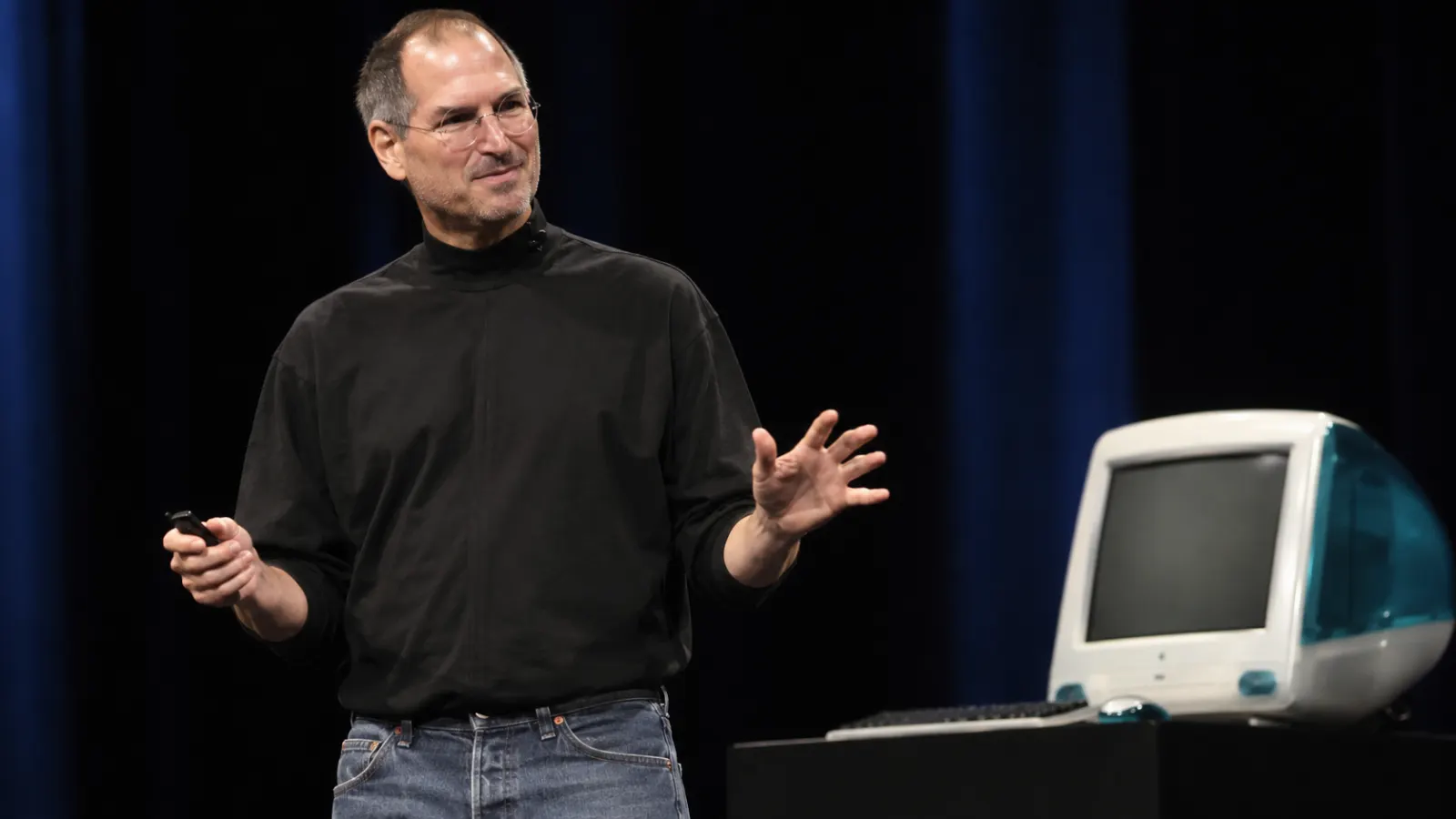
The iMac, introduced in 1998, became an early symbol of the revived company. Its translucent industrial design, emphasis on internet connectivity and simplified product positioning made Apple visually distinctive again.
But Apple's recovery was not simply a design victory.
Tim Cook, who joined the company in 1998, radically strengthened operations and supply-chain management. Jony Ive and Apple's industrial-design team became central creative partners. Software engineers built the operating-system foundations descended from NeXT technology. Retail, logistics, component sourcing and manufacturing had to perform at enormous scale.
The mature Jobs therefore operated less as a person personally making everything and more as an editor of an institution.
He concentrated priorities, selected senior talent and forced teams with different expertise to solve the same product problem.
The iPod and iTunes: Integration Became the Business Model
At the beginning of the 2000s, Apple remained primarily a computer company. Jobs and his leadership team began presenting the Mac as a digital hub for a growing collection of cameras, music players and other digital devices.
The iPod, introduced in 2001, demonstrated the emerging strategy.
Portable digital music players already existed. Apple's achievement was not inventing the category from nothing. It was reducing the friction across several parts of the experience: device design, navigation, computer software, music management and later legal digital purchasing through the iTunes Store.
The system mattered more than any one component.
This approach also required business negotiation. The recording industry was struggling with digital piracy and uncertainty about how to sell music online. Apple persuaded major labels to participate in a system that made purchasing individual tracks simple and tightly connected the store, software and iPod.
Jobs's broader insight was increasingly clear: consumer technology could gain enormous value when hardware, software, services and content relationships were designed as one system.
That philosophy would reach a much larger scale with the iPhone.
The iPhone Was an Integration Breakthrough, Not an Invention From Nothing
Jobs introduced the original iPhone on 9 January 2007 as a device combining a mobile phone, internet communication and the functions of an iPod. Apple's original announcement emphasised its multitouch interface and the replacement of much physical-button interaction with a software-controlled screen.
Apple did not invent the telephone, smartphone, touchscreen, internet browser or mobile applications.
The significance of the iPhone was architectural.
Apple controlled the device hardware, operating system, interface, browser and industrial design as parts of one tightly coordinated product. A large capacitive multitouch screen allowed software to determine much of what the interface looked like rather than forcing every application through permanent physical buttons.
The first iPhone was also incomplete by later standards. It lacked 3G mobile networking, copy and paste, video recording and third-party native applications at launch.
The App Store, opened in 2008, fundamentally expanded the concept. The smartphone became not simply a device containing a fixed set of manufacturer-selected functions but a platform on which outside developers could build businesses and services.
Photography, navigation, ride-hailing, messaging, banking, media consumption, retail and many other activities were progressively reorganised around smartphone software.
Jobs did not personally create those industries.
But the product architecture he helped drive provided one of the platforms on which they grew.
The iPad and Jobs's Ability to Judge Timing
Apple introduced the iPad in January 2010. Tablet computers had existed for many years, just as portable music players and smartphones had existed before Apple's versions.
Apple's official announcement positioned the iPad between smartphones and notebook computers, built around multitouch interaction, mobile applications, battery efficiency and an increasingly mature iPhone-derived software ecosystem.
The recurring pattern is important.
Jobs was not usually the first person to encounter an idea.
His unusual strength was often determining when a collection of technologies had matured enough to produce a mass-market experience.
A tablet launched before displays, processors, batteries, wireless networking and touch software were ready could remain a specialist curiosity. Once those components reached sufficient quality simultaneously, the same broad concept could become commercially viable.
This is why measuring Jobs primarily by a list of technologies he “invented” creates the wrong test.
His strongest talent was often integration plus timing.
Steve Jobs's Major Products and Companies
| Period | Product or company | Jobs's most important role |
|---|---|---|
| 1976 | Apple I | Commercialising Wozniak's computer and turning the project into a company |
| 1977 | Apple II | Pushing toward a more complete consumer product and building the business around it |
| 1984 | Macintosh | Driving product integration, interface priorities, design and launch storytelling |
| 1985 | NeXT | Founding an integrated hardware/software company after leaving Apple |
| 1986 onward | Pixar | Financing, governing and negotiating for the computer-animation company |
| 1997–1998 | Apple turnaround / iMac | Simplifying the product portfolio and restoring design-led focus |
| 2001 | iPod | Integrating hardware, software and digital music management |
| 2003 | iTunes Store | Building a legal digital-content ecosystem around Apple hardware |
| 2007 | iPhone | Integrating multitouch hardware, software and mobile internet into a new smartphone architecture |
| 2008 | App Store | Extending the iPhone into a third-party software platform |
| 2010 | iPad | Bringing mature touch computing into a mass-market tablet product |
The table also illustrates why the lone-genius narrative is misleading.
Every item required large teams.
Jobs's influence was usually strongest at the boundaries between disciplines, where engineering decisions became user-experience decisions and product decisions became business strategy.
Design Was Not Decoration to Jobs
Jobs spoke frequently about design, but he did not use the word simply to mean appearance.
For Apple, product design increasingly included the physical enclosure, materials, internal component arrangement, software interface, sounds, packaging, retail presentation and interaction between devices and services.
That is why his partnership with Jony Ive became so important. Ive and Apple's industrial-design organisation did not merely convert Jobs's sketches into finished objects. The design process relied on prototypes, manufacturing knowledge, materials research and iteration among design and engineering teams.
Jobs's role was powerful because he could elevate design choices to the level of corporate strategy.
A component might be rejected not only because it failed technically but because it made the product too thick, noisy or confusing. Software teams could be asked to change behaviour because of how hardware should feel. Packaging could receive serious attention because the first minutes of using the product were treated as part of the experience.
This integration sometimes increased product coherence.
It also contributed to Apple's preference for closed systems and strong central control.
The same philosophy that allowed the company to make hardware and software work unusually well together could limit user modification, third-party flexibility and repairability.
Product integration therefore brought both advantages and trade-offs.
The Reality Behind the “Steve Jobs Invented Everything” Myth
Jobs's historical importance does not require giving him credit for inventions he did not make.
Steve Wozniak was indispensable to Apple's earliest engineering.
Graphical computing had deep roots in research institutions such as Xerox PARC.
The Macintosh was created by a team that included numerous hardware and software engineers, designers and managers.
NeXT's software depended on engineers with deep operating-system expertise.
Pixar's films were created by directors, writers, animators and computer scientists.
The iPod, iPhone and iPad were produced by enormous organisations involving industrial designers, chip engineers, software developers, manufacturing specialists and suppliers.
The Smithsonian's exhibitions on Jobs's patents illustrate a related point: Jobs appears on large numbers of design and technology patents, but patents themselves often show collaborative invention rather than a solitary inventor working alone.
Jobs's distinctive contribution was product synthesis.
He could examine technology not merely as an engineer asking whether it worked but as a user asking whether the overall experience made sense.
That is a real form of innovation.
It simply differs from personally inventing every underlying technology.
The Management Problem: High Standards Versus Harmful Behaviour
Jobs's management style remains one of the most controversial parts of his legacy.
Accounts from former employees describe a leader who could generate enormous urgency, challenge teams to achieve results they considered impossible and reject mediocre work quickly. The same accounts also describe public criticism, abrupt judgments, emotional volatility and behaviour that could make colleagues fearful or exhausted.
The temptation in business culture is to connect these facts too neatly.
Apple produced extraordinary products.
Jobs could behave harshly.
Therefore, harsh behaviour must have produced extraordinary products.
That conclusion does not logically follow.
High standards require clear judgment, accountability and willingness to reject inadequate work. They do not inherently require humiliation or contempt.
Jobs himself also changed over time. His later Apple leadership relied on a stronger senior executive group and greater organisational maturity than the structure he had managed during his first period at the company. The Steve Jobs Archive preserves his later description of the chief executive's role in terms of recruiting excellent people, establishing direction and motivating them—not personally performing every function.
The useful management lesson from Jobs is therefore not to copy his temperament.
It is to understand the value of focus, product judgment, strong teams and the ability to say no.
Marketing and the Product Launch as Explanation
Jobs also changed expectations about technology presentations.
His product launches were carefully structured narratives. He usually began with a problem or an existing product category, explained why current solutions were inadequate and then positioned the new Apple product as a simpler or more coherent answer.
The famous theatrical elements—the black mock turtleneck, sparse slides, demonstrations and “one more thing” moments—were techniques.
The deeper skill was framing.
A technical company can know exactly how its product works while failing to explain why a customer should care. Jobs repeatedly forced Apple to translate engineering advantages into understandable human consequences: more music in a pocket, direct touch interaction, a thinner notebook or information synchronised across devices.
This ability should not be dismissed as “only marketing.”
Marketing becomes strategically important when it forces a company to answer a difficult question:
What is the product actually for?
At the same time, presentation should never be confused with the engineering itself. A brilliant launch cannot make a poor product durable, reliable or useful.
Jobs's strongest launches succeeded because the storytelling and the product usually reinforced each other.
Health, Privacy and the Limits of What Outsiders Can Know
Jobs's health became a major public issue during his final years because Apple was unusually associated with its founder's personal leadership.
He was diagnosed with a pancreatic neuroendocrine tumour, a rare form of pancreatic cancer distinct from the more common and generally more aggressive pancreatic adenocarcinoma. He underwent surgery in 2004. Contemporary reporting based on Jobs's own communication to Apple employees described the tumour as an islet-cell neuroendocrine tumour.
Jobs had delayed surgery while exploring other approaches after the original diagnosis. That decision has since been used repeatedly as a warning about relying on alternative medicine for potentially treatable cancer.
A careful account should stop before claiming a precise counterfactual.
It is reasonable to say that delaying recommended cancer treatment can carry serious risk and that Jobs did postpone surgery. It is not possible for outside observers to calculate with certainty exactly how long he would have lived under a different treatment sequence.
In 2009, Jobs received a liver transplant and later acknowledged the transplant publicly. His deteriorating health led to several periods of medical leave, with Tim Cook taking increasing responsibility for Apple's day-to-day operations.
This created another question beyond medicine: how much health information does the chief executive of a major public company owe shareholders when investors view that executive as unusually important to the company's value?
Jobs strongly valued privacy.
Markets wanted information about succession and continuity.
The tension remains relevant whenever a corporation becomes heavily identified with one founder.
Resignation, Death and the Succession Test
On 24 August 2011, Jobs resigned as Apple's chief executive and recommended Tim Cook as his successor. Apple's board appointed Cook CEO and elected Jobs chairman.
Jobs died on 5 October 2011, aged 56.
At the time, a serious question surrounded Apple: had Jobs built an institution capable of surviving him, or had he created a company dependent on his personal taste?
The answer can now be judged across a much longer period.
Cook led Apple for 15 years, expanding its operations, services business, wearable-device ecosystem and global scale while overseeing major technical transitions such as Apple-designed processors for the Mac. Whatever differences existed between Cook's operational leadership and Jobs's product-centred style, Apple clearly did not collapse when its founder disappeared.
The succession story acquired another chapter on 1 September 2026, when Cook moved into the role of executive chairman and hardware leader John Ternus became Apple's CEO following a succession process Apple said had been planned over the long term.
That transition is relevant to Jobs's legacy because the institutional question has now moved beyond even his immediate successor.
A company that once appeared inseparable from one founder has entered a third chief-executive era.
The strongest evidence of founder success may ultimately be an organisation that can continue after the founder is no longer capable of directing it.
What Steve Jobs's “Vision” Actually Meant
The word visionary is attached to Jobs so frequently that it can become meaningless.
He did not possess supernatural knowledge of future inventions.
A more precise description is that Jobs developed a strong theory about how consumer technology should be organised.
He believed technology should hide unnecessary complexity from users. Hardware and software should be designed together when integration improved the result. Design should influence engineering decisions from the beginning rather than decorate a finished product. Companies should concentrate resources on a limited number of products instead of maintaining sprawling portfolios. Customers might respond more meaningfully to a functioning product than to abstract market-research questions about inventions they had never experienced.
Most importantly, Jobs repeatedly treated the entire system as the product.
The iPod was stronger because iTunes existed.
The iPhone became more valuable because software, hardware and later the App Store worked together.
The Mac depended on the interaction of physical hardware and operating system.
Apple stores affected how customers discovered and received support for devices.
That systems view became one of Apple's strongest competitive advantages.
It also produced one of its most persistent criticisms: the same integration gave Apple extensive control over what users, developers and repairers could do within its ecosystem.
Vision can create coherence.
Coherence can also create control.
What Entrepreneurs Should—and Should Not—Learn From Steve Jobs
Jobs has become a recurring model for founders, but copying visible behaviour can produce exactly the wrong lessons.
The useful lesson is focus. Apple's revival involved killing products and concentrating resources.
Another is cross-functional integration. Engineers, designers and marketers should not work as though their decisions never affect one another.
A third is product clarity. A company should be able to explain why the product improves the user's experience rather than hiding behind technical specifications.
A fourth is recruiting people better than the founder in specialist disciplines. Jobs's later success depended on people such as Ive and Cook precisely because one person could not master industrial design, manufacturing, logistics, software and global operations simultaneously.
The wrong lesson is that exceptional leaders should humiliate employees.
Another wrong lesson is that customers never matter because Jobs supposedly ignored market research. Apple observed users, competitors, technology trends and market behaviour extensively; rejecting simplistic surveys is not the same as ignoring evidence.
Nor should founders conclude that secrecy or centralisation is always beneficial. Those practices worked within a particular product strategy and organisational context and carried substantial disadvantages as well.
The strongest lesson from Jobs is therefore not a personality template.
It is an approach to prioritisation and integration.
Common Myths About Steve Jobs
One myth is that Steve Jobs invented the personal computer. He did not. Personal computing emerged from the work of many companies and engineers, while Wozniak was the principal technical creator of Apple's earliest machines.
Another is that Apple invented the graphical user interface. Graphical interfaces had important predecessors, particularly at Xerox PARC. Apple's contribution was helping adapt and commercialise graphical interaction for mass personal computing.
It is also misleading to say that Jobs was simply fired from Apple one morning in 1985. He lost operational authority following a power struggle, remained chairman temporarily and then resigned months later.
Another myth is that Jobs created Pixar's films. He played a crucial ownership, financing and strategic role, while the studio's films were created by Pixar's directors, artists and technical teams.
Nor did Apple invent the smartphone or tablet computer. The significance of the iPhone and iPad lay largely in integration, interface design, timing and the software ecosystems that formed around them.
Finally, Apple did not prove that abusive management is necessary for innovation. Jobs's achievements demonstrate the value of standards and focus; they do not establish that humiliation is an essential management technique.
Frequently Asked Questions About Steve Jobs
Who was Steve Jobs? Steve Jobs was an American entrepreneur and product executive who co-founded Apple, founded NeXT, became Pixar's principal owner and later returned to Apple, where he oversaw products including the iMac, iPod, iPhone and iPad.
When was Steve Jobs born? He was born on 24 February 1955 in San Francisco, California.
Who founded Apple with Steve Jobs? Steve Wozniak was Jobs's principal technical co-founder, while Ronald Wayne was briefly part of the company's original founding partnership. Apple was established in 1976.
Did Steve Jobs invent the Apple computer? Jobs played a major commercial and product role, but Steve Wozniak designed the core electronics of the Apple I and Apple II.
Did Steve Jobs invent the graphical user interface? No. Graphical-interface concepts were developed by earlier researchers, including teams at Xerox PARC. Apple helped commercialise and extend those ideas through products such as Lisa and Macintosh.
Why was Steve Jobs removed from Apple? A conflict with CEO John Sculley and Apple's leadership intensified after Macintosh sales problems and disagreements about management. Jobs lost operational authority in 1985 and later resigned.
What was NeXT? NeXT was the computer company Jobs founded after leaving Apple. Its hardware struggled commercially, but its NeXTSTEP software became strategically important and helped provide foundations for Apple's later operating systems.
Did Steve Jobs create Pixar? Jobs purchased Lucasfilm's computer division in 1986 and established it as the independent company Pixar. He financed and led the business, while Pixar's artistic and technical teams created its films.
Did Steve Jobs invent the iPhone? No single person invented the iPhone. Jobs was a central product and executive leader who drove the integration of hardware, software, multitouch interaction and mobile internet into Apple's product.
When was the iPhone introduced? Jobs introduced the first iPhone on 9 January 2007, and it went on sale later that year.
When was the iPad introduced? Apple unveiled the original iPad on 27 January 2010.
What type of cancer did Steve Jobs have? Jobs had a pancreatic neuroendocrine tumour, a rarer form of pancreatic cancer distinct from the more common pancreatic adenocarcinoma. He underwent surgery in 2004.
Did Steve Jobs receive a liver transplant? Yes. He received a liver transplant in 2009 and later discussed it publicly.
When did Steve Jobs resign as Apple CEO? He resigned on 24 August 2011, when Tim Cook became CEO and Jobs became chairman.
When did Steve Jobs die? Jobs died on 5 October 2011 at the age of 56.
What was Steve Jobs's greatest strength? His strongest contribution was arguably product integration: recognising how engineering, software, design, manufacturing, business models and communication could be coordinated into a coherent user experience.
Was Steve Jobs a good manager? The answer depends on the standard used. He produced extraordinary strategic focus and inspired demanding work, but numerous accounts also describe behaviour that was volatile, demeaning or difficult. His leadership should not be reduced to either admiration or condemnation.
Who succeeded Steve Jobs? Tim Cook succeeded Jobs as CEO in 2011 and led Apple for 15 years. On 1 September 2026, John Ternus became Apple's CEO while Cook moved to executive chairman.
Steve Jobs's Real Legacy Is More Interesting Than the Lone-Genius Story
The easiest version of the Steve Jobs story is also the least useful.
In that version, one brilliant founder invents the personal computer, steals ideas from Xerox, gets expelled from his own company, creates Pixar, returns triumphantly and then personally invents the iPod, iPhone and iPad.
Real history is less cinematic.
Steve Wozniak's engineering made early Apple possible.
Graphical computing had important predecessors at Xerox PARC and elsewhere.
The Macintosh was built by a team.
NeXT's software depended on highly skilled engineers.
Pixar's success belonged to its artists, directors and technologists as well as the executive who financed the company.
Apple's recovery depended on Ive, Cook and thousands of employees whose names never appeared on the keynote stage.
The more interesting question is why Jobs mattered so much despite all of that.
He mattered because modern technology is rarely only an engineering problem.
A powerful processor inside an incomprehensible product may fail.
Beautiful industrial design wrapped around unreliable software may fail.
Advanced software without a viable business model may fail.
A brilliant product that nobody understands may fail.
Jobs repeatedly worked at the intersection of those problems.
He demanded that engineering become usable.
He pushed designers to think about manufacturing.
He forced product teams to eliminate features as well as add them.
He used marketing to explain a product's purpose rather than merely advertise its specifications.
He recognised that sometimes the most powerful product was not one device but an ecosystem in which devices, software and services reinforced one another.
That is a more defensible description of his “vision” than pretending he could see inventions before everyone else.
His failures are equally instructive.
The original Macintosh showed that extraordinary design could still encounter price and performance constraints.
His first Apple tenure showed that product intuition did not automatically translate into mature organisational leadership.
NeXT showed that technically impressive products could fail commercially.
His treatment of employees demonstrated that high standards can become entangled with unnecessary cruelty.
His health history showed the limits of control even for a leader famous for imposing control on nearly everything around him.
What changed during his second Apple period was not that Jobs became a completely different person.
He became better at constructing an organisation around his strengths.
He had Ive in design.
Cook in operations.
Strong software and hardware organisations.
A retail strategy.
An increasingly sophisticated global supply chain.
A clearer product portfolio.
That institutional design ultimately mattered as much as any keynote.
Jobs's final succession decision provides the clearest evidence. He chose Tim Cook, a leader whose personality and expertise differed sharply from his own rather than attempting to create another Steve Jobs. Apple then survived and expanded for 15 years under Cook before moving into another planned CEO transition in September 2026.
The founder's greatest achievement was therefore not merely leaving behind several famous devices.
Products eventually become obsolete.
The original Macintosh became history.
The classic iPod disappeared.
Even the iPhone continually replaces its previous form.
A more durable achievement was establishing a way of thinking about technology: engineering, design and user experience should be treated as one problem rather than three separate departments.
That approach influenced not only Apple but the wider technology industry.
Steve Jobs did not create the digital age alone.
He became one of its most influential editors.
And once the lone-genius myth is removed, that achievement becomes easier—not harder—to understand.