How Infections Spread: The Chain of Infection, Transmission Routes and Prevention
Understanding how infections spread is more useful than simply knowing that “germs are everywhere.” Bacteria, viruses, fungi and parasites can cause infectious disease, but many microorganisms around us are harmless or beneficial. Even encountering a pathogen does not automatically mean that infection will occur.
For an infection to spread successfully, several things have to line up. A pathogen needs a source or reservoir, a way to leave that source, a route to travel, an entry point into another person and a host who is susceptible enough for the organism to establish infection. CDC and NIOSH describe this sequence as the chain of infection. Breaking any important link can interrupt transmission.
That framework explains why infection prevention is not about trying to sterilise ordinary life. Different pathogens move in different ways. Cleaner indoor air matters for many respiratory infections. Handwashing is especially important when hands can carry pathogens toward the eyes, nose, mouth or food. Safe water and sanitation interrupt fecal-oral transmission. Sterile needles and blood-safety procedures address bloodborne infections. Mosquito control matters for vector-borne diseases.
The useful question is therefore not simply “Where are the germs?” It is “How can this particular pathogen get from its source into another susceptible person?”
What Is the Chain of Infection?
The classic chain of infection contains six connected elements: an infectious agent, reservoir, portal of exit, mode of transmission, portal of entry and susceptible host. NIOSH uses this framework to show that disease transmission requires more than the mere presence of a microorganism.
The infectious agent is the pathogen capable of causing disease. The reservoir is where that organism normally lives or persists. The portal of exit is how it leaves the source—for example through respiratory secretions, blood or stool. The mode of transmission is how it moves to another host. The portal of entry is the route by which it gets into the next person's body. The final link is a susceptible host.
This chain should not be imagined as a perfectly literal sequence for every infection. Real transmission can involve complex environmental and biological pathways. But as a prevention model it is extremely useful because it turns a vague problem into a series of possible intervention points.
A healthcare worker may block transmission by cleaning hands before touching a patient. A vaccination programme may reduce host susceptibility. A food-safety system may prevent contaminated food from reaching consumers. A ventilation system may reduce the concentration of infectious respiratory particles indoors.
Each intervention acts on a different link.
Reservoirs: Where Infectious Agents Come From
Humans are common reservoirs of infection, but they are far from the only ones. CDC identifies people, animals and environmental sources as important parts of infectious-disease transmission. Reservoirs can include respiratory tracts, skin, blood, gastrointestinal systems, food, water, soil, surfaces and specialised environmental niches.
An infected person may spread a pathogen while visibly ill, but symptoms are not required for transmission. Some infections can spread before symptoms begin. Other people may remain asymptomatic or carry microorganisms without developing disease themselves.
This is an important reason why “avoid obviously sick people” cannot be a complete infection-prevention strategy. It can reduce some exposure, particularly during acute respiratory illness, but pathogens are sometimes transmitted before either person realises an infection is present.
Animal reservoirs also matter. Many infectious diseases are zoonotic, meaning pathogens circulate primarily or partly in animals and can sometimes infect humans. Other pathogens depend on environmental reservoirs such as contaminated soil or water.
The reservoir determines what kind of intervention is realistic. Human-to-human transmission may respond to isolation, vaccination or hygiene. A waterborne infection may require sanitation infrastructure. A pathogen circulating through an animal population may need veterinary surveillance or vector control.
How Respiratory Infections Spread
Breathing, talking, singing, coughing and sneezing release respiratory particles across a range of sizes. Some particles settle relatively quickly, while smaller particles can remain suspended in air and accumulate indoors, particularly when ventilation is poor.
This is why the old idea that respiratory infections must be classified as either purely “droplet” or purely “airborne” can be misleading when applied too rigidly. Different pathogens, particle sizes, distances, environments and activities contribute differently to transmission.
The practical prevention measures overlap. Someone who is acutely ill can reduce exposure by staying away from others when possible. Covering coughs and sneezes limits direct release toward nearby people and surfaces. Cleaner indoor air lowers the concentration of infectious particles. Well-fitting masks can provide an additional layer of protection in situations where exposure is more likely or consequences are greater.
CDC's current respiratory-virus guidance recommends a layered approach that includes recommended immunisation, hygiene, cleaner indoor air and precautions when sick. After returning to normal activities following an illness, additional measures such as masks, distancing, testing and cleaner air can be particularly useful around people at higher risk of severe disease.
Ventilation matters because respiratory particles generally become more concentrated indoors than outdoors. Bringing in outdoor air, filtering recirculated air and improving building ventilation can reduce exposure. CDC/NIOSH specifically notes that better ventilation lowers airborne viral concentrations and therefore lowers the amount occupants may inhale.
Hands and Surfaces: How Contact Transmission Works
Hands frequently act as vehicles of transmission rather than being the original source of infection. They touch people, food, bodily fluids, animals and shared objects, then can carry microorganisms toward the mouth, nose, eyes, wounds or food.
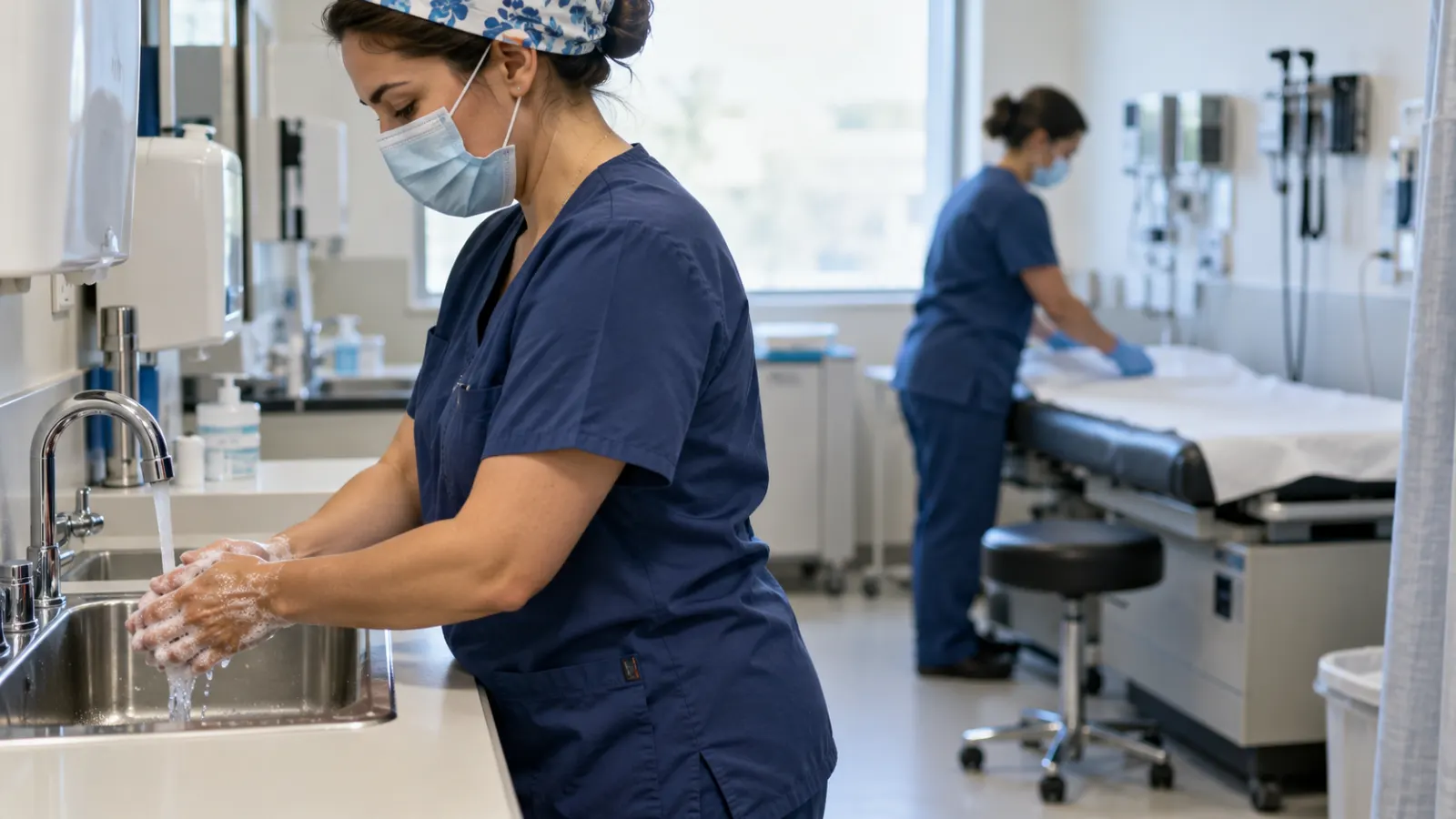
This is why handwashing is one of the most useful infection-prevention measures. Soap and water physically remove microorganisms and contaminants from the skin, making it less likely that hands will transfer them to an entry point or another person.
CDC recommends washing hands with soap and water in key situations and using an alcohol-based hand sanitizer containing at least 60% alcohol when soap and water are unavailable in many everyday circumstances. Sanitizer is not interchangeable with handwashing in every situation: soap and water are more effective for certain organisms and when hands are visibly dirty or greasy.
Surfaces can also participate in transmission, but their importance varies greatly by pathogen. Detecting viral or bacterial material on a doorknob does not automatically prove that touching the doorknob is a major source of infections. Some pathogens lose infectivity quickly outside the body, while others persist much longer and transfer efficiently through hands and surfaces.
That means cleaning should be proportionate. Routine cleaning of frequently touched surfaces is sensible, especially during illness. Constantly disinfecting every household object is usually unnecessary unless there is a specific pathogen or outbreak for which surface transmission is especially important.
Norovirus is an important example. CDC emphasises that the virus can spread through contaminated hands, food and surfaces and that soap-and-water handwashing is preferable because hand sanitizer alone does not work well against norovirus.
This is precisely why infection control should be matched to the pathogen rather than turned into one universal cleaning ritual.
Fecal-Oral, Foodborne and Waterborne Transmission
Some pathogens leave an infected person through stool and eventually reach another person's mouth. This is known as fecal-oral transmission. The quantities involved can be microscopic, so visible contamination is not required.
Hands are one possible bridge. A person uses the toilet or changes a diaper, does not wash properly and later prepares food. Pathogens can then move from hand to food and from food to another person.
Contaminated water can create a much larger pathway. If sanitation systems allow human waste to contaminate drinking water, a single infrastructure failure can expose entire communities.
Foodborne infection can begin at many stages before a meal reaches the table. Contamination can occur during farming, slaughter, processing, transportation, storage or preparation. Some pathogens multiply when food is kept at unsafe temperatures, while others survive in foods that appear completely normal.
This is why prevention requires several layers: safe water, sanitation, handwashing, clean food-processing systems, separation of raw and ready-to-eat foods, proper refrigeration and adequate cooking.
The household kitchen matters, but foodborne infection is also a systems problem. Regulation, inspection, agricultural practices, processing standards and water infrastructure determine risks long before consumers open the package.
Blood, Body Fluids and Sexual Transmission
Some pathogens spread when infected blood or certain other body fluids enter another person's bloodstream or contact susceptible tissues. Relevant pathways can include contaminated needles, unsafe injections, sexual exposure, needlestick injuries and contact between infectious material and damaged skin or mucous membranes.
These infections require a very different prevention strategy from ordinary respiratory disease.
Cleaning the room more frequently will not substitute for sterile injection equipment. Ventilation will not prevent transmission through a reused contaminated needle. Avoiding casual contact does not meaningfully reduce transmission of infections that require specific blood or sexual exposure pathways.
Effective prevention may instead involve sterile medical equipment, safe handling of sharps, screening of blood products, appropriate protective equipment, safer-sex measures, vaccination where available and rapid post-exposure management for certain infections.
This illustrates one of the central principles of infectious-disease prevention:
the route determines the intervention.
Without knowing the route, people can expend enormous effort on precautions that do little to reduce the actual risk.
Vector-Borne Infections
Mosquitoes, ticks and other arthropods can carry pathogens between hosts. These organisms are known as vectors.
Malaria parasites are transmitted by mosquitoes. Dengue virus is spread primarily by Aedes mosquitoes. Lyme disease is transmitted through infected ticks. Many other pathogens depend on similar biological relationships.
The vector is not simply a dirty surface carrying germs passively. In many vector-borne diseases, the pathogen develops or multiplies inside the vector before transmission.
This changes prevention completely.
Handwashing cannot prevent a mosquito bite. The relevant measures may include insect repellents, protective clothing, mosquito-net use, reducing breeding sites, environmental management, vaccination where available and public-health vector-control programmes.
Vector-borne transmission also shows why infectious disease often sits at the intersection of human behaviour, ecology, climate, urban planning and animal biology.
Portals of Entry: How Pathogens Get Into the Body
The body has strong physical and biological barriers, but it also has necessary openings through which air, food, fluids and reproductive secretions enter and leave.
Common portals of entry include the respiratory tract, digestive tract, eyes, genital tract, urinary tract, damaged skin and direct access to blood.
Intact skin is an effective barrier against many microorganisms. A cut, wound, burn or invasive medical device can bypass some of that protection. Mucous membranes are more exposed because their normal function requires interaction with the environment.
This explains several ordinary prevention recommendations. Avoiding unnecessary face touching can reduce opportunities for pathogens on hands to reach the eyes, nose or mouth. Proper wound care protects damaged skin. Sterile technique matters when medical procedures intentionally cross the body's normal barriers.
The appropriate portal also depends on the pathogen. A microorganism capable of causing gastrointestinal disease may not necessarily cause disease after landing on intact skin. Successful infection requires access to a biologically suitable route.
Why the Same Exposure Does Not Affect Everyone Equally
Exposure does not guarantee infection, and infection does not guarantee severe disease.
The final link in the chain is the susceptible host. Age, immune function, previous exposure, vaccination, pregnancy, chronic disease, medications and nutritional status can all affect the response to a pathogen. NIOSH includes age, health, comorbidities, immune status, medications and infective dose among factors influencing susceptibility.
This is why two people exposed in the same setting can have very different outcomes. One person may never become infected. Another may develop mild symptoms. A third may become seriously ill.
Vaccination is one way of changing host susceptibility. Vaccines train the immune system to recognise specific pathogens before a dangerous natural infection occurs. WHO describes vaccination as a method of building protection using the body's own immune defences and estimates that immunisation prevents millions of deaths each year.
Vaccination does not have to prevent every infection to be valuable. Depending on the vaccine and disease, protection may include reducing infection, symptomatic illness, severe disease, complications or transmission.
The relevant outcome therefore depends on the vaccine.
Dose, Duration, Distance and Environment
Transmission is not always a simple yes-or-no event. The amount of infectious material encountered, the length of exposure and the environment can all affect probability.
Consider respiratory exposure. Spending a long period in a crowded, poorly ventilated indoor room with an infectious person generally creates more opportunity to inhale respiratory particles than briefly passing that person outdoors. Improved ventilation reduces the concentration that can accumulate in the shared air.
Distance can matter, especially for respiratory particles that are most concentrated near the infected person, but distance alone does not create an absolute boundary because smaller particles can remain suspended and travel through indoor air.
Dose can also matter in foodborne, vector-borne and other infections, although the infectious dose differs enormously among pathogens. Some organisms can cause disease after relatively small exposures, while others require much larger amounts.
There is therefore no universal “safe exposure time” or “safe distance” that works for all infectious diseases.
Risk emerges from the interaction of pathogen, dose, host and environment.
Why People Can Spread Infection Without Symptoms
One of the most important public-health lessons is that infectiousness and symptoms do not always begin and end at the same time.
Some people transmit pathogens during an incubation period before they feel ill. Others remain infectious after symptoms improve. Some carry pathogens without developing noticeable symptoms at all.
CDC's infection-control framework explicitly recognises that sources can include people with active infection, people in an incubation or asymptomatic stage and people who are colonised without disease symptoms.
This explains why symptom screening has limits.
It can identify visibly ill people.
It cannot reliably identify everyone capable of transmission.
For some diseases, vaccination, ventilation, hand hygiene or other preventive systems therefore provide protection even when nobody in the room appears sick.
Colonisation Is Not the Same as Infection
People can carry microorganisms on or inside their bodies without those organisms invading tissue or causing symptoms. CDC refers to this state as colonisation.
A colonised person is not necessarily ill, but in some circumstances they may still transmit the organism to another person.
This distinction is particularly important in healthcare, where patients may be vulnerable and invasive devices can create new entry points.
It also helps explain why laboratory detection does not always equal disease. Finding a microorganism is only one part of diagnosis. Clinicians interpret symptoms, location, quantity, host factors and other evidence to decide whether an actual infection exists.
Why Respiratory, Contact and Airborne Categories Can Overlap
Traditional infection-control systems often classify transmission as contact, droplet or airborne because these categories help determine precautions.
Real-world respiratory spread can involve overlapping mechanisms.
An infected person may emit larger particles that land directly on another person's eyes, nose or mouth. Smaller particles may remain suspended and be inhaled. Secretions may contaminate hands and nearby surfaces. The relative importance of each pathway depends on the pathogen and environment.
This is why treating every respiratory infection as if one route completely excludes the others can produce confusing advice.
A more useful approach is to ask what interventions reduce exposure across plausible pathways.
Staying away from others while acutely ill reduces close-range exposure.
Masks can reduce emission and inhalation of infectious particles.
Ventilation lowers indoor airborne concentrations.
Hand hygiene reduces transfer from hands toward entry points.
These measures work at different places in the chain.
Prevention Works Best When It Matches the Route
The most efficient infection prevention is targeted.
| Transmission pathway | Examples of useful prevention |
|---|---|
| Respiratory particles | Staying away from others when sick, cleaner indoor air, well-fitting masks in appropriate settings, vaccination where available |
| Hands/contact | Handwashing at key times, appropriate surface cleaning, avoiding transfer to eyes/nose/mouth |
| Fecal-oral | Soap-and-water handwashing, sanitation, safe food and water |
| Foodborne | Safe processing, refrigeration, adequate cooking, avoiding cross-contamination |
| Waterborne | Safe drinking-water treatment, sanitation and sewage management |
| Blood/body fluids | Sterile needles, safe sharps handling, protective equipment, screened blood, safer-sex measures |
| Vector-borne | Repellents, nets, protective clothing, vector control, vaccines or preventive medicines where appropriate |
| Wounds/direct entry | Appropriate wound care, sterile medical procedures |
| Susceptible host | Vaccination and condition-specific preventive healthcare |
No column should be treated as a universal prescription. The correct combination depends on the organism, setting and individual circumstances.
The advantage of the framework is that it prevents people from using the wrong intervention for the wrong route.
Why Handwashing Is Powerful—but Not Universal
Handwashing deserves its strong public-health reputation because hands participate in so many pathways.
People touch food, body fluids, animals, toilets, objects and their own faces repeatedly. Cleaning hands at key moments can therefore interrupt several transmission routes at once.
But handwashing cannot solve every infection.
It does little to prevent prolonged inhalation of infectious respiratory particles accumulating in poorly ventilated indoor air. It cannot stop mosquitoes from transmitting malaria. It cannot protect against a contaminated needle.
The correct message is therefore not “handwashing prevents all infections.”
It is that hand hygiene is an exceptionally useful intervention for the many infections in which hands serve as a route of transport.
CDC describes hand cleaning as one of the most important actions for preventing spread and recommends soap and water in situations such as after toilet use and when hands are visibly dirty, with alcohol-based sanitizer useful in many other circumstances.
Why Surface Disinfection Can Become Excessive
The early stages of an outbreak can create understandable pressure to clean everything repeatedly.
But infection prevention works best when effort is proportionate to the actual route of spread.
For many ordinary respiratory infections, ventilation, staying away from others when ill and reducing respiratory-particle exposure may be more important than repeatedly disinfecting walls, floors or groceries.
CDC's current respiratory hygiene guidance recommends routine cleaning of frequently touched surfaces as one element of prevention, not constant environmental sterilisation.
Certain pathogens justify stronger surface precautions. Norovirus contamination after vomiting or diarrhoea is an obvious example, where CDC recommends specific disinfection procedures.
The general principle is simple: clean according to the transmission risk, not according to how frightening the word “germ” sounds.
Layered Prevention Creates Redundancy
No prevention method is perfect.
A vaccine may reduce disease risk without preventing every infection. A mask may reduce inhalation without eliminating all particles. Ventilation lowers airborne concentration but does not reduce it to zero. Handwashing is highly effective when done properly but cannot be performed continuously.
Combining compatible measures creates redundancy.
If one layer fails or is incomplete, another may still reduce transmission.
CDC's current respiratory-virus guidance explicitly uses this layered approach, combining immunisation, cleaner air, hygiene and situation-dependent additional measures such as masking and distancing.
The goal is not to use every imaginable precaution at maximum intensity forever. The appropriate number of layers depends on the pathogen, level of exposure, consequences of infection and vulnerability of the people involved.
A crowded hospital during a respiratory-virus surge requires different controls from a short outdoor conversation between healthy adults.
Proportionate prevention protects health without turning ordinary social contact into a permanent contamination emergency.
Infection Prevention Is Also an Infrastructure Problem
Many infection-prevention messages focus on personal behaviour because individuals can act immediately.
But major reductions in infectious disease have also depended on systems that individuals cannot build alone.
Safe drinking-water networks prevent waterborne disease.
Sewage systems interrupt fecal-oral transmission.
Food-safety regulations reduce contamination across supply chains.
Ventilation standards affect indoor respiratory exposure.
Vaccination programmes make preventive products widely accessible.
Hospitals use infection-control systems, sterile equipment and surveillance.
Vector-control programmes manage mosquitoes and other disease carriers.
Paid sick leave can make it economically possible for contagious workers to stay home instead of exposing colleagues.
CDC itself encourages organisations to develop policies that allow sick workers to remain home and reduce spread.
This matters because a person cannot follow advice that the surrounding system makes impossible.
Infectious-disease prevention is therefore both personal behaviour and public infrastructure.
Common Myths About How Infections Spread
One common myth is that all microorganisms are dangerous germs. Many microorganisms are harmless, and many organisms living on and inside the human body are part of normal microbial communities.
Another is that touching any contaminated surface automatically causes infection. A viable pathogen must still reach an appropriate portal of entry and overcome host defences.
It is also incorrect to assume that respiratory viruses spread only through large droplets. Respiratory transmission occurs through particles across a spectrum of sizes, and smaller particles can accumulate in poorly ventilated indoor air.
Another misconception is that hand sanitizer replaces handwashing in every situation. CDC specifically recommends soap and water for situations including visibly dirty hands and identifies norovirus among organisms for which soap-and-water washing is preferable.
Nor does exposure guarantee infection. Host immunity, vaccination, dose, route and pathogen biology all influence the outcome.
Finally, infection prevention does not require eliminating every germ from everyday life. The goal is to interrupt meaningful routes of transmission.
Frequently Asked Questions About How Infections Spread
How do infections spread? Infections spread when a pathogen moves from a source or reservoir through a suitable mode of transmission, enters another susceptible person's body and establishes infection.
What is the chain of infection? The classic chain includes an infectious agent, reservoir, portal of exit, mode of transmission, portal of entry and susceptible host.
What are the main modes of infection transmission? Major routes include respiratory particles, direct and indirect contact, contaminated food and water, blood or body fluids and vectors such as mosquitoes and ticks.
Can people spread infections without symptoms? Yes. Some infections can spread before symptoms appear, after symptoms improve or from people who never develop noticeable symptoms.
Do all germs cause disease? No. Only a minority of microorganisms encountered in everyday life cause infectious disease, and many microorganisms are harmless or beneficial.
How do respiratory infections spread? They can spread through respiratory particles released during breathing, talking, coughing and sneezing. Risk depends on factors including proximity, duration and indoor-air conditions.
Does ventilation help prevent respiratory infections? Improving ventilation and filtration can reduce concentrations of infectious particles in indoor air and therefore reduce exposure.
Do masks prevent infection? Masks can reduce the release of respiratory particles from infected people and can reduce the wearer's inhalation of infectious particles. Protection depends on fit, type and consistent use.
Can infections spread through surfaces? Yes, some can, but the importance of surface transmission varies greatly among pathogens.
Why should I wash my hands? Hands can carry pathogens from people, surfaces, food and bodily fluids toward the eyes, nose, mouth or food. Cleaning them interrupts that route.
Is hand sanitizer as good as soap and water? Not always. Alcohol-based sanitizer works well in many situations, but soap and water are preferable when hands are visibly dirty and for some pathogens such as norovirus.
What is fecal-oral transmission? It occurs when pathogens shed in stool eventually reach another person's mouth, often through contaminated hands, food, water or surfaces.
What are vector-borne infections? These are infections transmitted by organisms such as mosquitoes or ticks that carry pathogens between hosts.
What is a susceptible host? A susceptible host is someone whose biological circumstances allow a pathogen to establish infection. Immunity, age, health and other factors can alter susceptibility.
Why don't all exposed people become infected? Exposure dose, route, immune protection, vaccination, prior immunity and pathogen characteristics differ among people and situations.
Can vaccines break the chain of infection? Yes. Vaccines can reduce susceptibility to vaccine-preventable diseases and, depending on the disease and vaccine, can reduce infection, illness, severe outcomes or transmission.
Why are some infections more common indoors? Respiratory particles can accumulate more readily indoors, particularly when ventilation is poor. Outdoor air generally dilutes particles much more quickly.
Is infection the same as colonisation? No. Colonisation means microorganisms are present without causing disease symptoms, although colonised people may sometimes transmit them.
Can cleaning everything prevent infection? No. Cleaning can interrupt some routes, but infections transmitted primarily through air, blood or vectors require different interventions.
What is the best way to prevent infections? There is no single universal method. Prevention works best when measures are matched to the pathogen's actual route and layered when appropriate.
Breaking the Chain Is More Realistic Than Eliminating Germs
The most useful way to understand how infections spread is to stop imagining infection as something that happens whenever a dangerous microorganism is nearby.
A pathogen has to complete a journey.
It must exist in a source.
It must leave that source.
It must survive long enough to reach another person.
It must travel through a suitable route.
It must enter through an appropriate part of the body.
And the new host must be susceptible enough for infection to become established.
Every one of those stages creates an opportunity for prevention.
Stay away from others when acutely ill and use appropriate precautions to reduce respiratory spread.
Improve indoor air when respiratory pathogens are an important risk.
Wash hands when they can carry organisms toward food or the face.
Use safe water and sanitation to interrupt fecal-oral transmission.
Prepare food safely.
Use sterile injection equipment and appropriate precautions around blood.
Prevent mosquito and tick exposure where vector-borne infections are common.
Protect wounds and use sterile technique when normal skin barriers are crossed.
Use recommended vaccines to strengthen protection against vaccine-preventable diseases.
These measures work for different reasons.
That is precisely why understanding transmission matters.
A society that treats every infection as a surface-contamination problem may over-clean while neglecting ventilation.
A person worried about a mosquito-borne disease gains little from disinfecting their phone.
Someone exposed to a bloodborne pathogen needs a different response from someone sitting beside a person with influenza.
Norovirus requires greater attention to soap-and-water handwashing and environmental contamination than many ordinary respiratory infections.
The chain-of-infection model replaces vague fear with a more useful strategy:
identify the source, identify the route, identify the vulnerable entry point and break the link that actually matters.
Public health does not require a sterile world.
It requires making successful transmission harder.
Medical Note
This article provides general educational information and is not a substitute for diagnosis, treatment or personalised medical advice. Prevention recommendations vary by pathogen, exposure and individual risk. Infants, older adults, pregnant people, immunocompromised individuals and people with severe or rapidly worsening symptoms may require earlier professional assessment. Urgent symptoms such as severe breathing difficulty, confusion, loss of consciousness or other signs of serious illness require prompt medical care.