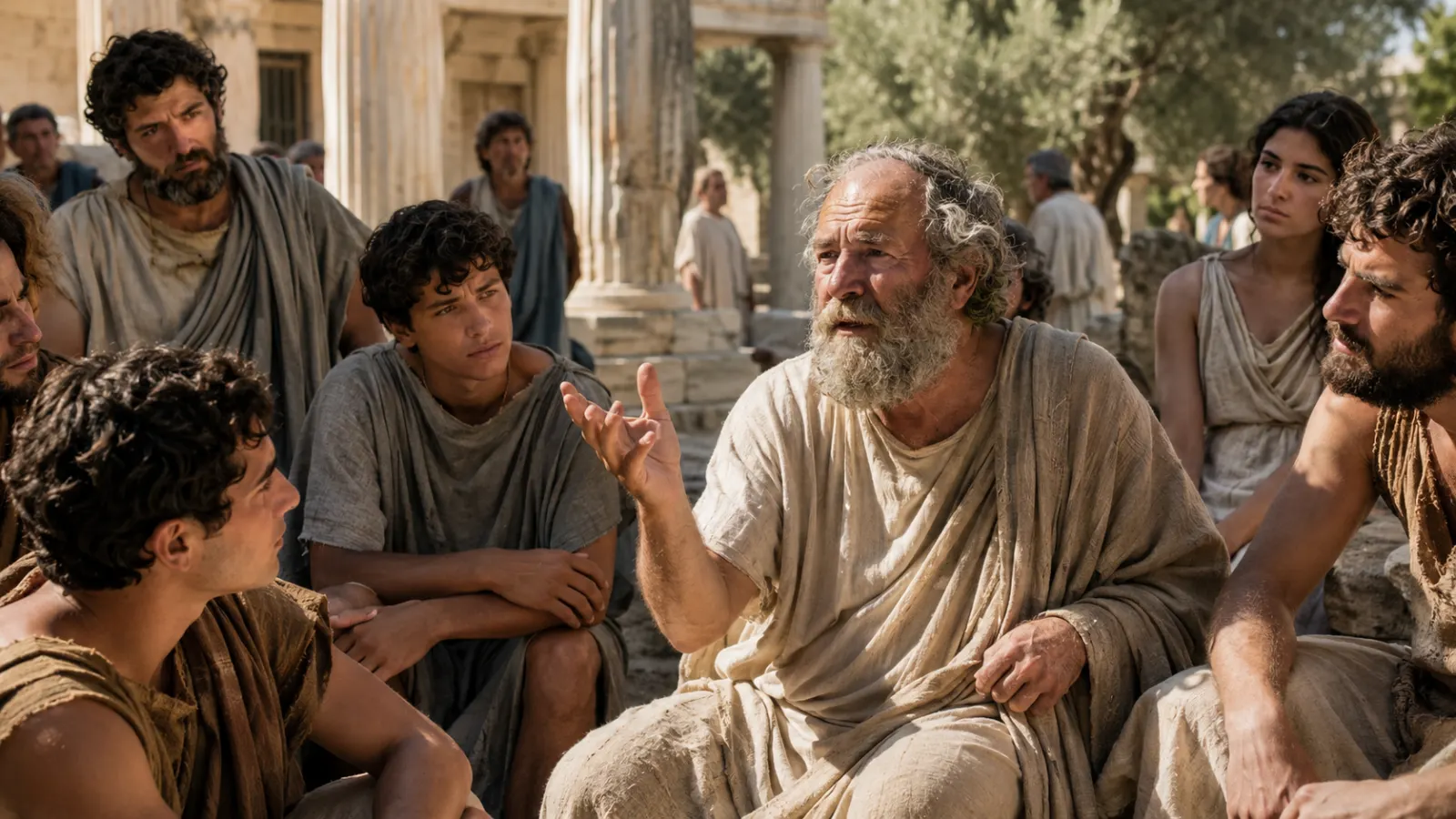
Socrates: The Philosopher Who Made Questioning a Way of Life
Socrates occupies an unusual place in intellectual history: he became one of the world’s most influential philosophers without leaving any philosophical writing of his own. What later generations know about him comes through other people, especially Plato and Xenophon, but also Aristophanes and later ancient testimony. That is not a minor problem for historians. It determines how any responsible account of Socrates must be written. There was a historical Socrates—an Athenian citizen who lived in the fifth century BCE, served in war, questioned fellow citizens, attracted younger associates, was prosecuted in 399 BCE and was executed by drinking hemlock. There is also a literary Socrates, especially the figure Plato uses to explore ethics, knowledge, politics, metaphysics and the meaning of philosophy. The two overlap, but they cannot simply be treated as identical.
That uncertainty makes Socrates strangely appropriate to his own philosophical legacy. He became famous for exposing false confidence, yet much about his own biography must be treated with caution. Understanding him therefore requires something close to the discipline associated with his name: examine the evidence, distinguish what is known from what is inferred, test confident claims and avoid pretending that uncertainty has disappeared simply because a story is memorable.
Socrates in Fifth-Century Athens
Socrates was born around 469 BCE in Athens, although precise ancient chronological details are not completely secure. Later tradition identifies his father as Sophroniscus, often described as a stonemason or sculptor, and his mother as Phaenarete, a midwife. The image of midwifery became philosophically important because Plato later presents Socrates as helping others “give birth” to ideas rather than simply supplying them with answers. Whether every biographical detail behind that metaphor can be verified is less important than understanding how powerfully it shaped the later image of Socratic teaching.
The Athens in which Socrates lived was politically ambitious, culturally productive and deeply unstable. It developed democratic institutions while also exercising imperial power. The same century produced major drama, architecture, rhetoric and philosophical experimentation, but also the Peloponnesian War, political coups and eventual military defeat. Intellectuals commonly grouped as the Sophists travelled and taught rhetoric, argument and civic skills, often for payment. Socrates is frequently contrasted with them in later philosophical literature, but the historical landscape was more complicated than a simple opposition between a truth-seeking philosopher and dishonest rhetoricians. Both Socrates and the Sophists participated in a wider debate about whether virtue could be taught, what political competence required and whether inherited moral assumptions could survive argument.
Socrates became distinctive partly because he did not present himself as a conventional teacher offering a complete curriculum. His activity was questioning.
The Socratic Problem: Which Socrates Can We Recover?
Modern scholarship often uses the phrase “Socratic problem” for the difficulty of reconstructing the historical Socrates from sources that portray him differently. Plato knew Socrates personally and made him the central speaker in many dialogues. Works such as Apology, Crito and Euthyphro, along with several early ethical dialogues, are often especially important for understanding the Socratic style of inquiry. But Plato was not producing transcripts. His dialogues are literary and philosophical works, and in later writings Socrates sometimes becomes the speaker for arguments that may reflect Plato’s own developing philosophy.
Xenophon presents another Socrates in works such as Memorabilia and his own Apology of Socrates. His portrait is generally more practical and straightforward, and part of Xenophon’s purpose is clearly defensive: he wants to show that Socrates was morally useful rather than corrupting. Aristophanes gives yet another image in Clouds, a comedy first staged decades before Socrates’s trial. Its Socrates runs a “Thinkery,” speculates about nature and manipulates arguments, combining traits associated with intellectual innovators and Sophists. The play is not reliable biography, but it matters because caricatures can shape public reputation.
The safest approach is therefore not to choose one source and assume it is simply factual. The points on which different traditions converge deserve greater confidence: Socrates was known for questioning, attracted younger associates, developed an unconventional public reputation and became controversial. Beyond that core, certainty has to be graded carefully.
Socrates Did Not Teach a Finished System
Socrates did not leave a treatise explaining a complete philosophical doctrine. Instead, the literary tradition places him in conversations about questions such as: What is courage? What is justice? What is piety? Can virtue be taught? What does it mean to know something?
A typical Socratic exchange begins when someone confidently uses a moral concept. Socrates asks what that concept actually means. The first definition turns out to be too narrow, too broad or inconsistent with another belief the speaker holds. Further questioning reveals contradictions, and the conversation may end without a final definition.
This state of unresolved puzzlement is often described as aporia. It matters because the goal is not always to lead the student toward a hidden answer already possessed by the teacher. Sometimes the philosophical achievement is discovering that a confident belief cannot yet be defended.
That is why the ancient practice behind the “Socratic method” is more demanding than the simplified classroom version in which a teacher asks guiding questions until students reach the correct answer. Socratic questioning can unsettle. It can reveal ignorance without immediately replacing it with knowledge.
The deeper intellectual shift is crucial: philosophy becomes the examination of reasons. Wealth, reputation, office and confidence do not prove that a claim about justice or virtue is coherent.
The Socratic Elenchus: Testing Beliefs Through Refutation
The questioning procedure associated with Socrates is often called the elenchus, usually translated as examination or refutation. Someone states a belief, Socrates draws out additional commitments and the conversation reveals that those commitments cannot all be true together.
The value of the process lies not simply in defeating another person. A contradiction provides evidence that something in the belief system needs revision.
This gives Socratic philosophy an enduring structure. Instead of beginning by asking, “What great doctrine should I believe?”, the method asks, “Can the beliefs I already hold survive examination?”
That shift makes philosophical progress possible even before a final answer is available. Discovering that one does not yet understand justice is intellectually superior to confidently repeating an inadequate definition.
“I Know That I Know Nothing” Is Not a Safe Verbatim Quote
One of the most famous slogans associated with Socrates is “I know that I know nothing.” It captures part of the tradition, but it should not casually be presented as a direct quotation from the historical Socrates. The more important source is Plato’s Apology, where Socrates recounts a story involving the Delphic oracle.
According to Plato’s account, Socrates’s associate Chaerephon asked the oracle whether anyone was wiser than Socrates and received the answer that no one was. Socrates says he found this puzzling because he did not consider himself wise. He then questioned politicians, poets and craftsmen. Many had genuine abilities, but they also appeared to believe that expertise in one area made them knowledgeable about matters they did not actually understand.
Socrates’s limited superiority, in this account, was that he did not pretend to possess knowledge he lacked.
This is not simple modesty. Socratic ignorance is productive. Recognising uncertainty creates a reason to investigate. Pretending certainty removes that incentive.
That principle remains relevant far beyond ancient philosophy. Science, journalism, law and serious public debate all depend in different ways on distinguishing between what evidence supports and what people merely assert.
Socrates Put Ethics at the Centre of Philosophy
Earlier Greek thinkers had investigated nature, change, matter, being and the structure of the cosmos. Socrates did not erase those traditions, but the portrait preserved in the early Platonic dialogues places a different set of questions at the centre: how should a person live?
He asks about courage, friendship, justice, moderation, piety and virtue. These are not treated merely as private preferences. Socrates assumes that people can be wrong about what makes a life good and that moral language deserves the same kind of rigorous examination applied to other claims.
A recurring Socratic idea is that the condition of one’s character matters more than wealth, prestige or physical comfort. The language of “care of the soul” appears prominently in the tradition, but modern readers should not automatically import later religious meanings into it. In the Socratic ethical context, concern for the soul is closely connected with the moral condition of the person: whether one is just, truthful and ordered by reason.
This focus explains why Socratic questioning could become socially uncomfortable. If status does not prove wisdom, respected politicians can be challenged. If traditional moral words require definition, inherited authority can be questioned. If younger citizens learn to expose contradictions in prominent adults, philosophy becomes politically irritating even when it does not constitute a formal political movement.
Socrates Challenged Expertise Without Rejecting Expertise
The Socratic critique of false knowledge is sometimes misunderstood as hostility toward experts. The oracle story suggests something subtler. Craftsmen, Socrates says, often possessed genuine expertise. The problem appeared when competence in one field encouraged confidence about matters outside that competence.
This creates an important distinction between knowing something and possessing social prestige. Socrates repeatedly asks whether someone claiming authority can give an adequate account of what they claim to understand.
That challenge applies to politicians, poets and other socially respected figures, but it does not imply that all opinions are equal. Socratic questioning is demanding precisely because knowledge must be justified.
The target is not expertise.
It is expertise claimed without sufficient reason.
Socrates Was Also a Soldier and Citizen
The image of Socrates wandering Athens asking philosophical questions can obscure another part of the ancient tradition: his military service during the Peloponnesian War. Plato and Xenophon preserve accounts of his endurance and conduct on campaign, including associations with Potidaea, Delium and Amphipolis. Such accounts contain literary elements, but they complicate the idea of Socrates as a philosopher detached from civic obligations.
Plato’s Apology also connects military service with philosophical commitment. Socrates compares remaining at his philosophical “post” with remaining where commanders had assigned him during war. Inquiry becomes a duty rather than an intellectual pastime.
The Platonic tradition also portrays Socrates resisting actions he considered unlawful. When he served on the Athenian Council, he is represented as opposing a procedurally improper collective trial involving generals after the battle of Arginusae. Under the later oligarchic Thirty, he says he refused an order to participate in the arrest of Leon of Salamis.
These episodes are important to Plato’s defence of Socrates as someone guided by principle rather than by whichever regime happened to be in power. They should not, however, be transformed into evidence that Socrates held modern democratic convictions. His relationship with Athenian politics was more complicated.
Alcibiades and Critias Complicated Socrates’s Reputation
Two politically notorious figures became closely associated with Socrates in later memory: Alcibiades and Critias.
Alcibiades was a talented and charismatic Athenian aristocrat whose shifting loyalties during the Peloponnesian War made him one of the most controversial figures of his generation. He moved among Athens, Sparta and Persia and became associated with both military ability and political instability. Plato’s dialogues portray a particularly intense relationship between Alcibiades and Socrates.
Critias became one of the leading figures in the Thirty Tyrants, the brutal oligarchic regime established after Athens’s defeat in 404 BCE. Xenophon explicitly responds to accusations that Socrates had corrupted figures such as Critias and Alcibiades, arguing instead that they departed from Socratic discipline.
These associations help explain why the accusation that Socrates corrupted young people could have carried political weight. Athens in 399 BCE had recently endured war, defeat, oligarchic terror and democratic restoration. The formal prosecution cannot simply be reduced to political revenge, but its social context matters.
Socrates did not need to support tyranny for citizens to be uneasy about a teacher associated with young aristocrats who had played destructive roles in Athenian public life.
The Charge of Impiety Was More Complicated Than Atheism
The formal accusation, as preserved through Plato and Xenophon, alleged that Socrates did not recognise the gods recognised by the city, introduced new divine things and corrupted the young.
Calling Socrates an atheist therefore oversimplifies the evidence. The sources repeatedly associate him with divine language. Plato’s Socrates refers to a daimonion, often translated as a divine sign or warning, which restrains him from certain actions. He also describes his philosophical mission in religious terms.
The issue was therefore not simply belief versus unbelief. It involved civic religion, unconventional claims about divine guidance, theological innovation and public reputation.
Aristophanes’s earlier comic portrait had already connected Socrates with intellectual speculation perceived as irreverent. Plato later works hard to distinguish Socrates from that caricature, but public reputations do not always depend on philosophical precision.
The trial emerged where religious anxiety, intellectual controversy, generational conflict and political memory overlapped.
The Trial of Socrates in 399 BCE
Socrates was prosecuted by Meletus, Anytus and Lycon. What survives is not a modern courtroom transcript. Plato’s Apology is a philosophical and literary reconstruction of Socrates’s defence, probably connected closely to the historical event but shaped by Plato’s purposes. Xenophon preserves another account.
In Plato’s version, Socrates refuses to build his defence primarily around emotional pleading. He questions Meletus, examines the logic of the accusations and explains why he has spent his life questioning Athenians.
One of the most memorable images is the gadfly. Socrates compares Athens to a large and noble but sluggish horse that needs to be awakened. His questioning is uncomfortable precisely because the city benefits from being forced to examine itself.
The jury convicted him.
Athenian procedure then moved to the question of penalty. Socrates famously suggests, at one stage, that he deserves maintenance in the Prytaneum—an honour associated with public benefactors. Whatever philosophical purpose the statement served, it was unlikely to reassure jurors who had just voted to convict him. He later proposes a fine, with friends offering financial support, but the jury ultimately selected death.
The Trial Should Not Be Reduced to a Simple Free-Speech Myth
Later tradition often treats Socrates as the pure martyr of free thought executed by an ignorant democracy. That interpretation captures part of his symbolic afterlife but flattens the historical situation.
Athens had undergone decades of war and acute political trauma. Some individuals connected with Socrates had become enemies of democratic government. His public questioning challenged respected citizens and social conventions. The religious charges operated inside a civic religious system very different from modern ideas about private belief.
None of this makes the execution intellectually comfortable or morally justified.
It does mean that explaining the trial requires more than a simple story in which philosophy confronts mindless political authority.
The uncomfortable historical question is why a democratic city that valued public argument could nevertheless decide that Socrates’s particular form of questioning had become intolerable.
Why Socrates Refused to Escape
Plato’s Crito imagines Socrates in prison after conviction while his friend Crito urges him to escape. Socrates refuses.
The dialogue became one of the foundational texts in debates about political obligation. Through the personified Laws of Athens, Plato develops the argument that Socrates has lived under the city’s legal order, benefited from its institutions and cannot simply reject that order because one verdict harms him.
But the position should not be reduced to “always obey the law.” The Socratic tradition also portrays him refusing political orders he considered unjust. In the Apology, he implies that his philosophical duty would continue even if the city ordered him to stop.
This creates a productive tension. Political authority matters, but it cannot transform injustice into justice merely by commanding it.
Why, then, accept execution? Plato’s portrayal suggests that escape would violate commitments Socrates had repeatedly defended. Saving his life through an action he regarded as unjust would undermine the moral integrity he had spent decades demanding from others.
Whether the historical Socrates expressed the reasoning exactly this way cannot be established. Philosophically, however, Plato turns the refusal to escape into a demonstration that principles matter most when keeping them is costly.
The Death of Socrates Became Part of the Philosophy
Plato’s Phaedo presents Socrates spending his final hours discussing death and the soul before drinking hemlock. It is one of philosophy’s most memorable literary scenes.
It must also be used carefully as evidence. The Phaedo is a mature Platonic dialogue containing metaphysical arguments that should not automatically be attributed directly to the historical Socrates.
Nevertheless, the scene fixed the image of Socrates for later history: calm, argumentative, surrounded by companions and unwilling to abandon inquiry even when death is imminent.
Later Stoics, Christian writers, Enlightenment thinkers and modern dissidents repeatedly reused this image. Socrates became the philosopher whose conduct supposedly proved the seriousness of his ideas.
That enormous symbolic afterlife also creates distortion. Different eras have remade him as sceptic, rationalist, religious seeker, democrat, anti-democrat, ethical teacher and martyr for free thought.
Because Socrates wrote nothing, he became unusually available for appropriation by later intellectual traditions.
Did Socrates Actually Have a Doctrine?
If Socrates cannot simply be identified with everything Plato makes him say, what can reasonably be attributed to him?
Scholars continue to disagree. Certain orientations recur strongly across the evidence: moral examination has priority, intellectual humility matters, virtue is closely connected with knowledge, and wrongdoing harms the moral condition of the wrongdoer.
But even these should not be turned too quickly into a fixed catechism.
Socratic philosophy may be better understood as an orientation toward inquiry rather than as a completed theoretical system. Socrates demands reasons, distrusts unjustified confidence, distinguishes competence from prestige and insists that the quality of one’s life matters more than public appearance.
That orientation remains recognisable even when specific reconstructions of his beliefs differ.
Was Socrates a Sceptic?
Socrates is sometimes treated as a sceptic because he repeatedly exposes ignorance. Yet his questioning does not imply that nothing can be known or that all claims are equally uncertain.
The entire practice of elenchus assumes that better and worse reasons can be distinguished. Contradiction matters because beliefs should cohere. Moral examination matters because some ways of living are better than others.
Socratic ignorance therefore differs from complete scepticism.
The admission “I do not yet know” functions as an invitation to investigate rather than as a conclusion that knowledge is impossible.
Virtue and Knowledge
One of the strongest themes associated with Socratic ethics is the close relationship between virtue and knowledge. If someone truly understands what is good, Socratic arguments often suggest, wrongdoing becomes difficult to explain as a fully informed choice.
This leads toward the provocative idea that people do wrong because they are ignorant of what is genuinely good for them.
Modern readers may resist this because people often seem capable of recognising that an action is wrong and doing it anyway. Later philosophers, including Plato and Aristotle, would develop more complicated accounts of desire, weakness and moral psychology.
But the Socratic challenge remains powerful: how much wrongdoing depends on misunderstanding what genuinely contributes to a good life?
If greed, injustice or cruelty ultimately damage the person practising them, apparent advantage may conceal deeper ignorance.
The Examined Life
One of the most famous ideas associated with Socrates comes from Plato’s Apology: a life without examination is not worthy of human beings in the fullest sense.
The point is often converted into a general slogan encouraging introspection. Socratic examination is more demanding than simply “thinking about yourself.”
It involves asking whether the concepts guiding one’s life are coherent. What do I mean by success? Why do I believe wealth is good? What makes an action just? Does my behaviour match the values I claim to hold?
The examined life therefore combines ethical self-scrutiny with argumentative discipline.
A person does not become wise by having opinions about everything.
Wisdom begins by discovering which opinions can actually be defended.
The Socratic Method in Modern Education
Modern educators frequently use the term Socratic method for discussion-based teaching in which students are guided through questions rather than simply given answers.
The inheritance is valuable, but the ancient model should not be romanticised. Socratic questioning can expose contradictions without producing immediate knowledge. A participant may end in confusion. The method also depends heavily on the skill and authority of whoever controls the questions.
The original dialogues also emerge from social contexts very different from modern classrooms. Their participants are overwhelmingly drawn from male citizen and elite intellectual environments.
The most useful modern inheritance is therefore not the theatrical imitation of Socrates. It is the disciplined habit of making assumptions explicit, asking what evidence supports a conclusion and checking whether a set of beliefs can remain consistent under questioning.
Socrates and Democracy Remain Difficult to Separate
Socrates lived within Athenian democracy but should not simply be described as either its champion or its enemy.
He participated in civic institutions, performed military service and in the Platonic account resisted illegal or unjust political actions. Yet several of his associates became hostile to democracy, and Plato’s later political philosophy contains severe criticism of democratic rule.
The historical Socrates’s exact political commitments remain difficult to recover.
What survives more clearly is a tension between philosophy and public opinion. Socrates does not accept majority approval as evidence that something is true. A claim must survive examination regardless of how many people believe it.
That principle is essential to critical thinking but politically uncomfortable. Democracies depend on citizens’ judgments while also needing institutions capable of recognising expertise, evidence and minority dissent.
Socrates remains relevant partly because this tension has never disappeared.
Frequently Asked Questions
Who was Socrates? Socrates was an Athenian philosopher who lived in the fifth century BCE and became famous for questioning people about knowledge, virtue, justice and the proper way to live.
When was Socrates born? He was born around 469 BCE, although precise ancient chronological details are not completely secure.
Did Socrates write any books? No philosophical writings by Socrates survive, and the tradition strongly presents him as a thinker known through conversation rather than authored treatises.
How do we know about Socrates? The major ancient sources include Plato, Xenophon and Aristophanes, supplemented by later testimony.
What is the Socratic problem? It is the historical difficulty of reconstructing the real Socrates from sources with different literary, philosophical and defensive purposes.
Was Plato’s Socrates the real Socrates? Plato knew Socrates, but his dialogues are literary and philosophical compositions rather than transcripts. Some Platonic arguments may go substantially beyond the historical Socrates.
What is the Socratic method? It is broadly associated with testing claims through disciplined questioning, especially by examining definitions, assumptions and contradictions.
What is the Socratic elenchus? The elenchus is the process of examining or refuting a position by showing that it conflicts with other beliefs held by the speaker.
What is aporia? Aporia is a state of puzzlement or intellectual difficulty that can result when an apparently confident belief collapses under questioning.
Did Socrates really say “I know that I know nothing”? That familiar sentence should not be treated casually as a verbatim historical quotation. Plato’s Apology instead presents Socrates as wiser in the limited sense that he does not claim knowledge he lacks.
What did Socrates believe was most important? The tradition strongly associates him with moral examination, care of character, intellectual humility and the demand that people give reasons for their beliefs.
Was Socrates a Sophist? Ancient sources frequently distinguish him from Sophists, but he belonged to the same broader intellectual environment in which rhetoric, virtue, education and civic reasoning were being debated.
Did Socrates charge students money? The Socratic tradition generally contrasts him with professional teachers who charged fees, although reconstructing the precise economics of his relationships requires caution.
Did Socrates serve in the military? Ancient sources associate him with military service during the Peloponnesian War, including campaigns at Potidaea, Delium and Amphipolis.
Who were Alcibiades and Critias? They were politically controversial figures associated with Socrates. Alcibiades became notorious for shifting allegiances during the Peloponnesian War, while Critias became a leader of the Thirty Tyrants.
Why was Socrates put on trial? The formal accusations concerned impiety and corrupting the young, within a wider environment shaped by political instability, intellectual controversy and Socrates’s public reputation.
Was Socrates an atheist? The surviving sources do not support that simple description. Plato’s Socrates frequently refers to divine matters and to a personal divine sign.
Who prosecuted Socrates? The prosecution was brought by Meletus, Anytus and Lycon.
When did Socrates die? He was executed in 399 BCE.
How did Socrates die? Ancient tradition describes him dying after drinking hemlock following his conviction and death sentence.
Why did Socrates not escape? Plato’s Crito presents him as believing that escape would violate principles concerning justice, law and the commitments by which he had lived.
Did Socrates support democracy? His precise political position is difficult to reconstruct. He participated in Athenian civic life but also maintained that truth cannot be decided merely by majority opinion.
What did Socrates mean by the examined life? It refers to critically examining the beliefs, values and assumptions according to which one lives rather than accepting them simply because they are conventional.
Why is Socrates important today? He helped make disciplined questioning, moral self-examination and intellectual humility central to the philosophical tradition.
The Socratic Method Is Not About Winning Arguments
Socrates is frequently portrayed as someone who could defeat anyone in debate. That interpretation misses the more important philosophical purpose of his questioning.
An argument can expose another person’s inconsistency while leaving both participants still uncertain about the correct answer. The achievement is not necessarily victory.
It is greater intellectual honesty.
This is why aporia matters. Discovering that a confident definition of justice cannot survive examination may feel like failure, but philosophically it is progress. A false sense of knowledge has been removed.
The goal is not to humiliate the interlocutor.
It is to make unsupported certainty harder to maintain.
The Historical Socrates and the Literary Socrates Must Remain Distinct
Socrates became philosophically powerful partly because Plato made him so. The Socrates who discusses metaphysics in mature Platonic dialogues cannot automatically be treated as a transparent record of a fifth-century Athenian teacher.
Yet separating the two completely would also be misleading. Plato had known Socrates, and the persistent image of questioning, ethical examination and intellectual discomfort must have emerged from something historically recognisable.
The responsible approach therefore accepts degrees of confidence rather than forcing a simple choice between “everything Plato says is historical” and “nothing about Socrates can be known.”
That method is itself appropriately Socratic.
The Central Idea
Socrates changed philosophy less by leaving a doctrine than by changing what philosophical seriousness looked like. Instead of treating confidence, reputation or inherited authority as proof of knowledge, he demanded examination. A person claiming to understand justice should be able to explain justice. Someone regarded as wise should know where their expertise ends. A citizen should examine the moral language used by politicians rather than assuming that public prestige guarantees understanding.
This helps explain why Socrates became both intellectually transformative and socially disruptive. His questioning destabilised comfortable assumptions without always providing new certainties. He could leave respected people appearing ignorant in front of younger listeners. His circle included politically controversial figures. His unusual religious reputation collided with civic expectations, and his trial took place in a city recently traumatised by war and oligarchic violence.
The later philosophical tradition turned his conviction and death into something larger than the trial itself. Plato’s Socrates refuses to abandon inquiry, refuses to escape on terms he considers unjust and ultimately becomes an image of a life in which philosophical principle is tested by consequence.
But the historical uncertainty should remain visible. We know Socrates through authors with their own purposes. The Apology is not a courtroom transcript. The Phaedo should not automatically be read as a verbatim final conversation. Aristophanes offers caricature rather than biography. Xenophon writes partly in defence.
That uncertainty does not weaken the Socratic legacy.
It clarifies it.
The wisdom associated with Socrates is not a collection of unquestionable quotations. It is a discipline: ask what a claim means, ask what evidence supports it, expose contradictions, distinguish expertise from reputation and be prepared to admit when the available reasons are not enough.
His most durable lesson is therefore not “doubt everything.”
It is more demanding:
Do not claim to know more than your reasons can support—and do not stop questioning merely because certainty is socially convenient.
That is why a philosopher who wrote nothing became one of the central figures in the history of ideas.