Mangal Pandey: Barrackpore, 1857 and the Making of a Revolutionary Symbol
On 29 March 1857, Mangal Pandey, a sepoy of the East India Company’s 34th Bengal Native Infantry, attacked British officers at Barrackpore, north of Calcutta. He called on fellow soldiers to join him, fired on Lieutenant Henry Baugh, fought with Baugh and Sergeant-Major James Hewson, and eventually attempted to shoot himself when British authority closed in. He survived, was court-martialled on 6 April and was hanged two days later, on 8 April 1857. Contemporary court-martial records identify him as Sepoy No. 1446 of the 5th Company of the 34th Native Infantry.
Within weeks, a much larger rebellion erupted at Meerut on 10 May and moved to Delhi the following day. Because Pandey’s attack preceded those events, later nationalist memory often presented him as the man who began the Revolt of 1857. The chronology makes that interpretation understandable, but it gives one individual more causal power than the evidence supports. The Bengal Army had already entered a serious crisis before 29 March. Cartridge rumours were circulating, the 19th Bengal Native Infantry had resisted orders at Berhampore, and longstanding anxieties over military service, religion and British policy had weakened trust between sepoys and their officers. The National Army Museum similarly describes the uprising as the result of accumulated grievances rather than a rebellion produced by any single cause.
Mangal Pandey therefore matters not because one soldier single-handedly created the uprising. His significance lies in what Barrackpore revealed: distrust inside a military system on which Company rule depended had already reached the point where an Indian sepoy could publicly attack his officers, appeal to comrades to resist authority and discover that many of those comrades were unwilling to restrain him even if they were not yet prepared to rebel openly.
The Bengal Army was already under strain
Mangal Pandey is one of the best-known figures associated with 1857, yet the secure documentary record of his life before Barrackpore is surprisingly limited. Government of India commemorative material identifies him as coming from Ballia in the North-Western Provinces and records approximately seven years of military service, while his court-martial gives his age as twenty-six years, two months and nine days and describes his previous service character as good.
Beyond such details, later biographies frequently become much more confident than the contemporary record allows. Stories about childhood, early patriotism and carefully developed revolutionary beliefs are often reconstructed retrospectively from the importance he acquired after death. The imbalance is itself revealing. Colonial military archives recorded ordinary Indian soldiers most intensively when they became disciplinary problems; independent India later wanted personal biographies for men who had become national symbols.
The better-documented story is the military world around him.
The East India Company ruled large territories with armed forces in which Indian sepoys substantially outnumbered European soldiers. The Bengal Army recruited heavily from north India, including Awadh and the Gangetic plain. Military employment provided income and status, but soldiers did not become socially detached from the communities from which they came. Caste practices, religious obligations, family ties and developments in their home regions continued to matter.
By the 1850s, trust within this system had been eroding. Questions of overseas service raised concerns about caste practice and allowances. Indian troops faced racial limits within the military hierarchy. The annexation of Awadh in 1856 affected a region from which many Bengal Army sepoys and their families came. British expansion and missionary activity also fed suspicions that colonial rule threatened existing religious and social arrangements.
None of these grievances made rebellion inevitable. They did, however, affect how soldiers interpreted new military orders.
The immediate controversy centred on cartridges associated with the Pattern 1853 Enfield rifle. Soldiers were expected to bite open cartridges as part of the loading procedure, and rumours spread that the cartridges had been greased with cow and pig fat. For Hindu soldiers who regarded the cow as sacred and Muslim soldiers for whom pigs were religiously prohibited, the allegation carried obvious implications. The National Army Museum describes the cartridge controversy as the immediate catalyst operating within a much broader accumulation of discontent.
The deeper issue was trust. The political effect of a rumour does not depend only on whether every detail is eventually proven. It depends on whether the people hearing it already believe the authority involved might be capable of the alleged act. Once sepoys suspected that the government might disregard or deliberately violate their religious obligations, official reassurance could not easily restore confidence.
This is why the cartridge became more than an item of military equipment. It concentrated multiple fears—religious pollution, racial hierarchy, compulsory obedience and the expanding reach of Company rule—into an object soldiers might literally have to place in their mouths.
Berhampore came before Barrackpore
The chronology matters.
Before Pandey attacked his officers, the 19th Bengal Native Infantry at Berhampore had already resisted cartridge-related military orders in February 1857. British authorities decided to disband the regiment. Soldiers elsewhere therefore knew that the cartridge controversy had become a confrontation over discipline and that collective resistance could produce collective punishment. The National Army Museum places Berhampore directly within the escalating sequence that preceded Barrackpore and the later outbreak at Meerut.
Mangal Pandey was consequently acting inside an already disturbed military environment. Government of India material records that he was aware of the events at Berhampore and of rumours concerning greased cartridges and possible British plans to disarm suspicious sepoys.
This does not establish that he belonged to a centrally coordinated conspiracy. It establishes something more limited and more defensible: he was not acting in a political vacuum.
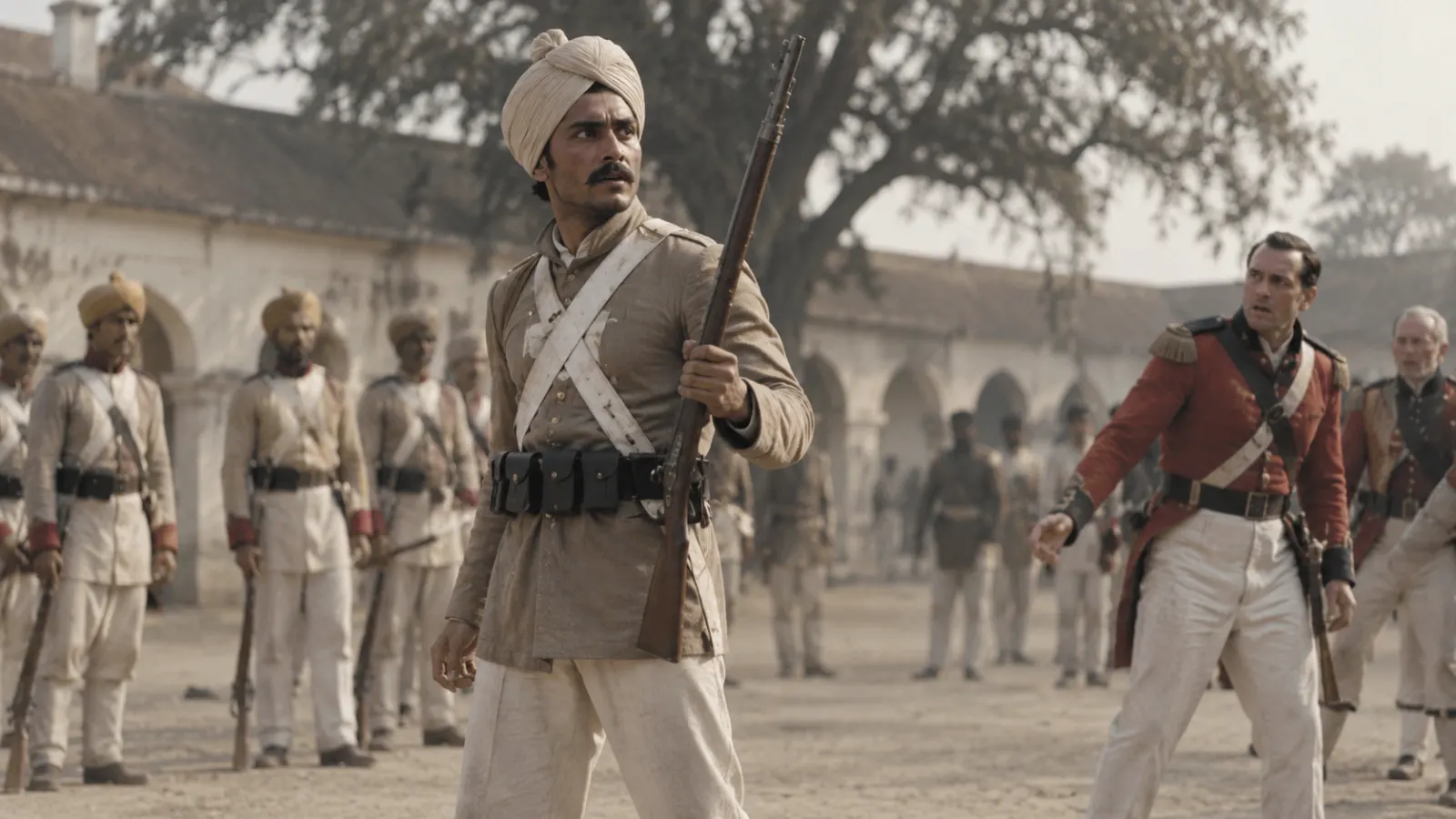
On the afternoon of 29 March, Pandey appeared armed near the quarter guard of his regiment and called on fellow sepoys to join him in resisting authority. The formal charge later read at his court-martial accused him of going onto the parade ground armed with a sword and musket and using words intended to incite his regiment to resistance.
Sergeant-Major James Thornton Hewson and Lieutenant Bempde Henry Baugh confronted him. Pandey fired his musket and subsequently fought the officers with a sword. Testimony differs over some details of the fast-moving confrontation, but the central sequence is unusually well documented because many witnesses later appeared before the military court.
What did not happen is equally important: the regiment did not immediately rise with him.
Pandey tried to transform his defiance into collective action, but most nearby soldiers stopped short of joining an open rebellion. The National Army Museum notes that when his comrades were ordered to restrain him they refused, yet they also did not join his revolt.
That hesitation reveals the difficult threshold between discontent and mutiny. Soldiers can sympathise with a grievance, refuse enthusiastically to defend authority and still hesitate before openly joining an armed revolt whose consequences may include execution.
Barrackpore approached that threshold on 29 March without fully crossing it.
Shaikh Paltu, the quarter guard and divided loyalties
Later nationalist narratives can make the confrontation look like a simple scene in which Indian soldiers stood collectively against British officers. The episode itself was more complicated.
Sepoy Shaikh Paltu intervened against Pandey and helped restrain him while British officers were under attack. Other soldiers hesitated or failed to act against Pandey. Jemadar Ishwari Prasad, responsible for the quarter guard, was later prosecuted for his failure to take effective action and was eventually executed. Accounts of the incident therefore reveal several positions within the same Indian regiment: active rebellion, refusal or hesitation, continued obedience and attempts to protect officers.
This complexity should not be dismissed as inconsistency. Military rebellion is rarely produced by every member of a unit reaching the same conclusion simultaneously. Individuals assess risk, loyalty, grievance and the expected behaviour of others. A sepoy who privately resented cartridge policy still had to decide whether enough comrades would support open rebellion before risking execution.
Pandey attempted to force that collective decision.
When the confrontation turned against him, he placed his musket against himself and fired. The shot wounded but did not kill him. National Army Museum material records that he survived the attempted suicide, was taken into custody and subsequently tried and executed.
His survival proved historically important because it created a formal judicial record of the event.
The court-martial gives evidence, but not a complete explanation
Mangal Pandey was brought before a native general court-martial at Barrackpore on 6 April 1857. The surviving proceedings are unusually detailed. They identify the charges against him, reproduce witness testimony and record both the verdict and death sentence. Fourteen officers voted him guilty on the charges, while eleven voted for the death penalty. The sentence was confirmed on 7 April and ordered to be carried out at 5:30 the following morning in the presence of troops stationed at Barrackpore.
The trial is valuable because it was conducted only days after the incident, but it should not be expected to answer every historical question about Pandey or the uprising. A military court exists to establish whether a soldier committed specified offences. It does not exist to produce a comprehensive investigation of political culture, military dissatisfaction or the inner motives of every sepoy who watched without acting.
The proceedings are strongest when describing observable conduct: Pandey was armed, appealed to other soldiers, attacked superior officers and later attempted to shoot himself. They are far weaker when later writers use them to prove either that he was carrying out a sophisticated national revolutionary plan or that his conduct was merely an irrational private episode.
The question of intoxication illustrates this problem.
After his conviction, Pandey was asked whether he had acted freely, whether anyone had instructed him and whether he had been under the influence of drugs. The recorded answers state that he said he had acted on his own will, expected to die and had recently been taking bhang and opium; he also claimed he had not been aware of what he was doing.
Colonial narratives could use such evidence to portray him as irrational or intoxicated rather than politically motivated. Later nationalist accounts had an opposite incentive to minimise the issue because it appeared inconsistent with a deliberate act of patriotic resistance.
Neither conclusion is necessary.
Drug use, if accepted from the record, does not explain why the Bengal Army was already destabilised by cartridge fears, why the Berhampore confrontation had occurred, why Pandey appealed to fellow soldiers in explicitly collective terms or why other sepoys hesitated to restrain him. Intoxication and political grievance are not mutually exclusive categories.
The strongest historical conclusion is narrower. Pandey acted violently within a real and already developing military-political crisis, but the surviving evidence does not establish that he was executing a centrally organised plan for a subcontinental rebellion.
He also refused to provide names implicating others when questioned after sentencing. Later commemoration converted that silence into evidence of revolutionary loyalty. It can certainly be read that way, but the documentary record itself establishes only that he declined to identify others.
Execution did not restore military trust
Mangal Pandey was hanged at Barrackpore on the morning of 8 April 1857. Government of India archival summaries cite military-department records for his court-martial and execution, while the contemporary proceedings record the order for his hanging on that date.
Ishwari Prasad was executed separately on 21 April. The 34th Bengal Native Infantry was subsequently disbanded after authorities concluded that the regiment had failed to fulfil its duty during the Barrackpore incident.
The punishments demonstrated British determination to restore discipline, but punishment could not repair the collapse of confidence within the Bengal Army.
On 10 May, sepoys at Meerut mutinied after fellow soldiers had been imprisoned for refusing cartridges they believed threatened their religious obligations. They freed prisoners, attacked Europeans and moved toward Delhi. The following day, rebel soldiers entered the Mughal capital and sought the authority of Bahadur Shah Zafar. At that point, a military crisis acquired a larger political centre and expanded far beyond anything witnessed at Barrackpore.
This sequence is why Pandey occupies such a prominent position in the history of 1857. Barrackpore happened before Meerut and Delhi, but it happened after the crisis had already begun.
He belongs to the opening phase of the uprising, not to an isolated moment from which every later event mechanically followed.
Did Mangal Pandey start the Revolt of 1857?
The answer depends on what the word “start” is supposed to mean.
If it means that Pandey was one of the earliest soldiers to engage in open armed defiance during the crisis that culminated in the 1857 rebellion, the description captures something important. His attack on 29 March was dramatic, public and directly connected to anxieties that later contributed to much wider military revolt.
If it means that he conceived, organised or caused the entire uprising, the claim goes beyond the evidence.
The Berhampore confrontation had already taken place. Cartridge fears were already circulating through military stations. Political discontent associated with Awadh and Company expansion predated Pandey’s attack. The National Army Museum explicitly describes the rebellion as the product of numerous accumulating factors and identifies Meerut on 10 May as the point at which rebellion began “in earnest.”
Nor did the later uprising operate through one unified command created by Pandey or any other individual. Delhi, Awadh, Kanpur, Jhansi, Bihar and central India developed different combinations of military mutiny, elite resistance, rural rebellion and local grievances.
The label applied to the conflict has itself reflected different interpretations. British histories commonly described it as the “Indian Mutiny” or “Sepoy Mutiny,” emphasising rebellion within the Company’s army. Indian nationalist traditions increasingly called it the “First War of Independence,” emphasising its anti-colonial political meaning. Much subsequent scholarship has stressed that 1857 combined military mutiny with broader regional rebellions whose character varied considerably by place.
Pandey sits exactly at the intersection of those interpretations. His documented action was unmistakably an act of military mutiny, but the larger events that followed gave it a political meaning that exceeded the Barrackpore parade ground.
The historically precise description is therefore that he was an early and highly visible participant in the crisis that developed into the Revolt of 1857, rather than its sole originator.
Why the cartridge crisis became politically explosive
The cartridge controversy is sometimes taught as though one technical mistake suddenly created rebellion. That interpretation is too narrow.
The problem was not simply grease. It was credibility.
Military authorities could modify procedures, deny offensive ingredients or attempt reassurance, but such measures depended on soldiers trusting them. By early 1857, many sepoys increasingly interpreted military changes through suspicions that the government intended to interfere with religion and caste practice.
The cartridge thus became politically powerful because it condensed other grievances into a single compulsory military act.
This mechanism matters beyond the specific history of 1857. Institutions can suffer crises not only when leaders intend harm but when those subject to their authority no longer believe official explanations. Once trust collapses, new policies are interpreted through existing suspicion.
The British response intensified this problem. Disbanding regiments could enforce immediate discipline, yet punishment also spread evidence that the dispute had become serious enough to threaten entire military units. News moved between cantonments through soldiers, families, letters, rumours and returning men.
There was no need for a single national conspiracy for anxiety to circulate.
This is one of the reasons historians have examined rumour so closely in the making of the 1857 uprising. Information moved through military society in uneven, distorted and politically potent forms, allowing local incidents to influence expectations elsewhere without implying central coordination.
From court-martialled sepoy to national martyr
The Mangal Pandey remembered after Indian independence was not identical to the soldier described in British military papers.
National commemoration transformed him into a pioneer of anti-colonial resistance. Government of India publications describe him as a martyr of 1857, while memorials, postage stamps, textbooks and cultural representations have made his name familiar far beyond specialist histories.
That transformation corrected one distortion while creating the possibility of another.
Colonial accounts could reduce Pandey to an insubordinate or intoxicated soldier and detach his actions from the broader collapse of military trust. Nationalist commemoration restored political meaning to his resistance. But commemoration sometimes went further, supplying precise speeches, private motivations or biographical details for which contemporary evidence is thin.
The historical Mangal Pandey does not require those inventions to remain significant.
The documented facts are already extraordinary. A sepoy with a previously good service record appeared armed before his regiment during an escalating military crisis, called on comrades to resist, attacked British officers, attempted to take his own life when surrounded, was rapidly court-martialled and executed, and became associated retrospectively with an uprising that challenged Company rule across a large part of northern and central India.
The 2005 film Mangal Pandey: The Rising illustrates how difficult the gap between archive and popular biography can become. Cinema requires relationships, dialogue, motivations and narrative continuity. The historical record supplies far more information about the afternoon of 29 March and the military proceedings that followed than about Pandey’s private life. Popular culture inevitably fills those spaces, but those reconstructions should not be confused with documentary evidence.
The uncertainty is itself part of the history.
What Barrackpore tells us about Company rule
Mangal Pandey’s importance extends beyond the question of whether he was the “first” revolutionary of 1857.
His story reveals a structural vulnerability at the centre of Company rule. British territorial expansion in India depended heavily on Indian soldiers. The East India Company could possess superior command structures, financial resources and European officers, but much of its coercive power still rested on the continued service of sepoys.
That relationship worked only while military discipline and political trust remained strong enough to hold it together.
Barrackpore showed what happened when those conditions began to separate. Officers could still issue commands, but some soldiers no longer wanted to enforce them against one another. A regiment could remain formally intact while obedience became uncertain. Once enough soldiers concluded that serving Company authority threatened their interests or religious obligations, the military instrument of empire could become a source of rebellion against it.
Pandey did not cause that structural weakness. His action exposed it.
The weeks that followed confirmed how serious the weakness had become. Punishing Pandey and disbanding his regiment did not stop unrest from travelling. Meerut produced a much larger revolt, Delhi supplied a symbolic sovereign in Bahadur Shah Zafar, and regional movements subsequently developed their own leaders and political objectives.
Seen in this chronology, 29 March is neither the complete beginning of 1857 nor an irrelevant isolated episode.
It is an early diagnostic moment: the point at which a crisis of confidence within the Bengal Army became visibly violent.
Mangal Pandey between evidence and memory
An evidence-based assessment does not require choosing between two caricatures.
The colonial image of an irrational or intoxicated soldier is insufficient because it cannot explain the institutional crisis surrounding him. The equally simplified image of a revolutionary mastermind who personally launched a coordinated national war cannot be sustained by the documentary record.
Mangal Pandey was a sepoy operating inside a deeply unsettled military system. On 29 March 1857 he chose armed defiance and attempted to draw fellow soldiers into it. His regiment did not immediately follow him, but many soldiers also failed to act decisively against him. He was arrested, rapidly tried and executed as the authorities attempted to restore discipline.
They restored neither confidence nor stability.
Within little more than a month, rebellion at Meerut and Delhi transformed the crisis. Pandey’s action acquired a historical meaning larger than the immediate event because later developments made Barrackpore look like an early warning of what was coming.
That retrospective meaning should be acknowledged without rewriting chronology.
Mangal Pandey did not create the Revolt of 1857 by himself. He became one of its most enduring symbols because his individual act of resistance occurred at precisely the moment when a much larger system of military obedience was beginning to break.
His significance lies in that intersection between individual agency and structural crisis. It is more historically revealing than either the image of the accidental troublemaker or the legend of a lone man who started a national revolution.