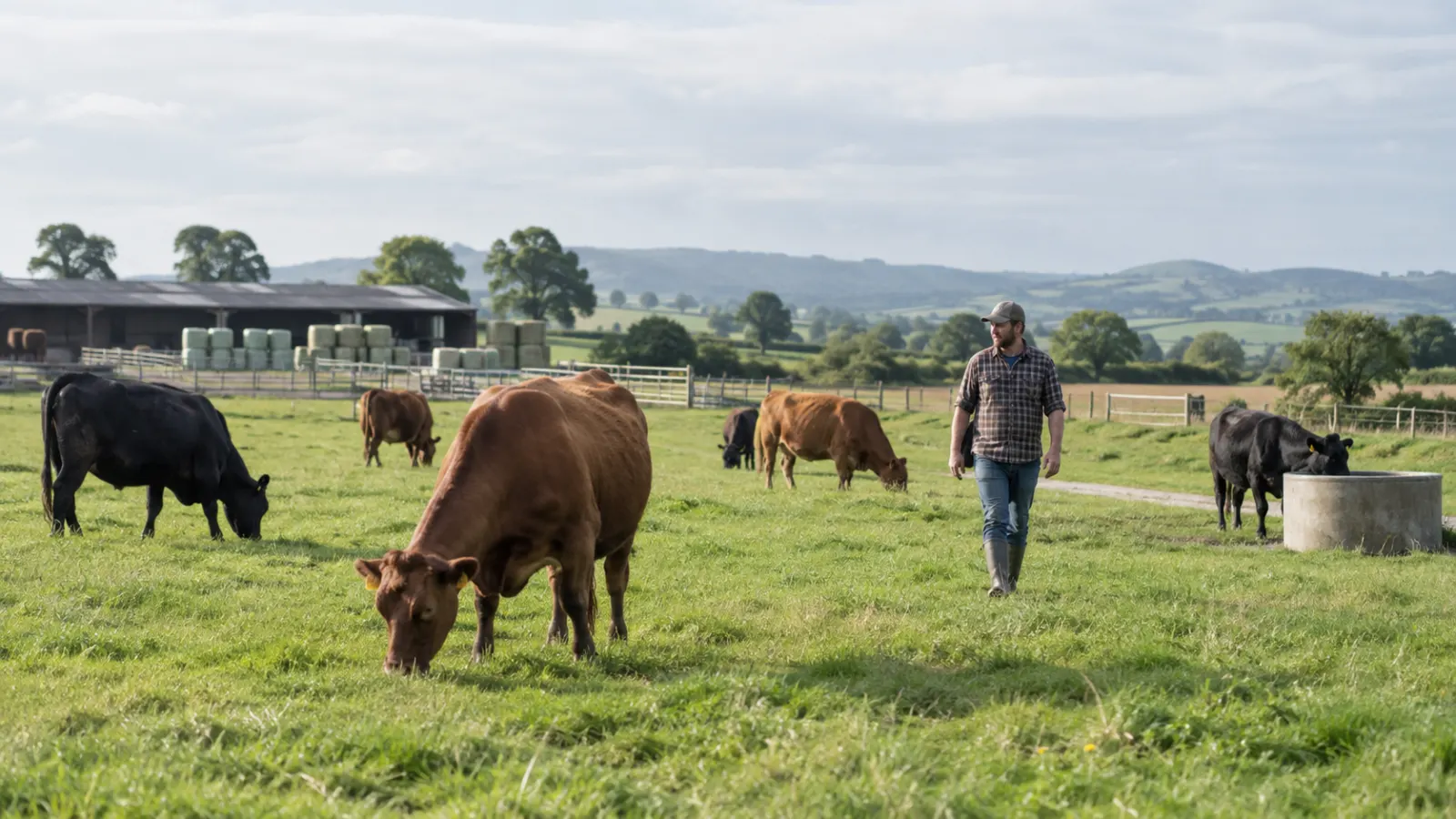
Local and Seasonal Eating: When It Helps—and When Food Miles Mislead
Local and seasonal eating sounds like one of the simplest rules for reducing the environmental impact of food. If a tomato travels 50 kilometres instead of 5,000, surely the closer tomato must be better. If strawberries grow naturally in summer, eating them in summer rather than producing them through energy-intensive winter systems also seems sensible.
Both ideas can be useful.
Neither is a reliable sustainability test on its own.
A food's environmental footprint begins long before transportation. Farming can involve land-use change, methane from livestock, fertiliser production and nitrous oxide, irrigation, machinery, heated greenhouses, refrigeration and processing. After harvest, food may be packed, stored for months, moved by several transport modes and eventually cooked or discarded. A nearby product can therefore have a larger environmental footprint than an imported alternative when their production systems differ substantially.
This is why food miles should be treated as one part of a lifecycle, not as a substitute for lifecycle thinking.
The most useful question is not simply, “How far did this food travel?” It is: What kind of food is it, how was it produced, how was it transported and stored, and what happens to it before it is eaten?
Food Miles Measure Something Real—but Much Less Than a Full Footprint
The term food miles refers broadly to the distance food travels through the supply chain. More formal calculations often combine the mass being transported with distance, producing measures such as tonne-kilometres. The concept became popular because transportation is highly visible: consumers can see country-of-origin labels and reasonably imagine that a product travelling halfway around the world requires more energy than one coming from nearby.
Transport does create greenhouse-gas emissions. Trucks, ships, trains and aircraft consume energy, while refrigeration and distribution infrastructure can add additional demand. But food miles alone do not tell us how a crop was fertilised, whether forest was cleared to create farmland, how much methane livestock emitted, whether a greenhouse was heated or how much food was wasted before consumption.
This explains why lifecycle studies often find much larger differences between food types than between transport distances within the same food category.
A widely used synthesis based on global lifecycle data estimates that transportation accounts for around 5% to 6% of food-system greenhouse-gas emissions, while much larger shares come from agriculture itself and land-use change. In that dataset, road transport contributes substantially more than aviation because trucks move enormous quantities of food through domestic and regional supply chains. (ourworldindata.org)
This finding is often summarised as “food miles do not matter.”
That goes too far.
Transport matters. It simply does not usually dominate the lifecycle footprint of most foods.
Why One Major Study Put Food-Mile Emissions Near 20%
Readers researching the subject can quickly encounter what appears to be a contradiction.
One source says transport contributes only around 5% or 6% of food emissions.
A 2022 study published in Nature Food estimated that global food-mile emissions corresponded to about 19% of total food-system emissions when the researchers accounted for transport throughout the entire upstream global supply-chain network. (nature.com)
The difference largely reflects method and system boundaries.
The Nature Food researchers used a global multi-region accounting framework tracing food-related freight through complex international and domestic supply chains, including upstream movements associated with production. Their estimate was substantially higher than earlier calculations based on narrower transport stages. The journal itself noted that food-mile estimates can differ widely depending on calculation methods and system boundaries. (nature.com)
This is an important lesson in environmental statistics.
A number is only meaningful when we know what has been counted.
If one analysis measures direct movement from producer toward consumer and another traces freight embedded through upstream input and intermediate supply chains, they are not measuring precisely the same thing.
The responsible conclusion is therefore not that food transport is either trivial or responsible for exactly one-fifth of every meal's environmental impact.
It is that transport can be important, its importance varies across supply chains, and production conditions still have to be considered alongside distance.
For consumers, this means that distance alone is too crude to determine which food is environmentally preferable.
Transport Mode Can Matter More Than the Number of Kilometres
A kilometre travelled by ship is not environmentally equivalent to a kilometre travelled by aircraft.
This is one of the biggest reasons intuitive food-mile calculations can mislead.
International shipping can move enormous amounts of cargo relatively efficiently. Air freight moves food much faster but at far higher emissions per tonne-kilometre. Our World in Data's synthesis of lifecycle evidence estimates that air transport produces roughly 50 times as much greenhouse-gas emissions per tonne-kilometre as shipping, while only a very small fraction of global food miles are travelled by air. (ourworldindata.org)
That small proportion matters because the foods that are flown tend to be highly perishable products for which speed is commercially important.
A berry, asparagus spear or fresh fish sold very far from its production region may have travelled under completely different conditions from coffee, bananas, grains or avocados transported by sea.
This makes mode of transport a useful question when evaluating imported food.
A product travelling thousands of kilometres on a container ship can sometimes have surprisingly modest transport emissions. A highly perishable product flown a shorter international distance can accumulate a much larger freight footprint.
Road transport deserves attention too. Trucks dominate much of the final and intermediate movement within food systems, and the 2024 Our World in Data synthesis estimated road transport alone at about 3.9% of total food-system greenhouse-gas emissions in the underlying global dataset. (ourworldindata.org)
This also explains why buying from a distant country does not necessarily imply that international transport dominates the footprint.
The food may cross an ocean efficiently and then travel through several road-based distribution stages closer to the consumer.
Geographical distance matters.
Logistics matter more.
Seasonality Matters Because It Changes Production Conditions
Seasonal eating can provide a more useful environmental signal than simple distance because seasonality often changes how the food has to be produced.
A crop grown outdoors under suitable temperatures and daylight may require far less energy than the same crop produced locally during a cold season inside a heated and artificially lit greenhouse. The locally grown version can travel fewer kilometres yet require more fossil energy before it leaves the farm.
Research on greenhouse crops illustrates this clearly.
A recent lifecycle study comparing Swiss greenhouse production with imports found that heating, supplementary lighting and carbon-dioxide enrichment were major drivers of the carbon footprint of local greenhouse crops. Imports from warmer production regions could have lower carbon footprints despite travelling farther because they avoided those energy-intensive production requirements. The same analysis also found important water-use trade-offs, demonstrating that the answer changes depending on which environmental pressure is being measured. (sciencedirect.com)
Earlier research comparing European tomato supply chains reached a similar conclusion. Tomatoes produced in capital-intensive heated systems in Austria had substantially higher greenhouse-gas emissions than imported tomatoes from Italy and Spain, while less-intensive seasonal Austrian production could outperform the imports. (link.springer.com)
The important variable was not simply local versus foreign.
It was the production system.
Seasonal eating can therefore help because it often aligns consumption with periods when crops can be grown with less artificial heat, lighting or other environmental control.
That does not make “seasonal” automatically sustainable either. A crop can be seasonal while using large quantities of irrigation water, fertiliser or pesticides. Local climate suitability is one part of the analysis rather than a guarantee of low impact.
The calendar itself has no environmental benefit.
The production conditions associated with the calendar do.
Storage Can Reverse an Apparently Simple Local-versus-Imported Comparison
Modern food systems extend seasons partly through storage.
Apples, potatoes, onions and many other crops can be harvested during one part of the year and sold months later. Refrigerated and controlled-atmosphere storage reduces spoilage, stabilises supply and allows farmers to market products beyond a short harvest period.
Those are significant benefits.
Storage also requires energy.
This means that late in the storage season, a locally grown crop that has spent months under refrigeration may compete environmentally with a recently harvested crop imported from somewhere currently in season. Which performs better depends on storage technology, electricity supply, spoilage, transport distance and transport mode.
There is no universal point at which imports become better than stored local food.
The important lesson is that distance and freshness are not the same variable.
A supermarket shelf can contain one apple harvested locally six months earlier and another harvested recently thousands of kilometres away. The word “local” reveals geography but not the energy history of either product.
Cold chains illustrate another important trade-off.
Refrigeration consumes energy, but inadequate refrigeration can produce food losses. Preventing one tonne of food from spoiling may avoid the agricultural inputs and emissions that would otherwise have produced food nobody eats.
The sustainability objective is therefore not to eliminate storage.
It is to use storage efficiently where its benefits outweigh its environmental costs.
What You Eat Often Matters More Than How Far It Travelled
One of the strongest findings from lifecycle research is that the type of food often matters more for climate impact than transport distance.
Ruminant livestock such as cattle and sheep can produce substantial methane emissions through digestion. Livestock can also require pasture and animal-feed production, and expansion of grazing or feed crops can contribute to land-use change. Many plant foods have much lower average production emissions.
Our World in Data's synthesis of the large lifecycle dataset by Poore and Nemecek illustrates the size of these differences. Transport generally represents a relatively small portion of the total footprint for many foods, while production and land-use emissions vary dramatically among food categories. (ourworldindata.org)
This creates a common sustainability mistake.
Someone may spend considerable effort replacing imported lentils with local beef because the beef travelled fewer kilometres.
The change reduces food miles.
It can substantially increase the meal's overall climate footprint.
That does not mean everyone must adopt one identical diet. Nutrition, culture, affordability and individual medical needs matter. Nor does it mean local animal agriculture has no environmental advantages in particular contexts.
It means that food miles should not distract from larger sources of impact.
For someone trying to reduce diet-related greenhouse-gas emissions, the broad composition of the diet and production system will often matter more than whether every ingredient was grown nearby.
Local sourcing works best as an additional criterion after the major impact differences are understood.
Local Food Can Still Create Benefits That Carbon Accounting Does Not Capture
Rejecting food miles as a universal carbon metric does not make local food irrelevant.
Local and regional food systems can generate economic and social benefits that greenhouse-gas accounting does not fully measure.
Farmers' markets, community-supported agriculture and direct purchasing can bring producers and consumers into closer contact. Shorter commercial chains may allow producers to retain a larger share of the sale price in some circumstances. Regional procurement by schools, hospitals or public institutions can create stable markets for nearby producers.
Local demand can also support varieties and foods tied to regional agricultural traditions.
These benefits overlap with the ideas explored by movements such as Slow Food: a food system produces culture, livelihoods and relationships in addition to calories and commodities.
FAO's work on sustainable food systems similarly recognises the role of territorial and local-market approaches in connecting consumers, small producers and regional economies while addressing social, economic and environmental objectives together. (fao.org)
But these advantages should not be converted into automatic environmental claims.
A nearby farm can overdraw groundwater.
Local horticulture can create nutrient pollution.
A nearby greenhouse can be heated with fossil fuel.
Locally produced livestock can still have high methane and land-use footprints.
“Local” tells us where something happened.
It does not automatically tell us whether what happened there was sustainable.
That distinction allows local food to be valued for legitimate reasons without requiring exaggerated climate claims.
Trade Is Not the Opposite of a Resilient Food System
Strict localism also creates problems when it is extended from a purchasing preference into a model for entire food systems.
Most regions cannot efficiently grow every food their populations consume. Climate, soil, water, land availability and growing seasons vary. Cities in particular depend on food arriving from wider regional, national and international systems.
Trade allows food to move from surplus regions toward deficit regions.
It can also diversify food supply and reduce the consequences of a local harvest failure. FAO has specifically identified diverse sourcing through international trade as one mechanism that can improve agrifood-system resilience by spreading exposure to shocks across different production regions. (fao.org)
The IPCC likewise notes that trade can improve food availability, diversify diets and pool production risks across markets, while also creating vulnerabilities when countries become overly dependent on disrupted trade routes or volatile international markets. (ipcc.ch)
The issue has become even more important as climate and geopolitical shocks affect food markets. FAO's State of Agricultural Commodity Markets 2026 emphasises that global food trade has expanded dramatically while exposure to extreme weather, conflict, pandemics and economic shocks has also increased. The policy challenge is therefore to make trade more resilient rather than assuming either complete global dependence or complete local self-sufficiency is inherently safe. (fao.org)
A resilient food system is likely to be layered.
Local and regional production can provide foods particularly well suited to the local environment and strengthen regional capacity.
Storage can smooth seasonal supply.
National and international trade can provide diversity and backup when local production fails.
The objective is not to minimise every kilometre.
It is to avoid fragile dependence on any one source while reducing unnecessary environmental impacts throughout the network.
A Better Way to Use Local and Seasonal Eating
Consumers rarely have enough information to calculate the full lifecycle footprint of every product.
Country-of-origin labels reveal location but not fertiliser use, greenhouse heating, storage duration or transport mode. “Local” labels may reveal distance while saying nothing about water stress. Organic certification answers some production questions while leaving others outside its scope.
This information gap helps explain why simple rules such as “eat local” remain attractive.
A more realistic approach is to use a hierarchy of questions.
First ask what kind of food it is and whether its production normally has a relatively high or low environmental impact.
Then consider how it was produced. Was a greenhouse heated heavily? Is irrigation occurring in a water-stressed region? Are land-use pressures important?
Next consider transport mode. Was a highly perishable product likely to have been flown? If it arrived by ship or efficient road freight, transport may represent a smaller share.
Then consider seasonality and storage. Is the local product being grown naturally in season, or was it held in cold storage for many months? Is the imported food coming fresh from a region where conditions currently favour production?
Finally consider food waste.
The lowest-impact strawberry is not environmentally efficient if it spoils in the refrigerator and is thrown away. Agricultural inputs, cooling, packaging and transport have already occurred.
This is why buying amounts that will actually be eaten can matter more than selecting an environmentally fashionable label and wasting the product.
Broad priorities are therefore more useful than rigid rules: favour a diverse, nutritionally appropriate diet; reduce food waste; consider the large production differences among food categories; favour seasonal production when it avoids energy-intensive methods; avoid unnecessary air-freighted perishables where practical; and support local producers when their farming practices and social value make that choice worthwhile.
Local and seasonal food can fit naturally inside this framework.
They simply should not sit above every other consideration.
The Best Food System Is Not Necessarily the One With the Fewest Miles
The appeal of food miles comes from their simplicity.
Distance can be measured.
A local farm can be seen.
A foreign country looks far away.
But food systems are networks rather than straight lines. Farming, storage, processing, packaging, transport and waste interact, and the largest environmental pressure can occur at very different points depending on the food.
That is why two apparently conflicting statements can both contain truth.
Transport can represent a relatively modest share of food-system emissions in lifecycle datasets that focus on direct supply-chain stages. A broader accounting framework tracing upstream global freight can assign food transport a much larger share. (ourworldindata.org) (nature.com)
Neither result turns distance into a universal sustainability metric.
Transport mode matters.
Production method matters.
Food type matters.
Storage matters.
Water and land conditions matter.
Waste matters.
Trade can create environmental costs while also supporting food security and resilience.
Local production can support communities while also concentrating environmental pressure locally.
Seasonality is useful when it allows food to be produced under naturally favourable conditions rather than forcing energy-intensive production out of season.
That leads to a more defensible principle than “always eat local”:
Eat with the production system in mind, and use distance as one clue rather than the final verdict.
A local, seasonal product grown efficiently and actually eaten can be an excellent choice.
So can an imported food produced in a suitable climate and transported efficiently.
The goal is not to make every meal travel the shortest possible distance.
It is to build food systems that produce nutritious food with lower environmental pressure, less waste, viable livelihoods and enough diversity to remain resilient when conditions change.