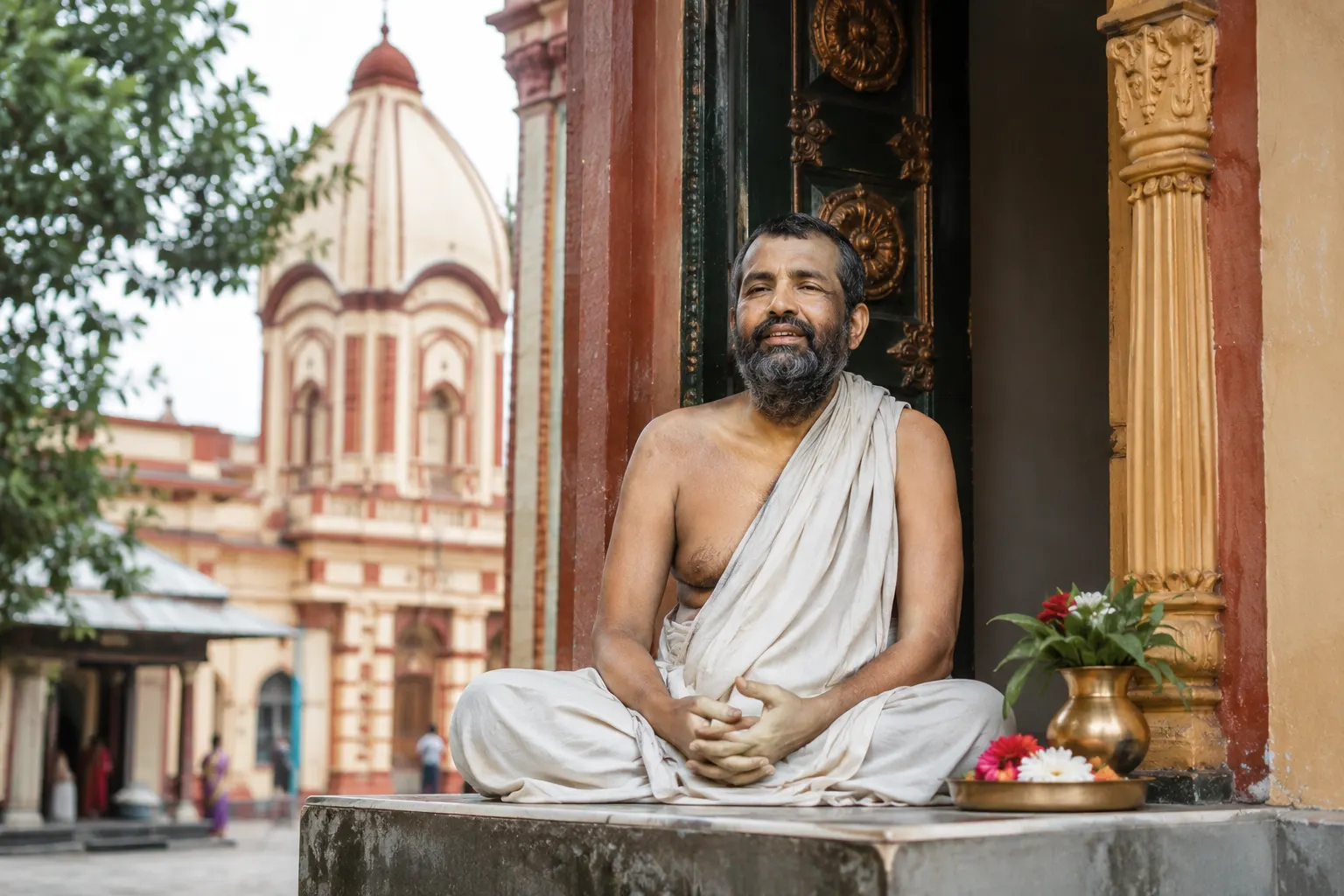
Kabir is remembered with unusual confidence for someone whose biography is so uncertain. Schoolbooks assign him dates. Religious communities tell stories about his birth, teachers, disputes and death. Collections print thousands of verses under his name. Public speech regularly borrows a Kabir couplet to attack hypocrisy, caste pride or empty ritual. Yet the closer historians move toward the fifteenth century, the less stable the conventional biography becomes.
That tension is not a weakness in Kabir’s story. It is one of the keys to understanding his importance.
The figure who survives in the historical record is not a court poet with an archive, a ruler with inscriptions, or a scholar whose manuscripts can be dated securely to his lifetime. Kabir emerges through remembered poetry, early sectarian references and textual collections assembled in different regions. His verses were carried by singers, disciples, religious communities and scribes before modern editors attempted to establish fixed texts. The result is that Kabir is at once a historical poet and a long cultural tradition.
What can be said with confidence is more limited than popular biographies suggest. Kabir belongs to the religious and literary world of north India in roughly the fifteenth century. He is strongly associated with Banaras, with the occupational world of weaving, and with a devotional language that challenged both Brahmanical ritualism and Muslim religious formalism. His verses entered several important textual lineages, including the Bijak associated with the Kabir Panth, the north Indian Kabir Granthavali tradition, and the Sikh scripture, the Guru Granth Sahib. These textual routes do not preserve exactly the same Kabir. Together, however, they preserve one of the most powerful vernacular voices of premodern India.
The historical problem: a famous poet with an uncertain life
Traditional biographies often give Kabir a birth in 1398 and a death in 1518. Those dates are repeated so frequently that they can appear settled. Historians are more cautious. The early evidence does not support such precision, and the long life implied by the traditional dates may partly reflect later attempts to connect Kabir with other revered figures.
The most familiar origin story says that the infant Kabir was found near Banaras and raised by Muslim weavers, often named Niru and Nima. Another tradition places him firmly within the julaha weaving community. Still other accounts reshape his origins to suit different theological claims. The weaving identity is historically plausible and deeply embedded in Kabir memory, but the detailed birth narrative belongs to hagiography rather than secure contemporary documentation.
The same problem affects the famous relationship with Ramananda, the Vaishnava teacher. In later stories, Kabir wants initiation from Ramananda despite social barriers. He lies on the steps where the teacher bathes at dawn; Ramananda accidentally steps on him and utters the divine name, which Kabir treats as initiation. The tale is elegant because it condenses Kabir’s challenge to caste hierarchy and formal religious authority into one scene. Whether it happened cannot be demonstrated.
For an editor, the distinction matters. A legend can be historically important without being literal history. The Ramananda story tells us how later communities imagined Kabir’s spiritual authority. It does not give us a courtroom-quality record of fifteenth-century events.
Banaras, weaving and the world behind the poems
Kabir’s association with Banaras is central to his cultural identity. The city was a major centre of Sanskrit learning, pilgrimage, temple culture and commercial activity. It was also a place where artisans, merchants, mendicants and multiple religious communities interacted. The world of textiles connected local production to large networks of trade. A weaver-poet therefore stood at a productive social intersection: economically integrated into urban life but outside the highest ritual status groups.
Kabir’s poetry repeatedly uses the language of ordinary work, bodily experience and material processes. Threads, weaving, vessels, marketplaces, animals, food and household life become instruments of metaphysical argument. This is one reason his poetry remains unusually portable. It does not depend on the reader knowing an elaborate scholastic system before encountering its force.
Yet it would be simplistic to treat Kabir as merely an uneducated folk critic attacking learned religion. His verses show engagement with a wide range of concepts circulating through Vaishnava, yogic, Nath, Islamic and devotional environments. Terms associated with Ram, Allah, Khuda, sahib, yoga, the subtle body, rebirth, maya and the divine name can appear within the Kabir corpus. His poetic world is not evidence of a tidy synthesis called “Hindu-Muslim unity.” It is evidence of a multilingual religious environment in which concepts crossed social boundaries even as communities argued intensely about truth.
Nirguna devotion: a God beyond image and category
Kabir is usually placed within the nirguna stream of north Indian bhakti: devotion directed toward a divine reality without limiting form or attributes. The classification is useful, though Kabir’s actual language is more unruly than any textbook category.
He often uses the name Ram, but this Ram is not always simply the royal hero of the Ramayana. In many verses, the name points toward the supreme reality itself. Kabir’s God is near and yet difficult to grasp, present within the body and beyond ritual representation. The divine cannot be monopolised by temple, mosque, scripture, caste or clergy.
This is why Kabir’s religious criticism cuts in more than one direction. He mocks external marks of Hindu holiness when they are disconnected from inner transformation. He attacks mechanical pilgrimage and idol-focused ritual when these become substitutes for truth. He also ridicules forms of Muslim piety when public observance masks greed, violence or ego. The targets differ, but the underlying accusation is consistent: institutions and identities can become performances that conceal the absence of genuine spiritual insight.
Kabir’s language should not be flattened into the modern slogan that “all religions are the same.” His poetry can be confrontational, even abrasive. He does not always reconcile traditions politely. He questions their claims to authority. His universalism, where it appears, comes less from diplomatic tolerance than from his insistence that ultimate reality cannot be confined within inherited labels.
The couplet as a weapon against pretence
Modern readers often encounter Kabir through the doha, the compact rhyming couplet. The form suits his reputation because it can turn an ethical argument into something memorable enough to survive orally.
Many of the best-known couplets attributed to Kabir contrast book learning with lived wisdom, ritual purity with moral conduct, or social pride with mortality. Their compactness helps explain their extraordinary afterlife. A two-line poem can travel across generations more easily than a theological treatise.
But attribution is a serious editorial issue. The fact that a couplet is widely called “Kabir ka doha” does not prove that a text can be traced to an early Kabir manuscript tradition. Oral cultures continuously reshape memorable sayings. Modern internet quotation culture accelerates the process. Some verses are modernised; others are detached from context; still others may have migrated between named poets.
A responsible article therefore should not build major claims around a viral couplet unless its textual history has been checked. Kabir’s importance does not depend on preserving every popular attribution.
The *Bijak* and the problem of multiple Kabirs
The Bijak is one of the most important collections associated with Kabir, especially within the Kabir Panth. Its title suggests a key, account or register—something that reveals hidden value. The text contains different forms, conventionally including sakhi, sabad and ramaini materials, and it presents a sharp, frequently paradoxical voice.
Yet the Bijak is not simply “the book Kabir wrote.” The surviving textual tradition developed after the poet’s lifetime. Other major Kabir collections preserve overlapping but not identical material. The Guru Granth Sahib contains compositions attributed to Kabir, incorporated into the Sikh scriptural canon compiled under Guru Arjan in the early seventeenth century. Rajasthan and other regions preserved additional Kabir traditions.
For literary history, this plurality is extremely important. It means that asking for the one original, complete and final “Kabir text” may impose a modern authorial model on a premodern oral-manuscript world. Kabir’s authority grew partly because communities continued to sing, remember, interpret and select his words.
Textual variation does not make the poetry meaningless. It changes the question from “Which modern book contains everything Kabir personally wrote?” to “How was a Kabir voice recognised, transmitted and authorised across communities?”
Caste and inherited status
Kabir’s reputation as an opponent of caste rests on a substantial thematic foundation. His poetry repeatedly attacks pride based on birth and the assumption that ritual status guarantees spiritual superiority. The body is a particularly effective weapon in these arguments: every human is born, bleeds, hungers and dies. The claimed purity of one group becomes difficult to sustain when viewed through ordinary physical existence.
At the same time, modern readers should resist turning Kabir into a twenty-first-century policy theorist. He did not write a constitutional programme for affirmative action, nor did he analyse caste through modern social-science categories. His challenge was ethical, spiritual and social. It deprived hierarchy of divine legitimacy by insisting that access to truth did not depend on inherited rank.
That was radical enough.
A religious world in which spiritual authority could arise from a weaver rather than from a high-status ritual specialist contained a profound challenge to social order. Later Kabir Panth communities and anti-caste thinkers would draw on this memory in different ways.
Was Kabir Hindu or Muslim?
The question is understandable but often poorly framed.
Traditional narratives place Kabir in a Muslim weaving household while also connecting him to Vaishnava devotional teaching. His poetry uses vocabulary familiar from both Hindu and Islamic worlds while refusing the adequacy of formal identity alone. Later Hindus, Muslims, Sikhs and Kabir Panthis all found ways to preserve or claim parts of his legacy.
If the aim is to force Kabir into one modern census box, the evidence frustrates the exercise. If the aim is to understand the religious world in which he spoke, the ambiguity becomes illuminating.
Kabir’s poetry repeatedly suggests that people become trapped by labels while failing to know the reality those labels are supposed to serve. The famous later story of his death makes the point symbolically: Hindus and Muslims quarrel over whether his body should be cremated or buried, only to discover flowers beneath the cloth and divide them between the two communities. There is no reason to treat this miracle tale as a documented event. Its endurance tells us how powerfully later memory associated Kabir with the refusal of exclusive possession.
Language: why Kabir could travel
Kabir did not write in the polished Sanskrit of scholastic theology or the Persian of elite imperial administration. The language attributed to him belongs to the mixed vernacular world of north India. Modern labels such as Sadhukkari are used to describe a transregional idiom containing elements associated with several dialect zones.
This linguistic mobility helped the poetry travel. A verse could be sung, adapted and understood across communities without belonging exclusively to one court or learned institution.
That does not mean Kabir’s poetry is simple. Its surface vocabulary can be ordinary while its meanings are compressed. Paradox is central. The seeker may be told that what he is searching for is already within him. The fish may be imagined as thirsty while surrounded by water. The teacher may overturn the relationship between visible religious achievement and inner ignorance.
Such images demand interpretation, but they do not demand formal initiation into a scholarly language. This combination—conceptual intensity with vernacular accessibility—helps explain Kabir’s unusually wide audience.
Kabir and the Sikh scripture
One of the most consequential forms of preservation occurred in the Sikh tradition. Compositions attributed to Kabir were included in the Guru Granth Sahib alongside the hymns of Sikh Gurus and other Bhagats.
This inclusion matters for two reasons. First, it provides an early and highly influential textual witness to Kabir-associated poetry. Second, it shows that Sikh scriptural formation did not define spiritual authority solely by the institutional identity of the author. The canon includes voices from different social and devotional backgrounds when their teachings were understood as consistent with the scripture’s theological vision.
Kabir therefore occupies an unusual position: central to the Kabir Panth, deeply influential in broader north Indian devotional culture, and canonically preserved within Sikh scripture without becoming a Sikh Guru.
The Kabir Panth and the transformation from poet to saint
After Kabir, organised communities developed around his authority. The Kabir Panth eventually established monasteries, lineages, pilgrimage centres and textual traditions. This institutionalisation created a paradox that appears frequently in religious history.
Kabir’s poetry attacks the tendency of institutions to become self-satisfied and ritualistic. Yet preserving his teaching required institutions.
The Panth made Kabir durable. It copied texts, trained religious specialists, maintained places of memory and gave communities a shared identity. At the same time, different branches developed their own narratives and ritual practices. The anti-institutional poet became the centre of institutions.
That development should not be treated as simple betrayal. Every tradition must find ways to transmit memory. But it helps explain why the historical Kabir and the Kabir of later devotion cannot be assumed to be identical.
Kabir in modern India
Kabir’s modern career is almost as remarkable as his premodern one.
He has been presented as a saint of religious harmony, a critic of caste, a working-class poet, a mystic beyond institutions, a precursor of secular humanism and a symbol of vernacular Indian wisdom. Different political and cultural movements select different Kabirs.
Musicians have been especially important in keeping his poetry alive. Folk singers, classical performers, devotional groups and contemporary fusion artists continue to reinterpret verses attributed to him. Performance prevents Kabir from becoming only a textbook chapter.
Academic scholarship has simultaneously complicated the popular image. Textual historians ask which collections preserve early material. Historians examine the social worlds of artisans and religious specialists. Scholars of religion analyse the differences between nirguna devotion, Nath influences, Vaishnava language and Islamic vocabulary. These approaches do not destroy Kabir’s message. They reveal how many historical layers stand behind the apparently simple couplet.
The danger of making Kabir too agreeable
There is a final distortion worth resisting: the conversion of Kabir into a harmless motivational speaker.
His poetry is memorable partly because it is uncomfortable. It accuses religious professionals of hypocrisy. It questions the proud scholar. It mocks the person who travels to holy places but remains morally unchanged. It exposes the insecurity beneath caste superiority. It refuses to let inherited identity substitute for spiritual knowledge.
A Kabir who merely says “be kind to everyone” is easier to celebrate but less historically recognisable.
His language works through abrasion. The listener is not invited only to admire the poet; the listener is implicated in the problem.
Reading Kabir across competing textual traditions
The multiplicity of Kabir collections also changes how modern editors should quote him. A verse found in the Bijak may appear in a different linguistic form in a Rajasthan manuscript or in the Guru Granth Sahib, and some widely circulated modern Hindi versions smooth older vocabulary into contemporary usage. Those differences are not merely spelling problems. They can affect tone, metaphor and theological emphasis.
For this reason, serious Kabir scholarship often identifies the textual tradition behind a quotation instead of pretending that one standardised modern text represents an untouched fifteenth-century original. The practice is especially important online, where unattributed couplets are repeatedly copied from one website to another until repetition begins to look like evidence.
This does not make Kabir inaccessible to general readers. It simply asks for the same discipline applied to any ancient or premodern author: identify the witness, compare variants where the wording matters, and distinguish a traditional attribution from a secure early textual attestation. In Kabir's case, textual criticism is not an academic obstacle placed between poet and reader. It is part of the story of how the poet survived.
Why Kabir still matters
Kabir survives because the questions in his poetry are structurally difficult to eliminate.
Can a religious identity become a substitute for ethical life? Can learning become pride rather than wisdom? Can ritual become performance? Can social rank disguise spiritual emptiness? Can people search for transcendence everywhere except within the conditions of their own lives?
Those questions are not confined to the fifteenth century.
The historical Kabir remains elusive. We cannot reconstruct his life with the precision available for a modern public figure. But the uncertainty around biography should not obscure the evidence of influence. His poetic voice entered multiple textual traditions, crossed religious boundaries, challenged inherited hierarchies and became part of the moral vocabulary of north India.
Kabir’s power lies in that combination: a poet difficult to possess, preserved by communities that disagree about him, speaking in language simple enough to remember and sharp enough to remain dangerous.
Sources / Further Reading
Linda Hess and Shukdev Singh, The Bijak of Kabir, Oxford University Press — critical translation and study of the Bijak tradition.
Guru Granth Sahib — hymns attributed to Bhagat Kabir in the Sikh scriptural canon.
Charlotte Vaudeville, Kabir and related scholarship on Kabir’s historical and devotional context.
David N. Lorenzen, studies of Kabir, the Kabir Panth and north Indian religious traditions.
John Stratton Hawley, scholarship on north Indian bhakti, textual transmission and saint traditions.
Suggested Internal Links
The Devotion of Kabir — Planned companion article
The Reformer Guru Nanak — Article 34
The Mystic Poet Mirabai — Article 32
What Was the Bhakti Movement? — Planned internal link
How Caste Shaped Premodern Indian Society — Planned internal link