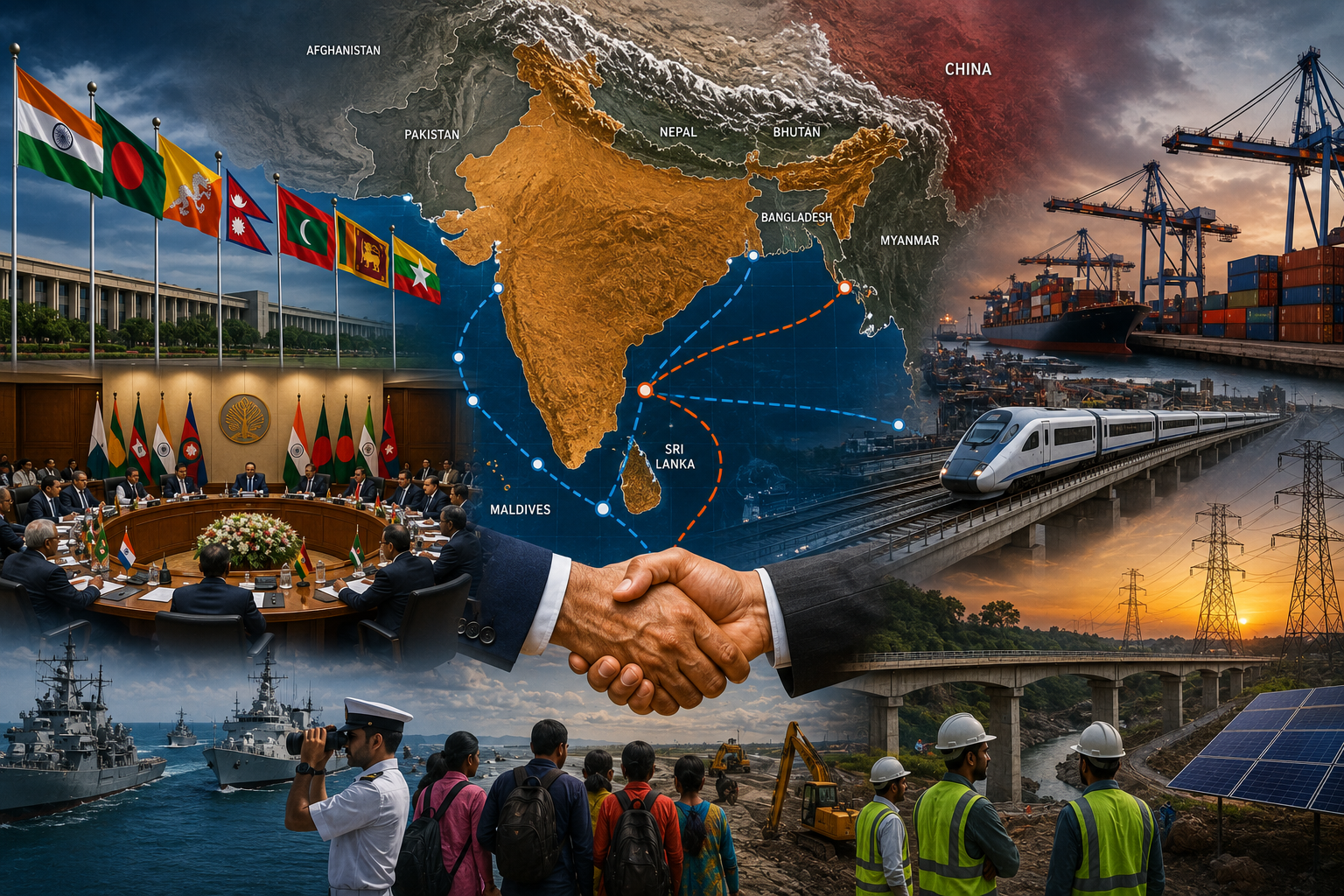
India's global ambitions are rising. It speaks of multipolarity, Global South leadership, supply chain resilience, digital public infrastructure and strategic autonomy. It sits at major diplomatic tables and is courted by competing powers. Yet the most difficult test of India's leadership is not in Washington, Moscow, Brussels or Tokyo. It is at its own doorstep.
A country cannot be a convincing global power if its immediate neighbourhood sees it as unreliable, overbearing or absent. South Asia is India's first credibility test. Nepal, Bhutan, Bangladesh, Sri Lanka, Maldives and Myanmar are not just border states. They are the arena where India's power is experienced most directly. If India's rise does not produce stability and opportunity around it, the larger claim of leadership weakens.
The current trigger is the simultaneous pressure across the neighbourhood. Bangladesh is politically unsettled. Sri Lanka is recovering from debt crisis. Maldives has tested India through strategic balancing. Nepal continues to use external options in its bargaining. Bhutan is negotiating boundary questions with China. Myanmar remains unstable. China is present through infrastructure, finance and diplomacy. Climate shocks, migration, debt, energy insecurity and domestic nationalism are making all relationships harder.
India's traditional advantage is geography. It is the largest economy, military power and market in South Asia. It shares borders, cultures, rivers, religions and histories with its neighbours. It is often the first responder in disasters. It offers lines of credit, grants, training, power, market access and infrastructure. The Ministry of External Affairs notes that India's lines of credit cover hundreds of development projects across sectors such as railways, roads, agriculture, power, hospitals and disaster management. This is a significant base of influence.
But geography is no longer enough. Smaller neighbours have learned to diversify. China offers capital and political support. The Gulf offers jobs and remittances. Japan offers infrastructure. The West offers development finance and governance partnerships. Multilateral institutions offer crisis support. India's neighbourhood is no longer a closed strategic space. It is an open marketplace of influence.
The first analytical dimension is delivery. India's neighbours often appreciate Indian support but complain about delays. Projects announced with enthusiasm can suffer from bureaucratic slowness, land issues, procurement problems or local political resistance. In influence politics, delay is not neutral. A delayed bridge, railway or power line creates space for another partner. India must judge its neighbourhood policy by completion, not announcement.
The second dimension is respect. Smaller states are sensitive to Indian tone. Because India is large, even casual political statements can sound threatening. Domestic rhetoric in India can spill into neighbourhood perceptions, especially when it touches religion, migration or identity. India's diplomacy must therefore separate domestic political theatre from regional statecraft. A regional leader must be firm, but not casually humiliating.
The third dimension is economic integration. South Asia remains one of the least integrated regions in the world relative to its potential. India's market could be the engine of regional prosperity, but non-tariff barriers, political mistrust, poor connectivity and protectionism limit the gains. If India wants leadership, it must make neighbours richer by being connected to India. That means easier trade, reliable transit, energy grids, digital payments, tourism circuits, education links and resilient supply chains.
The fourth dimension is security sensitivity. India's concerns are real. External military presence, anti-India groups, illegal migration, drug trafficking, radical networks, maritime surveillance and border disputes cannot be ignored. But security policy must be paired with incentives. If neighbours feel India only sees them through threats, they will search for alternative partners. Security without development becomes suspicion. Development without security becomes vulnerability. India needs both.
The fifth dimension is crisis response. India performed strongly during several regional emergencies: vaccines during the pandemic, assistance to Sri Lanka during the economic crisis, disaster relief in the neighbourhood and evacuation support in conflict zones. These actions build credibility because they are visible and immediate. But crisis response must be institutionalised. India should not rely only on ad hoc goodwill. It needs standing regional mechanisms for food, fuel, health, climate and financial shocks.
The India angle is unavoidable. Regional leadership affects India's national security, economic growth and global image. If neighbours are unstable, India faces refugees, smuggling, terrorism, maritime risks and diplomatic distraction. If neighbours are prosperous and connected, India gains markets, corridors, energy security and legitimacy. India's global rise and regional leadership are therefore not separate projects. They are the same project at different scales.
China's role complicates the picture. Beijing does not need to replace India everywhere. It only needs enough presence to limit India's options. A port here, a road there, a political constituency elsewhere, a credit line during crisis, a diplomatic gesture at the right time - each can create leverage. India must compete without turning neighbours into battlegrounds. The best way to counter China is not to demand loyalty, but to offer better partnership.
The counter-view is that India is often judged unfairly. Neighbours blame India for domestic failures, use anti-India nationalism for electoral gains and then expect emergency support. This is true in many cases. Smaller states sometimes use China as a bargaining card and then seek Indian help when crises deepen. But leadership is not about receiving fair treatment. It is about managing unfairness without losing strategic focus.
Another counter-view is that South Asia's political culture makes regional integration difficult regardless of India. Borders are contested, nationalism is strong, institutions are weak and domestic politics often rewards suspicion. This too is true. But it does not absolve India. A leading power must create incentives strong enough to overcome mistrust. Europe integrated after devastating wars. Southeast Asia built ASEAN despite diversity. South Asia's failure is not destiny.
What happens next depends on whether India upgrades its neighbourhood compact. The old formula of aid, visits and goodwill is insufficient. India needs a twenty-first-century regional offer: faster infrastructure, energy market integration, digital public goods, climate resilience funds, education access, health cooperation, easier visas for legitimate travel, border-area development and private-sector participation. It must also empower Indian states that border neighbours, because they are frontline actors in foreign policy.
The editorial conclusion is direct: India's regional leadership will not be proven by speeches about the Global South. It will be proven by whether Dhaka, Colombo, Thimphu, Kathmandu and Male believe India's rise improves their future. If they do, India becomes a natural leader. If they do not, India's global ambition will carry a weak flank at home.
India's leadership problem is partly structural. South Asia is asymmetrical. India is so large relative to most neighbours that even normal actions can be interpreted as pressure. When India offers assistance, some fear dependence. When India delays assistance, some accuse it of neglect. When India intervenes diplomatically, it is accused of interference. When it stays silent, it is accused of indifference. This is the burden of being the central power.
The answer is not to withdraw. It is to create rules, habits and institutions that reduce fear. India should make its regional engagement more predictable. Neighbours should know what support they can expect in disasters, what financing terms are available, how projects are selected, how disputes are escalated and how concerns are heard. Predictability turns power into reassurance.
One major gap is regional institutional weakness. SAARC is largely paralysed because of India-Pakistan tensions. BIMSTEC has promise but still lacks the depth needed for economic transformation. Subregional groupings such as BBIN have potential in transport and energy, but progress is uneven. India should not wait for perfect regional consensus. It should build coalitions of the willing around electricity, transport, digital payments, climate resilience and health.
India also needs to link neighbourhood policy with its domestic growth centres. The Northeast should become a gateway, not a security buffer. Tamil Nadu and Kerala can deepen maritime and economic links with Sri Lanka and Maldives. West Bengal and Assam can shape engagement with Bangladesh and Bhutan. Bihar and Uttar Pradesh can support Nepal connectivity. Gujarat and Maharashtra can support Indian Ocean trade. When border states benefit economically, they become advocates of regional cooperation.
The private sector must be brought in more seriously. Government grants and lines of credit are important, but they cannot alone build regional prosperity. Indian companies should invest in logistics, healthcare, education, renewable energy, digital services, tourism and manufacturing across the neighbourhood. However, private investment needs political risk insurance, dispute resolution mechanisms and diplomatic support. A regional leader must mobilise its businesses, not only its bureaucracy.
People-to-people policy needs equal attention. Student visas, medical visas, research exchanges, media fellowships, tourism promotion and cultural circuits can create durable goodwill. Many future leaders in neighbouring countries should have positive experience with India. If China trains officials and builds elite networks while India relies only on old familiarity, India will lose influence gradually.
Communication is another weakness. India often does substantial work but fails to tell the story effectively in local languages and local media. Chinese-funded projects are often branded visibly. Indian projects sometimes become invisible because they are delayed, poorly communicated or politically underplayed. Strategic communication is not propaganda; it is making benefits legible to citizens.
There is also a moral dimension. A regional leader must be seen as generous in moments of crisis. India's vaccine supplies, disaster relief and Sri Lanka assistance strengthened its image because they were timely. But generosity must be consistent. Selective support based only on political comfort can create distrust. The neighbourhood watches how India treats each country and compares.
India's global partners can help, but they cannot replace India. Japan, the EU, the US and multilateral banks can co-finance infrastructure and resilience projects. But if external partners lead and India follows, India's regional credibility weakens. The ideal model is India-led, partner-supported development that offers transparent finance and high standards.
The most difficult test will be dealing with governments India dislikes. Regional leadership cannot depend on ideological comfort. India must engage elected governments, interim governments, military-influenced systems and fragile coalitions with professionalism. Personal chemistry is useful, but institutional continuity is essential. Neighbours should not fear that a change in their domestic politics will automatically freeze ties with India.
India's doorstep will remain turbulent because South Asia is young, climate-vulnerable, unequal and politically intense. But this turbulence also gives India an opportunity. If it can provide stability, markets and public goods, it will become indispensable. If it only complains about Chinese influence and neighbourly ingratitude, it will appear reactive.
The final measure of India's leadership is simple: do neighbours voluntarily choose more India? More trade with India, more electricity links with India, more students in India, more digital systems connected to India, more crisis coordination with India, more comfort with Indian investment. Leadership is not declared; it is chosen repeatedly by others. India's task is to make that choice easy.
India must also understand the psychology of smaller neighbours. They often fear domination more than abandonment, but they resent abandonment when crises come. This creates a delicate expectation: India should be present, but not intrusive; generous, but not controlling; powerful, but not arrogant. Managing this paradox is the art of regional leadership. It cannot be solved by one summit or one slogan.
Development partnerships should be measured by local satisfaction. A project may look successful in Delhi because funds were allocated, but if the road is incomplete, the hospital lacks staff or the power project faces delays, local opinion may be negative. India should create feedback systems in neighbouring countries, including beneficiary surveys, local media tracking and independent audits. Listening is a strategic tool.
The region also needs climate leadership. South Asia faces floods, heatwaves, cyclones, glacial risks and water stress. India can build a regional climate resilience platform with early warning systems, disaster-response logistics, resilient agriculture, insurance tools and adaptation finance. This would position India as a provider of future security, not only traditional aid.
Health cooperation is another area where India has natural strength. Pharmaceuticals, vaccines, telemedicine, medical training and affordable hospital access can create enormous goodwill. Many citizens from neighbouring countries already seek treatment in India. Formalising and improving this health corridor would turn India's medical capacity into regional soft power.
Education may be the most underused instrument. If future officials, engineers, journalists and entrepreneurs from neighbouring countries study in India and build positive networks, India's influence becomes organic. Scholarships should be expanded, visa processes simplified and university partnerships improved. Competing with China requires investing in minds, not only roads.
India also needs to manage anti-India narratives with patience. Some criticism is unfair, but some is based on real grievances. Dismissing all criticism as foreign manipulation prevents learning. New Delhi should distinguish between manufactured hostility and legitimate concern. Mature powers correct mistakes without becoming defensive.
Regional leadership also requires economic openness. India cannot ask neighbours to trust its leadership while keeping markets difficult to access. Selective protection may be necessary in sensitive sectors, but overall policy should make it easier for neighbours to export, invest and connect. Asymmetry means India can afford more generosity. In fact, generosity is cheaper than instability.
The China factor should be used carefully in Indian diplomacy. If India tells every neighbour that cooperation is necessary because China is dangerous, the neighbour may feel instrumentalised. India should instead present cooperation as beneficial on its own terms. A road should be built because it helps trade, not only because China is nearby. A power line should be built because it lowers costs, not only because Beijing is competing. Positive logic creates stronger partnerships than fear.
The doorstep test is continuous. Every border incident, delayed project, crisis response, trade rule and political statement becomes evidence in the minds of neighbours. India's reputation is built cumulatively. A single generous act helps, but repeated reliability transforms perceptions. The region must learn that when India promises, India delivers.
If India succeeds, South Asia can become a platform for its global rise. If it fails, the neighbourhood will remain a strategic drag. The difference lies not in ambition but in execution. Regional leadership is not a crown India wears. It is a responsibility India must perform daily.
India's leadership should also be judged by whether it reduces the strategic loneliness of its neighbours. Small states often feel that they face debt, climate disasters, political instability and great-power pressure alone. If India can become the partner that appears early, listens seriously and stays after the cameras leave, its leadership will become trusted. Reliability is the highest form of regional power.
Another priority is policy memory. Neighbourhood policy often changes tone with personalities and crises. India needs institutional continuity so that projects, dialogues and commitments survive political cycles both in India and in neighbouring countries. A regional strategy must be larger than individual leaders. It should be embedded in systems, budgets and long-term public support.
The final test is generosity with confidence. India is big enough to offer asymmetric benefits without fearing loss of status. Easier market access, faster visas, emergency support and patient diplomacy can create loyalty that coercion never can. In South Asia, leadership will belong not to the power that demands the most respect, but to the one that earns the most trust.