India's relationship with Bangladesh is often described through history, culture and the memory of 1971. But the everyday reality of the relationship is shaped by three harder forces: border, migration and trade. These forces decide whether the partnership feels secure or strained, whether connectivity becomes opportunity or anxiety, and whether public opinion on both sides sees the neighbour as a partner or a problem.
Bangladesh is not just another neighbour for India. It surrounds much of India's Northeast, connects the subcontinent to the Bay of Bengal and sits at the heart of India's Act East ambitions. A stable, cooperative Bangladesh reduces India's strategic vulnerability. A hostile or unstable Bangladesh complicates border security, migration politics, trade routes, minority concerns, river management and regional connectivity.
The current trigger is the more uncertain political environment in Bangladesh and the resulting pressure on bilateral ties. Since 2024, India's comfort with the earlier political stability in Dhaka has weakened. Border enforcement, trade restrictions, transit questions and public rhetoric have all become more sensitive. The relationship has not collapsed, but it has entered a more difficult phase in which old assumptions no longer work automatically.
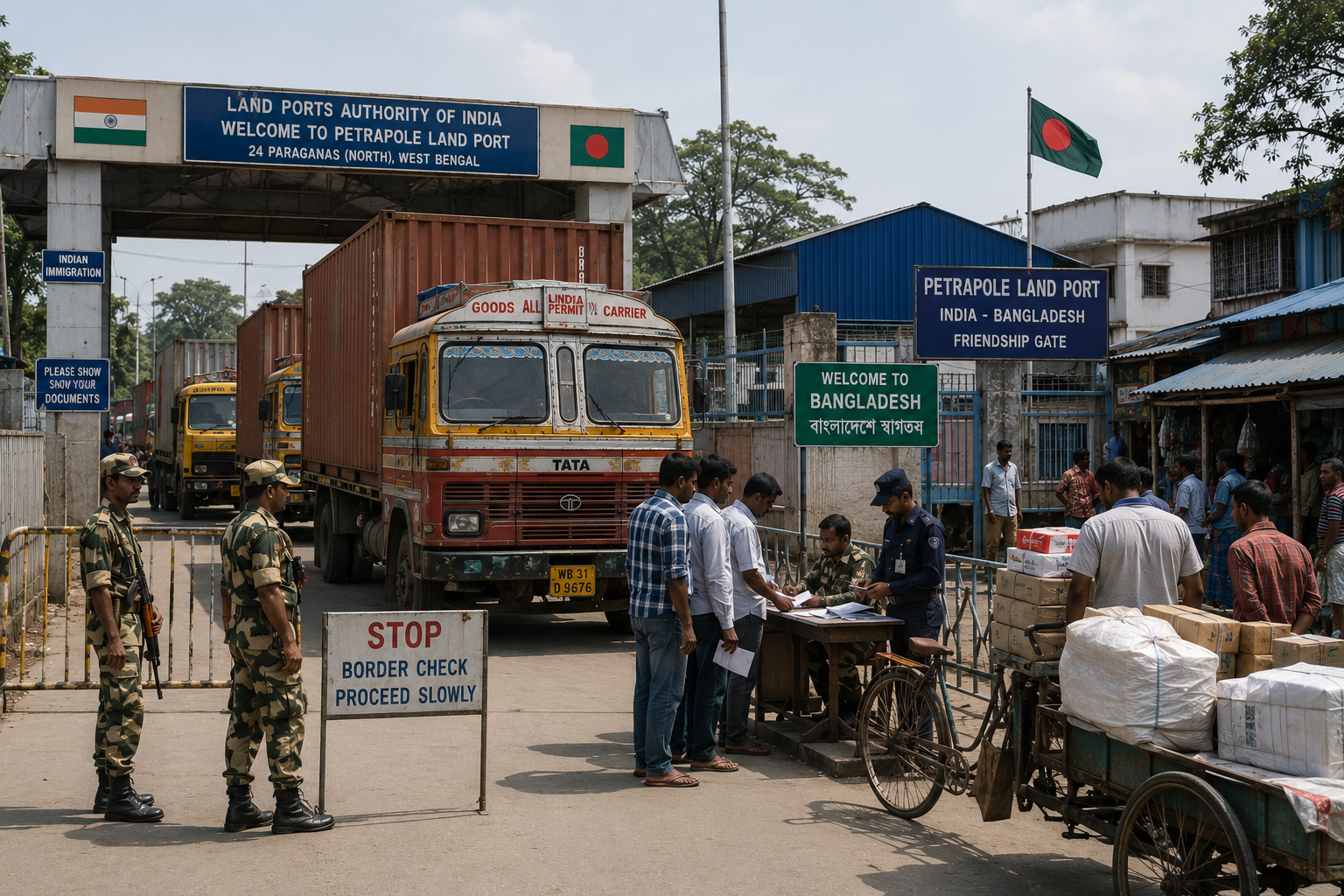
The first dimension is the border. The India-Bangladesh border is one of the longest and most socially complex borders in the world. It cuts across villages, rivers, markets, families and migration routes. The 2015 Land Boundary Agreement resolved a historic anomaly of enclaves and adverse possessions, proving that even difficult border problems can be settled. But fencing, smuggling, trafficking, cattle movement, illegal migration and border deaths remain politically charged issues.
Border management is not just a security task. It is a governance task. A border that disrupts local livelihoods creates resentment. A border that is too porous creates security anxiety. A border that is managed without coordination produces diplomatic incidents. India and Bangladesh must constantly balance enforcement with humanity. The Border Security Force and Border Guard Bangladesh cannot alone solve what is ultimately a social, economic and political frontier.
The second dimension is migration. In India, migration from Bangladesh is often discussed through electoral language, especially in Assam and West Bengal. It touches identity, citizenship, employment and security. In Bangladesh, the issue is viewed through dignity and sovereignty. No government in Dhaka wants to be publicly treated as a source of illegal migration. The political danger is that migration becomes a permanent suspicion machine: every Bengali-speaking poor person becomes vulnerable to being treated as foreign, while every enforcement action becomes a diplomatic irritant.
A mature policy requires better documentation, legal labour pathways, border-area development, intelligence cooperation and depoliticised verification mechanisms. India cannot ignore illegal migration, but it also cannot afford careless rhetoric that alienates Bangladesh. Bangladesh cannot deny cross-border movement, but it also cannot accept public humiliation. Both sides need quiet, professional mechanisms rather than loud politics.
The third dimension is trade. Bangladesh is India's largest trade partner in South Asia, with official figures showing bilateral goods trade of around USD 14.01 billion in FY 2023-24. But the trade relationship is structurally imbalanced. India exports far more to Bangladesh than it imports. For Bangladesh, this imbalance can create resentment. For India, Bangladesh is a growing market and a connectivity partner. The challenge is to make trade feel mutually beneficial.
Trade also intersects with domestic industry. Textiles, garments, food products, power, logistics and border haats all carry political economy implications. When restrictions are imposed or transit facilities are altered, the impact is not only bilateral. It affects exporters, transporters, consumers and India's Northeast. Connectivity through Bangladesh can reduce logistics costs for the Northeast dramatically, but only if political trust remains strong.
The fourth dimension is security cooperation. One of the strongest phases of India-Bangladesh relations came when Dhaka acted against anti-India insurgent networks. That cooperation helped stabilise parts of the Northeast. India must not underestimate how valuable this was. If political distrust rises in Bangladesh, security cooperation can weaken. That would be a strategic setback for India.
The fifth dimension is water and climate. The Teesta issue remains unresolved, and river management is becoming more difficult due to climate variability. Floods, erosion and dry-season stress affect border communities and public perceptions. Water disputes can quickly spill into trade and political trust. This is why India-Bangladesh ties must be treated as an integrated system, not separate files in different ministries.
The India angle is powerful. Bangladesh is the key to India's eastern connectivity. Roads, railways, inland waterways, ports and energy links through Bangladesh can transform the Northeast from a peripheral region into a bridge to Southeast Asia. But connectivity requires trust. No corridor can succeed if the political relationship is unstable. For India, Bangladesh is not only a neighbour; it is the hinge of eastern strategy.
The global implications are equally important. As supply chains shift and companies seek alternatives to China, South Asia has a chance to create regional value chains. India and Bangladesh could collaborate in textiles, pharmaceuticals, light engineering, logistics, digital services and energy. But if the relationship becomes dominated by suspicion, both will miss the opportunity. Regional trade in South Asia is already far below potential. India-Bangladesh cooperation is one of the few places where this can change.
The counter-view is that Bangladesh may now seek greater balance by engaging China, Turkey, the Gulf and Western partners more actively. This is not necessarily anti-India. It is normal diversification. India must not panic over Bangladesh's external options. It must instead make partnership with India more profitable and predictable. The danger lies not in Bangladesh having options, but in India becoming unattractive due to delays, restrictions or political signalling.
What happens next will depend on three choices. First, whether both countries can keep border incidents from becoming nationalist crises. Second, whether they can restore confidence in trade and transit. Third, whether India can engage whichever political formation governs Dhaka without appearing partisan. India's Bangladesh policy must be state-to-state, not leader-to-leader alone.
The editorial insight is clear: India-Bangladesh relations are not sustained by nostalgia. They are sustained by daily management of border, migration and trade. If those three are handled with maturity, the relationship can become South Asia's strongest partnership. If they are mishandled, even shared history will not prevent strategic drift.
The border question becomes especially sensitive because it is linked to identity inside India. In Assam, migration debates are tied to language, land and citizenship. In West Bengal, they are tied to labour, culture and electoral politics. In Tripura, the demographic memory is different again. This means Bangladesh policy is never purely external. It passes through India's domestic anxieties. A responsible government must enforce the border, but it must also prevent the issue from becoming a tool for indiscriminate social suspicion.
Bangladesh also has its own sensitivities. It is a proud state born from a liberation struggle. It does not want to be spoken of only as a source of migrants or security risks. Its economy has made major gains over the last two decades, especially in garments, remittances and social indicators. If Indian discourse ignores this progress and frames Bangladesh only negatively, it damages goodwill among Bangladeshis who might otherwise favour cooperation.
Trade imbalance deserves more serious attention. India exports far more to Bangladesh than it imports. While this reflects India's economic scale, it can create political unease in Dhaka. India should support greater Bangladeshi exports where feasible, especially through standards assistance, faster customs clearance, logistics support and market access. A neighbour that earns from trade with India will defend the relationship domestically. A neighbour that only buys from India may eventually resent it.
Connectivity is the strategic prize. For India's Northeast, Bangladesh can reduce the tyranny of distance. Goods that must travel through the narrow Siliguri Corridor could move more efficiently through Bangladeshi routes and ports. Inland waterways, rail links and road corridors can transform regional economics. But connectivity requires political predictability. If each diplomatic disagreement leads to trade or transit restrictions, businesses will not invest in long-term regional supply chains.
The energy relationship is also important. Bangladesh has imported power from India and has been linked to regional electricity cooperation. In the future, cross-border grids could support renewable balancing, hydropower trade from Nepal and Bhutan, and more efficient energy markets. Energy interdependence can create stability because both sides gain from continuity. But it requires transparent pricing, reliable supply and public trust.
Border haats offer a smaller but symbolically important model. These local markets allow communities near the border to trade legally and socially. They reduce incentives for smuggling and humanise the frontier. Expanding such mechanisms, where security permits, can turn the border from a line of suspicion into a zone of livelihood. Big diplomacy often fails when local communities see no benefit.
Migration policy should also distinguish between categories. Refugees, undocumented economic migrants, trafficked persons, seasonal workers and long-settled populations cannot be treated with one blunt instrument. India needs legal clarity, humane procedures and cooperation with Bangladesh for verification and return. Arbitrary action creates fear and diplomatic friction. Weak enforcement creates domestic anger. The middle path is difficult but necessary.
There is a China dimension to Bangladesh as well. Dhaka has accepted Chinese infrastructure and military equipment while maintaining strong ties with India and other partners. This is classic balancing. India should not expect Bangladesh to reject China entirely. Instead, India should focus on areas where its advantages are natural: geography, market access, culture, health, education, power, digital systems and connectivity. Strategic confidence is better than possessiveness.
The future of the relationship also depends on how India handles political change in Bangladesh. A policy overly dependent on one leader or one party becomes vulnerable when domestic politics shifts. India must build broad relationships across institutions, business groups, civil society, youth, armed forces, bureaucracy and regional actors. A durable partnership must survive elections and street protests.
Ultimately, border, migration and trade are connected. If trade expands and border economies improve, migration pressure may reduce and local cooperation may rise. If border communities remain poor and trade is restricted, smuggling and illegal movement become attractive. Security policy must therefore be linked to economic policy. A prosperous border is easier to secure than a desperate one.
The lesson for New Delhi is practical. Bangladesh should be treated as a central pillar of India's eastern strategy, not as a file activated only during crises. The relationship needs daily maintenance, economic imagination and careful language. A stable Bangladesh connected to India is one of the strongest strategic assets India can have. A resentful Bangladesh is one of the most avoidable problems India can create.
The relationship also requires better crisis insulation. If a border incident occurs, trade should not automatically suffer. If a political controversy erupts in Dhaka or Delhi, power cooperation should not immediately become hostage. Mature partnerships create firewalls between disputes and essential cooperation. India and Bangladesh need such firewalls because their relationship is too important to be destabilised by every incident.
Customs modernisation can make a major difference. Delays at land ports, inconsistent standards, paperwork and infrastructure gaps raise costs and frustrate traders. If India wants Bangladesh to see it as an economic opportunity, border trade must become smoother. Digitised customs, better warehousing, cold chains, testing labs and coordinated working hours can make practical improvements without grand diplomacy.
The Northeast should be placed at the centre of Bangladesh policy. For decades, the region suffered from geographic isolation. Cooperation with Bangladesh can change that. Access to Chittagong and Mongla ports, rail links, road corridors and inland waterways can reduce logistics costs and attract investment. But local communities in the Northeast must feel included. If they fear that connectivity benefits only big business or creates demographic pressure, support will weaken.
Security cooperation should also adapt to new threats. Earlier, the focus was insurgent groups. Today, cybercrime, narcotics, trafficking, radical networks, counterfeit goods and illegal financial flows are equally important. Joint training, intelligence-sharing and technology-enabled border management can help. But security cooperation must remain professional and discreet. Public accusation weakens trust.
Water disputes and border management often intersect. Riverine borders shift, chars emerge and local populations move with ecological changes. Climate-induced displacement may complicate migration politics in the future. India and Bangladesh should begin discussing climate mobility before it becomes a crisis. A humane and rules-based framework will be better than panic responses after disasters.
Trade diversification is another priority. The relationship should move beyond basic goods into pharmaceuticals, automobiles, electronics components, processed food, logistics, health services, education and digital collaboration. Bangladesh's garment strength and India's textile, chemical and machinery base can be complementary if policy barriers are reduced. Regional value chains will make both economies more resilient.
There is also an opportunity in the Bay of Bengal. Ports, coastal shipping, fisheries, energy exploration and blue economy projects can widen the relationship beyond the land border. Bangladesh gives India a crucial eastern maritime partner. India gives Bangladesh a vast market and security partner. The Bay of Bengal should become a cooperation zone, not a neglected space.
Political communication must be disciplined. Leaders and officials on both sides should avoid language that humiliates the other. In a relationship with deep people-to-people overlap, words travel quickly. A statement made for domestic applause can damage bilateral trust. Responsible language is a strategic necessity.
The future of India-Bangladesh relations will likely be more transactional than the past. Shared history will still matter, but younger generations will ask what the relationship delivers now. Jobs, trade, mobility, education, energy and security will define opinion. India should welcome this shift because it can compete strongly if it delivers. Bangladesh should also recognise that a cooperative India is essential for its regional options.
The larger editorial point is that the border should not be treated only as a line of control. It should become a line of connection, with enough security to prevent threats and enough openness to support prosperity. If India and Bangladesh can achieve that balance, they will create the strongest model of practical regionalism in South Asia.
India should also recognise Bangladesh's changing self-image. It is no longer only the vulnerable neighbour of earlier decades; it is an economy with industrial capacity, social achievements and strategic options. Treating Bangladesh with outdated assumptions will produce resentment. A modern partnership must speak to Bangladesh as a confident state that wants dignity along with cooperation.
Similarly, Bangladesh must recognise India's security sensitivities. Illegal migration, trafficking, radical networks and border crimes are not imaginary concerns. Dismissing them as Indian politics alone prevents serious problem-solving. The better approach is joint verification, better policing, economic development of border areas and professional cooperation that keeps the issue away from public humiliation.
The relationship will be strongest when both sides stop seeing the border as proof of separation and start treating it as a managed interface. Goods, energy, tourists, patients, students and ideas should move legally and efficiently; criminals and traffickers should not. That is the practical balance on which the future partnership depends.
The practical future should be built around predictable rules. Traders should know that consignments will move. Border residents should know that legal livelihoods are possible. Security agencies should know that cooperation channels will function during tension. Predictability is the foundation of trust.