Gum Disease Explained: Why Gums Bleed and How Periodontitis Is Treated
Bleeding gums are common, but that does not make them healthy.
Many people first notice a problem when they see a small amount of blood while brushing or flossing. They may assume that the toothbrush was too hard or that floss cut the gum. Vigorous cleaning can certainly injure soft tissue, but repeated gum bleeding is commonly a sign of inflammation, particularly when it occurs alongside redness, swelling or tenderness.
Gum disease usually begins quietly. It often causes little or no pain in its early stages, which means someone can have significant inflammation without feeling ill. That is one reason waiting for toothache is a poor way to judge periodontal health.
The encouraging part is that the earliest plaque-related gum inflammation can often be reversed. The concern is what can happen when inflammation progresses deeper into the tissues and bone supporting the teeth.
Understanding gum disease therefore starts with an important distinction: gingivitis and periodontitis are related, but they are not the same condition.
How plaque turns bleeding gums into a deeper periodontal problem
Dental plaque is a sticky microbial film that continually forms on teeth. It is not something that appears only when someone has “dirty teeth.” Everyone develops plaque. The question is whether it is disrupted regularly enough to prevent harmful accumulation around the gumline and between teeth.
Brushing and interdental cleaning remove much of this soft plaque. If it remains for long enough, some of it can harden into calculus, or tartar. NIDCR notes that tartar cannot be effectively removed with ordinary home brushing and requires professional cleaning by a dentist or dental hygienist. Its rough surface can also provide additional sites where plaque accumulates. (nidcr.nih.gov)
The earliest plaque-related disease is generally gingivitis.
The gums may become redder, swollen or tender and may bleed during brushing, flossing or a dental examination. At this stage, inflammation is largely confined to the gums and has not yet produced the destructive loss of supporting attachment and bone characteristic of periodontitis.
That difference matters because plaque-induced gingivitis can usually improve substantially when plaque is removed consistently through effective home cleaning and professional care where tartar is present. NIDCR describes early plaque-related gum disease as often reversible through regular brushing and cleaning between the teeth. (nidcr.nih.gov)
Periodontitis goes deeper.
The inflammatory process damages the supporting structures that hold teeth in place. The gum can detach from the tooth surface, periodontal pockets can deepen, and supporting connective tissue and bone can be lost.
This is no longer simply a problem of red gums.
It is damage to the tooth's support system.
Once periodontal attachment and bone have been destroyed, brushing cannot simply grow them back. Modern periodontal treatment can control infection and inflammation, stabilise disease and sometimes regenerate selected defects using specialised procedures, but established periodontitis should not be described as though it can always be returned to a mouth that never had the disease.
That is why recognising gingivitis early matters.
How dentists tell gingivitis from periodontitis
Looking in the mirror is not enough to determine how healthy the supporting tissues are.
A mouth can appear relatively ordinary while disease exists beneath the gumline.
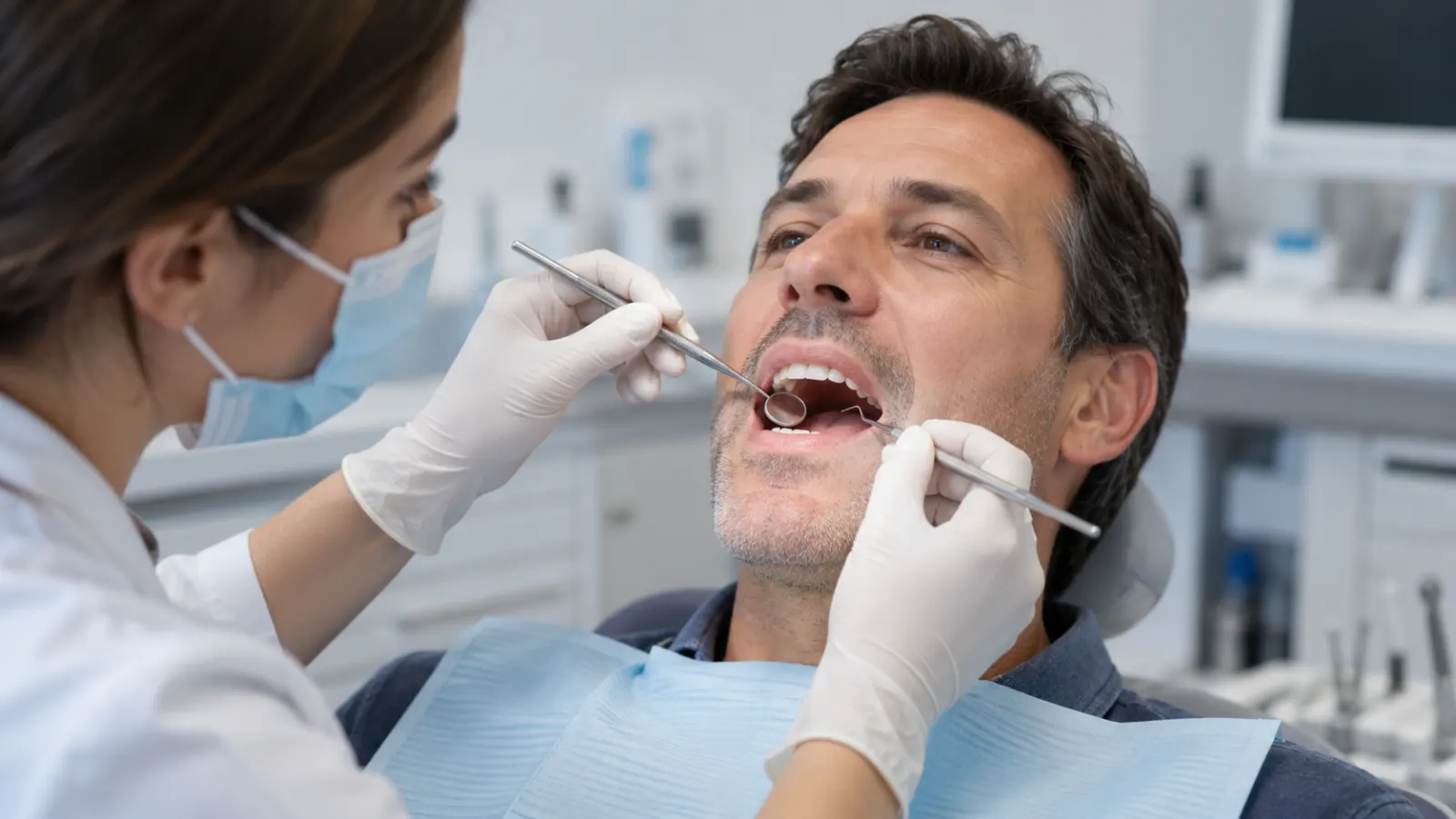
During a periodontal examination, the dentist or dental hygienist looks for signs including inflammation, bleeding and gum recession. A small measuring instrument called a periodontal probe is gently placed around the teeth to assess the depth of the space between the gum and tooth.
NIDCR states that in a healthy mouth these pockets are commonly about one to three millimetres deep. Deeper measurements can be one sign of periodontal disease, but dentists interpret them together with bleeding, attachment levels, recession, tooth mobility and other findings rather than treating one number in isolation. (nidcr.nih.gov)
X-rays can add information that cannot be obtained by looking at the gums alone. Periodontitis can destroy the bone supporting the teeth, and dental radiographs can help show whether that bone has been lost.
The diagnostic picture therefore comes from several pieces of information:
the appearance of the gums, periodontal measurements, tooth stability, medical and tobacco history, and imaging where appropriate.
This also explains why gum recession does not automatically mean periodontitis.
Periodontal disease can certainly cause gums to recede as supporting tissues are damaged, but recession can have other causes. Thin gum anatomy, traumatic or overly aggressive brushing and local mechanical factors can expose root surfaces without the same disease process.
Likewise, a loose tooth is concerning but not uniquely diagnostic of periodontitis. Severe periodontal bone loss can create mobility, but trauma, excessive bite forces and other dental conditions can also contribute.
The correct response is assessment rather than self-diagnosis from appearance.
Why some people develop more severe gum disease than others
Plaque is central to common forms of gingivitis and periodontitis, but people do not all respond to plaque in exactly the same way.
Two people can have similar oral-hygiene habits and develop very different levels of periodontal destruction. Individual susceptibility is influenced by biological, behavioural and medical factors.
Among the most important is tobacco use.
NIDCR currently describes smoking and other tobacco use as the most significant risk factor for gum disease. Tobacco can increase disease risk, delay healing and reduce the success of periodontal treatment. (nidcr.nih.gov)
Smoking also creates a potentially misleading clinical effect.
Inflamed gums normally bleed because blood flow and inflammatory changes increase in affected tissues. Smoking can suppress visible bleeding even while deeper periodontal destruction is occurring. Research has repeatedly found smokers can have more probing depth and attachment loss while showing less bleeding on probing than non-smokers. (pubmed.ncbi.nlm.nih.gov)
So a smoker should not interpret gums that rarely bleed as proof that the gums are healthy.
Diabetes is another important risk factor.
People with diabetes have a higher likelihood of periodontal disease, and the disease tends to occur more frequently and severely when blood glucose is poorly controlled. Diabetes can also slow healing and complicate periodontal treatment. NIDCR additionally notes that having gum disease may make blood glucose more difficult to control, creating a potentially bidirectional relationship. (nidcr.nih.gov)
This does not mean treating gum disease replaces diabetes treatment. Periodontal care should complement—not substitute for—appropriate medical management, glucose monitoring, medication when prescribed and other diabetes care.
Age also matters, although ageing itself should not be treated as proof that tooth loss is inevitable. Older adults have had more years during which periodontal disease can develop, and other risk factors such as diabetes, medications, dry mouth or reduced dexterity may accumulate.
Genetic susceptibility, immune disorders, stress, obesity and particular medical conditions or medications can also influence periodontal risk. NIDCR lists older age, diabetes and genetics among recognised factors and notes associations with several systemic conditions. (nidcr.nih.gov)
The practical lesson is that periodontal care should be matched to risk rather than assuming everyone requires exactly the same monitoring schedule.
What gum-disease treatment actually involves
The goal of periodontal treatment is not to make the gums look prettier for a few days. It is to control infection and inflammation, preserve the tissues supporting the teeth and prevent further destruction.
For plaque-related gingivitis, improving home plaque removal and professionally removing tartar may be enough to restore health.
Established periodontitis usually requires professional treatment below the gumline.
One common non-surgical treatment is scaling and root planing. During this procedure, deposits and bacterial biofilm are removed from affected root surfaces below the gumline so that inflammation can settle and periodontal tissues can heal as effectively as possible.
NIDCR identifies scaling and root planing as a standard deep-cleaning approach for periodontal disease and notes that more advanced cases may require additional medication or periodontal surgery. (nidcr.nih.gov)
Treatment is increasingly approached in stages rather than as one dramatic procedure. Evidence-based periodontal guidelines emphasise controlling plaque and risk factors first, then carrying out subgingival instrumentation and reassessing the response before considering more complex surgical treatment where necessary. (pubmed.ncbi.nlm.nih.gov)
This matters because not every deep pocket automatically requires surgery.
Nor should periodontal surgery be described as evidence that previous treatment “failed.” Some anatomical defects, residual deep pockets or advanced patterns of bone loss need interventions that ordinary non-surgical cleaning cannot completely address.
The appropriate plan depends on the distribution and severity of disease, tooth anatomy, overall health, smoking, diabetes control and how well the tissues respond to initial therapy.
Treatment is followed by maintenance—not a permanent cure
One of the most common misunderstandings about periodontal treatment occurs after a patient completes deep cleaning.
The gums improve.
Bleeding falls.
Pockets may become shallower.
The patient assumes the disease has now been permanently cured.
But plaque begins forming again almost immediately.
Someone who has already experienced attachment or bone loss remains at higher future risk than someone who never developed periodontitis.
This is why modern periodontal care includes supportive periodontal therapy, often called periodontal maintenance.
Long-term evidence and clinical guidance support ongoing risk-based monitoring after active treatment. The purpose is to identify recurrent inflammation, remove deposits that cannot be controlled at home, reassess periodontal pockets and treat sites showing renewed disease. A single fixed interval is not appropriate for every patient; follow-up should reflect individual risk. (pubmed.ncbi.nlm.nih.gov)
For someone with previous severe periodontitis, tobacco use or poorly controlled diabetes, the maintenance schedule may need to be more intensive than for someone who had mild gingivitis.
This is why saying:
“I had my gums cleaned last year, so the problem is finished”
can be misleading.
Successful treatment means disease is controlled and further destruction is prevented.
It does not mean the past loss of supporting tissue never happened.
Dental implants still need healthy gums and bone
A dental implant cannot develop a cavity in the same way a natural tooth can.
That does not make it immune to plaque-associated disease.
The soft and hard tissues around an implant can become inflamed. Peri-implant mucositis affects the soft tissues without the progressive supporting bone loss characteristic of peri-implantitis and can often improve if detected and managed early.
Peri-implantitis involves inflammation together with loss of supporting bone around the implant.
The American Academy of Periodontology identifies previous periodontal disease, poor plaque control, smoking and diabetes among important risk factors for peri-implant disease. (perio.org)
So replacing a lost tooth with an implant does not eliminate the need for periodontal prevention.
The structure being protected has changed.
The biological tissues surrounding it remain vulnerable.
Why gums sometimes bleed more when someone starts flossing
A person who has not cleaned between their teeth regularly may start flossing and immediately notice bleeding.
The natural conclusion is:
“Flossing is damaging my gums.”
Sometimes floss can injure tissue if it is snapped forcefully into the gum.
But repeated gentle bleeding often reflects inflammation that was already present because plaque had accumulated between teeth.
NIDCR explains that plaque-related gingivitis can cause gums to become red, swollen and easily bleeding and that daily plaque removal can reverse early disease. (nidcr.nih.gov)
For many people, consistent gentle cleaning causes bleeding to decrease as inflammation improves.
Avoiding the area completely can leave the underlying plaque undisturbed.
Persistent bleeding, substantial swelling, pain, pus, recession or other concerning changes still warrant professional assessment rather than simply continuing to floss harder.
Bad breath, pain and loose teeth need context
Persistent bad breath can accompany periodontal disease because bacterial deposits can accumulate around the teeth and inside periodontal pockets.
But bad breath is not a periodontal diagnosis.
Tongue coating, smoking, dry mouth, certain foods and other oral or medical conditions can also contribute.
Mouthwash may temporarily reduce odour while leaving an underlying periodontal problem untreated.
Likewise, pain is an unreliable measure of periodontal severity.
Early disease can be painless.
Advanced disease may eventually produce painful chewing, sensitive exposed roots, abscesses or tooth movement—but waiting for pain means waiting for a late warning sign.
Loose or shifting teeth are particularly important because they may indicate substantial loss of support. Once bone and attachment destruction become severe, treatment options become more limited and some teeth cannot be predictably retained.
Earlier diagnosis generally preserves more choices.
Prevention is repetitive because plaque formation is repetitive
There is no permanent professional cleaning that stops plaque from forming again.
Oral prevention works through ordinary habits repeated consistently.
NIDCR recommends brushing twice daily with fluoride toothpaste, cleaning between teeth regularly with floss or another appropriate interdental device, attending professional dental care and avoiding tobacco. (nidcr.nih.gov)
The exact interdental tool can vary.
Some people can use floss effectively.
Others may benefit from interdental brushes, water flossers or specialised aids because of:
larger spaces;
crowded teeth;
bridges;
implants;
orthodontic appliances;
or previous periodontal disease.
The appropriate tool is the one that can clean the relevant surfaces safely and consistently.
Technique matters too. Aggressive scrubbing is unnecessary and can contribute to gum trauma or recession. NIDCR specifically recommends gentle brushing rather than hard back-and-forth scrubbing. (nidcr.nih.gov)
Smoking cessation is particularly important. Research consistently associates smoking with greater periodontitis risk and poorer response to non-surgical periodontal therapy, while cessation improves the long-term risk profile. (pubmed.ncbi.nlm.nih.gov)
For people with diabetes, good glucose management and good periodontal care reinforce one another.
The prevention strategy is therefore not glamorous.
It is effective because it is repeated.
When bleeding gums deserve professional attention
A small amount of bleeding on one occasion after accidentally injuring the gum is different from gums that bleed repeatedly for weeks.
Dental assessment is particularly appropriate when bleeding:
keeps returning;
occurs with swelling or tenderness;
is accompanied by gum recession;
comes with persistent bad breath;
occurs around an implant;
or is associated with tooth movement, pus, painful chewing or other changes.
People with diabetes, tobacco exposure, previous periodontitis or significant immune problems should generally be particularly attentive to gum changes because their risk can be higher.
Rapid facial swelling, fever associated with spreading dental infection, difficulty swallowing or breathing, uncontrolled bleeding or severe acute symptoms require more urgent professional care.
The goal of gum treatment is to keep teeth supported for life
Gum health is not mainly cosmetic.
Teeth survive repeated chewing forces because they are supported by a sophisticated biological system involving gum tissue, the periodontal ligament and jawbone.
Gingivitis is an early warning that this environment is inflamed.
Periodontitis means the structures providing physical support are being progressively damaged.
That distinction explains why bleeding gums should neither cause panic nor simply be ignored.
Early plaque-related gingivitis can often be reversed.
Established periodontitis can usually be treated and controlled, but lost support may not be fully restored.
Advanced disease can eventually produce loose teeth and tooth loss.
The practical objective is therefore simple:
recognise inflammation early, treat destructive disease before unnecessary support is lost, and maintain periodontal health after treatment instead of assuming one cleaning permanently solved the problem.
People do not need perfectly white teeth or elaborate dental products to protect their gums.
They need consistent plaque control, appropriate professional assessment, treatment when disease is present and attention to major risk factors such as tobacco use and diabetes.
Periodontal disease is common.
Tooth loss from it is not an inevitable part of ageing.
The purpose of prevention and treatment is to preserve enough healthy supporting tissue for natural teeth—and implants where present—to remain functional for as long as possible.
Medical note
This article provides general educational information and is not a substitute for personalised dental or medical diagnosis and treatment. Persistent bleeding, swelling, tooth mobility, pain or other concerning oral symptoms should be evaluated by an appropriately qualified dental professional.