Challenges of Electric Cars: Cost, Charging, Batteries and the Grid
Electric cars are no longer an experimental technology waiting to prove that mass adoption is possible.
More than 20 million electric cars were sold worldwide in 2025, an increase of about 20% from the previous year, and electric models represented one in four new cars sold globally. China alone sold more than 13 million electric cars, while European sales rose to about 4.2 million. Even outside China, Europe and the United States, sales reached around 2 million as adoption accelerated across emerging markets.
Those numbers settle one question.
Electric cars can work at mass-market scale.
They do not settle a much harder one:
Can electric cars become affordable, practical and reliable for the much wider range of drivers who do not resemble today's easiest EV customer?
A homeowner with a garage, inexpensive overnight electricity and a short urban commute experiences electric mobility very differently from an apartment resident who depends on public charging. A Chinese buyer may be able to choose an electric model that costs less than a comparable petrol car, while buyers elsewhere still face a meaningful purchase-price premium. A city commuter may rarely use half the battery's range, while someone who drives long distances through remote areas needs a much denser fast-charging network.
The real challenges of electric cars therefore extend far beyond “range anxiety.”
They involve vehicle affordability, charging access, electricity networks, battery manufacturing, mineral production, recycling, used-car markets and government policy. Most of these problems are technically solvable. But solving them requires infrastructure and institutions to scale alongside the cars themselves.
Electric cars are becoming cheaper, but affordability remains highly unequal
Battery costs have fallen dramatically over the long term, manufacturing has scaled and competition has increased. Yet there is still no universal point at which an electric car costs the same as an equivalent combustion vehicle.
China shows what mature competition can produce.
The IEA reports that average battery-electric vehicle prices in China fell by more than 10% during 2025. Even before government incentives, nearly 70% of battery-electric cars sold in China were already cheaper than comparable internal-combustion cars, up from roughly half in 2021. In the SUV segment, battery-electric models reached average price parity with combustion alternatives for the first time.
The picture is very different elsewhere.
In Europe, manufacturers introduced more lower-cost models in 2025, but inexpensive electric cars remained much less available than low-cost combustion cars. Fewer than 10% of battery-electric models were priced below USD 30,000, compared with roughly one-quarter of combustion models. In the United States, less than 20% of available electric models had base prices below the median price consumers paid for a conventional car.
This matters because consumers do not buy vehicles using lifecycle-cost spreadsheets alone.
An electric car may cost less to fuel and maintain over several years but still remain inaccessible to someone who cannot finance the initial purchase price. Interest rates, insurance premiums, battery warranties, expected depreciation and the value of the car when it is eventually resold all shape affordability.
Government incentives can narrow the gap, particularly while markets are young.
But incentives have limitations.
They cost public money, may disproportionately benefit households already capable of buying new cars and can create sharp sales swings when changed suddenly. Canada, New Zealand and the United States have all demonstrated how quickly sales momentum can change when incentives or regulatory structures shift. In the United States, electric-car sales fell sharply in the final quarter of 2025 after federal policy changes ended purchase tax credits and weakened some regulatory incentives.
Long-term mass adoption therefore cannot depend indefinitely on subsidies.
It requires competitive manufacturing, smaller and less expensive models, cheaper batteries, access to affordable finance and enough competition that automakers have incentives to pass falling production costs on to buyers.
The used-car market will eventually become equally important.
Most people around the world do not purchase new premium vehicles. If electric cars are to spread beyond higher-income early adopters, buyers need confidence that a five- or eight-year-old EV still has useful battery capacity and that replacing or repairing major battery components will not destroy the vehicle's economic value.
That creates a new information problem.
With a conventional used car, buyers may examine mileage, service history and mechanical condition. With an EV, battery state of health becomes an additional major asset.
Manufacturers already collect detailed battery data through battery-management systems. The challenge is making that information understandable, standardised and credible enough for used-car buyers, lenders, insurers and dealers.
Without that transparency, buyers may discount used EVs more heavily than their real condition justifies.
Charging access may become a bigger inequality issue than vehicle range
For drivers who can charge at home, an electric car can be unusually convenient.
The vehicle is parked overnight anyway. The driver plugs it in and begins most mornings with enough energy for the day's travel. There is no separate visit to a petrol station.
The IEA estimates that the global stock of private light-duty EV charging points exceeded 43 million in 2025, supporting an electric light-duty fleet of about 76 million vehicles. Survey evidence suggests EV owners currently conduct almost three-quarters of their charging privately, mainly at homes and workplaces.
That experience does not translate automatically to people who live differently.
Apartment residents may not have assigned parking.
Renters may not be permitted to install chargers.
Older buildings may require electrical upgrades.
Many urban residents park on public streets.
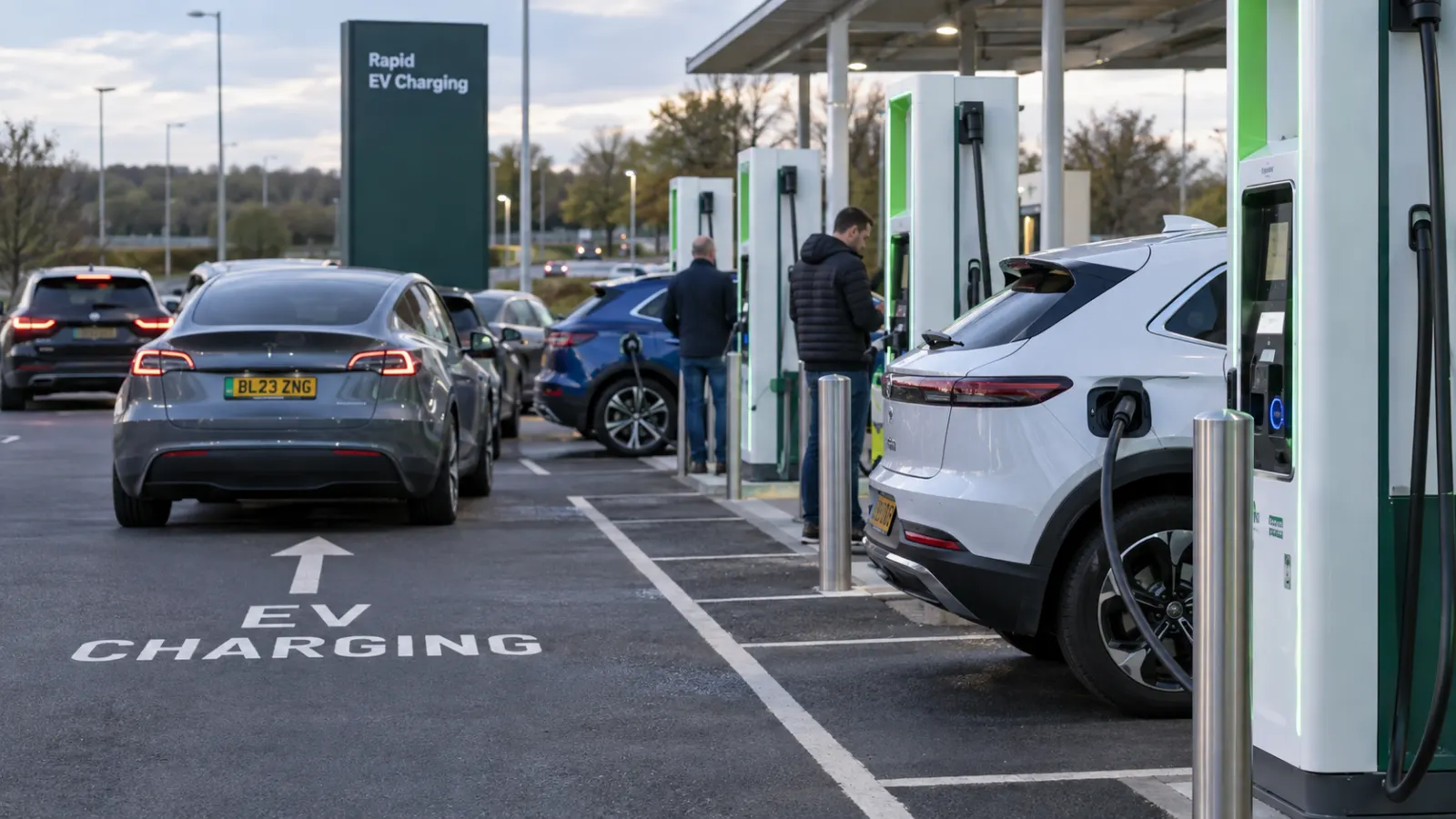
For these drivers, public charging is not merely an emergency service used during road trips. It can become the ordinary equivalent of the fuel station.
That can significantly change the economics.
The IEA finds that public slow charging can cost substantially more than residential electricity, while public fast charging can carry even larger mark-ups. In some major markets, a driver relying exclusively on public fast charging could lose the running-cost advantage that a home-charging EV enjoys over a petrol vehicle.
This creates an uncomfortable distributional problem.
The household with a detached home and private driveway may receive the cheapest and easiest electric mobility.
The apartment resident who has less private space may pay more for charging and spend more time accessing it.
A fair transition therefore requires more than installing highway fast chargers. Cities need practical solutions for apartments, workplaces, public car parks and streets where residents cannot install private equipment.
Public charging networks are expanding quickly. Almost 1.8 million public charging points were added globally in 2025, taking the total above 7 million. The average charging speed is also increasing as fast and ultra-fast equipment accounts for a larger share of installations.
But counting charging plugs alone can be misleading.
Drivers care about whether the charger they need is:
working;
available;
compatible with their car;
able to accept payment;
located somewhere safe and accessible;
and capable of delivering something close to the expected charging speed.
A station listed on a map contributes little if several chargers are broken or occupied.
Fast-charging corridors also need redundancy. A petrol station with one broken pump still has several others. An isolated EV charging location with one failed charger can create a much more serious problem.
Reliability therefore becomes just as important as raw charger numbers.
Range is becoming less of a universal problem—and more of a use-case problem
Early electric cars often had limited range, which made range anxiety a rational concern rather than a psychological defect.
The market has changed significantly.
The IEA reports that the average range of battery-electric cars is now almost 380 kilometres, with the global average having largely plateaued in recent years. In many markets, average daily driving is only around 40 kilometres, while even the United States averages roughly 65 kilometres per day—far below the range of the typical new battery-electric car.
For ordinary daily commuting, many modern EVs therefore provide much more range than drivers normally use.
That does not mean range has stopped mattering.
Highway driving consumes energy differently from slow urban driving. Heating and cooling require electricity. Cold temperatures can reduce battery performance and increase heating demand. EPA notes that cold weather, high-speed driving and accessory use such as air conditioning can significantly reduce real-world EV range.
Towing can have an even larger effect.
So can steep terrain, heavy payloads and sustained high-speed driving.
A city commuter who travels 25 kilometres each way and charges every night has almost no practical relationship with the theoretical maximum range of the vehicle.
A rural driver regularly travelling hundreds of kilometres between sparse towns does.
The same car can therefore be highly practical for one household and frustrating for another.
That is why the right question is not:
“Do EVs have enough range?”
It is:
“Does this particular vehicle have enough usable range, charging access and charging speed for this driver's actual journeys?”
Bigger batteries are not a free solution
Manufacturers can always reduce range anxiety by installing larger batteries.
But larger packs introduce new costs.
More battery capacity usually means more material, greater weight and a higher vehicle price. The heavier vehicle then requires more energy to move and can contribute to greater tyre wear. Structural components, brakes and suspension may also need to accommodate additional mass.
The IEA explicitly notes the trade-off: adding battery capacity can increase both cost and weight, while expanding fast-charging networks reduces the value of carrying ever-larger amounts of stored energy.
This creates a system-level choice.
One strategy is to give every vehicle enough battery for an unusually long journey that its owner makes only several times a year.
Another is to use smaller, cheaper batteries for ordinary driving and make long-distance charging sufficiently dependable that drivers do not need to carry hundreds of kilometres of rarely used reserve capacity every day.
The second approach can reduce vehicle cost and battery-material demand.
But it works only when the charging network is good enough to substitute for battery size.
Charging infrastructure and vehicle design therefore cannot be planned separately.
The battery challenge is increasingly about supply chains, not whether batteries work
Lithium-ion batteries have improved fast enough to make modern electric cars commercially viable.
The industrial system that produces them is much more concentrated than the automobile market itself.
In 2025, China accounted for more than 80% of global battery-cell production, around 85% of cathode active-material production and more than 90% of anode active-material production used in EV batteries. Chinese manufacturers also supplied almost three-quarters of the batteries deployed in electric cars globally.
This concentration has advantages.
Large industrial clusters bring economies of scale. Suppliers are geographically close to one another. Expertise accumulates. Manufacturing improves quickly, helping reduce battery prices.
The same concentration creates strategic vulnerability.
Trade restrictions, geopolitical conflict, export controls or disruptions in one region can affect manufacturers in countries thousands of kilometres away.
Governments in Europe, the United States and elsewhere have therefore encouraged domestic or regional battery manufacturing.
But opening a battery-cell factory is not enough to diversify the supply chain.
A cell factory needs cathode material.
Cathode production requires processed minerals and precursor materials.
Anodes require graphite or alternative materials.
Factories require highly specialised production equipment.
The IEA finds that several of these midstream stages remain even more concentrated in China than final cell production.
Real diversification therefore requires building an entire industrial ecosystem.
That takes years.
Different battery chemistries change—but do not eliminate—mineral dependence
Public debate often speaks about “the EV battery” as though every battery uses the same ingredients.
They do not.
Nickel-rich chemistries can use lithium, nickel, cobalt and manganese in different proportions.
Lithium iron phosphate, or LFP, avoids nickel and cobalt and has become increasingly important because it can reduce cost while providing adequate performance for many vehicles.
But LFP does not eliminate raw-material dependence.
It still requires lithium and graphite, alongside iron and phosphate, while the vehicle itself also requires copper, aluminium and many other materials.
Mining and processing those materials have environmental consequences.
Projects can disturb land, require significant water, generate waste and create conflicts with surrounding communities. Some mineral supply chains have also raised serious labour and human-rights concerns.
These impacts deserve scrutiny.
But comparison requires equal boundaries.
A combustion car also contains mined metals, while its engine consumes petroleum repeatedly throughout its operating life. Oil must be extracted, transported, refined and burned continuously.
An electric vehicle concentrates more of its resource requirement in manufacturing, particularly the battery, while electricity generation determines much of its later operational footprint.
The environmental question is therefore not whether an EV is impact-free.
No car is.
It is how the full lifecycle compares—and how vehicle size, battery chemistry, manufacturing energy and electricity generation affect that comparison.
Recycling will become crucial, but it cannot solve today's mineral demand
Battery recycling is essential to a mature electric-vehicle economy.
Lithium, nickel, cobalt, copper and other materials should not be discarded after one vehicle reaches the end of its life. Recovering them can reduce pressure on mining, lower waste and create more geographically diverse supplies.
The difficulty is timing.
The electric-car boom is relatively recent.
Most of the batteries installed during the rapid sales growth since 2020 are still operating inside vehicles and will remain there for years.
The IEA estimates a structural lag of roughly 15 years between rapid growth in EV battery deployment and the point when comparable quantities begin reaching end of life. Until the mid-2030s, production scrap is expected to remain more important to the recycling industry than old vehicle batteries.
This means recycling cannot provide a circular supply chain immediately.
During the growth phase, manufacturers need materials to produce a rapidly expanding battery fleet while relatively few old batteries are available to recycle.
Later, the arithmetic improves.
When a large installed fleet begins retiring, end-of-life batteries can become a substantial mineral source. Recycling also has the advantage that battery metals do not disappear when used: unlike petroleum, lithium or nickel can potentially be recovered and returned to new batteries.
But effective recycling requires infrastructure before those volumes arrive.
Batteries need systems for collection, transport, disassembly and safe processing. Product design influences how easy materials are to recover. Regulation determines who is responsible for end-of-life packs.
There is also another complication.
Some EV batteries may remain useful after their automotive life because stationary storage is less demanding than vehicle use. Export of used electric cars to other countries can delay when batteries enter domestic recycling systems.
A recycling strategy therefore has to follow batteries through their whole life rather than assume they automatically arrive at a local recycling plant when the first owner replaces the car.
Electric cars do not require an impossible amount of electricity—but they change when and where power is needed
A common criticism of large-scale EV adoption is that electricity grids could not possibly support millions of vehicles.
At the global level, the numbers are less dramatic than that argument suggests.
The IEA projects that, under current-policy assumptions, EV electricity consumption could exceed 1,500 TWh by 2035, around six times the 2025 level. Even then, it would add only roughly 4% to total global electricity demand in 2035.
The challenge is not simply total annual electricity.
It is location and timing.
An EV is an unusually large household electrical load. If a neighbourhood containing hundreds of homes begins charging vehicles at high power immediately after people return from work, local transformers and distribution lines can experience much greater peak demand.
Highway fast-charging hubs create another challenge.
A site containing many ultra-fast chargers can demand megawatts of power. Connecting that load may require new transformers, feeders or substations, and grid upgrades often take longer than installing charging hardware.
Electric bus and truck depots can concentrate even larger loads in one place.
This means utilities need information about where EV adoption is growing before local networks become constrained.
Fortunately, vehicles are also unusually flexible electrical loads.
A car may remain parked for ten hours while requiring only two or three hours of actual charging.
Smart charging can therefore delay or modulate charging so that vehicles still reach the required state of charge while avoiding the most congested hours.
Time-of-use electricity tariffs can encourage the same behaviour by making overnight electricity cheaper.
Vehicle-to-grid systems could eventually allow some EVs to return electricity to the grid during high-demand periods. The first commercial V2G offers for private customers appeared in 2025, although compatible cars remain limited and regulations and technical standards are still fragmented.
So EVs create new grid demand.
They can also create a large pool of controllable electricity demand—and eventually distributed storage—if charging becomes intelligent rather than unmanaged.
The climate advantage depends partly on how the electricity is produced
Battery-electric cars produce no exhaust emissions from the vehicle itself.
That is especially valuable in cities because combustion vehicles emit pollutants directly where people live and breathe.
But zero tailpipe emissions do not mean zero lifecycle emissions.
The battery and vehicle require energy and materials to manufacture.
The electricity used for charging must come from somewhere.
An EV charged predominantly from coal-heavy generation will have a larger operational carbon footprint than the same vehicle charged from a low-carbon electricity system.
This is why vehicle electrification and electricity-sector decarbonisation reinforce each other.
An unusual advantage of the electric drivetrain is that the same vehicle can become cleaner during its life.
A petrol car purchased today still burns petrol years later.
An electric car bought on a relatively carbon-intensive grid can produce fewer driving emissions in future if renewable power, nuclear generation or other lower-carbon electricity expands while the car remains on the road.
The direction of the electricity system therefore matters.
It also reinforces the case for efficiency.
A very large electric SUV requires more battery material and electricity than a smaller EV carrying the same number of people.
Electrification removes the combustion engine.
It does not eliminate the value of using less energy and fewer materials to provide mobility.
Policy and transport design determine what problem EVs actually solve
Electric cars exist within one of the world's most heavily regulated industries.
Vehicle standards, tariffs, purchase incentives, fuel taxes, charging rules, building codes and emissions regulations all influence adoption.
That makes policy stability important.
Automakers make factory and product-platform investments years in advance.
Battery companies sign long-term supply contracts.
Charging operators invest in sites whose utilisation may grow slowly.
Consumers care about future taxation, resale value and access to charging.
If governments repeatedly reverse direction, uncertainty can delay investment even where the underlying technology is improving.
Recent market developments demonstrate how powerful these effects can be. In the United States, electric-car sales weakened sharply after 2025 policy changes altered incentives. Meanwhile, European sales rose strongly as manufacturers responded to tighter CO₂ standards, and many emerging markets grew rapidly as lower-cost models—often imported from China—became available.
This does not mean governments determine everything.
China increasingly demonstrates a market in which the purchase economics of many EVs work even without incentives. Nearly 70% of battery-electric cars sold there in 2025 were cheaper than comparable combustion models before government support.
That is the direction mature EV markets ultimately need to move toward:
technology and production economics strong enough that adoption does not depend entirely on political subsidy.
But electric cars also have a boundary that policy discussions sometimes ignore.
They solve many problems associated with combustion engines.
They do not solve every problem created by cars.
An electric vehicle still occupies road space.
It still requires parking.
It can still be involved in fatal crashes.
Its tyres still wear.
A traffic jam made entirely of electric vehicles is still a traffic jam.
A city redesigned around enormous electric SUVs may dramatically reduce tailpipe pollution while remaining spatially inefficient and expensive to navigate without a car.
A complete transport strategy therefore includes more than changing engines.
Public transport, walking, cycling, intercity rail, compact urban design and electrification can complement one another.
The appropriate mix differs by place.
Rural areas may remain much more car-dependent than dense city centres.
Electric cars are therefore best understood as a powerful tool for decarbonising motorised road transport, not as a universal solution to transportation itself.
The hardest EV problems are now system problems
Electric cars have already overcome several barriers that once appeared fundamental.
Modern models provide enough range for most daily driving.
Battery manufacturing has reached enormous scale.
More than 20 million electric cars can be sold in one year.
Public charging networks are expanding rapidly.
In some major markets, electric vehicles are already cheaper to buy than combustion alternatives.
The next stage is different.
It requires making the technology work beyond the ideal early adopter.
Affordable models need to reach more countries and more vehicle segments.
Apartment residents need charging options that do not make electricity dramatically more expensive than home charging.
Public chargers need to work reliably, not merely exist on maps.
Utilities need to plan local grid upgrades before demand arrives.
Battery supply chains need greater geographical diversity without replacing one set of environmental problems with poorly regulated mining elsewhere.
Recycling systems need to be built before large numbers of batteries reach retirement.
Used-car buyers need trustworthy battery-health information.
And governments need policy frameworks stable enough for manufacturers, utilities and consumers to make long-term decisions.
None of these challenges demonstrates that electric cars cannot scale.
The fact that one-quarter of new cars sold globally in 2025 were already electric shows that scaling is underway.
But rising sales alone should not be confused with completion of the transition.
The decisive test will come when electric cars cease to be easiest only for affluent homeowners in well-served markets and become practical for apartment residents, used-car buyers, rural drivers, commercial fleets and households whose first question is not technological enthusiasm but affordability.
The electric-car transition succeeds at mass scale when the driver no longer has to organise life around the drivetrain.
The car simply has to be affordable, charge where people actually park, travel where they actually need to go and remain economically useful for years.
At that point, the hardest achievement will not have been inventing the electric car.
It will have been building the energy, industrial and transport system around it.