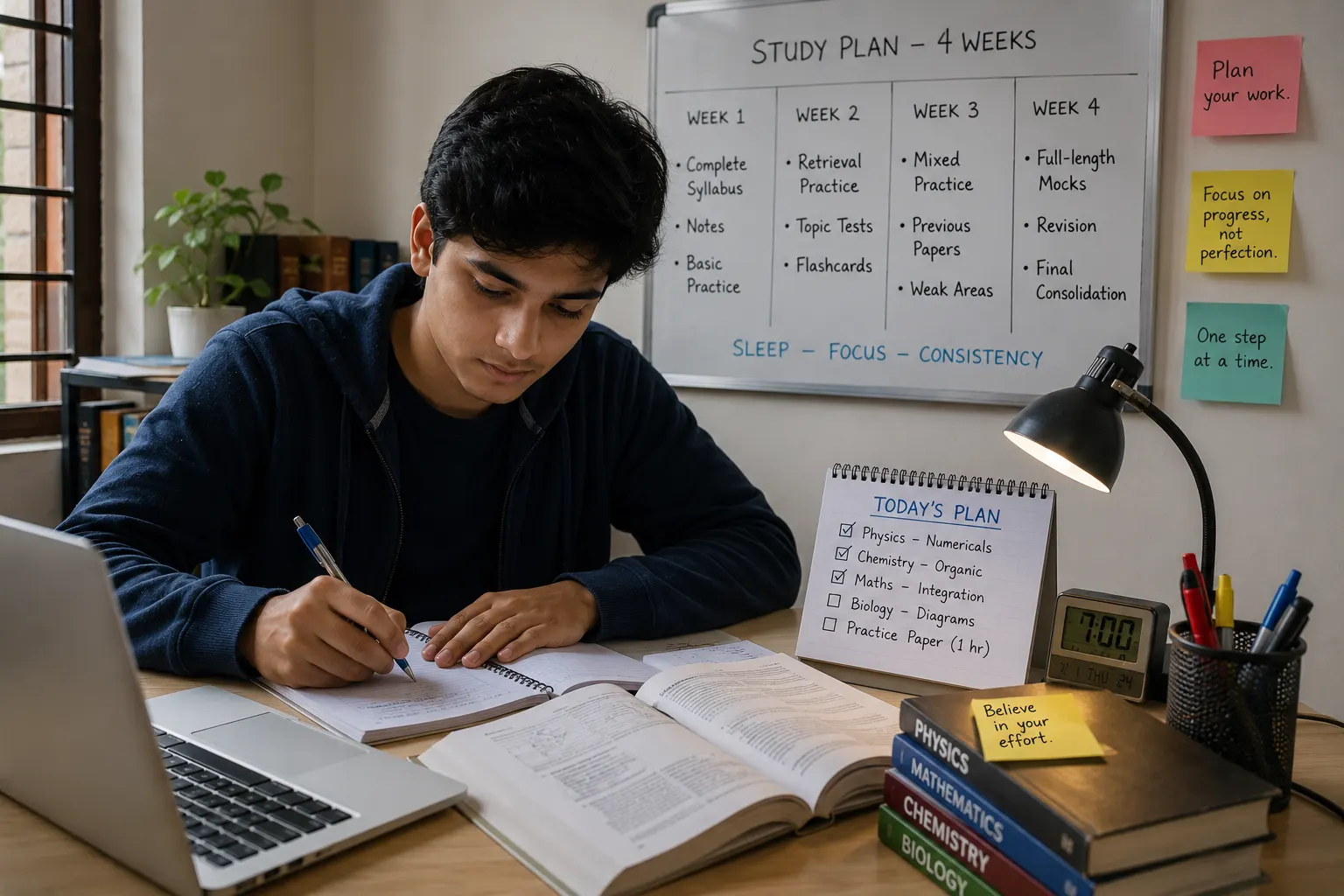
Why a Dedicated Study Space Helps — and What Actually Matters About It
A study space is useful because it removes decisions
A dedicated study space is often presented as an aesthetic project: buy a desk, add a lamp, arrange stationery and create the right atmosphere.
The more important benefit is behavioural.
When one place is repeatedly used for focused learning, several decisions disappear. You know where the materials are. The chair and light are already available. The environment becomes associated with beginning work. Competing activities can be kept elsewhere.
This does not require a private room. For many students, that is unrealistic.
A “dedicated space” can be a corner of a shared room, one library table, or even a portable setup that is recreated consistently.
Why physical environments affect learning
Learning happens in a body inside an environment.
Noise, temperature, lighting, air quality, crowding and furniture can influence comfort, fatigue and attention. Reviews of classroom environmental quality have found that acoustic conditions, thermal comfort, lighting and indoor air quality can all matter for learning and cognitive performance, although effects differ by setting and study design.
The lesson is not that there is one scientifically perfect room.
It is that persistent environmental discomfort consumes attention that could otherwise be used for learning.
Noise is often the first variable to control
Meaningful speech is difficult to ignore.
Research on classroom and environmental noise has found associations with poorer performance on tasks including reading and memory, especially when noise is chronic or intrusive.
For a study area, ask:
Can I hear television conversations?
Do people frequently walk through the space?
Are phone calls happening nearby?
Does traffic noise repeatedly capture attention?
If noise cannot be eliminated, try predictable masking sound, earplugs or non-lyrical background audio. The goal is not silence at any cost; it is fewer attention-grabbing changes.
Lighting should make reading effortless
Poor lighting does not make learning impossible, but eye strain and discomfort can shorten useful study time.
Use enough light to read without leaning forward or squinting. Reduce glare on screens. If daylight is available, use it without placing the screen directly against a bright window.
The best light is the light you stop noticing because it allows the task to remain visually comfortable.
Temperature and air matter because discomfort is distracting
A room that is too hot, too cold or poorly ventilated can make concentration harder.
Systematic reviews of indoor environmental quality in classrooms have repeatedly examined temperature, air quality, noise and lighting as factors that influence comfort and performance.
You may not control the building. But small adjustments can help:
open a window when appropriate;
use a fan;
change seating;
take short breaks in fresh air;
avoid studying in a room where you consistently become drowsy.
The desk should support the task, not display your identity
A good study surface needs enough space for the current materials.
Too little space creates constant rearrangement.
Too much clutter creates visual competition.
Keep only what the session needs:
book;
notebook;
laptop if required;
calculator or stationery;
water.
Everything else can remain nearby but outside the central work area.
The aim is not minimalism. It is reducing irrelevant cues.
A dedicated space can create a start cue
Habit research shows that stable context can support automaticity.
The same principle can apply to studying. When you repeatedly begin the same type of work in the same setting, sitting down there can become part of the initiation routine.
You can strengthen the cue by keeping the beginning consistent:
sit down;
place phone away;
open the task list;
start the first question.
Over time, the location becomes less about inspiration and more about predictability.
But studying in one place does not mean you must take the exam there
Memory can be influenced by environmental context, and a classic meta-analysis found reliable context-dependent memory effects under some conditions.
But those effects are not a reason to insist that students can recall material only where they learned it.
Strong conceptual knowledge, retrieval practice and varied cues reduce dependence on incidental environmental details.
In fact, when transfer matters, occasionally practising in different settings can be useful because it tests whether knowledge is tied too closely to one context.
Use a dedicated space for behavioural consistency, not because the room itself stores the memory.
What if you live in a crowded home?
Many students cannot control noise, privacy or furniture.
In that case, design a portable study environment.
Keep essential materials in one bag or box.
Use the same headphones or earplugs.
Choose a predictable time when the shared space is quieter.
Use a library, community space or campus room when possible.
Create a visual signal to family members that a study block is in progress.
The goal is to reproduce a small set of cues even when the location changes.
Separate study from high-distraction activities where possible
If the same desk is used for gaming, streaming, eating, chatting and studying, the location sends many competing behavioural signals.
Complete separation may be impossible.
You can still create boundaries:
use a different browser profile;
clear entertainment devices before studying;
change the chair position;
use one side of the table for learning;
store study materials together and bring them out only for work.
Small environmental distinctions can make transitions clearer.
Comfort matters, but too much comfort can change the task
A bed is comfortable because it is designed for rest.
For some people, that makes it a poor location for demanding study. Posture collapses, sleepiness increases, or entertainment habits take over.
A study space should be comfortable enough to avoid pain but structured enough to support alertness.
Use a supportive chair and a surface at a workable height. If sitting for long periods is uncomfortable, alternate positions and take movement breaks rather than attempting to endure poor ergonomics.
Should you personalise the space?
A few personal objects can make a study area feel welcoming, but decoration should support rather than dominate the task.
The important question is whether an object helps the space function.
A calendar may make deadlines visible.
A formula sheet may support repeated retrieval.
A small plant may make the area pleasant.
A large television directly in front of the desk may create a competing cue.
Avoid assuming that a perfectly minimalist desk is scientifically superior. Some learners prefer visually sparse environments; others are not bothered by ordinary personal items. The useful distinction is between stable background and objects that repeatedly trigger unrelated behaviour.
If you keep checking, touching or rearranging something, move it. If you barely notice it, it is probably not an important problem.
The study space should support the kind of learning you are doing
Different tasks need different physical arrangements.
Reading may require a comfortable chair and good light.
Mathematics needs enough surface space for worked problems.
Online classes need reliable audio and a screen positioned comfortably.
Group study needs conversation space without disturbing others.
Memorisation may benefit from the ability to stand, speak or use flashcards.
Do not force every learning task into one identical posture simply because the desk has been labelled the “study zone.”
A dedicated space is most useful when it is adaptable enough to support the actual work.
How to build a useful study space on a small budget
Prioritise in this order:
1. Reduce interruptions.
Choose the quietest feasible location and time.
2. Create a stable surface.
A basic table often matters more than decorative equipment.
3. Improve light.
Use existing daylight or an inexpensive task lamp.
4. Control the phone.
Keep it outside the immediate workspace.
5. Keep materials ready.
Reduce the setup cost of beginning.
6. Make the start routine repeatable.
Use the same first steps every session.
None of these requires a designer workspace.
The study space should make learning easier to start
The best study environment is not the most beautiful one.
It is the one in which:
you can begin quickly;
distractions are manageable;
the body is reasonably comfortable;
the materials are available;
the work has a clear boundary from competing activities.
A dedicated space is valuable because it shifts some of the burden of concentration from the person to the environment.
That is a practical advantage, especially on days when motivation is low.
Sources / Further Reading
Brink et al., systematic review of classrooms' indoor environmental conditions, 2020
Shield & Dockrell, effects of environmental and classroom noise on school performance, 2008
Smith & Vela, “Environmental context-dependent memory: a review and meta-analysis,” 2001
Suggested Internal Links
How to Avoid Distractions While Learning - Planned internal link
How to Build a Daily Routine - Planned internal link
The Importance of Time Management - Planned internal link
How to Prepare for Exams Without Stress - Planned internal link
How to Use Flashcards Effectively - Planned internal link
Approximate article word count: 1230